
 menu icon in the top, right corner of the screen.
 icon above to close this box.
 icon at the bottom of the screen below the browser—if you don't see it, swipe up to unhide it.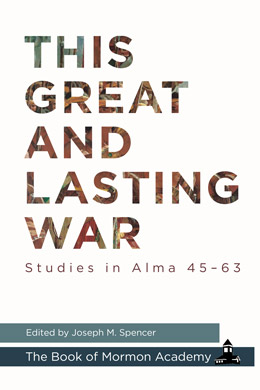
Is Moroni Also Among the Prophets?
The Title of Liberty, the Remnant Motif, and the Prophetic Imagination
Robbie Taggart
Robbie Taggart, "Is Moroni Also Among the Prophets?: The Title of Liberty, the Remnant Motif, and the Prophetic Imagination," in This Great and Lasting War: Studies in Alma 45–63, ed. Joseph M. Spencer (Provo, UT: Religious Studies Center, Brigham Young University, 2025), 73–96.
Robbie Taggart is an assistant professor of ancient scripture at Brigham Young University.
Readers of the Book of Mormon have long found inspiration in the image of Captain Moroni—incandescent with outrage at Amalickiah’s threats to the church and to the liberty of his people—tearing his coat as a symbol of his refusal to accede to the devastation this dissenter seeks to inflict on those Moroni leads. In times of darkness, inspired individuals can shine like hope. But how might readers understand the anger and anguish that motivate this moment and that lie behind many of Moroni’s interactions with dissenters and usurpers? Authors Fatimah Salleh and Margaret Olsen Hemming question “why the text gives space for Moroni’s fury in a way that is different from other positively-viewed Nephite leaders.”[1] If traditional readings of the Book of Mormon generally interpret Moroni as a paragon of righteous patriotism, some recent scholarship has noted the chief captain’s apparent moral failings, his propensity to anger, his rashness and sometimes-violent impatience with dissension.[2] Such interpretations can make Moroni seem un-Christian for some modern readers, hindering a sense of relevance and meaning in the sacred text. While the discussion regarding the ethics manifested in Moroni’s behavior certainly possesses merit, this chapter seeks to examine his actions through a paradigm of prophetic pathos developed by biblical scholars interested in understanding Hebrew prophets’ “way of being.” By contextualizing Moroni within this Old Testament framework, his attitudes and behaviors become more comprehensible and, I argue, more inspiring.
After briefly addressing the ongoing discussion surrounding the moral character of the chief captain, this chapter considers instances in which Moroni’s way of being—including his passionate anger—manifests what theologian Walter Brueggemann calls “the prophetic imagination.” Latter-day Saints have a robust and complex understanding of prophets that extends beyond the concept as it is depicted in the Bible and Book of Mormon. Latter-day Saint scholar Avram R. Shannon has noted that this reality can cause some to draw “conclusions about prophets based on assumptions that are not actually based on the Book of Mormon record.” He notes that the “modern Latter-day Saint usage of the word prophet simply does not map well to the use of the word in either the Old Testament or the Book of Mormon.”[3] Thus, this chapter specifically draws on the writings of two scholars attentive to the works of prophets in the Hebrew Bible, Abraham Joshua Heschel and Walter Brueggemann, to provide an interpretive lens for understanding Moroni’s actions and temperament. These writers portray the prophetic imagination as a perspective of Hebrew prophets that recognizes God’s ongoing work of redemption in present circumstances and then articulates that vision in a way that urges listeners to live in light of that transcendent reality. This prophetic way of being, as demonstrated in the lives and words of the classical Hebrew prophets, is fundamentally impatient with exploitative systems and self-destructive behavior, and it envisions and expresses an alternative mode of existence presided over by God. With this framework, this chapter will specifically examine the prophetic quality of Moroni’s imagination in his rejection of the oppressive politics of his antagonists, in his creation of the title of liberty and its introduction to his people, and in his reinterpretation of the brass plates prophecy of Jacob regarding a remnant of the seed Joseph.
Character and the Prophetic Imagination
What manner of man is Moroni? Grant Hardy acknowledges him as a “skilled and humane commander” but also asserts that “he is not portrayed as a particularly religious man.”[4] He notes his “blunt manner, aggressive posture, and hasty suspicions” and affirms that Moroni engages rarely in visible acts of faith, initiates overly aggressive peacekeeping tactics, slaughters his political opponents, and is frequently described as angry.[5] Duane Boyce has vigorously defended Moroni’s virtue, meticulously opposing Hardy’s interpretations. He describes Moroni as a man of “spiritual character” whose conduct “appears well-founded, mature, and even patient.”[6] In fact, Boyce sees Moroni as an exemplar of how to embody “in extreme circumstances” the virtues and state of heart Jesus articulated in the Sermon on the Mount.[7] It would be difficult to imagine two more opposite interpretations of this compelling scriptural figure. By somewhat sidestepping the debate regarding the moral character of Captain Moroni, this study seeks to examine the instances in which he approximates the Hebrew prophets’ way of being.[8] This approach acknowledges the validity of both Hardy’s emphasis on Moroni’s brusqueness and Boyce’s assessment of Moroni’s consecrated heart by framing them within a tradition of prophetic imagination, which conceives of an alternative social order to the dominant, oppressive model. In this light, Moroni’s intensity can be seen as an element of his prophetic pathos.
In his landmark work The Prophets, rabbi and theologian Abraham Joshua Heschel depicts the Hebrew prophets as souls both luminous and explosive who experience a profound “fellowship with the feelings of God, . . . a communion with the divine consciousness.”[9] This possession of the divine pathos enables the prophet to transcend the myopia of a debasing culture and to creatively imagine new worlds and new ways of being. The prophet has the life of the people as his subject. He possesses a special affinity for the weak, the poor, and the marginalized, and he harbors a special exasperation with rulers and leaders who oppress. He is “a person who is not tolerant of wrongs done to others, who resents other people’s injuries.”[10] The prophetic cry articulates God’s pain at humanity’s anguish. Heschel asserts that “the purpose of prophecy is to conquer callousness, to change the inner man as well as to revolutionize history.”[11] Standing midway between reality as it is and reality as it will be in God, the prophet seeks to awaken others to a sense of their own most radiant possibility.
Building on the work of Heschel, Walter Brueggemann has proposed that part of the work of biblical prophets is to engage in “an act of imagination by word and image that evokes and hosts a world other than the one readily available.”[12] The prophet first criticizes and then energizes. With piercing clarity, the prophet perceives the suffering that underlies royal oppression of the marginalized and then passionately articulates a competing agenda which places God above and against such domination. One scholar summarizes three basic steps through which the prophetic imagination proceeds: first, it “penetrates despair with honest cries over pain and loss that result from social injustices;” second, it awakens the prophet’s people “by drawing on ancient, artistic traditions that energize the community to imagine and live into a more just order;” and finally, “it ends in hope and gratitude for the surprising gift of an emancipated future.”[13] I believe that examining Moroni’s behavior in light of this paradigm of prophetic imagination proves illuminating.
The prophetic imagination begins with a lament—an acknowledgment of the unsustainability of a self-destructive culture that runs contrary to the purposes and compassion of God. Heschel asserts that in the face of injustice, “the prophets are scandalized and rave as if the whole world were a slum.”[14] The prophet’s first enemy is complacency. Apathy must be rent before it overwhelms the people who suffer under what Brueggemann calls “the royal consciousness”—a leadership approach that replaces “the politics of justice with the politics of oppression.”[15] The prophet must assert “the legitimacy of a tradition that requires us to remember,” the reality of an “authority that expects us to answer,” and the importance of a “community that calls us to care.”[16] This emphasis on a sustaining religious tradition, on God’s authority, and on the centrality of covenant community appear throughout Moroni’s words and ministry.
The Rise of Royal Consciousness
During his time as chief captain of the Nephite military, Moroni repeatedly encounters and confronts individuals and groups that embody the royal politics of oppression described by Brueggemann. This sociopolitical milieu seems to affect the tenor of his ministry. While Heschel and Brueggemann often depict prophets as those who come from the margins, Moroni is arguably among the cultural and political elite in Nephite society. He seems to see himself as a defender of the marginalized, and he uses his power to “nurture, nourish, and evoke a consciousness and perception alternative to the consciousness and perception of the dominant culture around” him.[17] In the eighteenth year of the reign of the judges, the Lamanite commander Zerahemnah unambiguously seeks to “usurp great power over” the Nephites and to enslave them (Alma 43:8). He employs exploitative tactics that foment animosity in order to subject others to his control and to increase his political influence. In this context, Moroni steps into his role as a leader among his people, inspiring them with an alternate vision, urging them to cry “unto the Lord their God, for . . . freedom from bondage” (v. 49). When the Lamanite and Zoramite armies begin to retreat, Moroni commands them “in the name of [the] all-powerful God” to relinquish their weapons and to end the conflict (44:5). Moroni exhibits a distinct distaste for Zerahemnah’s lust for power, and like a prophet, he speaks in the name of God to urge transformation.
The text repeatedly contrasts the unjust political practices of Zerahemnah with the people-centered religious focus of Moroni. The chief captain asserts, “We have not come out . . . that we might shed your blood for power; neither do we desire to bring any one to the yoke of bondage. But this is the very cause for which ye have come against us” (v. 2).[18] Moroni proclaims a counter-consciousness approach to the oppressive approach of Zerahemnah by asserting that he and his people “owe all [their] happiness” to “the sacred word of God” (v. 5). He sees land, people, and behavior as relational and sacred, infused with divine purpose. And he seeks to extend to Zerahemnah the mercy and restraint the Lamanite leader refuses to offer others. When Zerahemnah rejects Moroni’s worldview and continues the conflict, “Moroni [is] angry, because of the stubbornness of the Lamanites” and fights until Zerahemnah and his surviving followers covenant to depart in peace (vv. 17, 19–20).
Perhaps it would be beneficial to note here that in some instances it seems to stretch the imagination to consider Moroni’s behavior as the manifestations of a prophetic pathos. While they certainly exhibit explosive behaviors, most of the classical prophets see violence itself as idolatrous. Heschel asserts, “When the prophets appeared, they proclaimed that might is not supreme, that the sword is an abomination, that violence is obscene.”[19] In contrast, Moroni seems to have viewed violence and warfare as evils necessary for the elimination of greater evil. One can certainly find examples of Hebrew prophets and patriarchs preceding the classical prophets engaging in violent behavior inspired by their opposition to injustice. Moses slew the Egyptian who was beating a Hebrew slave and commanded Joshua to battle the Amalekites who attacked the refugee Israelites (Exodus 2:11–12; 17:8–16). In a continuation of that historic conflict, Samuel hewed the Amalekite king Agag in pieces (1 Samuel 15:33). Abram led an army to contend against the kings who carried off Lot from Sodom (Genesis 14). The reasons for their violence may stem from prophetic resistance to oppression and from love for the oppressed. One writer has asserted, “The opposite of love is not rage. The opposite of love is indifference. . . . Grief is the price of love. Anger is the force that protects that which is loved.”[20] Mormon, as editor of the record, asserts that in spite of his passion for opposing tyranny, Moroni was a man who “did not delight in bloodshed” (Alma 48:11). Despite his sometimes violent tactics, Moroni regularly provides a nonviolent alternative and offers his opponents opportunities to cease their fighting and enter into covenant.[21] Though he rages against abuse, he fundamentally emphasizes covenantal relationships over military victories.
In abridging the record, Mormon seems to deliberately depict the dissenter brothers Amalickiah and Ammoron as the inheritors of Zerahemnah’s legacy, emphasizing how the methods of these brothers mirror the tone and intent of Zerahemnah’s antagonism. This emphasis is shown in part by the repetition of words such as power and bondage to describe the desires of each of these so-called leaders.[22] A division rends the fabric of Nephite society as Amalickiah and his followers reject the ecclesiastical regulation initiated by Helaman and his brethren in the year after the conflict with Zerahemnah (see Alma 45:20). The nature of the reforms initiated by Helaman are unclear, but the text makes apparent that Amalickiah seeks the power and authority of a king and has no regard for the lives of those who oppose him. He is supported by “lower judges of the land” who were “seeking for power” and by those who sought to be “rulers over the people” (Alma 46:4, 5). Because Helaman and his brethren represent opposition to his political agenda, Amalickiah “determined to slay them” (v. 2). Amalickiah here becomes the embodiment of the royal consciousness, which seeks its own advancement and control above all.
On his path to the Lamanite throne, Amalickiah exhibits an exquisite lack of regard for the lives of those he leads. Despite some Book of Mormon writers depicting the Lamanites as blood-thirsty, in Amalickiah’s day, an apparently large number of Lamanites did not desire to go to battle against the Nephites, “being fixed in their minds with a determined resolution that they would not . . . go against the Nephites” (47:6).[23] But Amalickiah has no interest in their desires, and he uses deceit to coerce them into joining his cause. Once he obtains command of the Lamanite army, Amalickiah repeatedly puts the soldiers under his direction into harm’s way to advance his own power and influence. Mormon writes that Amalickiah “did not care for the blood of his people” (49:10). From the perspective of a royal consciousness, people are instrumentalized and objectified as means to a leader’s political advancement and comfort. These dissenters reject an “economics of equality,” which seeks the wellbeing of all in the society, in favor of an “economics of affluence,” which is “hierarchical and not democratic in its distribution.”[24]
Into this obsession with power and control comes the distraught cry of Moroni. The Israelite prophets reserve their most scathing denunciations for their own people, and as Nephites who have dissented, Amalickiah and his supporters are Moroni’s people. Moroni believes they should have an understanding of the covenant devotion and expectations of the God who enjoined them to bear one another’s burdens and comfort those who stand in need of comfort (Mosiah 18:8). Amalickiah seeks a society that is secure for those in power at the expense of the welfare of those under their tyranny. In every instance, Moroni’s passionate resistance responds to a culture of oppression and injustice.[25] Sometimes only by deconstructing the way things are can prophets help people find new life in God.
The Title of Liberty as Dramatic Prophecy
If a prophet’s style “is charged with agitation, anguish, and a spirit of nonacceptance,” Moroni is perhaps nowhere more prophetic than in the moment in which he creates and introduces the title of liberty among his people.[26] As Moroni witnesses the relentless march of Amalickiah’s cunning, flattery, and opposition to the work and ways of God, he cannot remain still. Heschel notes that the “prophet is a man who feels fiercely. God has thrust a burden upon his soul, and he is bowed and stunned at man’s fierce greed.”[27] This seems a fitting description for the emotional state of Moroni who, Mormon laconically notes, “was angry with Amalickiah” (Alma 46:11). In his agitated condition, Moroni rends his coat and writes upon it an alternate vision for his people’s future.
While the practice of tearing clothing repeatedly appears as a sign of mourning throughout the Bible, the Book of Mormon does not contain other descriptions of people rending their garments as an act of penance nor as a symbol of deep grief. Whether or not Moroni deliberately taps into the biblical imagery of tearing his clothing as a gesture of anguish, he will transform this act into a symbol rooted in the ancestral record of his people as he associates it with the prophecy of Jacob from the brass plates. Brueggemann notes that in order to cut through the numbness of the dominant culture, the prophet’s task has three parts: (1) the offering of symbols rooted in tradition that serve as “vehicles for redemptive honesty,” (2) the public expression of the “fears and terrors that have been denied so long and suppressed so deeply,” and (3) the need to “speak metaphorically but concretely about the real deathliness that hovers over us and gnaws within us, and to speak neither in rage nor with cheap grace, but with the candor born of anguish and passion.”[28] We will examine the ways in which the title of liberty and its connection with the prophecy of Jacob accomplishes each of these elements by providing a symbol saturated in traditional significance, by naming the horrors latent in the hearts of Moroni’s hearers, and by candidly acknowledging the precariousness of the Nephites’ situation. The way in which Moroni offers this symbol through the tearing of his clothing seems steeped in the prophetic imagination.
In rending his coat to create the title of liberty, Moroni’s behavior approximates that of Old Testament prophets who conveyed their God-given messages through dramatic action. Throughout the Hebrew Bible, several prophets engage in performative prophecy, participating in movements or gestures to symbolically convey their inspired message to their audiences. Such displays are often called dramatic prophecy or prophetic sign acts. The following examples provide a sense for the tone and tenor of the imagination manifested in these sign acts.
After lying on his side next to a model of Jerusalem to signify the coming Babylonian siege, Ezekiel shaves his head and beard and divides the hair into three parts: one third he burns, one third he smites with a knife, and the final third he scatters in the wind (Ezekiel 5:1–2). God intends this drastic behavior to symbolically represent the ways the people of Judah will be destroyed: “A third part of thee shall die with the pestilence, and with famine . . . a third part shall fall by the sword . . . and I will scatter a third part” (v. 12). This willingness to behave in ways contrary to custom exhibits the prophet’s full commitment to the message. Similarly, Jeremiah shatters a potter’s vessel in the presence of the elders and senior priests near one of the city gates to indicate that because the people have abandoned their covenant relationship with God, the Lord will “break this people and this city, as one breaketh a potter’s vessel, that cannot be made whole again” (Jeremiah 19:1, 10–11). The prophets exhibit an intensity of feeling and an urgency of purpose in such dramatic gestures. Perhaps Isaiah’s most memorable sign act comprised the three years he “walked naked and barefoot” among his people, signifying the coming humiliation and servitude of the Egyptians and Ethiopians who opposed Assyria (Isaiah 20:1–6). Certainly, as Donald W. Parry notes, such “dramatized action can be much more shocking than the spoken word.”[29] The prophetic behavior serves to jolt an audience out of complacency or despair.
In addition to the prophets of the Old Testament, Book of Mormon prophetic figures occasionally engage in symbolic gestures to convey spiritual messages. For example, toward the end of a passionate sermon, Lehi’s son Jacob removed his garments and shook them before the people, declaring, “I pray the God of my salvation that he view me with his all-searching eye; wherefore, ye shall know at the last day . . . that the God of Israel did witness that I shook your iniquities from my soul, and that I stand with brightness before him” (2 Nephi 9:44). The act of removing his clothing and waving it symbolized Jacob’s innocence and freedom from the sins of the people. His garment becomes a synecdoche for his entire soul, a metaphor for his spiritual state. One can imagine the recipients of Jacob’s impassioned message experiencing astonishment—“a strain on the emotions, wrenching one’s conscience from the state of suspended animation.”[30] The purpose of the prophetic act was to first criticize corrupt culture and then to animate witnesses into newness of life.
In this light, Moroni’s creation of the title of liberty and the people’s subsequent response might be seen as the enacting of a prophetic message.[31] The tearing of the coat may have served to pique the interest of his people and to symbolize the destruction that awaited if they chose not to repent and turn to God. Donald Parry notes that with a prophetic sign act, the symbolic gesture was often “conducted in the presence of an audience.” He asserts that “symbolic actions tend to involve the audience, causing them to question the movements and postures and moving them to a higher plane of understanding.”[32] While the narrative does not make clear whether Moroni’s initial rending of his coat was performed in public or in private, textual clues indicate the likelihood that Moroni was not alone when he engaged in this dramatic gesture.[33] Many readers have likely imagined his preparation of the title of liberty and his prayer as activities that occurred away from the gaze of the crowd.[34] However, the naming of the land as a chosen land of liberty, which occurs in the text immediately after the creation of the banner and Moroni’s prayer, presumes an audience acknowledging the designation.[35]
The presence of listeners comes into clearer focus in Alma 46:18 when, immediately after praying and dedicating the land, Moroni said, “Surely God shall not suffer that we who are despised because we take upon us the name of Christ shall be trodden down and destroyed” (emphasis added). Note the first-person plural pronouns, implying a gathering of believers witnessing his actions and words. When Moroni goes “forth among the people, waving the rent part of his garment in the air, that all might see the writing,” readers can imagine him among the people who had just witnessed the creation of the banner (v. 19). This helps make sense of the immediacy with which the people respond by “running together . . . rending their [own] garments in token, or as a covenant, that they would not forsake the Lord their God” (v. 21).[36] If Moroni created the title of liberty before an audience, several aspects of his behavior might be considered elements of a prophetic sign act: the tearing of the clothing, the writing on the remnant, the waving of the rent part of the garment, and the subsequent covenantal response of the people.
Tearing clothing provides a memorable prophetic image. As illustrated by Isaiah’s and Jacob’s removal of apparel mentioned above, prophetic sign acts frequently involve clothing or garments. Jeremiah, Elijah, Ahijah, and Samuel all use clothing to convey messages about the spiritual life of their people.[37] Each of these instances manifests the creativity and alternate worldview of the prophet. Clothing serves as a useful symbol because it can represent the identity, character, or capacities of a people. As one scholar notes, “The clothes follow and partake of the total character of the soul.”[38] This seems to be the way Moroni portrays his torn coat, and it is consistent with other references to clothing in the Book of Mormon.[39] The life of the people will be riven if they refuse to repent.
When Moroni tears his coat, he writes upon a piece of it a series of three paired couplets to articulate his vision for an alternative way of being: God and religion, freedom and peace, wives and children.[40] This is the moment Moroni moves from prophetic criticism to prophetic energizing. These couplets represent the making of a holy community guided by God, founded in peace, and focused on connection. Amalickiah seeks to destroy not only the vision of godly community that Moroni articulates but the very community itself. If “out of a human community [God] wills to make His kingdom,” that which threatens the community opposes God.[41] Moroni’s worldview centers on the divine, on the welfare of his people, and on human relationships. This is the prophetic new song, a doxology rooted in covenant memory. Moroni waves the message publicly as a rallying point for his followers.
Several scholars have seen the people’s response to Moroni’s title of liberty as the enactment of a simile curse or oath.[42] Beyond the formal making of an oath, their behavior manifests the way Moroni’s message awakens them to new aliveness and hope. Brueggemann notes the prophet’s task “to present an alternative consciousness that can energize the community to fresh forms of faithfulness and vitality.”[43] After Moroni waves his banner in the sight of the people, he cries “with a loud voice,” urging his listeners to “come forth in the strength of the Lord, and enter into a covenant, . . . that the Lord God may bless them” (Alma 46:19, 20). The people’s immediate response fulfills every prophet’s usually frustrated dream: “The people came running together . . . rending their garments in token, or as a covenant, that they would not forsake the Lord their God” (v. 21). They become dynamic participants in the sign act as they “cast their garments at the feet of Moroni” and articulate their understanding of the significance of the act (v. 22). They sense that the rending of Moroni’s coat could symbolize either their destruction or their preservation. And they are prepared to live in the new future preserved by God. This is a costly gesture of commitment. Brant Gardner calls this action “a dramatic one in a culture that had to make its own clothing,” noting that “for many of them, it may have been their only garment. They therefore might have continued to wear it, partially out of necessity, but also partially as a reminder of their oath.”[44] From this moment, a new memory lives in the collective consciousness. Moroni’s prophetic imagination has ignited the imaginations and stimulated the dedication of his people.
Is Moroni Also Among the Prophets?
To interpret Moroni’s actions as an instance of dramatic prophecy begs the question, Can Moroni be considered as a prophetic figure? When discussing the pattern of sign acts in the Old Testament, Parry notes that a fundamental aspect of the performance is that in each instance “a prophet played a major role in the symbolic actions as prophecy.”[45] The Book of Mormon conception of the prophetic work expands upon what Heschel and Brueggemann outlined. Some prophets in the text clearly manifest the prophetic imagination as described above. However, in addition to criticizing and energizing, Book of Mormon prophets also regularly receive divine manifestations, testify of the coming of Jesus Christ, and engage in inspired commentary on the words of previous prophets.[46] The Book of Mormon does not appear to specifically designate every prophetic figure as a “prophet.” Avram R. Shannon has pointed out that very few individuals in the Book of Mormon are specifically designated as prophets contemporaneously, noting, “Abinadi, Alma2, Ammon, Nephi2, Samuel the Lamanite, and Ether are the only figures unique to the Book of Mormon who are identified within the text as prophets.”[47] When the Book of Mormon writers reference “prophets,” they often refer to a nameless group of preachers whose primary message is “repent or be destroyed.”[48] It is unclear whether these bands of prophets have an ecclesiastical role or whether they function outside established religious institutions. Named prophets in the text sometimes have ecclesiastical or governmental authority, and sometimes they do not.[49]
During the Amalickiahite wars, the recognized ecclesiastical leaders are a group of people repeatedly referred to in the text as “Helaman and his brethren” (Alma 45:22–23; 46:1, 6; 48:19; 53:14; 62:45). These core spiritual leaders are accompanied by a group of “those who had been ordained by the holy order of God . . . and sent forth to preach among the people” (49:30). While the text nowhere associates Moroni with this band of ecclesiastical leaders, later in the abridgment, Mormon editorially notes that “it was the custom among all the Nephites to appoint for their chief captains, (save it were in their times of wickedness) some one that had the spirit of revelation and also prophecy” (3 Nephi 3:19). One might assume, therefore, that the selection of young Moroni as chief captain represented a tacit acknowledgment of his capacity to receive revelation and to embody the spirit of prophecy. Despite this, at the beginning of his military career, Moroni seeks inspiration and direction from the clear contemporary prophetic figure, Alma2 (Alma 43:23–24). By the end of the Amalickiahite wars, however, Moroni is asserting access to his own communications from God, essentially following the oracular formula of “thus saith the Lord” (see Alma 60:33).[50] He seems to have fully developed a prophetic self-conception. Therefore, prophetic activity within the Book of Mormon appears not to be necessarily limited to those specifically designated as prophets, and those who act in prophetic ways, like Moroni, might fruitfully be considered prophetic figures. In fact, in his engagement with an ancient text about a preserved remnant, Moroni embodies a specifically Nephite depiction of prophetic work: likening scripture.
The Prophecy of Jacob and the Remnant Motif
There is a fundamental element of intertextuality to the prophetic imagination, “an imagination which responds to and is deeply dependent upon received traditions; an imagination whose creativity is never entirely a new creation, but one founded upon older authoritative words and images.”[51] The pattern of a prophetic figure reading an ancient sacred text and finding applicability to his own contemporary circumstances is familiar to readers of the Book of Mormon. Nephi and Jacob made this a foundational part of their prophetic work as they found relevance and meaning in the prophecies of Isaiah and “likened” his words to their experiences. One theme recurs with frequency in such prophetic reappropriations: the motif of a remnant of Israel that God will gather in fulfillment of covenant promises and which God will use to bring about divine redemptive purposes. Joseph Spencer notes that “the Book of Mormon’s emphasis on Israel’s remnant is something it consciously borrows from the Israelite prophets.”[52] The concept of the remnant was integral to Nephite self-conception since the first generation of Lehites in America. When Nephi read Isaiah and likened his teachings to his people, he focused on the chapters in which Isaiah expounds his remnant theology.[53]
Discussions of a remnant that will be preserved to fulfill the purposes of the Lord are ubiquitous throughout Nephi’s writings, appearing twenty-two times in 1 Nephi and 2 Nephi. Similarly, a high concentration of references to the remnant, another twenty-nine times, occurs in 3 Nephi through Ether. Surprisingly, references to the remnant disappear throughout most of Mormon’s abridgment of the large plates. The only references to a “remnant” of the covenant people between the book of Mosiah and the beginning of 3 Nephi appear in Alma 46, in which Moroni creates the title of liberty.[54] There are more instances of the word “remnant” in Alma 46 than in any other chapter in the Book of Mormon. Moroni—or Mormon as the abridger—seems in some ways to be making a connection between the remnant theology of Nephi and Jesus and this moment with Moroni’s title of liberty. Brueggemann notes that the methods a prophet employs should “move back into the deepest memories of [a] community and activate those very symbols” that have been meaningful to that particular community, asserting that “the symbols of hope cannot be general and universal but must be those that have been known concretely in this particular history.”[55] If Mormon’s reading of the small plates influenced the structuring of his abridgment of the large plates,[56] what might be his objective in centering this scene with its repeated references to the remnant? Perhaps, evoking the image of the remnant reminds attentive readers or listeners that God’s redemptive covenant promises offer the ultimate source of their hope, which will not finally depend on the success or failure of any military campaign. And perhaps this prophetic image serves to link Moroni with the work of other prophets in the text.
But Moroni seems to employ the image of a remnant in an original way that varies slightly from the way Nephi and the later writers do. The most common articulation of the remnant motif in the Book of Mormon features the likening of Isaiah’s remnant prophecies to the future restoration of a remnant of Lehi and Sariah’s descendants to covenantal relationship with God through the coming forth of the Book of Mormon in the latter days.[57] But Moroni does not draw on Isaiah’s words, and he does not emphasize a future fulfillment. Instead, he goes even further back in his people’s collective consciousness and focuses his interpretive attention on the application to the immediate context of his people of a now-lesser-known prophecy of the patriarch Jacob, which was ostensibly recorded on the brass plates. Mormon seems to reference this prophecy in 3 Nephi 10:17 when he notes, “Behold, our father Jacob also testified concerning a remnant of the seed of Joseph. And behold, are we not a remnant of the seed of Joseph? And these things which testify of us, are they not written upon the plates of brass which our father Lehi brought out of Jerusalem?” (emphasis added). It is somewhat curious that Nephi never commented on this passage since he focused so extensively on the idea of a remnant. But this commentary on Jacob’s prophecy seems to play a role in Mormon’s larger literary project, forming a bridge between the prophetic imagination of Nephi and the prophecies at the end of the Book of Mormon that foresee a future remnant of Lamanites receiving and responding to the text. Moroni’s mention of Jacob’s prophecy accomplishes this by reminding readers that the redeemed and redeeming remnant will come about according to the will and wisdom of God.
As Moroni witnesses his people casting their garments at his feet as an oath that they will be faithful or be trodden underfoot, his prophetic imagination kindles with associative connections. He recalls the coat of Joseph, which was “rent by his brethren into many pieces” (Alma 46:23),[58] and he connects the image to his own torn coat and to the symbolic actions of his people. The word coat appears four times in this chapter. It has not appeared in the Book of Mormon prior to the moment in which Moroni rends his coat in anguish.[59] Moroni—or Mormon—seems to be making an overt connection here between the coat of Moroni and the coat of Joseph, reawakening a sense of this people’s ancient covenant identity. While it is not clear whether or not Moroni associated the title of liberty with Jacob’s prophecy, spontaneously inspired by the actions of his people, the story of Joseph is foundational, not incidental, to understanding the title of liberty. Moroni declares, “Behold, we are a remnant of the seed of Jacob; yea, we are a remnant of the seed of Joseph . . . and now behold, let us remember to keep the commandments of God, or our garments shall be rent by our brethren, and we be cast into prison, or be sold, or be slain” (v. 23).
Grant Hardy writes of this association with Joseph that the “scriptural precedent is somewhat awkwardly employed [since] Moroni is telling his people that if they do not keep God’s commandments, they will suffer the same fate as their ancestor Joseph, who did keep the commandments and was nonetheless cast into prison and sold.”[60] But, as Brueggemann notes, the prophetic “hope that must be spoken is hope rooted in the assurance that God does not quit even when the evidence warrants his quitting. . . . The memory of this community-about-to-hope revolves around such hope-filled events as that of . . . rejected Joseph observing to his brother that in all things God works for good.”[61] The prophetic image conjures hope despite the very real threats and lived experiences of imprisonment, destruction, and bondage. If Moroni employs Joseph as a symbol of hope in God’s power to redeem apparently hopeless situations, this moment can awaken his people to faithfulness despite the war and devastation that surround them.
One reason Moroni’s explication of remnant prophecies relies on an older text and differs somewhat from Nephi’s and Mormon’s may have to do with his lack of exposure to the texts they cite. It is unclear from his discussion in Alma 46 whether Moroni understood that the remnant to be preserved from his branch of the house of Israel would specifically come from the Lamanites. The knowledge of Nephite destruction and Lamanite preservation was available to Nephi before he ever set foot in the promised land. He recorded it on the small plates in his apocalyptic vision in 1 Nephi 12. Even as he likened Isaiah’s prophecies about a redeemed remnant to his family’s situation, he understood that the preserved people would largely comprise the descendants of his brothers. However, while Moroni clearly had access to the brass plates, it is uncertain to what extent the writings on the small plates were available generally to the Nephite populace. Joseph Spencer notes, “That the small plates are never specifically mentioned [throughout Mormon’s abridgment of the large plates] and are seldom quoted is somewhat confusing and one wonders how the small plates had become so marginalized over the course of the centuries.”[62] Rebecca A. Roesler argues that the record on the small plates likely did not have wide circulation during the middle period of the Book of Mormon—from Benjamin to Mormon. She asserts that the lack of clear knowledge during this time about doctrines such as the resurrection, the spirit world, the dating of Christ’s coming, and so forth, which were articulated clearly on the small plates, points to a relative absence of knowledge about this record.[63] Other scholars somewhat complicate this interpretation by noting parallels between passages in the small plates and in the large plates.[64]
If Moroni does understand that the Lamanites will ultimately destroy the Nephites in a great final battle, he likely also comprehends that the time has not yet come for the extermination of his people.[65] His interpretive emphasis, therefore, focuses on the immediate context of his listeners. In Jacob’s prophecy there are two remnants—one that perishes and one that is preserved. When the aged patriarch Jacob observed “that a part of the remnant of the coat of Joseph was preserved and had not decayed,” he prophesied: “Even as this remnant of garment of my son hath been preserved, so shall a remnant of the seed of my son be preserved by the hand of God . . . while the remainder of the seed of Joseph shall perish, even as the remnant of his garment” (Alma 46:24; emphasis added). It is clear that one remnant of the descendants of Joseph will be preserved and “taken unto God” (v. 25). This seems different from Isaiah’s concept of the remnant, in which the preserved and restored remnant finally fulfills God’s intended work in the world.
In Jacob’s prophecy, one remnant appears to experience an eschatological preservation while the other perishes in an undefined manner. Moroni never asserts that his contemporary Nephite soldiers will be the preserved remnant. Instead, he expresses his concern that they avoid becoming the remnant that will perish. He says to his people, “And now who knoweth but what the remnant of the seed of Joseph, which shall be as his garment, are those who have dissented from us? Yea, and even it shall be ourselves if we do not stand fast in the faith of Christ” (v. 27; emphasis added). Their faithfulness will protect them from becoming the fulfillment of the dire prophecy about a perishing remnant. Thus, as described above, Moroni speaks “about the real deathliness that hovers over” his people, “neither in rage nor with cheap grace, but with the candor born of anguish and passion,” reimagining an ancient symbol to revitalize his people into fresh faithfulness.[66] His heartache and anger at Amalickiah’s oppressive campaign awakens the prophetic pathos and inspires his creation of the title of liberty and its subsequent interpretation. This ancient image inspired his people to resist Amalickiah’s regime and ultimately led to “much peace and rejoicing in the church” for a season (v. 38).
Conclusion
Walter Brueggemann writes, “The hope-filled language of prophecy, in cutting through the royal despair and hopelessness, is the language of amazement. It is a language that engages the community in new discernments and celebrations just when it had nearly given up and had nothing to celebrate.”[67] By resisting the oppression, marginalization, and destruction of the rising royal consciousness in his day, Moroni awakened his people to a new sense of possibility. He resurrected the ancient symbol of Joseph’s miraculously preserved coat as he engaged in the dramatic prophetic sign act of rending his coat and created the title of liberty. He articulated a new hope, anchored in ancestral memory, through the God-centered, beloved community described in the terse inscription on his banner: “In memory of our God, our religion, and freedom, and our peace, our wives, and our children” (Alma 46:12). In doing so, he tapped into the passionate prophetic imagination with its capacity to give hope in desperate times.
Notes
[1] Fatimah Salleh and Margaret Olsen Hemming, The Book of Mormon for the Least of These, vol. 2, Mosiah–Alma (Common Consent Press, 2022), 334. They note that “of all the Nephite protagonists, only Moroni exhibits extreme anger.”
[2] See Grant Hardy, Understanding the Book of Mormon: A Reader’s Guide (Oxford University Press, 2010), 148, 174–78; Salleh and Olsen Hemming, The Book of Mormon for the Least of These, 335; Patrick Q. Mason and J. David Pulsipher, Proclaim Peace: The Restoration’s Answer to an Age of Conflict (Neal A. Maxwell Institute for Religious Scholarship, Brigham Young University; Deseret Book, 2021), 161–62. Each of these authors at times also generously interpret aspects of Moroni’s character and behavior.
[3] Avram R. Shannon, “Prophets and Prophecy in the Book of Mormon: The Case of Samuel the Lamanite,” in Samuel the Lamanite: That Ye Might Believe, ed. Charles Swift (Religious Studies Center, Brigham Young University, 2021), 19n2.
[4] Hardy, Understanding the Book of Mormon, 174, 176.
[5] Hardy, Understanding the Book of Mormon, 174–77.
[6] Duane Boyce, “‘Beloved by All the People’: A Fresh Look at Captain Moroni,” Interpreter: A Journal of Latter-day Saint Faith and Scholarship 45 (2021): 189, 202. See also Boyce, “Did Captain Moroni Lack the Typical Religious Virtues?,” Interpreter: A Journal of Latter-day Saint Faith and Scholarship 45 (2021), 217–40; and Thomas R. Valletta, “The Captain and the Covenant,” in The Book of Mormon: Alma, the Testimony of the Word, ed. Monte S. Nyman and Charles D. Tate Jr. (Religious Studies Center, 1992), 223–48.
[7] Duane Boyce, “Captain Moroni and the Sermon on the Mount: Resolving a Scriptural Tension,” BYU Studies 60, no. 2 (2021): 154.
[8] In a discussion on the character of the biblical prophets, one commentary notes that the Bible seems to “stress the prophet’s wholehearted dedication to Yahweh and to the obedience of the covenant rather than his or her moral excellence” (William Sanford LaSor, David Allan Hubbard, and Frederic Wm. Bush, Old Testament Survey: The Message, Form, and Background of the Old Testament, 2nd ed. [Eerdmans, 1996], 224).
[9] Abraham Joshua Heschel, The Prophets (Harper Perennial, 2001), 31.
[10] Heschel, Prophets, 262.
[11] Heschel, Prophets, 20.
[12] Walter Brueggemann, The Prophetic Imagination, 40th anniversary ed. (Fortress Press, 2018), 129.
[13] Davis Hankins, foreword to The Prophetic Imagination, 40th anniversary ed.,xiv.
[14] Heschel, Prophets, 3.
[15] Brueggemann, Prophetic Imagination, 21, 31.
[16] Brueggemann, Prophetic Imagination, 37.
[17] Brueggemann, Prophetic Imagination, 3. This is in keeping with Brueggemann’s depiction of Moses, the political and spiritual leader of his people, as “the dominating figure . . . who provides our primary understandings” of “the radical and revolutionary social reality” that the prophet promotes (p. 5). It is also consonant with Book of Mormon depictions of prophets as those who sometimes come from within established social institutions and at other times are portrayed as outsiders, which will be discussed in more detail below.
[18] Obviously, these words represent Moroni’s interpretation of his enemies’ objectives. It is impossible to know the reasons for another’s actions without asking them.
[19] Heschel, Prophets, 203.
[20] Valarie Kaur, See No Stranger: A Memoir and Manifesto of Revolutionary Love (One World, 2020), 106–7. Kaur is revising an aphorism articulated by Elie Wiesel: “The opposite of love is not hate, it’s indifference.” US News and World Report 27 (October 1986).
[21] See Alma 44:1, 6, 15, 20; 48:16; 52:37; 62:16–17, 27–29. Patrick Mason and David Pulsipher see this tension between the word and the sword as a persistent “ambivalent legacy” left by Nephi—a foundational Book of Mormon prophetic figure—to his descendants (Proclaim Peace, 62).
[22] See Alma 43:8, 29; 44:2; 46:4; 48:4, 7.
[23] For examples of depictions of Lamanites as ferocious and bloodthirsty, see Enos 1:20; Mosiah 10:12; Alma 17:14. Salleh and Olsen Hemming point out that the Lamanites’ reluctance to contend may be in part because “they wish to adhere to the covenant of peace they made a mere two years earlier after Zerahemnah’s campaign failed.” The Book of Mormon for the Least of These, 2:316.
[24] Brueggemann, Prophetic Imagination, 31, 27.
[25] A final manifestation of the royal consciousness that Moroni will confront arises in the group known as king-men who seek “to overthrow the free government and to establish a king over the land” (Alma 51:5). Again, these dissidents consist of “those of high birth” who “sought power and authority over the people” (v. 8).
[26] Heschel, Prophets, 7.
[27] Heschel, Prophets, 5.
[28] Brueggemann, Prophetic Imagination, 45.
[29] Donald W. Parry, “Symbolic Action as Prophecy in the Old Testament,” in Sperry Symposium Classics: The Old Testament, ed. Paul Y. Hoskisson (Religious Studies Center, Brigham Young University; Deseret Book, 2005), 343.
[30] Heschel, Prophets, 8.
[31] I am not the first to read Moroni’s actions with the title of liberty as a prophetic sign act. See Mark J. Morrise, “Simile Curses in the Ancient Near East, Old Testament, and Book of Mormon,” Journal of Book of Mormon Studies 2, no. 1 (1993): 124–38; Terrence Szink, “An Oath of Allegiance in the Book of Mormon,” in Warfare in the Book of Mormon, Stephen D. Ricks and William J. Hamblin, eds. (FARMS; Deseret Book, 1990), 35; Donald W. Parry, “Symbolic Action as Prophetic Curse,” in Reexploring the Book of Mormon, ed. John W. Welch (FARMS; Deseret Book, 1992), 207; RoseAnn Benson, “The Title of Liberty and Ancient Prophecy,” Interpreter: A Journal of Latter-day Saint Faith and Scholarship 23 (2017): 299–307.
[32] Parry, “Symbolic Action,” in Hoskisson, Old Testament, 340, 343.
[33] Mormon’s source for this story is somewhat unclear. He is ostensibly creating an abridgment of the large plates which were in the possession of Helaman at this time. If this is a solitary scene that takes place only between Moroni and God, to what documentary evidence would Mormon have access? He may have possessed the personal writings of Moroni as he earlier had Zeniff’s memoir (see Mosiah 9–10). Or if, as I argue below, Moroni’s actions are more public in nature, this event could be part of the large-plates narrative of the life of the Nephite people.
[34] This is how Salleh and Olsen Hemming read this moment in The Book of Mormon for the Least of These, vol. 2, Mosiah–Alma, 312.
[35] Brant A. Gardner imagines Moroni’s naming of the land a chosen land of liberty as a public gesture designed to inspire the people with a sense of spiritual legacy. He notes that Moroni builds on Lehi’s two foundational themes from 2 Nephi 1:5–7 of liberty and promise. He writes, “By extracting these terms and placing them on the banner, he was invoking Yahweh’s promise to the people and reminding them of their heritage.” Second Witness: Analytical and Contextual Commentary on the Book of Mormon, vol. 4, Alma (Greg Kofford Books, 2007), 606.
[36] Terrence L. Szink, assuming the generally private nature of the initial creation of the title of liberty, proposes four possible explanations for the people’s quick and unanimous response: (1) Moroni may have explained a more elaborate ritual which is not recorded by the narrator; (2) this was part of an already-established practice of simile oaths among the Nephites; (3) there may have been a limited audience of Moroni’s officers, who in turn “could have instigated the symbolic simile responses among the people at large”; or (4) the narrator wrote into the account of Moroni’s private experience language from the more public display. See Szink, “Oath of Allegiance,” in Ricks and Hamblin, Warfare in the Book of Mormon, 35. I am proposing a more general audience from the commencement of the incident.
[37] For example, God commands Jeremiah to hide a linen girdle in a hole in a rock near the river, and when he returns to retrieve it after several days, he finds the girdle rotted and decayed. God tells Jeremiah that thus will the pride of Judah be marred (see Jeremiah 13:1–11). The dropping of Elijah’s mantle upon Elisha signifies the passing of authority and the power to perform miracles (2 Kings 2:11–15). When Solomon turns his heart from God and initiates an “economics of affluence” and a “politics of oppression,” God sends the prophet Ahijah to Solomon’s rival, Jeroboam the son of Nebat. Ahijah grabs hold of Jeroboam’s new garment and rends it in twelve pieces. The prophet then gives Jeroboam ten of the pieces, symbolizing the ten tribes over which the son of Nebat will reign (1 Kings 11:29–31). Similarly, in the wake of Saul’s disobedience to Samuel’s prophetic instructions, Samuel takes hold of Saul’s mantle and tears it, declaring, “The Lord hath rent the kingdom of Israel from thee this day” (1 Samuel 15:26–28).
[38] Johannes Pedersen, Israel (Oxford University Press, 1926), 227.
[39] Other than straightforward descriptions of apparel or armor, references to clothing in the Book of Mormon usually fall under a few categories: as a metonym for the spiritual state of a person (garments made white, etc.) (see 1 Nephi 12:11; 2 Nephi 9:44; Jacob 2:2; Mosiah 2:28; Alma 5:27; Alma 7:25; Alma 13:12; Alma 34:36; 3 Nephi 19:25; 3 Nephi 20:36; 3 Nephi 27:19; Mormon 9:35; Ether 12:37); as a prideful status symbol of materialistic groups or individuals (see 1 Nephi 8:27; 1 Nephi 13:8; 2 Nephi 28:13; Helaman 13:28; Alma 1:6; Alma 4:6; Alma 31:28; Alma 32:2; 4 Nephi 1:24; Mormon 8:36); or included in injunctions to clothe the naked and care for the vulnerable (see Mosiah 4:26; Helaman 4:12). Moroni’s title of liberty draws on the imagery of the first and most common use of references to clothing in the text.
[40] Kerry Hull points out the Hebraic roots of these semantic couplets in “War Banners: A Mesoamerican Context for the Title of Liberty,” Journal of Book of Mormon Studies 24, no. 1 (2015): 99.
[41] Martin Buber, The Prophetic Faith (Macmillan, 1949), 172.
[42] See especially Morrise, “Simile Curses”; and Szink, “Oath of Allegiance,” in Ricks and Hamblin, Warfare in the Book of Mormon.
[43] Brueggemann, Prophetic Imagination, 59.
[44] Gardner, Second Witness, 4:607.
[45] Parry, “Symbolic Action,” in Hoskisson, Old Testament, 338.
[46] Abinadi perhaps offers the paradigmatic example of the Book of Mormon prophet. He stands as a witness against Noah’s royal consciousness. He calls for repentance and offers striking imagery to his listeners. In keeping with the Book of Mormon prophetic work, he also prophesies of Christ, comments on the words of Isaiah and Moses, and applies their teachings to his people (see Mosiah 11–17). Heschel also asserts the oracular role of a prophet as divine messenger; see Heschel, Prophets, 547.
[47] Shannon, “Prophets and Prophecy,” in Swift, Samuel the Lamanite, 13. Shannon does acknowledge that “Mormon also says that Gidgiddoni and Lachoneus were ‘great prophets’ among the Nephites, but he connects that status not to their leadership in the church but to their leadership in the army and government (see 3 Nephi 3:16–19)” (p. 14).
[48] See Jarom 1:10; Words of Mormon 1:16–17; Ether 7:23; 9:28; 11:1, 12, 20.
[49] Of those named as prophets, Abinadi, Samuel, and Ether appear to come from outside the structures of ecclesiastical institutions while Alma2 and Nephi2 appear to hold positions of ecclesiastical authority within the Nephite church. Ammon’s role within the church is ambiguous, and his designation as a prophet comes from Lamanites who appear to have little familiarity with Nephite religion. Shannon notes that even Lehi, Nephi, and Jacob are not designated as prophets in the text of the Book of Mormon and that no small plates writers carry that designation which “seems to suggest that however the various authors in the small plates saw themselves and the work they were doing, they did not carry the title of ‘prophet’” (Shannon, “Prophets and Prophecy,” in Swift, Samuel the Lamanite, 10). While technically true, this interpretation is challenged somewhat when considering that Nephi specifically imagines the small plates being passed down “from one prophet to another” (1 Nephi 19:4). He seems to see himself and Jacob, at least, as prophetic figures in relation to their creation of sacred texts.
[50] Due to the scope of this paper, I will not examine Moroni’s epistolary interactions with Ammoron and Pahoran, but they appear to partake of the same prophetic spirit I have been discussing. In fact, some of Moroni’s clearest expressions of the prophetic imagination, with its impatience with the royal consciousness, appear in his letter to Pahoran (see especially Alma 60). Grant Hardy has called Moroni’s impassioned epistle to Pahoran an “off-the-mark revelation” because it assumes that Pahoran is personally responsible for the neglect his people (Hardy, Understanding the Book of Mormon, 177). However, the tone of the epistle, condemning those who seek for power and security while common and impoverished people suffer, clearly aligns with the notions of social justice for which Old Testament prophets fiercely advocate. Additionally, Duane Boyce opposes Hardy, saying that since Moroni’s epistle is directed to a more general leadership including “all those who have been chosen by this people to govern and manage the affairs of this war” (Alma 60:1), the spirit and tone of his revelation are fundamentally accurate. (See Duane Boyce, “Captain Moroni’s Revelation,” BYU Studies 58, no. 4 [2019]:155).
[51] Michael Fishbane, “Inner Biblical Exegesis: Types and Strategies of Interpretation in Ancient Israel,” in Midrash and Literature, ed. Geoffrey Hartman and Sanford Budick (Yale University Press, 1986), 19.
[52] Joseph M. Spencer, “The Prophet’s Remnant Theology: A Latter-day Saint Perspective,” in Prophets and Prophecies in the Old Testament, ed. Aaron P. Schade, Brian M. Hauglid, and Kerry Muhlestein (Religious Studies Center, Brigham Young University, 2017), 205.
[53] See Joseph M. Spencer, The Vision of All: Twenty-Five Lectures on Isaiah in Nephi’s Record (Greg Kofford Books, 2016), 191–201.
[54] The word remnant appears in three other passages in this middle section of the Book of Mormon, but it never refers to a remnant of the covenant people. Alma 25:7 speaks of a “remnant of the children of Amulon”; in Mosiah 8:12, Limhi expresses a desire to learn from the twenty-four Jaredite plates of “a remnant of the people who have been destroyed”; and Alma 2:21 recounts how “Alma sent spies to follow the remnant of the Amlicites.”
[55] Brueggemann, Prophetic Imagination, 64.
[56] See Words of Mormon 1:3–5.
[57] See Sharon J. Harris, Enos, Jarom, Omni: A Brief Theological Introduction (Neal A. Maxwell Institute for Religious Scholarship, Brigham Young University, 2020), 3–4.
[58] The story in Genesis never explicitly states that the brothers tore Joseph’s coat into pieces, but the notion is central to Jacob’s prophecy and to the interpretation Moroni offers here.
[59] The only other use of the word appears in Jesus’s sermon at the temple in which he urges listeners to give their cloaks if they are sued for their coats. See 3 Nephi 12:40.
[60] Grant Hardy, The Annotated Book of Mormon, (Oxford University Press, 2023), 447; italics in original.
[61] Brueggemann, Prophetic Imagination, 67.
[62] Joseph M. Spencer, An Other Testament: On Typology, 2nd ed. (Neal A. Maxwell Institute for Religious Scholarship, Brigham Young University, 2016), 125.
[63] Rebecca A. Roesler, “Plain and Precious Things Lost: The Small Plates of Nephi,” Dialogue: A Journal of Mormon Thought 52, no. 2 (2019), 85–106. Interestingly, Isaiah’s “stump prophecy” (Isaiah 11:1–12), which Nephi cites in 2 Nephi 21, includes the mention of an “ensign” or banner that would “assemble the outcasts of Israel” (v. 12). If Moroni were familiar with the small plates record, this would seem like a natural connection for him to make to associate his title of liberty with ancient prophecies about the remnant. However, this prophecy focuses on the coming forth of a shoot, or remnant, from the stem of Jesse, or the tribe of Judah, so if Moroni was familiar with it, it may have felt less relevant to his Josephite people’s circumstances. By likening this passage to his people, Nephi seems to assert that it can apply to the descendants of Lehi, who will be partially destroyed but will spring back with hopeful promise as God gathers a Lamanite remnant. Alternately, as a non-Judahite people, this prophecy may have pointed the descendants of Lehi and Sariah to a hope in Christ as the branch of Jesse as much as it reflected their self-conception as the remnant that would serve to restore covenantal faithfulness to God. Either way, Moroni does not draw on this imagery in his creation of a banner or in his discussion of the remnant.
[64] See John Hilton III, “Jacob’s Textual Legacy,” Journal of the Book of Mormon and Other Restoration Scripture 22, no. 2 (2013): 52–65; Spencer, An Other Testament; and Gardner, Second Witness, 4:606.
[65] Nephi clearly prophesied that the eradication of his descendants would not come until four generations after the Savior’s visit among his people (see 1 Nephi 12:11–15, 19–20; 15:5). Similarly, Alma2 declares prophetically to Helaman that “four hundred years from the time that Jesus Christ” will appear to the descendants of Lehi, “the people of Nephi shall become extinct” (Alma 45:10, 11). Since Alma requested that his son write and conceal this prophecy from his people, Moroni would likely only know of his people’s future destruction from the small plates.
[66] Brueggemann, Prophetic Imagination, 45.
[67] Brueggemann, Prophetic Imagination, 67–68.
