
 menu icon in the top, right corner of the screen.
 icon above to close this box.
 icon at the bottom of the screen below the browser—if you don't see it, swipe up to unhide it.
White as Snow
Chad H Webb
Chad H Webb, "White as Snow," Religious Educator 27, no. 1 (2026): 1–14.
Chad H Webb, First Counselor in the Sunday School General Presidency of The Church of Jesus Christ of Latter-day Saints, delivered this keynote address at the Religious Education Symposium in Honor of Sidney B. Sperry, held at Brigham Young University in Provo, Utah, on Friday, January 23, 2026.
 “Though your sins be as scarlet, they shall be as white as snow; though they be red like crimson, they shall be as wool” (Isaiah 1:18). Sandra-Beatrice Molnar/
ABSTRACT: Drawing on Isaiah’s imagery and prophecies, this address explores how God manifests his tender mercies and lovingkindness in redeeming a sinful and forgetful people. Isaiah’s promise that scarlet sins can become white as snow finds fulfillment in the restoration of the gospel of Jesus Christ, including prophets, priesthood keys, the Book of Mormon, missionary work, and temples. Ultimately, the “marvelous work and a wonder” centers on the atoning sacrifice of Jesus Christ, through whom the rejected stone becomes the sure foundation and cornerstone of salvation.
KEYWORDS: repentance, Old Testament, Atonement of Jesus Christ
I’m grateful to be with you today. For many years (including this year) I’ve been blessed by the faithful scholarship of the speakers and writers of this symposium. This is a unique place and a unique group of people. I love what this gathering represents. Thank you for blessing the Church, and the world, by applying your remarkable gifts of scholarship and teaching in ways that deepen faith in and testimony of Jesus Christ, his restored gospel, and his latter-day prophets. Thank you for helping so many to become his lifelong disciples and for helping us strengthen our ability to find answers, resolve doubts, and respond with faith.
I’m also grateful for a new resource called Scripture Helps. It was developed by Seminaries and Institutes of Religion to replace our institute student manuals and can be found in the Gospel Library. You will notice in this presentation that I used some of these helps to prepare for today.
I’m grateful for the Old Testament, an ancient witness with the express purpose of testifying of Jesus Christ (Luke 24:25–27; John 5:39; 1 Nephi 19:23). If that’s the primary purpose for which it was written, it is also the primary purpose for which we study and teach it. I love the Old Testament’s witness of the premortal role of Jesus Christ, his role as the great Jehovah, his role as the messenger of the everlasting covenant, and the many prophecies and teachings regarding his mortal and eternal ministries.
And while I’m grateful for the teachings and testimonies of all the Old Testament writers, like many of you, I have a special place in my heart for the prophet Isaiah. I’ve wondered how Isaiah must have felt if he was able to hear (from the other side of the veil) Jesus instructing the Nephites to “search these things diligently; for great are the words of Isaiah” (3 Nephi 23:1). Today I would like to reflect on just a few of the teachings of Isaiah—specifically related to the theme of this symposium, “Tender Mercies and Lovingkindness: The Goodness of God in the Old Testament.”
I’d like to begin in chapter 1 of Isaiah, and I invite you to open your scriptures as we work our way through some of these remarkable chapters.
Isaiah chapter 1 may have been written later than many of the other writings of Isaiah but was placed first, much like Doctrine and Covenants section 1, as a preface to the rest of the book.[1] I hope you will see the significance of that as we move forward. As you take a quick moment to review verses 2 to 4, you will see a description of the children of Israel in Isaiah’s day. Some of the words you will find include rebellious, sinful, laden with iniquity, evildoers, corrupters, people who have forsaken and provoked the Lord. Not to mention the part about the ox who knoweth his master—the one who cares for, protects, and nourishes it, and yet Israel has forgotten from whom they receive their blessings. They have forgotten their God.
However, in the very same chapter or preface, in verses 16 and 17, we read that despite this, the Lord will invite them to become clean, to put away evil, and learn to do well. He then promises in verse 18, “Come now, and let us reason together, . . . though your sins be as scarlet, they shall be as white as snow; though they be red like crimson, they shall be as wool.”
What a remarkably merciful promise for a rebellious and sinful group of people who have forgotten God and the covenants they had made with him. I love Isaiah’s reference to wool, which invokes the imagery of covering the body. The Hebrew word kippur is taken from the verb “to cover” and is translated numerous times in the Old Testament as “atonement.” In other words, the covering of wool of which Isaiah is speaking, is the covering provided by the Lamb of God himself.
Sharon Eubank once taught: “The scarlet dye of the Old Testament was not only colorful but also colorfast, meaning that its vivid color stuck to the wool and would not fade no matter how many times it was washed. . . . White wool stained scarlet can never go back to being white. But Jesus Christ declares, ‘My ways [are] higher than your ways’ [Isaiah 55:9], and the miracle of His grace is that when we repent of our sins, His scarlet blood returns us to purity. It isn’t logical, but it is nevertheless true.”[2]
I also love the image of snow, even more so because of an experience I had years ago. When Kristi and I were first married, we bought a house that had been abandoned and then repossessed by the bank. It was a prototypical fixer-upper, including the yard. There had not been any grass planted, and weeds were growing everywhere. There was a hill in front of the house, and so I bought some railroad ties to create levels before planting grass. I was busy in the fall and didn’t get around to doing much, and so our yard remained an eyesore. To make matters worse, everyone who came into our neighborhood had to drive down a street that curved in front of our house. So for about a half block you saw our house at the end of the street before turning into the rest of the neighborhood. Next to us lived a single man named Wade. Wade mowed his perfect lawn a few times a week in a checkerboard pattern that looked like Fenway Park. His trees and flowers only added to the splendor of his yard and highlighted the blight that was ours. Then one day, while I was at work teaching seminary, mercifully it snowed. What a feeling, as I headed home and drove down our street, to see Wade’s perfect yard—and ours. With a soft covering of beautiful white snow, they looked exactly the same. “Though your sins be as scarlet, they shall be white as snow” (Isaiah 1:18).
So here’s a question: How will the Lord do that? How will he take a corrupt, sinful nation, filled with rebellious, forgetful people whose sins are as scarlet and make them white as snow? If that is the preface to a book, the rest of the book can be seen as an opportunity to look for the answer.
At the heart of the answer is Isaiah’s beautiful statement, “For unto us a child is born, unto us a son is given: and the government shall be upon his shoulder: and his name shall be called Wonderful, Counsellor, The mighty God, The everlasting Father, The Prince of Peace” (Isaiah 9:6).
I love the statement by preacher and author F. W. Boreham, who said of the early part of the 19th century:
Men were following, with bated breath, the march of Napoleon, and waiting with feverish impatience for the latest news of the wars. And all the while, in their own homes, babies were being born. But who could think about babies? Everybody was thinking about battles. . . .
In one year, . . . between Trafalgar and Waterloo, there stole into the world a host of heroes, . . . [including Gladstone, Alfred Tennyson, Oliver Wendell Holmes, Abraham Lincoln, Frederic Chopin, Felix Mendelssohn, and Elizabeth Barrett Browning]. . . . But nobody thought of babies. Everybody was thinking of battles. Yet, . . . which of the battles of 1809 mattered more than the babies of 1809? . . .
We fancy that God can only manage His world by big battalions abroad, when all the while He is doing it by beautiful babies at home. When a wrong wants righting, or a work wants doing, or a truth wants preaching, or a continent wants opening, God sends a baby into the world to do it. That is why, long, long ago, a babe was born at Bethlehem.”[3]
The babe of Bethlehem was sent into the world because of a loving Father in Heaven, and a willing Savior’s relentless pursuit[4] to redeem us. Despite our tendency to wander, or rebel, or forget, they were willing to make a way for our redemption because of their unfailing love for us. As President Dallin H. Oaks taught, “Repentance begins with our Savior, and it is a joy, not a burden. . . . Overarching God’s plan and all His commandments is His love for each of us. . . . We know that our loving Savior opens His arms to receive all men and women on the loving conditions He has prescribed to enjoy the greatest blessings God has for His children.”[5]
Isaiah wrote other beautiful prophecies regarding the Redeemer. I know you are familiar with all of them, but it’s good just to have them in the air. Statements like “I [will] not forget thee. Behold, I have graven thee upon the palms of my hands” (Isaiah 49:15–16). Or “He is despised and rejected of men; a man of sorrows. . . . Surely he hath borne our griefs, and carried our sorrows. . . . He was wounded for our transgressions, he was bruised for our iniquities: the chastisement of our peace was upon him; and with his stripes we are healed” (Isaiah 53:3–5). And “It pleased the Lord to bruise him; he hath put him to grief: when thou shalt make his soul an offering for sin, he shall see his seed” (Isaiah 53:10)
Abinadi, after quoting these verses from Isaiah, would add that the seed of the One being offered, Jesus Christ, are those who have “heard the words of the prophets . . . and believed that the Lord would redeem his people, and have looked forward to that day for a remission of their sins” (Mosiah 15:11).
Isaiah and Abinadi make the Atonement very personal as they invite us to consider that in the Savior’s moment of suffering, he would see all those who believed in the testimony of prophets and looked forward to being forgiven through the blood of the Lamb. “Though your sins be as scarlet, they shall be white as snow.”
So, in addition to the matchless gift of his Son, the Lord would also call prophets to help gather his wayward children, then and now.
I say “then and now” because Isaiah, in extraordinary ways, jumps back and forth from his day to the latter days, to the millennium, and even to the premortal existence to teach us of the tender mercies and lovingkindness of his God.[6] For example, in Isaiah 29:13 we find the words referred to by the Lord as he taught Joseph Smith in the Sacred Grove, saying that the creeds of his day “were an abomination in his sight” and that those who professed them were quote “corrupt,” that “they draw near to me with their lips, but their hearts are far from me” (Joseph Smith—History 1:19). Not too unlike those of Isaiah’s day, people in Joseph Smith’s day had also forgotten God, or at least they had forgotten or rejected his power, his doctrine, and his covenants.
As a result, as recorded in Isaiah 29:14, the Lord would do a marvelous work and a wonder. I find it interesting that in the previous chapter, in Isaiah 28:16 we also get this remarkable gem: “Therefore thus saith the Lord God, Behold, I lay in Zion for a foundation a stone, a tried stone, a precious corner stone, a sure foundation.” The Lord’s marvelous work and wonder—in Isaiah’s day, the Prophet Joseph’s day, and ours—will help a people who honor God with their lips but not their hearts repent and make Jesus their cornerstone—the tried, precious, and sure foundation of their lives.
The prophecy of a marvelous work and a wonder in the last days, recorded in Isaiah 29:14 is immediately preceded by another prophecy that refers to a group of people who, as we see in verse 1, come out of Jerusalem or from Judah. In verse 4 we learn that they speak out of the ground with a voice that has a “familiar spirit.” This phrase is wonderfully explained in the Scripture Helps for the Old Testament that I mentioned earlier. It comes from a Hebrew word that refers to a ghost or spirit of the deceased.[7] The voice will come in the form of a “book that is sealed, which men deliver to one that is learned, saying, Read this, I pray thee: and he saith, I cannot for it is sealed: and the book is delivered to him that is not learned, saying, Read this, I pray thee: and he saith, I am not learned” (vv. 11–12). You recognize this prophecy as a reference to the coming forth of the Book of Mormon and more specifically the experience had between Martin Harris and Charles Anthon, a professor of Latin and Greek in New York City.[8] That story has been recounted many times but is still a remarkable prophecy from the prophet Isaiah regarding the Book of Mormon. Equally significant is the context in which it is given. In response to a need to make Jesus Christ the sure foundation, in a time when people honor God with their lips but not their hearts, and in preparation for a marvelous work and wonder, the Lord would bless his children with a book that will bring them to the Savior of the World.
In Isaiah 5:26 we find another prophecy connected to this one. It reads, “And he will lift up an ensign to the nations from far, and will hiss unto them from the end of the earth.” The word hiss in this context refers to a whistle used to get people’s attention or to summon them.[9] An ensign was a flag or banner that an army carried and was raised during battle so that an army’s soldiers could gather beneath it or march behind it.[10] Second Nephi 29:2 helps to clarify that this banner is referring to the Book of Mormon.
Isaiah continues, “Behold, they shall come with speed swiftly: none shall be weary nor stumble among them; none shall slumber nor sleep; neither shall the girdle of their loins be loosed, nor the latchet of their shoes broken” (5:26–27). In other words, the Lord will send messengers (with his ensign, the Book of Mormon) to call to the ends of the earth. They will travel so quickly they will not need to undo their belts or shoelaces—something unheard of in Isaiah’s day for long-distance travel. The next verses suggest this would be done—with what Isaiah described from a vision—as arrows and bent bows, horses’ hoofs like flint, and wheels like a whirlwind. Whatever Isaiah saw, the result was that these messengers, like young lions, would lay hold of the prey, but unlike any lions known before, they would deliver their prey safely.
These messengers with a book in their hands would be a means to gather scattered Israel. There are currently nearly ninety thousand full-time missionaries, and that number is rapidly growing. They travel to the ends of the earth—young men and women of faith, having accepted a call from a prophet of God. The instrument they have been given to bring the world to Jesus Christ is the Book of Mormon: Another Testament of Jesus Christ. The Book of Mormon changes lives. It has changed my life. And it is the catalyst for faith in Jesus Christ and his restored gospel for millions and millions who have read it and have come to know of its truthfulness through the Holy Ghost. It is an unequivocal fruit of the calling of the Prophet Joseph Smith. It is a witness of Jesus Christ, placing him as the cornerstone of true Christianity. It has been the means of bringing countless children of God to repentance and forgiveness through the atonement of Jesus Christ. It has now been published over two hundred million times and translated into more than 115 languages, with portions translated into an additional 21. The Book of Mormon is an ensign to the nations, and it is preparing all those who believe in its witness for the Second Coming of Jesus Christ.
When I served as a missionary, I had the opportunity to meet the Ariel family in a place that some might call the end of the earth. My companion and I lived in a small village in rural Mexico. To get to the Ariels’ house, we had to take a bus to an even smaller village where they lived. But part of the lovingkindness of the Lord is that he knows where his children are and when they are ready. After teaching the Ariels three or four discussions, we noticed they had not accepted any of our invitations. They had not prayed, studied, or attended church. As hard as it was, we told them we would not be able to continue teaching them. We had many interested people who were progressing to a point where it made sense to focus our time on them. Before leaving, my companion and I shared our testimonies with them. We testified of the Book of Mormon and again invited them to read it. We expressed our love for them and said goodbye.
A few weeks later, my companion and I were walking down the street when we suddenly stopped and almost simultaneously turned to each other and said that we felt we needed to visit the Ariels. We went to the bus station and made the trip to their village. As we walked from the bus stop, still some distance from their home, we saw Sister Ariel running to meet us. She told us that something marvelous had happened. After our visit two weeks earlier, her husband had decided to read the Book of Mormon. She said she would look outside and see him standing in the field next to his two oxen, but instead of plowing, he would be standing still reading the Book of Mormon. She would go into their field and take the Book of Mormon away from him so he would continue to work. But every chance he got, he would continue to read. Sister Ariel also started to read the Book of Mormon, and after two weeks they both knew, through the Holy Ghost, that the Book of Mormon was true. With that came a testimony of the Savior, the Prophet Joseph, and the restored gospel of Jesus Christ. Their experience with the Book of Mormon changed them. From that time—both before and after their baptism throughout the entire time I was there—despite great sacrifice, they were the first members of the branch to arrive at church each Sunday morning.
The Book of Mormon is proof that God has not forgotten his children and that he will manifest himself to them through the teaching and testimonies of ancient prophets, just as Isaiah prophesied centuries before the plates were given to Joseph Smith. How will the Lord help a rebellious, sinful, people return to him? He will provide the Book of Mormon, carried to his children by (using Isaiah’s symbolic language) young lions who will bring them safely home.
Although Isaiah teaches of the Lord’s tender mercies in many ways, may I speak of one additional evidence of God’s love: his teachings regarding the house of the Lord. I love that the east entrance to Temple Square in Salt Lake City now prominently displays a stone plaque with an inscription of Isaiah 2:2, “And it shall come to pass in the last days, that the mountain of the Lord’s house shall be established in the top of the mountains and shall be exalted above the hills, and all nations shall flow unto it.” Isaiah continued, “He will teach us of his ways, and we will walk in his paths: for out of Zion shall go forth the law, and the word of the Lord from Jerusalem” (v. 3).
As the Scripture Helps on Isaiah 2 describe, while this prophecy may point to a future temple in Jerusalem, modern prophets have also cited these verses in connection to the restoration of The Church of Jesus Christ of Latter-day Saints and its temples throughout the world.[11] The temple truly is a place of instruction and revelation where the Lord teaches and tutors us.
Isaiah also draws on the imagery of the tabernacle, the portable temple the Israelites carried through the wilderness. Isaiah 4:6 is a reference to the house of the Lord, where Isaiah teaches that the tabernacle will be “a place of refuge” and “a covert from storm.”
Think about how President Russell M. Nelson taught this truth. He said, “If you and I are to withstand the forthcoming perils and pressures, it is imperative that we each have a firm spiritual foundation built upon the rock of our Redeemer, Jesus Christ. . . . The temple lies at the center of strengthening our faith and spiritual fortitude because the Savior and His doctrine are the very heart of the temple. . . . As we keep our covenants, He endows us with His healing, strengthening power.” He added, “Whenever any kind of upheaval occurs in your life, the safest place to be spiritually is living inside your temple covenants!”[12] Talk about a refuge from the storm!
In chapter 6, Isaiah returns to this theme with his vision of the Lord sitting on his throne in his temple. A careful reading of Isaiah 6 will point our minds to many principles associated with the temple. One is found in verse 5, when after seeing the Lord on his throne, Isaiah acknowledges that he is “undone”—or perhaps as a better translation of the Hebrew, he is cut off from the Lord because of his sins. The solution for Isaiah is fascinating. We are told in verse 6 that one of the seraphim in the temple flew to him with “a live coal in his hand, which he had taken . . . from off the altar.”
It seems reasonable that the Lord would have used Isaiah’s Jerusalem temple experience to teach him in this vision. The Jerusalem temple was patterned after the tabernacle in the wilderness, which was full of symbolism. Because symbols can mean different things at different times, according to individual needs and circumstances, and because the Lord reserves the right to personally teach certain lessons, we should be careful about being too definitive when assigning meaning to these symbols. However, the ancient tabernacle does give us plenty to contemplate, and that reflection can help us learn more about our own temple experience. In the center of the courtyard of the ancient temple was an altar that had four horns.[13] The number 4 and the corners of the altar remind some of the cardinal points of a compass. To understand one potential way to interpret the symbol of the horns, the Scripture Helps for the New Testament describe them as an extension of an animal’s power. Therefore, they may represent priesthood power and were ultimately a symbol of Jesus Christ.[14]
There was a perpetual fire on the altar, representing the light or presence of God (Leviticus 6:12–13). Wood placed on the altar would produce coals. These coals were used to burn incense from a smaller altar located within the holy place of the tabernacle (Leviticus 16:12). Incense represented prayer ascending to heaven. The primary purpose of the large altar was to offer sacrifices.[15] The blood of the sacrifice was used to touch the horns on the altar, which can remind us that through priesthood ordinances the power of godliness is manifest (Doctrine and Covenants 84:20) and that the blood of the Savior will cleanse all corners of the earth.
On the Day of Atonement, the high priest would take coals from the altar of incense along with blood from the altar of sacrifice into the Holy of Holies, as described in Leviticus 16. Blood would be sprinkled on the mercy seat of the ark of the covenant.[16] The coals were used in a separate ceremony, creating a thick cloud of smoke that served to cover the mercy seat and shield the high priest from seeing the glory of God directly (Leviticus 16:12–13).
This symbolic cleansing of the house of Israel was also specific to its individual members. So when Isaiah felt unworthy to be in the presence of God, it is significant that a live coal, a burning coal, was taken from the altar of sacrifice and touched to his lips. This act, done in the temple, signified the purification of sins, or as recorded in verse 7, Isaiah’s iniquity was taken away and his sin purged. “Though your sins be as scarlet, they shall be white as snow.”
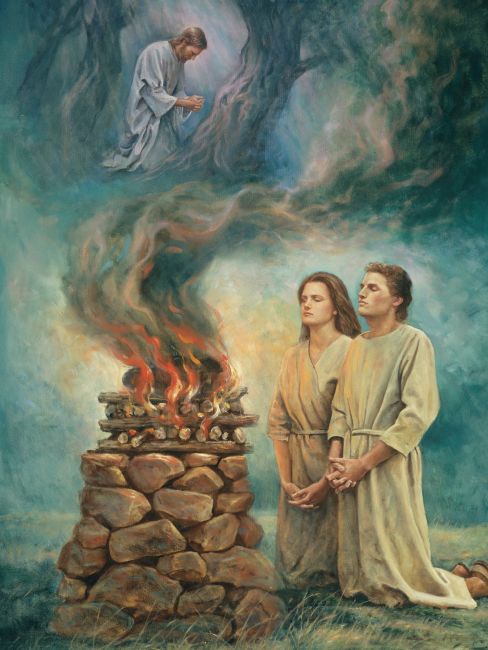
One connection to these separate ceremonies and separate altars was made very early on when Adam and Eve first offered sacrifices. They were taught by an angel, “This . . . is a similitude of the sacrifice of the Only Begotten of the Father, which is full of grace and truth. Wherefore, thou shalt do all that thou doest in the name of the Son, and thou shalt repent and call upon God in the name of the Son forevermore” (Moses 5:7–8).
President Jeffrey R. Holland shared the following insight regarding these verses. He asked, “Call upon God for what? What is the nature of this first instruction to the human family? Why are they to call upon God? Is this a social visit? Is it a friendly neighborhood chat? No, this is a call for help from the lone and dreary world. This is a call from the brink of despair. ‘Thou shalt repent and call upon God in the name of the Son forevermore.’ This is a call from the personal prison of a sinful heart. It is a call for the forgiveness of sins.”[17]
The temple experience in Isaiah’s day was a reminder that we are to repent and call upon God, and that repentance is possible because of the sacrifice of the Son of God. An altar of incense and an altar of sacrifice, coals and burnt offerings, pointed the minds of ancient Israel to the redemption that was possible because of the coming Messiah.
 The Lamb of God was born into the world to suffer for our sins and to allow us to become like him—not only forgiven and cleansed but also changed and perfected in him. Intellectual Reserve, Inc.
Everything in the ancient tabernacle, from the outer curtains and the colors on priestly robes to the mercy seat in the Holy of Holies, pointed to Jesus Christ and his atoning sacrifice. It is the same today. President Russell M. Nelson said, “Everything taught in the temple, through instruction and through the Spirit, increases our understanding of Jesus Christ.”[18] He also promised, “Every sincere seeker of Jesus Christ will find Him in the temple.”[19] My testimony is that ancient and modern temples are powerful reminders of the tender mercies, the lovingkindness, and the goodness of the God of the Old Testament.
To finish where we started: How does our loving Father in Heaven propose to save a sinful, rebellious, forgetful people? How will he make their sins, though as scarlet, white as snow? And how will he make Jesus Christ—the stone that was once rejected by the builders—become the cornerstone, the sure foundation? He will do a marvelous work and a wonder that will include a restoration of his gospel and Church, with prophets, covenants, priesthood keys, missionaries, the Book of Mormon, and temples. And most of all, he does it by the incomparable gift of the atoning sacrifice of Jesus Christ. The Lamb of God was born into the world to suffer for our sins and to allow us to repent, to overcome physical death, to overcome all that is unfair in life, to be healed, to bring comfort and peace, to have the strength to forgive others, and ultimately to make us like him, not only forgiven and cleansed but also changed and perfected in him.
All of this and so much more is evidence of the tender mercy and lovingkindness of the God of the Old Testament; the God of Abraham, Isaac, and Jacob; the God of Isaiah; the God of the everlasting covenant. I am grateful that today, much like in Isaiah’s day, we continue to see his tender mercies and lovingkindness in our lives. In the remarkable opportunity we have to study and teach the Old Testament, may we look for his tender mercies and his lovingkindness. And as we do, may we find him. I testify of his unfailing, delivering, exalting love.
Notes
[1] See “Isaiah 1: What Is Significant About Isaiah 1?,” in “Isaiah 1–12,” in Scripture Helps: Old Testament (The Church of Jesus Christ of Latter-day Saints, 2025).
[2] Sharon Eubank, “Christ: The Light That Shines in Darkness,” Liahona, May 2019, 75.
[3] Frank W. Boreham, Mountains in the Mist: Some Australian Reveries (Charles H. Kelly, 1919), 166–67, 169.
[4] See Patrick Kearon, “God’s Intent Is to Bring You Home,” Liahona, May 2024, 87–89.
[5] Dallin H. Oaks, “Cleansed by Repentance,” Liahona, May 2019, 92, 94.
[6] See Dallin H. Oaks, “Scripture Reading and Revelation,” Ensign, January 1995, 8.
[7] See “Isaiah 29:4: What Does It Mean That the Inhabitants of Jerusalem Would ‘Speak out of the Ground’ as One with ‘a Familiar Spirit’?,” in “Isaiah 13–14; 22; 24–30; 35,” in Scripture Helps: Old Testament.
[8] See Joseph Smith—History 1:63–65. See also Saints: The Story of the Church of Jesus Christ in the Latter Days, vol. 1, The Standard of Truth, 1815–1846 (The Church of Jesus Christ of Latter-day Saints, 2018), 46–48.
[9] See Joseph Fielding McConkie and Robert L. Millet, Doctrinal Commentary on the Book of Mormon (Deseret Book, 1987), 1:348, note on 2 Nephi 29:2.
[10] See Guide to the Scriptures, under “Ensign.”
[11] See “Isaiah 2:1–3. What Is the ‘Mountain of the Lord’s House’?,” in “Isaiah 1–12,” in Scripture Helps: Old Testament.
[12] Russell M. Nelson, “The Temple and Your Spiritual Foundation,” Liahona, November 2021, 93–94, 96.
[13] See Bible Dictionary, under “Altar.”
[14] See “Luke 1:69: What Does the Phrase ‘Raised up an Horn of Salvation’ Mean?,” in “Matthew 1; Luke 1,” in Scripture Helps: New Testament (The Church of Jesus Christ of Latter-day Saints, 2024).
[15] See “Exodus 35–40: What Was the Purpose of the Tabernacle?,” in “Exodus 35–40; Leviticus 1; 4; 16; 19,” in Scripture Helps: Old Testament.
[16] See “Leviticus 16: What Was the Day of Atonement?,” in “Exodus 35–40; Leviticus 1; 4; 16; 19,” in Scripture Helps: Old Testament.
[17] Jeffrey R. Holland, “I Stand All Amazed,” Ensign, August 1986, 69.
[18] Nelson, “Temple and Your Spiritual Foundation,” 93–94.
[19] Russell M. Nelson, “The Lord Jesus Christ Will Come Again,” Liahona, November 2024, 121–22.
