
 menu icon in the top, right corner of the screen.
 icon above to close this box.
 icon at the bottom of the screen below the browser—if you don't see it, swipe up to unhide it.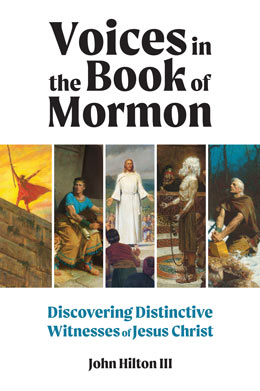
There Was More Than One
Abinadi's Influence on the Book of Mormon
John Hilton III, "There Was More Than One: Abinadi's Influence on the Book of Mormon," in Voices of the Book of Mormon: Discovering Distinctive Witnesses of Jesus Christ (Provo, UT: Religious Studies Center, Brigham Young University; Salt Lake City: Deseret Book), 151–70.
As we discovered in chapter 4, Abinadi is a somewhat mysterious figure in the Book of Mormon.[1] He lived in a time when the Nephites were divided into two groups; some lived in the land of Zarahemla (led by King Mosiah), and others were in the land of Nephi (led by King Noah). We know nothing of Abinadi’s background; all Mormon tells us is that during a time of great wickedness Abinadi “began to prophesy” (Mosiah 11:20). Abinadi’s warnings of affliction and bondage if the people did not repent were not well received. Mormon records that the people “hardened their hearts against the words of Abinadi, and they sought from that time forward to take him. And king Noah hardened his heart against the word of the Lord, and he did not repent of his evil doings” (Mosiah 11:29).
After two years, Abinadi came among the people in disguise and again warned them of God’s coming judgments. This time he was captured and brought before King Noah and his priests. After Abinadi preached a powerful discourse on the coming of Christ, King Noah commanded that Abinadi be put to death. “But there was one among them whose name was Alma. . . . He was a young man, and he believed the words which Abinadi had spoken” (Mosiah 17:2). King Noah was angry with Alma the Elder for his objections, cast him out, and sent guards to slay him. I wonder what Abinadi thought at that moment. Had he developed a relationship with Alma the Elder? Did Abinadi see Alma come to his defense? Did he know that after Alma escaped, he carefully recorded Abinadi’s words? We simply don’t know.
What we do know is that ultimately Abinadi did not escape like Alma but was “bound . . . and scourged . . . with faggots, yea, even unto death” (Mosiah 17:13). This, however, did not bring an end to the influence Abinadi would have on Alma and later Book of Mormon authors. His words formed a key part of Alma the Elder’s teachings (see Mosiah 18:1) and, as we will see, influenced many others.
Grant Hardy has suggested that it would be fruitful for our understanding of the Book of Mormon “to track various phrases throughout the Book of Mormon to determine which Nephite prophets were particularly influenced by their predecessors.”[2] Abinadi is one of the first prophets quoted in the extant abridgment of the large plates and as such has potential to be an influential predecessor. Moreover, Abinadi was directly connected with Alma the Elder’s conversion, which created a subsequent lineage of recordkeepers, all of whom likely had intense interest in the words of the person who helped convert their ancestor and shaped the doctrinal understanding of the Nephite church.
The purpose of this chapter is to explore how Abinadi’s words[3] reverberate through later generations of Book of Mormon prophets. I first focus on Amulek and Alma’s use of Abinadi’s words while preaching in Ammonihah. I next briefly mention Abinadi’s influence on Alma’s words to Corianton (discussed in depth in the following chapter) and then Mormon’s use of Abinadi’s phraseology. In the final section of this chapter, I provide an extended discussion of the relationship between the words of Abinadi and King Benjamin. Although Amulek, Alma, and Mormon all clearly had access to Abinadi’s words, it is not immediately apparent if or how King Benjamin could have accessed Abinadi’s words, a subject we will discuss toward the conclusion of this chapter.
Amulek and Alma Preaching in Ammonihah[4]
While on trial in King Noah’s court, Abinadi testified that the Father and the Son “are one God, yea, the very Eternal Father of heaven and of earth” (Mosiah 15:1–4). A few verses later Abinadi concludes his message, saying that “redemption cometh through Christ the Lord, who is the very Eternal Father” (Mosiah 16:15). It is difficult to determine exactly what Abinadi meant with these words, but it seems clear that what he was teaching was unorthodox. In fact, it formed the basis of his death sentence (see Mosiah 17:7–8).[5]
Whatever controversy was embedded in this statement, it appears to have been repeated when, while preaching in the land of Ammonihah, Amulek was confronted by Zeezrom, who asked, “Is the Son of God the very Eternal Father? And Amulek said unto him: Yea, he is the very Eternal Father of heaven and of earth, and all things which in them are” (Alma 11:38–39). The phrase very Eternal Father is utilized only in these two pericopes; thus it may be that Amulek appeals to Abinadi’s authority as he responds to Zeezrom.[6] Following this allusion to Abinadi’s words, Amulek uses a structure similar to Abinadi’s by focusing on Christ’s Atonement (Mosiah 15:15–6; Alma 11:40), death (Mosiah 15:7; Alma 11:42), and Resurrection (Mosiah 15:8–9; Alma 11:42–44). In addition to teaching with thematic coherence, Amulek also uses phrases that originated with Abinadi, as illustrated in table 8.1.
Table 8.1. Parallel phrases between Abinadi and Amulek.
| Abinadi | Amulek |
But remember that he that persists in his If Christ had not come into the world, And if Christ had not risen from the dead, or | And he shall come into the world to Therefore the wicked remain as though |
Some of these phrases are unique and suggest intentional borrowing. For example, the words as though and redemption appear together in only five verses of scripture, and Abinadi is the first to use these words together in the Book of Mormon.[7] Moreover, the phrase "bands of death" originates with Abinadi.[8] Amulek may be attempting to bolster his own authority by using Abinadi’s words, or perhaps he’s manifesting his acceptance and belief of Abinadi’s words.[9]
After Amulek finishes speaking, Alma begins to further establish the points Amulek made. He likewise utilizes Abinadi’s words while teaching the people of Ammonihah, echoing both Amulek and Abinadi in teaching that the wicked “shall be as though there had been no redemption” (Alma 12:18; compare Mosiah 16:5–6; Alma 11:41). Abinadi had taught that “this mortal shall put on immortality, and this corruption shall put on incorruption, and shall be brought to stand before the bar of God, to be judged of him according to their works whether they be good or whether they be evil” (Mosiah 16:10). Alma also utilizes these words, teaching that we will be “raised from this mortality to a state of immortality, and being brought before the bar of God, to be judged according to our works” (Alma 12:12). While the concepts of resurrection and judgment appear throughout scripture, these two chapters are the only places where these specific textual phrases are found.[10]
The example just cited compares Alma 12:12 with Mosiah 16:10. Additional textual similarities are found within this same cluster of scriptures, as illustrated in table 8.2.
Table 8.2. Parallel phrases between Abinadi and Alma.
| Abinadi | Alma |
| All mankind were lost; and behold, they would have been endlessly lost were it not that God redeemed his people from their lost and fallen state. . . . And if Christ had not risen from the dead, or have broken the bands of death that the grave should have no victory, and that death should have no sting, there could have been no resurrection. But there is a resurrection. (Mosiah 16:4, 7–8) | By [Adam’s] fall, all mankind became a lost and fallen people. . . . Now, if it had not been for the plan of redemption, which was laid from the foundation of the world, there could have been no resurrection of the dead; but there was a plan of redemption laid. (Alma 12:22, 25) |
The phrase "could have been no resurrection" appears only in these two passages.[11] The structure of “if . . . then . . . but . . .” also indicates intentional borrowing. Both Alma and Abinadi immediately negate their use of the phrase "could have been no resurrection" by testifying that God’s plan has been put into effect. Thus, in form and text Alma utilizes Abinadi’s words as part of his message to the people of Ammonihah.
Both Amulek and Alma incorporate multiple phrases from Abinadi while preaching in Ammonihah. Why do they do this? Is there a connection between Ammonihah and Noah’s court? Or are they simply quoting one who stands at the head of the Nephite church’s doctrinal position? While the text itself is silent on the issue, one potential clue stems from Zeezrom’s question “Is the Son of God the very Eternal Father?” (Alma 11:38). Given Zeezrom’s general rhetorical strategy of attempting to trap Amulek in his words, it is plausible that the particular issue of Christ being the Eternal Father was an important and controversial theological issue for some people at that time. Perhaps Zeezrom was attempting to lead Amulek down a path that could lead to the charge of blasphemy. If this were the case, it would make sense for Amulek and Alma to utilize Abinadi’s words to rectify misconstrued meanings of Abinadi’s teachings.
Another possible reason that Amulek and Alma referred to Abinadi was that they wanted to appeal to what for them might have been scriptural authority that they hoped would speak to the hearts of the people. Alma’s father (Alma the Elder) was the founder of the Nephite church (see Mosiah 29:47). Very few words of his are recorded in the Book of Mormon; perhaps the only recent prophets that Amulek and Alma could appeal to were King Benjamin and Abinadi. A connected possibility is that Abinadi’s words formed a significant part of Amulek and Alma’s understanding of the principles they were teaching.
Alma’s Use of Abinadi While Teaching Corianton
Corianton had at least three major issues that concerned him at the time his father counseled him. These concerns regarded the Resurrection (Alma 40:1), the plan of restoration (Alma 41:1), and the justice of God in punishing the sinner (Alma 42:1). As Alma provided doctrinal clarification to help his son, he frequently turned to the words of Abinadi. As described in detail in the following chapter, there are at least thirteen instances in which Alma appears to have utilized Abinadi’s words when teaching Corianton. For example, phrases such as “carnal, sensual, devilish,” or “stand as a testimony against you at the last day” appear only in those two pericopes within the Book of Mormon. Moreover, as we will see in the following chapter, most of Alma’s usage of Abinadi’s words clusters around Corianton’s specific concerns.
Mormon’s Use of Abinadi’s Words
As the editor of the Book of Mormon, Mormon clearly was aware of Abinadi’s words and teachings. Indeed, Mormon’s specific reference to Abinadi more than four hundred years after his death illustrates Abinadi’s impressive influence (see Mormon 1:19). In this section I will demonstrate three specific instances in which Mormon utilizes Abinadi’s words.
First, as Mormon summarizes Aaron’s teachings to the father of King Lamoni, he states that Aaron “did expound unto him the scriptures from the creation of Adam . . . and also the plan of redemption, which was prepared from the foundation of the world, through Christ, . . . that he breaketh the bands of death, that the grave shall have no victory, and that the sting of death should be swallowed up in the hopes of glory” (Alma 22:13–14). This passage appears to be directly connected to Abinadi, who taught that “if Christ had not risen from the dead, or have broken the bands of death that the grave should have no victory, . . . there could have been no resurrection. But there is a resurrection, therefore the grave hath no victory, and the sting of death is swallowed up in Christ” (Mosiah 16:7–8).[12] In the Book of Mormon, the phrase sting of death appears only in three passages (these two and one other that will be discussed shortly).[13]
Why does Mormon use Abinadi’s words when summarizing Aaron’s teachings? It may be that Mormon is simply reflecting Aaron’s actual teachings and that Aaron himself referred to Abinadi. Alternatively, perhaps Mormon uses a phrase that Abinadi said when preaching to King Noah to draw a contrast between the receptivity of Noah and the father of King Lamoni. Both kings received similar messages; the king of the Lamanites’ acceptance of this prophetic word illustrates faith and humility that King Noah lacked.
Another possibility, admittedly speculative, is that Mormon is indirectly illustrating the significance of Abinadi’s mission. In essence, the whole narrative of the Book of Mormon from Mosiah 12 forward hinges on Abinadi’s words. Abinadi is the central figure in the narrative of Zeniff’s people, and his words are instrumental in Alma the Elder’s conversion. Every recordkeeper for the next three centuries is directly related to this convert of Abinadi. It is possible that the sons of Mosiah would not have gone on a mission to the Lamanites had their associate Alma’s father not been converted by Abinadi. Thus, by using Abinadi’s phraseology in describing Aaron’s teachings, Mormon may be reminding us of the connection between Abinadi and the mission to the Lamanites.[14]
Another passage illustrating the extent to which Abinadi influenced Mormon’s text is found in Abinadi’s teaching that all people will “stand before the bar of God, to be judged of him according to their works whether they be good or whether they be evil—if they be good, to the resurrection of endless life and happiness; and if they be evil, to the resurrection of endless damnation” (Mosiah 16:10–11). Mormon utilizes these words almost verbatim as he records that all will “stand before God, to be judged of their works, whether they be good or whether they be evil—if they be good, to the resurrection of everlasting life; and if they be evil, to the resurrection of damnation” (3 Nephi 26:4–5). The sheer volume of related words in the parallel passages indicates intentional use by Mormon.
In this instance Mormon is paraphrasing the resurrected Jesus. Does this textual connection stem from Mormon or the Savior himself? This question cannot be answered with certainty. It is possible that Christ alluded to Abinadi as he expounded all scripture in one and that Mormon is reflecting this usage in his summary of Christ’s words. If so, this would indicate a pattern on the part of Christ in referring to Abinadi’s words.[15] If this is not the case, and Mormon is simply utilizing these words of his own accord, it may indicate the extent to which Abinadi’s words influenced Mormon’s thoughts and writing.
The premise that Abinadi strongly influenced Mormon is also illustrated in Mormon’s use of Abinadi’s phraseology in his final words. Speaking to the remnant who would be spared, Mormon urged them to know that Christ had “gained the victory over the grave; and also in him is the sting of death swallowed up” (Mormon 7:5; compare Mosiah 16:8). Surely Mormon took seriously the prospect of writing his concluding comments in the book to which he had dedicated his life. Thus, Mormon’s intense feelings about the importance of Abinadi’s words may be shown through his use of Abinadi’s phraseology in his final farewell. Although Abinadi’s words represent a relatively small portion of the text of the Book of Mormon, these foregoing passages illustrate the influence Abinadi had on its chief editor.
Textual Connections between Abinadi and King Benjamin
In terms of textual influence, it may be that Abinadi’s strongest influence was actually on King Benjamin. Both King Benjamin and Abinadi give extended discourses in the book of Mosiah. King Benjamin delivers his farewell address in Mosiah 2–5, and Abinadi testifies before King Noah’s court in Mosiah 12–17. Although close in sequence, these sermons take place in two different locations: Benjamin’s in the land of Zarahemla, and Abinadi’s in the land of Nephi. John Sorenson estimates that these locations are 180 miles apart[16] and that traveling between them would take approximately twenty-two days—if one knew the way.[17]
It appears that there was no communication between these groups of Nephites. Amaleki, in reporting on a brother who went to the land of Nephi, said, “I have not since known concerning” him (Omni 1:30). Decades later King Mosiah “was desirous to know concerning the people who went up to dwell in the land of Lehi-Nephi, . . . for his people had heard nothing from them from the time they left the land of Zarahemla” (Mosiah 7:1).
Given the distance that separated the two groups of Nephites and the explicit reported lack of communication between them, it would seem unlikely that the discourses of King Benjamin and Abinadi were related. Furthermore, Mormon (in abridging and creating the text we have today) likely had access to written ancient versions of both speeches. Alma the Elder wrote down “all the words of Abinadi” (Mosiah 17:4) shortly after hearing them,[18] and King Benjamin “caused that the words which he spake should be written” (Mosiah 2:8). Because we are told that separate primary documents exist for each of the discourses, it seems less likely that in composing his abridgment Mormon would have altered the addresses to create textual similarities between them.[19]
Notwithstanding the foregoing, previous researchers have pointed to textual connections between these two speeches and wondered whether Benjamin and Abinadi had contact with each other. Lew Cramer, writing in the Encyclopedia of Mormonism, states, “Similarities between [Abinadi’s] and Benjamin’s words . . . could mean that [Abinadi] spent some time in Zarahemla with King Benjamin and his people,” thus implying that Abinadi was influenced by Benjamin’s speech.[20] But did Benjamin influence Abinadi, or was it the reverse? Or do they both draw on a similar text or prophetic voice? Before discussing these questions, let us first establish the textual connections between the two sermons. Table 8.3 lists fourteen phrases that appear exclusively (or nearly so) in these two discourses.[21]
Table 8.3. Connections between the sermons of King Benjamin and Abinadi.
| Case # | Words from King Benjamin and his audience | Words from Abinadi and his audience | Allusion | Times exact phrase is used elsewhere in scripture |
| 1 | Mosiah 1:13; 2:29; 3:17; 3:20 | Mosiah 13:28 | And moreover I say unto you | 1 (Alma 5:47) |
| 2 | Mosiah 2:38; 3:19 | Mosiah 16:5 | Enemy to God | 0 |
| 3 | Mosiah 3:5; 4:2 | Mosiah 13:34; 15:1; 7:27; 17:8 | Come down . . . children of men | 1 (Genesis 11:5) |
| 4 | Mosiah 3:8 | Mosiah 15:2 | He shall be called . . . Son of God | 0 (1 John 3:1 is very similar) |
| 5 | Mosiah 3:12 | Mosiah 15:27 | Salvation cometh to none such | 0 |
| 6 | Mosiah 3:15 | Mosiah 13:32 | The law . . . except it were through . . . | 0 |
| 7 | Mosiah 3:17 | Mosiah 16:13 | Only in and through . . . Christ | 1 (Alma 38:9; 2 Nephi 10:24 is also similar) |
| 8 | Mosiah 3:20 | Mosiah 16:1 | Time shall come . . . every nation, kindred, tongue, and people | 0 |
| 9 | Mosiah 3:24 | Mosiah 16:10 | Judged . . . according to their works whether they be good or whether they be evil | 1 (Alma 11:44) |
| 10 | Mosiah 3:24 | Mosiah 17:10 | Stand as a . . . testimony against you | 3 (2 Nephi 25:28; Alma 39:8; and Ether 5:4; Doctrine and Covenants 98:27 is also similar) |
| 11 | Mosiah 3:25 | Mosiah 16:11 | And if they be evil . . . damnation | 1 (3 Nephi 26:5; John 5:29; Alma 9:28; and Helaman 12:26 are similar) |
| 12 | Mosiah 4:6–7 | Mosiah 15:19 | Prepared from the foundation of the world | 8 (Mosiah 18:13; Alma 12:30; 13:3, 5; 18:39; 22:33; 42:26; and Ether 3:14; Matthew 25:34; 1 Nephi 10:18; and 2 Nephi 9:18 are similar) |
| 13 | Mosiah 4:23 | Mosiah 12:26 | I say unto you, wo be unto | 1 (Doctrine and Covenants 10:28) |
| 14 | Mosiah 4:30 | Mosiah 13:10 | But this much I tell you[22] | 0 |
Not only are there multiple matching phrases, but they also often occur closely in sequence. For example, cases 3 and 4 above appear next to each other (compare Mosiah 3:5, 8 and Mosiah 15:1–2), as do cases 9 and 11 (compare Mosiah 3:24–25 and Mosiah 16:10–11). In addition, a high level of thematic coherence exists between the two speeches. Themes of fallen man being an enemy to God, the absolute necessity of Christ, the efficacy of the Atonement for ignorant sinners, the salvation of little children, judgment according to our works, and the damnation that awaits the evil all figure prominently in both discourses. These parallels are particularly concentrated in just a few verses in Mosiah 3 and 16. Table 8.4 illustrates how, when rearranged and slightly modified, selected phrases from Mosiah 3:17–25 closely resemble phrases from Mosiah 16:1–15.
Table 8.4. Selected phrases from Mosiah 3:17–25 and Mosiah 16:1–15.
| Benjamin’s words | Abinadi’s words |
| The natural man is an enemy to God, . . . [and] at the judgment day . . . every man . . . shall be judged . . . according to his works, whether they be good, or whether they be evil. And if they be evil . . . they have drunk damnation to their own souls. [But] the time shall come when the knowledge of a Savior shall spread throughout every nation, kindred, tongue, and people . . . [for] salvation can come . . . only in and through the name of Christ, the Lord. | He that persists in his own carnal nature . . . is . . . an enemy to God . . . [and all] shall . . . be judged . . . according to their works whether they be good or whether they be evil . . . and if they be evil [they receive] the resurrection of endless damnation. . . . [But] the time shall come when . . . every nation, kindred, tongue, and people . . . shall see the salvation of the Lord . . . [for] only in and through Christ can ye be saved. . . . Redemption cometh through Christ the Lord. |
Based on the information in tables 8.3 and 8.4, it seems evident that these two sermons are related.[23] If we accept this premise, the natural question is “Who influenced whom?” While no explicit answers are found in the text, there are enough clues to at least rule out certain possibilities. Let us begin to answer this question by trying to ascertain which discourse came first in terms of chronology.
Based on the Nephite timeline presented by Mormon, King Benjamin gave his address in about 124 BC (see Mosiah 6:4). In contrast, no explicit dating information is given about when Abinadi spoke. Nevertheless, through contextual clues we can approximately determine this information. Alma the Elder died in 91 BC at the age of eighty-two (see Mosiah 29:46). Thus Alma the Elder was born in 173 BC. He was a “young man” at the trial of Abinadi (Mosiah 17:2). Unless the definition of “young man” is stretched to include one who is fifty years old, Abinadi clearly spoke before King Benjamin’s address in 124 BC. If we assume “a young man” was about twenty years old, Abinadi spoke in 153 BC, approximately thirty years before King Benjamin.[24]
Accepting the premise that Abinadi spoke before King Benjamin eliminates the possibility that Abinadi heard Benjamin’s address and used it as he spoke in King Noah’s court. And it seems unlikely that Benjamin heard Abinadi’s words and later used them in his speech, given that the people in Zarahemla had no knowledge of what had happened to Zeniff’s descendants (see Mosiah 7:1–2).[25]
The possible influence of an angel
When we revisit the textual connections previously demonstrated, another possible explanation for the parallels emerges. Eleven of the fourteen textual connections (cases 1–11 in table 8.3) between the two discourses come not from King Benjamin’s words but from the words of an angel who spoke to King Benjamin. In Mosiah 3:3 King Benjamin states, “And he [an angel] said unto me” (Mosiah 3:3) and commences a lengthy quote. While it is not entirely clear where the quotation ends, it seems most likely that it ends with Mosiah 3:27, given that Mosiah 4:1 says, “And now, it came to pass that when king Benjamin had made an end of speaking the words which had been delivered unto him by the angel of the Lord . . .”[26]
Because Mosiah 3:3–27 is a quotation from an angel, it is possible that the textual connections between the discourses of King Benjamin and Abinadi are the result of the same angel visiting both men (or different angels visiting each man but with similar messages). The strongest connections between King Benjamin’s and Abinadi’s discourses presented in table 8.3 and the allusions in table 8.4 occur when Abinadi’s words are compared with Benjamin’s quotation of an angel. This lessens the possibility that the connections stem from some common text, unless the angel was quoting unknown texts to both prophets.
The cluster of parallels surrounding the voice of the angel begs the question: Did the same angel who appeared to King Benjamin also appear to Abinadi? While we cannot know for certain, some have speculatively suggested another possibility—that Abinadi himself was the angel that appeared to King Benjamin.[27] While such an assertion must be extremely tentative, it is important to note that King Benjamin frequently refers to the angelic messenger (see Mosiah 3:2, 3; 4:1, 11). In addition, those in King Benjamin’s audience specifically emphasize the angel’s words, further highlighting his importance in King Benjamin’s discourse (see Mosiah 5:5). In contrast, there is no mention of angels anywhere in the pericope surrounding Abinadi and those who heard his message, suggesting that an angelic messenger may not have played an important role in Abinadi’s ministry. If Abinadi was in fact the angel who appeared to Benjamin, his words have an additional influence in the Book of Mormon through King Benjamin’s important speech.
Therefore, What?
Abinadi’s voice reverberates throughout the Book of Mormon. Amulek and Alma both utilize Abinadi’s phraseology when teaching the people in Ammonihah. Alma clearly alludes to Abinadi when talking with his son Corianton, and Mormon also references Abinadi’s words, including both lengthy and unique phrases. While we cannot establish that Abinadi directly influenced King Benjamin, there is an unmistakable textual connection between the two discourses, and Abinadi’s speech clearly came first.
Abinadi’s influence on the text of the Book of Mormon may be underestimated by some. As a pivotal prophet who spoke 450 years after Lehi left Jerusalem, he is responsible for the conversion of Alma the Elder. Alma the Elder and his posterity would keep the sacred records and guide the Church for the next 470 years. Abinadi, living chronologically halfway between Lehi and Mormon, thus radically shaped the second half of Nephite history. The textual connections I have described in this chapter illustrate instances in which multiple phrases from Abinadi appear in connection with specific later pericopes.[28] Abinadi’s testimony of Christ affected generations and clearly had an important textual influence on later Book of Mormon individuals.
Abinadi’s influence causes me to ponder Mormon’s words about Abinadi’s trial: “But there was one among them whose name was Alma. . . . He was a young man, and he believed the words which Abinadi had spoken” (Mosiah 17:2). The last Abinadi saw of Alma the Elder was him fleeing the court and King Noah sending guards to execute him. Abinadi may have died thinking his words had influenced only one . . . and that one had perished.
But Alma the Elder survived and went on to gather “four hundred and fifty souls” (Mosiah 18:35) from among the people. Eventually he became “the founder” of the church of the Nephites (Mosiah 23:16; 29:47). His son Alma, grandson Helaman, great-grandson Helaman, great-great grandson Nephi, and great-great-great grandson Nephi each in turn kept the plates. This last Nephi was present when Jesus Christ came and ministered to the Nephites. In other words, Abinadi’s influence extended far beyond the “one” he was aware of.
The textual connections between Abinadi and later voices in the Book of Mormon speakers provide a literary reminder that there was more than “one” who listened to Abinadi’s words. Seeing this big picture of Abinadi’s influence reminds us that while at times our efforts may seem fruitless, we can influence generations unseen through our diligent efforts to teach others. Because there was one, literally millions were blessed.
In 2001, President James E. Faust shared the following story:
Many years ago an elder who served a mission in the British Isles said at the end of his labors, “I think my mission has been a failure. I have labored all my days as a missionary here and I have only baptized one dirty little Irish kid. That is all I baptized.”
Years later, after his return to his home in Montana, he had a visitor come to his home who asked, “Are you the elder who served a mission in the British Isles in 1873?”
“Yes.”
Then the man went on, “And do you remember having said that you thought your mission was a failure because you had only baptized one dirty little Irish kid?”
He said, “Yes.”
The visitor put out his hand and said, “I would like to shake hands with you. My name is Charles A. Callis, of the Council of the Twelve of The Church of Jesus Christ of Latter-day Saints. I am that dirty little Irish kid that you baptized on your mission.”
That little Irish boy came to a knowledge of his potential as a son of God. Elder Callis left a lasting legacy for his large family. Serving as a mission president for 25 years and in his apostolic ministry for 13 years, he blessed the lives of literally thousands.[29]
Sometimes we, like Abinadi, may reach only “the one,” but we can have hope knowing that our influence may extend beyond what we know. On other occasions we might be “the one” to speak up in difficult circumstances. In a pivotal moment, Alma stood alone in believing the words of the Lord’s prophets. We too may have opportunities to be the only one to stand for what is right—but our decisions to do so can influence others in ways we could never predict.
Notes
[1] This chapter is adapted from John Hilton III, “Abinadi’s Legacy: Tracing His Influence through the Book of Mormon,” in Abinadi: He Came among Them in Disguise, ed. Shon D. Hopkin (Provo, UT: Religious Studies Center, Brigham Young University, 2018): 93–116. Used with permission.
[2] Grant Hardy, Understanding the Book of Mormon (New York: Oxford University Press, 2010), 134.
[3] For an extended discussion on the authorship of Mosiah, and the Abinadi pericope specifically, see John W. Welch, The Legal Cases in the Book of Mormon (Provo, UT: BYU Press; Neal A. Maxwell Institute for Religious Scholarship, 2008), 140–45.
[4] I acknowledge the work of Jaron Hansen and Taze Miller, who helped identify many of the phrases discussed in this section.
[5] For additional discussion on this point, see Welch, Legal Cases in the Book of Mormon, 193–95.
[6] It also seems likely that Zeezrom’s question indicates that Zeezrom is familiar with the words of Abinadi.
[7] See Mosiah 16:5–6; Alma 11:41; 12:18; Moroni 7:38.
[8] The phrase "bands of death" first appears in Mosiah 15:8 and is used thirteen times in the Book of Mormon and once in the Doctrine and Covenants. In addition, the words band and death appear together in Psalms 73:4; 107:14; and Ecclesiastes 7:26. See also Scripture Central, “Why Does Abinadi Use the Phrase ‘the Bands of Death’?,” KnoWhy #93, Book of Mormon Central, May 5, 2016, https://
[9] Amulek revisits some of these same themes when speaking to the Zoramites in Alma 34. On that occasion he also echoes Abinadi, although not to the extent to which he does in Ammonihah. For example, Amulek states that the Atonement brings “about the bowels of mercy, which overpowereth justice, and bringeth about means unto men that they may have faith unto repentance. And thus mercy can satisfy the demands of justice” (Alma 34:15–16). This is reminiscent of Abinadi’s words that Christ would have “bowels of mercy; being filled with compassion towards the children of men; standing betwixt them and justice; having broken the bands of death, taken upon himself their iniquity and their transgressions, having redeemed them, and satisfied the demands of justice” (Mosiah 15:9).
[10] The phrase "before the bar of God, to be" appears only in these two verses. The more generic phrase "before the bar of God" appears in two additional verses (Jacob 6:9 and Alma 5:22), and the word bar appears in twelve Book of Mormon verses. In addition, the words mortal and immortal appear together relatively infrequently in scripture (fourteen total verses in all scripture contain these two words).
[11] Note also that before the phrase "could have been no resurrection" occurs is the phrase "lost and fallen." This latter phrase, while perhaps sounding common, is used only three times in the Book of Mormon. Nephi1 provides the other use (see 2 Nephi 25:17); however, he is talking about the gathering and scattering of Israel, not the effects of the Fall.
[12] While key phrases in these passages appear in Isaiah 25:8 and 1 Corinthians 15:54–55, within the Book of Mormon the words victory and death appear together originally in the words of Abinadi and rarely thereafter. Abinadi uses these terms together in Mosiah 15:8 and Mosiah 16:7–8. Mormon uses them in Alma 22:14; 27:28; and Mormon 7:5. Outside Isaiah 25 and 1 Corinthians 15, these two words never appear together in any other passage of scripture.
[13] The phrase sting of death also appears in 1 Corinthians 15:56.
[14] Another indication that Mormon connects the sons of Mosiah with the labors of Abinadi is found in his use of Isaiah 52:7 to describe their work. Earlier, a priest had asked Abinadi about this passage, saying, “What meaneth the words which are written, and which have been taught by our fathers, saying: [begins quotation of Isaiah 52:7] ‘How beautiful upon the mountains are the feet of him that bringeth good tidings; that publisheth peace; that bringeth good tidings of good; that publisheth salvation; that saith unto Zion, Thy God reigneth’” (Mosiah 12:20–21). Abinadi identifies Jesus Christ and those who testify of him as those whose feet are beautiful upon the mountains (see Mosiah 15:13–18). Mormon uses this same phraseology to describe the sons of Mosiah, saying, “They did publish peace; they did publish good tidings of good; and they did declare unto the people that the Lord reigneth” (Mosiah 27:37).
[15] In the Book of Mormon, the phrase "light and the life of the world" is first spoken by Abinadi and later echoed by the Savior. The specific phrase "light and the life of the world" appears in Mosiah 16:9; 3 Nephi 9:18; 3 Nephi 11:11; and Doctrine and Covenants 12:9; 34:2; 39:2; and 45:7. The key words light, life, and world also appear in John 8:12 and Alma 38:9.
[16] John L. Sorenson, Mormon’s Map (Provo, UT: FARMS, 2000), 57.
[17] Since they did not know the way, Ammon and the fifteen men who came with him took forty days to make the journey (see Mosiah 7:4). Given that the Lamanites also became lost in the same wilderness (see Mosiah 22:16), the terrain may have been difficult to navigate.
[18] Note that Alma the Elder recorded Abinadi’s words (thus creating a source document for Mormon) before he returned to Zarahemla and gained access to King Benjamin’s address.
[19] As will be shown, there are a number of phrases that appear only in these two sections. It seems unlikely that Mormon would have modified these speeches, employing phraseology that was then never used elsewhere in the Book of Mormon.
[20] Lew W. Cramer, “Abinadi,” in Encyclopedia of Mormonism, ed. Daniel H. Ludlow (New York: Macmillan, 1992), 1:5. Cramer also suggests the possibility that Abinadi received “similar revelation” as King Benjamin “during this period.”
[21] For additional discussion of intertextual connections between some of these phrases and the New Testament, see Nicholas J. Frederick, “If Christ Had Not Come into the World,” in Abinadi: He Came among Them in Disguise, ed. Shon D. Hopkin (Provo, UT: Religious Studies Center, Brigham Young University, 2018), 117–38.
[22] These words (even when not used together as a phrase) appear together only in Mosiah 4:30 and Mosiah 13:10.
[23] While some of these connections are clearer than others, taken together they make a robust case for a relationship between the sermons. Many of these connections are stronger than they might initially appear. For example, Abinadi alludes to prophets who had said that “God himself should come down among the children of men, and take upon him the form of man, and go forth in mighty power upon the face of the earth” (Mosiah 13:34). This statement was apparently so provocative that it caused his death, and it was cited almost verbatim by King Limhi (see Mosiah 7:27), leading us to believe that we are getting an actual account of Abinadi’s words. This statement is very similar to King Benjamin’s, that “The Lord Omnipotent . . . shall come down from heaven among the children of men, and shall dwell in a tabernacle of clay, and shall go forth amongst men, working mighty miracles” (Mosiah 3:5).
[24] I gratefully acknowledge Heather Hardy for sharing this observation with me when she reviewed an earlier draft of this chapter. Another way to demonstrate that Abinadi spoke first is by looking at the timeline of Limhi’s people. Because Limhi’s people arrived in Zarahemla between 121–120 BC and King Benjamin spoke in 124 BC, for King Benjamin to speak before Abinadi, all the events in Mosiah 17–22 would have had to have happened in less than three years—a very unlikely occurrence. For example, “Amulon began to exercise authority over Alma and his brethren, and began to persecute him, and cause that his children should persecute their children” (Mosiah 24:8). Amulon and his fellow priests left their Nephite wives and children behind when they fled with King Noah (see Mosiah 19:13; 20:3). However, after abducting the daughters of the Lamanites, they married and had children with their kidnapped brides (see Mosiah 23:33; Mosiah 24:8; Alma 25:7). How much time would need to elapse before the children of Amulon would be capable of persecuting Alma the Elder’s children? If we assume that Amulon’s children had to be at least four years old to be able to persecute other children, a minimum of five years (and likely much more) would be needed between the kidnapping of the daughters of the Lamanites and Alma’s captivity.
[25] It is possible that in the two years between Abinadi’s first and second appearance (see Mosiah 12:1), he went to the land of Zarahemla. Although he would not have heard King Benjamin’s address at that time, perhaps he collaborated with “the holy prophets who were among his people” (Words of Mormon 1:16). While this idea cannot be completely ruled out, given the reported complete lack of communication between the two groups of Nephites, it seems unlikely that Abinadi’s presence in the land of Zarahemla would have gone unnoticed.
[26] In Mosiah 3:23 we read the phrase “And now I have spoken the words which the Lord God hath commanded me.” It is possible that this signals the end of Benjamin’s quotation of the angel (or they may be the words of the angel). However, even if the words in Mosiah 3:23 are King Benjamin’s, he immediately begins another quotation (see Mosiah 3:24). Thus, either way the words in Mosiah 3:24–27 should not be attributed to Benjamin.
[27] Todd Parker offers this conclusion in “Abinadi: The Man and the Message (Part 1)” (Provo, UT: FARMS, 1996), 5, https://
[28] In addition to these instances in which multiple textual connections appear in short succession, there are several phrases that appear to originate with Abinadi in the Book of Mormon that later appear throughout the text—for example, “vultures of the air” (Mosiah 12:2; compare Alma 2:38), “driven and scattered” (Mosiah 17:17; compare Alma 28:3; Mormon 5:20), and “filled with compassion towards [people]” (Mosiah 15:9; compare 3 Nephi 17:6; Doctrine and Covenants 101:9).
[29] James E. Faust, “Them That Honour Me I Will Honour,” Ensign, May 2001, 46–47.
