
 menu icon in the top, right corner of the screen.
 icon above to close this box.
 icon at the bottom of the screen below the browser—if you don't see it, swipe up to unhide it.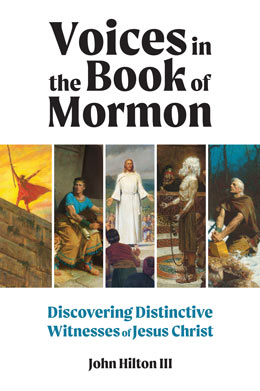
Introduction
In the Book of Mormon we hear the voices of many individuals. Nephi speaks, Laman and Lemuel complain, Jacob quotes Zenos, Korihor mocks, Alma exhorts, and Giddianhi threatens. Altogether, 149 different individuals or groups are portrayed as speaking in the Book of Mormon. These include the voices of God the Father and Jesus Christ, angels and prophets, wives and mothers, anti-Christs and missionaries, and many others. [1]
These are real people with important lessons to teach. Identifying their voices can provide new perspectives on the Book of Mormon. What insights might we gain from examining their distinctive voices? What meaning can studying unique voices of the past lend to our lives today?
I am excited to explore these questions with you. In this book we will carefully examine some of the unique voices in the Book of Mormon through two approaches: first, a study of select individual voices; and second, how later Book of Mormon speakers draw on the voices of their predecessors.
Part 1: Unique Voices
Because the Book of Mormon contains writings from different individuals, unique writing styles should be found within its pages.[2] In part 1 I will highlight some of the distinctive voices that are heard throughout its pages. The first chapter provides an overview of identifying voices in the Book of Mormon and discusses how distinguishing between these voices can deepen our understanding of this sacred text. In the following four chapters, I discuss five individual voices: Jacob; Alma; Abinadi; Nephi, the son of Helaman (herein referred to as Nephi2);[3] and Jesus Christ.[4] Examining their individual voices not only illustrates the complexity of the Book of Mormon but also illuminates spiritual insights uniquely emphasized by these speakers.
Part 2: Voices in Harmony
In part 2 I explore how later individuals in the Book of Mormon harmonize their voices with those of earlier Book of Mormon speakers by utilizing their unique words and phrases. After an overview of intertextuality in chapter 6, the following six chapters provide extended examples of textual connections within the Book of Mormon. I show how later Book of Mormon prophets use both Jacob’s and Abinadi’s words in their teachings, including the surprising connections between Abinadi and King Benjamin. We will see how Alma uses words from both Lehi and Abinadi as he counsels his son Corianton. Finally, we will discuss unique ways in which Samuel the Lamanite quotes from Nephite prophets in his sermon atop a wall and examine the Savior’s use of Nephi’s words.
Therefore, What?
Elder Jeffrey R. Holland remarked that President Boyd K. Packer would often say, after hearing a presentation, “Therefore, what?”[5] The implication was that while the presentation might introduce interesting details or facts, the questions “Why does this matter?” and “What should we do as a result?” remained.[6] Thus I want to pause now, and at the end of each chapter, to consider how this information might be relevant in our lives.
Collectively, the chapters in this book illustrate the textual complexity of the Book of Mormon, adding evidence that it was not the product of Joseph Smith. But perhaps more importantly, these chapters add another layer of insight into our understanding of who the individuals in the Book of Mormon were and what they can teach us. For example, what words did Jesus Christ emphasize, and how can this impact our lives today? What does Alma’s use of Lehi’s and Abinadi’s words teach us about counseling those who are struggling? How can modern-day parents and teachers emulate the ways in which Samuel used the words of previous prophets? How did their circumstances inform their perspective, their character, and their voices?
Elder Neal A. Maxwell wrote, “The [B]ook [of Mormon] is like a vast mansion with gardens, towers, courtyards, and wings. There are rooms yet to be entered, with flaming fireplaces waiting to warm us. The rooms glimpsed so far contain further furnishings and rich detail yet to be savored.”[7] This book will provide a glimpse into one such room—a room focused on the voices heard within the pages of the Book of Mormon. Carefully studying these individual voices and hearing them harmonize has deepened my appreciation for the Book of Mormon and its doctrine. It has strengthened my testimony of scripture, God, and his choreography and care in our lives. I sincerely hope it does the same for you.
Author’s Note
In this book I operate on the assumption that the Book of Mormon is a literal translation of ancient voices.[8] While Joseph Smith may have had some leeway in the translation process, the fact that unique voices appear throughout the Book of Mormon argues for some degree of “original voice” remaining throughout redaction and translation processes (discussed further in chapter 1).
Throughout this book I use the 2013 version of the Book of Mormon. I have compared textual details with Royal Skousen’s The Book of Mormon: The Earliest Text and note significant differences in notes when they occur.
Notes
[1] See the appendices for a detailed list of these voices.
[2] This assumes that unique voices can be detected after the processes of redaction and translation. This will be discussed further in chapter 1.
[3] When possible, I avoid subscripts when naming Book of Mormon people to maintain simplicity. In this volume I use “Nephi” to refer to the son of Lehi and “Alma” to refer to the son of Alma1 (Alma the Elder). When clarity is needed, I use subscripts to identify specific individuals.
[4] Other key voices I could have examined include Nephi, Mormon, and Moroni. But since Grant Hardy has already extensively analyzed their unique voices, I have focused on other individuals in this present volume. See Grant Hardy, Understanding the Book of Mormon: A Reader’s Guide (New York: Oxford University Press, 2010).
[5] Jeffrey R. Holland, “Therefore, What?” (address given to religious educators at a symposium on the New Testament, Brigham Young University, August 8, 2000), 3.
[6] President Dallin H. Oaks wrote, “A few years ago I showed one of my senior brethren a talk I had prepared for future delivery. He returned it with a stimulating two-word comment: ‘Therefore, what?’ The talk was incomplete because it omitted a vital element: what a listener should do. I had failed to follow the example of King Benjamin, who concluded an important message by saying, ‘And now, if you believe all these things see that ye do them’ (Mosiah 4:10).” Dallin H. Oaks, “Following the Pioneers,” Ensign, November 1997, 72.
[7] Neal A. Maxwell, Not My Will, but Thine (Salt Lake City: Bookcraft, 1988), 33.
[8] This is sometimes referred to as a “tight translation.” See Royal Skousen, “How Joseph Smith Translated the Book of Mormon: Evidence from the Original Manuscript,” Journal of Book of MormonStudies 7, no. 1 (1997): 22–31. For a discussion on different translation possibilities, see Brant A. Gardner, The Gift and Power: Translating the Book of Mormon (Salt Lake City: Greg Kofford Books, 2011), or, more briefly, Nicholas J. Frederick and Joseph M. Spencer, “The Book of Mormon and the Academy,” Religious Educator 21, no. 2 (2020): 173–75.
