
 menu icon in the top, right corner of the screen.
 icon above to close this box.
 icon at the bottom of the screen below the browser—if you don't see it, swipe up to unhide it.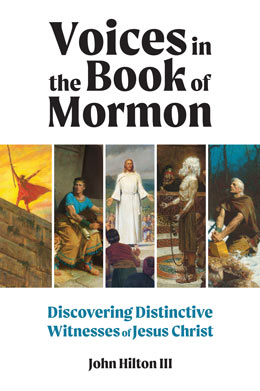
Conclusion
John Hilton III, "Conclusion," in Voices of the Book of Mormon: Discovering Distinctive Witnesses of Jesus Christ (Provo, UT: Religious Studies Center, Brigham Young University; Salt Lake City: Deseret Book), 247–50.
In the introduction of this book, I quoted Elder Neal A. Maxwell as saying, “The [B]ook [of Mormon] is like a vast mansion with gardens, towers, courtyards, and wings. There are rooms yet to be entered, with flaming fireplaces waiting to warm us. The rooms glimpsed so far contain further furnishings and rich detail yet to be savored.”[1]
This volume has provided a glimpse into the corner of the room devoted to how individual Book of Mormon voices distinctively speak and harmonize with others. Multiple connections remain to be explored. What unique speaking patterns can we find in the words of the Lord? Do different speakers quote the Lord in different ways? How are Lehi’s words employed throughout the Book of Mormon? As Christ ministers in Bountiful, does he refer to the words of Book of Mormon prophets besides Nephi? What can we learn from studying the voices of minor speakers like Zeniff? Why are there so many connections between the voices of Ammon and Alma?[2] These and many other questions can begin to be answered as we carefully examine the Book of Mormon with the lens of unique voices.
More than forty years ago, Noel B. Reynolds wrote: “There are at least two distinct reasons to examine the literary structure of the Book of Mormon. For those who recognize the Book of Mormon as sacred scripture, such a study can enhance their appreciation of its teachings. For others, a literary analysis provides a subtle test of the skeptical hypothesis that this book is a unique product of early nineteenth-century American folk culture.”[3] My hope is that our exploration of the voices in the Book of Mormon has both enhanced your appreciation for prophetic teachings and strengthened your testimony that the Book of Mormon is the ancient record Joseph Smith testified it was.
Research about unique phrases and speech patterns in the Book of Mormon, as intellectually interesting as it is, is not an end in itself. For me, reading with the lenses of “Who is speaking?” and “Who is this speaker drawing on?” have helped me find many lessons that I might have otherwise missed. They have illuminated key doctrine and principles, such as the reality of hell and the blessings of baptism. They have motivated me to strive to emulate the Book of Mormon authors who carefully read scripture and have shown me that as I teach others, I should draw on scriptural teachings.
In the introduction I posed two questions to consider in our exploration of the voices in the Book of Mormon: What insights might we gain from examining distinctive voices found in the book? And what meaning can studying unique voices of the past lend to our lives today?
I hope our study of some of the voices in the Book of Mormon—both in how they are unique and in how they harmonize with others—has led you to deeper insights that will enrich your testimony of the Savior and your life. This is the purpose of all scripture—to lead us to Jesus Christ.
Nephi taught that “the Lord God giveth light unto the understanding; for he speaketh unto men according to their language; unto their understanding” (2 Nephi 31:3). Perhaps this is why we have the records of so many different prophets with their own unique stories, focus, and delivery: it allows more ways for the Lord to speak to us in a language we might understand. Perhaps Jacob’s anxiety resonates with some, while Alma’s care for our souls may be the message others need to hear. There are 150 individuals who are portrayed as speaking in the Book of Mormon. When you close the pages of this book, I hope you will pick up your Book of Mormon and continue the study of these voices. What are they saying? Who are they saying it to? To what previous words do they allude? And why does it matter?
Throughout this book, at the end of each chapter has been a section called “Therefore, What?” It is a powerful phrase meaning “OK, I understand, so now what?” It implies action on our part, taking a step beyond what’s been given. So, now that you have read this entire book, tables and all, I ask, “Therefore, What?” What does it mean to you? What will you do with what you’ve learned and felt?
You have heard their voices. And now, therefore, what?
Notes
[1] Neal A. Maxwell, Not My Will, but Thine (Salt Lake City: Bookcraft, 1988), 33.
[2] Alma and Ammon are the only Book of Mormon speakers to use phrases such as “this is my joy” (Alma 29:9; 26:37); “behold the marvelous light of God” (Mosiah 27:29; Alma 26:3); “his great mercy” (Alma 38:7; 26:20); “sing redeeming love” (Alma 5:9; 26:13); “do not boast” (Alma 38:11; 26:11); and “wanderers in a strange land” (Alma 13:23; 26:36). More work is needed to further examine the significance of these textual connections.
[3] Noel B. Reynolds, “Nephi’s Outline,” in Book of Mormon Authorship: New Light on Ancient Origins, ed. Noel B. Reynolds, Religious Studies Monograph Series 7 (Provo, UT: Religious Studies Center, Brigham Young University, 1982), 54.
