
 menu icon in the top, right corner of the screen.
 icon above to close this box.
 icon at the bottom of the screen below the browser—if you don't see it, swipe up to unhide it.
Footnotes and Selections
Kent P. Jackson, "Footnotes and Selections," in Understanding Joseph Smith's Translation of the Bible (Provo, UT: Religious Studies Center, Brigham Young University; Salt Lake City: Deseret Book), 215‒20.
In 1979 the Church of Jesus Christ of Latter-day Saints published an edition of the Bible to meet the needs of Latter-day Saint scripture readers. It was unique in that it contained chapter summaries, cross-references, and notes that were geared to Latter-day Saint interests and that connected the Bible with the other standard works of the Church—the Book of Mormon, the Doctrine and Covenants, and the Pearl of Great Price. As we saw in chapter 22, companion editions of those three books came out two years later.[1] The work was overseen by a committee of members of the Quorum of the Twelve Apostles.
In the English Bible
One of the most important features of the new Bible was the inclusion in it of excerpts from the Joseph Smith Translation. This may not seem significant to Latter-day Saints today, but in its time it represented a major shift in vision on the part of the Church’s leadership regarding the New Translation. When Robert Matthews began his serious academic research on the Prophet’s translation in the 1960s, the doubts and suspicions about it that had begun a century earlier were still strong. The shift toward embracing it came slowly. Beginning in 1965 Matthews published several articles and eventually a book on the New Translation, and those works and the confidence Church leaders had in him helped them come to see how the New Translation could be trusted and that making use of it would be of benefit to the Church.[2] When the Church decided to create a Latter-day Saint edition of the Bible as well as new editions of the other scriptures, Matthews received a calling to assist the committee of apostles in the work.[3]
Church leaders decided to add excerpts from the JST as footnotes in the Bible. Passages that were too long to serve well as footnotes were placed in a seventeen-page appendix in the back of the book, with footnotes to direct readers to it. It became obvious that the most logical footnote acronym for the New Translation, “NT,” could not be used because it more frequently represents the New Testament. Thus was born the title Joseph Smith Translation, created for the need of an acronym—JST—and highlighting the translation’s prophetic origin.
Because space for JST passages would be limited, the decision was made to select excerpts on a priority basis. Matthews explained the selection of the passages: “It was anything that was doctrinal, anything that was necessary in the Old Testament to help us understand the New Testament, anything that bore witness of Christ, anything that bore witness of the Restoration.” In addition, “anything that was clarified in the JST which no other scripture would clarify.”[4] Few of the thousands of grammatical refinements, verbal clarifications, and modernizations of language were included. Where there were similar changes made in two or more of the synoptic Gospels, it was considered sufficient for the Bible’s needs to include only one of the revisions.[5]
The decision was made to take the excerpts directly from the published Inspired Version. Matthews’s work with RLDS archivists over the previous years, along with recent positive interactions between LDS and RLDS historians, had created an atmosphere of cooperation between the two churches. Because the passages were to come directly from a copyrighted print volume, the Church sought and obtained permission from the Reorganized Church of Jesus Christ of Latter Day Saints and its publishing arm, Herald House. The cost for using the excerpts was set at one dollar.[6] Matthews acquired two identical copies of the most recent printing of the Inspired Version, a 1974 printing of the 1944 “Corrected Edition.” He cut the verses out by hand with scissors. He needed two copies in case cutting out a selected verse on one side of the page would remove part of another selected verse on the other side of the same page.[7]
In general, the editors of the Inspired Version retained the verse divisions of the King James translation, but where Joseph Smith’s insertions created new chapters or longer verses, RLDS editors created verse breaks unique to the printed Inspired Version. This explains why in the footnotes and appendix of Latter-day Saint Bible editions of 1979 and 2013, the JST references and the KJV reference sometimes do not match.[8]
When the Latter-day Saint Bible came off the press, it contained over eight hundred Joseph Smith Translation verses in the notes and the appendix. This may not seem like many, given the size of the New Translation, but coupled with the Book of Moses and Joseph Smith—Matthew, it represented a considerable portion of the content changes in the Bible revision. And significantly, the selected passages included those that many careful observers agreed were the most important ones.
As we have seen, in 2013 the Church published new editions of the English standard works, including a new edition of the Bible. There were some adjustments and corrections of the printing in the scriptural texts, but they were few. The main changes came to what were called the “study aids”—introductions, chapter summaries, footnotes, and so forth. Among the items that received the most attention were the JST footnotes in the Bible. Editors made adjustments to several existing entries, sometimes to add new verses and sometimes to highlight additional words. They increased the number of passages in the appendix in the back of the Bible. They also added a few dozen new JST footnotes, some with new excerpts and some referring to entries in the appendix. Unlike what happened with the 1979–81 editions, which motivated several innovative scripture lovers to scour the new editions to create lists of all the changes, in 2013 the Church released detailed lists of the revisions that were made.[9]
In Languages Other than English
The 1993 edition of the Spanish triple combination (Book of Mormon, Doctrine and Covenants, and Pearl of Great Price) included an appendix in the back called “Selections from the Joseph Smith Translation of the Bible in English.”[10] It contained twenty-two pages of JST excerpts. When the Church subsequently published a Latter-day Saint edition of the Spanish Bible in 2009, JST footnotes were included throughout the book and also in a section in the back called “Selections from the Joseph Smith Translation.”[11] The selections contained twenty-eight pages of JST passages too long to be placed in footnotes. With the publication of the Spanish Bible, the excerpts in the triple combination were no longer needed, and editors did not include them in subsequent printings.[12]
These were the Church’s first efforts to incorporate Joseph Smith’s Bible revision into scriptures in languages other than English. In the vast majority of the world’s languages, the Church does not have its own Bible editions but publishes the JST selections with the triple combination.[13] In that way, some of the best material from the New Translation has been made available to Latter-day Saints around the world.
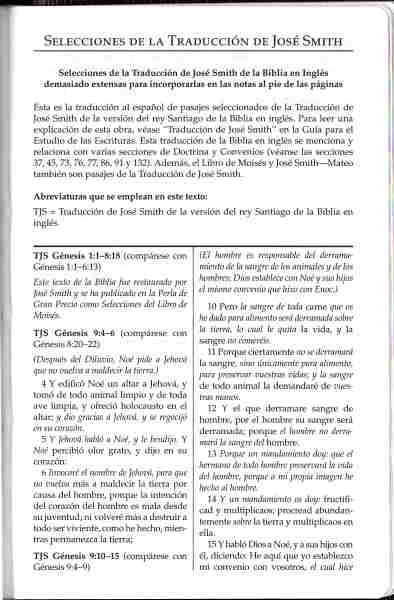 Selections from the Joseph Smith Translation in the back of the Spanish Latter-day Saint edition of the Bible.
The translation of JST passages into languages other than English has posed its own set of challenges. A large portion of Joseph Smith’s revisions are specific to the King James translation and deal with issues that do not exist in other languages. Thus, most of the many modernizations and clarifications that the JST provides would not be needed with most non-English translations used by Church members, most of which are in more contemporary language than the King James Version. The selected passages, however, deal primarily with revisions in content, not in word choices, and the same criteria that Robert Matthews voiced with respect to the selections in the 1979 edition still generally applied in later years. It is significant that the footnotes in the Spanish and Portuguese editions and in the Selections in many languages are not simply repeats of those found in the 1979 English edition. They are often improvements on them. Many of the new JST excerpts in the 2013 English Bible first appeared in the Spanish Bible’s footnotes and in the selections in other languages before the publication of the 2013 English edition.[14] In 2015 the Church began including the same JST excerpts in all languages.
The published excerpts from the Joseph Smith Translation will always miscommunicate to some degree. Many Latter-day Saints who use them have the impression that the Prophet’s Bible revision is a collection of quotes, a set of brief commentaries to accompany the standard Bible. Notwithstanding that, and despite their limitations, the footnotes and Selections are a blessing to Church members because they have brought the Prophet’s Bible revision to the attention of Latter-day Saints around the world, and they shed light on their study of the scriptures. The wisdom and inspiration of Church leaders who decided to make them available has been confirmed many times over since their first inclusion in the Bible in 1979.
Notes
[1] See Robert J. Matthews, “The New Publications of the Standard Works—1979, 1981,” BYU Studies 22, no. 4 (Fall 1982): 387–424.
[2] Matthews’s many publications on the New Translation, beginning in 1965, are listed in Alexander L. Baugh, comp., “Writings of Robert J. Matthews,” in A Witness for the Restoration: Essays in Honor of Robert J. Matthews, ed. Kent P. Jackson and Andrew C. Skinner (Provo, UT: Religious Studies Center, Brigham Young University, 2007), 307–35.
[3] See Fred E. Woods, “The Latter-day Saint Edition of the King James Bible,” in The King James Bible and the Restoration, ed. Kent P. Jackson (Provo, UT: Religious Studies Center, Brigham Young University, 2011), 260–80.
[4] Matthews, interview by Fred E. Woods, in Woods, “The Latter-day Saint Edition,” 269.
[5] Author’s conversations with Matthews.
[6] Woods, “The Latter-day Saint Edition,” 270.
[7] Author’s conversations with Matthews.
[8] The same is true in Latter-day Saint scripture editions in languages other than English.
[9] “Summary of Approved Adjustments for the 2013 Edition of the Scriptures” and “Detailed Summary of Approved Adjustments for the 2013 Edition of the Scriptures,” churchofjesuschrist.org.
[10] “Selecciones de la Traducción de José Smith de la Biblia en Inglés.”
[11] “Selecciones de la Traducción de José Smith.”
[12] For the Spanish scriptures, see Joshua M. Sears, “Santa Biblia: The Latter-day Saint Bible in Spanish,” BYU Studies Quarterly 54, no. 1 (2015): 63–66.
[13] Much of this discussion is based on Daniel O. McClellan, Translation Department, Church of Jesus Christ of Latter-day Saints, to Kent P. Jackson, July 31, 2020.
[14] See Sears, “Santa Biblia,” 65–66.
