
 menu icon in the top, right corner of the screen.
 icon above to close this box.
 icon at the bottom of the screen below the browser—if you don't see it, swipe up to unhide it.
Adding to the Words of Jesus
Kent P. Jackson, "Adding to the Words of Jesus," in Understanding Joseph Smith's Translation of the Bible (Provo, UT: Religious Studies Center, Brigham Young University; Salt Lake City: Deseret Book), 83‒92.
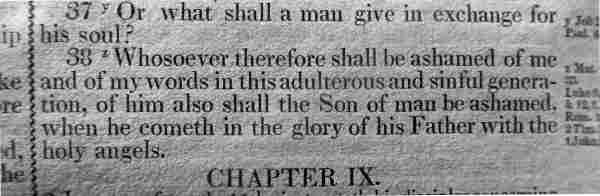
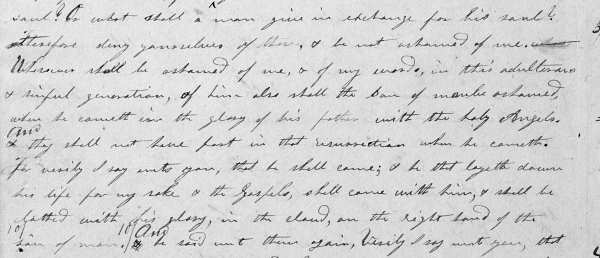 Mark 8:37–38 from the King James Bible and the same verses in the Joseph Smith Translation, which adds several lines of new text. This original dictation, in the hand of John Whitmer, shows the later refinements by which the text was made ready for publication, including the addition of capitalization and sentence and verse breaks and some changes of ampersands to “and.” Courtesy of Community of Christ Archives.
There are many places in the New Translation where Joseph Smith changed or added to Jesus’s words as preserved in the Bible. In this chapter we will look at revisions in which the New Translation inserts new text that often adds greater clarity and precision.
Restoring the Context
As we saw in chapter 10, several insertions precede existing verses to provide context, in this case adding context to the words of Jesus. In the following three examples from the Sermon on the Mount, Jesus is speaking to his disciples to help prepare them for their missionary service. Two of these are preceded by the phrase “Go ye into the world.” In Matthew 6:25 Jesus tells his disciples that their Heavenly Father will provide for them, thus explaining the words that follow.
Matthew 6:25
| Therefore I say unto you, Take no thought for your life, what ye shall eat, or what ye shall drink; nor yet for your body, what ye shall put on. Is not the life more than meat, and the body than raiment? | “And again I say unto you, go ye into the world and care not for the world. For the world will hate you and will persecute you and will turn you out of their synagogues. Nevertheless ye shall go forth from house to house teaching the people. And I will go before you, and your Heavenly Father will provide for you—whatsoever things ye need for food, and what you shall eat and for raiment, what ye shall wear or put on. Therefore I say unto you, take no thought for your life, what ye shall eat or what ye shall drink, nor yet for your bodies, what ye shall put on. Is not the life more than meat and the body more than raiment?” |
The revision at Matthew 7:5 expands on Jesus’s instructions as he taught his disciples how to approach the scribes, Pharisees, priests, and Levites and challenge them regarding their hypocrisy. The final sentence is then recast to become an instruction to the disciples on what to say to them.
Matthew 7:5
| Thou hypocrite, first cast out the beam out of thine own eye; and then shalt thou see clearly to cast out the mote out of thy brother’s eye. | And Jesus said unto his disciples, “Beholdest thou the scribes and the Pharisees and the priests and the Levites? They teach in their synagogues but do not observe the law nor the commandments, and all have gone out of the way and are under sin. Go thou and say unto them, ‘Why teach ye men the law and the commandments when ye yourselves are the children of corruption?’ Say unto them, ‘Ye hypocrites, first cast out the beam out of thine own eyes, and then shalt thou see clearly to cast out the mote out of thy brother’s eye.’” |
The insertions in the following passage, also in Jesus’s instructions to his disciples, add text both before and after the biblical words. These additions not only explain the metaphor but also teach the principle behind it.
Matthew 7:6
Give not that which is holy unto the dogs, neither cast ye your pearls before swine, lest they trample them under their feet, and turn again and rend you. | “Go ye into the world saying unto all, ‘Repent, for the kingdom of heaven has come nigh unto you.’ And the mysteries of the kingdom ye shall keep within yourselves, for it is not meet to give that which is holy unto the dogs. Neither cast ye your pearls unto swine lest they trample them under their feet. For the world cannot receive that which ye yourselves are not able to bear, wherefore ye shall not give your pearls unto them lest they turn again and rend you.” |
The above text and the revision at Matthew 6:25 are remarkable because they look to the future of the Twelve going “into the world” to preach the gospel. According to Matthew’s narrative, Jesus did not give the Twelve their commission until three chapters later, when he told them, in Joseph Smith’s revision, “Go not into the way of the Gentiles and enter ye not into any city of the Samaritans, but rather go to the lost sheep of the house of Israel.”[1] It was only after the Savior’s mortal ministry that he sent them beyond those bounds to preach the gospel to “all nations.”[2] These JST revisions anticipate that broader mission.
The following two passages, both providing context for the words in the Bible, receive several lines of new text. In the first one the JST reassigns the biblical words from Jesus to his hearers.
Luke 12:39
| And this know, that if the goodman of the house had known what hour the thief would come, he would have watched, and not have suffered his house to be broken through. | “And now verily I say these things unto you that ye may know this, that the coming of the Lord is as a thief in the night. And it is like unto a man who is an householder who, if he watcheth not his goods, the thief cometh in an hour of which he is not aware and taketh his goods and divideth them among his fellows.” And they said among themselves, “If the good man of the house had known what hour the thief would come, he would have watched and not have suffered his house to be broken through and the loss of his goods.” |
Luke 14:34
| Salt is good: but if the salt have lost his savour, wherewith shall it be seasoned? | Then certain of them came to him, saying, “Good master, we have Moses and the prophets, and whosoever shall live by them, shall he not have life?” And Jesus answered saying, “Ye know not Moses, neither the prophets. For if ye had known them ye would have believed on me, for to this intent they were written. For I am sent that ye might have life. Therefore I will liken it unto salt which is good. But if the salt has lost its savour, wherewith shall it be seasoned?” |
Some of the material in Jesus’s discourses in the Gospels reads like a collection of detached statements. Joseph Smith’s Bible revision often provides them with a setting within the overall story and sometimes turns seemingly disconnected sayings into narrative. The next example, from Luke 16:17, adds context in two directions. The insertion connects with Jesus’s words both before and after it, bridging the gap between verses 16–17 and 18.
Luke 16:16–18
The law and the prophets were until John: . . . And it is easier for heaven and earth to pass, than one tittle of the law to fail. Whosoever putteth away his wife, and marrieth another, committeth adultery: and whosoever marrieth her that is put away from her husband committeth adultery. | Then said Jesus unto them, “The law and the prophets testify of me. Yea and all the prophets who have written, even until John, have foretold of these days. . . . And it is easier for heaven and earth to pass than for one tittle of the law to fail. And why teach ye the law and deny that which is written and condemn him whom the Father hath sent to fulfill the law that you might all be redeemed? O fools! For you have said in your hearts, ‘There is no God,’ and you pervert the right way, and the kingdom of heaven suffereth violence of you. And you persecute the meek, and in your violence you seek to destroy the kingdom, and ye take the children of the kingdom by force. Woe unto you, ye adulterers!” And they reviled him again, being angry for the saying that they were adulterers. But he continued, saying, “Whosoever putteth away his wife and marrieth another committeth adultery. And whosoever marrieth her who is put away from her husband committeth adultery.” |
Explaining Metaphor
There will be more about the New Translation’s response to metaphor in chapter 14, but the following two examples are given to show extended insertions of new text into Jesus’s teachings. Notice how these revisions not only explain the metaphor but also teach the principle or doctrine. Both of these examples insert new words into the existing words of Jesus, in addition to adding explanations after them.
Luke 6:29
And unto him that smiteth thee on the one cheek offer also the other; and him that taketh away thy cloak forbid not to take thy coat also. | “And unto him who smiteth thee on the cheek, offer also the other. Or in other words, it is better to offer the other than to revile again. And him who taketh away thy cloak, forbid not to take thy coat also. For it is better that thou suffer thine enemy to take these things than to contend with him. Verily I say unto you, your Heavenly Father, who seeth in secret, shall bring that wicked one into judgment.” |
Luke 17:37
And they answered and said unto him, Where, Lord? And he said unto them, Wheresoever the body is, thither will the eagles be gathered together. | And they answered and said unto him, “Where, Lord, shall they be taken?” And he said unto them, “Wheresoever the body is gathered, or in other words, whithersoever the saints are gathered, thither will the eagles be gathered together, or thither will the remainder be gathered together.” This he spake signifying the gathering of his saints and of angels descending and gathering the remainder unto them—the one from the bed, the other from the grinding, and the other from the field, whithersoever he listeth. “For verily there shall be new heavens and a new earth wherein dwelleth righteousness, and there shall be no unclean thing. For the earth becoming old, even as a garment having waxed in corruption, wherefore it vanisheth away, and the footstool remaineth sanctified, cleansed from all sin.” |
Expanding the Message
Several insertions in the New Translation expand and augment Jesus’s teachings by adding additional sentences to them. These examples change neither the speaker nor the subject matter but act to continue and develop the message of the existing words.
Mark 8:38
| Whosoever therefore shall be ashamed of me and of my words in this adulterous and sinful generation; of him also shall the Son of man be ashamed, when he cometh in the glory of his Father with the holy angels. | “Whosoever shall be ashamed of me and of my words in this adulterous and sinful generation, of him also shall the Son of Man be ashamed when he cometh in the glory of his Father with the holy angels. And they shall not have part in that resurrection when he cometh. For verily I say unto you that he shall come, and he that layeth down his life for my sake and the gospel’s shall come with him and shall be clothed with his glory in the cloud on the right hand of the Son of Man.” |
Luke 12:29–30
| And seek not ye what ye shall eat, or what ye shall drink, neither be ye of doubtful mind. For all these things do the nations of the world seek after: and your Father knoweth that ye have need of these things. | “Therefore seek not what ye shall eat or what ye shall drink, neither be ye of doubtful mind. For all these things do the nations of the world seek after, and your Father who is in heaven knoweth that ye have need of these things. And ye are sent unto them to be their ministers, and the labourer is worthy of his hire. For the law saith that ‘a man shall not muzzle the ox that treadeth out the corn.’” |
In Jesus’s excoriation of the scribes and Pharisees in Matthew 23, he warns them that the punishment for all the sins of previous generations would happen in their time. They, additionally, would be held to a higher standard of accountability than their progenitors.
Matthew 23:36
| Verily I say unto you, All these things shall come upon this generation. | “Verily I say unto you, all these things shall come upon this generation. You bear testimony against your fathers when you yourselves are partakers of the same wickedness. Behold your fathers did it through ignorance, but you do not. Wherefore their sins shall be upon your heads.” |
Joseph Smith revised most of Matthew 26 twice (see chapter 19), and in both cases he added language to Jesus’s instruction to the Twelve regarding the sacramental bread and wine. He did not revise the same passage in Luke, but in Mark he revised the text even more extensively, adding words both inside the existing text and after it.
Mark 14:24
| And he said unto them, This is my blood of the new testament, which is shed for many. | And he said unto them, “This is in remembrance of my blood, which is shed for many, and the new testament which I give unto you. For of me ye shall bear record unto all the world. And as oft as ye do this ordinance, you will remember me in this hour that I was with you and drank with you of this cup, even the last time in my ministry.” |
One of the largest insertions of text in the New Testament is found at Matthew 21:46. It is a remarkable, multifaceted addition of almost two hundred words onto a seemingly unremarkable sentence in which Matthew tells of the reaction of the chief priests and Pharisees to what Jesus said to them. The revision begins with a statement from Jesus’s opponents that provides context for their actions. Then it adds words of Jesus in which he explains to his disciples the meaning of Psalm 118:22–23, which he had quoted earlier in the chapter in the context of the parable of the wicked husbandmen. The passage from Psalms reads, “The stone which the builders refused is become the head stone of the corner. This is the Lord’s doing; it is marvellous in our eyes.” The synoptic Gospels and 1 Peter quote this passage.[3] Peter identifies Jesus as the rejected stone, but in the Gospels the reference to Jesus, though understood by his opponents, is not expressed in the text. Joseph Smith’s revision of Matthew makes this identification explicit: Jesus says, “I am the stone,” and “I am the head of the corner.” He then refers to the parable and places it in the context of the last days. Matthew then provides a summary interpretation.
Matthew 21:46
| But when they sought to lay hands on him, they feared the multitude, because they took him for a prophet. | And they said among themselves, “Shall this man think that he alone can spoil this great kingdom?” And they were angry with him. But when they sought to lay hands on him they feared the multitude because that they learned that the multitude took him for a prophet. And now his disciples came to him and Jesus said unto them, “Marvel’ ye at the words or the parable which I spake unto them? Verily I say unto you, I am the stone, and those wicked ones reject me. I am the head of the corner. These Jews shall fall upon me and shall be broken, and the kingdom of God shall be taken from them and shall be given to a nation bringing forth the fruits thereof (meaning the Gentiles). Wherefore on whomsoever this stone shall fall it shall grind him to powder. And when the Lord therefore of the vineyard cometh, he will destroy those miserable wicked men and will let again his vineyard unto other husbandmen, even in the last days, which shall render him the fruits in their seasons.” And then understood they the parable which he spake unto them, that the Gentiles should be destroyed also when the Lord should descend out of heaven to reign in his vineyard, which is the earth and the inhabitants thereof. |
All the revisions highlighted in this chapter show innovation and sophistication as they infuse greater meaning into the biblical text. They do that by making the settings of individual passages clearer and by illuminating the circumstances that led to Jesus’s words.
Notes
[1] Matthew 10:5–6; NT2, page 18.
[2] Matthew 28:19.
[3] Matthew 21:42; Mark 12:11; Luke 20:17; 1 Peter 2:7–8.
