
 menu icon in the top, right corner of the screen.
 icon above to close this box.
 icon at the bottom of the screen below the browser—if you don't see it, swipe up to unhide it.
Ancients versus Moderns
Conflicting Perspectives
Gregory Steven Dundas, "Ancients versus Moderns: Conflicting Perspectives," Mormon's Record: The Historical Message of the Book of Mormon (Provo, UT: Religious Studies Center, Brigham Young University; Salt Lake City: Deseret Book), 29–54.
In 1687 Isaac Newton published his magnum opus, the Philosophiæ Naturalis Principia Mathematica (Mathematical Principles of Natural Philosophy). This work, more than any other single book of that era, represented a watershed event in Western civilization, effectively overturning thousands of years of thinking about the nature of the cosmos and establishing an entirely new worldview. Before the discoveries of Newton (along with the work of a few of his distinguished predecessors, men like Hobbes, Bacon, Descartes, and Galileo), the phenomenal world of nature had been viewed as an orderly realm that conformed not to impersonal laws of nature but to the will of deity. Nature was filled with sacredness—either directly (in the case of ancient paganism) because the gods were highly immanent in nature, or indirectly (in the case of medieval Christianity) because a transcendent God had created everything in the world and watched over it all and directed it with loving concern and for the specific benefit of humankind. In light of this sacredness, the world was viewed as being filled with purpose and meaning. After Newton, in contrast, nature had become transformed into a mere machine—one that had, to be sure, been constructed and set in motion by God but thereafter operated on its own without any need for divine oversight. Earth was no longer the center of the universe—nor was humankind the focus of God’s ongoing attention—which made it much harder to discern any real meaning or purpose in the world.[1]
This materialistic, mechanistic, impersonal view of nature is the one that permeates our modern worldview; having been unwittingly absorbed from our earliest childhood, it constitutes the lens through which we all perceive the world around us.[2] What is ironic—and also much less widely known—about Newton’s key role in this process of secularizing (or, better, desacralizing) the world is that he, along with most of his distinguished predecessors, was a devout Christian who had no conscious intention of, as it were, disengaging God and the sacred from people’s understanding of the world. Not only was he a believer in God and Christ (though an ardent anti-Trinitarian), but he was a devout student of the Bible who, it turns out, spent much of his intellectual efforts attempting to understand and decode the prophecies in the books of Revelation and Daniel. He also devoted a remarkable amount of his time to the study of alchemy.[3] This duality of Newton’s thought, as both a prophet of modernity and as the “last of the magicians,” as John Maynard Keynes described him, highlights Newton’s place as a truly pivotal figure in the revolutionary transformation of the archaic into the modern world.[4] He had his feet firmly planted, as it were, in both worlds.
Mormon, in contrast, had his feet planted firmly in the archaic world. It is difficult to know with any depth of understanding exactly what his cultural upbringing was like. Undoubtedly it had Hebrew roots and retained much of its Israelite heritage, but exactly how much cultural evolution Nephite society had undergone over the course of a thousand years of history by the time of Mormon’s birth is impossible to say. Nevertheless, his thought in general was clearly that of a man of antiquity. He did not conceive of the world as Newton and his successors have taught us to view it (i.e., from an objective, scientific perspective), but rather from a sacral point of view in which Deity played a preeminent role and the vagaries of everyday life were determined not by impersonal laws of nature combined with random chance but by the purposes of the divine will.[5] While Mormon’s own worldview would not have matched that of any other civilization in all its particulars, in general terms he would have shared with them a similar mentality, or broad outlook, which greatly differed from our own modern viewpoint.
Because we are discussing worldviews at the level mostly of unspoken cultural assumptions—ideas and attitudes that one takes for granted without a moment’s thought—it is essential that, before attempting to understand Mormon’s history, we first lay a robust groundwork to ensure as much as possible an accurate understanding of the mentality of the archaic world. When reading an ancient text, we can easily take for granted our own modern assumptions and entirely misinterpret what was really going on. One might mention, say, the tacit assumption of most moderns that democracy is superior to monarchy. Monarchy as an institution is nearly dead in the modern world, yet in antiquity democracy was the rare exception while monarchy was both the most common and assumed to be the most natural form of governance. Even many Greeks viewed democracy critically. Kingship, in most cases, was viewed in sacral terms—that is, the king was believed to be in some manner appointed by deity, not only to rule but to serve as a mediator between the gods and humankind. Surprisingly, even King Mosiah, while declaring his intention to transform the government from a kingship to a more democratic system of elected judges, insisted that kingship was theoretically the best system “if it were possible that you could have just men to be your kings” (Mosiah 29:13; compare 23:8 for Alma’s similar view).[6] We will discuss in part I the place of sacral kings in ancient culture, including the king’s role in establishing justice. But for the moment it is enough to point out the likelihood that many readers of the Book of Mormon have supposed, because of their modern assumptions, that Mosiah believed democracy to be superior to kingship.[7]
* * *
The following discussion of this ancient sacral perspective does not focus on any one ancient culture but attempts to draw out the broad traits common to a wide variety of civilizations of antiquity. Doing so will give the reader a broad perspective in which to situate Mormon and his writings. The focus of my discussion will be on the world of the ancient Near East, including the ancient peoples of Mesopotamia (Sumerians, Babylonians, Assyrians) and ancient Israel, as well as ancient Egypt, which although geographically part of Africa had strong cultural ties with Western Asia. I also discuss examples from ancient Greece and Rome, which held many of their basic attitudes about the world in common with their much older neighbors to the east. Technically speaking, reference to the ancient world should also include the Far Eastern civilizations of ancient India and China as well, and while I will mention those cultures on occasion, it would needlessly complicate and lengthen our discussion (and be outside my area of expertise) to attempt to be comprehensive.[8] At times I use the word archaic to refer to all premodern civilizations, including the nations of medieval Europe, which despite the major differences in worldview because of their adherence to monotheistic Christianity, still shared many underlying assumptions about the general nature of the cosmos with their polytheistic ancestors. Francis Oakley, a distinguished medievalist, emphasizes that evidence of the sacral mentality can be found all over the world from Ireland to the Sudan, India, China, Scandinavia, and Polynesia. It endured through countless centuries and into the medieval world, and even into the nineteenth and twentieth centuries in certain places.[9]
Because the practical reality is that the sacral aspects of these ancient cultures could fill volumes, the brief survey below does little more than scratch the surface of this vast subject to point out a few broad but nevertheless instructive similarities.
The Ancient Sacral Perspective
Archaic civilization was sacral civilization, meaning that the cosmos was viewed as saturated with sacredness. According to the eminent scholar of religion Mircea Eliade, the ancients “live[d] in a sacralized cosmos” and participated “in a cosmic sacrality manifested equally in the animal world and in the vegetable world.”[10] All ancient peoples had this sacral worldview in common, although they differed considerably in many of their specific beliefs about the gods and the cosmos. The various peoples of the ancient Near East, in particular, shared a variety of traditions and attitudes and were quite familiar with each other’s beliefs and ways of thinking. While it is certainly true that each of these civilizations had its own unique culture and differed in innumerable ways from its neighbors—and these differences should by no means be minimized or ignored—our emphasis in this brief overview will be on the numerous elements they held in common. Those commonalities become all the more distinct when placed in direct contrast with modern assumptions.[11]
The people of Israel, of course, differed strikingly from all their neighboring peoples in worshipping a single, unique deity. That crucial difference gave rise to a significant divergence in worldviews between the Israelites and all other ancient civilizations. The most significant difference was that Yahweh was viewed as transcending the natural world to a much greater degree than the pagan deities, who were linked rather closely to the phenomena of nature such as the sun, the moon, the earth, and the sky. Nevertheless, it would be incorrect to suppose that the Hebrew culture was entirely unique and shared nothing in common with the ideas and practices of its neighbors. It is clear that the Israelites possessed many cultural characteristics in common with the surrounding peoples, which included the Mesopotamians, the Egyptians, and particularly the Canaanites, their closest neighbors, and it is widely acknowledged that they are properly viewed as belonging to the broad cultural milieu of the ancient Near East.[12]
One of the most notable common elements was the presence of temples, which represented not only a house of deity but also, in varying manner, the cosmos itself.[13] One neat way of conceiving the similarities among neighboring civilizations is that “when we think of Old Testament religious concepts such as ritual sacrifice, sanctuaries/
Although the ancient Greeks lived on the margins of this shared culture of the ancient Near East, they retained many of the sacral traits characteristic of the much older civilizations to their east. It has become abundantly clear in recent decades that Greek culture did not spring full-blown from Greek soil but developed over many centuries, in part as the Greeks borrowed and adapted ideas and practices from their neighbors. The Greeks were fully conscious of their debt to other nations; besides their alphabet, which derived from the Phoenician writing system of Western Asia, their early sculpture owed much to the Egyptians and their mathematics to the Babylonians. Their gods and goddesses bore many resemblances to those of the surrounding peoples, and their myths show direct borrowing of motifs from the myths of the Hurrians, Ugaritians, and others. From at least the time of Homer (eighth century BC), and increasingly over the following centuries, the Greeks developed these cultural traits in their own unique ways, emphasizing like no other people in antiquity the human aspect of things. They transformed the relationship between deity and humankind: the Greek gods were perceived as more like humans, and human beings as more akin to the gods than was the case in eastern religions.[15] And when they focused on fundamental questions about life, they began seeking answers not in symbolic and mythic terms but through models that stressed reasoned analysis.[16]
Nevertheless, it must be emphasized that while Greek thought evolved in a direction that has come to be thought of as more “Western” in its orientation (i.e., more abstract, philosophical, and explicitly oriented around the careful use of logic), the Greeks (and their Roman successors) were still an ancient people who continued to adhere in many ways to the common sacral outlook of the antique world. Both worldviews—the rationalist and the sacral—were inherited by the peoples of medieval Europe; the former by way of the Greek and Roman writers, the latter by way of the deep religiosity of the Israelites and the early Christians. The amalgam was often awkward as men tried to synthesize ideas based on conflicting principles. For our purposes it is important to stress that right up to the age of the Scientific Revolution, the cosmos was still viewed as fundamentally sacred, filled with the spirit of divinity, and created by God for the explicit purpose of blessing humankind.[17]
Sacrality versus religion
It may be tempting, as mentioned above, to reduce the differences between archaic and modern worldviews to simply a matter of “religion”: the ancients were much more religious than we moderns whose thinking is primarily secular in nature. This distinction, however, does not do adequate justice to the nature of ancient sacral thought. In the modern world, many people describe themselves as religious. Yet even the most devout among us, whether Catholic, Protestant, Latter-day Saint, Jewish, Muslim, or Buddhist, view the physical world from the impersonal perspective of modern science. Very few people today (those who consider themselves neo-pagans might be considered a slight exception) view nature—that is, the earth, sun, moon, stars, plants, and animals—as in any way sacred, apart from the general belief that the world is a creation of God. And no matter how fervent people may be in their faith in today’s world, religion is only one aspect of their private lives. Modern life is partitioned into numerous discrete categories: family, work, recreation, politics,
religion, and so on. Each of these segments of one’s life is mostly separate and affects the others only minimally and indirectly.[18] Modern Christians might pray daily and believe in some general sense that all things are under the control of God, but by and large their perceptions of the rest of the world—work, entertainment, family—are based on secular, or nonreligious, notions.
In contrast, for archaic peoples the sacred—the perception of a divine reality in the world—impinged on all aspects of life. Acknowledgment and worship of the gods were embedded in all facets of life—birth, death, daily meals, farming, government, war, and so on. Yet no person of the archaic world would have identified himself or herself as “religious” in our sense of the word. None of the ancient languages even had a word for religion.[19] The closest correspondence is the Latin word religio, which is properly translated not as religion but as a person’s sense of awe before what is sacred and exactness in carrying out religious ceremony.[20] Similarly in Greek, ta hiera (the holy things) referred primarily to sacred rituals. What we think of today as separate societal institutions that can be considered abstractly in isolation—for example, the state or the family—were viewed by ancient peoples as part of human existence more broadly. The individual was regarded in broad terms as part of a society, which in turn was regarded as embedded in nature; nature in its turn was perceived fundamentally as “the manifestation of the divine.”[21] The ancients viewed “the various fields of nature and culture—cosmic life, state policy, the cult, science, art, ethics and the private life of the individual [as forming] a unity” centered around the divine.[22] The arts and crafts of civilization were believed to have been established by the gods and taught to humankind by divine directive so that the social order had deep roots in nature and the cosmos.[23]
The ancients . . . experienced human life as part of a widely spreading network of connections which reached beyond the local and the national communities into the hidden depths of nature and the powers that rule nature. The purely secular—in so far as it could be granted to exist at all—was the purely trivial. Whatever was significant was imbedded in the life of the cosmos, and it was precisely the king’s function to maintain the harmony of that integration.[24]
Ancient peoples took the view that “all action is associated with, and the result of, divine or spiritual agency.”[25] Agriculture, the principal means of livelihood for most people throughout the ancient world, was the focus of much religious ritual that was linked to the cycle of nature and the seasons. Birth, death, and marriage typically were hedged about with sacred rituals. Kings were viewed as integral links between the people and their gods. Military leaders sacrificed to the gods before battle and consulted with prophets and diviners. The Spartans, during the great battle of Marathon, declared themselves unable under their laws to assist the Athenians in defending Greece against the invading Persian army because they were in the midst of a ten-day religious festival. In ancient Greece and Rome even private clubs (hetaireia [Gr.] or collegia [Lat.]) had a sacral orientation, even when the worship of a deity was not their primary purpose. An association of merchants, for example, might be linked with Mercury, the god of commerce, and meet in a temple of Mercury, where they would offer sacrifice to that god as an integral part of their activities.[26]
The mythic mindset
Sacral societies have sometimes been described as employing “mythic” or “mythopoeic” thought.[27] These are acceptable terms, but only after establishing a proper understanding of the term myth. For most people the word myth, as applied to the ancient world, typically summons memories of the Greek myths encountered in childhood. Myths, according to this perspective, are entertaining and sometimes even comical stories concerning the ancient gods. In one well-known Greek myth, for example, Zeus transforms himself into a white bull to escape notice of his wife Hera; he then carries off the beautiful Europa with whom he was infatuated and seduces her. The story is amusing but of no deep significance. However, this viewpoint does not do full justice even to the Greek myths, let alone to myth in general. It is important to keep in mind that the versions of these stories that have come down to us in the writings of classical authors are frequently literary renderings written more with literary values in mind than religious ones and were often intended to be humorous and even titillating. The Roman poet Ovid (from whom we get many of our well-known myths), who wrote from the perspective of a worldly skeptic and had little belief in the gods, was more interested in entertaining his audience than in conveying the old stories with pious respect.[28] Even blind Homer, who lived in a simpler and more pious age many centuries before Ovid, was clearly interested in the entertainment value of his epic poems at least as much as he was in accurate depictions of Greek religious beliefs and practices. He was criticized even in antiquity for his trivialization of the gods: Xenophanes, a poet-philosopher in the sixth century BC, opined that “Homer and Hesiod ascribed to the gods everything that among men is a shame and disgrace: theft, adultery, and deceiving one another.”[29]
Ancient Near Eastern myths, in contrast, rather than being regarded as amusing but superficial tales about the gods, are more appropriately understood as narrative attempts to explain—or, better said, illustrate—sacred truths about the gods and the nature of reality, including the place of humankind in the world. Myths are stories imbued with meaning and power.[30] Such accounts were not meant to be taken entirely literally, in the modern sense of a precise, objective explanation of reality, but entailed a great deal of symbolism and metaphor.[31] Today, with our strong scientific bias, we are inclined to dismiss such writings as meaningless flights of the imagination rather than tease out the underlying nature of the transcendent realities they are attempting to address. Yet this modern perspective is grounded on the underlying assumption that anything that cannot be reduced to material and naturalistic terms simply does not exist or is unimportant. The ancients, in contrast, did not suppose themselves capable of fully depicting the reality of the divine, so consequently they had frequent recourse to symbols—sometimes multiple symbols. “There seems to have been a feeling that the creation of the universe was too mysterious and complex to be explained always in the same terms.”[32] This is clearest in the case of Egypt, but it also applies to Egypt’s cultural neighbors. By the same token, symbols are often multivalent; they can simultaneously have more than one meaning and represent more than one thing or one reality either at the same time or in different contexts.
This ancient approach to understanding reality should not be conceived, as it sometimes still is, as “primitive” or “prelogical” thought, as though ancient peoples could not think clearly or logically. It is adamantly clear that the Egyptians, Mesopotamians, and their neighbors were equally intelligent as the inhabitants of any modern civilization. They were greatly skilled at building elaborate canal systems, pyramids, ziggurats, and temples that have lasted thousands of years. They were also highly capable in managing complex societies, inventing governments and schools, and developing such technical fields of thought as astronomy and mathematics.[33] In the Egyptian document known as the Edwin Smith Medical Papyrus, very practical advice is given to treat wounds that have clear external causes, although in a tiny number of cases involving unclear causes the use of magical spells is recommended.[34] The eminent Sumerologist Samuel Noah Kramer, in his History Begins at Sumer, discusses what he calls thirty-nine “firsts”—institutions and practices invented by the Sumerians, apparently (insofar as the written record reveals) without any preexisting templates to imitate, including such complex institutions as schools, law codes, and even the first bicameral congress![35] Accordingly, archaic mythic thought is prelogical only in the sense that the ancient peoples naturally lacked many of the conceptual and analytical tools that we moderns take for granted. A sizeable number of the rules and categories of abstract analysis that we use today without much thought were invented by Plato and especially Aristotle in fourth-century Greece.[36]
 The goddess Hathor was sometimes depicted as a cow or as a woman with a cow's horns. Here she is shown with the ear of a cow. Courtesy of Wikimedia Commons.
The metaphorical nature of myth can be understood more clearly if it is approached from the perspective of art. In attempting to depict visually the gods and their place in the cosmos, Egyptian artists resorted to what other civilizations found to be off-putting, even repulsive, symbols. A common illustration, for example, portrayed the sky in the form of a cow (the goddess Hathor) stretched over the god Geb, who represented the earth. Two boats carrying, respectively, the rising sun god (Re) and the setting sun are depicted as traveling along the cow’s underbelly. All these symbols, which we cannot explore here, represented key elements of Egyptian theology and cosmology. The point is that no Egyptian ever believed the sky was actually a huge cow stretched over the earth, nor did the Egyptians view Hathor literally as a woman bearing a cow’s head, as she was also commonly depicted.
We should not . . . assume that the Egyptians imagined Hathor as a woman with a cow’s head. It is more plausible to see the cow as one possible manifestation of Hathor, and the cow’s head and cow’s horns as attributes that allude to a manifestation of the goddess or a part of her nature. In Hathor there is the maternal tenderness of the cow, but, among many other characteristics, also the wildness of the lioness and the unpredictability of the snake. Any iconography can be no more than an attempt to indicate something of her complex nature. . . . Pictures of gods should not be understood as illustrations or descriptions of appearances, but rather as allusions to essential parts of the nature and function of deities.[37]
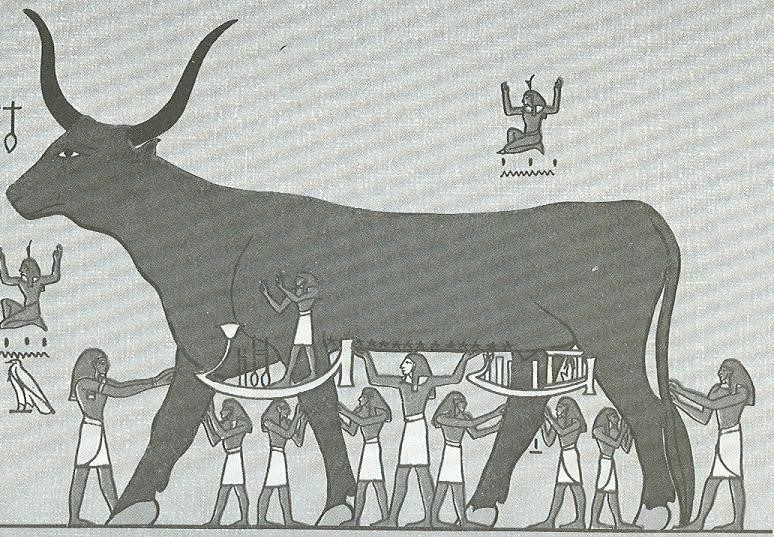 Nut, goddess of the sky, is represented as a huge cow overarching the earth. Courtesy of Wikimedia Commons.
All other Egyptian depictions of deities and the divine cosmos are best understood with the same regard for sacred metaphor and symbolic representation. The same approach must be used when seeking to understand religious texts. For example, the role of metaphor is particularly obvious in the following mortuary text from the Egyptian Coffin Texts:
My head is a vulture,
That I might ascend and rise to the sky;
The sides of my head are the stars of the god,
That I might ascend and rise to the sky;
My pate is [. . .] and Nun,
That I might ascend and rise to the sky;
My face is Wepwawet,
That I might ascend and rise to the sky;
My eyes are the great ones at the head of the bas of Heliopolis,
That I might ascend and rise to the sky;
My nose is Thoth,
That I might ascend and rise to the sky. . . . [38]
This description does not suppose that the deceased’s head was actually turned into a vulture (the symbol of the goddess Nekhebet) or his nose into the god Thoth. Rather, this language was a highly concrete way of expressing his transformation after death into a god.
Such use of sacred metaphor was not limited to Egypt. The art historian Mehmet-Ali Ataç has characterized ancient Near Eastern art as “transcending specific events or clearly defined ritual activities in order to operate in a more fundamental semantic that has a primarily philosophical component.” He describes the simple motif of water flowing from a vase as having “cosmological implications” and as “perhaps one of the most deeply mystical symbols of ancient Mesopotamia.”[39]
In applying the term metaphor to myths, however, it cannot be stressed highly enough that we are not referring to mere metaphor in a literary sense. The Greek bard Homer is well known for his frequent use of extended epic similes; for instance, he describes Trojan warriors as “swarming [around Odysseus] like blood-red mountain jackals around a stricken horned stag that a man has shot with an arrow from his bowstring.”[40] These are brilliant literary devices designed to bring the action of the epic poem to life, dramatically and visually. Metaphor in the context of myth, however, had a much deeper purpose. According to the Egyptologist Jan Assmann, “The theme of myth was . . . the essence of reality. . . . The stories they tell about deities are supposed to bring to light the meaningful structure of reality.”[41] The Old Testament scholar John H. Walton has observed:
We should ask the question of why a culture should consider stories about the gods to be important. A Babylonian would consider the myths to be important because they offered explanations of how the world functioned. The inhabitants of Mesopotamia would not have considered their myths to be fanciful or fictional, though they would not have considered a myth the same as a court chronicle. . . . The gods were real to the ancients, and their stories gave account of the gods and the world in ways that were important for understanding the world and life in general.[42]
What I have said about myths was equally true about ancient ritual. For us today, the term ritual has equally as negative a connotation as myth—repetitive actions devoid of real meaning, as used in the phrase “mere ritual.” For ancient peoples the idea of ritual was exactly the opposite. Rituals were actions packed with meaning and significance and were closely related to myths. The exact relationship between ritual and myth has long been debated; one common theory is that myths and rituals were somehow coordinated—that myth served as a narrative intended to accompany specific rituals. I will not take the time to argue that specific point here except to stress that many rituals were, at their core, reenactments of acts believed to be performed by the gods in primordial time—that is, the time before, during, or just following the Creation. But they were full of symbols and metaphors; they were not intended to be taken as objective, blow-by-blow reenactments.[43]
In the eyes of the ancients, ritual could actually be constitutive of reality in a metaphysical sense.[44] In Egypt the embalming process not only consisted of physical procedures, such as filling the corpse with oils and other substances to make the tissues supple again, but included the recitation of sacred words intended to restore the deceased to life and full vitality. For example:
Your eyes are given you so as to see,
your ears, so as to hear [what] is said,
your mouth, so as to speak,
and your legs, so as to walk.
Your hands and arms are to serve you.
May your flesh be firm, and your vessels be well.
May you have enjoyment of all your limbs!
May you have control of your limbs, they being all present and intact,
and there being no evil in you.[45]
As Jan Assmann has observed, “The Egyptian concept of the world rested on an unusually firm belief in the binding power of symbols”;[46] one could add to this a belief in the binding power of words.[47]
Both Egypt and Mesopotamia practiced rituals designed to, in effect, bring wooden cult images to life. Contrary to the Jewish (and, later, Christian) mockery of such objects as “dumb idols,” as though the pagans did not realize that their images were made by human craftsmen of wood and stone,[48] the Mesopotamians administered the ritual known as mīs pî (“washing of the mouth”) to cult statues before they were placed in a temple. The rite not only consecrated the image for use in a temple but actually animated it; once its mouth and eyes had been ritually opened, it was thought to be inhabited by the god or goddess and could thereafter receive the typical daily cult. In Egypt, although the details of the rite known as the “opening of the mouth” (wpt-r) were somewhat different, the purpose was exactly the same.[49]
This concept is challenging for modern people to grasp, but one way of thinking about it is to compare it to the ritual of swearing in a new president. That ceremony does not merely install the winner of an election in a new office. Once sworn in, the president-elect becomes a new person (temporarily, for the term of office) in the sense that he or she possesses infinitely greater power—real, effective power—than he or she did a few moments before, including the power to unleash armies and perhaps nuclear weapons. Perhaps a better analogy is the Roman Catholic doctrine of the Eucharist. According to the doctrine known as transubstantiation, when a priest pronounces the eucharistic prayer over the host (i.e., bread or wafer) and the wine, they become transformed into the body and blood of Christ, even though their outward characteristics appear unchanged. In a similar sense, as we shall see, a man (or, on very rare occasion, a woman!) who was crowned as pharaoh in a sense became one of the gods. The same was true for kings in Mesopotamia, particularly in Assyria, though in a slightly more restrained fashion.[50] For people of the ancient world, power was conceived not only in practical but more importantly in metaphysical terms.
Jon D. Levenson, Harvard professor of the Hebrew Bible, discusses a variety of ways in which the people of Israel participated in the mythic mindset. Some of these will be discussed in the next three chapters in the appropriate sections, but we can mention here the centrality of the temple in Israelite culture. The Jerusalem temple, he maintains, was not conceived literally as the house of deity, limiting God’s presence to one locality. Rather, it served as a “model or representation of the world” in its essence, depicting “the theology of creation rendered in architecture and glyptic craftsmanship. In the Temple, God relates simultaneously to the entire cosmos, for the Temple . . . is a microcosm of which the world itself is the macrocosm.”[51] On another level, the earthly temple was a metaphor for the heavenly temple, God’s true dwelling place.[52]
Cornelius Loew described what he called the “cosmological conviction” of the ancient world (specifically, as invented by the Sumerians) as consisting of at least five facets:
- There is a cosmic order that permeates every level of reality;
- This cosmic order is the divine society of the gods;
- The structure and dynamics of this society can be discerned in the movements and patterned juxtapositions of the heavenly bodies;
- Human society should be a microcosm of the divine society—it should be organized and governed like the macrocosm; and
- The chief responsibility of priests and kings is to attune human order to the divine order.[53]
These five elements apply reasonably well to the Israelite worldview, with only a few tweaks to accommodate their monotheism. Since the God of Israel was perceived as being not only solitary but all-powerful, there was less emphasis on the cosmic order and the divine society and greater stress on the world order specifically laid down and commanded by Yahweh. But equally with their pagan neighbors, the Israelites saw correlations between the macrocosm of heaven and the microcosm of the human world. The very idea of the existence of such correspondences is one of the most pervasive assumptions that distinguish the entire premodern world, up to and including the late medieval world, from the modern.
Notes
[1] What I am describing as the “sacral” view of the world is akin to what Morris Berman has described as the “enchanted” view of nature that existed up to the eve of the Scientific Revolution: “Rocks, trees, rivers, and clouds were all seen as wondrous, alive, and human beings felt at home in this environment. The cosmos, in short was a place of belonging. A member of this cosmos was not an alienated observer of it but a direct participant in its drama. His personal destiny was bound up with its destiny, and this relationship gave meaning to his life.” The Reenchantment of the World (Ithaca: Cornell University Press, 1981), 16. In contrast, the modern view leads to a feeling of separateness and alienation from the world in which humankind lives.
[2] See Thomas S. Kuhn, The Copernican Revolution: Planetary Astronomy in the Development of Western Thought (Cambridge, MA: Harvard University Press, 1957), 94–98:“We like to forget that many of the concepts in which we believe were painfully drummed into us in our youth. We too easily take them as natural and indubitable products of our own unaided perceptions, dismissing concepts different from our own as errors, rooted in ignorance or stupidity and perpetuated by blind obedience to authority. Our own education stands between us and the past.” For some basic bibliography on the rise of the modern worldview, see E. A. Burtt, The Metaphysical Foundations of Modern Science, 2nd ed. (New York: Doubleday, 1932); Charles Taylor, A Secular Age (Cambridge, MA: Belknap, 2007); Michael Allen Gillespie, The Theological Origins of Modernity (Chicago: University of Chicago Press, 2009); and Marcel Gauchet, The Disenchantment of the World: A Political History of Religion, trans. Oscar Burge (Princeton: Princeton University Press, 1997). For a convenient summary of this transformation of worldview, see Richard Tarnas, The Passion of the Western Mind: Understanding the Ideas That Have Shaped Our World View (New York: Ballantine, 1991), 248–323. From the perspective of government and the decline of the archaic institution of sacral kingship, see Francis Oakley, Kingship: The Politics of Enchantment (Malden, MA: Blackwell, 2006). His masterful trilogy, The Emergence of Western Political Thought in the Latin Middle Ages, is, in large part, an account of how “the sacral dimension of kingship . . . gradually leached out of the European cultural subsoil,” so that while for much of the medieval age (as in antiquity) the secular and the sacred were almost inextricably intertwined, they were substantially separated by the age of Hobbes and Newton (The Watershed of Modern Politics: Law, Virtue, Kingship, and Consent (1300–1650) [New Haven, CT: Yale University Press, 2015], xiii).
[3] See Rob Iliffe, Priest of Nature: The Religious Worlds of Isaac Newton (Oxford: Oxford University Press, 2017), 21–22. See also Rob Iliffe, “The Religion of Isaac Newton,” in The Cambridge Companion to Newton, ed. Robert Iliffe and George E. Smith, 2nd ed. (Cambridge: Cambridge University Press, 2016), 485–523. On Newton’s alchemical interests, see Betty Jo Teeter Dobbs, The Janus Faces of Genius: The Role of Alchemy in Newton’s Thought (Cambridge: Cambridge University Press, 1991); and William R. Newman, “A Preliminary Reassessment of Newton’s Alchemy,” in Cambridge Companion to Newton, 454–84. The physicist Marcelo Gleiser has described Isaac Newton’s life as “one long search for God.” See https://
Mathematics was only one avenue to Truth, and though mathematics was a powerful tool in his hands, Newton’s methodology was much broader than that implied by the creation of mathematical models, and Newton’s goal was incomparably more vast than the discovery of the “mathematical principles of natural philosophy.” Newton wished to penetrate to the divine principles beyond the veil of nature, and beyond the veils of human record and received revelation as well. His goal was the knowledge of God, and for achieving that goal he marshaled the evidence from every source available to him: mathematics, experiment, observation, reason, revelation, historical record, myth, the tattered remnants of ancient wisdom. (Janus Faces of Genius, 7)
However, despite Newton’s own religious proclivities, it was the mathematical and mechanical aspect of his thought regarding nature that dominated the thinking of his successors.
[4] John Maynard Keynes, the eminent twentieth-century economist who acquired Newton’s alchemical papers at bargain-basement prices (because at the time they were viewed as unimportant and unrepresentative of Newton’s best work), wrote: “Newton was not the first of the age of reason. He was the last of the magicians, the last of the Babylonians and Sumerians, the last great mind which looked out on the visible and intellectual world with the same eyes as those who began to build our intellectual inheritance rather less than 10,000 years ago.” “Newton, the Man” (lecture, Royal Society of London, 1946, https://
[5] W. T. Stace, in Religion and the Modern Mind (Philadelphia: J. B. Lippincott, 1960), argues at length that the presence of the idea of purpose in the world, which was lost (or abandoned) following the Scientific Revolution, is the fundamental dividing line between the archaic and modern worlds. His meaning of purpose, or teleology, is best illustrated by the creation account in Genesis 1. God does not simply create, but he creates for specific reasons. He creates light, dry land, plants, animals, and so on because they are good, and, specifically, he creates the lights in the firmament “to separate the day from the night” and “to give light upon the earth.” All that he creates he does for the benefit, or good, of mankind. Under the scientific paradigm of creation, in contrast, there is no purpose whatsoever, merely the working out of impersonal laws of nature. Plato, in his dialogue Phaedo (97b–99d), criticizes the naturalist paradigm of Anaxagoras and a few other early scientist-philosophers when he relates how disappointed he was as a young man to find out that Anaxagoras offered only mechanical explanations of life—explanations that had nothing to do with “mind” or “the good”: “I might compare him to a person who began by maintaining generally that mind is the cause of the actions of Socrates, but who, when he endeavoured to explain the causes of my several actions in detail, went on to show that I sit here [in prison, not because of anyone’s conscious intentions but merely] because my body is made up of bones and muscles; and the bones, as he would say, are hard and have joints which divide them, and the muscles are elastic . . . and as the bones are lifted at their joints by the contraction or relaxation of the muscles, I am able to bend my limbs, and this is why I am sitting here in a curved posture . . . , forgetting to mention the true cause, which is, that the Athenians have thought fit to condemn me” (following the translation in Stace, 28–29). In other words, the naturalistic perspective came up with only superficial, mechanical explanations of why things are as they are and ignored the deeper reasons for things, which involved conscious intentions and purposes.
[6] See Gregory Steven Dundas, “Kingship, Democracy, and the Message of the Book of Mormon,” BYU Studies Quarterly 56, no. 2 (2017).
[7] Richard L. Bushman points out in his essay “The Book of Mormon and the American Revolution” how easy it is to read Americanist assumptions into the Book of Mormon. He observes that the headnote to the book of Mosiah in the standard edition before 1981 claimed that Mosiah in chapter 29 was recommending “a representative form of government,” even though the judgeship had nothing to do with political representation. In Book of Mormon Authorship: New Light on Ancient Origins, ed. Noel B. Reynolds (Provo, UT: FARMS, 1982), 210n21.
[8] Readers are encouraged to consult the works of Mircea Eliade, an expert in the religions of India whose comparative writings make use of many examples of archaic thinking from Far Eastern traditions.
[9] See Oakley, Kingship, 10–44.
[10] Mircea Eliade, The Sacred and the Profane: The Nature of Religion (San Diego: Harcourt, 1959), 17.
[11] See the discussion in Mehmet-Ali Ataç, Art and Immortality in the Ancient Near East (Cambridge: Cambridge University Press, 2018), 15–18. John H. Walton discusses in detail what he refers to as a common cognitive environment in the ancient Near East, which very much included the Israelites. See his Genesis 1 as Ancient Cosmology (Winona Lake, IN: Eisenbrauns, 2011), 23–121.
[12] The question of how distinctive Israelite culture was vis-à-vis neighboring cultures has been discussed at great length for many decades. John H. Walton, in Genesis 1 as Ancient Cosmology, 193–99, conveniently outlines the similarities and differences between the Israelites and their Near Eastern neighbors in the area of cosmology. See also C. L. Crouch, War and Ethics in the Ancient Near East: Military Violence in Light of Cosmology and History (Berlin: De Gruyter, 2009), 2.
[13] See John M. Lundquist, “What Is a Temple? A Preliminary Typology,” in Temples of the Ancient World: Ritual and Symbolism, ed. Donald W. Parry (Salt Lake City: Deseret Book; Provo, UT: FARMS, 1994), 83–117; and Lundquist, “The Common Temple Ideology of the Ancient Near East,” in The Temple in Antiquity: Ancient Records and Modern Perspectives, ed. Truman G. Madsen (Provo, UT: Religious Studies Center, Brigham Young University, 1984), 53–76.
[14] John H. Walton, Ancient Near Eastern Thought and the Old Testament: Introducing the Conceptual World of the Hebrew Bible, 2nd ed. (Grand Rapids, MI: Baker Academic, 2006), 24.
[15] Regarding the connections between Greece and the Near East, see Walter Burkert, The Orientalizing Revolution: Near Eastern Influence on Greek Culture in the Early Archaic Age, trans. Margaret E. Pinder and Walter Burkert (Cambridge, MA: Harvard University Press, 1992); Burkert, Babylon, Memphis, Persepolis: Eastern Contexts of Greek Culture (Cambridge, MA: Harvard University Press, 2004); Carolina López-Ruiz, When the Gods Were Born: Greek Cosmogonies and the Near East (Cambridge, MA: Harvard University Press, 2010); M. L. West, Early Greek Philosophy and the Orient (Oxford: Oxford University Press, 1971); and Johannes Haubold, Greece and Mesopotamia: Dialogues in Literature (Cambridge: Cambridge University Press, 2013). Kurt A. Raaflaub refers to a “cultural koinē,” or common “pool of ideas and knowledge[,] that emerged from intense interaction among various cultures in the ancient Mediterranean.” See his “Early Greek Political Thought in Its Mediterranean Context,” in A Companion to Greek and Roman Political Thought, ed. Ryan K. Balot (Malden, MA: Blackwell, 2013), 38; see also his “Influence, Adaptation, and Interaction: Near Eastern and Early Greek Political Thought,” http://
[16] See the remarks by Henri Frankfort on the desire of the Egyptians to “put into the conceptual form of language notions which cannot be entirely rationalized—‘truths’ which are sensed rather than known.” Kingship and the Gods: A Study of Ancient Near Eastern Religion as the Integration of Society and Nature (Chicago: University of Chicago Press, 1948), 41. For a summary discussion of how Greek civilization was derivative of more ancient cultures yet came to transcend them in many ways, see John Boardman, Jasper Griffin, and Oswyn Murray, eds., The Oxford History of the Classical World (Oxford: Oxford University Press, 1986), 4–5.
[17] Mircea Eliade, in Myth and Reality (New York: Harper & Row, 1963), 162–81, discusses some of the ways in which ancient cosmic belief survived the coming of Christianity. On the awkwardness of the medieval synthesis, see Arthur O. Lovejoy, The Great Chain of Being: A Study of the History of an Idea (Cambridge, MA: Harvard University Press, 1936). See also the remarks in Jürgen Moltmann, The Trinity and the Kingdom of God: The Doctrine of God, trans. Margaret Kohl (London: SCM, 1981), 22.
[18] See Peter Harrison’s description of the new meaning that crept into the notion of “religion” during the early modern age. Religion “came to denote something like ‘subscribing to a particular set of beliefs.’ Protestant religion in particular emphasized the importance of the acquisition of knowledge, for redemption was to be attained through the instrument of ‘saving knowledge.’ The mainspring of religion thus ceased to be the performance of ritual acts presided over by an ecclesiastical hierarchy—baptism, confirmation, penance, the mass. Instead, religion came to be identified with systems of belief. Various ‘religions’ were thus distinguished by the beliefs of their adherents.” The Bible, Protestantism, and the Rise of Natural Science (Cambridge: Cambridge University Press, 1999), 272–73.
[19] See Jan Assmann, The Search for God in Ancient Egypt (Ithaca, NY: Cornell University Press, 2001), 1; and William G. Dever, Did God Have a Wife? Archaeology and Folk Religion in Ancient Israel (Grand Rapids, MI: Eerdmans, 2005), 3.
[20] This meaning began to shift in the time of the early Christians toward a more modern conception as they began to differentiate their beliefs and practices from the traditional Roman ones. See James B. Rives, Religion in the Roman Empire (Malden, MA: Blackwell, 2007), 14.
[21] Henri Frankfort and H. A. Frankfort, “Introduction: Myth and Reality,” in Henri Frankfort et al., The Intellectual Adventure of Ancient Man (1946; repr., Chicago: University of Chicago Press, 1977), 366–67.
[22] C. J. Bleeker, Egyptian Festivals: Enactments of Religious Renewal (Leiden: Brill, 1967), 6–7.
[23] Stephen Toulmin and June Goodfield, The Discovery of Time (Chicago: University of Chicago Press, 1965), 31.
[24] Frankfort, Kingship and the Gods, 3 (emphasis added).
[25] R. M. Ogilvie, The Romans and Their Gods in the Age of Augustus (New York: W. W. Norton, 1969), 10.
[26] See Samuel Dill, Roman Society from Nero to Marcus Aurelius (New York: Meridian, 1956), 269–86.
[27] See Frankfort and Frankfort, “Introduction: Myth and Reality,” 3–30; and Nicolas Wyatt, “The Mythic Mind,” in The Mythic Mind: Essays on Cosmology and Religion in Ugaritic and Old Testament Literature (London: Equinox, 2005), 173. Wyatt prefers the word mythic over mythopoeic or mythopoetic because the latter terms “carry a historical burden, which is in part the supposition that such thinking is primitive.”
[28] See, for example, Charles Segal, “Ovid’s ‘Metamorphoses’: Greek Myth in Augustan Rome,” Studies in Philology 68, no. 4 (October 1971): 371–394.
[29] Robin Waterfield, ed., The First Philosophers: The Presocratics and the Sophists (Oxford: Oxford University Press, 2000), 27.
[30] According to John Van Seters, a myth is “a traditional story about events in which the god or gods are the primary actors, and the action takes place outside of historical time. In addition, myth contains some structure of meaning that is concerned with the deep problems of life and offers explanations for the way things are.” Prologue to History: The Yahwist as Historian in Genesis (Louisville, KY: Westminster John Knox Press, 1992), 25.
[31] See Geraldine Pinch, Egyptian Myth: A Very Short Introduction (Oxford: Oxford University Press, 2004), 2, 48.
[32] R. T. Rundle Clark, Myth and Symbol in Ancient Egypt (London: Thames and Hudson, 1959), 36. See Vincent Arieh Tobin, Theological Principles of Egyptian Religion (New York: Peter Lang, 1989), 61. See the introduction to the present volume, note 22, on the contrast between the scientific mindset, which tolerates only a single answer to a given problem, and the predilection for multiple approaches to reality in the mythic mindset.
[33] Wyatt, “Mythic Mind,” 155.
[34] See James P. Allen, The Art of Medicine in Ancient Egypt (New York: The Metropolitan Museum of Art, 2005), 70–71. See the discussion in Kurt A. Raaflaub, ed., The Adventure of the Human Intellect: Self, Society, and the Divine in Ancient World Cultures (Malden, MA: Wiley-Blackwell, 2016), 57–58.
[35] See Samuel Noah Kramer, History Begins at Sumer: Thirty-Nine Firsts in Recorded History, 3rd ed. (Philadelphia: University of Pennsylvania Press, 1981).
[36] See, for example, Edward Grant’s discussion of Aristotle in A History of Natural Philosophy: From the Ancient World to the Nineteenth Century (Cambridge: Cambridge University Press, 2007), 33–42; Françoise Dunand and Christiane Zivie-Coche, Gods and Men in Egypt: 3000 BCE to 395 CE, trans. David Lorton (Ithaca: Cornell University Press, 2004), 29; and Wyatt, “Mythic Mind,” 155.
[37] Erik Hornung, Conceptions of God in Ancient Egypt: The One and the Many, trans. John Baines (Ithaca: Cornell University Press, 1982), 113. Stephen Quirke discusses the basis for the use of animals in depictions of the gods in Ancient Egyptian Religion (London: British Museum Press, 1992), 16. See also Tobin, Theological Principles, 36. Hugh Nibley discusses the canons of Egyptian art in An Approach to the Book of Abraham (Salt Lake City: Deseret Book; Provo, UT: FARMS, 2009), 158–68, and observes that for the Egyptian “only the permanent and the universal interested him, all else being mere passing impressions—a trick, a game, an illusion” (167).
[38] Assmann, Search for God, 93.
[39] Ataç, Art and Immortality, 48, 56–57.
[40]Iliad 11.474–76 (Oxford: Oxford University Press, 2011), 177–78.
[41] Assmann, Search for God, 112.
[42] Walton, Ancient Near Eastern Thought, 43.
[43] Dunand and Zivie-Coche, Gods and Men in Egypt, 95–96; Tobin, Theological Principles, 28–31.
[44] Irene J. Winter, “‘Idols of the King’: Royal Images as Recipients of Ritual Action in Ancient Mesopotamia,” Journal of Ritual Studies 6, no. 1 (Winter 1992): 13–42. Tobin, in Theological Principles, 28, observes that the rituals of royal succession and coronation “were more than mere rituals of accession. It was through these rites that the new ruler was enabled to take his proper place in the divinely ordained system of nature and the political world, for these same rites functioned actually to create the divine nature of the monarch” (emphasis added). See further pp. 30–31; and Jan Assmann, The Mind of Egypt: History and Meaning in the Time of the Pharaohs (Cambridge, MA: Harvard University Press, 2003), 70–73.
[45] Jan Assmann, Death and Salvation in Ancient Egypt, trans. David Lorton (Ithaca: Cornell University Press, 2005), 34. See also Nicolas Wyatt, Space and Time in the Religious Life of the Near East (Sheffield: Sheffield Academic, 2001), 38.
[46] Assmann, Death and Salvation, 34.
[47] See Dunand and Zivie-Coche, Gods and Men in Egypt, 56.
[48] See, for example, Psalms 115:4–5; Isaiah 44:9–20; Acts 19:23–27; Apocalypse of Abraham 1–7; and Letter of Jeremiah.
[49] For the Mesopotamian ritual, see Eckart Frahm, “Rising Suns and Falling Stars: Assyrian Kings and the Cosmos,” in Experiencing Power, Generating Authority: Cosmos, Politics, and the Ideology of Kingship in Ancient Egypt and Mesopotamia, ed. Jane A. Hill, Philip Jones, and Antonio J. Morales (Philadelphia: University of Pennsylvania Museum of Archaeology and Anthropology, 2013), 104; more fully, C. B. F. Walker and Michael B. Dick, The Induction of the Cult Image in Ancient Mesopotamia: The Mesopotamian Mīs Pî Ritual (Helsinki: University of Helsinki Press, 2001). For Egypt, see Assmann, Death and Salvation, 310–29; see also Hugh Nibley, The Message of the Joseph Smith Papyri: An Egyptian Endowment, 2nd ed. (Salt Lake City: Deseret Book; Provo, UT: FARMS, 2005), 164–82; and Michael B. Dick, ed., Born in Heaven, Made on Earth: The Making of the Cult Image in the Ancient Near East (Winona Lake, IN: Eisenbrauns, 1999).
[50] See Frahm, “Rising Suns and Falling Stars,” 97–120.
[51] Jon D. Levenson, Sinai and Zion: An Entry into the Jewish Bible (New York: HarperCollins, 1985), 138–39.
[52] See Levenson, Sinai and Zion, 140.
[53] Cornelius Loew, Myth, Sacred History, and Philosophy: The Pre-Christian Religious Heritage of the West (New York: Harcourt, Brace & World, 1967), 13.
