
 menu icon in the top, right corner of the screen.
 icon above to close this box.
 icon at the bottom of the screen below the browser—if you don't see it, swipe up to unhide it.
The Loving Christ
John Hilton III
John Hilton III, "The Loving Christ," in Learn of Me: History and Teachings of the New Testament, ed. John Hilton III and Nicholas J. Frederick (Provo, UT: Religious Studies Center, Brigham Young University; Salt Lake City: Deseret Book), 177‒94.
John Hilton III is a professor of ancient scripture at Brigham Young University.
When some colleagues and I surveyed almost a thousand Latter-day Saint adults and asked them this question, 88 percent said, “in the Garden of Gethsemane,” and 12 percent said, “on the cross at Calvary.” One might think, “That is an unfair question—people were forced to choose between only two options.” To remedy this situation, my colleagues and I asked 792 Latter-day Saint adults (who did not participate in the first survey) the same question and gave them a third possible response: “equally in Gethsemane and Calvary.” But even with this third option, 58 percent—still a strong majority—selected Gethsemane only.[1]
This indicates a tendency among some Latter-day Saint adults to give priority to the atoning significance of Gethsemane over that of Calvary. In this essay, I will show how the scriptures, Joseph Smith, Church leaders collectively, the hymns, and the Savior himself more frequently talk about Christ’s Crucifixion than they do his sufferings in Gethsemane. I will then provide two reasons why studying the Savior’s sacrifice on Calvary can help us and share two examples of how focusing on Christ’s Crucifixion can strengthen us spiritually. Before I continue, let me be clear that Gethsemane and Golgotha are both vital aspects of Christ’s Atonement. They are not in competition with each other. My point is that some Latter-day Saints underemphasize the importance of Christ’s Crucifixion. As we more fully embrace scriptural and prophetic teachings about the Savior’s death, we will draw closer to him.
When I learned that Latter-day Saints heavily emphasized Gethsemane over Calvary, I was curious. Why was there so much emphasis on Gethsemane? Did it come from the scriptures? Across the standard works, there are two passages of scripture that talk about Jesus Christ suffering for our sins in Gethsemane.[2] In contrast, there are fifty-three passages that talk about Jesus Christ dying for our sins: twenty-one in the New Testament, eighteen in the Book of Mormon, twelve in the Doctrine and Covenants, and two in the Pearl of Great Price.[3] For example, at the beginning of the Book of Mormon, Nephi recounts, “I, Nephi, saw that [Christ] was lifted up upon the cross and slain for the sins of the world” (1 Nephi 11:33).
The emphasis on Calvary also appears in the noncanonized writings and sermons of Joseph Smith, in which he only referred to Gethsemane one time. In this instance, he does not discuss its atoning significance; rather, he uses it as an example of Jesus doing the will of his Father. In contrast, Joseph Smith spoke or wrote about Christ’s Crucifixion on thirty-four occasions. Nine of these are explicit statements that Jesus Christ was crucified for the sins of the world.[4] For example, in his 1832 account of the First Vision, Joseph wrote that Jesus said to him, “I am the Lord of glory. I was crucified for the world, that all those who believe on my name may have eternal life.”[5] On another occasion, Joseph Smith said, “The fundamental principles of our religion are the testimony of the Apostles and Prophets, concerning Jesus Christ, that He died, was buried, and rose again the third day, and ascended into heaven; and all other things which pertain to our religion are only appendages to it.”[6]
 The Crucifixion, by Harry Anderson. © Intellectual Reserve, Inc.
A focus on Calvary also exists when looking at the teachings of Church leaders from 1850 to the present. Collectively, for each one statement from Church leaders about Christ suffering for our sins, there are more than five about him dying for our sins. If we look only at the words of Church Presidents, the gap widens—for every one statement from a Church President about Christ suffering for our sins in Gethsemane, there are more than twelve about him dying for our sins on the cross.[7]
The hymns likewise share this emphasis. A study of four Latter-day Saint hymnbooks—the three earliest and the current one—shows that less than 1 percent of the hymns refer to Gethsemane, while 16 percent refer to Calvary.[8] For example, a popular sacrament hymn states, “We’ll sing all hail to Jesus’ name, / And praise and honor give / To him who bled on Calvary’s hill / And died that we might live.”[9]
To me, what is most significant is the Savior’s own emphasis on his gift from Golgotha. In scripture, Christ personally refers to his experience in Gethsemane on one powerful occasion. In contrast, he refers to his death more than twenty times.[10] When Jesus Christ defines his gospel, his Crucifixion is front and center (see 3 Nephi 27:14).
Thus far, I have shown a juxtaposition between what the scriptures, Joseph Smith, later Church leaders, hymns, and the Savior himself have taught and emphasized as far as the atoning significance of Calvary relative to what the average Latter-day Saint adult seems to believe. Before continuing, let me be very clear—the events that took place in Gethsemane are a significant part of the Savior’s Atonement; I am certainly not recommending we de-emphasize them. Many Latter-day Saints have focused primarily on Christ’s sufferings in Gethsemane and not thought as often about his death on the cross. I’m not suggesting we reverse this error by exclusively prioritizing Golgotha and ignoring Gethsemane. Indeed, we should pay more attention to every facet of Christ’s life, including his sermons, miracles, and actions.
At the same time, I have found that for many Latter-day Saints, an in-depth study of Christ’s Crucifixion is particularly profitable because, in underestimating its significance, some of us have not studied it as carefully as we could. President James E. Faust taught, “Any increase in our understanding of [Christ’s] atoning sacrifice draws us closer to Him.”[11] Better understanding any aspect of Christ’s Atonement—including, and perhaps especially his Crucifixion—can deepen our relationship with the Savior.[12]
 1852 European edition of the Doctrine and Covenants. Photo courtesy of Megan Cutler, used with permission; edition found in L. Tom Perry Special Collections, Harold B. Lee Library, Brigham Young University, Provo, Utah.
At this point, many readers are likely wondering, “If there has been such an emphasis on Christ’s Crucifixion in the scriptures and elsewhere, why do so many Latter-day Saints seem to prioritize Gethsemane when it comes to the Savior atoning for our sins?” In trying to answer this question, incorrect speculations have been proposed. For example, some have suggested that Christ atoned for our sins and overcame spiritual death only in Gethsemane and then separately conquered physical death on the cross. Elder Gerald N. Lund called this a “doctrinal error” and wrote, “Nowhere in the scriptures do we find indications that the cross alone overcame physical death or that the Garden alone overcame spiritual death.”[13]
A related doctrinal error comes if we minimize Christ’s experience on the cross by saying, “What Christ experienced on the cross was no different than the suffering experienced by thousands of others who were crucified.” That statement is false. The Savior’s experience on the cross was completely different from other victims of crucifixion. Jesus did not just die—he “died for our sins” (1 Corinthians 15:3); his Crucifixion had atoning efficacy. President Russell M. Nelson taught that the suffering Christ experienced in Gethsemane was “intensified as He was cruelly crucified on Calvary’s cross.”[14]
Although the space available does not afford a complete answer as to why there is a disconnect between the beliefs of average Church members and collective Church teachings, possible reasons for an emphasis on Gethsemane by Church members include the following: (1) Latter-day Saints have a unique doctrinal understanding of the importance of Gethsemane and so have foregrounded it. (2) A handful of statements from Church leaders from several decades ago prioritized Gethsemane over Calvary. Some of these statements were published in past (but not current) Church curriculum materials, perhaps giving them outsized importance even though they are out of the mainstream of prophetic teachings.[15] (3) Perhaps the most significant reason Church members de-emphasize the atoning significance of Calvary is the lack of Crucifixion artwork and cross iconography in our church buildings.
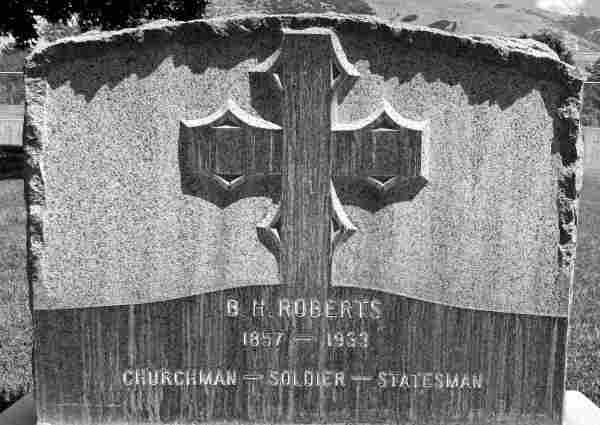 The grave of B.H. Roberts. Courtesy of Megan Cutler, used with permission.


Brigham Young's daugher, Nabby Young Clawson (top), and his wife, Amelia Folsom Young, wearing crosses. © Utah State Historical Society.
While not the focus of this essay, the scarcity of Crucifixion imagery merits attention. When Latter-day Saints are asked why their church does not display crosses, they tend to paraphrase words stated by President Gordon B. Hinckley in 1975. In response to a minister’s question about the lack of a cross in a temple, President Hinckley responded, “I do not wish to give offense to any of my Christian brethren who use the cross on the steeples of their cathedrals and at the altars of their chapels, who wear it on their vestments, and imprint it on their books and other literature. But for us, the cross is the symbol of the dying Christ, while our message is a declaration of the living Christ. . . . The lives of our people must become the only meaningful expression of our faith and, in fact, therefore, the symbol of our worship.”[16] It is important to note that in this same talk President Hinckley also referred to “the cross on which [Christ] hung and died,” and said, “We cannot forget that. We must never forget it, for here our Savior, our Redeemer, the Son of God, gave Himself a vicarious sacrifice for each of us.”[17] Thus, while de-emphasizing the Church’s use of the cross as an institutional symbol, President Hinckley emphasized the atoning significance of Calvary.
Symbols are multifaceted: they permit, even invite, layers of meaning. A cursory look at Church history indicates that the symbol of the cross has been viewed in different ways across the decades. For example, multiple nineteenth-century Latter-day Saints posed for formal photographs while wearing cross jewelry, including a wife and a daughter of Brigham Young. A cross appears on the 1852 European edition of the Doctrine and Covenants, and a floral cross was present at the funeral of John Taylor. In addition, a proposal for a cross to be placed on Ensign Peak was approved by President Joseph F. Smith, and a large cross is on the gravestone of Elder B. H. Roberts of the Seventy.[18] Consider a few quotes that illustrate the diversity with which the cross has been viewed by Latter-day Saints:
- Eliza R. Snow referred to “the triumphs of the cross.”[19]
- A 1915 editorial published in the Young Woman’s Journal stated, “The cross . . . has become a symbol of love and salvation.”[20]
- A 1933 editorial in the Relief Society Magazine said that “Christ changed the cross into a symbol of Glory.”[21]
- Elder Edward Dube referred to seeing an image of Christ’s Crucifixion as one of the “defining moments” of his life.[22]
- Elder F. Enzio Busche said that looking at a crucifix helped him develop “a tremendous hope” in the redeeming power of Jesus Christ.[23]
Many similar examples could be provided. My point is that throughout the history of Christianity and even within the restored Church, faithful believers have had differing perspectives on how the cross should be used to represent Christ’s atoning sacrifice. Regardless of how one views the cross as a symbol, we should focus on the doctrinal reality that Jesus Christ was, in his own words, “crucified for the sins of the world” (Doctrine and Covenants 53:2).
Thus far, I have demonstrated the scriptural emphasis on Christ’s Crucifixion and provided a few possible reasons why church members have tended to focus more on Gethsemane. In the remainder of this essay, I will provide two reasons why studying Christ’s Crucifixion can be beneficial and then share two examples of how focusing on Christ’s Crucifixion can strengthen us spiritually.
Reason 1: Connecting with the Loving Christ
First, studying Christ’s Crucifixion can help us connect with the loving Christ. Some Church members focus exclusively on the living Christ, and of course it is the living Christ that we worship. At the same time, we also worship a loving Christ, and the scriptures repeatedly teach that both Heavenly Father and Jesus Christ manifested their love for us through the Savior’s death. For example, Paul declared, “God commendeth his love toward us, in that, while we were yet sinners, Christ died for us” (Romans 5:8; see also John 10:17; 1 John 3:16; 4:9–10). Jesus Christ himself called the Crucifixion his greatest act of love, saying, “Greater love hath no man than this, that a man lay down his life for his friends” (John 15:13; see also 2 Nephi 26:24; Ether 12:33).
Latter-day Saints throughout the decades have taught this same idea. For example, in 1910 Henry W. Naisbitt wrote, “When I think of the cross, the glorified cross, / On earth as in heaven above, / Resplendent forever undimmed it shall shine, / The eloquent symbol of love!”[24] In 1935 Grace Jacobsen poetically penned, “See the cross and bleeding feet . . . / Hear the message, tender sweet, / Hear him calling, gently calling / All mankind to Him above, / For He gave His life a ransom, / From the depths of perfect love.”[25] Marguerite J. Griffin, writing in 1946, taught that Jesus offered his life “on the cross because of his great love for you and me.”[26] More recently, Elder Dale G. Renlund stated, “Jesus Christ . . . loves and cares for us. He knows us and laid down His life for His sheep.”[27]
Do you and I want to feel more love from Jesus?
Do you and I want to feel more love for Jesus?
Then let us study the Crucifixion—the event Christ personally defined as his greatest act of love. By better understanding the Savior’s death, we will feel his love in greater abundance and be increasingly able to share that love with others.
Although we believe in the living Christ, we can also be strengthened by learning more about his sacrifice and death. Jennifer Lane, former dean of the faculty of Religious Education at BYU–Hawaii, wrote, “As we think about the Lamb slain from the foundation of the world, we can also know that he is the life and the light of the world: Christ as the sacrifice and Christ as the living Word. We don’t have to pick which one to focus on because we can’t have one without the other.”[28] Jesus is both the living and the loving Christ.
Reason 2: Building Bridges
A second reason to study Christ’s Crucifixion is to remember that there are 2.3 billion Christians in the world and that nearly all of them believe Christ died for our sins, providing Latter-day Saints with a perfect opportunity to build on common beliefs. When I was a full-time missionary, if I saw somebody wearing a cross, I probably would have thought, “Oh, they are different.” If I were a full-time missionary today, I would be so excited! I would say, “Hi, I can see from your jewelry that you probably believe in Jesus Christ. Could you tell me about your beliefs?” After listening, I might tell them about my beliefs or share a passage from the Book of Mormon that focuses on the importance of the cross, such as 3 Nephi 27:14.
Unfortunately, we don’t always take advantage of opportunities to build on common beliefs. A Latter-day Saint woman who lived in the southern United States told me about inviting a neighbor to attend her daughter’s baptism. When the neighbor presented the eight-year-old with a cross necklace, both the child and her mother froze, not knowing what to do. Sensing their discomfort, the neighbor took back the cross and said she would get the child a different gift. Regretfully looking back on this experience, the Latter-day Saint said that she wished she had seen this as an opportunity to rejoice with her friend in their shared belief in Jesus Christ rather than let it divide them.
Eric D. Huntsman, professor of ancient scripture at Brigham Young University, recounted the following:
I remember being surprised once when a . . . Presbyterian friend corrected me when I told her that we preferred to worship a living rather than a dead Christ; she responded that she did too. The cross reminded Protestants that Jesus died for their sins, but it was empty because he was risen and was no longer there on it. I was chastened by her response, realizing that just as we do not appreciate others mischaracterizing our beliefs, neither should we presume to understand or misrepresent the beliefs and practices of others.[29]
Such mischaracterizations happen not only between Latter-day Saints and those of other denominations but also among Latter-day Saints themselves. A young adult told me that she had an institute sticker on her car that allowed her to park in the institute parking lot. She also had a cross hanging from her rearview mirror, which for her signified her belief in the Savior’s Atonement. One day she found a note on her car that said, “Why do you have an institute sticker and cross on your car? Pick one!” I’m grateful this individual has remained firm in her commitment to the Church of Jesus Christ but wonder how many visitors or others have left because of unnecessary comments about the cross.
To be clear, I’m not suggesting we all start wearing cross jewelry. I am suggesting that you and I as individuals should let go of any stigma we feel about the cross, and we should certainly never put down somebody who wears or displays one. Let us celebrate those who believe in Jesus Christ and are willing to publicly proclaim their belief in him—however they manifest it. The doctrinal significance of Christ’s Crucifixion is much more important than whether one uses a specific symbol. As we embrace and learn more about the Crucifixion of Jesus Christ, we will find that we have something in common with other Christians and a great opportunity to build bridges.
Illustration 1: Understanding Christ’s Crucifixion Can Strengthen Us to Carry Our Crosses
I now turn to two illustrations of spiritually strengthening insights we can gain as we study Christ’s Crucifixion. First, understanding the Savior’s death can help us press forward despite extreme difficulties. The book of Hebrews teaches, “Jesus . . . for the joy that was set before him endured the cross, despising the shame, and is set down at the right hand of the throne of God” (Hebrews 12:2). Similarly, the Book of Mormon prophet Jacob spoke of those “who have endured the crosses of the world, and despised the shame of it, they shall inherit the kingdom of God, which was prepared for them from the foundation of the world, and their joy shall be full forever” (2 Nephi 9:18). Note that in both passages, there is a connection between enduring a cross, despising the shame of the cross, and finding joy.
As we follow the path of Christian discipleship, we will bear crosses and perhaps be shamed by others for our belief in Christ and his teachings. But Jesus endured his cross and received great joy; he says to each of us, “If any want to become my followers, let them deny themselves and take up their cross daily and follow me” (Luke 9:23 NRSV).[30] Note that we are instructed to take up our crosses daily and do so while following Jesus.
Today when we hear the phrase “take up the cross,” we perhaps think metaphorically about carrying our different burdens. How would Christ’s disciples have thought about this phrase? The Greek word translated as “cross” in Luke 9:23 is the same word used to describe Jesus on the physical cross where he was crucified (see Luke 23:26). The disciples had likely seen others literally take up their crosses on the way to execution. Is it possible that to Jesus’s disciples the phrase “take up your cross” had a more graphic feel than it does to us today? Evangelical scholar Dr. D. A. Carson writes,
In the first century it was as culturally unthinkable to make jokes about crucifixion as it would be today to make jokes about Auschwitz. To carry your cross does not mean to move forward with courage despite the fact you lost your job or your spouse. It means you are under sentence of death; you are taking up the horizontal cross-member on your way to the place of crucifixion. You have abandoned all hope of life in this world. And then, Jesus says, and only then, are we ready to follow him.[31]
Contemplating the realities of Roman crucifixion can deepen our understanding of Christ’s call to deny ourselves, take up our crosses daily, and follow him. If we consider this invitation in a first-century context, as suggested by Dr. Carson, the vivid connection between Christ’s taking up his cross and our taking up our own can move us to greater courage when we face challenging circumstances. The Savior did not flinch from the cross he faced; rather, as Paul wrote, Jesus “emptied himself . . . and became obedient to the point of death—even death on a cross” (Philippians 2:7–8 NRSV; see also 2 Nephi 9:18). Pondering Christ on his cross can strengthen us to deny ourselves, despise the shame of the world, carry our crosses daily, and follow Jesus—even when we feel like giving up.
Illustration 2: Crucifying the Sin Within
A second illustration of a spiritually enriching insight related to Calvary is how Christ’s Crucifixion can help us overcome sin. The apostle Paul writes, “Those who belong to Christ Jesus have crucified the flesh with its passions and desires” (Galatians 5:24 NRSV). Thus, Paul uses crucifixion language to motivate us to destroy any remnants of evil lying within us. In effect, Paul encourages us to nail our sins to the cross of Jesus Christ and leave them with him on Calvary.[32]
In this same epistle, Paul writes, “I am crucified with Christ” (Galatians 2:20). This visceral image suggests that to follow Christ, we must follow him to the cross and spiritually crucify the natural man or woman in each of us. In fact, at the conclusion of Galatians, Paul writes, “In the cross of our Lord Jesus Christ, . . . the world is crucified unto me” (Galatians 6:14). Think about those words: the world is crucified unto me. Paul seems to suggest that because of Christ’s Crucifixion, sin can become less appealing, eventually becoming dead to us. While such a state may not come immediately, it will come as we increasingly draw closer to Jesus and understand his atoning sacrifice (see Alma 13:12).
How can we crucify our lustful flesh and thus decrease our desire to sin? At least one approach is to accept the Savior’s personal invitation to fix our eyes on his crucifixion wounds. The living Christ has said, “Behold [meaning “fix your eyes upon”[33]] the wounds which pierced my side, and also the prints of the nails in my hands and feet” (Doctrine and Covenants 6:37). The more we remember what he did for us, the more we will do what he asks of us. Perhaps this is why the Book of Mormon prophet Jacob wanted all to “view [Christ’s] death” (Jacob 1:8), and Mormon encouraged his son to let the death of Christ rest in his mind forever (see Moroni 9:25). Accepting the scriptural invitations to “behold [Christ’s] wounds,” “view his death,” and let Christ’s death “rest in [our] mind[s] forever” can strengthen us to, in Paul’s words, crucify “the flesh with its passions and desires” (Galatians 5:24 NRSV).
Conclusion
Although Latter-day Saints tend to give atoning priority to Gethsemane, the scriptures, Joseph Smith, Church leaders, the hymns, and Jesus Christ himself all more heavily emphasize Calvary. Throughout the history of The Church of Jesus Christ of Latter-day Saints, there has been a diversity of opinions about the meaning of the cross as a symbol. Many Latter-day Saints have viewed it as a symbol of love, glory, and triumph, perhaps suggesting that some of us today could reevaluate our current feelings toward the cross as a symbol.
We will fortify our relationship with the Savior as we focus on an event he often uses to identify himself. Our feelings for Jesus will grow as we recognize him as both the living and the loving Christ. We will feel a greater abundance of the Spirit as we rejoice with other Christians in our common belief that Christ died for our sins. A deeper understanding of Christ’s Crucifixion will strengthen us in our trials and help us to nail our sins to his cross—and leave them there. These and many other powerful principles will distill in our souls as we, in the words of the apostle Paul, “glory . . . in the cross” (Galatians 6:14). Studying Christ’s death can change our lives.
Of course, the Savior’s Crucifixion should not be the sole focus of our studies. His life and his parables, his resurrection and his miracles also merit a lifetime of careful examination. President Russell M. Nelson has promised, “The more we know about the Savior’s ministry and mission—the more we understand His doctrine and what He did for us—the more we know that He can provide the power that we need for our lives.”[34]
In Doctrine and Covenants 46, the Lord lists several spiritual gifts. The very first gift listed is to know through the Holy Ghost “that Jesus Christ is the Son of God, and that he was crucified for the sins of the world” (Doctrine and Covenants 46:13, emphasis added). This testimony is a spiritual gift each of us can receive and develop at increasingly deeper levels. President M. Russell Ballard taught that every member of the Church is entitled to and can “develop an apostolic-like relationship with the Lord.”[35] Learning more about every aspect of Christ’s life and atoning sacrifice will help us gain this witness.
My heart is filled with gratitude for the Savior. He is “Christ crucified,” “the Lamb slain from the foundation of the world” (1 Corinthians 1:23; Revelation 13:8). He is the one who “liveth, and was dead; and . . . [is] alive for evermore” (Revelation 1:18). He is “our peace,” “our passover,” “our life,” and “our Lord Jesus Christ” (Ephesians 2:14; 1 Corinthians 5:7; Colossians 3:3; Philippians 4:23). May we each strive to learn all we can about him—including the sacrifice he made on Calvary.
John Hilton III, “The Loving Christ,” in The Power of Christ’s Deliverance, ed. Jan J. Martin and Alonzo L. Gaskill (Provo, UT: Religious Studies Center, Brigham Young University; Salt Lake City: Deseret Book, 2022), 67–90.
Notes
Significant portions of this chapter are drawn from John Hilton III, Considering the Cross: How Calvary Connects Us with Christ (Salt Lake City: Deseret Book, 2021), used with permission.
[1] John Hilton III, Anthony Sweat, and Joshua Stratford, “Latter-day Saints and Images of Christ’s Crucifixion,” BYU Studies Quarterly 60, no. 2 (2021): 49–70, available at http://
[2] See Mosiah 3:7; Doctrine and Covenants 19:16–19. Other verses, such as Isaiah 53:4 and Alma 7:11–13, may connect to the Garden of Gethsemane, but the verses themselves do not directly reference Christ’s sufferings there. Luke 22:44 speaks of Christ’s sweat being like great drops of blood; however, it does not attach atoning significance to this event.
[3] See John 3:14–15; 12:32; Romans 5:6, 8, 10; 1 Corinthians 5:7; 15:3; 2 Corinthians 5:15; Galatians 3:13; Ephesians 2:16; Colossians 1:20, 21–22; 2:14; 1 Thessalonians 5:10; Hebrews 9:15, 26; 10:10, 12; 1 Peter 2:24; 3:18; Revelation 5:8–9, 1 Nephi 11:33; 2 Nephi 2:7–8; 9:5; 26:24; Mosiah 14:12; 15:7–9, 12; 18:2; Alma 21:9; 22:14; 30:26; 33:22; 34:15; Helaman 14:15–16; 3 Nephi 9:21–22; 11:14; 27:14; Ether 12:33; Doctrine and Covenants 18:11; 20:23–25; 21:9; 35:2; 45:2–5; 46:13; 53:2; 54:1; 76:41; 138:2, 35, 57; Moses 7:45–47, 55. For a discussion of these passages, see John Hilton III, “Teaching the Scriptural Emphasis on the Crucifixion,” Religious Educator 20, no. 3 (2019): 132–53, available at http://
[4] For a comprehensive discussion of Joseph Smith’s teachings regarding these topics, see John Hilton III, “The Teachings of Joseph Smith on Gethsemane and Jesus Christ’s Crucifixion,” in How and What You Worship: Christology and Praxis in the Revelations of Joseph Smith, ed. Rachel Cope, Carter Charles, and Jordan Watkins (Provo, UT: Religious Studies Center, Brigham Young University; Salt Lake City: Deseret Book, 2020), 303–29.
[5] “Circa Summer 1832 History,” [1], The Joseph Smith Papers.
[6] “Elders’ Journal, July 1838,” [44], The Joseph Smith Papers.
[7] For an analysis of these references, see John Hilton III, Emily K. Hyde, and McKenna Grace Trussel, “The Teachings of Church Leaders Regarding the Crucifixion of Jesus Christ, 1852–2018,” BYU Studies Quarterly 59, no. 1 (2020): 49–80, available at http://
[8] John Hilton III, Emily K. Hyde, and Megan Cutler, “An Atoning Priority in the Hymns of Calvary and Gethsemane,” Journal of Mormon History, in press.
[9] Richard Alldridge, “We’ll Sing All Hail to Jesus’ Name,” Hymns (Salt Lake City: The Church of Jesus Christ of Latter-day Saints, 1985), no. 182.
[10] In mortality, Christ referred to his death at least ten times: Matthew 16:21; 17:22; 20:18; 26:2; John 3:14; 8:28; 10:15, 17; 12:32; 15:13 (this list does not include references in Mark and Luke that parallel those given by Matthew). In addition, after his Crucifixion, he referred to his death at least eleven times: 3 Nephi 9:21–22; 11:14; 27:14; 28:6; Doctrine and Covenants 6:37; 27:2; 35:2; 45:4–5; 52; 53:2; 110:4.
[11] James E. Faust, “The Atonement: Our Greatest Hope,” Ensign, November 2001, 18.
[12] A careful study of the Savior’s Atonement is vital; as Elder Joseph B. Wirthlin explained, “No other doctrine will bring greater results in improving behavior and strengthening character than the doctrine of the Atonement of Jesus Christ.” “You’ll Grow into It,” New Era, November 2000, 40. For a short but powerful exposition of the atoning significance of Christ’s Crucifixion, see Gaye Strathearn, “The Crucifixion,” in New Testament History, Culture, and Society: A Background to the Texts of the New Testament, ed. Lincoln Blumell (Provo, UT: Religious Studies Center, Brigham Young University; Salt Lake City: Deseret Book, 2019), 353–71.
[13] Gerald N. Lund, “The Fall of Man and His Redemption,” in The Book of Mormon: Second Nephi, The Doctrinal Structure, ed. Monte S. Nyman and Charles D. Tate Jr. (Provo, UT: Religious Studies Center, Brigham Young University, 1989), 94.
[14] Russell M. Nelson, “The Correct Name of the Church,” Ensign, November 2018, 88.
[15] Here I am referring to statements that specifically put down Calvary relative to Gethsemane. See John Hilton III and Joshua P. Barringer, “The Use of Gethsemane by Church Leaders, 1859–2018,” BYU Studies Quarterly 58, no. 4 (2019): 49–76, and John Hilton III, Considering the Cross: How Calvary Connects Us with Christ (Salt Lake City: Deseret Book, 2021), 96–100.
[16] Gordon B. Hinckley, “The Symbol of Christ,” Ensign, May 1975, 92, emphasis added. This talk was slightly modified to become a First Presidency message in the April 2005 Ensign and also appears in the March 1989, April 1990, and April 1994 editions of the Liahona. This phrase has been quoted more than twenty times in Church magazines, manuals, and other writings of Church leaders.
[17] Hinckley, “Symbol of Christ,” 93.
[18] For an in-depth discussion of these and other indications that the cross was favorably viewed by some early Latter-day Saints, see Michael G. Reed, Banishing the Cross: The Emergence of a Mormon Taboo (Independence, MO: John Whitmer Books, 2012).
[19] Eliza R. Snow, cited in “Lucy Mack Smith, History, 1845,” 334, The Joseph Smith Papers.
[20] “The Drawing Power of the Risen Redeemer,” Young Woman’s Journal, April 1915, 260.
[21]“The Light of the World,” Relief Society Magazine, April 1933, 235.
[22] Edward Dube, “Gaining My Faith One Step at a Time,” New Era, April 2020, 31.
[23] F. Enzio Busche and Tracie A. Lamb, Yearning for the Living God: Reflections from the Life of F. Enzio Busche (Salt Lake City: Deseret Book, 2004), 52.
[24] Henry W. Naisbitt, “’Twas Calvary’s Cross,” Young Woman’s Journal, March 1910, 137.
[25] Grace C. Jacobsen, “Gently Calling,” Relief Society Magazine, August 1935, 528.
[26] Marguerite J. Griffin, “Echoes of Hope,” Relief Society Magazine, April 1946, 226.
[27] Dale G. Renlund, “Our Good Shepherd,” Ensign, May 2017, 32.
[28] Jennifer C. Lane, Finding Christ in the Covenant Path: Ancient Insights for Modern Life (Provo, UT: Religious Studies Center, Brigham Young University; Salt Lake City: Deseret Book, 2020), 148.
[29] Eric D. Huntsman, “Preaching Jesus, and Him Crucified,” in His Majesty and Mission, ed. Nicholas J. Frederick and Keith J. Wilson (Provo, UT: Religious Studies Center, Brigham Young University; Salt Lake City: Deseret Book, 2017), 73.
[30] Christ invites his followers to take up their cross in Matthew 10:38; 16:24; Mark 8:34; 10:21; Luke 9:23; 14:27; 3 Nephi 12:30; Doctrine and Covenants 23:6; 56:2; 112:14. In this chapter I occasionally use the NRSV because of its gender-inclusive and simpler language.
[31] D. A. Carson, Scandalous: The Cross and Resurrection of Jesus (Wheaton, IL: Crossway, 2010), 25. At the same time, Joel Marcus argues that those who instigated or wrote about crucifixion at times did so with “grisly humor.” “Crucifixion as Parodic Exaltation,” Journal of Biblical Literature 125, no. 1: 73–87.
[32] Elder D. Todd Christofferson taught, “If we are among the penitent, with His Atonement our sins are nailed to His cross, and ‘with his stripes we are healed.’” “The Love of God,” Liahona, November 2021.
[33] Noah Webster, An American Dictionary of the English (New York: S. Converse, 1828) , s.v. “behold.”
[34] Russell M. Nelson, “Drawing the Power of Jesus Christ into Our Lives,” Ensign, May 2017, 39.
[35] M. Russell Ballard, cited in “We Are Witnesses,” Ensign, July 2019, 17.
