
 menu icon in the top, right corner of the screen.
 icon above to close this box.
 icon at the bottom of the screen below the browser—if you don't see it, swipe up to unhide it.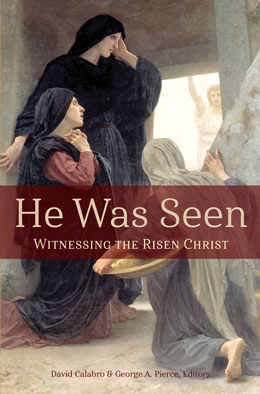
Standing Again through the Resurrection of Christ
Lincoln H. Blumell and Spencer Kraus
Lincoln H. Blumell and Spencer Kraus, "Standing Again through the Resurrection of Christ," in He was Seen: Witnessing the Risen Christ, ed. David Calabro and George A. Pierce (Provo, UT: Religious Studies Center, Brigham Young University; Salt Lake City: Deseret Book), 59–74.
Lincoln H. Blumell is an associate professor of ancient scripture at Brigham Young University.
Spencer Kraus is a student in computer science, ancient Near Eastern studies, and Modern Hebrew at Brigham Young University as well as a research associate for Scripture Central.
 Balm of Gilead, by Anne Henrie. Courtesy of Intellectual Reserve, Inc.
According to the Prophet Joseph Smith, “The fundamental principles of our religion is the testimony of the apostles and prophets concerning Jesus Christ, ‘that he died, was buried, and rose again the third day, and ascended up into heaven;’ and all other things are only appendages to these, which pertain to our religion.”[1] In other words, the Atonement and Resurrection of Jesus Christ are central to all that Latter-day Saints believe. Without this miraculous event that had been testified of by witnesses in both the Old and New Worlds, our faith would, as the Apostle Paul once said, be in vain (see 1 Corinthians 15:14).
One significant aspect of the Resurrection of Christ and the blessings that flow from it can be understood from the meaning of resurrection in Greek; the word anastasis can literally be translated as “standing or rising.”[2] In a very literal sense, that is precisely what the Resurrection is—the dead stand again, being raised up to immortality and eternal life.
Because Jesus stood again following his Crucifixion, he offers all God’s children the ability to stand again. However, as modern and ancient prophets have taught, these blessings are not reserved just for the Millennium when we will join him in the Resurrection. Rather, the blessings that extend from this miraculous event extend throughout time and into eternity, allowing us to gain comfort and metaphorically stand again while awaiting that day.
We would like to discuss three primary ways that the blessings of standing again can be experienced by God’s children—namely, because Jesus suffered and died for us, we can stand in the midst of afflictions we face throughout mortality, stand again as a resurrected being with our loved ones, and stand spotless before the Lord not only during this life but ultimately as we become holy and pure like the Father.
 Agony in the Garden, by Frans Schwartz. Courtesy of Wikimedia Commons.
Standing in the Midst of Our Afflictions
One of the blessings we receive through the Atonement and Resurrection of Christ can have a more immediate effect for us throughout our lives. Through the miracle of the Resurrection, we are able to stand in the midst of, and perhaps even despite, the afflictions, tribulations, and trials faced throughout mortality.
This is exhibited throughout the scriptures but perhaps most literally through the healing of a lame man outside the temple gate. Shortly following the death and Resurrection of Jesus Christ, Luke records, “Peter and John went up together into the temple at the hour of prayer, being the ninth hour.” At the same time as Peter and John were arriving at the temple, “a certain man lame from his mother’s womb was carried . . . to ask alms of them that entered into the temple” (Acts 3:1–2).
Expecting to receive some money, the lame beggar asked for alms from the two Apostles, perhaps unaware of who he was addressing. However, what Peter said and did next would forever change his life: “Silver and gold have I none; but such as I have give I thee: In the name of Jesus Christ of Nazareth rise up and walk. And he took him by the right hand, and lifted him up: and immediately his feet and ankle bones received strength. And he leaping up stood, and walked, and entered with them into the temple, walking, and leaping, and praising God” (Acts 3:6–8). As Peter would testify, it was only through faith in the name of “the Prince of life, whom God hath raised from the dead” that such a miracle could be performed (see Acts 3:15–16).
As we read many of the miracles recorded throughout the New Testament, we are constantly reminded of the need for unwavering faith even as we face adversity and challenges beyond our control. In these miracles, such as the healing of the lame man in Acts 3, faith plays a pivotal role in the healing and, ultimately, the transformation of the called disciple.
Of course, not every trial, pain, sickness, or other infirmity we experience in life will be as dramatically healed as was the case in Acts 3. The afflictions we experience may be physical, emotional, or spiritual; indeed, as expressed by Elder Neil L. Andersen, “we search for happiness. We long for peace. We hope for love. And the Lord showers us with an amazing abundance of blessings. But intermingled with the joy and happiness, one thing is certain: there will be moments, hours, days, sometimes years when your soul will be wounded.”[3]
During these trying moments, we may take comfort in the declaration of the Prophet Joseph Smith, who “wished all of the saints to be comforted with the victory they were to gain by the resurrection. It is sufficient to encourage the saints to overcome in the midst of every trial, trouble, and tribulation. Though thunders roar and earthquakes bellow, lightnings flash and wars are upon every hand, yet suffer not a joint to tremble, nor let not your heart faint, for the great Elohim will deliver you, and if not before the resurrection, [he] will set you eternally free from all these things: from pain, sorrow, and death.”[4] Furthermore, “what can earthquakes, wars, and tornados do? Nothing—all your losses will be made up to you in the resurrection provided you continue faithful.”[5]
The same sentiment was expressed by the prophet Mormon, who declared that “ye shall have hope through the atonement of Christ and the power of his resurrection, to be raised unto life eternal, and this because of your faith in him according to the promise” (Moroni 7:41). It is through the Resurrection that we, like the beggar outside the temple, can stand again through our trials. Through our faith in Jesus and his Atonement, all can be made right.
Standing at the Resurrection
Another key blessing that comes from the Resurrection of Christ is the ability for everyone to stand again in a perfect body, having been resurrected just as Jesus has been resurrected. This principle is taught clearly and powerfully throughout the scriptures.
 The Resurrected Christ, by Wilson Ong. Courtesy of Intellectual Reserve, Inc.
For example, when Amulek was confronted by a wicked Zeezrom, he affirmed that Jesus was in fact the Christ. Furthermore, Amulek taught that because “the death of Christ shall loose the bands of this temporal death, that all shall be raised from this temporal death. The spirit and the body shall be reunited again in its perfect form; both limb and joint shall be restored to its proper frame, even as we now are at this time; and we shall be brought to stand before God” (Alma 11:42–43). This blessing would come to all people, “both old and young, both bond and free, both male and female, both the wicked and the righteous,” as the effects of temporal death are overcome universally through the Atonement of Jesus Christ (Alma 11:44).
Interestingly, Joseph Smith taught in 1843, “God hath shown unto me a vision of the resurrection of the dead, and I saw the graves open and the saints as they arose took each other by the hand, even before they got up or while getting up, and great joy and glory rested upon them.”[6] That is, as each of the dead was raised to life, they were taken by the hand and lifted up as they literally stood again. In so doing, they likewise became recipients of the joy and glory of the Lord.
This Resurrection of all people is closely associated in the scriptures with being brought to stand in the presence of God to be judged according to our works. This is especially clear in the discourses of Alma, Amulek, and Lehi, who each describe how as all will be resurrected because of the Atonement of Jesus Christ, all will then stand in his presence to be judged.[7] This aspect of the Resurrection will allow all God’s children to receive a kingdom of glory fitting their desires and works.
What is even more significant about this topic, however, is what the Resurrection then means for us. Ultimately, we can find comfort in the assurance that through the Atonement and Resurrection of Jesus Christ, “the grave shall have no victory, and that the sting of death should be swallowed up in the hopes of glory” (Alma 22:14). Therefore, as death is a universal aspect of mortality, and as we all are parted from our loved ones, we have reason to hope despite losing our family and friends to “the gateway we call death.”[8]
 The Resurrected Christ, by Walter Rane. Courtesy of Intellectual Reserve, Inc.
When Jesus met Mary and Martha, mourning over the death of their beloved brother, he comforted them with this powerful statement about his divine identity: “I am the resurrection, and the life: he that believeth in me, though he were dead, yet shall he live: and whosoever liveth and believeth in me shall never die” (John 11:25–26). Through Jesus Christ, death itself will have no power to separate us from the love of God and from the love of those who have passed on before us (see Romans 8:35–39).
According to Joseph Smith, “we have the greatest hope in relation to our dead of any people on earth.”[9] He went on to declare, “How consoling to the mourner, when they are called to part with a husband, wife, father, mother, child, or dear relative, to know, that although the earthly tabernacle shall be dissolved, that they shall rise in immortal glory, not to sorrow, suffer, or die anymore, but they shall be heirs of God and joint heirs with Jesus Christ.”[10]
Ultimately, because all shall literally stand again at the Resurrection, all people—the parent who has lost a child, the children who have lost their parents, those who have never known their ancestors—can have the hope of a joyous reunion with our loved ones and the Lord in a bright and beautiful day to come. As we await the glorious day where we will be reunited with our loved ones, we can take comfort in the declaration of the prophet Isaiah: “He will swallow up death in victory; and the Lord God will wipe away tears from off all faces; and the rebuke of his people shall he take away from off all the earth: for the Lord hath spoken it” (Isaiah 25:8; compare Revelation 21:4).
Standing Spotless before God
A final and noteworthy connection between standing and the Resurrection is for the righteous to “stand spotless before [Jesus] at the last day” (3 Nephi 27:20). This is done as we repent and make and keep sacred covenants with God and his Son, preparing for the ultimate day when we can become like them. There are two major ways this promise is fulfilled.
First, it is possible to stand spotless, as it were, as we serve God throughout our lives. Through our service to him in the Church, temples, and our homes, we can invite his presence into our lives more fully. Throughout the scriptures and other ancient texts, it is especially meaningful that those approaching the presence of the Lord are always invited to stand, as was the case with Ezekiel, Daniel, Bartimaeus, Saul, Alma, and Nephi son of Nephi.[11] It is likewise worthwhile to note that many rabbinic and midrashic commentaries on the creation of Adam and Eve place their formation in terms of their ability to stand and serve God, just as we will again be made to stand in the Resurrection.[12]
The injunction to “stand ye in holy places, and be not moved” (Doctrine and Covenants 87:8) is especially noted by biblical scholars who have studied the ancient temple. Robert Hayward, for example, noted, “You stand in the temple, you stand before the Lord, you pray standing up—you can’t approach God on all fours like an animal. If you can stand, you can serve God in His temple.”[13] This would notably require the temple petitioner who desired to “ascend into the hill of the Lord” and “stand in his holy place” to be worthy—that is, they must have “clean hands, and a pure heart” (Psalm 24:3–4). When we serve the Lord faithfully, we then are able to stand in his presence both symbolically and ritually.[14]
When Jesus Christ visited the Nephites, he called, “Arise and come forth unto me, that ye may thrust your hands into my side, and also that ye may feel the prints of the nails in my hands and in my feet, that ye may know that I am the God of Israel, and the God of the whole earth, and have been slain for the sins of the world” (3 Nephi 11:14). Standing in his presence allowed these righteous Nephites to become witnesses of his death and Resurrection and would further allow them to establish a four-generation peace as they lived the gospel.
 Illustration by Dan Burr. Courtesy of Intellectual Reserve, Inc.
Second, we are promised that those who remain true and faithful to the covenants they have made with the Lord will be able to stand in his presence forever following the Resurrection.
The Apostle Paul declared that because we are children of God, then we are also “heirs; heirs of God, and joint-heirs with Christ; if so be that we suffer with him, that we may be also glorified together” (Romans 8:17). Those who maintain their covenantal relationship with the Father then become “partakers of the divine nature, having escaped the corruption that is in the world” (2 Peter 1:4). Under these circumstances are we able to dwell with God forever, having become like him, as revealed through the Prophet Joseph Smith (see Doctrine and Covenants 76:53, 58).
Indeed, according to Joseph Smith, “the Father of our spirits [provided] a sacrifice for His creatures, a plan of redemption, a power of atonement, a scheme of salvation, having as its great objects, the bringing of men back into the presence of the King of heaven, crowning them in the celestial glory, and making them heirs with the Son to that inheritance which is incorruptible, undefiled, and which fadeth not away.”[15]
We have only a few glimpses through the scriptures to understand what the exact nature of the exalted state of the righteous will look like. However, while “it doth not yet appear what we shall be: but we know that, when he shall appear, we shall be like him; for we shall see him as he is. And every man that hath this hope in him purifieth himself, even as he is pure” (1 John 3:2–3). At that day, we will be able to be witnesses of the Savior in the truest and most complete sense, being like him and living with him in eternal glory.
Conclusion
Through the Atonement and Resurrection of Jesus Christ, we are all invited to stand again as new creatures in Christ (see 2 Corinthians 5:17). The ability for each of us to stand again through the Resurrection of Christ can be found throughout this life and will ultimately be fulfilled in the bright morning of the Resurrection at the millennial day.
Although we may suffer in this life, oftentimes unjustly, we may pray that the Lord will fix what is broken. As Elder Ronald A. Rasband has noted, we can rest assured that “the miracle [we need] will come, though not necessarily on our timetable or with the resolution we desired.”[16] Whatever trial we may face, we can know that the Lord will make all things right, allowing us to live with him and see our family members who have passed on before us again. In that day, we will finally be able to look past the dark mirror that we see through mortal lenses. Rather, we will finally see the Lord and ourselves “face to face” and finally know ourselves even as we are known (1 Corinthians 13:12).
Notes
[1] Questions and Answers, 8 May 1838, p. 44, The Joseph Smith Papers, https://
[2] See Frederick William Danker, A Greek-English Lexicon of the New Testament and Other Early Christian Literature,3rd ed. (Chicago: University of Chicago Press, 2000), s.v. ἀνάστασις.
[3] Neil L. Andersen, “Wounded,” Ensign or Liahona, November 2018, 84.
[4] Discourse, 16 April 1843, as Reported by Wilford Woodruff, pp. 26–27, The Joseph Smith Papers, spelling and punctuation modernized, https://
[5] Discourse, 16 April 1843, as Reported by Willard Richards, p. 145, The Joseph Smith Papers, spelling and punctuation modernized, https://
[6] Discourse, 16 April 1843, as Reported by Wilford Woodruff, p. 27, The Joseph Smith Papers, spelling and punctuation modernized, https://
[7] See the sermons recorded in Alma 40, Alma 11, and 2 Nephi 2.
[8] This is taken from the title of a book written by President Russell M. Nelson, The Gateway We Call Death (Salt Lake City: Deseret Book, 1995).
[9] Discourse, 7 April 1844, as Reported by Wilford Woodruff, p. 139, The Joseph Smith Papers, https://
[10] Discourse, 7 April 1844, as Published in Times and Seasons, p. 614, The Joseph Smith Papers, spelling and punctuation modernized, https://
[11] See Ezekiel 2:1–2; Daniel 10:11; Mark 10:49; Acts 26:16; 36:7–8; 3 Nephi 11:19–20.
[12] This is especially clear in Rashi’s commentary of Genesis 2:7, who discusses the ability of Adam and Eve to stand when they were created and at the Resurrection, contrasted with animals who will not “stand to be judged” of their actions.
[13] Notes taken by David J. Larsen on an unpublished talk by Robert Hayward, cited in Jeffrey M. Bradshaw, “Stand Ye in Holy Places, and Be Not Moved” (Moses 4:29–31), Book of Moses Essays 69, available online at interpreterfoundation.org.
[14] For more discussion on standing in the temple to serve the Lord, see Bradshaw, “Stand Ye in Holy Places”; Jeffrey M. Bradshaw, “Standing in the Holy Place: Ancient and Modern Reverberations,” in Ancient Temple Worship: Proceedings of The Expound Symposium, 14 May 2011, ed. Matthew B. Brown, Jeffrey M. Bradshaw, Stephen D. Ricks, and John S. Thompson (Orem, UT: The Interpreter Foundation; Salt Lake City: Eborn Books, 2014), 71–142.
[15] “The Elders of the Church in Kirtland, to Their Brethren Abroad,” January 22, 1834, published in Evening and Morning Star, February 1834, 135.
[16] Ronald A. Rasband, “‘Behold! I Am a God of Miracles,’” Liahona, May 2021, 111.
