
 menu icon in the top, right corner of the screen.
 icon above to close this box.
 icon at the bottom of the screen below the browser—if you don't see it, swipe up to unhide it.
Overcoming Obstacles
Daniel Becerra, Amy Easton-Flake, Nicholas J. Frederick, and Joseph M. Spencer, "Overcoming Obstacles," in Book of Mormon Studies: An Introduction and Guide (Provo, UT: Religious Studies Center, Brigham Young University; Salt Lake City: Deseret Book), 63‒82.
From all we’ve said so far, it should be apparent that the field of Book of Mormon studies not only has a fascinating and sometimes fraught past but also has a good many promising prospects as it looks to the future. The survey in the last chapter points to the fact that there are genuinely new things stirring today. The twentieth century’s consistently dominant emphasis on historical research—whether critical toward or defensive of the Book of Mormon’s antiquity—has become only a part, and really a relatively small part, of the field in the twenty-first century. Literary and theological approaches have freed themselves from former constraints and become major contributors. Reception history and intertextuality, almost without precedent, have arisen to become particularly important parts of the growing field. Political, ethical, and ideological questions have broadened dramatically, with unanticipated answers to old questions appearing. Even the story of the coming forth of the Book of Mormon has been set on wholly new footing in the last decade or two. It seems safe to say that the field of Book of Mormon studies today would be largely unrecognizable to someone visiting from the 1950s using a time machine. It would even be largely unrecognizable to someone visiting from the 1980s or 1990s.
Change is never easy, however, and massive, rapid change is especially hard. And as we overviewed in the last chapter, the changes that have taken place in Book of Mormon studies are as massive as they’ve been quick. We don’t need to imagine time machines to think about how today’s field would look to someone shaped by the late twentieth century’s version of Book of Mormon studies. Many people right now who were shaped by this version express surprise at what has happened and what’s happening now. For some, the changes are welcome and exhilarating. For others, they’re confusing but interesting. For others still, they’re downright alarming. All these reactions are understandable. They’re also all important. Younger scholars in Book of Mormon studies must learn as much from the older generation’s expressions of concern as from its words of encouragement. This is partly because change isn’t hard just for more seasoned individuals who see familiar forms of things pass away. Change is also hard in its own way for those who are born into or shaped by the new. One unfortunate limitation for those not influenced by the old is the potential to be blind to real dangers that lurk in the new. This blinding can lead them to ignore the sage advice of those who have seen the old and the new.
We’ll dwell on all that more in a moment as we examine closely what obstacles Book of Mormon studies faces. First, though, it’s worth addressing one particularly important and instructive indication that something fundamentally new is happening in Book of Mormon studies. It’s insufficient just to point out that the interests and approaches garnering the most attention in the field find little or only scattered precedent in previous decades. It isn’t terribly surprising that what shaped the 2000s and 2010s isn’t the same as what influenced the 1980s or the 1990s (let alone the 1950s and 1960s). What is surprising—and especially telling—is that the first decades of the twenty-first century have seen a return to the methods of the decades that preceded the 1950s. In crucial ways, we’ve returned to the formative period of Book of Mormon studies—but with professional and genuinely academic tools.
In previous chapters, we talked about Book of Mormon studies as having really begun with the emergence of academically trained scholars in the 1940s. The field began to take shape as a recognizable discipline only with the seminal work of Sidney B. Sperry, M. Wells Jakeman, and especially Hugh W. Nibley. It was on these three scholars’ shoulders that later twentieth-century Book of Mormon scholars stood when they watched over the growth and development of the field. But Sperry, Jakeman, and Nibley didn’t work in an intellectual vacuum. As we mentioned in chapter 1, serious and productive readers and interpreters of the Book of Mormon worked influentially from the late 1870s into the 1940s. They were, strictly speaking, amateurs, but one should highlight the etymological meaning of “amateur”: lover. They were lovers of the Book of Mormon, and they lovingly plowed the field in which Sperry, Jakeman, and Nibley planted the seeds of the discipline. And today’s Book of Mormon scholars—apart from the question of professional training—have more in common with those amateur students of the book than they do with the scholars that followed.
Most important in this regard are figures like Orson Pratt, George Reynolds, Janne M. Sjödahl, and B. H. Roberts—figures we’ve already mentioned in previous chapters. What united these early students of the Book of Mormon was their focus on preliminary, ground-laying work. They didn’t shy away from the thankless labor that someone had to do to make serious study of the Book of Mormon possible in the first place. Orson Pratt devoted untold hours to creating the first edition of the book that was geared specifically for study. George Reynolds produced the first well-received reference materials for Book of Mormon study. Janne Sjödahl’s interpretive labors inspired his son-in-law to gather Sjödahl’s writings into the first substantial commentary on the Book of Mormon. And B. H. Roberts undertook the first speculative interpretation of the entire book’s meaning, which was audacious and in conversation with the science and theology of his day. Editions organized for careful study, substantial reference materials with reliable information, verse-by-verse commentaries to guide readers, and large-scale interpretations meant to generate real conversation—these are exactly the kinds of things required for a field of productive scriptural scholarship to thrive. They’re also exactly the kinds of things scholars at the end of the twentieth century—and now in the first decades of the twenty-first century—have been attending to.
 A page from the book of Omni in Orson Pratt's 1879 edition of the Book of Mormon.
Orson Pratt’s work on the 1879 edition of the Book of Mormon, discussed briefly in chapter 1, was the first of its kind. Elder Pratt received the assignment earlier that year to produce a new edition that devoted closer attention to the needs of readers. Accordingly, he divided the text into shorter chapter divisions, introduced versification into the text for the first time, and supplied the volume with its first cross-referential and even interpretive footnotes. Readers of the edition publicly celebrated its merits, commenting on the way its system of citation made study of the text more possible than before. Explanatory footnotes, along with footnotes containing inter- and intratextual references, gave readers a more intellectually engaged experience with the Book of Mormon. Elder Pratt felt the Saints’ need for an edition of the Book of Mormon they could study—something that required a great expenditure of effort on his part, and he faithfully delivered it. The same need has apparently been felt—by a surprising number of people—late in the twentieth and early in the twenty-first century.
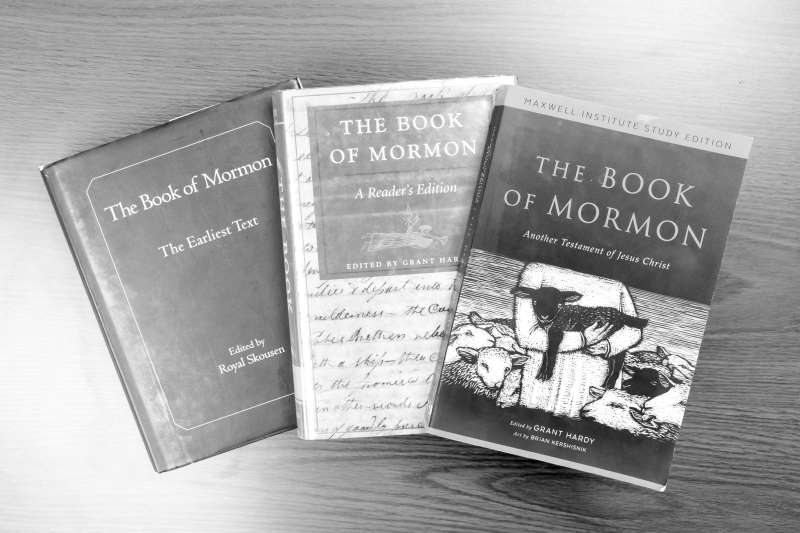 Study-focused editions of the Book of Mormon. Courtesy of Yale University Press, the University of Illinois Press, and the Neal A. Maxwell Institute for Religious Scholarship.
Work that culminated in the most important twenty-first-century editions of the Book of Mormon began in the early 1980s with critical analysis of the book’s print history. First headed up by Robert Smith, whose critical text appeared in the mid-1980s, the project eventually became the life’s work of Royal Skousen. Skousen has carefully examined and reexamined the manuscripts (the original manuscript and a manuscript copy used in printing, appropriately called the printer’s manuscript), as well as every major print edition of the Book of Mormon. He’s tracked all variants among these many versions of the text, analyzed them carefully, worked to place them in a larger linguistic framework, and published his detailed notes for all the world. The year 2009 saw the first major culmination of Skousen’s monumental work: The Book of Mormon: The Earliest Text (ideally read alongside the six-volume Analysis of Textual Variants of the Book of Mormon that explains how every decision about The Earliest Text was made). Smith and Skousen were thus the first to seriously embrace the idea that progress in Book of Mormon studies depends on a textually reliable edition. The service they’ve provided deserves the gratitude of all Book of Mormon scholars.
As Skousen labored away on his project, other scholars began to express similar concerns about the readability of the Book of Mormon. Starting with Grant Hardy’s The Book of Mormon: A Reader’s Edition, various new editions of the Book of Mormon in the 2000s and 2010s have tried to make its shape and flow clearer for readers. To date, the most important of these is Hardy’s 2018 Maxwell Institute Study Edition, which combines the best of Hardy’s literary insights with the most important of Smith’s and Skousen’s discoveries. In all this work, Orson Pratt’s spirit seems to hover nearby, always pressing for a more readable text. These developments mark an important return to the very beginnings of Book of Mormon research—a recognition that progress won’t be made until the book’s shape and flow are apparent and its meaning accessible.
“It is wonderful to me how much more interesting the study of the Book of Mormon has become since it has been divided into chapters and verses. I seem to get hold of the sense so much better than when it was in such long paragraphs.” —George Reynolds, “Correspondence,” Millennial Star, October 1879, 669
Elder Pratt’s 1879 edition made George Reynolds’s labors to create Book of Mormon reference material possible (something Reynolds himself pointed out). Elder Pratt’s citation systems (chapters and verses) were certainly necessary before a concordance was possible. As Reynolds read the Orson Pratt edition, his study led him to produce A Dictionary of the Book of Mormon, a major systematization of Book of Mormon characters, places, and events. Going further, he then published A Complete Concordance to the Book of Mormon, a massive work that tabulated every word used in the Book of Mormon and took twenty-one years to complete. Reynolds essentially created these resources from scratch, with little by way of even amateur scholarship available to him. He nonetheless rightly saw that serious study of the Book of Mormon couldn’t move forward without good and reliable reference materials. Scholars like Sperry, Jakeman, and Nibley couldn’t have done their work without Reynolds’s tools ready at hand.
Here again, twenty-first-century scholars are returning to the insights of the Book of Mormon’s earliest students. Already in the late 1990s, the Foundation for Ancient Research and Mormon Studies (FARMS) published A Comprehensive Annotated Book of Mormon Bibliography (overseen by Donald W. Parry), Charting the Book of Mormon (principally the work of John W. Welch), and The Geography of Book of Mormon Events (the tireless effort of John L. Sorenson). To these important and preliminary reference works are joined many more resources created in the twenty-first century. Skousen’s work on the critical text project has yielded some of the most important of these: his six-volume Analysis of Textual Variants of the Book of Mormon and seven-volume History of the Text of the Book of Mormon. Also important are the Joseph Smith Papers publications of the manuscript sources for the Book of Mormon, alongside web-based access to these manuscripts and other historically important editions of the book. Other twenty-first-century resources have focused on gathering and synthesizing past work. In 2003, for instance, Deseret Book published the Book of Mormon Reference Companion, edited by Dennis L. Largey, which surveys and summarizes Book of Mormon scholarship from the twentieth century. The online archive of Book of Mormon Central gathers much of this same scholarship in full (rather than in summary). More recently, Oxford University Press has published Larry E. Morris’s Documentary History of the Book of Mormon, gathering into one place historical sources about the process of translating, publishing, and printing the Book of Mormon.
These new reference materials are indispensable, but it’s worth pausing for a moment to state that they’re only a start. Twentieth-century scholarship, as well as more recent scholarship, needs sifting to decide on its most lasting insights. Updates to the 1996 Comprehensive Annotated Book of Mormon Bibliography need to be made, and specialized literature reviews need to be written (some have in fact begun to appear in the Journal of Book of Mormon Studies). A full critical text of the Book of Mormon needs to appear, along with searchable versions of various historically important editions of the Book of Mormon. Dictionaries of word usage in the Book of Mormon would be of great value, ideally with entries that detail various possible meanings drawn from historical English and American usage. Systematic lists and preliminary analyses of intertextual connections between the Book of Mormon and the Bible, as well as between the Book of Mormon and other key Restoration texts, would help guide further work on the text. In short, the return of Reynolds’s interest in producing reference material is more than welcome.
Often associated with George Reynolds is Janne Sjödahl, since their names appear together on the cover of the first multivolume commentary on the Book of Mormon ever published. But neither Reynolds nor Sjödahl set out to produce that commentary during their lifetimes, so it appeared only after their deaths. Sjödahl was a trained minister who joined The Church of Jesus Christ of Latter-day Saints and soon brought his theological learning to the task of reading the Book of Mormon. An indefatigable reader of the book, he piled up mounds of unpublished reflections in addition to published articles and books over decades. After his death, his son-in-law Philip C. Reynolds—who also happened to be the son of George Reynolds—created from the two men’s writings the first substantial verse-by-verse commentary on the Book of Mormon. The format of the commentary would prove deeply influential, shaping more or less all commentaries on the Book of Mormon published since.
“Other than Joseph Smith and Oliver Cowdery, who are in a class unto themselves, Royal Skousen has done more to establish, correct, and elucidate the text of the Book of Mormon than anyone else in the history of the Church, including the first typesetter, John Gilbert; later editors such as Orson Pratt or James E. Talmage; and any number of commentators.” —Grant Hardy, “Approaching Completion: The Book of Mormon Critical Text Project,” BYU Studies Quarterly 57, no. 1 (2018): 179
 Commentary on the Book of Mormon. Courtesy of Deseret Book.
The commentary that appeared under Sjödahl’s and Reynolds’s names was multifaceted, eschewing a single approach to the text. The era begun by Sperry, Jakeman, and Nibley that would center on the historicity of the Book of Mormon hadn’t arrived yet. Further, the commentary appeared long before now-familiar interpretations of Book of Mormon passages settled. Even in the twenty-first century, then, the commentary often presents readers with novel and interesting approaches to the text, which speak to today’s expanding field. In all these ways, the commentary is surprisingly akin to Brant A. Gardner’s six-volume commentary on the Book of Mormon, Second Witness, published in 2007. And although Gardner’s commentary privileges historical and archaeological approaches to the text (as Reynolds and Sjödahl’s commentary did often enough), his commentary is as disciplinarily diverse as that of his earliest commentator forebears. Here as elsewhere, there’s been a crucial return to the very beginnings of Book of Mormon scholarship, however amateur those beginnings were.
 Second Witness. Courtesy of Greg Kofford Books.
It’s worth pausing briefly to say that Gardner’s commentary should be just the beginning of a revitalized commentary tradition. Serious and substantial commentaries are a good place for sifting previous work. They’re also good venues for novel approaches and systematic readings to appear. Ideally, however, commentaries on the Book of Mormon in the future will no longer represent the work of just one or two individuals. In biblical studies, few commentary series are sole authored. Rather, different scholars write on different biblical books—and often on just parts of different biblical books. Ideally, then, we’ll soon see great commentaries on the Book of Mormon written by a dozen or more scholars, with one contributor writing a long and detailed study of 1 Nephi and another writing a long and detailed study of Helaman. (Something like this has already begun to appear with the Maxwell Institute’s The Book of Mormon: Brief Theological Introductions series.)
What, finally, of B. H. Roberts? Roberts was a particularly important intellectual force in the early twentieth century, and he commanded reflection on the Book of Mormon for decades. What may have been most important about Roberts’s approach to the book, though, was his attempt to provide the book with a total reading. In other words, Roberts constructed a framework for making sense of the whole Book of Mormon rather than simply of this or that passage. He put this larger framework in conversation, moreover, with the best theological and scientific research of his day. It’s important to note at the same time, though, that the result of Roberts’s particular research was actually a dead end. Too attached to his model, he didn’t know how to deal with new data, and this actually threatened his long-standing faith in the Book of Mormon for a time. His work was nonetheless crucial and carried serious momentum in its time. With a more self-critical regard—or at least some conversation partners—he might have in fact represented an ideal interpreter of the Book of Mormon.[1]
Generally more cautious than Roberts was, recent interpreters of the Book of Mormon have also begun asking about the bearing of the whole book. Grant Hardy’s Understanding the Book of Mormon: A Reader’s Guide, Joseph Spencer’s An Other Testament: On Typology, Brant Gardner’s Traditions of the Fathers: The Book of Mormon as History, and Don Bradley’s The Lost 116 Pages: Reconstructing the Book of Mormon’s Missing Stories, among others, have attempted whole-book interpretations in just the past decade. Further, much recent literary and theological work on the Book of Mormon—even when it limits its insights to specific parts of the Book of Mormon—promises to contribute to proposals about the book’s total meaning. Here again is something of a return to the beginnings of Book of Mormon studies, an attempt to recapture something perhaps lost during the later twentieth century. Such Roberts-like work is certainly in its infancy. What exists today is a loose collection of proposals, some more and some less worked out. The scholars setting forth these proposals need to encounter each other to provoke a sustained conversation, avoiding the temptation to write in so many individual echo chambers. Mirroring Roberts but also learning from his mistakes, work of this sort, which has only just begun, might well prove to be definitive for the twenty-first century.
Today’s Book of Mormon scholars thus bring together the ground-laying intentions of early amateur Book of Mormon scholars and the professionalism of later trained Book of Mormon scholars. Conscious of how much preliminary work remains undone, current Book of Mormon scholars are building something with hope that it will last. Whether the result will be able to stand the test of time will be decided by the care with which this transitional and preliminary work is undertaken.
The watchword for the next several decades of Book of Mormon scholarship should therefore be caution. This, though, is a word too easily misunderstood—too easily taken to call for timidity or hesitance. The point isn’t to warn that every step must be taken fearfully and flinchingly. It’s rather to point out that success in this endeavor will be determined wholly by how thoroughly and undogmatically Book of Mormon scholars do their work. If dangers lurk in all directions, they’re the dangers of laziness and dishonesty. Earlier scholarship can’t be read from a position of ironic distance with a smirk about how naive earlier interpreters must have been. The textual data of the Book of Mormon has to be gathered and sorted and presented in solid reference works, which can’t be done in a slipshod fashion or with any agendas about what the data will look like. Big-picture theories about how to understand the Book of Mormon as a whole can’t be presented as if they are certain or decisive. It’s in these kinds of ways that the cardinal virtue of Book of Mormon scholarship for the near future has to be caution. What’s needed is unswerving commitment to intellectual humility and to real honesty, combined with the kind of patience and stamina necessary for doing preliminary (as well as not-so-preliminary) work well.
Caution will be as important for more traditional interpreters of the Book of Mormon as for those embracing newer methods or asking newer questions. Naturally, there are temptations in pursuing theological or literary work to push the text further in some interpretive direction than it can go—to uncritically adopt a sophisticated or fashionable theoretical lens even when it’s a barrier to reading the text well. Similar temptations attend reception history and ideology critique. In asking questions about gender, race, and class or about violence, disability, and politics, it’s easy to become tendentious. And so young scholars working in emerging subdisciplines in Book of Mormon studies need to exercise caution in pursuing their work.
But this doesn’t mean that more traditional interpreters—shaped in the molds cast by twentieth-century Book of Mormon scholars—don’t have as much need to exercise caution. Traditional defenses of the Book of Mormon have their own (and often unstated) theological, literary, and ideological commitments. Such work also faces the temptation to rigidly insist on its own theoretical frameworks, which are just as liable to obscure the text when they aren’t the right tool for the interpretive job. And unfortunately, the pits traditional interpreters are most likely to fall into can be more difficult to see, if only because their methods are familiar and accepted. The result is that scholars embracing newer methods tend to see where traditional work makes unquestioned assumptions, just as scholars who productively persist in traditional methods tend to see where younger scholars let newfangled theories get the better of them. And so, to whatever extent Book of Mormon studies can become a place for generous conversation—a place for mutual assistance in avoiding blind spots rather than for rancorous accusations—its future looks wonderfully bright.
This last point is worth making again but in more practical terms. As we pointed out at the beginning of this chapter, the changes in Book of Mormon studies that we’re talking about are hard for younger and older alike. And precisely for this reason, far too much that has been published recently about the Book of Mormon has been written in an unnecessarily contentious spirit. This is something that’s gone both ways, unfortunately. We feel certain that this contention is among the realest obstacles to Book of Mormon studies going forward. We all have to learn how to get along. All accusing parties ought to become more aware of their tendencies toward defensiveness.
It’s essential that there be scholars who write to defend the Book of Mormon against attack. The fact is that many have criticized the Book of Mormon in a mean spirit, dismissively, and with a deliberate aim at offending believers. In the right season and in the right spirit, such criticisms require a response. Others have written about the Book of Mormon in ways that have unintentionally but nonetheless really offended those who believe in its divine authenticity. In the right season, and again in the right spirit, such writers require a bit of correction from believers as well. In short, it’s right to defend sacred scripture. This is a duty that Book of Mormon scholars shaped by the twentieth century especially feel, and it is one they execute more consistently than those shaped by the twenty-first century. Those who take up this challenge, though, face a couple of temptations about which they ought to be deeply aware. In defending anything, there’s a very real temptation to “return railing for railing” (3 Nephi 6:13), to meet a contentious spirit (or even a perceived contentious spirit) with an equally contentious spirit. This should be avoided. Still more worrisome is a further temptation: to allow defense of the Book of Mormon to become a kind of gatekeeping among the Saints. That is, far too often accusations are made by one believer about another. Whether they’re written and published or whether they’re just whispered into individual ears in quieter settings, such accusations should have no place in the field of Book of Mormon studies. The spirit of accusation slows and stymies Book of Mormon scholarship in tragic ways. It’s also at odds with the very spirit of Zion, the community of faith.
Just as much at odds with the spirit of Zion is condescending dismissal of older scholarship by scholars shaped by twenty-first-century concerns. Newer, retooled, and diversifying subdisciplines within Book of Mormon studies are essential to a better understanding of the book. They’re important for strictly academic reasons, but they’re also important for the work of pressing forward in faith with the founding scripture of the Restoration. Younger members of the Church, certainly in the English-speaking world and often enough beyond it as well, have questions about race, class, gender, violence, war, and exclusion in the Book of Mormon. They need answers they can understand. They need them. Further, the Church has become so much more international and diverse in recent decades, and current research projects may do important work in helping the Book of Mormon speak to this much broader body of Saints. It’s right to expand the interpretive horizons of the book, and this is something scholars tend to do today. But this comes with its own temptations that require vigilance. It’s easy for someone attuned to concerns about race or gender to accuse scholars who sift through the sands of archaeology of political myopia—if not of implicit racism or sexism. It’s also easy for someone working in subdisciplines that appeal to scholars outside the community of faith to preen themselves, to be proud of their acceptance in the academy, and so to speak dismissively of scholars who labor to reach believing Latter-day Saints. However, this type of attitude destroys rather than builds Zion. Zion can’t be built without, and the Book of Mormon can’t shine without, the contributions from all willing scholars of the Book of Mormon.
There’s reason, then, to call for a new vocabulary in Book of Mormon studies going forward—the vocabulary that academics refer to when they speak of “charity.” To call for charity isn’t to call for a dishonestly “nice” way of talking about one another. It certainly isn’t to call for eliminating every form of criticism within the community. And it’s not to rule out having disagreements or real worries about another’s conclusions (even worries that another’s conclusions go beyond the boundaries of faithfulness). Instead, a call for charity is a call for us all to recognize our own tendency to misunderstand and misconstrue others. It’s a call for us all to have more intellectual humility and to be willing to give one another the benefit of the doubt. In our writing, we display this charity through a slight adjustment of tone. We need a tone that indicates that we’re willing to see the best rather than the worst in another’s motivations and that invites individuals to clarify positions we may find troubling. Adopting this kind of tone is neither naive nor dishonest, and it’s not a way of capitulating to social pressure. It’s a way of being honest about how easy it is to misconstrue others’ intentions and avoid opportunities to learn.
The writerly generosity we’re advocating is particularly important between representatives of different interpretive methods. It’s entirely permissible to have strong and deep-seated suspicions about another’s approach, but it’s wrong and damaging in a myriad of ways to assume without serious and sustained interaction that someone embraces a potentially problematic method only for perverse reasons. For those working within the household of faith, it’s far more likely that they do their work with good intentions—that they rightly see something of value that’s difficult for another to see or that they wrongly see something of value and stand to learn from generous interaction. And there’s nothing to lose in being generous. If we really could learn something from another’s approach, it would be tragic for us to prohibit friendly discussion. We’d end up only with an impoverished view of the world. And if there really was only error in the other’s approach, it would still be tragic for us to have prohibited friendly discussion. We’d end up leaving the other person with an impoverished view of the world, which we might have helped change. Acrimonious debate almost always assumes that it’s impossible to learn from each other, but the fact is that there’s little that people can learn without leaning on each other. Book of Mormon studies will move forward only if it becomes a far friendlier place without compromising anyone’s deepest convictions.
“And as all have not faith, seek ye diligently and teach one another words of wisdom; yea, seek ye out of the best books words of wisdom; seek learning, even by study and also by faith” —Doctrine and Covenants 88:118
Maybe we can put all this another way. In a sense, Book of Mormon studies will flourish the most when it’s finally assumed that basically every Latter-day Saint working in the field is doing some kind of faithful apologetics (a term we’ll define in a moment). It’s disappointingly common to hear Book of Mormon studies talked about as if it were divided between believing apologists and secular scholars, between those who wish to build the kingdom of God and those who wish to build their own careers and reputations. It’s just as disappointingly common to hear the same division described as being between those who honestly face up to the real evidence and those who dishonestly defend traditional perspectives. Both sorts of talk are inaccurate. Some scholars, it’s true, need to be aware of the lure of following academic trends to establish themselves as intellectual elites. And others, it’s true, need to be aware of the enticement of defending whatever is familiar as God’s own truth without addressing critical questions. These temptations are real. But the idea that there’s a war to be waged among the Saints between believing apologists and secular scholars is simply false. So far, the twenty-first century hasn’t witnessed the rise of a faction that resists and sullies apologetics. Rather, what’s happened is that apologetics has been broadened.
So what is apologetics? Why is it sometimes claimed to be the exclusive property of the faithful? Must it be antagonistic? And why is it sometimes thrown at someone as if it were a bad word, usually coupled with an accusation of conservatism?
The word apologetics simply refers to reasoned defense of something, especially something that won’t be accepted by everyone. Obviously the truth of the Book of Mormon is something that won’t be accepted by everyone. Book of Mormon apologetics is thus simply the reasoned defense of the truth of the Book of Mormon. For the many good reasons that we reviewed in previous chapters, most of the work done on the Book of Mormon in the second half of the twentieth century focused on defending the truth of the Book of Mormon. More specifically, it focused on defending just one dimension of the truth of the Book of Mormon: its claim to be an ancient record. For a long time, Book of Mormon apologetics has been principally—if not in fact exclusively—a practice of defending the ancient historicity of the book. This task has been and remains today an important one for believing Latter-day Saints. To whatever degree it’s possible to argue for the Book of Mormon’s claims about its antiquity, it ought to be done.
In light of all this, one way of describing what’s happened in recent decades is that many scholars have developed a deeper interest in other dimensions of the truth of the Book of Mormon. These other dimensions of the truth of the Book of Mormon do not contradict but add to its ancient historicity. Many people have developed a clear conviction that there’s more to the truth of the Book of Mormon than has sometimes been assumed. Unfortunately, though, it’s sometimes claimed that scholars with a wider range of interests in the truth of the Book of Mormon think there’s less to the truth of the Book of Mormon than has been assumed in the past. It’s sometimes assumed that a particular scholar’s interest in other dimensions of the truth of the Book of Mormon is an indication that he or she means to avoid the Book of Mormon’s antiquity. For the majority of individuals asking new questions or providing new answers in earnest, though, the aim is precisely to deepen and defend the truth of the Book of Mormon, more broadly conceived. It’s to acknowledge the important apologetic work that’s already been done and to push that forward.
It’s time for all accusation and all questioning of motivation to cease. We can feel confident doing this because taking the Book of Mormon seriously is already assuming the position of the apologist. We need to recognize that both scholars particularly shaped by twentieth-century concerns and scholars particularly shaped by twenty-first-century concerns are all apologists together, to the extent that they work seriously on the Book of Mormon. All earnest readers of the Book of Mormon attune themselves to its truth, even if in the act of thinking further about difficult issues they occasionally draw conclusions that make more traditional believers temporarily uncomfortable. Certainly all readers of the Book of Mormon who explicitly avow faith in the truth of the book deserve the benefit of the doubt from all other readers who avow faith in the truth of the book. We’re all working on a truth that’s grander than any of our individual approaches to it can reveal.
What we’re saying here might seem more obvious after considering how traditional apologists proceed when they work. They don’t simply marshal self-interpreting evidence that the Book of Mormon is historical—say, by simply pointing to archaeological discoveries that just obviously bolster the Book of Mormon’s antiquity. In other words, they aren’t simple gatherers of information that’s just waiting there for anyone to come along and pick it up. Rather, traditional apologists stop us in our intellectual tracks when they show us that we’re overlooking evidence for the Book of Mormon’s historicity because we don’t read carefully enough. Take the towering figure of Hugh Nibley, for instance. In all his apologetic work on the Book of Mormon, he (1) showed people how to be more sophisticated and discerning readers of the Book of Mormon text, (2) further showed people how to be more open-minded and imaginative readers of ancient history generally, and (3) explained how a discerning reading of the Book of Mormon might allow it to link up with freshly understood ancient history. This is what good traditional apologetics looks like. It leaves neither the Book of Mormon nor ancient history in the state it found them. It transforms both in the name of faith, seeking insight and understanding.
This is exactly what earnest and compelling Book of Mormon scholars are seeking to do today, whether they’re working on historical questions or on the many other questions making up the field. An uninteresting study of gender in the Book of Mormon provides only a brief statistical analysis of the book’s overt references to women, drawing the apparently obvious conclusion that it’s misogynistic. But this isn’t what good work on gender in the Book of Mormon has been doing at all. Fascinating recent studies of gender in the Book of Mormon show that there’s something going on with women and men in the text that most readers don’t see. Effective scholars simultaneously link a sophisticated reading of the text with an imaginative and thoughtful intervention in the field of gender studies. Similarly, a simple study of intertextuality in the Book of Mormon just points out that there’s New Testament language in the text and facilely concludes that this means that the King James Bible was among the Book of Mormon’s sources. But this isn’t what good work on intertextuality has been doing either. Fascinating recent studies on intertextuality in the Book of Mormon show that there’s striking and unexpected creativity in the book’s handling of New Testament language, working to clarify the nature of textual borrowing and its rhetorical impact on readers.
 Elder Neal A. Maxwell. Courtesy of Intellectual Reserve, Inc.
Thus, in the end, good Book of Mormon scholarship of the new sort proceeds in exactly the way traditional apologists have. The only real difference between earlier forms of scholarship and recent approaches to the Book of Mormon is that there’s an effort being made to discover additional dimensions of the book’s truth—to turn the interpretive kaleidoscope in the hope of seeing more. In other words, the twenty-first century has marked not the slow and agonizing death of Book of Mormon apologetics but rather the dramatic expansion of Book of Mormon apologetics. Elder Neal A. Maxwell once said that he wished to see believing scholars ensure that there were no “uncontested slam dunks” against the Book of Mormon.[2] What motivates newer forms of Book of Mormon scholarship is quite precisely growing recognition that there are games other than that of history where slam dunks are going on—without much of a response. Young readers of the Book of Mormon are as likely to put the book down over questions about racism, gender, or violence today as they are over questions about historicity. They’re as likely to give up on the book because they feel that it doesn’t have compelling theology or that it reads as literarily quaint, if not boring, as they are because they have questions about its historicity. In our experience, in fact, they’re more likely to be concerned about these issues than they are about historicity. New forms of Book of Mormon scholarship are working to provide answers for these readers and their questions. Older forms of Book of Mormon scholarship are necessary to continue to provide answers about familiar questions as well—questions that come up again and again.
Now we’ve argued in this chapter that Book of Mormon scholars should give one another the benefit of the doubt. We’ve said in this context that it’s best to see all earnest participants in Book of Mormon studies as part of the same larger apologetic enterprise. We’d like to add here that it might even be advisable to speak of nonbelievers who try to seriously understand what the Book of Mormon says or how it works as part of the larger apologetic enterprise, at least in a certain regard. When a scholar outside the faith reads the Book of Mormon carefully and honestly, showing believers its depth and richness, shouldn’t we welcome them into the conversation with open arms? In our view, such scholars fulfill in an interesting way a passage from Isaiah (one of Nephi’s favorites): “Thus saith the Lord God, Behold, I will lift up mine hand to the Gentiles, and set up my standard to the people: and they shall bring thy sons in their arms, and thy daughters shall be carried upon their shoulders. And kings shall be thy nursing fathers, and their queens thy nursing mothers” (Isaiah 49:22–23). Our own precious book is being enriched by the sacrifices and honor not only of our own covenant sisters and brothers—scholars from within the ranks of the believers—but also of those who stand outside our faith. Most Book of Mormon scholars, whether traditional Latter-day Saints or not, are serving today as nursing fathers and nursing mothers, carrying the Book of Mormon in their arms and on their shoulders as they help in the divine work of the book’s coming forth.
Notes
[1] See Truman G. Madsen, “B. H. Roberts and the Book of Mormon,” BYU Studies 19, no. 4 (1979): 427–45; and Matthew Bowman, “Biblical Criticism, the Book of Mormon, and the Meanings of Civilization,” Journal of Book of Mormon Studies 30 (2021): 62–89.
[2] Neal A. Maxwell, quoted in Gilbert W. Scharffs, “I Have a Question,” Ensign, January 1995, 62.
