
 menu icon in the top, right corner of the screen.
 icon above to close this box.
 icon at the bottom of the screen below the browser—if you don't see it, swipe up to unhide it.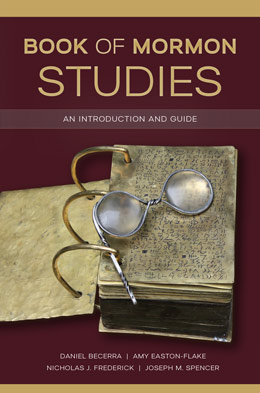
The Field
Daniel Becerra, Amy Easton-Flake, Nicholas J. Frederick, and Joseph M. Spencer, "The Field," in Book of Mormon Studies: An Introduction and Guide (Provo, UT: Religious Studies Center, Brigham Young University; Salt Lake City: Deseret Book), 31‒62.
As we’ve indicated, Book of Mormon studies has flourished in the first decades of the twenty-first century. In fact, scholars have broken new ground on so many topics—and have done their groundbreaking work in such a variety of venues—that it can be hard to get a sense for the field as a whole. It’s time, then, to survey that field. In doing so, we hope to provide readers with a map that’s clear enough to guide them wherever they want to go. The following survey divides the field into its seven major areas of ongoing research—the seven subdisciplines of Book of Mormon studies. For each, we provide a basic sketch of its history, an outline of major developments in the past two decades, and a summary of its current state and promise for the future. Full bibliographic information for any works and authors mentioned, as well as further information about publishing outfits and research institutions, can be found in the appendix.
Textual Production
A first major area of research—as old as the discipline of Book of Mormon studies but greatly enhanced by the work of many historians in recent years—focuses on what’s often called the “coming forth” of the Book of Mormon. While events surrounding the Book of Mormon’s dictation and publication drew attention from the beginning, scholarly conversation on the topic really began after Fawn M. Brodie’s 1945 work No Man Knows My History: The Life of Joseph Smith. Brodie argued that Joseph Smith, impressed by Native American mounds in western New York, set out to explain how the peaceful and culturally advanced mound-builder civilization was destroyed by its more violent and primitive neighbors. According to Brodie, the young Joseph initially intended to write a secular and explicitly fictional account—hoping only to make money for his impoverished family—but then decided for complicated reasons to transform the project into something religious and allegedly nonfictional. Brodie’s work was to that point the most sophisticated attack on the origins of the Book of Mormon. For Brodie, the Book of Mormon wasn’t sacred text but frontier mythology. When Hugh W. Nibley published a fierce rebuttal to Brodie’s work, humorously entitled No, Ma’am, That’s Not History, and then when scholars like Richard Lloyd Anderson contested much of Brodie’s primary evidence, this first category of research—the textual production of the Book of Mormon—was effectively born. Its aim is simply to reconstruct as responsibly as possible the circumstances surrounding the translation and publication of the Book of Mormon.
| Subdisciplines in Book of Mormon Studies |
| - Textual production |
| - Historical origins |
| - Literary criticism |
| - Intertextuality |
| - Theological interpretation |
| - Reception history |
| - Ideology critique |
After his initial response to Brodie, Nibley waited until the 1960s to reflect at length on the historical circumstances of the Book of Mormon’s coming forth. His work coincided with the rise of the “new Mormon history” movement that soon furnished scholars with more specialized training and serious time for archival and library research on the subject. By the 1980s, important and enduring research on the matter began to appear. Two books in particular appeared that would guide and shape further research: Richard L. Bushman’s Joseph Smith and the Beginnings of Mormonism and D. Michael Quinn’s Early Mormonism and the Magic World View. The latter, drawing on Joseph Smith’s youthful connections to folk magic, painted a picture in which the Book of Mormon was translated in the midst of a deeply enchanted culture on the margins of polite society. A decade later, John L. Brooke’s The Refiner’s Fire would develop this approach to Book of Mormon origins even further. Bushman’s study, however, foreshadowing what he’d do twenty years later in Joseph Smith: Rough Stone Rolling, presented a more measured account of things. Bushman placed the young Prophet in a historically and socially complex New England, from which he emerged with a clear sense of mission and purpose—and with a sacred book in hand.
 From Darkness unto Light. Courtesy of Religious Studies Center, Brigham Young University.
In the twenty-first century, historians have generally followed the tradition of Bushman’s book. They’ve done so, though, with the added benefit of the systematic labors of the Joseph Smith Papers Project. Michael Hubbard MacKay and Gerrit J. Dirkmaat brought such research to a remarkable first fruition in what is now the standard treatment of the coming forth of the Book of Mormon: From Darkness unto Light, published in 2015. (A follow-up that focused just on the use of seer stones was published the next year, written by MacKay and Nicholas J. Frederick.) MacKay and Dirkmaat’s book breaks much new ground; for example, it weaves a much more complex story about Martin Harris’s famous trip to visit scholars in New York City. This kind of work, though, has in many ways only begun. Recent studies—such as articles by Robin Scott Jensen and Angela Erdmann, for instance—show that much remains to be learned from close historical investigation of events surrounding the printing of the first edition of the Book of Mormon. Especially novel in this regard is Don Bradley’s recent book The Lost 116 Pages: Reconstructing the Book of Mormon’s Missing Stories—a much-anticipated study of historical sources surrounding the famed lost manuscript. Consensus about the production of the Book of Mormon has been reached on many points, but the ground has been cleared for more specialized research. And it’s likely that much of that more specialized research will have major and unanticipated interpretive and historical implications.
A subject of particular importance for students of the Book of Mormon’s coming forth—one that has not settled into consensus—is the mechanics of the translation process. How did the original language on the gold plates become the English text of the Book of Mormon? Joseph Smith was hesitant to speak about this issue, as authors often note, but believers and critics have long expressed interest in it. Eyewitnesses to the text’s dictation were less reticent than Joseph, providing descriptions in various interviews in the nineteenth century. Serious discussion of these primary sources, however, began only with B. H. Roberts in the twentieth century. Roberts was the first to seriously broach the practical difficulties posed by the Book of Mormon translation, both in reconciling witness statements with each other and in making sense of the English text of the Book of Mormon itself. Roberts pushed back against the lay notion that the Prophet simply dictated the text he saw in the Nephite interpreters, arguing for a more complex process. According to Roberts, Joseph divinely received facts and ideas and then worked to express these in his own language. This would explain apparent deficiencies in the Book of Mormon text, such as errors in spelling and grammar. Roberts further argued that when the Prophet came to sections of the Nephite record with a significant parallel in the King James Bible (like the so-called Isaiah chapters), he used a copy of the Bible as the basis for the English text.
“All the circumstances connected with the work of translation clearly prove that it caused the Prophet the utmost exertion, mental and spiritual, of which he was capable, and while he obtained the facts and ideas from the Nephite characters, he was left to express those ideas in such language as he was master of.” —B. H. Roberts, “Elder Roberts’s Reply to Criticism on the Book of Mormon,” Salt Lake Tribune, November 29, 1903
Roberts’s contemporaries and immediate successors in the Latter-day Saint intellectual community largely agreed with him, although some (such as Elder John A. Widtsoe and Brigham Young University [BYU] professor Sidney B. Sperry) worked to soften aspects of Roberts’s account. Their concerns grew out of increasing awareness that, in discussing the translation of the Book of Mormon, the historicity of the text might be at stake. Cavalier suggestions that Joseph Smith provided the language of the Book of Mormon raised questions about whether the book revealed more about its ancient authors or about Joseph Smith. Discussions of the actual mechanics of the translation process thus soon took a back seat to the quest to prove historical authenticity. Leading the charge in this direction was Nibley in his 1960s treatments of the coming forth of the Book of Mormon. Nibley argued that questions about seer stones and the like were ultimately distracting and that just trusting that Joseph’s translations were dependent on revelation was enough.
Nibley’s work was highly influential, with scholars at the Foundation for Ancient Research and Mormon Studies (FARMS) in the 1980s and 1990s often assuming that Joseph Smith wasn’t a source for the Book of Mormon text. Pointing to poetic structures and Hebrew idioms that seem to have survived the process of translation into the English text of the Book of Mormon, FARMS scholars also downplayed the mechanics of translation. Meanwhile, however, historians intrigued by increased clarity about the Prophet’s youthful folk-magic associations developed a relative scholarly consensus about the mechanics of translation and the use of seer stones—exemplified in Richard Van Wagoner and Steve Walker’s “Joseph Smith: ‘The Gift of Seeing.’” Late in the 1980s, however, an oft-cited paper by Blake Ostler appeared in Dialogue: A Journal of Mormon Thought, arguing that the English text of the Book of Mormon represents a considerable expansion of an ancient text. For Ostler, in some ways revitalizing the conversation among Roberts, Widtsoe, and Sperry, the Prophet had access to a real Nephite record but also had the freedom to cast it in his own language, even in certain ways misrepresenting the original sources. Ostler’s position was received at the time as somewhat extreme, but it became relatively common among scholars by the early twenty-first century—one of several ways of defending the antiquity of the Book of Mormon without needing to explain away every alleged trace of nineteenth-century influence in the English text of the book.
During the first decade of the twenty-first century, then, the conversation on Book of Mormon translation largely halted between two positions. The first was the one inherited from FARMS and has been most strongly represented by Royal Skousen (in various publications), who has argued that the Book of Mormon text was transmitted directly to Joseph Smith (largely) without the latter’s influence—that is, with “tight control.” Skousen developed the traditional FARMS position beyond that of the 1980s and 1990s, however, arguing (alongside his colleague Stanford Carmack) that the English text of the Book of Mormon belongs to the sixteenth rather than the nineteenth century. The second position was best represented by Brant A. Gardner (in The Gift and Power). Gardner has overtly defended the antiquity and Mesoamerican setting of the Book of Mormon. At the same time, he argues that Joseph Smith recast the ancient book in at least a gently nineteenth-century guise. Arguing thus for a model of “loose control” over the translation process, Gardner updated and clarified Ostler’s earlier work.
By the end of the 2010s, however, it was clear that numerous authors had grown dissatisfied with the two standard positions on Book of Mormon translation. In part, this is because both approaches are of interest only to believing scholars, leaving out increasingly interested scholars working from outside the faith tradition. Some believers, however, have also felt constrained by these two standard positions. The year 2020 saw the publication of a major book-length study of the idea of translation in Joseph Smith’s career (Samuel Morris Brown’s Joseph Smith’s Translation), as well as a large collection of essays (Producing Ancient Scripture) on the same subject with strikingly inventive articles on the Book of Mormon’s translation by authors like Samuel Brown, Richard Bushman, Grant Hardy, Jared Hickman, and others. All this very recent work points in rather different directions, suggesting that the conversation about Book of Mormon translation is still ongoing.
Historical Origins
A second area of ongoing Book of Mormon research concerns the historical circumstances of the Book of Mormon’s original creation (not just its translation or dictation). Some scholars seek these origins in the ancient world (often motivated by faith in the book’s claims about itself), while others seek them in the modern world (often motivated by skepticism about the book’s claims). Like questions about the coming forth of the Book of Mormon, questions about historical origins arose as early as when the book came into print. Here again, though, it’s arguably only with Fawn Brodie and Hugh Nibley, positioned at opposite extremes, that the issue came into its own as an area of scholarly research. Before them, those who wrote on the subject ventured opinions and defended them with scattershot data rather than sifting carefully through historical sources to build an intellectually defensible case. In No Man Knows My History, as already noted, Brodie developed a theory of how the Book of Mormon came into being. In direct response to Brodie, Nibley began in the late 1940s—and continued into the mid-1960s—to gather extensive data that might situate the Book of Mormon squarely in the ancient world. Proficient in numerous languages and well trained in a scholarly field that had been around for centuries, Nibley brought the wealth of classical learning to studying Book of Mormon origins. In three books that all began as Church publications in one way or another, Nibley argued that the best way to defend Book of Mormon historicity was to examine its rootedness in an Old World setting rather than to search for archaeological traces of the book in the New World.
A hundred years of amateur and hobbyist archaeological speculation about the Book of Mormon’s ancient historical setting preceded Nibley’s interventions. For that reason, Nibley took aim as much against such speculation as against critics of Book of Mormon historicity. During the very years of Nibley’s entry into Book of Mormon studies, though, amateur Book of Mormon archaeology began to give way to Book of Mormon archaeology undertaken by trained specialists—most crucially at first, M. Wells Jakeman. Despite his training, Jakeman’s work was often tendentious and problematic, and Nibley criticized it both privately and publicly during the 1950s. Both Nibley and Jakeman eventually produced followers, however, who pushed forward their respective efforts at setting the Book of Mormon in the ancient world. The two intellectuals’ heirs apparent—John W. Welch for Nibley and John L. Sorenson for Jakeman—agreed with each other much more readily than their predecessors. And so the search for Book of Mormon origins in the ancient Near East and in the ancient Americas became a kind of unified program in the 1980s, undertaken amicably by the scholars gathered about FARMS. Sorenson’s 1985 An Ancient American Setting for the Book of Mormon set Jakeman’s archaeological work on better footing, while Welch’s enormous literary output on the Book of Mormon (including his often selfless work of editing others’ scholarship for publication) continued in the vein Nibley had carved out. Welch also oversaw the editing and republication of Nibley’s writings on the Book of Mormon in four volumes of Nibley’s Collected Works in the late 1980s.
The 1980s also witnessed the rise of Brodie’s direct heirs, mostly gathered around Signature Books. Building on professionalized Latter-day Saint history, these scholars—with Dan Vogel at their head—worked to gather evidence that supported nineteenth-century origins for the Book of Mormon. Especially in Indian Origins and the Book of Mormon (but also later in Joseph Smith: The Making of a Prophet), Vogel worked to develop and substantiate Brodie’s relatively brief treatment of the Book of Mormon. He also gathered work by other scholars into a 1990 collection of essays, The Word of God: Essays on Mormon Scripture, that drew heavy fire from Stephen E. Robinson in the FARMS-published Review of Books on the Book of Mormon. A volley followed. Vogel and his colleagues responded with a direct assault on FARMS’s scholarship in essays gathered under the title New Approaches to the Book of Mormon, edited by Brent Lee Metcalfe and published in 1993. Many essays in the volume examined FARMS scholars’ historical methods—the methods of those defending the Book of Mormon’s ancient Near Eastern roots and of those defending its ancient American setting. This collection of essays in turn drew a spirited response and cemented a controversy between Brodie’s and Nibley’s heirs that continued to the end of the decade and beyond.
 Joseph Smith: Rough Stone Rolling. Courtesy of Alfred A. Knopf.
By the end of the 1990s, FARMS was producing historically oriented scholarship more prolifically than ever, and Signature Books continued to respond with naturalizing responses. But as the twentieth century gave way to the twenty-first—and especially with the appearance of Terryl L. Givens’s By the Hand of Mormon: The American Scripture That Launched a New World Religion—the intensity of the conflict lessened. As the first decade of the twenty-first century wore on, the FARMS Review (once titled the Review of Books on the Book of Mormon) and the Journal of the Book of Mormon and Other Restoration Scripture (once titled the Journal of Book of Mormon Studies) broadened their focuses and largely left the Book of Mormon behind. And with a professional discipline of “Mormon studies” taking root after Givens’s book—and especially after Richard Bushman’s 2005 Joseph Smith: Rough Stone Rolling—Brodie’s heirs grew quieter as well. The larger FARMS project, in its ancient Near Eastern and ancient American dimensions, found itself funneled into the remarkable six-volume Book of Mormon commentary Second Witness, hosted online for a time and then published by Greg Kofford Books. Written single-handedly by Brant Gardner, this commentary summed up and read critically the Old World research of 1980s and 1990s FARMS scholars while it also inherited and extended the New World research produced by Sorenson and others at FARMS.
Since Gardner’s commentary (and his follow-up volume, Traditions of the Fathers: The Book of Mormon as History), historical research on the Book of Mormon has slowed somewhat—both defensive and critical. An explosion of popular interest in the Latter-day Saint tradition during the years surrounding Mitt Romney’s 2012 presidential campaign boosted already-growing scholarly interest. And in that climate, there was more interest than ever before in nonpartisan discussions of aspects of the Latter-day Saint faith, the Book of Mormon included. Talk of “bracketing” the question of the Book of Mormon’s historical origins to study the text in its own right has become common—and has been fundamental to the early twenty-first century’s most important book on the Book of Mormon, Grant Hardy’s 2010 Understanding the Book of Mormon. As publications in the Mormon Interpreter (later renamed Interpreter: A Journal of Latter-day Saint Faith and Scholarship) show, there nonetheless remains much work to do on the historical origins of the Book of Mormon—especially to tame the zeal of amateur archaeologists who claim more than the evidence allows. Some of the best work of this sort is being done by members of BYU’s Book of Mormon Academy: Kerry Hull and Mark Alan Wright on the Book of Mormon ancient American setting and Daniel L. Belnap and Avram R. Shannon on the book’s ancient Near Eastern roots.
Approaches to the Historical Origins of the Book of Mormon | |
Theory/ | Major Figures/ |
| The Book of Mormon is an ancient document, as will be demonstrated through historical, anthropological, linguistic, and archaeological study of the ancient Americas. | M. Wells Jakeman and John Sorenson in the twentieth century; Brant Gardner, Mark Wright, and Kerry Hull in the early twenty-first century (focused principally on Mesoamerica); various figures promoting other geographical locations |
| The Book of Mormon is an ancient document, as will be demonstrated through comparative study of the text and ancient Near Eastern documents and sources. | Hugh Nibley and the Foundation for Ancient Research and Mormon Studies in the twentieth century; scholars publishing in the Interpreter journal in the twenty-first century |
| The Book of Mormon is a modern document and so should be studied as a product of nineteenth-century culture and influences. | Fawn Brodie, various historians, and those gathered around Signature Books in the twentieth century; various historians in the twenty-first century |
Literary Criticism
A third and growing area of research in Book of Mormon studies focuses on literary criticism. Whereas Hugh Nibley’s work could draw on centuries of research into the ancient Near East, bringing the Book of Mormon into contact with an old and established discipline, literary readers of the Book of Mormon have taken their cue from a much newer style of scholarship. Literary criticism on the Bible began to appear in earnest only in the middle of the twentieth century, given a name and an impetus in many ways by Northrop Frye’s 1957 Anatomy of Criticism. The first serious literary work on the Book of Mormon actually appeared slightly earlier, beginning with Sidney Sperry’s Our Book of Mormon in 1947. Sperry himself was skeptical about the literary value of the Book of Mormon, and his literary work on the book was more limited than that of the school of biblical literary criticism that would soon appear. While Sperry therefore limited himself to identifying literary genres in the Book of Mormon, he’s often looked back to as having paved the way for a new approach to the Book of Mormon.
| An Example of Hebrew Poetic Form: Chiasmus |
And now it shall come to pass, that whosoever shall not take upon him the name of Christ must be called by some other name; therefore, he findeth himself on the left hand of God. And I would that ye should remember also, that this is the name that I said I should give unto you that should never be blotted out, except it be through transgression; therefore, take heed that ye do not transgress, that the name be not blotted out of your hearts. I say unto you, I would that ye should remember to retain the name written always in your hearts, that ye are not found on the left hand of God, but that ye hear and know the voice by which ye shall be called, and also, the name by which he shall call you. (Mosiah 5:10–12) |
As literary approaches to the Bible grew in popularity during the 1970s, literary readers of the Book of Mormon began to appear as well. This included scholars, such as John W. Welch and Noel B. Reynolds, who, like Sperry before them, had training in ancient languages. They scoured the text, looking for Hebrew poetic forms. But by the late 1970s, something new was stirring. While Welch and Reynolds fused their literary interests with an aim to establish the ancient historicity of the text, other scholars began to write with more purely literary interests. Studies by George S. Tate, Steven P. Sondrup, Bruce W. Jorgensen, Richard Dilworth Rust, and Mark D. Thomas, among others, appeared in the last years of the 1970s and first years of the 1980s. Initially, these scholars gathered about a new organization with a variety of literary interests, the Association for Mormon Letters. As their work began to draw wider attention, however, they contributed important essays on the Book of Mormon to a 1981 volume published by BYU’s Religious Studies Center under the title Literature of Belief. Several contributors were speaking at the time of grand projects that would bring the Book of Mormon’s literary contributions into focus.
Most literary study of scripture in the 1970s and 1980s emphasized study of the text alone—its structure, message, and use of literary devices—rather than its social or historical background. Dominant methods included rhetorical analysis (focused on explaining the author’s intentions through investigation of poetic devices, structure, and word choice), formal analysis (focused on scripture’s artful use of language, repetition, dialogue, allusion, and ambiguity to generate meaning), and narrative criticism (focused on analyzing constitutive features of storytelling, such as plot, setting, characters, point of view, the narrator, the implied author, and the implied reader). As the 1980s wore on, however, the roads traveled by literary criticism in biblical studies and literary criticism in Book of Mormon studies diverged. In biblical studies, literary criticism grew still more popular, securing its position as a compelling alternative to tired debates over traditional historical methods. In Book of Mormon studies, however, historical research made an important resurgence, as we have seen. Historical work in fact became important enough in the 1980s and then the 1990s to cause the near-total exclusion of literary criticism that didn’t immediately align itself with a historical program of one sort or another. Especially after an essay in Brent Metcalfe’s New Approaches to the Book of Mormon endorsed treating the Book of Mormon as (what was sloganized at the time as) “sacred fiction,” it became particularly fraught to engage in Book of Mormon literary criticism.
Three books heralded a return of literary criticism to Book of Mormon studies in the late 1990s: Marilyn Arnold’s Sweet Is the Word: Reflections on the Book of Mormon—Its Narrative, Teachings, and People; Richard Dilworth Rust’s Feasting on the Word: The Literary Testimony of the Book of Mormon; and Mark D. Thomas’s Digging in Cumorah: Reclaiming Book of Mormon Narratives. All three authors offered straightforward literary analyses of the Book of Mormon that resumed the work done in the late 1970s and early 1980s, devoting attention to the artful use of language, imagery, symbolism, syntax, narrative viewpoint, compositional unities, poetic devices, literary genres, characterization, plot, and so on. Such literary work also found advocates like Edgar Snow, James E. Faulconer, and especially Alan Goff, who argued that literary insights and literary criticism’s underlying theoretical framework might be useful to defenders of Book of Mormon history. Since that time, literary interpretations have become an increasingly prolific and significant part of Book of Mormon studies.
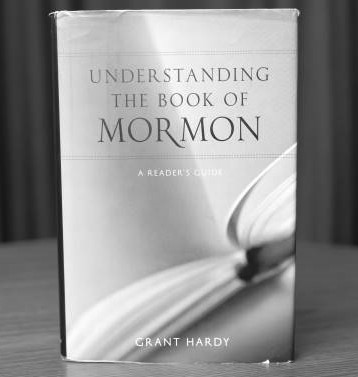 Understanding the Book of Mormon. Courtesy of Oxford University Press.
For a breakthrough literary study of the Book of Mormon, though—one that also brought the literary value of the Book of Mormon to the attention of outsiders—one had to wait until the twenty-first century. This came in the form of Grant Hardy’s 2010 study published by Oxford University Press, Understanding the Book of Mormon. Hardy had already written in 2000 an appreciation of literary work in the FARMS Review and published in 2003 a Reader’s Edition of the Book of Mormon. He made good on the implicit promises of these premonitory works in Understanding the Book of Mormon. By explicitly bracketing questions of historicity and authorship and focusing instead on the form and sophistication of the text via its narrators, Hardy modeled an approach meant to allow believers and nonbelievers alike to engage productively with the text. Using the major narrators of the Book of Mormon to organize his discussion, Hardy illustrated their representative literary techniques (such as repetition, chiasmus, intertextuality, and flashbacks). He also, though, revealed underlying organizational structures in the text that are often obscure to those approaching the text with strictly doctrinal or historical concerns. When brought to the surface, such organizational structures make the text more accessible, particularly for those less familiar with it. Hardy combines a macroscopic view of the text with insightful microscopic readings of shorter passages, making his work seminal for anyone wishing to engage with the Book of Mormon as literature.
It quickly became apparent that Hardy’s book marked a watershed moment. Literary readers of the Book of Mormon began to appear afterward in surprising numbers. Articles soon started to appear in the Journal of Book of Mormon Studies—exemplarily, Kylie Turley’s “Alma’s Hell: Repentance, Consequence, and the Lake of Fire and Brimstone”; Samuel Mitchell’s “‘Caught with Guile’: Tricksters in the Book of Mormon”; and Michael Austin’s “How the Book of Mormon Reads the Bible: A Theory of Types.” Such essays show the merits of close reading through rhetorical, formalist, and narratological lenses. The Journal of Book of Mormon Studies is published by BYU’s Neal A. Maxwell Institute (along with the University of Illinois Press) and so tends to feature authors from within the faith tradition. But the development of a strong literary angle on the Book of Mormon has been striking in Book of Mormon studies in part because it’s drawn strong contributions from outside the Latter-day Saint faith and from outside the Latter-day Saint publishing world.
 Americanist Approaches to the Book of Mormon. Courtesy of Oxford University Press.
Particularly important in setting the tone for the larger 2010s literary conversation about the Book of Mormon were two essays published in 2013–14: Elizabeth Fenton’s “Open Canons: Sacred History and Lay American History in The Book of Mormon” (published in J19: The Journal of Nineteenth-Century Americanists) and Jared Hickman’s “The Book of Mormon as Amerindian Apocalypse” (published in American Literature). Dramatically more theoretical in nature than literary studies published in traditional Latter-day Saint outlets, Fenton’s and Hickman’s essays offered new readings of the text, but they also functioned as a call to theoretically and historically inclined Americanists to look seriously at the Book of Mormon. Hickman was soon directing a PhD dissertation at Johns Hopkins University with a serious treatment of the Book of Mormon, while Fenton was teaching a graduate seminar on the Book of Mormon at the University of Vermont. In 2018 the Journal of Book of Mormon Studies published an interview with Fenton about her seminar, along with a selection of papers produced by students in the seminar. Then, in 2019, Fenton and Hickman published an edited collection of essays of immense importance. Issued by Oxford University Press and entitled Americanist Approaches to “The Book of Mormon,” this volume marks a first culmination for literary criticism and the Book of Mormon. The book brings together seventeen essays analyzing the Book of Mormon from various literary and historical approaches, indicating the new acceptance of the Book of Mormon into the academy.
On its own turf, literary theory encompasses a number of complementary and competing theoretical methods: New Historicism, narratology, structuralism, poststructuralism, formalism, deconstruction, rhetorical criticism, feminist theory, postcolonialism, and reader-response theory, among many more. Consequently, applications of literary theory to the Book of Mormon have only begun to appear. Since the 1980s, literary criticism’s vast range of possibilities and diverse set of questions have reinvigorated biblical studies, and volumes like Understanding the Book of Mormon and especially Americanist Approaches to “The Book of Mormon” show that these possibilities and questions can and likely will do the same for Book of Mormon studies.
Intertextuality
A fourth major area in Book of Mormon studies groups together several different kinds of study, all having to do with the study of the Book of Mormon’s relationship to other sacred texts (especially the Bible). Although the word intertextuality has come into use in Book of Mormon studies only recently, it nicely covers these various dimensions of research, some of which have been going on for decades longer than others. Intertextuality, simply put, is a name for relationships between different texts, and intertextual study thus asks whether there are themes, characters, or ideas common to two distinct (sacred) texts. Commonality may imply deliberate dependence, but it doesn’t have to imply any more than suggestive interaction in the mind of a reader. In biblical studies, naturally, intertextual research most commonly involves considering how New Testament authors use Old Testament texts in their writings—something that, unsurprisingly, has deepened understandings of the New Testament in remarkable ways. In Book of Mormon studies, intertextual research usually takes one of two forms. A first focuses on how the Book of Mormon adopts and adapts language, characteristics, and ideas from the Bible, whether the Old Testament or the New Testament. A second form, though, asks about how the Book of Mormon interacts (or at least might be compared) with major religious texts from faith traditions outside Christianity.
For a century, most of what was said about the Book of Mormon and the Bible was either that they confirmed and bolstered each other (the position of believers) or that the one shamelessly plagiarized the other (the position of unbelievers). Talk of either sort tended to focus on the evidence that the Book of Mormon is written in the same style and diction as the King James Bible and that it contains lengthy quotations from Isaiah, Malachi, and the Sermon on the Mount (all largely corresponding to the King James Version). These facts have played a role from the beginning in research on Book of Mormon translation, and they’ve also been important to literary study of the Book of Mormon. Further, though, they’ve called for attention in their own right as a focus of a kind of subdiscipline all their own.
Sidney Sperry laid important groundwork for a more sustained study of the Book of Mormon’s relationship to the Bible—and to the King James Bible in particular. Sperry classified and then tackled head-on some of the more complex questions posed by the Book of Mormon’s intertextual relationship with the Bible. He was the first to bring biblical scholarship to bear on the question of the Isaiah chapters in the Book of Mormon. Because many biblical scholars date parts of Isaiah (as well as its larger shape) to the sixth and fifth centuries before Christ, some have raised questions about whether these parts could have been included in brass plates taken from Jerusalem before the city’s capture by Babylon around 586 BC. Sperry’s approach to this issue, questioning the assumptions of some biblical scholars, proved deeply influential; it still appears in the writings of some scholars addressing the issue. Sperry also formed an influential answer to questions about the presence of New Testament language throughout the Book of Mormon. Sperry argued that New Testament and Book of Mormon authors had independent access to common sources that provided them with similar language. Hugh Nibley furthered and deepened Sperry’s approach to this issue in his own work.
| Isaiah Chapters and Their Equivalents in the Book of Mormon |
Isaiah 2–14 = 2 Nephi 12–24 Isaiah 29 = 2 Nephi 26–27 Isaiah 48–49 = 1 Nephi 20–21 Isaiah 50–52 = 2 Nephi 7–8 Isaiah 53 = Mosiah 15 Isaiah 54 = 3 Nephi 22 |
Less reactive and more provocative approaches to these issues came later, and they came from scholars outside the Latter-day Saint tradition. Philosopher Truman G. Madsen invited important biblical scholars to visit BYU in the 1970s, asking them to speak about the Book of Mormon in light of their own expertise. The resulting essays were published by BYU’s own Religious Studies Center in 1978, and they remain refreshingly insightful almost half a century later. James H. Charlesworth’s contribution focused on how the Book of Mormon’s notion of the Messiah compares and contrasts with Jewish texts from the centuries just before Jesus Christ’s birth. But especially important was Krister Stendahl’s treatment of the Sermon on the Mount in the Book of Mormon. Stendahl pointed to subtle differences between the Book of Mormon and biblical versions of the sermon, noting how the differences bring the sermon from the Gospel of Matthew into conversation with the Gospel of John. Stendahl’s approach thus largely set aside questions of what the connections with the Bible suggested about authorship or historicity and instead focused on how the intertextual connections, closely analyzed, revealed something about the text’s meaning.
The potential fruits of this kind of approach unfortunately didn’t really begin to appear until the twenty-first century. An important exception was Philip L. Barlow’s Mormons and the Bible, published in 1991, which dedicated a chapter to assessing the uses of biblical language in the Book of Mormon. Barlow’s book remains today the standard survey of the basic issues, with helpful data and a balanced discussion. The 1980s and 1990s were mostly given, though, to the debates between FARMS and Signature Books scholars that circled around whether Sperry’s and Nibley’s treatments of the Book of Mormon’s relationship to the Bible were defensible. At times, as in the late-1990s FARMS volume Isaiah in the Book of Mormon, discussion of intertextual issues moved beyond debate to genuine clarification and interpretation of the meaning of the text. Generally, however, the conversation remained where it had already been before Stendahl or Barlow. Especially important, then, in shifting things definitively onto new terrain was Grant Hardy’s Understanding the Book of Mormon. Hardy refused to offer simple solutions to the presence of New Testament language or potentially problematic Isaiah texts. He outlined ways believers might make sense of such intertextual relationships without compromising their faith, but he insisted that more would come from asking about what the Book of Mormon’s interactions with the Bible do for the meaning of the text rather than for its relationship to history. Hardy’s book, though, doesn’t simply call for a new approach; it models it, and to remarkable effect. Showing that the Book of Mormon can be read as creatively adapting biblical language, he has pressed intertextual relationships into the service of something approaching theology.
“The Book of Mormon narrative bulges with biblical expressions. More than fifty thousand phrases of three or more words, excluding definite and indefinite articles, are common to the Bible and the Book of Mormon.” —Philip L. Barlow, Mormons and the Bible: The Place of the Latter-day Saints in American Religion
In Hardy’s wake, the twenty-first century’s second decade has witnessed major developments in research on the Book of Mormon’s interaction with biblical texts. Joseph M. Spencer’s The Vision of All has undertaken a serious theological investigation of the uses of Isaiah in Nephi’s record. Acknowledging the importance of historical questions about Isaiah but prioritizing textual meaning, he has shown how much has remained unasked during decades of wrangling over historical issues. Similar in spirit but focused on the presence of New Testament language in the Book of Mormon is Nicholas J. Frederick’s work. In a major book-length study, The Bible, Mormon Scripture, and the Rhetoric of Allusivity, and several essays published in the Journal of Book of Mormon Studies, Frederick has examined the rhetorical functions played by New Testament language in the Book of Mormon. Further, though, he has revealed with particular force how inventively Book of Mormon texts interact with New Testament texts—breaking the dichotomy between supposedly slavish plagiarism of biblical sources and supposedly slavish dependence on ancient (but unknown) sources. Frederick’s work thus, like Hardy’s, pushes for recognizing deeper theological significance in how the Book of Mormon interacts with the Bible. Developments by Hardy, Spencer, and Frederick suggest that only the first stirring of serious intertextual work on the Bible and the Book of Mormon has yet occurred.
While most intertextual work has focused on the Bible and the Book of Mormon, several recent studies draw attention to what might be learned from setting the Book of Mormon alongside key religious texts from, for example, Islam or Hinduism. Such work is very new and thus largely untheorized. Part of the purpose in studying the Book of Mormon side by side with other scriptural texts is to reveal potentially similar teachings and clarify real differences. Particularly important in laying the foundation for future study is Grant Hardy’s “The Book of Mormon as Post-Canonical Scripture.” This essay compares the Book of Mormon with other (relatively) recently canonized works of world scripture and argues that the Book of Mormon, like them, advocates for a reopening of a closed canon. This is what the Adi Granth does for Islam’s Qur’an and what the Book of Mormon does for the Bible. A more involved example of comparative scripture that involves the Book of Mormon can be found in the Maronite Catholic scholar Jad Hatem’s book Postponing Heaven: The Three Nephites, the Bodhisattva, and the Mahdi, a study that veers strongly in the direction of theology or even philosophy of religion. The book compares the “human messianicity” (the religious disposition to save others) of the Book of Mormon’s “Three Nephites” with the bodhisattvas of Mahayana Buddhism and the Mahdi figure in Twelver Shi‘ite Islam. Hatem’s work highlights how the story of the Three Nephites can be understood as presenting something more salvific and theologically approachable than has been suspected.
Two recent publications in the Journal of Book of Mormon Studies also deserve mention for helping pave the way for intertextual study of the Book of Mormon alongside world scripture. The first, Joseph Spencer’s “Christ and Krishna: The Visions of Arjuna and the Brother of Jared,” looks at the story of the brother of Jared side by side with that of Arjuna from the Hindu sacred text the Bhagavad Gita. Spencer argues that a comparison of the two allows for a better appreciation of the revolutionary nature of the brother of Jared’s story. The second study, D. Morgan Davis’s “Prophets and Prophecy in the Qur’an and the Book of Mormon,” compares the prophetologies of the two texts. (A prophetology is a theory of what makes a prophet.) Davis’s article also does important work in theorizing comparative scripture for Latter-day Saints. Articles like these, however, mostly demonstrate that scholars have only just begun to scratch the surface of comparative work on the Book of Mormon and other religious texts.
Theological Interpretation
A fifth area of research in Book of Mormon studies has a more complex backstory than others. In certain ways, theology is the oldest lens through which the Book of Mormon has been viewed—already used by W. W. Phelps and Orson Pratt in the 1830s and 1840s. Lay and even semiprofessional theological reflection on the Book of Mormon prevailed through the nineteenth century into the twentieth. But with the intensification of historical interest in the Book of Mormon—in and after Fawn Brodie’s biography—theological reflection on the Book of Mormon largely halted. It’s ironic that the very same decades that saw the retreat of theology from Book of Mormon studies also saw the emergence of an intense program of “biblical theology” in biblical studies. Something of the same spirit that animated Christian biblical theology, however, arguably found its way into the Latter-day Saint context. This took place in what O. Kendall White Jr. has called the neo-orthodox moment in Latter-day Saint history. Growing out of Joseph Fielding Smith’s writings but coming especially into focus in the books and sermons of Elder Bruce R. McConkie, this moment involved an intense interest in doctrine. Although without training in theology or philosophy (or the history of Christianity), doctrinal thinkers and scholars drew from commonsense readings of scripture and of the teachings of Latter-day Saint authorities to construct an overarching theological picture of the Restoration.
The doctrinal framework constructed in the mid-twentieth century soon became a lens for viewing scripture. Beginning with Elder McConkie’s own three-volume Doctrinal New Testament Commentary, a style of interpretation developed that read texts largely to confirm the truth of the larger doctrinal schema of those texts. In the unstable 1980s—when literary readings of the Book of Mormon came under suspicion and reasoned defense of the Book of Mormon’s antiquity became particularly intense—religious educators at BYU found stability by transferring Elder McConkie’s program of interpretation from the New Testament to the Book of Mormon. In annual symposia (later published as collections of essays), BYU’s Religious Studies Center gathered doctrinally minded scholars to read the Book of Mormon. Doctrinal scholarship in Elder McConkie’s wake was uninterested in intellectual novelty or in simply adding to the encyclopedia of knowledge. It exhibited a spirit of loyalty rather than individuality as it wove deliberately devotional insights into doctrinal exposition. The approach was thus simultaneously learned and yet aimed at nonscholars in a particularly successful way.
The doctrinal program of interpreting the Book of Mormon came to a kind of first culmination with the four-volume Doctrinal Commentary on the Book of Mormon, primarily written by BYU religious educators Robert L. Millet and Joseph Fielding McConkie (the latter of whom was Elder McConkie’s son). Other doctrinal studies of the Book of Mormon would follow, along with other doctrinal commentaries (such as Monte S. Nyman’s six-volume Book of Mormon Commentary or D. Kelly Ogden and Andrew C. Skinner’s two-volume Verse by Verse: The Book of Mormon). From its beginning to the end of the twentieth century, such doctrinal study of the Book of Mormon proceeded without its adherents seeking training in theology or philosophy. The first decades of the twenty-first century, however, saw a tightly knit group of theological interpreters emerge—with a particular focus on the Book of Mormon—united by their training in these and closely related fields (such as literary theory).
Gathered around James E. Faulconer, a BYU philosophy professor with deep interests in philosophy of religion and the theory of interpretation, several of these young philosophers and theologians launched the Mormon Theology Seminar in 2008 (later renamed the Latter-day Saint Theology Seminar) and then Salt Press in 2011 (later absorbed into the Neal A. Maxwell Institute). The first volume published by the Seminar, focused on readings of Alma 32, opens with a manifesto of sorts that distinguishes theological interpretation from both historical research and doctrinal study. Especially important to this interpretive project is a distinction between theology and doctrine. Doctrine, editor Adam S. Miller explains, is authoritative, decided and announced by leaders of the Church. By contrast, theology is deliberately academic and speculative, addressing questions of interest to the life of faith but of little or no institutional importance. Gathering at Seminar symposia—as well as at conferences organized by the Society for Mormon Philosophy and Theology, the Association of Mormon Scholars in the Humanities, and eventually the Book of Mormon Studies Association—Latter-day Saint scriptural theologians began in the early 2010s to lay the foundations for a recognizable subdiscipline.
The first single-authored book in the strictly theological vein was Joseph Spencer’s An Other Testament: On Typology, a study that explicitly distances itself from Nibley’s historical program and Hardy’s literary program. Informed by both of these other disciplines but asking a different set of questions, Spencer’s work brings the Book of Mormon into conversation with major philosophical and theological questions (in particular, the question “What does it mean to read a text spiritually?”). Spencer’s book, moreover, opened a book series published by BYU’s Maxwell Institute starting in 2016, to which were soon added Jad Hatem’s comparative study of the Book of Mormon alongside Buddhism and Islam (Postponing Heaven) and David Charles Gore’s rhetorical-theological study of political discourse in the Book of Mormon (The Voice of the People). And similar developments were occurring elsewhere. About the same time that Spencer’s book appeared in the Maxwell Institute series, John Christopher Thomas’s A Pentecostal Reads the Book of Mormon: A Literary and Theological Introduction appeared, showing the interest that theological readings of the text can have for those outside the faith.
By the end of the 2010s, theological studies had begun appearing in journals both inside and outside the Latter-day Saint publishing context. Notable examples are Kimberly Matheson Berkey’s “Temporality and Fulfillment in 3 Nephi 1” and Rosalynde Frandsen Welch’s “Lehi’s Brass Ball: Astonishment and Inscription,” both published in the Journal of Book of Mormon Studies, and Nicholas J. Frederick and Joseph M. Spencer’s “John 11 in the Book of Mormon,” published in the Journal of the Bible and Its Reception. Another important publishing endeavor for theological reading of the Book of Mormon has been the output of the already-mentioned Latter-day Saint Theology Seminar. To date, volumes have appeared on Alma 32; 2 Nephi 26–27; 1 Nephi 1; Jacob 7; and Alma 12–13, with volumes forthcoming on Mosiah 15 and Mosiah 4. Perhaps most important, however, is the 2020 publication of a twelve-volume series of theological studies by the Maxwell Institute, marking a first culmination for theological research on the Book of Mormon. The Book of Mormon: Brief Theological Introductions features twelve different authors, each assigned a part of the Book of Mormon to address in a deliberately theological way. Featuring thinkers trained in philosophy, early Christian history, literature, and theology proper (ranging from Terryl Givens to David F. Holland and from Deidre Nicole Green to Rosalynde Frandsen Welch), the series clearly shows that theology has become an important contributor to Book of Mormon studies.
Reception History
A sixth area of active research in Book of Mormon studies has a less complicated prehistory and represents an angle on the text as new as the theological. This is the work of studying reception history. The field of reception history—of tracing the ways people have received, appropriated, and used scriptural texts throughout history—is relatively new even in biblical scholarship, but its arrival in Book of Mormon scholarship can be said to have only a very few traces before the twenty-first century. There have been reviews of the literature from the beginning of Book of Mormon studies, but reception history is a different beast. Reception historians analyze how scripture has functioned in scholarship but also in authoritative religious sermons and teaching curricula, art and literature, advertising and merchandizing, politics and scientific discourse, historiography and everything else. Aiming to understand how changing interpretations of the Book of Mormon reveal its significance, the reception historian locates these in specific cultural and historical frameworks. Since the possibilities for studying the reception history of scriptures are ever increasing, scholars have to decide with care whose responses are important for study, how to justify their choice of materials, and what methods to employ in analysis.
Early studies of the reception of the Book of Mormon focused on institutional concerns—for example, on how Church leaders have used the Book of Mormon in their writing and preaching. Seminal essays on this topic were Grant Underwood’s “Book of Mormon Usage in Early LDS Theology” and Noel B. Reynolds’s “The Coming Forth of the Book of Mormon in the Twentieth Century.” Analyzing all major Church periodicals published before 1846, as well as numerous tracts, pamphlets, and journals, Underwood found that the Saints’ earliest uses of the Book of Mormon were primarily eschatological (focused on end times) and fit a nineteenth-century millenarian worldview. His most cited finding is that early Saints quoted the Bible twenty times more frequently than the Book of Mormon. This data point was instrumental in establishing the now-common understanding that the Book of Mormon has functioned for the Saints from the beginning largely as a sign of Joseph Smith’s prophetic status. In his study, Reynolds sifted institutional records—especially those connected to BYU—to show that the Book of Mormon only slowly came to cultural prominence over the course of the twentieth century. Other important early studies of reception history, most published in the Journal of Book of Mormon Studies, concerned the history of the English Book of Mormon’s translation into a variety of languages for use by missionaries.
Terryl L. Givens’s 2002 By the Hand of Mormon proved to be a flash point for reception history. Givens took Underwood’s and Reynolds’s arguments for granted and built on them a large-scale history of the intellectual reception of the Book of Mormon. Givens traced the history of attacks on, as well as defenses of, the Book of Mormon’s historicity. That a major academic press published By the Hand of Mormon immediately drew serious attention to Givens’s argument, deepening the impression made by earlier research on the basic contours of the Book of Mormon’s reception history. Part of the impact of Givens’s study, however, lay in generating closer scrutiny of just how representative early Church periodicals were of the Book of Mormon’s role in the early Saints’ lives. Several scholars have accordingly pushed back against Givens, noting how the Book of Mormon influenced early efforts at Church organization and theology and Joseph Smith’s early social and political thought.
Leading the way in nuancing the early history of the reception of the Book of Mormon has been Janiece Johnson’s work, beginning with “Becoming a People of the Books: Toward an Understanding of Early Mormon Converts and the New Word of the Lord.” Published in the Journal of Book of Mormon Studies in 2018, this essay focuses on the private writings of early converts and shows that early Church members used the Book of Mormon much as they did the Bible. They turned to it less often than the Bible, but it was a regular part of devotional practice and a ready resource for self-understanding. Amy Easton-Flake’s work is also important in this regard. Easton-Flake has looked carefully at how members of the Church used scripture at the end of the nineteenth century in both personal and public writings. Together, Johnson’s and Easton-Flake’s work has begun to alter a long-received picture. It has also disclosed substantial differences between how women and men have employed the Book of Mormon in the Church’s history.
The fact that Givens used reception history to approach the Book of Mormon certainly played a role in making his study of interest to Oxford University Press. At any rate, the possibilities for bridging the distance between those inside and outside the faith tradition through reception history became suddenly clear with Givens’s successful study. Paul C. Gutjahr’s The Book of Mormon: A Biography accordingly soon followed, another broad reception history of the Book of Mormon but one written by a non–Latter-day Saint. Gutjahr’s book demonstrates in a way that Givens’s doesn’t the range that reception studies can have. It includes chapters on missionary work, scholarship, art and illustration, film and theater, and the translation of the text into non-English languages. Indebted to Givens and Gutjahr alike, reception history work in the 2010s quickly proliferated. Representative articles appeared in the Journal of Book of Mormon Studies, including J. David Pulsipher’s “Buried Swords: The Shifting Interpretive Ground of a Beloved Book of Mormon Narrative”; Christopher James Blythe’s “‘A Very Fine Azteck Manuscript’: Latter-day Saint Readings of Codex Boturini”; and Rebekah Westrup’s “Imaginings of the Book of Mormon: A Comparison of Arnold Friberg’s and Minerva Teichert’s Book of Mormon Paintings.” The 2021 issue of the Journal of Book of Mormon Studies, moreover, has been dedicated to sustained reflections on major aspects of the history of Book of Mormon studies as a field.
Book of Mormon reception history is of course still in its infancy. The larger contours of the Book of Mormon’s history of interpretation have been traced only in rough outline, providing only a first approximation. And detailed studies of aspects of the Book of Mormon’s reception have appeared for only a very few contexts. But because reception history—like literary study and to some extent theology—is removed from debates over historicity, it has particular promise for appealing to an audience of outsiders as much as to an audience of insiders. What’s clearest, though, is that the vast majority of reception history work remains undone. Potential studies in this vein of scholarship are limitless, and they’re crying for attention. Students of the subject may choose to consider how the Book of Mormon functions in contexts ranging from the tracts of nineteenth-century apocalyptic religious factions to the twenty-first-century production of action figures, from long-forgotten curriculum materials early in the twentieth century to personal devotional practices among working mothers in the international Church at the end of the twentieth century. Further, reception history points the way toward a field of Book of Mormon scholarship more invested in and aware of a wide range of readers, studying a book that sits in the hands of an increasingly diverse readership.
Ideology Critique
A final area of research in Book of Mormon studies concerns questions of diversity. Book of Mormon scholarship has followed a historical trajectory that’s similar to that of other disciplines in at least one crucial way. As the number of scholars from traditionally underrepresented demographics and diverse disciplinary backgrounds has increased, the contours of the field have changed in important ways. Thus, the last couple of decades have witnessed, alongside other developments, increasing interest in topics like disability, gender, race, postcolonialism, social justice, and the Book of Mormon’s relation to other religious texts. There has also been an increase in what scholars call “ideological” approaches to studying the Book of Mormon—that is, research that deliberately examines the text from the perspective of a particular social group, intentionally attentive to that group’s concerns and commitments. These methods of interpretation take seriously the notion that scripture is a living text, a text to be likened to the individual circumstances and the concerns of all its readers, wherever and whenever they live.
“The strength and beauty of a holy text is that it can be read again and again, with different and new understandings and insights revealed every time. A holy text is not exhausted by a single interpretation; it compels readers to return and review, reexamine, and reinterpret.” —Fatimah Salleh and Margaret Olsen Hemming, The Book of Mormon for the Least of These, vol. 1, 1 Nephi–Words of Mormon
First stirrings of readings along these lines can be traced once more to Hugh Nibley, whose speeches and writings on the Book of Mormon from the late 1960s onward (and especially during the 1980s) largely left off addressing historical issues in order to ask about the political and economic relevance of the Book of Mormon. Other readers followed suit in the wake of the social upheavals of the 1960s—among them John Sorenson (on racial matters) and Eugene England (on racial matters and also on questions of violence). A particularly important example of such readings somewhat later in the twentieth century is the handful of feminist interpreters who began writing about women in the Book of Mormon. Some of these hoped to defend the book against charges of misogyny (such as Jerrie W. Hurd, Francine R. Bennion, and Camille S. Williams), while others concluded that the book is ultimately patriarchal (such as Carol Lynn Pearson and Lynn Matthews Anderson). All, however, contributed in crucial ways to questions that have become only more prominent in the twenty-first century. Racial issues were less consistent than gender issues in drawing attention among Book of Mormon scholars during the last decades of the twentieth century, despite certain important contributions. This seems to be because other parts of Latter-day Saint scripture (especially the Book of Abraham) and history drew the bulk of attention concerning race.
Really, though, the broadening of these important concerns into a wider range of ethical motivations for interpreting the Book of Mormon had to wait for the twenty-first century. Recently, interest in these and many related issues has expanded dramatically. Blair Dee Hodges’s “A Disability Studies Reading of Moroni Chapter 8” is, for example, the very first study of its kind. Hodges examines the Book of Mormon’s treatment of infant baptism in light of concerns regarding baptizing individuals with intellectual or developmental disabilities. His essay argues that because baptism serves more functions in the Book of Mormon than representing or activating a remission of sins, people with disabilities might more often be included rather than prohibited from participating in the practice. For such individuals, baptism might function primarily as an adoptive ordinance, which would symbolically welcome them into the family of Saints. Hodges has opened the door for the possibility of disability research in the Book of Mormon, but that door has been open for such a short time so far that it remains unclear how soon other scholars will walk through.
Much more work has appeared in recent years about race and gender in the Book of Mormon. A particularly forceful and novel approach to questions of race in the book appeared in Jared Hickman’s 2014 “The Book of Mormon as Amerindian Apocalypse,” an important literary contribution as well as a reflection on race in the book. Hickman argues that the Book of Mormon indeed contains a problematic and worrisome portrayal of race but also that it contains a deliberate critique of that same portrayal of race. The book thus, in Hickman’s terms, undertakes a “metacritique” of racism and racialism that’s of interest far beyond simplistic yes-or-no questions about whether the Book of Mormon is racist. Hickman’s approach has rapidly become generative, shaping much that’s been published in the past decade—for example, Peter Coviello’s treatment of race and the secular in Make Yourselves Gods: Mormons and the Unfinished Business of American Secularism.
 Minerva Teichert (1888-1976), Love Story, 1949-1951, oil on masonite, 36 x 48 inches. Brigham Young University Museum of Art, 1969.
A similar argument about the Book of Mormon, but one that’s focused more on gender than on race, has appeared in Kimberly Matheson Berkey and Joseph M. Spencer’s 2019 essay “‘Great Cause to Mourn’: The Complexity of The Book of Mormon’s Presentation of Gender and Race.” Berkey and Spencer argue that the Book of Mormon resists misogyny in something like the way it problematizes race: by portraying a devastating history of violence toward women but then including important prophetic critiques of that history. In her contribution to the 2020 The Book of Mormon: Brief Theological Introductions series, Deidre Green made a similar argument at greater length and with further nuance. Arguing that the Book of Mormon might be an asset rather than a liability when it comes to pushing for real equality between the sexes, Green portrays a book of scripture that’s of deep relevance in the twenty-first century. These contributions are, though, just a sampling of what’s happened in recent years. Recognizing the need for more visibility of good work on these topics, the editors of the Journal of Book of Mormon Studies have helpfully published detailed reviews of the literature on the Book of Mormon and race (in the 2018 issue) and on the Book of Mormon and gender (in the 2020 issue).
 Review of Book on the Book of Mormon and Journal of Book of Mormon Studies. Courtesy of Neal A. Maxwell Institute for Religious Scholarship.
The past two decades have also played host to a fusion of reception studies with interest in politically complex issues. A good example is Stanley J. Thayne’s essay “‘We’re Going to Take Our Land Back Over’: Indigenous Positionality, the Ethnography of Reading, and The Book of Mormon.” Thayne’s essay draws attention to the ways that a citizen of the Catawba Indian Nation reads and understands the Book of Mormon. It thus provides an interpretation of the text that scholars easily miss because of their social locations and ideological perspectives. Similar work has appeared from Elise Boxer (“The Book of Mormon as Mormon Settler Colonialism”), Farina King (“Indigenizing Mormonisms”), Thomas W. Murphy (“Other Scriptures: Restoring Voices of Gantowisas to an Open Canon”), and Hayes Peter Mauro (Messianic Fulfillments: Staging Indigenous Salvation in America). Yet another question in which reception studies has productively fused with moral and political concerns is violence. Recent work, especially work by J. David Pulsipher and Patrick Q. Mason, considers the history of how Latter-day Saints have read the Book of Mormon’s more violent episodes—such as Nephi’s killing of Laban and Captain Moroni’s management of long wars—and asks how changing interpretations might assist in promoting a nonviolent reading of the Book of Mormon.
Still other works attend to issues of social justice more broadly, such as Todd M. Compton’s essay “The Spirituality of the Outcast in the Book of Mormon.” A particularly noteworthy recent publication of this sort is Fatima Salleh and Margaret Olsen Hemming’s The Book of Mormon for the Least of These, a commentary in several volumes (although only the first volume has as yet appeared). Authored by trained scholars but written to reach nonspecialist audiences, the book explores the first seven books of the Book of Mormon for messages about inequality, oppression, antiracism, nonviolence, and other issues relating to social justice. The volume differs significantly from previous Book of Mormon commentaries in that its primary interests aren’t doctrinal, historical, or literary aspects of the text. Rather, Salleh and Hemming’s goal has been to help readers work against oppression and see the world through the lens of a gospel in which the first will be last and the last first. The commentary brings into focus and provides a center of gravity for decades of scattered reflections on what it means to read the Book of Mormon with an eye to social justice, ensuring that the text can be scripture for all readers. It turns the interpretive kaleidoscope, allowing readers to view the text from different angles and perspectives. Indeed, all the work gathered under this final category of Book of Mormon research evaluates and critiques often unacknowledged assumptions of both scriptural authors and traditional interpreters of their writings.
* * *
For each of the subdisciplines that make up the field of Book of Mormon studies, there is an interesting and informative prehistory behind the current conversation. Also, though, over the past two decades, the field has matured and developed in significant ways in all its subdisciplines. There is every reason for scholars to press forward in each of these different areas of principal interest. There is especially good reason for them to do so while being deeply informed about the good work that has been done and thoroughly aware of the most recent developments in the field. Too often a lack of awareness of others’ work has marred otherwise productive research by people working in Book of Mormon studies. This can be easily improved with conscious effort and greater access to past research. It is, however, only one of many obstacles facing the discipline.
