
 menu icon in the top, right corner of the screen.
 icon above to close this box.
 icon at the bottom of the screen below the browser—if you don't see it, swipe up to unhide it.
Common Questions
Daniel Becerra, Amy Easton-Flake, Nicholas J. Frederick, and Joseph M. Spencer, "Common Questions," in Book of Mormon Studies: An Introduction and Guide (Provo, UT: Religious Studies Center, Brigham Young University; Salt Lake City: Deseret Book), 83‒108.
We’ll dedicate the present chapter to the first of these ways of getting precise about the changing shape of Book of Mormon studies. And then we’ll dedicate Chapter 5 to the second. Here, then, we want to ask how scholars today tend to answer yesterday’s questions. We’ll do so by asking two questions several times over. First, how did Book of Mormon scholars in the twentieth century approach certain key issues? And second, how do Book of Mormon scholars working now in the twenty-first century tend to approach the same key issues? We’ll ask these questions for each of seven different issues in Book of Mormon studies: the nature of the translation, changes made to the text, supposed modern sources for the Book of Mormon, alleged anachronisms within the text, Isaiah’s place in the Book of Mormon, the text’s use of New Testament language, and the question of Book of Mormon geography.
| Seven Questions about the Book of Mormon |
| How was the Book of Mormon translated? |
| Why have changes been made to the text of the Book of Mormon? |
| Did the Book of Mormon derive from nineteenth-century texts? |
| What about anachronisms in the Book of Mormon? |
| Does language from Isaiah belong in the Book of Mormon? |
| Does the Book of Mormon depend on the New Testament? |
| Where did the events of the Book of Mormon take place? |
How Was the Book of Mormon Translated?
In chapter 2 we gave some attention to the question of translation in our discussion of the subdiscipline of studying the textual production of the Book of Mormon. This already familiar issue serves as a helpful introduction to changing approaches even to traditional questions. Joseph Smith’s story about gold plates and angelic visits has always been a challenge—or even a scandal—to those outside the faith, especially to the irreligious. This of course hasn’t changed with rising academic interest in the Book of Mormon. The simple fact that the angel Moroni took the plates away after their translation is an affront to anyone hoping for an unbiased investigation into the Book of Mormon’s truth. Left only with an English text (and its various translations into other languages), how is one to determine the relationship between the Book of Mormon and the ancient origins it claims for itself? We call the book a translation, but what does “translation” mean if the translated text can’t be compared to the original? There are questions here for believing Latter-day Saints as well. Is there supposed to be a tight correlation between the English text of the Book of Mormon and the characters inscribed on the gold plates? What was Joseph Smith’s role in providing the English text of the book? Does the Book of Mormon reflect only the voices of its ancient and original authors, or does it also reflect the voice of its modern translator?
As we pointed out in chapter 2, over the course of the twentieth century two contrasting positions emerged among believing Book of Mormon scholars in response to these questions. Both positions developed in response to critics of the Book of Mormon. The earlier and perhaps most common position holds that Joseph Smith was given the words he dictated to his scribes, and so he didn’t directly inform the shape or diction of the translation. Today this position is usually called the “tight-control” model. It has been especially endorsed by FARMS scholars and particularly by Royal Skousen in recent years. The other position—first endorsed by B. H. Roberts, but more recently in the literature by Blake T. Ostler and Brant A. Gardner—holds that the Prophet received impressions rather than words and that he then had to decide which words (and perhaps even ideas) to use in giving shape to those impressions. This second position is usually called the “loose-control” model. Tight control arguably makes better sense of existing eyewitness descriptions of the translation process, while loose control seems better able to account for aspects of the text that appear more modern than ancient (but without giving up on the antiquity of the text).
| Two Contrasting Positions |
| Traditional model: tight control |
| The slowly emerging alternative (from B. H. Roberts through Blake Ostler to Brant Gardner): loose control |
The tight- and loose-control models represent extremes. There might of course be tighter or looser models on a sliding scale between the most extreme positions. Middle-ground positions might in fact prove most comfortable to believing scholars, since both extreme positions have some explaining to do. Those who have argued for tight control not only have felt pressure to explain every aspect of the text that looks modern in terms of ancient history but also have felt, at times, a responsibility to explain who exactly gave the translation of the text to Joseph Smith. Thus, tight-control theorists have occasionally speculated about which individual on the other side of the veil provided a translation of the ancient text that then appeared on the seer stones. At the other extreme, those who argue for loose control have felt a need to account for existing eyewitness statements that describe Joseph Smith working with a seer stone and some kind of visual experience. And so loose-control theorists have found themselves speculating about how the mind interacts with a seer stone. Seeking a position between these extremes hasn’t proven to be much easier. Those somewhere in the middle have had the unenviable task of determining where the contributions of ancient authors end and where the modern Prophet’s contribution begins.
 A replica of the gold plates. Photo by Gerrit J. Dirkmaat.
To scholars working outside the Latter-day Saint tradition, of course, this whole debate is moot. Rejecting the idea that Joseph Smith had a prophetic gift and rejecting the existence of an ancient New World Israelite people who created gold plates, such scholars simply assume the Book of Mormon had its origins in the nineteenth century. Thus, the conversation about how much the Book of Mormon reflects ancient sources or a nineteenth-century American perspective, while intense and of obvious interest to believers, remains insider talk. This debate has been most intense among those individuals involved in traditional debates over Book of Mormon historicity. Believing scholars who are more interested in questions we’ve mentioned in previous chapters and who work to speak to those within and without the Church often refrain from taking an overt position on this insider debate. They prefer to write simply and exclusively about the English text of the Book of Mormon rather than about the relationship between the English text and the gold plates. They of course believe that Moroni delivered gold plates to Joseph Smith but are unsure how much can constructively be done in trying to prove or disprove the divine origins of the plates. There’s plenty of work to do just in trying to understand the text God has given the modern world, regardless of what other work can be done to decide how much the respective environments of original production and ultimate translation shape the text we know. Many believing scholars are now putting their efforts toward answering questions simply about the meaning of the text.
For many of these scholars, we could say that their very methods assume a kind of tight control that they nonetheless feel no responsibility to defend. In other words, many believing scholars assume that what we have in the English Book of Mormon represents what God wants us to have and that the Prophet’s primary role was as a transmitter of that text. This, though, doesn’t mean for such scholars that the text is wholly foreign to the nineteenth-century context in which it appeared. It means only that they’re unconvinced that whatever smacks of the nineteenth century was the Prophet’s rather than God’s contribution. For our own part, we in fact find devotional comfort in the idea that God wished to ensure that an ancient text would have real relevancy in the context of its latter-day appearance. We marvel at God’s love and mercy that is manifested in the words he used as he gave the text to his Prophet “in his own language” and idiom so that the text could be given to the world (Doctrine and Covenants 90:11). With this model, the Book of Mormon as God gave it to Joseph Smith through divine means refuses to remain trapped in the ancient world where it originated. Instead, it makes its relevance to the modern world evident in the English text, which is our subject of study.
“To the question ‘What was the original language of the Book of Mormon?’ the real answer is: It is English! For the English of the Book of Mormon comes by revelation, and no one can go beyond revelation in the search for ultimate sources. Let us, then, rejoice in the text we have and not attempt to reconstruct it in Hebrew or Egyptian so that we can then analyze and translate what we have written!” —Hugh Nibley, The Prophetic Book of Mormon
Why Have Changes Been Made to the Text of the Book of Mormon?
As Joseph Smith dictated the Book of Mormon’s contents to his scribes, they recorded his dictation on what came to be called the original manuscript. As translation ended and printing began, the Prophet assigned Oliver Cowdery to copy the entirety of the original manuscript, thus creating a printer’s manuscript for use in production (while the original was kept safe). Although much of the original manuscript no longer exists (much of it was damaged in storage during the nineteenth century), the fragments that do remain can be compared with the printer’s manuscript, and there are interesting differences between the two. Some differences suggest simple errors on the copyist’s part, others that Cowdery struggled to read the original, and still others that there were transcription errors in the original that needed correcting. We can tell, then, that even before the Book of Mormon saw its way into print, there were already minor difficulties in deciding on the exact text of the book.
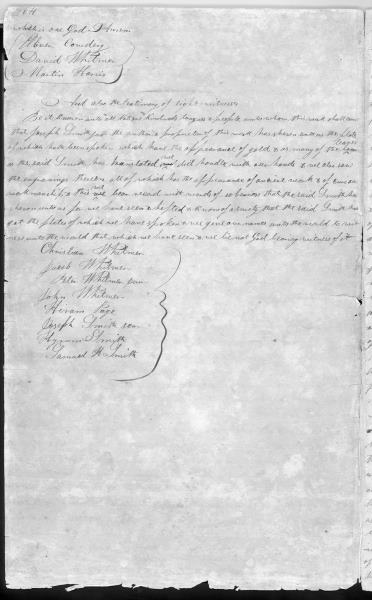 List of Eight Witnesses, Book of Mormon printer's manuscript. Copied by Oliver Cowdery, Church History Library.
Then four editions of the Book of Mormon appeared during Joseph Smith’s lifetime, all under his authority but three under his close supervision. The first appeared in 1830 in Palmyra, New York, set by John Gilbert largely (but not entirely) from the printer’s manuscript. Gilbert introduced punctuation along with—occasionally by mistake but at times intentionally—other variants into the text. The second edition appeared in Kirtland, Ohio, in 1837, set anew from the same printer’s manuscript. Oliver Cowdery had primary responsibility for printing this edition, but not before Joseph himself directly revised the printer’s manuscript with his own pen. The Prophet made over a thousand changes, most of them linked to fixing grammar or updating archaic language. A few changes were of potentially greater significance, however, such as changing “God” to “Son of God” in 1 Nephi 11:18. The Church then issued a third edition of the Book of Mormon in 1840 in Nauvoo, Illinois, with Don Carlos Smith (the Prophet’s brother) and Ebenezer Robinson as the printers. This edition included further corrections and a few clarifications, such as a shift from “a white and a delightsome people” to “a pure and a delightsome people” in 2 Nephi 30:6. The printers clearly consulted the original (and not just the printer’s) manuscript for this edition and corrected certain errors from the first two editions. Finally, a fourth edition appeared in 1841, removed from Joseph’s close supervision because it was published in Liverpool, England. It was largely reproduced from the 1837 edition.
The question for believing readers of the Book of Mormon in all this is how to understand the Prophet’s consistent efforts to revise the text of the book. If the words of the Book of Mormon were granted by the gift and power of God and correctly written down by scribes, isn’t the earliest or original text what God wants us to have in the book? Why change it? And what of the Prophet’s famous statement that the Book of Mormon is the most correct of any book?[1] It’s true that the overwhelming majority of the changes made by Joseph had to do with grammar, but one might still ask why God wouldn’t have given a grammatically flawless text in the first place. Isn’t it especially concerning that some changes appear to alter doctrinal content?
These questions occurred to—or were forcefully posed for—Latter-day Saints in the twentieth century as well. Scurrilous pamphlets announcing thousands of changes to a supposedly divine text have appeared occasionally. But sincere questions about the print history of the text have occurred to earnest believers as well. As such, various writers have attempted for a long time to provide answers to questions about the text’s transmission history. Really, the full scope of what needs addressing wasn’t available to scholars until Royal Skousen’s work on the textual history of the Book of Mormon matured. Even before that maturation, though, standard answers took shape that remain in circulation today.
For the most part, what has shaped these answers has been whether the one providing an answer endorses what we now call tight or loose control in understanding the process of translation. For those who embrace loose control—or who at least aren’t uncomfortable with a certain degree of looseness in God’s control over transcription and publication—the questions are largely toothless. That is, the questions seem to such individuals to have force only if one grants the specific notion that neither ancient nor modern prophets could have been under divine influence while producing grammatically incorrect or theologically imprecise language—things that would require correction or clarification later. A loose-control model rejects this idea at the theoretical level. Those who embrace tight control or push toward the tighter end of the spectrum have tended to come up with other (and sometimes rather ingenious) explanations for the grammar of the Book of Mormon. For example, Royal Skousen and Stanford Carmack have argued that there is no incorrect grammar in the Book of Mormon in its earliest form. There’s only nonstandard grammar, akin to the language of early modern English (from a couple of centuries before Joseph Smith’s own nineteenth century).[2] Joseph Smith’s and others’ editing of the text later was, for such scholars, a human affair—expressions of a sense of propriety had by those who work to see the Book of Mormon received well by its readers.
Many scholars working in the field today tend to regard the changes made to the text of the Book of Mormon as simply a familiar dimension of Joseph Smith’s work with his revelations and translations. In this context, we should all recognize that the editorial treatment of the Book of Mormon’s text from the moment of its initial reception has been extremely conservative. Quick comparisons with the histories of the revelation in the Doctrine and Covenants or the texts making up the so-called Joseph Smith Translation show just how stable the Book of Mormon text has been from the beginning. For many Book of Mormon scholars today, then, the historical changes made to the text of the Book of Mormon are so relatively insignificant and so theologically unimportant that they’re largely beside the point. Work on the textual history is of course important, as we discussed at length in a previous chapter, because it enables the best readings of the text. However, from the point of view of most scholars working in the field today, it’s only understandable that Joseph Smith received the text in the language and diction that made it immediately accessible to him and those around him and that he and other Church leaders later worked to make it immediately accessible to a wider readership or later generations with more education. The tension in the Book of Mormon’s editorial history has always been between modernizing or clarifying the text and leaving the historical and theological teachings of the book untouched. For most today, it looks like the Prophet and his heirs did good and certainly understandable work as they sought to balance competing loyalties.
Did the Book of Mormon Derive from Nineteenth-Century Texts?
Once the Book of Mormon was in print, it attracted the attention of critics, and that situation hasn’t abated in the nearly two hundred years since it began. One consistent form of critique has been to argue that Joseph Smith was influenced by contemporary texts. Some claimed early on that the so-called Solomon Spaulding manuscript provided a narrative framework the Prophet could easily have adopted. Later it was Ethan Smith’s View of the Hebrews that some claimed offered Joseph Smith ideas about connections between Israelites and Native American origins. Most recently, Gilbert Hunt’s The Late War between the United States and Great Britain has been identified as a possible catalyst for Joseph Smith’s writing an American history in biblical language. The first of these three alleged influences on the Book of Mormon drew extensive attention in the nineteenth century. The second drew much attention in the twentieth century. The third has only begun to draw attention in the twenty-first century.
 Manuscript Found: The Complete Original "Spaulding Manuscript". Courtesy of Religious Studies Center, Brigham Young University.
The earliest of these three theories asserted that Joseph Smith plagiarized the Book of Mormon from a manuscript written by Solomon Spaulding and passed to Joseph by Sidney Rigdon (who supposedly acquired the manuscript in Pittsburgh, Pennsylvania). Like the Book of Mormon, Spaulding’s tale centered on a group of refugees (Roman in Spaulding’s story) who landed in the Americas and interacted with different native tribes. Although no one could locate a copy of Spaulding’s manuscript, several individuals swore affidavits that the Spaulding manuscript and the Book of Mormon overlapped in several places—including names of characters and major plot points. In 1884, though, Spaulding’s actual manuscript resurfaced and made clear that, except at the broadest and therefore irrelevant level, the two manuscripts shared nothing. Apart from a few hobbyists, critics soon ceased to espouse the theory. At about the same time, though, critics turned to View of the Hebrews as a possible source text and developed a second theory. In 1823, Ethan Smith, a Congregationalist pastor from Vermont, published a well-received book arguing that Native Americans descended from the lost tribes of Israel. Parallels between View of the Hebrews and the Book of Mormon were more compelling than those between Spaulding’s manuscript and the Book of Mormon. B. H. Roberts, a believing Church leader in the first half of the twentieth century, famously wrestled long and perhaps inconclusively with parallels he found between the two books. Even in this case, though, the parallels are too broad to justify any theory of actual dependence, and the differences in conception are striking and important.
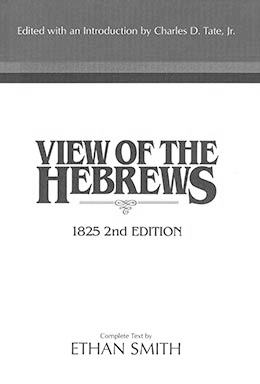 View of the Hebrews. Courtesy of Religious Studies Center, Brigham Young University.
A newer theory, motivated in a similar way, has emerged in just the last few years. The Late War plays the key role in the most recent attempt to discover a secular source for the Book of Mormon. This book, written in 1816 by Gilbert J. Hunt, was an attempt at a history of the War of 1812 in biblical style, representative of a genre of “pseudo-biblical” histories popular in the United States around the beginning of the nineteenth century. Because the book uses phrases such as “and it came to pass,” alludes to “freemen” and “king-men,” includes a possible chiasm, narrates the building of a ship, and relays a story of two thousand soldiers who fight against King George III, some have argued that Joseph Smith read The Late War in school and (consciously or even unconsciously) modeled the Book of Mormon after it. As with View of the Hebrews, many of the parallels in this case are broad or general ones, and similarities in language are rooted in both books having a biblical style (that of the King James Version).
Unsurprisingly, Latter-day Saint scholars have worked throughout the history of the Church to discredit these theories. While the Spaulding theory eventually undid itself (with even a critical biographer like Fawn M. Brodie emphatically refuting it), the Book of Mormon’s possible connections with View of the Hebrews and The Late War are still objects of interest today. For the most part, responses to these latter two theories have taken the shape of careful articulations of the real and telling differences between the alleged sources and the Book of Mormon itself. Establishing actual literary dependence is very difficult, especially the direct literary dependence that would be needed for a compellingly definitive argument against the Book of Mormon’s antiquity. At most, similarities between the Book of Mormon and View of the Hebrews or The Late War suggest that certain biblically influenced ideas and certain biblical turns of phrase were in the air in the early nineteenth century. But that’s no surprise. That the Book of Mormon would show up in a context where it would make cultural sense is the kind of thing any believer in the book ought to affirm.
For precisely these reasons, many or most scholars working in the field of Book of Mormon studies today don’t give much time or attention to these tired theories about alleged nineteenth-century sources for the Book of Mormon. Of course, some scholars working in the field do pay attention to these works, but principally as resources for clarifying the cultural context in which the Book of Mormon appeared and within which it had its first impact. Even non–Latter-day Saint scholars like Elizabeth Fenton (writing about Ethan Smith) and Eran Shalev (writing about Gilbert Hunt) don’t express interest in questions about the Book of Mormon’s sources but rather in questions about how the Book of Mormon was received in a context where books like View of the Hebrews and The Late War were popular. Thus, while understanding why potential connections between these works and the Book of Mormon might be troubling to believers, Book of Mormon scholars today tend to turn to these works with a completely different set of questions—hoping mostly to understand where and how the Book of Mormon was unique and where and how it may have changed popular understandings of the location of the lost ten tribes of Israel or the usefulness of biblical language in presenting history.
What about Anachronisms in the Book of Mormon?
Other long-standing critiques of the Book of Mormon concern elements of the text that might seem to fit better into the nineteenth-century context of the book’s appearance than in the ancient world. We briefly mentioned such elements above in connection with theories of translation. Still other long-standing critiques focus on things mentioned in the book that someone like Joseph Smith might have naturally believed would fit but that wouldn’t fit in pre-Columbian America, according to the best of current scientific knowledge. These sorts of critiques thus concern anachronisms—that is, things out of place in the time that the text claims to describe. Critics, for instance, point to the Book of Mormon’s references to steel and silk or to horses and elephants. Or they point to things like (relatively) democratic ideas or ideals, strongly racializing language, or religious questions of particular concern in pre–Civil War American culture. For critics, these kinds of things suggest origins in the nineteenth century. For believers, some explanation is needed. Unfortunately, these details are harder to explain than any of the supposed problems we’ve surveyed in the previous three sections.
The kinds of responses to these difficulties from early in the history of the Church and continuing into the late twentieth century aren’t hard to imagine. Some have pointed out the fallibility of archaeology as a discipline or underscored its being in an infant state for ancient America. Some have pointed to certain obstacles to archaeology in particular regions where the Book of Mormon’s events may have taken place, or they point to scattered anomalies in the archaeological record that suggest a more complicated picture than the current consensus endorses. Some have explored the possibility that certain English words in the Book of Mormon are approximations for ancient words that shouldn’t be taken too literally or that they’re accurately translated but were brought by Jaredites, Nephites, or Lamanites from the Old World and then used (technically inaccurately) to refer to somewhat similar New World things. Others point out sometimes subtle and sometimes not-so-subtle differences between political ideas or religious issues as they’re raised in the Book of Mormon and as they were of concern in nineteenth-century America. In most such work, the emphasis has been on explaining away each potential anachronism, one by one.
 Image of green seer stone next to an egg. Courtesy of L. Tom Perry Special Collections, Harold B. Lee Library, Brigham Young University.
For many scholars working in the context of twenty-first-century Book of Mormon studies, though, it seems these difficulties don’t hold their attention often or for long. Those who have written on the issue (for example, Adam S. Miller) tend to point out that anachronisms are something one should naturally expect from any good or useful translation. The Book of Mormon, after all, claims only that it’s a translation, by the gift and power of God, of what was written anciently by a few men whose eyes were squarely and prophetically focused on the last days. And prophecy is itself anachronistic—out of sync with the time of its utterance. So also is translation an anachronistic enterprise, a representation of things native to one context featured in a wholly different context, alienated from its proper time as it inhabits another. If the Book of Mormon weren’t anachronistic in certain ways, it would be unintelligible to modern readers. Also, if it weren’t anachronistic in a deep sense, it wouldn’t be prophetic or prepared to call the world to repentance in the last days.[3] Of course, this or that particular anachronism might well get under someone’s skin, and there’s certainly reason to work up some explanation of it. For many today, though, what’s most important about addressing any particular anachronism in the Book of Mormon is to understand the passage or context in which it appears. Indeed, for the believer, to see this task as important is itself a gesture of faith. And where it isn’t immediately possible to answer all the questions we have about the text, believing scholars seem to trust that it’s occasionally necessary to sit patiently and faithfully, living with a bit of mystery and refusing to let lingering concerns distract them from what matters most.
Does Isaiah Belong in the Book of Mormon?
Two potential anachronisms in the Book of Mormon deserve more discussion because they have drawn a special sort of attention in past literature and in present research. The first concerns Isaiah. The past century and a half has seen a consensus emerge among biblical scholars that the book of Isaiah weaves together writings that originated in three dramatically different periods of Israel’s history. The first set of writings is generally believed to go back to Isaiah of Jerusalem, who wrote during the eighth century before Christ. The second and third sets of writings, however, are believed to have originated more than a century later than Isaiah’s own lifetime and to have been appended to the collection of Isaiah’s writings long after his death. Isaiah scholars debate the details, but the vast majority agree on the general picture. It’s important to note that there are Isaiah scholars who take a dissenting position, but nearly all who dissent begin from conservative Christian theological assumptions about biblical inerrancy (that is, the idea that the Bible is wholly without error because it’s God’s word).
| Prevailing Views of Isaiah Authorship |
| Mainstream biblical scholarship divides Isaiah into three parts: |
|
|
|
All this poses difficulties for the Book of Mormon because Nephi (and Abinadi more briefly) quotes from certain supposedly later portions of the book of Isaiah. According to the Book of Mormon, Nephi and his family left Jerusalem with the brass plates (Nephi’s source for Isaiah) at the beginning of the sixth century before Christ. At least parts of what he quotes from Isaiah, however, are generally believed to have originated no earlier than a few decades into the sixth century—and certain other parts still later. Even the uncontested parts of Isaiah that Nephi quotes, it’s often argued, only received the shape they have in the Book of Mormon rather late, decades after Nephi’s family would have left for the promised land. The predominant scholarly consensus thus suggests that there’s something anachronistic about the Book of Mormon’s quotations of Isaiah. Put simply, to some it seems Nephi quoted from a text that didn’t yet exist at the time he was writing his record. This difficulty has long been recognized by Latter-day Saint scholars, who have been writing about it since the 1930s.
 The Great Isaiah Scroll. Courtesy of Wikimedia Commons.
Too eager to solve this potential problem for the Book of Mormon quickly, some have suggested that biblical scholars come to their conclusions simply because they don’t believe in real (predictive) prophecy. In other words, they don’t believe that Isaiah could have been aware of events that would occur after his lifetime and thus believe that he could not have written about them. But this response, which already appeared in the 1930s, unfortunately oversimplifies matters. It’s true that biblical scholars—and really, scholars of all kinds—are too quick to draw secularizing conclusions without having sifted all the evidence, but there are various kinds of evidence that have led scholars to their conclusions regarding Isaiah’s authorship. Additionally, it’s uncharitable and inaccurate to insist that the conclusions of biblical scholarship result solely or even primarily from the scholars’ worldviews. To be sure, worldviews always play a role in scholarship, but so does evidence, and it’s the evidence that needs to be dealt with. To show that passages from the book of Isaiah quoted in the Book of Mormon existed in their final form by the time Nephi acquired the brass plates, it would be necessary to engage directly and convincingly with the evidence for dating discussed by Isaiah scholars. Notably, more substantial responses along such lines did indeed appear at various points in the twentieth century. Such work most commonly investigated the places where the Book of Mormon’s version of Isaiah’s words differs from the biblical version. Scholars from Sidney B. Sperry to John A. Tvedtnes labored to show that some of these variants match up with other variant Isaiah texts known from the ancient world in unanticipated and surprising ways.[4]
| Parts of Isaiah quoted in the Book of Mormon that mainstream biblical scholars would object to |
| Isaiah 48–49 (in 1 Nephi 20–21) |
| Isaiah 50–51 (in 2 Nephi 7–8) |
| Scattered passages in Isaiah 2–14; 29 (in 2 Nephi 12–24; 27) |
| Isaiah 52 (in Mosiah 12; 3 Nephi 20) |
| Isaiah 53 (in Mosiah 15) |
| Isaiah 54 (in 3 Nephi 22) |
In many ways, though, the question of whether the Book of Mormon’s uses of Isaiah are decidedly anachronistic hasn’t yet been asked earnestly. It isn’t enough for critics to point to scholarly consensus to establish that the Book of Mormon stumbles on this point. Consensus changes, and it always has blind spots. But it also isn’t enough for defenders of the Book of Mormon’s antiquity to line up scattered points of evidence regarding the single authorship of Isaiah or to cast aspersions on the motivations of biblical scholars. The fact is that no Isaiah scholar has yet fully tested the hypothesis that all the parts of Isaiah quoted in the Book of Mormon (and no more) had their final form by the beginning of the sixth century before Christ. Non–Latter-day Saint scholars frankly have no motivation to pursue this hypothesis, and Latter-day Saint scholars with relevant training haven’t given sufficient attention directly to this question to decide it compellingly. Nothing definitive—certainly nothing definitive enough to risk one’s faith commitments on—has yet appeared in answer to such questions. It would be wonderful to see this issue receive the most serious treatment possible. For the moment, that hasn’t happened, and so every conclusion drawn is premature.
Further, though, it’s simply unclear just how important it would actually be to show that every Isaiah passage quoted in the Book of Mormon had been authored and given final shape by Nephi’s day. Grant Hardy—representative of the perspective of many twenty-first-century Book of Mormon scholars—has suggested that God might simply have wished for modern readers of the Book of Mormon to have a fuller Isaiah text than was available to Nephi on the brass plates. Because we don’t have access to the gold plates that the Book of Mormon was translated from, or to the brass plates that Nephi asserts to have drawn his Isaiah text from, we don’t know how exactly the English text of the Book of Mormon is meant to reproduce the ancient sources. For many of today’s Book of Mormon scholars, then, it seems much too hasty for a believer to decide against the Book of Mormon’s truth because of its uses of Isaiah. And precisely for this reason, study of Isaiah in the Book of Mormon in recent scholarship has taken a decidedly different tack than work in the twentieth century. Rather than working to decide whether the Book of Mormon is or isn’t historically defensible in including Isaiah passages, they work to ask just what role the book of Isaiah plays in the Book of Mormon. What do Isaiah texts add to the book’s message? How do they shape it or its theological perspective? Scholars asking these questions have begun to show that Isaiah is far more important to the Book of Mormon than has often been assumed and that the Book of Mormon has a consequent theological depth that’s been overlooked in certain ways.
Does Language from the New Testament Belong in the Book of Mormon?
A second potential anachronism worthy of special note is the Book of Mormon’s use of language reminiscent of the King James New Testament. New Testament language is, in fact, substantially more present in the text than is often recognized. Some have suggested that this is a threat to the Book of Mormon’s historicity—with Mark Twain already in the nineteenth century calling the Book of Mormon a plagiarism of the King James Bible.[5] The question has some force: How could a book with origins in a 600 BC migration from Jerusalem to the Americas contain passages from the standard nineteenth-century English translation of the New Testament? Phrases from (at least parts of) the Old Testament might well be expected, since the Nephites possessed some version of writings known in the Old Testament. But the presence of language from, say, the Gospel of John in 1 Nephi 10 is more difficult to understand, as the Gospel of John (not to mention every other book of the New Testament) wouldn’t have been written until centuries after Nephi’s death. Naturally, as with all criticisms of Book of Mormon historicity, there are various ways this issue has been dealt with.
The earliest and still the most traditional approach was to argue (or simply to assume, as the earliest Saints seemed to do) that New Testament language appears in the Book of Mormon because that’s what was inscribed on the gold plates by the book’s inspired ancient authors. With this view, the Book of Mormon is not directly dependent on the New Testament. The two have similar language, it’s true, but only because God reveals the same things to all peoples and at all times. A slight variation on this view eventually emerged, however. This was the idea that the ancient authors of the Book of Mormon were given, through divine experiences, knowledge of the language of the New Testament itself in advance, and so they used it in their writings. Nephite prophets in fact occasionally explain that they saw the last days and had a message directly intended for those living in a late Christian context. Yet another variation began to appear in the 1940s and 1950s that has proven quite enduring. This was the idea that Book of Mormon authors and New Testament authors had access to similarly worded ancient texts (in, say, the brass plates) that aren’t extant today. Such shared sources would contain older textual traditions that played a role in the composition of the Book of Mormon (such as Moroni 7) but also of parts of the New Testament (such as 1 Corinthians 13). What united all these early and enduring approaches from the beginning was an implicit tight-control model of translation. They all, in other words, took the text to be a word-for-word translation of the gold plates, which already had what we’d today recognize as New Testament language in them.
Another set of approaches has gained ascendancy in recent years, in large part owing to the emergence and popularization of the loose-control model of translation. These more recent approaches have also insisted on the existence of ancient gold plates and some correlation between the plates and the English text of the Book of Mormon. They have also, though, acknowledged that because any translator has to make choices about how to best make one language resonate in another, the English text might be expected to take certain liberties with the underlying gold-plates text. That is, these more recent approaches have taken the Book of Mormon’s English text as introducing New Testament language into an ancient text that wasn’t originally worded that way. Some among this school of thought have understood a looser translation like this to be the product of Joseph Smith’s own involvement, whether larger or smaller, in producing the English text. Others have taken it to be the work of some divine being—God or an angel—before the English words’ appearance on the seer stone. Either way, those who have embraced a looser notion of translation have tended to see a variety of reasons for a less literal translation. New Testament language makes the Book of Mormon more intelligible to a latter-day (and largely Christian) audience. It also lends rhetorical authority to the Book of Mormon, allowing it to speak in the voice of authoritative scripture.
Just as many believing scholars contributing to Book of Mormon studies today feel it unnecessary to take sides in the late twentieth-century and early twenty-first-century debate over tight and loose control, many of them do not seem to have strong feelings about just how or why New Testament language found its way into the English text of the Book of Mormon. Many take it for granted that the language is there and seek instead to ask what role such language plays in giving the text meaning. Happy to grant that the language is there by God’s design—however he made it happen—they ask questions like the following: Does the Book of Mormon simply reproduce New Testament tropes and turns of phrase, or does it recast New Testament language in theologically interesting ways? Do certain Book of Mormon figures share language with certain New Testament writers or figures, and is that significant? How does the use of the language of a specific New Testament author change over the course of the Book of Mormon, and what might that imply theologically? In pursuing these kinds of questions, Book of Mormon scholars today are beginning to discern a much more theologically robust and compelling picture that went unseen while the dominant question asked was whether New Testament language is a liability for the Book of Mormon.
Where Did the Events of the Book of Mormon Take Place?
Perhaps no topic is more hotly debated among amateur Book of Mormon enthusiasts today than that of geography. It might even be said that no topic has been more popular among amateur Book of Mormon enthusiasts since the book’s initial publication than questions of geography and archaeology. While there have been different theories as to where Book of Mormon events exactly took place, one model in particular became by far the most popular by the middle of the twentieth century, only gaining prominence as the century wore on. This model has suggestively placed Book of Mormon events in a limited geographic area somewhere in Central America (most popularly in the Tehuantepec region of southern Mexico and Guatemala). What gave rise to this Mesoamerican model was the presence in the region of developed urban areas during the last few centuries before Christ, as well as stronger geographic correlation to features mentioned in the Book of Mormon. It certainly helped that the 1950s saw (thanks to M. Wells Jakeman) the popularization of the idea that a monumental stela (an upright decorated stone slab) from this area was connected directly to Lehi’s famous dream in 1 Nephi 8. When John L. Sorenson succeeded Jakeman as the chief Book of Mormon geographer in the 1980s and 1990s, he (along with others) made a strikingly sustained case for the Mesoamerican model, even garnering implicit Church support by publishing some of his findings in the Church’s Ensign magazine. In the twenty-first century, Sorenson’s work has been furthered in important ways by Brant A. Gardner, Mark Alan Wright, and Kerry M. Hull.
The Mesoamerican model arose in major part as a complex and positive response to general skepticism about whether Nephite and Lamanite ruins could be found in America in any identifiable way. Correlations and correspondences suggested that skeptics entertained doubts about the viability of Book of Mormon archaeology too hastily. And when scholars like Sorenson occasionally drew impressive concessions from established scholars outside the faith, such as Cyrus H. Gordon, it certainly seemed that a Mesoamerican setting for the Book of Mormon might make the volume’s historicity intellectually defensible. From the beginning there were, of course, difficulties that the Mesoamerican model had to deal with. Those who endorsed the model quickly developed explanations and responses to these anomalies, however. A good example concerned simply the enormous geographic distance between Mesoamerica and the New York hill where Joseph Smith found the gold plates by angelic direction. In response to this issue, Mesoamerican scholars have argued that the Hill Cumorah spoken about in the Book of Mormon is a hill somewhere in Mesoamerica rather than the hill in New York that was the plates’ final resting place. Moroni, they’ve pointed out, journeyed for literal decades after the war at Cumorah and may have wandered quite far from where the Nephites were annihilated. (This is sometimes called the “two-Cumorah” theory.)
 Photograph of the Hill Cumorah taken in 1907. Courtesy of Wikimedia Commons.
In recent years, the dominance of the Mesoamerican model has come into question. Among trained scholars, it has retained solid and even majority support. Among lay enthusiasts, however, other models for Book of Mormon geography have emerged, one of them with an astonishing level of support among American Latter-day Saints. This last is what’s been dubbed the Heartland model of Book of Mormon geography. Those who espouse the Heartland model have passionately argued that all the events of the Book of Mormon took place in North America, specifically within the boundaries of the United States. Under this model, the Hill Cumorah of the text is in fact in New York, the River Sidon is the Mississippi River, and the west sea is one of the Great Lakes. Although some questionable archaeological data has appeared in writings endorsing this model, most of the evidence for it has derived from statements made by early Church leaders, such as a letter written by Oliver Cowdery and published in an early Church newspaper (the so-called Letter VII).[6] What ultimately seem to have been the primary motivations for the rise of the Heartland model, however, are political motivations—and in particular an idea of American exceptionalism. One motivation for this idea seems to be that Book of Mormon events occurred within the boundaries of the modern United States because the United States as a Christian nation is divinely ordained.
“The Church does not take a position on the specific geographic locations of Book of Mormon events in the ancient Americas. Speculation on the geography of the Book of Mormon may mislead instead of enlighten; such a study can be a distraction from its divine purpose.” —Gospel Topics, “Book of Mormon Geography,” topics.ChurchofJesusChrist.org
As the intensity of online and otherwise published debate over Book of Mormon geography has grown—alongside a lack of definitive archaeological evidence to decide among the options—Church leadership has increasingly taken a neutral position.[7] Likewise, most Book of Mormon scholars working in recent years have taken a neutral position. Although a few trained scholars continue to work in serious and interesting ways on connecting the Book of Mormon directly to its possible ancient American settings, the majority turn their attention elsewhere, leaving questions of geography to a few specialists and a large body of amateurs. For most, it seems, locating a geographic setting that might definitively inform interpretation of the text will become possible only with more definite information or undeniable archaeological finds. Until then, for such scholars, it seems best to give scholarly attention to dramatically understudied aspects of the text. Even among those scholars who do give serious attention to the Book of Mormon’s ancient American setting (Kerry M. Hull is a particularly good example), it’s become common to entertain a variety of possible settings in the ancient Americas in order to let archaeological research inform an interpretation of the text.
* * *
Even the cursory survey above reveals what those working in Book of Mormon studies have known for a long time: that real intellectual challenges face the believing scholar who wishes to leave no question unanswered. The Saints have had their good reasons to believe what they have claimed about the book, but those who oppose these claims have provided their own honest reasons for doing so. Precisely for this reason, Latter-day Saint scholars have long labored to defend the truth of the Book of Mormon—both its spiritual and its historical truth. At the same time, in part because Book of Mormon studies has begun to grow into a field of study in its own right and in part because of larger changes in the intellectual climate, traditional challenges to the Book of Mormon play a less dominant role in Book of Mormon studies today than they have in the past. Other questions have risen into prominence, and these are questions that need serious responses. Answering these other questions has in turn helped to shape new answers to the older questions as well. For anyone hoping to defend the place the Book of Mormon might occupy in the twenty-first century as a volume of scripture that demands believing adherents, familiarity with and sympathy toward new and changing questions are crucial. Taking such questions seriously today—like taking traditional questions seriously yesterday and today—is not a gesture of doubt but rather a demonstration of faith. It’s to trust that the Book of Mormon can hold up against our best scrutiny.
Notes
[1] See Joseph Smith, History, 1838–1856, volume C-1 [2 November 1838–31 July 1842], p. 1255, The Joseph Smith Papers, https://
[2] See Royal Skousen, with the collaboration of Stanford Carmack, The History of the Text of the Book of Mormon, Volume 3, Part 1: Grammatical Variation (Provo, UT: BYU Studies, 2016), 3–95.
[3] See, for instance, Adam S. Miller, “Messianic History: Walter Benjamin and the Book of Mormon,” in Rube Goldberg Machines: Essays in Mormon Theology (Salt Lake City: Greg Kofford Books, 2012), 21–35.
[4] See Sidney B. Sperry, Our Book of Mormon (Salt Lake City: Bookcraft, 1947), 172–77; and John A. Tvedtnes, The Isaiah Variants in the Book of Mormon (Provo, UT: FARMS, 1981).
[5] See Mark Twain, Roughing It (New York: Harper and Brothers, 1913), 1:110.
[6] For this letter, see Oliver Cowdery, “Letter VII,” Latter Day Saints’ Messenger and Advocate, July 1835, 155–59.
[7] See Gospel Topics, “Book of Mormon Geography,” topics.ChurchofJesusChrist.org.
