
 menu icon in the top, right corner of the screen.
 icon above to close this box.
 icon at the bottom of the screen below the browser—if you don't see it, swipe up to unhide it.
The Word of God
Translation of the Book of Mormon and other Latter-day Scriptures (2001)
Po Nien (Felipe) Chou and Petra Chou, "The Word of God: Translation of the Book of Mormon and other Latter-day Scriptures (2001)," in Voice of the Saints in Mongolia (Provo, UT: Religious Studies Center, Brigham Young University; Salt Lake City: Deseret Book), 149‒76.
“I told the brethren that the Book of Mormon was the most correct of any book on earth, and the keystone of our religion, and a man would get nearer to God by abiding by its precepts, than by any other book.” —Joseph Smith Jr., introduction to the Book of Mormon
After missionary work was established in Mongolia, the next important milestone was the translation of the Book of Mormon and other latter-day scriptures. Munkhtsetseg (Monica) Dugarsuren was the principal translator of the Mongolian Book of Mormon, the one hundredth published translation of this sacred record.[1] Khavtgai Shar was called to complete the translation of the other latter-day scriptures, the Doctrine and Covenants and the Pearl of Great Price. This chapter shares their conversion and experiences translating the scriptures, leading to the publication of the Mongolian Book of Mormon in 2001 and the triple combination in 2007.
Munkhtsetseg Dugarsuren’s Family and Conversion
Munkhtsetseg Dugarsuren was born in Ulaanbaatar, Mongolia, in June 1970. She grew up in the city, but her family spent the summers in the countryside at her grandmother’s home. There, an old man or monk with a set of old scripts or scriptures would visit and talk with her father. Young Munkhtsetseg was curious and often listened to their discussions. She recalled, “Grandma and I also had our own old scripts called ‘golden ray of great wisdom.’” Many of those old books came from Tibet and had much Buddhist wisdom. Munkhtsetseg loved books and attended school in Mongolian and later in Russian. She took the medical school’s entrance exam in 1987 but was unable to attend since her parents were forced to retire and government stipends for medical schools ended after the fall of communism. She worked as a nursing assistant to provide for her parents and siblings while attending nursing school in Mongolia. Then she went to Russia in 1989 to start a new job and work on her bachelor’s degree.[2]
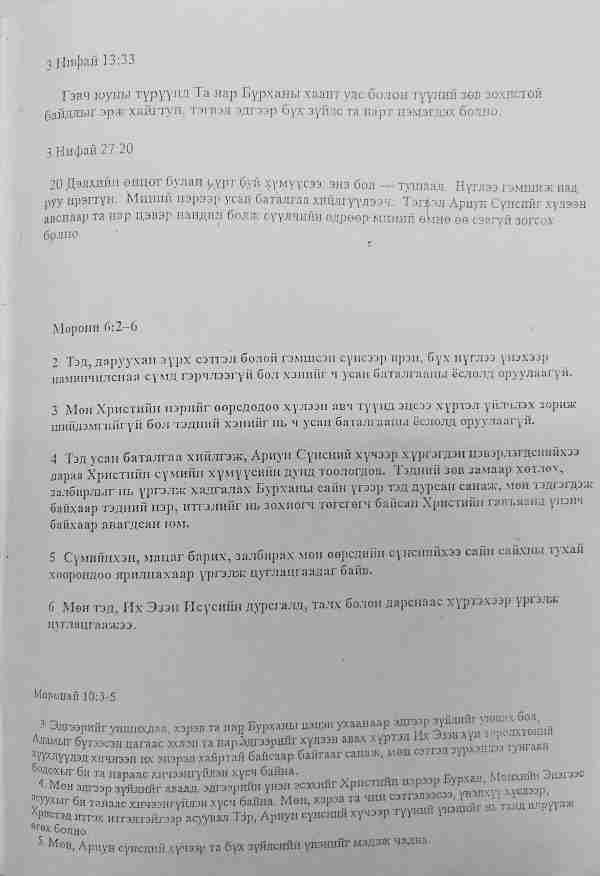 Early translated passages of the Book of Mormon used by missionaries in Mongolia. Courtesy of Po Nien (Felipe) and Petra Chou.
Munkhtsetseg returned to Mongolia in 1993 and called her cousin to go out to celebrate her birthday. “I can’t go because I am getting baptized,” responded her cousin. “Baptism? What’s that? I want to come and see,” responded Munkhtsetseg. She attended her cousin’s baptism, and soon after, the free English classes taught by the missionaries. After her first missionary lesson, she went to the Central Library in Mongolia to find information about the Mormons. She said, “They were all anti-Mormon books, . . . lots of anti-Mormon literature on avenging angel, polygamy, and so forth.” Equipped with two pages of questions, she returned for her second lesson to confront her two missionaries, Elders Blanchard and Rogers:[3]
I asked about everything and told them they were tricking me to join their church. . . . [Two days later] Elder Blanchard brought three volumes of the Encyclopedia of Mormonism. He made copies from it to answer my questions, . . . a ream of paper. He said, “You read, you study, and you decide.” I was walking home with a ream of paper thinking, “Why did they just let me choose and not try to convince me?” . . . I decided I was willing to listen. I read about polygamy, blacks and the priesthood, and so forth. . . .
I went to a Wednesday night family home evening (FHE). . . . Elder and Sister Cook’s FHE group. I volunteered to give the lesson and used Book of Mormon Stories to share. I thought that the best way to learn was to teach, but was taking the discussions cautiously. One day I was standing outside of the missionaries’ home. Elder Cook came out, put his hand around me and said, “Elders, it is time for her to be baptized.” So I decided to get baptized on September 10, 1994.
I could feel the senior missionaries’ love for Mongolia. I never before seen Caucasian people trying to learn Mongolian. It showed us that they had a great love and respect for us. Before I finished all the discussions, Elder Cook hired me to teach the missionaries how to speak Mongolian. . . . I was so fascinated with languages, began teaching the missionaries, and was baptized.[4]
Munkhtsetseg’s younger sister and little brother were later baptized. Her mother, initially against her joining the Church, was baptized with her father. Nine years after they joined the Church, her parents were sealed in the Laie Hawaii Temple and later to each of their children in three different temples in Laie, Hawaii; Salt Lake City, Utah; and Albuquerque, New Mexico.[5]
Translator and Interpreter for the Mission
In 1995 Munkhtsetseg visited Elder Richard E. Cook and Sister Mary N. Cook, then a senior missionary couple in Mongolia. They asked her, “Do you know who President Gordon B. Hinckley is?” She replied, “Yes, he is the new prophet.” They told her that President Hinckley had asked them to attend training in the United States and then return to establish the first mission in Mongolia, and they wanted her help. When the Cooks returned, Munkhtsetseg helped them at the mission office with many duties: cooking, cleaning the apartments, setting up the furniture, applying for visas, ordering office supplies, translating, typing documents, and interpreting for President Cook everywhere he went to teach in Mongolia. Those were long days, but she felt that she could not work less because President Cook was at his desk before 6 a.m., when she arrived, and stayed until after 10 p.m., when she left.[6] Her typical daily schedule was as follows:
6:00–8:00 a.m.: Teach Mongolian to two groups of new missionaries
8:00 a.m.–2:00 p.m.: Go to economics and finance classes
2:00 p.m.: Mission office work, including secretarial, translation, and interpretation work
Evening: Teach Mongolian to one group of older missionaries
10:00 p.m.: Leave for home[7]
Mission or Translation?
In the spring of 1996, Gary Machalprang from the Church’s Translation Department came to visit President Cook in Mongolia to explore the possibility of translating the Book of Mormon into Mongolian. Munkhtsetseg said, “Brother Machalprang asked me for a sample of my writing and testimony in Mongolian, which I later provided for him.” She had nearly forgotten that request when she began applying for a full-time mission a couple of months later. She was blessed to have the gospel and desire to teach others about it.[8] She explained what happened next:
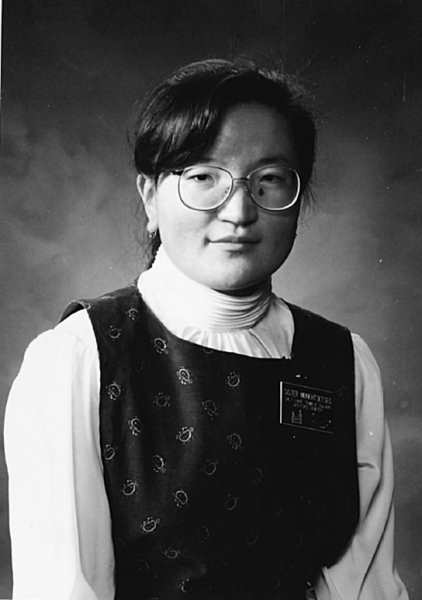 Sister Munkhtsetseg Dugarsuren (Monica) served as a full-time missionary in the Utah Salt Lake City Temple Square Mission in 1996. Courtesy of Munkhtsetseg Dugarsuren.
President Cook asked me, . . . “Remember the sample you submitted to Brother Machalprang? There were several samples from several people that were submitted, which were reviewed by a Mongolian university, and yours was the best! They want you to help with the Book of Mormon translation.”
I was working on my mission papers, but I would also love to do the Book of Mormon translation. I couldn’t decide because I loved both, and President Cook was leaving that summer. I told him that I would be happy to do either—whatever the Church decided. I would send in my mission papers, and I would also say okay to helping with the Book of Mormon translation, and although I would help translate, I would not be the primary translator.[9]
Munkhtsetseg sent out her mission papers in April 1996, and the Cooks completed their mission and left Mongolia in July. After three months and no word on her application, she began to worry that she didn’t qualify to serve a mission. But by mid-July, she received her call and was so delighted until she found out she was called to the [the] Temple Square mission in Utah. Her cousin, who was serving in the Utah South Provo Mission, had previously written a letter indicating that nearly everyone in Utah went to church and that it was difficult to find investigators in Utah. Munkhtsetseg thought, “If there is one place I don’t want to go, it is to Utah.”[10]
I went to President Cox, the new mission president, and told him I can’t go because there are no investigators in Utah. I didn’t want to go to Utah, and could he send me to Africa instead? President Cox explained to me that it doesn’t work that way. We can call your mission president and talk to him. . . . Temple Square mission president . . . said they [had] five million visitors every year, and I would be using all my language skills, including Mongolian and Russian and a little English. . . .
I became very excited about going on my mission. Back then, they had 170 sister missionaries covering over fifty-four plus languages at Temple Square. I was so worried they would judge Mongolia by how I represented my country. Nevertheless, I benefited the most from my mission.[11]
Munkhtsetseg didn’t hear back about the translation, and assumed she was just going on a mission. She received her patriarchal blessing and reported to the Missionary Training Center in Provo in 1996. This blessing included several mentions of her important role as a translator, a role she started when she was the mission president’s assistant and chief translator. She was blessed with the gift of tongues, which assisted her as a translator.[12]
The Temple Square Mission
Munkhtsetseg had only been a member for two years when she flew from Ulaanbaatar to Beijing to San Francisco to Salt Lake City in September 1996. She arrived three days before entering the Missionary Training Center, and this was her first time entering the United States. The Cooks took her to the Manti Utah Temple for her own temple endowment, where she had an amazing experience and felt tremendous peace. Sister Cook dropped her off at the Missionary Training Center, and she was there for only three of her scheduled eight weeks.[13]
Munkhtsetseg was busy at Temple Square with eleven tours to memorize, including the main tour, Book of Mormon tour, and temple tour. The scripts for each were in Russian and English. She also used her language skills to teach two adopted Russian children in Salt Lake and translate at a couple weddings at the Salt Lake Temple. She had twelve companions on her mission and spent all eighteen months at Temple Square. One day, her new mission president, Lowell M. Snow, switched missionaries from an assigned schedule to an assigned area, and asked all the sister missionaries to follow the Spirit and double the number of referrals. Munkhtsetseg said, “When President Snow wanted us to double referrals, I was unsure if that was possible, but within a year we doubled the number of referrals.” Reaching this goal was a wonderful surprise. Her greatest surprise, however, came from the Translation Department.[14]
Translation Begins at Temple Square
While serving as a missionary in Temple Square, Munkhtsetseg’s mission president asked her one day to meet with Gary Machalprang from the Translation Department on the twenty-first floor of the Church Office Building.[15] She recalled,
I was then still a missionary on Temple Square, and he wanted me to be the principal translator of the Mongolian Book of Mormon. I thought, “No way—there is no way for me to be the main translator. . . . I am just a new member, with no gospel knowledge, and I just read my scriptures in Russian.”
I was then praying at the South Visitors’ Center [on Temple Square] and opened the Doctrine and Covenants 9 and read about Oliver Cowdery’s experience and read the following, “Do this thing which I have commanded you, and you shall prosper. . . . Stand fast in the work wherewith I have called you, and a hair of your head shall not be lost.” I was inspired by this scripture, and the next day I told them, “I will try my best.” They said in reply, “Don’t try, just do it!”[16]
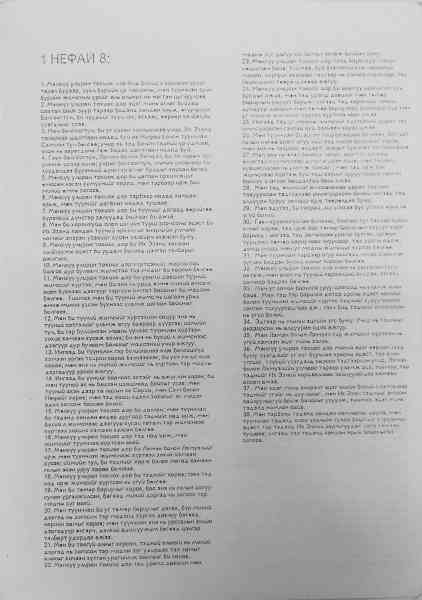 Early translation of 1 Nephi 8 of the Book of Mormon into Mongolian. Courtesy of Po Nien (Felipe) and Petra Chou.
She returned to the twenty-first floor of the Church Office Building in Salt Lake City. Elder Dallin H. Oaks of the Quorum of the Twelve, along with Brother Machalprang and his supervisor, Brother Burrup, laid hands on her head to set her apart as a translator. She was overwhelmed to meet with and receive a call and blessing from an Apostle of the Lord. In February 1997, she began translating 1 Nephi 1:1–10 and continued the work of translation until the end of her mission in March 1998.[17] She described her translation experience as follows:
I began to translate, . . . and it felt like I was being blown by a strong wind or a firestorm. Some days I couldn’t use a pen to write fast enough. . . . Using a pencil to write was much faster [she could erase and rewrite]. . . . I would write on the right side of the page, but I couldn’t keep up with everything flowing into my mind, as more thoughts on how to translate would come faster than I could write.
There were also a few days that I was stuck on a word and tried to look in the dictionary, etc. I would try to find the right word. I knew there was a word for it but couldn’t figure it out. But as I was about to walk out of the room to go back to Temple Square, as soon as I got to the doorknob, the right word would come. It was a great experience, and it was a test of my patience.[18]
There were other challenges as the translation work progressed. Her sister back home became pregnant and unable to care for her family, President Cook was diagnosed with cancer, and Brother Machalprang left the Translation Department. Still, she was blessed and pressed forward with faith on the translation of the Mongolian Book of Mormon. She worked on the translation from Monday to Friday, from 8 a.m. to 12 noon, and then returned to her missionary assignment on Temple Square.[19] She recalled,
I began with the introduction and 1 Nephi through 2 Nephi. I struggled with the Isaiah pages as they were really long and hard. . . . [1] was only allowed to use the English Book of Mormon to do the translation. We don’t use the Russian or other languages to translate from. I also had a dictionary and a three-volume lexicon. . . . Every word from the Book of Mormon, Doctrine and Covenants, and Pearl of Great Price were in this three-volume lexicon. For example, the word “child” and the number of times it came up, the meaning, etc. . . . I had to maintain consistency. So if the word “minister” had three different meanings, I had to find one word in Mongolian to match all three meanings. Also, Mongolians were Buddhists, so there were no terms for many Christian religion words, no words for “prophet,” “baptism,” “stake,” “bishop,” etc. The Bible in Mongolian only had the New Testament available from the Bible Society and that translation was hard to understand.[20]
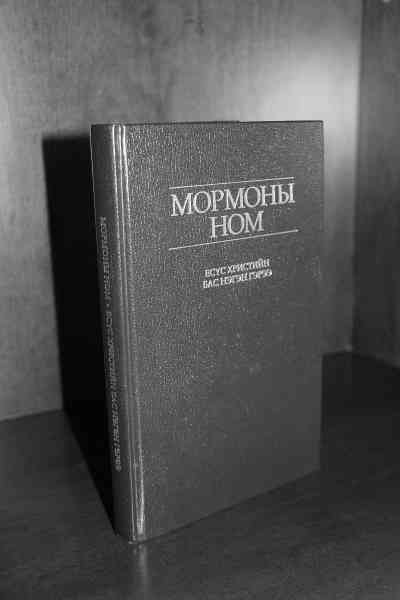 Mongolian Book of Mormon, first published in 2001. Courtesy of Odgerel Ochirjav.
Munkhtsetseg further explained her typical day and the translation process:
I would arrive at 8 a.m. each day to work on the translation on the twenty-first floor of the Church Office Building. It was a small room, maybe six feet by eight feet, with an old wooden desk, a file cabinet, and a chair. I would begin with a prayer, often on my knees. . . . Eventually I would just turn the chair against the table and remain kneeling on the chair and pray automatically when needed. I found this was much easier and less time consuming than getting off the chair to kneel on the floor each time to pray for help and then get[ting] back on the chair to continue the translation.
I would handwrite the translation, English on the left and the Mongolian translation on the right of each Translation Guide Pages or TGP. I wrote in pencil on the TGP, so it was a messy draft. But it was better than using a pen to write, since I could erase and rewrite with a pencil easier. Then I would type it in Mongolian on a computer. I had learned back in Mongolia how to type on an old typewriter. I also used the computer in the room to email and communicate with my team in Mongolia.
The team in Mongolia included a content reviewer, Brother Khavtgai Shar, who was an English teacher at a college and had joined the church a short time [earlier]. He read the English and Mongolian translation to compare the meaning and [to] check if the feeling was correct. Then I had a language reviewer without English. This was Sister Ichinkhand [Tsedev], a seventy-four-year-old woman who ha[0] taught Mongolian for thirty-four years at a high school. She only read the Mongolian to make sure it was correct and that it read okay, considering the classic versus traditional Mongolian. She would catch commas or punctuation, what was missing, and count phrases. Again, she didn’t speak English—it was just for Mongolian language review. I would email them one chapter at a time. If it was a long chapter, I would divide into three emails or about twenty verses [each].[21]
They had a three-step review process. First, the content reviewer made changes on the manuscript after comparing the Mongolian translation with the English. Munkhtsetseg and the content reviewer discussed the changes over the phone, and then cleaned up and typed the manuscript. Next, the language reviewer provided feedback on the reading of the Mongolian translation by itself for overall flow and feel. The manuscript was fixed again and a final draft prepared. Lastly, after a book was completed (e.g., 1 Nephi or 2 Nephi), the ecclesiastical review committee did a final review. This committee included three priesthood leaders and two sisters in Mongolia (and one at BYU–Hawaii). The committee members changed regularly, based on individual circumstances. Throughout this process, the project was overseen by a supervisor or managing director from the Translation Department. In March 1998, as Munkhtsetseg concluded her translation work in Salt Lake City, the two copies of the final manuscript of 1 Nephi and 2 Nephi were saved on floppy disks.[22]
Continuing the Translation in Mongolia
Before Munkhtsetseg returned from her mission, arrangements were made for her to continue the translation in Mongolia. Two computers, a keyboard, and books were packed in four boxes and sent by UPS or DHL to Mongolia for her. She left Salt Lake City with the floppy disks and translated files in her possession. On 6 March 1998, she returned to Mongolia, saw her family at the airport, and went to the mission office to be released by President Cox. Then she immediately went to a room at the mission office, took off her jacket, opened the four boxes from Salt Lake, and set up the computer to start translating again. She had landed in Mongolia at eleven o’clock in the morning but didn’t get home until eight o’clock that night.[23]
Finding a suitable place to translate was difficult. Munkhtsetseg started in a small office at the mission office, moved to a different building, and then moved from a translation room to the kitchen in a back room. She set up her computer after each move while she worked with content and language reviewers. The reviewers were older and didn’t use electronic manuscripts. Some came to her house to pick up the translated pages and others had her deliver those pages to their homes. Still, being in Mongolia made it easier to talk and discuss things with the content and language reviewers. Explaining the differences between “Bible” versus “Babel” (as in the tower of Babel), was much easier in person than via email from halfway across the world.[24] Khavtgai Shar served as a content reviewer and language editor, assisting Munkhtsetseg. Editing was tedious but a tremendous blessing to him, giving him the opportunity to read and study the Book of Mormon, and gain an undeniable testimony of the scriptures. He said,[25]
When I was working on the Book of Mormon as an editor, I used to read some parts 3–4 times. When I read it at first, I couldn’t understand, the second time I understood some parts, and the third time I could finally understand. . . .
At that time, our supervisor was Brother Neal Glad. He gave us a Translation Guide. This book helped to instruct me on what I was supposed to do as a translator, content reviewer, and language editor, and had First Presidency policy and instructions that we should follow as a language reviewer.
- General language policy: the scriptures written in English had to fit with the meanings [and grammar] in the Mongolian language;
- Dots and commas: note if it’s changing meanings;
- Word or letter spelling mistakes.
Those are three points I needed to focus on. I got used to opening the English version and read[ing] it sentence by sentence, comparing it with the Mongolian. And I also checked if [the scripture] was past tense or present tense. Usually, they are in the past and the future tenses. I also tried to fit it with the dialect of those days. In English, the topics are written in the present tense, but in Mongolian we can’t tell a story from 2,000 years ago in the present tense. We faced th[ese] kind of differences. I talked to Munkhtsetseg and we decided to use the Mongolian present tense. Also, the English and Mongolian grammar use dots and commas a bit differently too.[26]
Enkhjargal Barton and Brad Barton were also content reviewers, and together with Munkhtsetseg and Khavtgai, the team created a word list for the translation of gospel words. The review and editing allowed them to catch mistakes and correct errors. They also consulted a grammar book by Damdinsuren and another by Osor, as well as Tsevel’s dictionary. Due to different grammar used by different books, they counseled together and agreed to use only the one by Damdinsuren. Some words like “priestcraft” or “house of Israel” didn’t have a Mongolian word that gave the correct meaning. “House of Israel” was initially translated into Mongolian as “home of Israel,” but the translation didn’t feel quite right. They studied and searched the three-volume Lexicon Dictionary and chose the terms lineage or blood or kindred of Israel to express the meaning better. Since they had already translated five or six books in the Book of Mormon, they had to go back to change those. Another issue was deciding whether to use an old Mongolian dialect or a more modern one. Khavtgai explained, “In the beginning, Munkhtsetseg used a lot of old Mongolian (up down, Uighurjin—Mongolian script) endings. . . . [Initially,] she thought that if we used old dialects, we should use old writing too. But we decided that it would confuse our readers, so we just followed Neal Glad’s suggestion. He experimented and gathered a few members and let them read a portion of the translation. However, no one understood what they were reading, so we changed some of the words and phrases.”[27]
This experience helped to provide a better, more readable, and more understandable translation of the scriptures. Khavtgai noted that as he read and reviewed the Book of Mormon translation, he learned that when the Nephites got wealth and riches, they became prideful and disrespected God. But when they had faith and obeyed God, they were blessed and prospered. He noted that their experience was very similar to Mongolians’ history. He concluded, “If Mongolians do not accept Christ’s name upon them, or are not baptized, or do not choose the straight and narrow path, they might be destroyed as the Nephites.” He went on to say,[28]
This work helped me to understand the scriptures deeply. . . . My English wasn’t fluent like my Mongolian. So when I read it in English, I could only understand it generally; but [reading] in Mongolian was more meaningful and rich to me. . . .
While reading the scriptures, I gained a knowledge and strengthened my belie[f] that my faith is right, eternal life exists, and the gospel of Jesus Christ is true. . . .
I’m glad that I had a chance to work as a reviewer. I think this was a blessing from the God. . . . Now I know that this is the word of God, and God’s scripture. I know that by my faith.[29]
Working with Khavtgai and others in Mongolia was a blessing for Munkhtsetseg, but there were also new challenges translating in Mongolia. As a missionary, Munkhtsetseg could focus on doing God’s work full-time both as a missionary and as a translator. But once she returned home, she needed a job to help her family. Although arrangements were made to employ and pay her as a translator in Mongolia, she worked without pay for five months while the area office in Hong Kong figured out the logistics of employing and paying her. This matter was eventually resolved, and she was compensated for her work; however, she always felt the job was a calling and part of her consecrated work to further the Lord’s work.[30]
Munkhtsetseg was also interrupted regularly by some who misunderstood her role. Some expected her to translate other Church materials or even personal school projects. She politely explained her work to avoid offending them, but it wouldn’t always satisfy their demands. For example, after she told a young man that she was unable to translate his martial arts binder, his mom returned the next day and left her the binder with a clear expectation that she would “do her job” as the Church translator. In the Mongolian culture, you honor and respect those who are older, so she couldn’t say no, even though it was neither part of her job nor an appropriate request. During these challenges, she would often cry, laugh, and pray a lot. Despite these interruptions, she constantly saw the hand of God helping her with this project.[31]
It was amazing! When I got back to reading and working on the translation of the Book of Mormon, I knew it was not me. It was the hand of God helping with this work. I prayed a lot, and God helped me a lot. There were a couple of special experiences that helped me to know that there is a God. This is his work. He loves the Mongolian people, and he wants this book translated. I was overwhelmed by the outpouring of the Holy Ghost in this work. Sometimes while I was struggling and crying, I felt God’s hand on my shoulder saying it is okay, it’s fine, just keep going. I felt his presence so strongly and was scared to turn around and look to [literally] see him right there.
From February 1997 until March 1998, we had completed [the translation of] 1 Nephi and 2 Nephi. Then from March 1998 until 1 July 1999, the rest was completed through the book of Moroni. . . . I had been accepted to study at BYU in 1998 but had delayed it a year to finish the translation. BYU knew about it and [was] okay to delay until I was able to come and start studying at BYU in the fall of 1999.
When I came to BYU, I brought seven floppy disks with the translation to the Church Office Building. Brother Neil Glad was the translation supervisor then. I met him at the airport to deliver the seven floppy disks and said, “This is it. Take care of it.”[32]
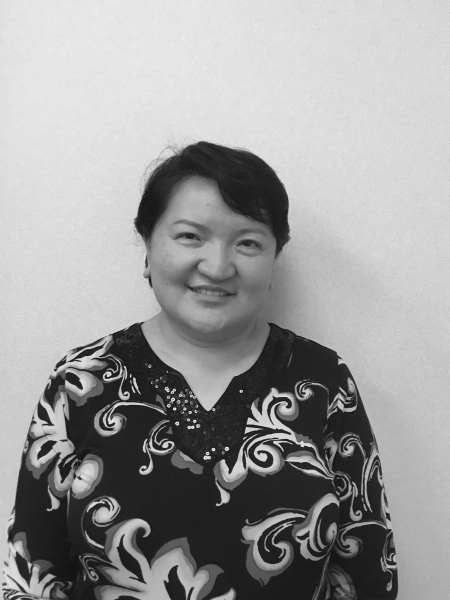 Munkhtsetseg Dugarsuren translated the Book of Mormon into Mongolian. Courtesy of Po Nien (Felipe) and Petra Chou.
This project was finalized two months later, and a draft of the manuscript was printed in six volumes, with the volume for 1 Nephi and 2 Nephi in a pink cover. The final review of the manuscript was finished in December 1999. When it was finally finished, Munkhtsetseg felt relief, happiness, and also sadness that the work had ended. For about two and a half years, she had worked on the translation of the Book of Mormon. She didn’t get sick, her family was taken care of, and her testimony of the Lord grew stronger. “I came to know Jesus Christ. . . . The Lord sent his angels to help me, and I could feel his presence guiding my mind and hand in this work.”[33]
The Mongolian Book of Mormon Is Published
The Mongolian Book of Mormon was officially released on 18 October 2001.[34] Mission president G. Harlan Clark recorded the following in the mission historical record in 2001: “This was the year that the Book of Mormon was translated into Mongolian. The first copies were printed in October, and the first copy arrived with a missionary returning to Mongolia from America. [1] put the first Book of Mormon on his desk under a small statue of Moroni, and everyone who came in touched this first copy. When the first shipment of copies of the Book of Mormon arrived and were distributed, one to a family, the members were hugging their copies as they received them.”[35]
At a combined October mission reunion for Presidents Cook and Cox in Midvale, Utah, Cook brought a brown box full of the first print run of the Mongolian Book of Mormon. Cook gave a copy of the softcover book to each of about twenty returned missionaries present. He asked Munkhtsetseg to sign “her book.” She replied, “No, it’s not my book, it’s the Lord’s book.” A couple of weeks later, Munkhtsetseg received her hardcover copy in the mail, with a letter signed by the First Presidency, Presidents Gordon B. Hinckley, Thomas S. Monson, and Henry B. Eyring. They expressed gratitude for her work in translating the Mongolian Book of Mormon, as it would bless countless people in Mongolia.[36] She later shared her testimony as follows:
The Lord loves me and knows me. He knew how stubborn I was. He knew I needed the translation process to gain a stronger testimony and to feel his love.
I am so grateful. It was a tough process, but I am grateful to be asked to translate. I have a witness that he loves us and cares about our people.
This translation process was part of a big picture for me to see. The gospel changes us from inside out. I have witnessed many lives and many people change. The Book of Mormon is the word of God. As we read and pray, we will witness and feel his love for each of us personally. It is another testimony of Jesus Christ, a witness of him and his hand in our lives. It makes life more meaningful, and it strengthens us. It helps us to be our true [selves]. This is the power of the Book of Mormon.[37]
Khavtgai Shar’s Conversion
In November 2000, Cree Frischkenecht, then managing director of the Translation Department, visited Ulaanbaatar to train Khavtgai Shar, Ganbold Davaasambuu, and others on the “side-by-side reading” of the typeset copy of the Mongolian Book of Mormon, as well as to evaluate the Mongolian Bible with the King James Version of the Bible. In addition, Khavtgai was called to be the principal translator of the remaining latter-day scriptures.[38]
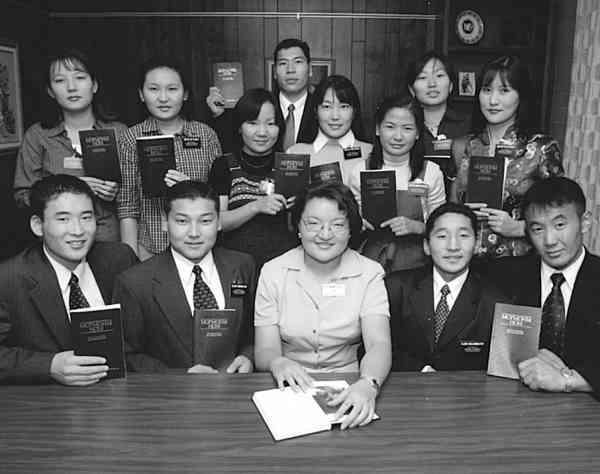 Munkhtsetseg Dugarsuren at the Missionary Training Center in Provo with a group of Mongolian missionaries receiving the first copies of the Mongolian Book of Mormon in 2000. Courtesy of Munkhtsetseg Dugarsuren.
Khavtgai Shar’s parents were simple herdsmen and had ten children. Khavtgai was the fifth child and graduated from Teacher’s School in 1964, even though his parents were nearly illiterate. After graduation, he worked as a Russian language and literature teacher for twenty years. He married his wife, Ganbold, and they had five children. Khavtgai believed in the communist ideology because he felt it valued equal rights, brotherhood, friendliness, and support of one another. Although he believed in these principles, he felt that their implementation became distorted and violated human rights. Between 1989 and 1990, many people lost trust in communism, including Khavtgai. Around this time, one of his children brought home a booklet of the Gospel of Luke, which taught about Jesus Christ. Khavtgai read it two or three times, pondered its message, and wondered if there was a Heavenly Father. In October 1996, Khavtgai’s brother got a job as a driver for the Church. He asked his brother about this church and its missionaries and then visited a Church meeting.[39]
After the sacrament meeting, I asked mission president Gary Cox to explain to me the Church’s purpose and activities. President Cox told me that before this life, we were spirits and lived with God then. He told me we are here to be tested. . . . If we agree to receive the name of Jesus Christ upon us and are baptized and receive the gift of the Holy Ghost, then after this life, we will live with God, our Father in Heaven. . . . I think this was a life-changing moment for me.
On May 2, 1997, I was baptized and became a member of the Church. After my baptism, Satan tempted me and I began to have doubts about some [gospel] principles . . . [like] eternal life. But when I discussed these topics with the senior missionaries . . . it was good. Because of those discussions and as I read the scriptures, I got my testimony that without a doubt, The Church of Jesus Christ of Latter-day Saints is the only true church on the earth, and in this life we need to stay on the straight and narrow path and endure to the end.[40]
Khavtgai’s family was against his baptism. His daughter criticized him and asked, “Why is a fifty-year-old man interested in such vain nonsense?” Notwithstanding, Khavtgai remained firm in his belief. Eventually his wife and others in his family were baptized in 1999.[41]
Translating the Doctrine and Covenants and Pearl of Great Price
As a new convert, Khavtgai had helped Munkhtsetseg as a content reviewer during the translation of the Mongolian Book of Mormon, which prepared him for his scripture translation work. After Munkhtsetseg left in 1999 to study at BYU, Khavtgai was called as the principal translator for the Doctrine and Covenants and the Pearl of Great Price. Khavtgai led this translation effort with the assistance of others, including Brother Enkhbold as a reviewer, Brother Purevsuren as the language reviewer, Sister Erdenetsetseg as content reviewer and proofreader, and others. Khavtgai was blessed by his previous experience assisting with the translation of the Book of Mormon, as well as the resources created from that effort.[42] He said,
 Brother Khavtgai Shar was the primary translator of the Doctrine and Covenants and the Pearl of Great Price into Mongolian. Courtesy of Odgerel Ochirjav.
The Doctrine and Covenants is much easier than the Book of Mormon, because it was written in English about 100 years ago. We still had to be careful, because scripture is still scripture. Brother Enkhbold worked from July 16 to August 1 and made a Word List using the one that we made for the Book of Mormon. We are using it in our translation. While translating the book, we recognized that there were more words needed to include into the Word List because of gospel meaning. . . .
We are not translating word for word. But some words like celestial, terrestrial, we’re not translating but we’re leaving them based on the same pronunciation.[43]
Sister Buyanaa Lamjav, who had previously helped translate several Church manuals and conference talks, was also among those called to assist with this scripture translation project. She would go to Brother Khavtgai’s house to help him proofread the manuscript. Sister Buyanaa said, “Brother Khavtgai was the primary translator of the Doctrine and Covenants and the Pearl of Great Price. . . . We would read [the translation] out loud together and talk, and he would make the changes needed.” She added that “after the initial translation was finished, there were some issues, and we had to review and fix several problems. . . . We noticed that after the translation, some changes had not been put into the manuscript, so as we were going over the PDF file, we needed to add those changes.” Others also helped with the manuscript.[44]
The initial draft of the translation of the Doctrine and Covenants and the Pearl of Great Price took about fourteen months. Having a word list with much of the terminology already defined during the translation of the Book of Mormon shortened the time needed for the translation of the other latter-day scriptures. Several people helped with the content, language, and ecclesiastical review. It took additional time for multiple reviews and revisions of the initial draft of the translation. Multiple reviewers assisted and switched roles over time, including Munkhtsetseg, Bradley Barton, and Enkhjargal. Having so many hands to help was a blessing to Khavtgai.[45] Khavtgai shared the following testimony:
The scriptures strengthened my faith about this church. The Church of Jesus Christ is the true Church. It’s still influencing me today. What was taught in the Bible can be found in the Book of Mormon too. What was taught in the Bible, the teachings of words of the prophets, are in the Doctrine and Covenants too. So I would say it has influenced me a lot. I realized I’m receiving these teachings through the Spirit, not by my intellect, and because of that, the scriptures have strengthened my faith and testimony. . . . I know The Church of Jesus Christ of Latter-day Saints is the only true Church on the earth. I got this testimony from the scriptures, especially the Book of Mormon. . . . The scriptures are the word of God. I know they provide guidance to our lives and light the path that we need to follow.[46]
2007 Triple Combination
Several people worked on the scripture translation and review teams of the 2007 triple combination. Batchimeg Magsar was among those who worked on the scripture review team for the new Mongolian scriptures. She used both the Russian and English scriptures to assist her with this project.[47] Buyanaa Lamjav, who previously had helped translate for general conference and other Church materials, also assisted while studying at BYU–Hawaii. She received the manuscript from the scripture translation team at the Church Office Building and was among those who helped review the translation of the new triple combination.[48]
The triple combination was published and introduced to the members on 2 December 2007 in a series of firesides in various buildings, after which the triple combination was available for sale at 600 MNT (Mongolian tögrög or tugrik). Firesides for the Mongolia Ulaanbaatar Mission were held at the Khovd, Muren, and Chlibalsan buildings for each of those mission branches. In the Darkhan District, firesides were held at the old Darkhan, Erdenet, Selenbe, and Zuun Kharaa buildings. For the Ulaanbaatar District, firesides were held at the Bayanzurkh, Chingeltei, Nalaikh, and Baganuur buildings. Mission president Allen D. Andersen presided at the fireside in the Bayanzurkh building, where 253 members attended. During President Andersen’s talk, he invited all the members to read the Doctrine and Covenants and the Pearl of Great Price within the next three months. Although the members had the Book of Mormon, they were now excited to read the other latter-day scriptures.[49]
Impact of the Translated Latter-day Scriptures
After the Mongolian Book of Mormon was published in 2001, its impact on missionary work was immediate. Whereas early converts had to just rely on the testimony of missionaries before, now they could read the Book of Mormon on their own and in their own language. Tuul Puntsagtseden was working at the Mongolian Service Center in 2001 when the Mongolian Book of Mormon was published. She was among the first to get a copy. “The couple missionaries signed their names and gave a copy of it [the Mongolian Book of Mormon] as a gift to each of us,” said Tuul. She added, “If I was not a member of the Church or had the scriptures, I don’t know where I am going. I just love the Church and the Book of Mormon!”[50]
Odserjmaa Dorjgotov, who was baptized in 1998, remembers the time when the Book of Mormon was not yet translated into Mongolian. “I could not read Russian or English, and back in 1998 they only had a few pages of the Book of Mormon in Mongolian. . . . So we had ‘Book of Mormon readings’ in the Central Building two nights per week.” She further explained that someone would read, and a returned missionary who knew English or Russian would translate, teach, and discuss. She summarized by saying, “The Book of Mormon in Mongolian came out in 2001, and I got a copy before my mission. I was fully excited to have the Book of Mormon in Mongolian because I was able to read it.”[51]
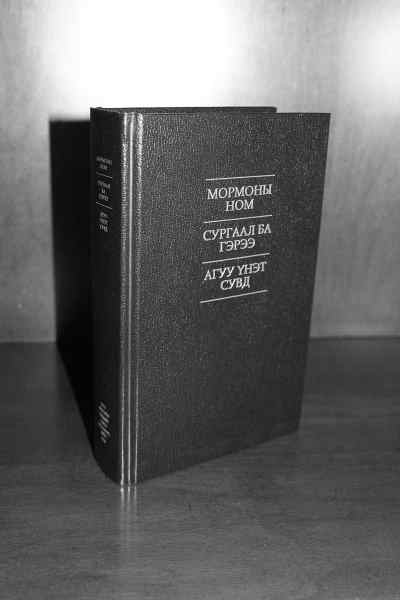 Mongolian triple combination, first published in 2007. Courtesy of Odgerel Ochirjav.
Tselmegsaikhan Sodnomdarjaa joined the Church in 2000 and said that while in the Provo Missionary Training Center, she was among the first group of missionaries to receive the Mongolian Book of Mormon in 2001. She said that before 2001, “we only had 1 Nephi 8, 3 Nephi 11, and Moroni 10 in a small pamphlet.” So she was very excited to receive and read the Book of Mormon in her native tongue. She said, “Yes! We finally had the full version of the Book of Mormon in Mongolian! Miracles happen when you have it [in your language]!”[52] Another example was shared by Bolormaa Ayurzana.
I was Buddhist [in 1997] when I went to a baptismal service with my best friends. . . . I attended sacrament meeting, and then I was baptized with two of my best friends on May 31, 1998. . . . Back then, new members were baptized in a pool or the river. The missionaries gave me a paper with a few verses translated into Mongolian, including verses in 1 Nephi 8, 3 Nephi 11, and Moroni 10:3–5. When the Mongolian Liahona came in 2000 and the Book of Mormon in Mongolian came in 2001, it was very great to have it! Before, we only had a few pages translated, so we joined the Church on faith.
I got the Book of Mormon in Mongolian on my mission in Billings, Montana. . . . I couldn’t understand it in English, so it was great to read it in my own language, which helped me understand the gospel [better]. . . . On my mission, I also read the English Doctrine and Covenants and the Pearl of Great Price. Then after my mission I got a Mongolian Doctrine and Covenants and the Pearl of Great Price at the Distribution Center. . . . I am grateful to have it in Mongolian![53]
Bayardelger Jamsran said, “When I was baptized, there was no Book of Mormon in Mongolian, only in English. So we needed the missionaries to help read the Book of Mormon for us. Then we got the triple combination in Mongolia[n], which was such a blessing for the members, . . . [to] gain their own testimony.” For those who couldn’t read English, being able to read the scriptures and other materials in their own language was a blessing.[54]
Summary
The publication of the Mongolian scriptures was a major milestone for the Church in Mongolia. They were a blessing to the continued missionary effort in Mongolia. While the early converts joined the Church based on faith that the Book of Mormon was the word of God, today’s converts are able to read and ponder its pages in their own language. Tsatsral Eukhtuvshin said that having the Book of Mormon translated in Mongolian is a blessing. She said, “I can now fully understand and appreciate it, and it has increased my testimony!” She also said that having the Doctrine and Covenants and the Pearl of Great Price in Mongolian “helped to increase our knowledge of Church history and our testimony and appreciation for the early Saints, . . . [helping them to] know the Book of Mormon is translated by Joseph Smith and the Church is led by a living prophet.”[55]
When Purevjargal Dorj was baptized in 1997, the Book of Mormon was not yet translated into Mongolian. Like other young people in Mongolia, Sister Purevjargal knew Russian and a little English; so, she first read the Book of Mormon in English and in Russian. However, she explained, “I never read the whole book until I got a copy of the Book of Mormon in Mongolian on my mission in California in 2002.” She continued, “Although it was translated in 2001, I didn’t get it [until] 2002 on my mission, and it was eye-opening for me to read it in Mongolian. It gave us the fullness of the gospel! . . . Reading the Book of Mormon opened a new chapter in my life to know more of Jesus Christ.”[56]
Notes
[1] “Mongolia,” Church Almanac: 2013, 525–26; Chou and Chou, “To Every Nation, Tongue, and People,” 227–63.
[2] Munkhtsetseg (Monica) Dugarsuren, interview by Po Nien (Felipe) Chou, 20 February 2018, Salt Lake City. A version of this chapter appears in Chou and Chou, “The Translation of the Mongolian Book of Mormon and Other Latter-day Scriptures,” 149–71.
[3] Dugarsuren, interview, 20 February 2018.
[4] Dugarsuren, interview, 20 February 2018.
[5] Dugarsuren, interview, 20 February 2018.
[6] Dugarsuren, interview, 20 February 2018.
[7] Dugarsuren, interview, 20 February 2018.
[8] Dugarsuren, interview, 20 February 2018.
[9] Dugarsuren, interview, 20 February 2018.
[10] Dugarsuren, interview, 20 February 2018.
[11] Dugarsuren, interview, 20 February 2018.
[12] Harper, “‘Nothing Less Than Miraculous,’” 19–49.
[13] Munkhtsetseg (Monica) Dugarsuren, interview by Po Nien (Felipe) Chou, 27 February 2018, Salt Lake City.
[14] Dugarsuren, interview, 27 February 2018.
[15] Dugarsuren, interview, 27 February 2018.
[16] Dugarsuren, interview, 27 February 2018.
[17] Dugarsuren, interview, 27 February 2018.
[18] Dugarsuren, interview, 27 February 2018.
[19] Dugarsuren, interview, 27 February 2018.
[20] Dugarsuren, interview, 27 February 2018.
[21] Dugarsuren, interview, 27 February 2018.
[22] Dugarsuren, interview, 27 February 2018.
[23] Dugarsuren, interview, 27 February 2018.
[24] Dugarsuren, interview, 27 February 2018.
[25] Khavtgai Shar, interview by Matthew K. Heiss, 12 September 2001, Ulaanbaatar, Mongolia, James H. Moyle Oral History Program, Church History Library, OH 2723, The Church of Jesus Christ of Latter-day Saints, Salt Lake City.
[26] Shar, interview.
[27] Shar, interview.
[28] Shar, interview.
[29] Shar, interview.
[30] Munkhtsetseg, interview, 27 February 2018.
[31] Munkhtsetseg, interview, 27 February 2018.
[32] Munkhtsetseg, interview, 27 February 2018.
[33] Munkhtsetseg, interview, 27 February 2018.
[34] Harper, “‘Nothing Less Than Miraculous,’” 19–49.
[35] Clark, “Mission Historical Summary 2001—Mongolia Ulaanbaatar Mission.”
[36] Munkhtsetseg, interview, 27 February 2018.
[37] Munkhtsetseg, interview, 27 February 2018.
[38] “Darkhan Mongolia District Annual Historical Report (Darkhan Mongolia District, Mongolia Ulaanbaatar Mission, 2000).”
[39] Shar, interview.
[40] Shar, interview.
[41] Shar, interview.
[42] Dugarsuren, interview, 27 February 2018, Salt Lake City.
[43] Dugarsuren, interview, 27 February 2018, Salt Lake City.
[44] Buyanaa Lamjav, interview by Po Nien (Felipe) Chou and Petra Chou, 19 June 2018, Ulaanbaatar, Mongolia.
[45] Munkhtsetseg, interview, 27 February 2018.
[46] Dugarsuren, interview, 27 February 2018.
[47] Batchimeg Magsar, interview by Po Nien (Felipe) Chou and Petra Chou, 19 June 2018, Ulaanbaatar, Mongolia.
[48] Buyanaa, interview, 19 June 2018.
[49] Odgerel Ochirjav, email message to Po Nien (Felipe) Chou, 7 June 2020.
[50] Adiyabold Namkhai and Tuul Puntsagtseden, interview by Po Nien (Felipe) Chou and Petra Chou, 19 June 2018, Ulaanbaatar, Mongolia.
[51] Odserjmaa Dorjgotov, interview by Po Nien (Felipe) Chou and Petra Chou, 19 June 2018, Ulaanbaatar, Mongolia.
[52] Tselmegsaikhan Sodnomdarjaa, interview by Po Nien (Felipe) Chou and Petra Chou, 19 June 2018, Ulaanbaatar, Mongolia.
[53] Bolormaa Ayurzana, interview by Po Nien (Felipe) Chou and Petra Chou, 19 June 2018, Ulaanbaatar, Mongolia.
[54] Bayardelger Jamsran, interview by Po Nien (Felipe) Chou and Petra Chou, 20 June 2018, Ulaanbaatar, Mongolia, translated by Ariunchimeg Tserenjav.
[55] Tsatsral Eukhtuvshin, interview by Po Nien (Felipe) Chou and Petra Chou, 19 June 2018, Ulaanbaatar, Mongolia.
[56] Purevjargal Dorj, interview by Po Nien (Felipe) Chou and Petra Chou, 19 June 2018, Ulaanbaatar, Mongolia.
