
 menu icon in the top, right corner of the screen.
 icon above to close this box.
 icon at the bottom of the screen below the browser—if you don't see it, swipe up to unhide it.
The Rising Generation
Children of Destiny to Light the World
Po Nien (Felipe) Chou and Petra Chou, "The Rising Generation: Children of Destiny to Light the World," in Voice of the Saints in Mongolia (Provo, UT: Religious Studies Center, Brigham Young University; Salt Lake City: Deseret Book), 243‒70.
“Therefore, hold up your light that it may shine unto the world. Behold I am the light which ye shall hold up” (3 Nephi 18:24).
Jay D. Clark served as the mission president in Mongolia from 2010 to 2013. In February 2011, the first group of new missionaries under President Clark left for the Manila Missionary Training Center. President Anthony D. Perkins, then Asia Area President, visited Mongolia with Reid Neilson and Richard E. Turley, assistant Church historians from Salt Lake City, to hold meetings regarding Church history and the keeping of personal histories in April 2011.[1]
Elder Holland Visits Mongolia
Elder Jeffrey R. Holland visited Mongolia in May 2011 and called the rising generation “children of destiny.” This chapter chronicles the efforts of the youth and young single adults to share “the Light of the World” in Mongolia. It gives an overview of the first handcart trek and the twentieth anniversary celebration of the Church in Mongolia. It also chronicles the story of a famous Mongolian opera singer and how music and a choir in Mongolia shared the light of the gospel through social media and the nationally televised Mongolia’s Got Talent! TV show to introduce the Church to a large amount of Mongolian people. Joseph P. Benson presided over the mission in Mongolia from 2013 to 2016, followed by Jeffrey C. Harper. Church membership during this period grew from 10,217 in 2011 to 11,436 in 2016.
Meeting Government Officials and Service Center Employees
At around 9 p.m. on 26 May 2011, Elder and Sister Holland, along with missionaries traveling from the Manila Missionary Training Center, arrived in Mongolia.[2] On 26–29 May 2011, Elder Holland and others meet with government officials, missionaries, and members of the Church in Mongolia. During this meeting, Elder Holland was asked about recommendations for the country’s religious policies. He responded, “[The government] is new and young in the same way the Church is here. . . . We’ll grow together.”[3]
 Luncheon at the Ger Resturant in Ulaanbaatar on 27 May 2011. From left to right: President Jay D. Clark (Mongolia Ulaanbaatar Mission president), Sister Patricia Hoge Clark, Sister Karen Pratt, Elder Carl B. Pratt (Second Counselor, Asia Area Presidency), Elder Jeffery R. Holland (Quorum of the Twelve), Sister Patricia Holland, Sister Ariunchimeg Tserenjav (translator), President Odgerel Ochirjav (UB West Stake president), Asia Area Seventy Elder Kuo Chiang (Joseph) Chung. Courtesy of Odgerel Ochirjav.
Sister Tselmegsaikhan Sodnomdarjaa, a translator for the Church, said, “Elder Holland met with the employees in Mongolia, and the Spirit . . . filled the room.”[4] Sister Batchimeg Magsar, who was working at the Mongolia Service Center, said, “To me, the most memorable part of Elder Holland’s speech . . . was that we would be the ones to lead this country, . . . and the Lord depended on us. He also blessed us that we would have righteous rulers in the country, so we would have a bright future.”[5]
Missionary Meeting with the “Children of Destiny”
 Elder Holland visits the Ministry of Foreign Affairs of Mongolia, Ulaanbaatar, Mongolia, on 27 May 2011. From left to right: Sister Soyolmaa Urtnasan (Mongolia Service Center manager), Elder Carl B. Pratt (Second Counselor, Asia Area Presidency), Mr. Gankhuyag Damba (director of the Department of Consular of the Ministry of Foreign Affairs of Mongolia), Elder Jeffery R. Holland (Quorum of the Twelve), President Odgerel Ochirjav (UB Stake President), Missis Siilegmaa Tserensonom (representative at the Ministry), President Jay D. Clark (Mongolia Ulaanbaatar Mission president). Courtesy of Odgerel Ochirjav.
President Clark recalled, “We wanted all the missionaries in the city to attend Elder Holland’s missionary meeting. . . . The conference started Friday evening on [May] the 27th and went through Sunday evening with a testimony meeting.”[6] Elder Holland met with more than one hundred full-time missionaries in the Mongolian Ulaanbaatar Mission, which included many native Mongolians. He called these native missionaries “children of destiny” and envisioned how they would help build and strengthen the Church in Mongolia.[7] He was so impressed by these young Mongolian missionaries, who, despite their age, already knew and were doing so much to build the Lord’s Church. He added,
There are a thousand things I could talk to you about, . . . [but] I’m going to go back to basics, . . . something that we call in our missionary approach the “doctrine of Christ.” For [your] own sake and for the Church’s sake, missionaries must understand who they are and what the Church is if they are to reach their potential and save the human family. . . .
The answer to every problem in life, whatever the question . . . is the Atonement of Jesus Christ—the doctrine of Christ, the gospel of Christ. . . . If you believe that, you will change. . . your history, you will change Mongolia’s history, and you will change the world’s history.[8]
Training for Local Leaders and Special Stake Conference
Elder Holland also trained local leaders and sought to understand the needs and unique challenges of Saints in Mongolia.[9] Brother Chimedbaatar Tseden, who shook hands with Elder Holland at the training, learned that they were the pioneers and leaders of the Church in Mongolia.[10] Brother Bayardelger Jamsran recalled,
 Elder Holland and company at the Sukhbaatar Square, Ulaanbaatar, Mongolia, on 27 May 2011. From left to right: President Odgerel Ochirjav (UB West Stake president), Elder Carl B. Pratt (Second Counselor, Asia Area Presidency), Elder Jeffery R. Holland (Quorum of the Twelve), President Jay D. Clark (Mongolia Ulaanbaatar Mission president), Sister Soylmaa Urtnasan (Mongolia Service Center manager), Erdenebileg Purevsuren (translator). Courtesy of Odgerel Ochirjav.
In the training for priesthood leaders [Elder Holland] taught us two things.
First, tithing. There were many questions about it. One brother asked. . . . “Do we pay net or gross, which is correct?” Elder Holland said, “What blessings do you want to have? That is up to you. Do you want gross or net blessings?”
Secondly, he said, “Brethren, you are the leaders of the Church in Mongolia and there is much to do. But this is important, please keep your sacrament meetings filled with the Spirit, and make it special for members.”[11]
On Sunday, 29 May, Elder Holland presided over a special stake conference and emphasized the importance of the family to about 2,000 people in attendance. He “taught the plan of salvation and emphasized that all families can live together with Heavenly Father.” He said that the “women of the Church have always borne the flag of faith.” He then “challenged the men to step up to their priesthood responsibilities and promised that as they [did], the power of the priesthood [would] change the country.”[12] During his trip, Elder Holland said, “I’ve come halfway around the world literally to say basically one thing: . . . We love you.” He added, “You may be a long way away from us physically or geographically, but you’re not more than a prayer away and heartbeat away from our affections and our admiration.”[13] Elder Holland said,
To come here and see the Church in Mongolia—born in a day in a sense—10,000 strong, . . . I was just unprepared for this. . . .
I have just come from a priesthood leadership conference with 120 men or so. All of them have to be, by definition, new to the Church; they are first generation because that's as long as we’ve been here. [But] we’ve got a stake, we ha[ve] two district presidents, we ha[ve] full presidencies and full councils, bishops and branch presidents. The Church has been born in a day in Mongolia.[14]
Sister Purevjargal Dorj felt the Spirit when Elder Holland spoke of missionary work.[15] She said that Elder Holland “pronounced a blessing on the land, on the government, and especially on the people, asking Heavenly Father to bless them that they might continue to see miracles as the Church in Mongolia continues to grow.”[16] Sister Bolormaa Ayurzana felt the Spirit during the apostolic blessing at the meeting in the “UB [Ulaanbaatar] Palace” event center.[17] President Clark added, “Elder Holland left the members with a special apostolic blessing. His wonderful influence will be felt in the lives of the Saints in Mongolia forever!”[18]
“Be One” Entertainment and MEFY
Bayasgalan Sukhbaatar’s family lived in Ulaanbaatar until they moved to Erdenet. He was baptized at age thirteen in 2003 along with his parents. After his mission, he founded the “Be One” band in 2011 with nine friends who had served together. “Be One” made over one hundred videos with hundreds of volunteer hours. It was hard to keep productions going, since those involved still had to earn money for a living. But gradually their financial position improved, allowing them to create better and more professionally polished productions.[19]
“Be One” also worked with others to create a singing band called MEFY (Mongolian Especially For Youth). Bayasgalan explained that it was hard to organize MEFY because “it was the first attempt to do something like this and people didn’t understand” or believe in it. However, with encouragement from the president of the Ulaanbaatar Mongolia West Stake, Bayasgalan held auditions with Church members, created songs, founded a music studio, and moved forward. “Be One” posted music videos on YouTube and also released an album. Bayasgalan said, “Now the members love MEFY, and many less actives are inspired by MEFY.” Their Facebook page has gathered over 20,000 likes and over 200,000 views. Bayasgalan said,
I want “Be One” to become a well-known studio in Mongolia. We share the gospel through our videos and our music. That’s why we created MEFY. . . .
Some people came to Church because of MEFY. We receive many emails and messages about our music videos. One man who works in the countryside listened to MEFY, and he told me he finds strength to resist temptation because of MEFY. . . . My friend and I. . . went on a mission together and we have since worked on all these projects together. We feel the Lord has called us to use our talents to help share the gospel with the people in Mongolia.[20]
Handcart Trek
According to the 2015 Handcart Trek Reenactments: Guide for Leaders, the purpose of these treks is to “provide powerful opportunities to strengthen testimonies, build unity, do family history, and learn core gospel principles.”[21] President Gordon B. Hinckley added the following:
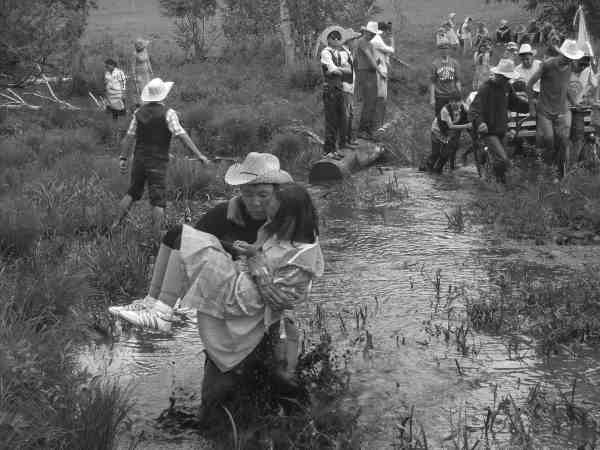

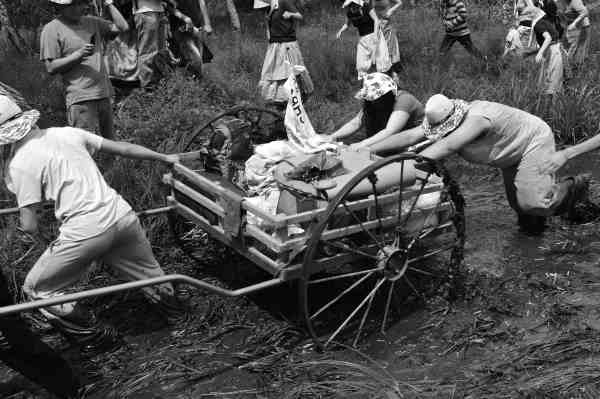 Top: Church leaders and youth participate in first handcart trek and youth conference in Mongolia, 2012. Middle: Mongolia youth push and pull handcarts during the first handcart trek and youth conference in Mongolia, 2012. Bottom: Pushing and pulling through mud, July 2013. Photos courtesy of Martha Hunt and Odgerel Ochirjav.
Look to the past to gain appreciation for the present and perspective for the future. It is good to look upon the virtues of those who have gone before, to gain strength for whatever lies ahead. It is good to reflect upon the work of those who labored so hard and gained so little in this world, but out of those dreams and early plans, so well nurtured, has come a great harvest of which we are the beneficiaries. Their tremendous example can become a compelling motivation for us all, for [all] of us [are] pioneer[s] in [our] own li[ves], often in [our] own famil[ies], and many of us pioneer daily in trying to establish the gospel foothold in distant parts of the world.[22]
The first handcart trek in Mongolia was held in 2012. Gary and Martha Hunt were a senior missionary couple in Mongolia at the time and suggested to President Odgerel Ochirjav that a handcart trek would be a great experience for the youth in Mongolia.[23] Elder Hunt said,
Sister Hunt and I were traveling with the Ulaanbaatar West Stake president to Northern Mongolia to do a PEF [Perpetual Education Fund] fireside, when we told President Odgerel that it would be a great experience for the youth in his stake if they could do a handcart trek. . . . [We] proceeded to tell him all about handcart treks and how thousands of youth participated in treks in America. . . . He asked many questions and then turned around and enthusiastically shouted, “Our stake will do a handcart trek this summer!”[24]
The Church News reported that “96 youth and 26 adult leaders . . . grabbed hold of handcarts and trekked across an open landscape in Mongolia.” Elder and Sister Hunt said, “The trek was full of fun, singing, friendship, helping others[, and a]constant feeling of love and cooperation. The beautiful Mongolian countryside added to the success of the trek.”[25] After the Ulaanbaatar West Stake’s trek in 2012, a country-wide trek was organized in 2013. Tserenbat Jamiyan, district president for the Darkhan District from 2009 to 2011, participated in a couple of treks and said, “We walked about ten kilometers in two days, pulling handcarts. . . . President Odgerel had the handcarts made in UB, and some of the kids took trains [from their home cities]. I organized the logistics to get kids from the train station to the site.”[26]
The youth and leaders traveled overnight, leaving Ulaanbaatar at 8 p.m. and arriving in Erdenet at 8 a.m. the next morning. Then they rode another fifty miles in thirteen vans to reach the site. The youth dressed like pioneers, with the sisters wearing aprons and bonnets while the brothers were wearing suspenders and cowboy hats. They sang many hymns, including “Come, Come, Ye Saints.” The youth took turns pulling the handcarts and reenacted the Sweetwater River rescue, where the young men carried young women across the water. They also participated in a local service project, “weeding a large nursery of baby pine trees.”[27] Elder Hunt reported,

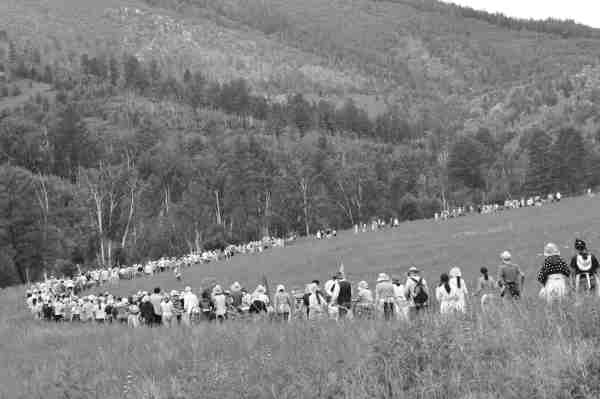
 Top: 2012 handcart trek in Mongolia. Middle: All-Mongolian youth handcart trek, July 2013. Bottom: Gathering of youth for the first Mongolian handcart trek. Photos courtesy of Martha Hunt and Odgerel Ochirjav.
The scenery was great with lots of rolling hills, many of which were pine covered. There were many herds of sheep, goat, horses, yaks and even a couple of camels. . . . It is hard to believe that in a short three and a half months an idea of a handcart trek could be born, planned and carried out in such an organized and efficient way. It truly was miraculous in many ways. The country was beautiful, the food was great, the kids were great, the trek was very authentic, . . . and, most important[ly], our testimonies were strengthened and deep bonds of friendship were formed and strengthened. I know the youth will never forget this experience and in years to come will tell how they “pioneered” the very first handcart trek.[28]
President Tserenbat Jamiyan, who has the title of “one who loves the young people,” said, “The prophet told us that the young people are our future, they are the future of the Church.” He added, “I have a witness that our young people are our future leaders.” Tserenbat, who helped to organize the logistics for a couple of handcart treks in Mongolia, recalled his second trek:[29]
One year, we had over thirty vans or mini-buses and about 400 youth and leaders participating in the pioneer handcart trek. We had more than ten handcarts, or something like that. It was for all the youth in Mongolia, and the kids were very active during the activity. . . .
The youth were never tired, they were good together and had fun together. They wore pioneer clothing. . . . There were many young people. I loved working with them and I am always grateful for them. We were in Erdenet, about eight hours away by bus from Ulaanbaatar. All the youth camped in Erdenet.[30]
Twentieth Anniversary
In 2013 the Church in Mongolia celebrated its twentieth anniversary since Elder Neal A. Maxwell of the Quorum of the Twelve visited and dedicated Mongolia for the preaching of the gospel. More than three hundred members went to the summit of Zaisan Hill in Ulaanbaatar to commemorate the dedication.[31] The Church News reported the following:
On a beautiful, snowy day—Monday, April 15, 2013, at precisely 4 p.m.—more than 300 Latter-day Saints gathered at the top of Zaisan Hill in Ulaanbaatar, Mongolia, to hear a recording of the prayer Elder Neal A. Maxwell offered as he dedicated the land 20 years earlier on that day, hour and location. The theme of the anniversary commemoration, “Remember, this is your gift” (Doctrine and Covenants 8:5), was a reminder of the gift of the gospel to the people of Mongolia.[32]
Before Elder Brough passed away, his biggest regret was that he was unable to take his wife to visit Mongolia. So when Elder Tai Kwok Yuen and his wife, Sister Tai Lai Hui Hua, returned for the celebration of the twentieth anniversary, they brought Sister Brough, who was so happy to fulfill her husband’s wish that she visit Mongolia.[33] The Church News reported,
Elder Tai Kwok Yuen, former member of the Asia Area Presidency who accompanied Elder Maxwell to Mongolia in 1993, observed how “the Lord’s hands have been moving unceasingly in this part of His vineyard.” Besides Elder and Sister Tai, the first two mission presidents and their wives attended, along with several of the first senior missionary couples.
Also in attendance was Sister Lanette Brough who spoke of the 1984 trip to Mongolia of her husband, Elder Monte J. Brough, a member of the Seventy from 1989–2007, and his sons. He and his sons fell in love with the Mongolian people. Elder Brough said, “I prayed that one day they would hear the gospel.” Before leaving Mongolia, one son asked, “Do you think they will ever hear the name of Joseph Smith here?” Elder Brough replied, “I don’t think so in my lifetime.” However, he later returned to Mongolia, representing the Asia Area Presidency, and in 1992 he negotiated the sending of six English-teaching missionary couples to Mongolia. Since that time, the name of Joseph Smith has become known in Mongolia. Before Elder Brough’s passing in 2011, there were more than 9,000 members of the Church.[34]
Others also returned to Mongolia for the weeklong celebration, including former missionary couples and mission presidents and their spouses.[35] Many displays depicted the early history of the Church in Mongolia, and the evening devotional was filled with “greetings and expressions of love from mission presidents, [their] wives and former missionaries who traveled to Mongolia for the anniversary.”[36] Bayardelger Jamsran said that many early pioneers in Mongolia shared their testimonies during the special fireside. He said, “I loved listening to the early members and how they joined the Church in different times during the regime change. They were totally new and amazing stories.”[37] The Church News reported,
The Cooks shared some of their “miracles of Mongolia” that paved the way for missionary work to go forward, including the acquisition of visas that had been hard to come by. Thursday evening’s devotional presented video greetings and expressions of love from former (and newly called) mission presidents and their wives, missionaries, and Elder John H. Groberg, now an emeritus General Authority who served as president of the Asia Area Presidency from 1994 to 1998.
On Friday afternoon, a family history open house featured displays that were hosted by Ulaanbaatar family history consultants. Displays encouraged members to gather, organize and preserve family records and included examples of memory books, old photographs, histories and pictures of couples sealed at the Hong Kong China Temple.[38]
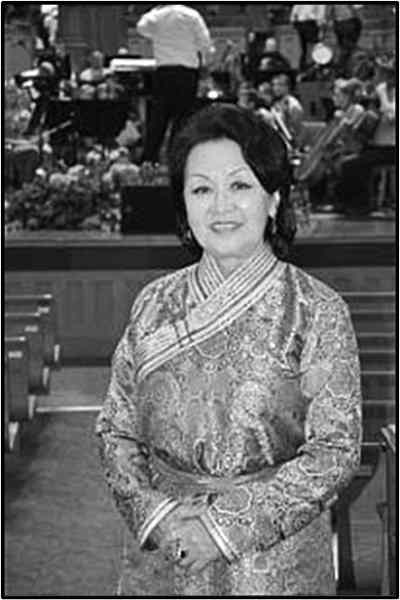 Buted Altangerel, a famous Mongolian opera singer, in June 2018, Ulaanbaatar. Courtesy of Linda Ford.
On Saturday afternoon, a combined mission reunion gathered about two hundred returned missionaries together. They shared mission experiences and uplifted one another. The Church News reported that “more than 1,000 Mongolians have served as full-time missionaries” up to this point, suggesting that nearly “one out of every 10 members of the Church in Mongolia” by 2013 had served a mission. A cultural extravaganza followed at the State Circus Building. The program showcased Mongolia’s rich culture and included “performances by local members, a contortionist, a morin khuur (a cello-type instrument) player, throat singers, traditional dancers, a combined stake and district choir, a missionary choir, operatic solos and music of the Restoration of the gospel.” A multimedia presentation on an overhead screen added to the performances shared. “The week’s anniversary events immediately followed the Asia Area broadcast of [the] April general conference. Most events were broadcast to the sixteen Church buildings throughout Mongolia. The week’s events touched hearts, renewed bonds of love, and strengthened thousands. Elder Stan Smith, one of the first senior missionaries to serve in Mongolia, said the twentieth anniversary was [the] highlight of his life second only to that of his mission to Mongolia.”[39]
Buted Altangerel, a famous opera singer and member of the Church in Mongolia, organized the choir for the twentieth anniversary celebration. She said, “The choir sang, . . . and I also sang at the beautiful anniversary event.”[40] Sister Purevjargal Dorj remembered the wonderful spirit at the devotional and fireside, as well as the performances at the cultural event.[41]
Singing with the Tabernacle Choir
Buted Altangerel first attended a sacrament meeting when her music student, Unurjargal Purev, invited her to church for a Mother’s Day activity in 1998. Buted grew up without religion, and her parents had just passed away, so she was happy to be invited, and she enjoyed her first Church meeting. She was surprised that her husband was willing to go with her the next Sunday. She recalled, “We met the elders and made an appointment and then joined the Church.” Buted and her husband, Batbayar Tserendorj, were baptized together in 1998 and sealed in the Hong Kong China Temple in 1999. Batbayar later served as a district president in 1999 and as the first stake patriarch in Mongolia in 2009.[42] The Church News reported,
Shortly after her baptism, Sister Buted was called as choir coordinator. She traveled around Mongolia, helping each ward and branch develop a choir.
Many members in Mongolia don’t have a musical background, but under Sister Buted’s training they created a choir that Elder Jeffrey R. Holland of the Quorum of the Twelve called “the Mormon Tabernacle Choir of Mongolia” when he visited in May 2011. . . .
Linda Ford served a mission in Mongolia with her husband from 2010 to 2012 and served on the music committee, where she got to know Sister Buted. Sister Ford helped with the Christmas pageant. . . .
Sister Buted said she wasn’t trained as a choir director, but Sister Ford insists that it was Sister Buted’s skills that made the Mongolian choir what it is.[43]
Buted was well known for her opera career and had received the Honored Actress of Mongolia award. She recounted her past experience as follows:
The opera theater was created in Mongolia and they wanted to prepare singers. I took and passed the test and went to Bulgaria in 1963. . . . I came back in 1969 and worked as an opera singer. It was six years in Bulgaria, then back to Mongolia.
I sang the main role in about 30 plays. I sang in the Mongolia Opera Theater, and sang in Bulgarian and Russian [in] the traditional opera or love triangle.
I have a picture taken in 1981. At the 60th anniversary of Mongolia’s independence, I sang the main role. . . . Mongolians from the “Opera and Dance State Academic Theater” sang for all of . . . Mongolia’s special celebrations.
I sang for ten traditional operas and the international classic opera.[44]
“I love hearing the Mormon Tabernacle Choir [renamed in 2018 as The Tabernacle Choir at Temple Square] when I joined the Church,” said Buted. She shared how she fulfilled her dream to sing with the Tabernacle Choir in 2013:[45]
I mentioned to President [Jay D.] Clark that I loved the Mormon Tabernacle Choir and wished to sing with them live. After a while, I got an email from him to tell me I can sing and perform with the choir. President Clark had asked Elder Holland if that was possible, and we got a letter back from Elder Holland. . . .
I flew to Utah in 2013 and Sister Ford came to the airport to greet me. She served in Mongolia and she gave me five music pieces. The notes were fine, but everything was in English. I had previously studied a bit of English when I attended English classes by the senior missionaries. It was very nice to be able to read the notes. . . .
I sat with the sopranos, the tone was still and small, but I had a powerful feeling with them. I sang five pieces with them, four regular hymns and one from Mozart. They videotaped me and gave me a copy of the wonderful video recording. It was a great moment in my church and singing.
Although it was not an actual concert, it was a rehearsal with the Mormon Tabernacle Choir’s general practice with three visitors from Poland, the United States, and me from Mongolia. I saw the concert on Sunday and was in the audience, when they mentioned I had practiced with them previously. . . .
As a singer and artist, we need to put our feelings [in] and express them in our talent. When I received the gospel, I felt those feelings opened up, and I felt even more. . . tender and [deep] feelings inside.[46]
Sister Ford, who accompanied Sister Buted, said, “It was amazing. . . . All the way home she said, ‘I am so happy. I am so very happy.’ It was so cute. She just beamed.”[47] Buted returned to Mongolia and continued to work with various choir members. She said, “At the music and dance school, I taught very talented people. But at church, the choir members had no talent but much heart and love for singing, . . . [and] they sing better than some of my students.”[48]
Christmas Choir and Choir Tours
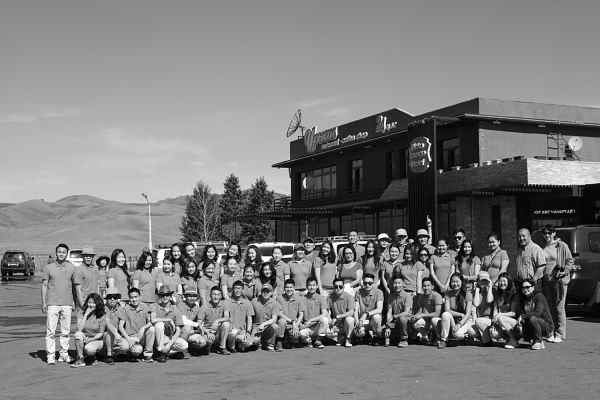
 Top: Church choir road show, circa 2015 or 2016. Bottom: The Church held various stake and ward activities, including its first wrestling championship in Mongolia in 2015. Photos courtesy of Odgerel Ochirjav.
Years before she sang on Temple Square, Sister Buted organized a Christmas choir after the BYU–Hawaii Concert Choir tour in Mongolia in 2008. She organized musical performances that included theatrical elements focused on the birth of Christ. The first Christmas musical devotional was on 25 December 2008, introducing Christmas to many in Mongolia. Oyunchimeg Baatar, who joined the church after singing with the choir, said that “the choir helped me to understand the true meaning of Christmas” and helped her gain a testimony of the Church.[49]
The Christmas choir was also invited to perform for dignitaries and ambassadors at the United States and United Kingdom’s embassies and at other locations. Onon Dalaikhuu said that “almost every year, television stations invited the choir to sing for their broadcasting on Christmas days.” In addition, the choir also sang in malls, hotels, and other public venues. Nomungerel Enkhtuvshin explained, “Christianity is a minority in Mongolia, so we face a lot of resistance. However, expressing ourselves through music reduces the resistance.”[50]
Unurjargal Purev, who was baptized in 1997, learned to play the piano and became a choir conductor at church while working with Sister Buted. Sister Unurjargal participated with the choir in all their various celebrations and activities. At the request of President Odgerel, she organized a choir tour to visit various units, including those in distant provinces like Darkhan. She recalled, “We prepared full concerts for all the members. We wanted the stake choir to reach far locations and bring the choir to them. Our mission was to share the Spirit with others through our thirty-plus member choir.” They worked with local government leaders and traveled and performed in public sites for both members and nonmembers.[51] She explained,
We always had a special feeling during our preparation, and we never knew who we might reach with that special feeling.
In the summer of 2015, we had a very successful tour, and felt we fulfilled a mission. We covered many miles and it was very organized. We had one big bus and stayed in hotels. It was organized well in advance, with a one-year preparation, singing at rehearsals, working out logistics, etc.
Part of the choir also had special musical numbers. We had nice [trending] songs [and] clean and popular songs, including gospel songs and Mongolian music.[52]
This experience, as well as the Christmas choir, prepared them for Mongolia’s Got Talent! Sister Unurjargal said, “I worked with the choir that went to Mongolia’s Got Talent! . . . to let people know about the Church.”[53]
Mongolia’s Got Talent!
In December 2016 the combined choir from the Ulaanbaatar Mongolia East and West stakes reached the semifinals of the second season of the nationally televised Mongolia’s Got Talent! TV show. The choir—composed of seminary and institute students, half of whom were returned missionaries—had no idea they would have this opportunity to share their beliefs and talents on such a large stage. Odgerel Ochirjav, the president of the Ulaanbaatar Mongolia West Stake, recalled when this choir was first conceived after a visit from a BYU choir in 2008. The idea to showcase the choir in Mongolia was something far from his mind at the time.[54]
In 2015 Elder Stephen L. Toronto, an Area Seventy in Asia, visited Mongolia and provided training on the public affairs efforts of the Church. President Odgerel was unsure how to proceed. Then in January 2016, his brother-in-law, Tsogtbayar Samandari (who was not a member of the faith), called and said, “I was watching Mongolia’s Got Talent, . . . [and] I had a strong impression that your church choir should participate.” President Odgerel discussed the idea with choir director Unurjargal Purev, and the choir members were excited about the possibility. The choir became known as Zion or “SION,” an acronym corresponding to the Mongolian words for spirit, faith, mind, and unity.[55] Sister Unurjargal said, “This was a one-year project, to help people learn about the Church.”[56] Sister Khaliunaa Shinen said they helped one other, and the Lord blessed them.[57] Sister Uyanga Eukhtuvshin added, “When we were asked to sing in Mongolia’s Got Talent, I was very excited because it was a big TV show. We wanted to use this opportunity to . . . improve the perception of the Church [in Mongolia].” She explained, “It was a big time and financial sacrifice, but I saw this as a wonderful opportunity for the Church.”[58]

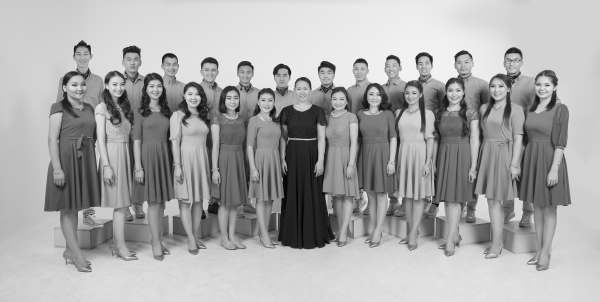 Top and bottom: UB east and west stakes combined choir participates in 2016's Mongolia's Got Talent! Courtesy of Odgerel Ochirjav.
In March 2016 SION sang during the first round of the competition in Ulaanbaatar. One judge said, “This is new and refreshing to have an acapella choir that moves and dances with the music.” A second judge said, “I see your faces light up! . . . We need to put your video on YouTube to showcase this show to the world.” The judges asked the choir what they would do if they won the grand prize of US $50,000. He was stunned to learn that the choir would donate it to an orphanage as a special Christmas gift. Of the four hundred participants, SION was among the two hundred who advanced to the second round. However, their performance was scheduled for the same day as a multistake youth conference, which involved half of the thirty-five choir members. With great sacrifice, the choir completed their performance and then traveled 480 kilometers (eight hours by bus) from the TV studio to the youth conference. Of the two hundred acts, SION was among the thirty-two to advance to the semifinals. The choir began to be featured on social media related to Mongolia’s Got Talent.[59] Brother Shijir Purevdorj said, “The fact that the band Zion was among the top 32 contestants is a big accomplishment. . . . As a result of this TV show, many people are cultivating a positive attitude towards the Church.”[60]
There were many late-night practices to prepare for the semifinals. On the day of this performance, the choir woke up at 4 a.m. to temperatures of -29 degrees Fahrenheit (-34 degrees Celsius).[61] Sister Nomuungerel Enkhtuvshin said, “The semi-final round took place during the coldest days of the winter and many members of our group caught a cold. But they got better as we prayed for them.” People throughout Mongolia viewed the show and texted their votes.[62] Adiyabold Namkhai, president of the Ulaanbaatar Mongolia East Stake, said, “When our choir performed, the judges and the audience were cheering.”[63]
Choir members increased their faith, gained self-confidence, and developed friendships. Brother Odgerel Tumursukh said, “We devoted our attention and time for a whole year while managing our jobs and other facets of our lives. Although it was difficult, we have received many blessings.” Brother Ganbaatar Ulziiduuren added, “Singing in the choir helped us to learn how to forgive and support one another.” Brother Bayartsogt Lhagvajav said, “My family has many relatives in Ulaanbaatar and not all of them understand my religion. Sometimes they criticize me, but after they watched Mongolia’s Got Talent, they changed their attitude towards the Church.”[64] “When I participate[0] in [the] Mongolian’s Got Talent competition,” Sister Onon Dalaikhuu explained, “I learned that encouraging and supporting each other [was the] key to [our] success.” She added, “Many of us were sick, busy, tired and just felt it was too much. However, when we prayed together, somehow we would find more power and desire to endure to the end. . . . [T]he Lord was guiding us during all this time!”[65]
The choir did not move on to the finals, but their performances gave the Church significant exposure. Sister Unurjargal Purev said, “On stage, they couldn’t tell we are members of the Church of Jesus Christ, but through our example, we showed them who we really are.”[66] Many organizations extended invitations for the choir to perform at various events, including the Christmas concert and 2016 New Year’s Eve concert in Ulaanbaatar, with almost 1.4 million people—45% of the country’s population. In 2017 they were invited to sing at the US Embassy’s New Year’s Party. President Odgerel said, “The Lord prepared a way. . . . Now the whole city talks about the Mormon choir’s participation in Mongolia’s Got Talent!” He added that the “appearance of SION increased the positive image of the Church [among] the people of Mongolia.”[67] President Adiyabold Namkhai said, “The show spread in the country, . . . [and] the choir was very much recognized by the public on social media. . . . Even though we did not win the competition, we accomplished our mission and helped the public affair[s] efforts to promote the Church’s name.”[68]
The Voice of Mongolia
Ankhbayar Otgonbyar was eleven years old when he went to church with his aunt and sang from a hymnbook. Years later he met the missionaries again and told them he wanted to sing the hymns again. They invited him to church to sing, and he was baptized in 2009. Participating with the choir that went to Mongolia’s Got Talent was a dream come true for him. He related his subsequent experience as a contestant on The Voice of Mongolia:[69]
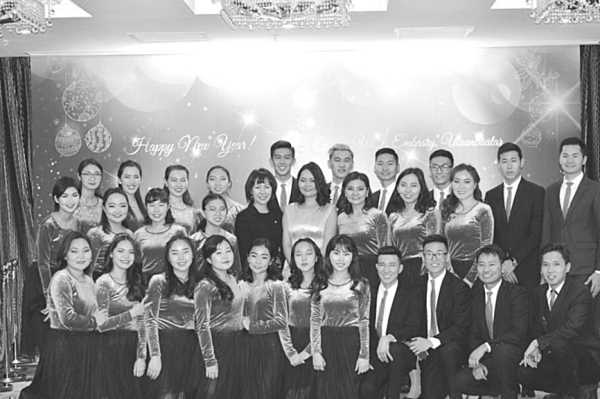 ZION choir band was invited to sing at the US Embassy New Year party in 2017. Courtesy of Mongolia public affairs office.
One reason I went to The Voice of Mongolia was because my experience in Mongolia’s Got Talent encouraged me and gave me experience with singing competition[s]. There were 13,000 people registered for Voice of Mongolia throughout Mongolia, 2,000 invited to the closed audition, and then 200 that came to the auditions open on television. It started in April 2017 and went till May 2018. During the show, they cut [the contestants] from 200 down to 64, and I made it to the 32 selected but didn’t go through to the final 16 contestants.
After they were down to 32 contestants, I thought that I would get cut because something more important was happening to me. When they announced I was cut, I felt happy! I was cut to focus on more important things. My wife, or fiancée at the time, was in the audience. On the last day of the show, I was at the airport going to Hong Kong to be sealed. I knew there were things more important, which was getting married and going to the temple to be sealed.[70]
Summary
As Elder Holland envisioned, Mongolia’s “children of destiny” are moving forward with faith, serving missions, establishing eternal families, and sharing the gospel. As the Church held its first handcart trek and celebrated its twentieth anniversary in Mongolia, members had the opportunity to reflect on the sacrifice and legacy from the early Mongolian pioneers and missionaries. Elder M. Russell Ballard of the Quorum of the Twelve said, “Prepare for a spiritual journey . . . by walking in the footsteps of our beloved pioneers in every land. We must be sure that the legacy of faith received from them is never lost. Let their heroic lives touch our hearts, and especially the hearts of our youth, so the fire of true testimony and unwavering love for the Lord and His Church will blaze brightly within each one of us as it did in our faithful pioneers.”[71]
The choir tours helped to share the light of the gospel, and these efforts eventually led to great exposure for the church as they competed in Mongolian’s Got Talent. In November 2015, Sisters Cheryl A. Esplin and Neill F. Marriott, counselors in the Primary and the Young Women General Presidency, visited Mongolia and emphasized the role of the youth in the future of the Church in Mongolia.[72]
“The youth in Mongolia are the hope,” stated Sister Marriott. “This is a first-generation church, and . . . their lives are the anchor that . . . the Church is going to build on. And they are steady.”
The women leaders were able to visit families in their homes called gers, which are portable, round tents.
“You know this was one of the sweetest experiences of my visit,” said Sister Esplin after meeting a woman named Nura who is raising her sister’s children and teaching them the gospel in a ger. “I think one of the things that I felt that I will never, never forget is the love that I felt in that home,” she said.
“And I felt such a kinship,” said Sister Esplin about her visit to the Asian country. “In a faraway land, these are my brothers and sisters.”
“The gospel shows up in the way they live,” summarized Sister Marriott. “And we felt it; we felt that kinship because we felt the same way they felt. . . . And we strengthened one another.”[73]
Notes
[1] Clark, “Mission Historical Summary 2011—Mongolia Ulaanbaatar Mission.”
[2] Clark, “Mission Historical Summary 2011—Mongolia Ulaanbaatar Mission.”
[3] “Elder Holland Instructs Mongolian Saints, Missionaries,” churchofjesuschrist.org.
[4] Tselmegsaikhan Sodnomdarjaa, interview by Po Nien (Felipe) Chou and Petra Chou, 19 June 2018, Ulaanbaatar, Mongolia.
[5] Batchimeg Magsar, interview by Po Nien (Felipe) Chou and Petra Chou, 19 June 2018, Ulaanbaatar, Mongolia.
[6] Clark, “Mission Historical Summary 2011—Mongolia Ulaanbaatar Mission.”
[7] Swensen, “New ‘Kirtlands’ Emerging in Asia,” 16–17.
[8] “Elder Holland Instructs Mongolian Saints, Missionaries,” churchofjesuschrist.org.
[9] “Apostles Visit Church Members in India, Hong Kong and Mongolia,” Church Newsroom, 27 May 2011.
[10] Chimedbaatar Tseden, interview by Po Nien (Felipe) Chou and Petra Chou, 20 June 2018, Ulaanbaatar, Mongolia, translated by Ariunchimeg Tserenjav.
[11] Bayardelger Jamsran, interview by Po Nien (Felipe) Chou and Petra Chou, 20 June 2018, Ulaanbaatar, Mongolia, translated by Ariunchimeg Tserenjav.
[12] “Elder Holland Instructs Mongolian Saints, Missionaries.”
[13] “Apostles Visit Church Members in India, Hong Kong and Mongolia.”
[14] “Apostles Visit Church Members in India, Hong Kong and Mongolia.”
[15] Purevjargal Dorj, interview by Po Nien (Felipe) Chou and Petra Chou, 19 June 2018, Ulaanbaatar, Mongolia.
[16] “Apostles Visit Church Members in India, Hong Kong and Mongolia”; “Elder Holland Instructs Mongolian Saints, Missionaries.”
[17] Bolormaa Ayurzana, interview by Po Nien (Felipe) Chou and Petra Chou, 19 June 2018, Ulaanbaatar, Mongolia.
[18] Clark, “Mission Historical Summary 2011—Mongolia Ulaanbaatar Mission.”
[19] Bayasgalan Sukhbaatar, interview by Po Nien (Felipe) Chou and Petra Chou, 19 June 2018, Ulaanbaatar, Mongolia, translated by Gankhuyag Tsogoo.
[20] Sukhbaatar, interview.
[21] Handcart Trek Reenactments: Guidelines for Leaders, 1–2.
[22] Hinckley, “Faith of the Pioneers,” Ensign, July 1984, 3.
[23] Prescott, “Modern-day Mongolian Pioneers Re-enact Trek,” 8–9.
[24] Prescott, “Modern-day Mongolian Pioneers Re-enact Trek,” 8–9.
[25] Prescott, “Modern-day Mongolian Pioneers Re-enact Trek,” 8–9.
[26] Tserenbat Jamiyan, interview by Po Nien (Felipe) Chou and Petra Chou, 20 June 2018, Ulaanbaatar, Mongolia, translated by Ariunchimeg Tserenjav.
[27] Prescott, “Modern-day Mongolian Pioneers Re-enact Trek,” 8–9.
[28] Prescott, “Modern-day Mongolian Pioneers Re-enact Trek,” 8–9.
[29] Jamiyan, interview.
[30] Jamiyan, interview.
[31] Tai Kwok Yuen and Tai Lai Hui Hua, interview by Po Nien (Felipe) Chou and Petra Chou, 17 January 2018, Provo, UT.
[32] “Members Celebrate 20 Years of Church in Mongolia,” Church News, 19 May 2013, 8–9.
[33] Tai and Tai, interview.
[34] “Members Celebrate 20 Years of Church in Mongolia,” 8–9.
[35] Dorj, interview.
[36] “Members Celebrate 20 Years of Church in Mongolia,” 8–9.
[37] Jamsran, interview.
[38] “Members Celebrate 20 Years of Church in Mongolia,” 8–9.
[39] “Members Celebrate 20 Years of Church in Mongolia,” 8–9.
[40] Buted Altangerel, interview by Po Nien (Felipe) Chou and Petra Chou, 20 June 2018, Ulaanbaatar, Mongolia, translated by Ariunchimeg Tserenjav.
[41] Dorj, interview.
[42] Altangerel, interview.
[43] Garrett, “Dream Comes True for LDS Mongolian Opera Star,” 10.
[44] Altangerel, interview.
[45] Altangerel, interview.
[46] Altangerel, interview.
[47] Garrett, “Dream Comes True for LDS Mongolian Opera Star,” 10.
[48] Altangerel, interview.
[49] Serena Dugar Ioane, “Mongolian Saints Help Introduce Christmas to Their Country” (unpublished, copy in possession of authors), 1.
[50] Ioane, “Mongolian Saints Help Introduce Christmas to Their Country,” 1.
[51] Unurjargal Purev, interview by Po Nien (Felipe) Chou and Petra Chou, 20 June 2018, Ulaanbaatar, Mongolia, translated by Ariunchimeg Tserenjav.
[52] Purev, interview.
[53] Purev, interview.
[54] A version of this section appears in Chou, “Choir Part of ‘Mongolia’s Got Talent,’” 14; and Chou, Chou, and Ochirjav, “Mongolia’s Got Talent,” 10–11; Odgerel Ochirjav, interview by Po Nien (Felipe) Chou, 21 December 2016.
[55] Ochirjav, interview.
[56] Purev, interview.
[57] Khaliunaa Shinen, interview by Po Nien (Felipe) Chou and Petra Chou, 20 June 2018, Ulaanbaatar, Mongolia, translated by Ariunchimeg Tserenjav.
[58] Uyanga Eukhtuvshin, interview by Po Nien (Felipe) Chou and Petra Chou, 20 June 2018, Ulaanbaatar, Mongolia, translated by Ariunchimeg Tserenjav.
[59] Ochirjav, interview.
[60] Shijir Purevdorj, email message to Odgerel Ochirjav, 22 December 2016. Copy in possession of authors.
[61] Ochirjav, interview.
[62] Nomuungerel Enkhtuvshin, email message to Odgerel Ochirjav, 22 December 2016. Copy in possession of authors.
[63] Adiyabold Namkhai, email message to Odgerel Ochirjav, 12 March 2017. Copy in possession of authors.
[64] Bayartsogt Lhagvajav, email messages to Odgerel Ochirjav, 22 December 2016 and 8 March 2017. Copy in possession of authors.
[65] Onon Dalaikhuu, email messages to Odgerel Ochirjav, 19 January 2017 and 8 March 2017. Copy in possession of authors.
[66] Purev, interview.
[67] Ochirjav, interview; Odgerel Ochirjav, email message to Po Nien (Felipe) Chou, 8 March 2017.
[68] Namkhai, email message to Odgerel Ochirjav.
[69] Ankhbayar Otgonbyar, interview by Po Nien (Felipe) Chou and Petra Chou, 20 June 2018, Ulaanbaatar, Mongolia, translated by Ariunchimeg Tserenjav.
[70] Otgonbyar, interview.
[71] Ballard, “Faith in Every Footstep,” 25.
[72] “Worldwide Mormon Leaders Cheryl Esplin and Neill Marriott Visit Women and Children in Asia,” Church Newsroom, 20 November 2015.
[73] “Worldwide Mormon Leaders Cheryl Esplin and Neill Marriott Visit.”
