
 menu icon in the top, right corner of the screen.
 icon above to close this box.
 icon at the bottom of the screen below the browser—if you don't see it, swipe up to unhide it.
A Marvelous Work and a Wonder
First Missionaries and Apostolic Dedication (1992-93)
Po Nien (Felipe) Chou and Petra Chou, "A Marvelous Work and a Wonder: First Missionaries and Apostolic Dedication (1992-93)," in Voice of the Saints in Mongolia (Provo, UT: Religious Studies Center, Brigham Young University; Salt Lake City: Deseret Book), 19‒42.
“Therefore, I will proceed to do a marvelous work among this people, yea, a marvelous work and a wonder, for the wisdom of their wise and learned shall perish, and the understanding of their prudent shall be hid” (2 Nephi 27:26).
“The Mongolia miracle” included the efforts of the first six missionary couples sent to assist the young Mongolian government with their educational system. These energetic and dedicated missionary couples helped to organize the first branch presidency and Relief Society in Mongolia and welcomed the first Mongolian converts to the Church. From their apartments in Building 7 by the Mercury Market and the Russian School #3, these missionary couples began to share the light of the restored gospel in Mongolia.
As the first missionaries labored in faith, with the aid of early Mongolian converts, the Church began to establish a foothold in Mongolia. The dedicatory prayer pronounced by Elder Neal A. Maxwell of the Quorum of the Twelve would officially turn the apostolic keys to open missionary work in Mongolia and provide the saving ordinances of the gospel to the people in Mongolia.
The First Six Missionary Couples in Mongolia
A revelation received by the Prophet Joseph Smith in November 1831 called upon the weak and the simple to proclaim “the fulness of [the] gospel . . . unto the ends of the world” and provided “those to whom these commandments were given . . . power to lay the foundation of this church, and to bring it forth out of obscurity” (Doctrine and Covenants 1:23, 30). In September 1992, The Church of Jesus Christ of Latter-day Saints confirmed that the first six missionary couples were being sent to Mongolia at the government’s request.[1] These missionaries would provide educational assistance and teach the fullness of the gospel in Mongolia.
Preparing for Their Call and Assignment
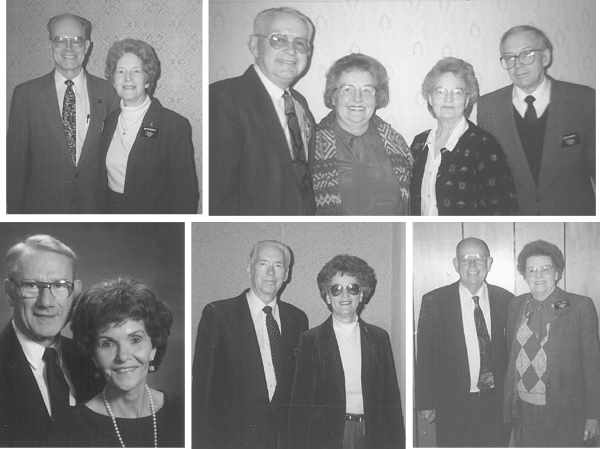 First six couple missionaries in Ullanbaatar, Mongolia, circa 1992. Top row: Elders and Sisters: Kenneth and Donna Beesley, Stanley and Marjorie Smith, Richard and Anna Harper. Bottom row: Elders and Sisters: Royce and Jane Flandro, DuWayne and Alice Schmidt, Gary and Barbara Carlson.
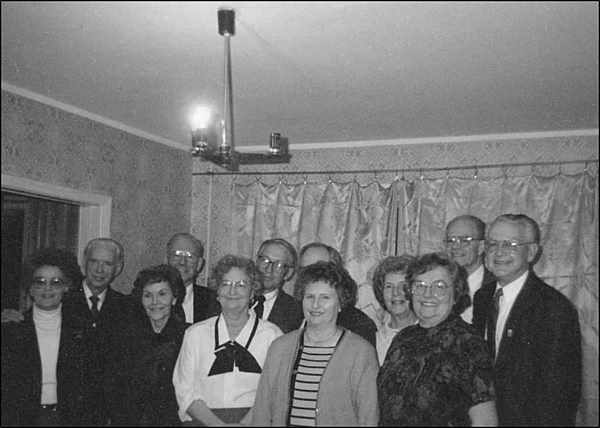 Center: Shirley Carmack and John K. Carmack (behind Sister Carmack) visit the first senior couple missionaires in Mongolia, March 1993, in Ulaanbaatar. Courtesy of Odgerel Ochirjav.
These missionary couples traveled from the US to the other end of the world with “power to lay the foundation of this church” in Mongolia. One of these missionary couples related the following: “When our stake president called us into his office late in the summer of 1992, he explained that the Lord had a special call for us to serve in Outer Mongolia. ‘Will you accept the call?’ he asked. We replied, ‘Of course, if the Lord has called us, we will serve. But now tell us, where are we really being called?’ He answered solemnly, ‘I am not kidding you, it is a call to Mongolia.’”[2]
Elder Monte J. Brough, then Asia Area President, said that these missionary couples would work under the direction of the Asia Area Presidency, teach others about the gospel, and hold regular Church meetings.[3] The unique educational background and experience of these missionary couples were ideal for their assignment in Mongolia. These missionary couples would be based in the capital city of Ulaanbaatar and serve at five universities and other professional and technical institutes while helping with “policy development and planning, curriculum development, and other related concerns.”[4] Elder Brough explained that during his time in the Asia Area Presidency, “It was our privilege to be involved in opening or reopening six countries. We were involved in reopening Sri Lanka. . . . We went to Pakistan. . . . We traveled to Bangladesh, to Hanoi, Vietnam, Mongolia and Nepal. What an exciting time to be in Asia.”[5]
In August 1992, Elder Brough visited Ulaanbaatar, Mongolia, to assess the living conditions before the arrival of the first missionary couples. He also met with Paul Hyer and his wife, Karen, who were in Ulaanbaatar for an academic conference, the World Conference of Mongolists. Hyer mentioned to Elder Brough that a member of the Church who worked at the American Embassy suggested that due to the extreme cold Mongolian winters, “it would be better for the missionaries to arrive in the spring.” Elder Brough was unphased and responded that “if the missionaries could not take a winter in Mongolia, they should not bother to come at all.”[6]
Missionary Couples Arrive in Mongolia
Kenneth and Donna Beesley arrived in Mongolia on 17 September 1992 and were assigned to lead this first group of missionary couples. Brother Beesley’s experience included several years as the associate commissioner of education over Church schools from 1970 to 1980, as well as president of LDS Business College from 1986 to 1991.[7] The other missionary couples arrived between October 1992 and May 1993. They included Gary and Barbara L. Carlson, Royce P. and Mary Jane Flandro, Richard G. and Anna M. Harper, C. DuWayne and Alice C. Schmidt, and Stanley B. and Marjorie Smith.[8]
The Smiths reported that they entered the mission home in the US in September 1992. After a few days and some training, the Smiths embarked on the long journey from Salt Lake City to Ulaanbaatar. They first traveled from Salt Lake City to San Francisco. The next leg of their trip was a long flight that crossed the international date line and brought them to Tokyo, which was followed by another stop in Beijing before they finally arrived in Ulaanbaatar in October 1992.[9]
Living Conditions and Building 7
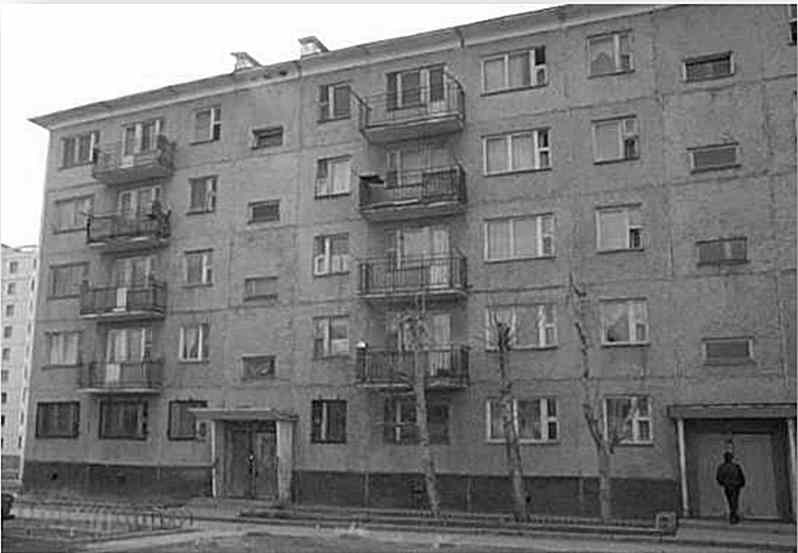 Many early missionaries were housed in Soviet-style apartments. Photo of Ulaanbaatar, July 1994. Courtesy of Bradley Pierson.
Suitable apartments were located and arranged with the Mongolian government before the missionaries’ arrival. However, once the missionaries landed in Mongolia, they learned the government had given away those apartments. Nayanjin, an individual who was helping Brother Beesley, offered them his own apartment with food and a refrigerator. When asked why he would give up his apartment for the missionaries and move back into a yurt, Nayanjin replied, “Because you are my brother.” According to Elder Brough, this was a response similar to the one he had given a university rector when the rector asked Elder Brough a similar question.[10] Nayanjin’s apartment was a blessing. Elder Brough noted the following:
Mongolia had no communication system when we first went there. . . . We had to go to the hotel, stand in line, pay our money, and use a very [antique] telephone to reach the outside world.
Because of Nayanjin’s apartment, we were able to establish a telephone link between headquarters in Hong Kong and Brother Beesley in Nayanjin’s apartment. We then obtained some fax machines. They didn’t [find] any . . . so we sent a staff person up from Hong Kong to install a fax machine in Nayanjin’s apartment. That fax machine became our communication. It was very, very difficult to communicate, but somehow we were enterprising and I think we did all right.[11]
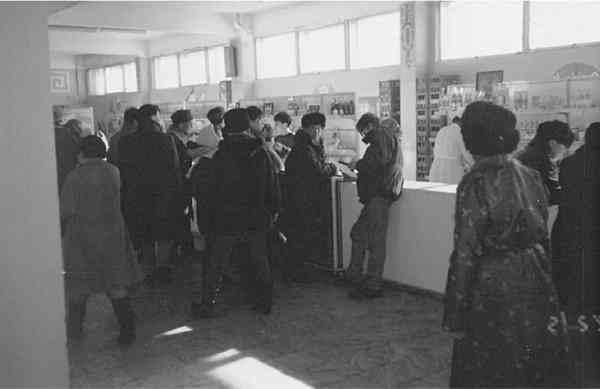 Finding supplies was sometimes challenging. Crowds at the market in Ulaanbaatar in 1994. Courtesy of Bradley Pierson.
In addition, Mongolia’s 1992–93 winter was especially hard on Mongolians and the missionaries. There were disruptions to the heat and electricity, and food and water was limited. Therefore, the food delivered by the Beijing Branch Relief Society was welcomed and appreciated by the missionary couples in Mongolia.[12] The missionary couples were housed in several individual apartments in Building 7 by Russian School #3 and the Mercury Market.[13]
The first Church services in Mongolia were held in [Building 7] apartment #5.
These apartments were owned by the Russian School #3 which is next to us. The Head of the school is a Russian named Ms. Sorenson and the physical facilities person is a Mongolian named Mr. Mendbayar. . . . We are charged $250 a month for rent which is reasonable. Heating, electricity and hot water are provided with the apartment. The telephone is extra. The school provides some of the basic furnishing[s] such as [a] stove, [a] fridge, tables, chairs, desks, beds and maybe a rug or two. They do an annual inspection of the apartments which is mainly to verify their furnishings and check for any damage. . . .
The Russian school takes care of such things as problems with plumbing, electricity, heating, water, [the] fridge, [the] stove and some painting.[14]
Missionaries Prepared to Assist Mongolia’s Higher Education
When the missionary couples arrived in Mongolia, they found several issues with the country’s higher education. According to Professor Steven C. Harper, “Mongolian higher education was in severe disarray. Buildings were in disrepair, libraries were undeserving of the name, and textbooks, where available, were outdated.” He added, “Forty tons of [updated] college texts, medicine, and other supplies were delivered.”[15] These first six missionary couples had the background, experience, and skills needed for such an occasion to assist and strengthen the educational system in Mongolia.
This talented group of missionaries included “a medical doctor responsible for postgraduate studies at a university medical center, a computer science professor, a business professor, a professor of curriculum development and administration, and an educational administrator.”[16] These missionaries received a warm welcome from the Mongolian government and the universities they were assigned to help, and they served as consultants in several important educational committees.[17] R. Lanier Britsch, a Latter-day Saint scholar, summarized their work as follows:
Elder Beesley held seminars for the Ministry of Science and Education (MOSE) with universities, a technical university, and several business colleges. He also taught [an English class]. Donna taught English classes at the Russian-Mongolian Secondary School No. 3 and tutored students outside class. Richard Harper taught psychology and English and consulted with the vice president of the Academy of Sciences. His wife, Anna, taught English and gave TOEFL (Test of English as Foreign Language) review sessions. Stanley B. Smith taught English and business classes, and his wife, Marjorie, taught English at Russian-Mongolian Secondary School No. 3. Royce P. Flandro consulted regarding curriculum, faculty evaluation, and distance-learning. His wife, Jane, taught classes on how to start and manage small businesses. C. DuWayne Schmidt, M.D., lectured at the Medical University, rewrote a Mongolian textbook on pulmonary diseases, and donated medical books and journals and some medicines to the Medical University. His wife, Alice, taught English. Gary Carlson taught computer systems and donated a large library of computer books and journals, software, and hardware to the Technical University. His wife, Barbara, taught English classes, contributed a large library of books and teaching materials to the Otgon-Tenger Foreign Language Institute, and established an ESL (English as a second language) library for LDS missionaries.[18]
Elder Brough visited the missionary couples in Mongolia regularly and noted that Brother Beesley “was the right person at the right time” to lead the efforts of these missionary couples and the Church there. Elder Brough added that the government and the people in Mongolia recognized the wonderful contributions of these missionary couples as they served faithfully throughout Mongolia.[19]
The Ulaanbaatar Branch
The first official Church meeting in Mongolia was held in September 1992. Elder Beesley presided over the small group at their apartment for this first meeting of the Ulaanbaatar Mongolia Branch. Although the branch had not been officially registered yet, this first branch meeting was held with the Beesleys and Bernard and Aleta Vetter, a couple visiting from Kaysville, Utah, to guide a hunting expedition.[20]
The program for this historical meeting was as follows: presiding and conducting, Elder Beesley; opening hymn, “We Are Sowing”; invocation, Elder Bernard Vetter; sacrament hymn, “Father in Heaven, We Do Believe”; administration of the sacrament, Elders Beesley and Vetter; remarks by all those in attendance; closing hymn, “Because I Have Been Given Much”; closing prayer, [Sister] Donna Beesley.
The following Sunday, September 27, 1992, sacrament meeting was held again in the Beesley apartment, as were the next ten meetings. Those in attendance at this meeting were Elder and Sister Beesley and Brother and Sister Steven and Nancy Kohlert, who were in Mongolia helping with medical supplies and visiting hospitals. Brother Kohlert was here with IHC.
On Sunday, October 4, 1992, the Beesleys were the only ones in attendance. Brother Beesley said of this meeting, he hoped it would be the smallest attendance they would have while they were in Mongolia, which indeed it was.[21]
Organizing the Branch Presidency
The next missionary couples to arrive in Mongolia were Stanley B. and Marjorie Smith and Richard G. and Anna M. Harper. The Smiths and Harpers arrived together in Ulaanbaatar in October 1992. On the following Sunday, 11 October 1992, the full branch presidency was officially organized. Elders Richard Harper and Stanley Smith were set apart, respectively, as the first and second counselors in the branch presidency. Sister Smith recorded, “There were just the three couples of us there, but we had a great meeting.” Elder Beesley was the branch president, having been previously set apart by Elders Boyd K. Packer and Neal A. Maxwell back in Salt Lake City. Elder and Sister Smith reported that it was quite exciting “being the first members of the church in a country as remote and unknown as Mongolia. The Lord was indeed taking his gospel to all the corners of the earth.”[22]
The missionaries taught at the university but were not allowed to teach the gospel during their educational assignments. However, in their spare time, they were able to proselytize and teach the gospel. Smith said, “The Lord . . . was mindful of our situation and instead of us having to seek out those interested in learning about Jesus Christ, he sent them to us.” Mongolian students would ask them if they believed in Jesus Christ and then ask the missionaries to teach them.[23] The Smiths chronicled some of the important events in first months in Mongolia.
October 28, 1992: Elder Brough arrived this afternoon. Brother Beesley picked him up and took him to the Bayangol Hotel. We all had dinner there tonight and afterwards we all went to President Brough’s room to visit. . . . How wonderful to have a general authority to visit with.
October 29, 1992: We had our zone conference. Brother Brough talked a little about his meetings with the government people. Then he talked about our assignment here. He said the eyes of the church were on us . . . [and] counseled us to learn the missionary discussions. . . . He gave us some new insights into some scriptures that I had never realized were there. He then had us bear our testimonies and . . . boy was the spirit in that room. It really touched and warmed my heart.[24]
During the week of November 16, 1992: Elder and Sister Royce and Jane Flandro arrived. Our missionary group was growing and it was good to have them with us.
December 13, 1992: We had six Mongolian visitors—Davaajargal, who went by the English name of Sylvia, Erdenebat, Batnasan, Purevsuren, Batchuluun, and Khurelbaatar attended. Erdenebat had come again, and the other five were students of Elder Smith.
That evening we had three sisters from the Beijing Branch Relief Society come on the train with 300 pounds of food and gifts for us. . . . It was a special treat to meet with the three sisters and to enjoy the wonderful things they brought, which had been collected by the saints in Beijing. The three sisters who came were Glenda Steele, Connie Blakemore, and Karen Fulk. . . . They were very brave to have come so far alone on the train with so many boxes of goodies and we truly appreciated them.[25]
While the missionaries struggled to learn the Mongolian language, the Lord blessed them to meet many young people who spoke enough English for the missionaries to communicate with and teach. Most of these investigators who came to the branch were university students in the college classes taught by the missionaries.[26]
Organizing the Relief Society
The Relief Society was first organized in 1842 in Nauvoo, Illinois, with Emma Smith as its president. By December 1992, the first branch Relief Society in Mongolia was organized with Sister Marjorie Smith called and set apart as the first branch Relief Society president.[27] Sister Smith recorded the following:
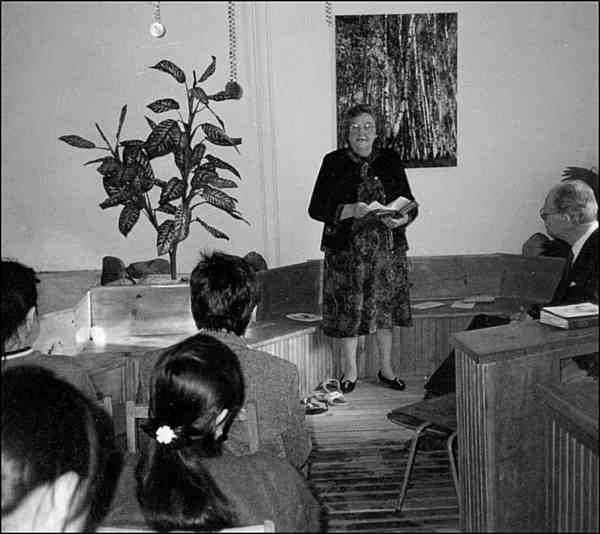 Marjorie Smith speaking at a baptismal service in February, 1993, Ulaanbaatar. Sister Smith was called as the first Relief Society president in Mongolia in December 1992. Courtesy of Odgerel Ochirjav.
December 21, 1992: I was asked today if I would be the Relief Society President in the branch, which I agreed to be. What a responsibility to be the very first to serve in that position in a country! This is the third time I have served in this position, but never before as quite such a pioneer.
December 28, 1992: Brother Beesley asked for recommendations for counselors and Secretary. Since there are only four sisters in the branch the choice was quite easy. Anna Harper will be the education counselor, Jane Flandro homemaking, and Donna Beesley, secretary.[28]
The other members of this first Relief Society presidency in Mongolia were sustained on January 3, 1993. Sister Smith had her Relief Society presidency fully organized on the first fast Sunday of the new year. Since it was fast and testimony meeting, those in attendance had the opportunity to share their testimonies, “including three Mongolian visitors—Sylvia, Purevsuren, and Bat-Ulzii.” Serving as the first Relief Society president in Mongolia, Sister Smith said, “It was quite an awesome responsibility to be called to start such an important work in a country where Christianity was so new.”[29]
Davaajargal Gendenjamts (Sylvia) became the first female convert in Mongolia in May 1993, and she became the first native Relief Society president in Mongolia on 9 January 1994. Joining Davaajargal in the Relief Society presidency was Donna Beesley and Sansartuya (Cosmos) Myagmarjav as her counselors and Enkhjargal Tsend as their secretary.”[30] Sister Smith wrote, “Sylvia is our very first woman convert. . . . I am really glad to see the members progress so they can take the responsibilities of the branch. . . . It was great to see the locals take over.”[31]
Moving to a “Chapel”
On 14 February 1993, the sacrament meeting moved to Elder and Sister Flandro’s apartment. Elder Flandro prepared the living room of their apartment to resemble a chapel, using a tabletop with its legs cut off as a raised platform and a small cabinet as a pulpit. “The arrangement of the room for a chapel made us feel at home because it looked very much like a real chapel,” said Elder and Sister Smith. Then on 19 February 1993, Elder DuWayne Schmidt and Sister Alice Schmidt arrived in Mongolia, increasing the number of missionary couples in Mongolia to five. The sixth missionary couple, the Carlsons, would not arrive until May.[32]
Elder and Sister Carmack, from the Area Presidency, arrived on 3 March 1993 from Hong Kong to visit the branch, but none of their luggage made it. The missionary couples had dinner with the Carmacks at the Bayangol Hotel, followed by a meeting in their room. During their zone meeting together, Elder Harper prayed for the Carmack’s luggage to arrive at the “appropriate time.” After the prayer, Elder Carmack said he thought the appropriate time had already passed. They had a good meeting with new members and investigators, and the Spirit in the meeting helped to strengthen their faith and testimonies.[33]
First Mongolian Baptisms
The missionaries were restricted from open proselytizing. However, they were allowed to answer questions when asked and invite interested people to their Church meetings or gatherings. There were no scriptures or other Church materials translated in Mongolian yet, but the Lord provided opportunities for the missionaries to meet many Mongolian students while teaching at the university. After teaching his class at the Mongolian National University, Elder Smith had two students ask him about Jesus Christ. Shortly after, Elders Smith and Harper began to teach these students, Purevsuren Lamjav and Bat-Ulzii Tsendkhuu, who were later baptized as the first two converts in Mongolia.[34]
Purevsuren and Bat-Ulzii
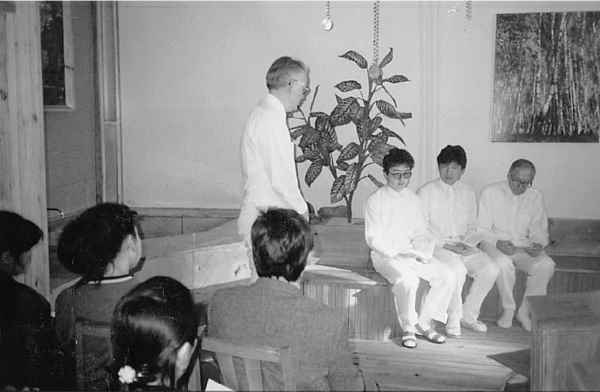 Purevsuren Lamjav and Bat-Ulzii Tsendkhuu were the first and second converts baptized in Mongolia on 6 February 1993. Courtesy of Bradley Pierson.
Purevsuren Lamjav grew up in western Mongolia, living with his family in a round, felt-lined tent called a ger. Like other nomadic or seminomadic families in Mongolia, they struggled to provide for their animals during the harsh Mongolian winters, and during the year they moved their ger to find new grazing pastures for their animals. He met the missionaries while attending a marketing class at the Mongolian National University. Purevsuren recalled, “My classmate Bat-Ulzii Tsendkhuu and I were curious why these American professionals would come to Mongolia.” He added, “Elder Smith told us about his church and invited us to attend, but he gave us an apartment address. We were surprised!”[35] Elder and Sister Smith recounted,
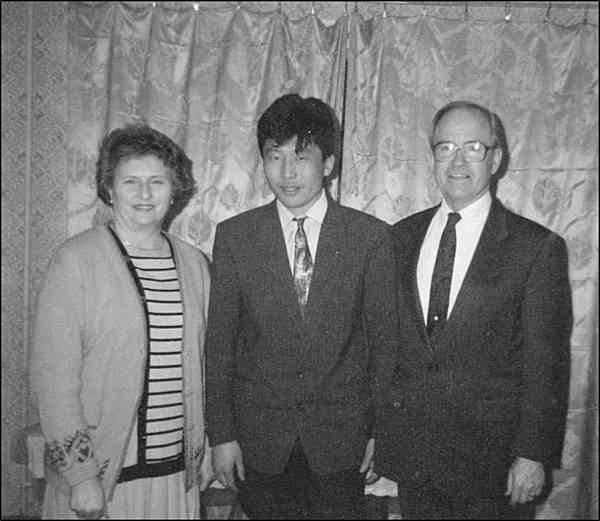 The Carmacks with Purevsuren Lamjav (center) in March 1993. Purevsuren was the first convert in Mongolia when he was baptized on 6 February 1993. Courtesy of Odgerel Ochirjav.
Purevsuren and Bat-Ulzii had started taking the discussions with Elder Smith and Elder Harper. They are very special spirits and were able to feel the Spirit of the Lord in what they were learning. When they finished one discussion they stood up and said, “We feel so good.” Elder Smith told them that what they were feeling was the Holy Ghost letting them know that what they were learning was the truth. Sylvia [Davajargal Gendenjamts] had not yet started the discussions. Bat-Ulzii and Purevsuren continued to take the discussions and attend church. They sometimes brought friends to church as did Sylvia.[36]
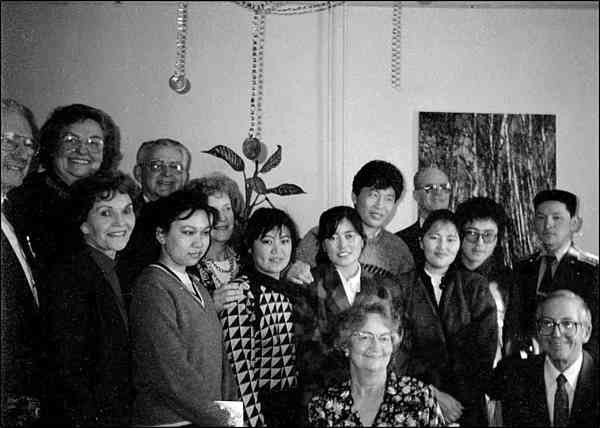 First missionaries with first new converts and investigators. February 1993, in Ulaanbaatar. Courtesy of Odgerel Ochirjav.
On 6 February 1993, the missionaries had their first convert baptisms in Mongolia. Purevsuren was a young single adult and university student. He was the first to enter the waters of baptism, and Elder Smith had the honor of performing the first baptism in Mongolia. Next came Bat-Ulzii’s turn with Elder Harper’s help. Bat-Ulzii had never put his head completely under water. He was “very frightened of the water and had put cotton in his ears so the water would not get in them.” The missionaries reported that Bat-Ulzii had to be baptized twice since he was not fully immersed the first time. Although it was a frightening experience for Bat-Ulzii, he had exercised tremendous faith in being baptized. The missionaries recorded that it was “a wonderful day and the branch had its first Mongolian members.” Bat-Ulzii was a married student, and his wife was expecting a baby at the time. The missionaries started teaching his wife after he was baptized.[37]
Purevsuren would later receive the Aaronic Priesthood and be ordained to the office of a priest on 19 May 1993. He was the first Mongolian to help in the administering and passing of the sacrament on 23 May 1993.[38] Bat-Ulzii, who exercised great faith in entering the waters of baptism, would later serve as the branch president for the Tuul Branch.[39]
Davaajargal Gendenjamts (Sylvia)
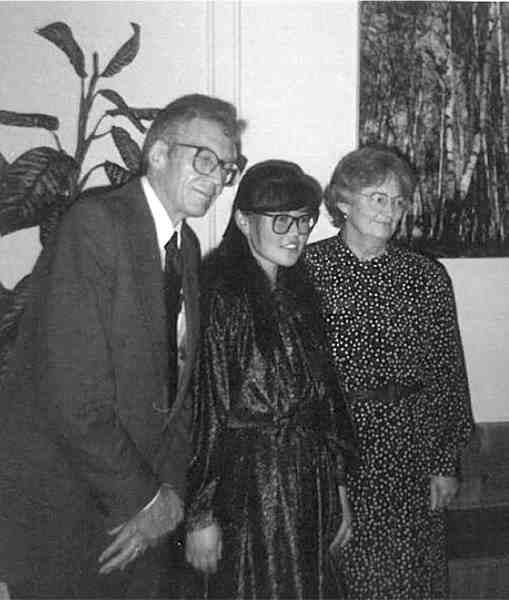 Elder and Sister Harper with Davaajargal Gendenjamts (Sylvia) at her baptism in Ulaanbaatar on 8 May 1993. Courtesy of Odgerel Orchijav.
Davaajargal Gendenjamts (Sylvia) was the third convert and first Mongolian sister to join the Church when she was baptized on May 8, 1993.[40] Elder and Sister Smith recorded the following:
Davaajargal (Sylvia), who had begun receiving the discussions, said that she wanted to be baptized on Saturday, May 8th. This was especially exciting to the [missionary] couples because she had been so active in bringing friends to our meetings. Also she would be the third person to be baptized. . . . Sylvia was baptized on May 8, 1993. She was our first Mongolian female member. She had already been a great missionary for us in bringing her friends to church, some of whom had begun receiving the discussions.[41]
First Mongolians Receive the Melchizedek Priesthood
On 16 January 1994, Elder Carmack of the Asia Area Presidency presided over the first branch conference in Mongolia. During this branch conference, Purevsuren Lamjav, Bat-Ulzii Tsendkhuu, Batsuuri Khaltar, and Enkhtuvshin Togtokh were the first Mongolians to receive the Melchizedek Priesthood and be ordained to the office of an elder.[42]
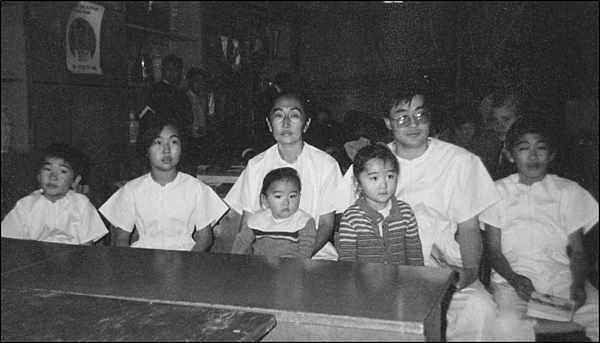 Brother Enkhtuvshin Togtokh was baptized in Germany in June 1993, and upon his return to Mongolia, his wife, Dashgerel Doyod, and their children joined the Church in November 1993 in Ulaanbaatar. Courtesy of Enkhtuvshin Togtokh and Dashgerel Doyod.
When Enkhtuvshin Togtokh was baptized in Germany on 27 June 1993, he was unaware that missionaries in Mongolia had baptized the first Mongolian converts in February 1993. He was so happy to find the missionaries when he returned to Mongolia, and he helped his wife and children learn the gospel from the missionaries and enter the waters of baptism. Enkhtuvshin and Dashgerel Doyod (Doyodlin) had five children, including three who were old enough to be baptized. Dashgerel was baptized along with their children, Tamir Enkhtuvshin, Selenge Enkhtuvshin, and Anand Enkhtuvshin on 13 November 1993.[43] Enkhtuvshin and Dashgerel, along with their five children, became the first Mongolian family to be sealed in the Hong Kong Temple on 25 October 1996.[44]
Dedication of Mongolia by Elder Neal A. Maxwell
In 1993, Elder Brough learned that he would be returning to the United States. After being notified that Elder Maxwell would be coming to offer a prayer to dedicate the country of Mongolia for the preaching of the gospel, Elder Brough “felt it would be best to have [Elder Tai Kwok Yuen of the Asia Area Presidency] accompany Elder Maxwell.” Elder Brough said, “I was aware of everything that was going on, but assigned Elder Tai to represent the Area Presidency, which was the right thing to do.”[45] Elder and Sister Tai had been traveling for almost a month. They were in Salt Lake City for training and the April 1993 general conference, and from there they accompanied Elder and Sister Maxwell to Mongolia. Sister Tai remembered that Elder Maxwell had only a small suitcase but was a kind and a special servant of the Lord.[46]
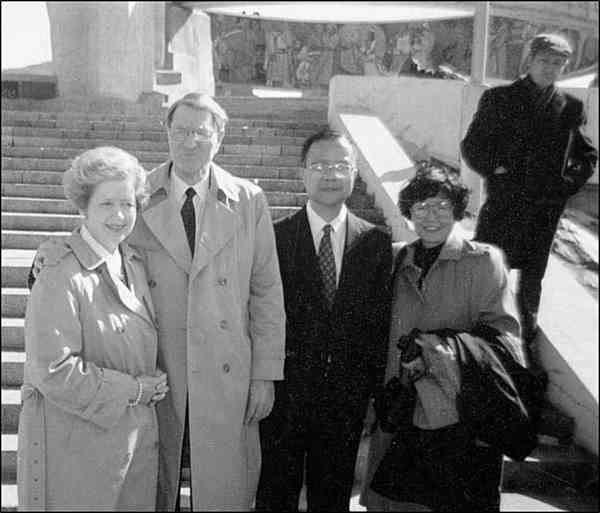 Elder Neal A. Maxwell visits Mongolia to offer a dedicatory prayer for the preaching of the gospel. From left to right: Sister Colleen Maxwell and Elder Neal A. Maxwell, Elder Benjamin M. Z. Tai and Sister Naomi Toma Tai at the dedication site, 15 April 1993, Ulaanbaatar. Courtesy of Odgerel Ochirjav.
Elders Maxwell and Tai Kwok Yuen and their wives arrived in Mongolia on 14 April 1993. Sister Smith wrote, “When Brother Maxwell arrived, he gave us all a big hug, that was pretty special getting a hug from a general authority.”[47]
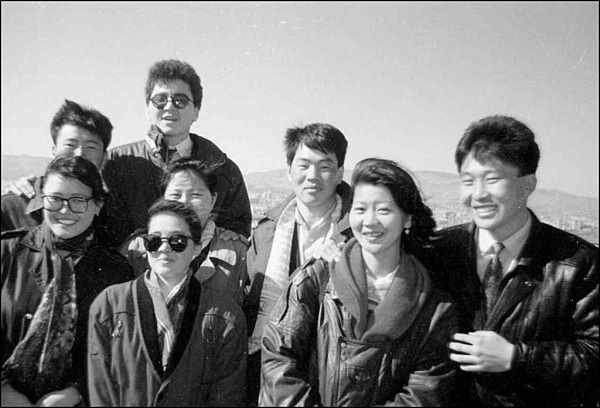 New converts and investigators at the dedication site, 15 April 1993, Ulaanbaatar. Courtesy of Odgerel Ochirjav.
The sky and air were clear the following day when the visitors and a small group of saints were greeted by a typical cold and windy day in the “land of the eternal blue sky.” Just after one o’clock in the afternoon, thirty-four people gathered on Zaisan (Monument Hill), overlooking Ulaanbaatar, for the dedication on 15 April 1993.[48] Elder and Sister Smith recounted this important event as follows: “Elder Maxwell and his wife, along with President Tai of the Area Presidency and his wife, were here for the dedication. . . . It was a beautiful, sunny day and the event was held on the steps of the Russian Mongolian monument located on a hill which overlooked the city of Ulaanbaatar. All of our members and missionaries, and several investigators, were in attendance.”[49] Sister Smith added, “Never in my wildest dreams did I think I would be able to attend the dedication of a country. . . . It was a choice experience.”[50]
Exercising the apostolic keys to dedicate a country for the preaching of the gospel, Elder Neal A. Maxwell dedicated Mongolia and prayed for a blessing upon the “pioneering couples and all those missionaries who will follow” and for the new converts to “be strong [because] they will shape the future of the Church in Mongolia . . . [and] that the winds of freedom will never cease to blow in Mongolia.”[51] He added,
We pray for the leaders, present and future, of this nation. Guide them and bless them to preserve freedom and to have a more adequate economy.
Father, we realize there are many in the world to whom Mongolia is unknown and unappreciated, but we plead with thee, Father, that Mongolia not go unblessed.
So, in the power and the authority of the Holy Apostleship, I dedicate the land of Mongolia and bless its leaders and people, its soil, and its sky—all to the end that the nation may be blessed, that it will so respond to the Gospel message so that Thy work may be firmly established here. May Mongolia even be a beacon light to other nations. . . .
We so dedicate this land. May the members of the Church here be good citizens of the Church and good citizens of this nation. For all these things we pray. As Mongolia faces the future, may the sunshine we experience this day symbolize Thine approval of this occasion and this dedication. We so pray in the name of Jesus Christ, Amen![52]
After this historic dedication, the Church held a special reception and hosted fifty government officials that evening.[53] The reception was held in honor of Elders Maxwell and Tai at a government reception center near the site of the dedication. In attendance were about seventy-five people, including many Mongolian government and education officials, as well as other members and friends of the Church. The Smiths added that “with the blessings of the Lord on this land and its people, we really began to see the branch grow and the work move ahead. What a great experience we all had being able to meet with, talk to, and have dinner with a spiritual giant such as Elder Neal Maxwell.”[54]
Summary
The Church in Mongolia began with six dedicated and consecrated missionary couples in Building 7 by Russian School #3 in Ulaanbaatar. Within a relatively short time, the gospel began to take root in Mongolia as several converts were baptized and the first branch of the Church and Relief Society was organized.[55] By 1993, Elder Neal A. Maxwell of the Quorum of the Twelve visited Mongolia to dedicate the land for the preaching of the gospel.[56] From these humble beginnings, “the Mongolian miracle” commenced. Years later, Elder Brough recorded his thoughts and feelings about the experience in Mongolia:
We are in Mongolia to stay. The quality of converts that have been identified and referred by the couples to the younger elders has been exceptional, and we have people that are headed for, and are already in, significant places, in all of Mongolia. . . . It’s a great thing to see what is happening there. It is thrilling. I have deep feelings for it. . . .
We had six missionary couples that were in Mongolia. Kenneth Beesley was the lead elder and Mongolia was part of the Asia International Mission. This was a specific assignment to the Area Presidency in Asia. It covered those areas like Nepal, Sri Lanka, where we have membership, but it’s outside an established part of the Church. In 1995, the Asia International Mission was the top baptizing mission in all Asia, mostly because of what was happening in Mongolia.[57]
Referring to the dedicatory prayer, in which Elder Maxwell mentioned turning the keys for the preaching of the gospel in Mongolia, Elder Brough said, “Elder Maxwell gave a magnificent blessing. It was profound. Much of it has been manifested in the events that have occurred subsequently to his blessing.”[58]
Notes
[1] Britsch, From the East, 308–11; By Study and Also by Faith, 415; a version of this chapter appears in Chou and Chou, “First Missionaries in Mongolia,” 114–32.
[2] Harper, “‘Nothing Less Than Miraculous,’” 19–49; Schmidt and Scmidt, “Mission Call to Outer Mongolia,” 37.
[3] “News of the Church: Missionaries in Mongolia,” 102.
[4] “News of the Church: Missionaries in Mongolia,” 102.
[5] Harper, “‘Nothing Less Than Miraculous,’” 19–49.
[6] Harper, “‘Nothing Less Than Miraculous,’” 19–49.
[7] Britsch, From the East, 308–11; By Study and Also by Faith, 415.
[8] “Mongolia,” Church Almanac, 2013, 525–26.
[9] Smith, “Marjorie W. Smith journal,” 1–4.
[10] Brough, Life Is a Collection of Stories, 103–6.
[11] Brough, Life Is a Collection of Stories, 109–10.
[12] Harper, “‘Nothing Less Than Miraculous,’” 19–49.
[13] Misbach, “Mongolian Mission Senior Couples Apartments Bldg. 7.”
[14] Misbach, “Mongolian Mission Senior Couples Apartments Bldg. 7.”
[15] Harper, “‘Nothing Less Than Miraculous,’” 19–49.
[16] “News of the Church: Missionaries in Mongolia,” 102.
[17] Britsch, From the East, 308–11; Beesley, “Mongolia,” in Garr, Cannon, and Cowan, Encyclopedia of Latter-day Saint History, 774–75.
[18] Britsch, From the East, 309–10.
[19] Brough, Life Is a Collection of Stories, 106–7.
[20] Smith and Smith, “History of the Ulaanbaatar Branch,” 1.
[21] Smith and Smith, “History of the Ulaanbaatar Branch,” 1.
[22] Smith, “Marjorie W. Smith journal,” 1–4; Smith and Smith, “History of the Ulaanbaatar Branch,” 1–2.
[23] Smith and Smith, “History of the Ulaanbaatar Branch,” 2.
[24] Smith, “Marjorie W. Smith journal,” 7.
[25] Smith and Smith, “History of the Ulaanbaatar Branch,” 2–3.
[26] Smith and Smith, “History of the Ulaanbaatar Branch,” 3.
[27] Smith and Smith, “History of the Ulaanbaatar Branch,” 3.
[28] Smith, “Marjorie W. Smith journal,” 10–11.
[29] Smith and Smith, “History of the Ulaanbaatar Branch,” 3.
[30] Smith and Smith, “History of the Ulaanbaatar Branch,” 11.
[31] Smith, “Marjorie W. Smith journal,” 34.
[32] Smith and Smith, “History of the Ulaanbaatar Branch,” 4.
[33] Smith and Smith, “History of the Ulaanbaatar Branch,” 4; Smith, “Marjorie W. Smith journal,” 13.
[34] Britsch, From the East, 308–11.
[35] Cook, “Mighty Change in Mongolia,” 75–76.
[36] Smith and Smith, “History of the Ulaanbaatar Branch,” 3–4.
[37] Smith and Smith, “History of the Ulaanbaatar Branch,” 3–4.
[38] Smith and Smith, “History of the Ulaanbaatar Branch,” 6.
[39] Cook, “Mighty Change in Mongolia,” 75–76.
[40] Britsch, From the East, 308–11.
[41] Smith and Smith, “History of the Ulaanbaatar Branch,” 6.
[42] Mongolia mission area, local member directory, as of 19 February 1994, copy in possession of the authors.
[43] Mongolia mission area, local member directory, as of 19 February 1994. Enkhtuvshin Togtokh (or Togtohyn) has been listed in some records as the first Mongolian baptized, but this is not accurate. However, he is believed to be the first Mongolian baptized in Germany.
[44] Dashgerel Doyod, interview by Po Nien (Felipe) Chou and Petra Chou, 21 June 2018, Ulaanbaatar, Mongolia.
[45] Brough, Life Is a Collection of Stories, 111.
[46] Tai Kwok Yuen and Tai Lai Hui Hua, interviews by Po Nien (Felipe) Chou and Petra Chou, 3 November 2017, 17 January 2018, Provo, UT.
[47] Smith, “Marjorie W. Smith journal,” 15.
[48] Britsch, From the East, 311–12.
[49] Smith and Smith, “History of the Ulaanbaatar Branch,” 5.
[50] Smith, “Marjorie W. Smith journal,” 15.
[51] Britsch, From the East, 311–12.
[52] Official Dedicatory Prayer of Mongolia by Neal A. Maxwell, 15 April 1993, Ulaanbaatar, Mongolia, copy in possession of the authors.
[53] “Mongolia,” Church Almanac: 2013, 525–26.
[54] Smith and Smith, “History of the Ulaanbaatar Branch,” 5.
[55] Bailey, “FYI: Mighty Mongolians,” 36.
[56] Britsch, From the East, 311–12.
[57] Brough, Life Is a Collection of Stories, 109.
[58] Brough, Life Is a Collection of Stories, 111.
