
 menu icon in the top, right corner of the screen.
 icon above to close this box.
 icon at the bottom of the screen below the browser—if you don't see it, swipe up to unhide it.
Go Forward with Faith
The Second Stake and Twenty-Fifth Anniversary
Po Nien (Felipe) Chou and Petra Chou, "Go Forward with Faith: The Second Stake and Twenty-Fifth Anniversary," in Voice of the Saints in Mongolia (Provo, UT: Religious Studies Center, Brigham Young University; Salt Lake City: Deseret Book), 271‒300.
“Now, we must look forward to the future, with complete faith in our Lord Jesus Christ.” —President Russell M. Nelson
A second stake and the reorganization of the stake presidency of the first stake became important milestones as the Church in Mongolia approached its twenty-fifth anniversary in 2018. These stake presidencies had many goals and a vision for how to further build upon the foundation that was set by the early missionaries and pioneers of the Church in Mongolia. Public affairs efforts provided opportunities for the Church to serve and build bridges with other organizations during this time. Jeffrey C. Harper served as mission president from 2016 to 2019, followed by A. David Hansen, who arrived in Mongolia in 2019.
The visit by Elder David A. Bednar, from the Quorum of the Twelve, further helped to strengthen and encourage the members in Mongolia, who were reminded to face the future with hope and a renewed focus to prepare themselves and their families for their temple blessings. Boundary changes transferred administration of the Church in Mongolia from the Asia Area to the Asia North Area. Meanwhile, the COVID-19 global pandemic led to new challenges for missionary work, which the Saints in Mongolia faced with faith and hope.
The Ulaanbaatar Mongolia East Stake
On 29 May 2016, Elders Chi Hong (Sam) Wong and Steven L. Toronto of the Quorum of the Seventy organized the second stake in Mongolia, the Ulaanbaatar Mongolia East Stake, with Adiyabold Namkhai as its first stake president. The new stake included five wards and two branches. President Adiyabold felt grateful yet overwhelmed and unprepared. But the Lord had been preparing him and his wife for many years.[1]
 The second stake in Mongolia was created on 28 May 2016. Adiayabold Namkhai was called as the stake president with Batbold Khishigdorj (first counselor) and Anand Enkhtuvshin (second counselor) as counselors. Courtesy of Odgerel Ochirjav.
“I grew up during the Soviet time, when there was no religion allowed. But I went with my grandmother to a Buddhist church,” recalled Adiyabold Namkhai. He was among the first Boy Scouts at church and met American missionaries at the Scout Training Center in 1994. He was interested in being friends with the missionaries and went to church with them at the Peace and Friendship Palace. A couple of years later, one of the missionaries asked him about taking discussion lessons and joining the Church, to which he readily replied yes. He was baptized in 1996. His branch president encouraged him to serve a mission, but he worried he had no scriptures and didn’t know any English. Nevertheless, he decided to go and served as a missionary in the Russia Samara Mission from 1998–2000. During his mission, he was in a group of ten missionaries endowed in the Stockholm Sweden Temple.[2]
Meanwhile, Tuul Puntsagtseden had joined the Church at her university in 1994. She then served in the Russia Moscow South Mission from 1997–98 and was one of the ten missionaries endowed in the Stockholm Sweden Temple with Adiyabold Namkhai. After their missions, they were sealed in the Hong Kong China Temple. Adiyabold Namkhai served in a variety of callings after his mission. He served as a branch president, counselor in the district presidency, and counselor in the stake presidency when the first stake in Mongolia was organized in 2009.[3] He explained his thoughts during that time as follows:
 UB West and UB East Stake presidencies after stake conference to establish the second stake in Mongolia, 28 May 2016. From left to right: Baatarchuluun Tumurbaatar (first counselor), Odgerel Ochirjav (UB West Stake president), Tserennyam Sunkhbaatar (second counselor), Batbold Khishigdorj (first counselor), Adiayabold Namkhai (UB East Stake president), Anand Enkhtuvshin (second counselor). Courtesy of Odgerel Ochirjav.
 Elder Sam Wong presided at the stake conference to organize the Ulaanbaatar Mongolia East Stake on 28 May 2016. From left to right: Elder Steven L. Toronto (Area Seventy), Elder Sam Wong (General Authority Seventy), UB East Stake president Adiyabold Namkhai and his wife, Sister Tuul Puntsagtseden, with their four children, and Sister Urtnasan Khasbat (Adiyabold's mother). Courtesy of Odgerel Ochirjav.
I always wondered about Mongolian people serving as Church leaders . . . and then Odgerel [Ochirjav] called me as his counselor. . . .
I always thought we needed the mission president or couple missionar[ies] to help us, but the couple missionar[ies] taught me that . . . as I mature with time, guidance will come from the Lord and the Holy Ghost.
Then President Benson, the mission president, called me to be the district president for the Ulaanbaatar Mongolia East District in 2014. I was worried and preferred to be a counselor. . . . I worried because now I was responsible for making decisions. Then two years later this district became the Ulaanbaatar Mongolia East Stake, and I was overwhelmed as a stake president. . . . I knew I needed the guidance from the Lord and the Spirit.[4]
Elders Wong and Toronto’s flight was delayed, so they conducted initial interviews via Skype while waiting for their flight to leave Beijing. After they arrived in Mongolia on Saturday, they continued with interviews on Sunday at the basement of the Bayanzurkh Building. Adiyabold Namkhai recalled that “they first interviewed us alone or separately via Skype on Saturday, then we had our second interview together in person on Sunday morning.” Tuul Puntsagtseden said, “Before my husband received this calling, Elder Toronto asked me if I would support my husband. I told him I am used to sustaining him in any calling.” Then with the other members in the stake, she sustained her husband as the first stake president of the Ulaanbaatar Mongolia East Stake.[5] President Namkhai explained,
We set goals with the Area Presidency and the Ulaanbaatar West Stake. Our goal is to have a temple in Mongolia, so we need to be a beacon of light for others. We need to grow and prepare by adding more wards, more stakes. . . .
I always have a feeling that there is something above us. When the missionaries taught me how to pray, I prayed sincerely in the bus and felt and knew that prayer was real. On my mission, my faith continued to grow, and it also grows in seminary and institute class or serving in the Church. At each meeting or training, my faith keeps growing. I am grateful for the Church in Mongolia. . . . Today, I love Jesus Christ more, and I am still learning, still reading, and learning more.[6]
President Harper, then president of the Ulaanbaatar Mongolia Mission, said, “It is a blessing that it is no longer a district. A creation of a stake gives opportunities for additional leadership.” Although there are economic challenges that can sometimes result in the loss of priesthood leadership who leave for jobs outside of Mongolia, the Church continues to thrive.[7]
Helping Hands to “Light the World”
Public affairs efforts included the service provided by Helping Hands and the “Light the World” campaign. Sister Tuvshinjargal Gombo, from the public affairs office of the Church in Mongolia, said, “We had several big projects to help serve others. The members were proud to be Church members, and serving made us happy because we were able to help others.”[8]

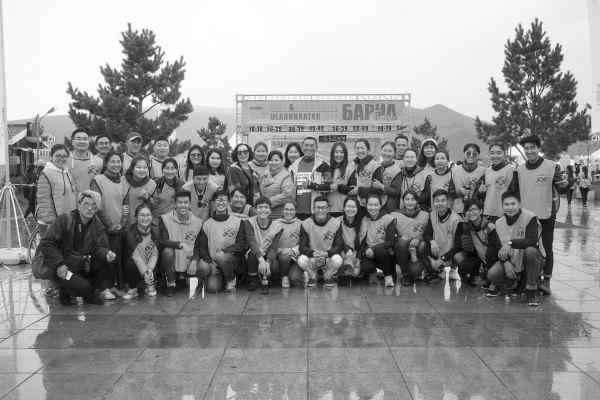 Top and bottom: Helping hands assisted at the annual marathon in the Mongolian National Garden Park in September 2017. Photos courtesy of Odgerel Ochirjav.
Helping Hands at the Marathon
An annual marathon is organized in the Mongolian National Garden Park by Achilles International Mongolia, a nongovernmental organization. In 2017 this event brought over 5,000 participants, including 168 with disabilities and 70–80 Helping Hands volunteers.[9] The Church News reported,
Tuvshinjargal Gombo, the public affairs director for the Church in Mongolia, decided to contact the race organizer after she received a prompting. She called Saranchuluun Otgon, the founder of the event, to introduce herself and offer to have volunteers from the Church assist with the race. . . . It was decided that the Church would help by preparing meals for about 700–750 race volunteers.
Enkhbat Damdin, who was asked to lead the cooking team, said, “When our priesthood leaders asked me to cook for more than 700 people, I thought, ‘That many people?’” Then immediately Luke 5:5 came to his mind, where Simon Peter said to the Savior, “Master, we have toiled all the night, and have taken nothing: nevertheless at thy word I will let down the net.”
[Enkhbat] continued, “I said, ‘I will do my best!’ Then all of the sudden, I found many others who were ready to help me cook.” He and half a dozen members cooked several large batches of rice on gas stoves before the race.[10]
Enkhbat Damdin was grateful for the opportunity to coordinate the cooking team, which was supported by the food delivery team.[11] The Church News report continued:
Later that morning, more than 70 members from the food delivery team arrived wearing their yellow Mormon Helping Hands jackets. . . . Over 750 people—including doctors, police, and other race volunteers—were greeted by a happy face with a plate of food. . . .
[Saranchuluun] Otgon expressed great appreciation and added, “We are so happy to cooperate with the members of the LDS Church in our activity, and . . . we are happy to invite the LDS Church again to partner with us in this and other activities in the future as well.”
On behalf of the Church, Lkhagvajargal Dalaichuluun accepted an “Appreciation Acknowledgment” certificate from the event founder. [She] said, “It was a wonderful experience for me. I was so proud that I could represent the Church at this marathon.”[12]
Other Service Activities and the “Light the World” Campaign
The public affairs office of the Church in Mongolia organized other humanitarian and service activities. In 2017 these included helping at an English conference in May, a lecture for women on “Principles That Lead to Real Prosperity and Happiness,” and so forth. On 21 March, for example, members helped with the World Down Syndrome Day for the Down Syndrome Association of Mongolia, organized at E-Mart and Shangri-La Hotel. Other service activities were part of the “Light the World” campaign throughout December 2017. On 2 December 2017, for example, about 25–30 members went to a nursing home operated by the Grateful Children organization to serve those with both mental and physical disabilities. Helping Hands volunteers removed snow and ice, cleaned and washed the building, provided meals, sang hymns, and donated supplies.[13]
Another group of young single adults served at the National Mental Health Center located in Bayanzurkh District on 12 December 2017. They delivered books and supplies to Dr. D. Enkhtuya, head of the Eighth Clinical Psychiatry Center for teenagers who are being treated for addiction and mental illness. Dr. Enkhtuya expressed gratitude to the Church and said, “We come from different religions [and] I am very glad that you belong to this Church. . . . I’ve seen that when people have a belief in any God, it helps them to stay on a good path.”[14]
Then on 19 December 2017, volunteers from the Church served at the Wish Palace, a special school for little children with disabilities and their parents. Members of the Church hosted “about eighty children and more than 130 parents, teachers, social workers, and civil officials” at a Church meetinghouse. Bolormaa, the head of the Wish Palace school said that “the gifts made by Relief Society sisters really touched the hearts of the parents and social workers who work so hard to raise these wonderful children with disabilities.” Also in December, the Church collaborated with MNCTV in Mongolia to broadcast the I Love Mongolia program to help the public learn about Christmas.[15]
Reorganization of the Ulaanbaatar Mongolia West Stake
In May 2018 the stake presidency for the Ulaanbaatar Mongolia West Stake was reorganized. After serving faithfully from 2009 to 2018 as the first stake president in Mongolia, Odgerel Ochirjav was released and joined others to sustain a new stake president, Tserennyam Sukhbaatar. Tserennyam Sukhbaatar was baptized in 2002 while attending college in Ulaanbaatar and then served as a full-time missionary in Korea from December 2003 to January 2006. He was later sealed to his wife in the Hong Kong China Temple in July 2006. He related the following prompting to return to Mongolia while in Utah.[16]
 The first UB West Stake presidency was released, and the new presidency was called on 13 May 2018. President Tserennyam Sukhbaatar was called as the second UB West Stake president with Atlankhuu Namnandorj as first counselor and Enkbaatar Agvaan as second counselor. Courtesy of Odgerel Ochirjav.
I was living in Orem, Utah. In July 2016 I was working on my MBA at Utah Valley University, and in August 2017 I was working after I graduated. Then in January 2018, I got a prompting during a sacrament meeting to go back to Mongolia. I had a job offer but prayed about it and went back to Mongolia. . . . I was not surprised when I was called, and realize it was the reason the Lord wanted me to go back to Mongolia.
Elders Peter F. Meurs and Benjamin Tai, from the Asia Area Presidency and an Area Seventy, interviewed over twenty people and invited me to meet with them three times. First time, they had just interviewed me and I was leaving the [Bayanzurkh] building when the stake president’s secretary called me back. Second time, they interviewed just me again and asked me to call my wife. The third time, I was back for them to interview me and my wife together, when they extended a call to me to be the new stake president. Elder Meurs asked me to recommend two counselors. I was to talk with my wife for ten minutes and pick two counselors to recommend to them. Then they interviewed and called them.[17]
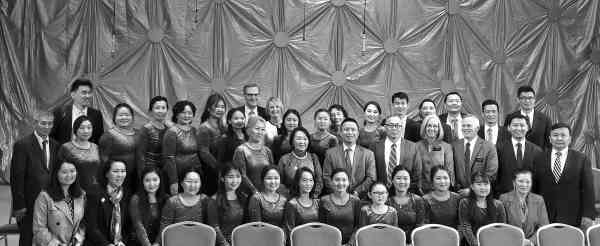 Elder Benjamin M. Z. Tai and Elder Peter F. Meurs reorganize the Ulaanbaatar Mongolia West Stake on 13 May 2018. Picture of Elders Tai and Meurs with mission president, former and new stake presidency, choir members, and others. Courtesy of Odgerel Ochirjav.
After his call as a new stake president, President Tserennyam set the following stake vision and goals. His vision included “establishing more stakes in Mongolia, preparing for the establishment of a temple in Mongolia, becoming a beacon of light to Mongolians by fulfilling Elder Maxwell’s prophetic dedicatory prayer, and increasing the . . . Church name recognition in the Mongolian community.” His plan was to help the youth complete seminary and prepare for BYU–Hawaii, send young single adults on missions, and help them to succeed.[18]
Twenty-Fifth Anniversary
While serving as the president of the Ulaanbaatar Mongolia West Stake, Odgerel Ochirjav spoke to Elder Benjamin M. Z. Tai, a member of the Eighth Quorum of the Seventy. President Odgerel said, “We were together at a coordinating council meeting when I told them the 25th anniversary of the Church in Mongolia was coming up. Elder Tai suggested we consider starting with a fireside.” Preparations to celebrate this milestone began immediately after this coordinating council.[19]
Elder Tai reflected on the privilege and opportunity he had during an assignment in Mongolia in 2017 to visit the dedication site, “My father [Elder Tai Kwok Yuen] went with Elder Neal A. Maxwell to dedicate Mongolia many years ago and since then the Church in Mongolia has grown, with multigeneration[al] families in two stakes. . . . For me, it was a humbling experience to stand on that sacred place where they stood.” With the twenty-fifth anniversary approaching, preparations began to celebrate this important milestone.[20]
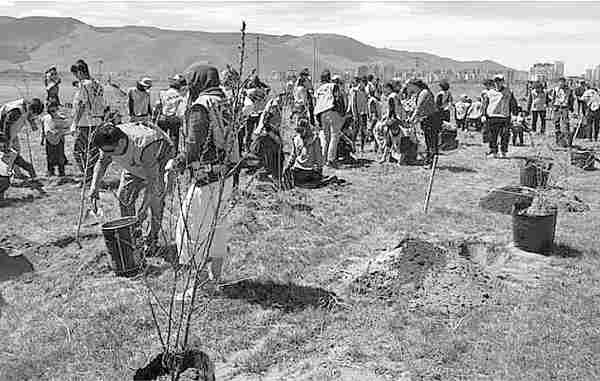 The Church's twenty-fifth anniversary celebration in Mongolia included participating in "The National Day of Tree Planting" in 2018. Courtesy of Mongolia public affairs office.
The Church celebrated twenty-five years in Mongolia in 2018 with a variety of activities throughout the year. First, they used Facebook Live to broadcast a special fireside in April for the dedication day. Altankhuu Namnandorj, then a member of the stake presidency, recalled preparing for the twenty-fifth anniversary celebration. “We invited pioneers to the fireside, including the first convert, the first missionaries, the first branch president, the first patriarch and first district president. It was a 2.5-hour meeting at the Bayanzurkh building, and it was very spiritual.” In addition, a slideshow was created of the first foreign missionaries, including the first couple missionaries and first mission president.[21]
Purevjargal Dorj, who previously served as a full-time sister missionary in Long Beach, California, recalled the 2018 celebration. She enjoyed the fireside but most importantly the meeting with other returned missionaries. Purevjargal said that by then there were many returned missionaries, some who had become inactive, and there was an effort to bring them back to the Church for the anniversary.[22]
In May, Church members participated in the National Day of Tree Planting, established by presidential decree in 2010. Sister Tuvshinjargal Gombo, from the public affairs office of the Church in Mongolia, provided the following report: “The National Tree Planting Day has involv[ed] a wide number of government, nongovernment, private organizations and entities, and citizens from year to year. This year about 42 organizations planted 5,000 trees at the National Park. On the occasion of the 25th anniversary of the Church of Jesus Christ of Latter-day Saints in Mongolia, about 100 members of the Church donned yellow “Mormon Helping Hands” vests [and] were excited to plant trees while having a great privilege to minister [to] the[ir] neighbors who were planting with us [and] representing many organizations.”[23] The stake also held a special single adult conference in August and a special devotional in December.[24]
After the anniversary celebration, mission president Jeffrey Harper said, “I am so grateful for the faithfulness of the members in Mongolia. Many have overcome great obstacles. . . . Many young people are growing [a] multigeneration[al] church and becoming a strength in their country.” Furthermore, he added, “For the twenty-fifth anniversary they had a youth conference. . . . Their patriarchal blessings include all the twelve tribes of Israel.” He added that it will be interesting to see their role in building the Church.[25]
Elder Bednar’s Visit
When Elder Bednar embarked on a four-country tour of Asia in May 2018, including a visit to Mongolia, he framed his teachings in three words: “I love you.” For many new members of the Church in Mongolia, this was their first time seeing an Apostle of the Lord Jesus Christ in person. For Elder and Sister Bednar, who have traveled to many other countries, this was their first visit there.[26]
 Sister Susan Bednar and Elder David A. Bednar visit Mongolia, May 2018. Courtesy of Odgerel Ochirjav.
Odserjmaa Dorjgotov, who was working at the Mongolian Service Center during this visit, shared a special experience that employees had with Elder Bednar before the devotional. She said, “I felt very special and honored to greet Elder Bednar in our traditional way and in traditional clothes.” She continued, “We greeted him with a bowl with dry curd and a ‘Khadag,’ a ceremonial long piece of fabric or scarf symbolizing purity and compassion, . . . which is our traditional way to meet an important guest, to show our highest appreciation and respect.” Odserjmaa was grateful she had the opportunity to welcome Elder Bednar on behalf of the service center employees and all the Saints in Mongolia.[27]
Meetings with Members, Missionaries, and Leaders
Tselmegsaikhan Sodnomdarjaa said that Elder Bednar held four meetings, one with all the members, one with the young single adults, one with returned missionaries and their spouses, and one with priesthood leaders and their spouses.[28] The meeting with all members was held at the Central Cultural Palace of Mongolian Trade Unions Building, while the other meetings were held at the Bayanzurkh Building.[29] Sister Tselmegsaikhan said, “During the devotional for all the members, we sang all 7 verses of hymn #6, “How Firm a Foundation.” Elder Bednar took time to explain about it. While singing it again, I felt the love [of] our Savior and that He is there for us. We sang the song before, but with the explanation from an apostle, we now sang with power. It was a powerful message for me. If we have the Holy Ghost, we can know everything. It was a very spiritual meeting![30]
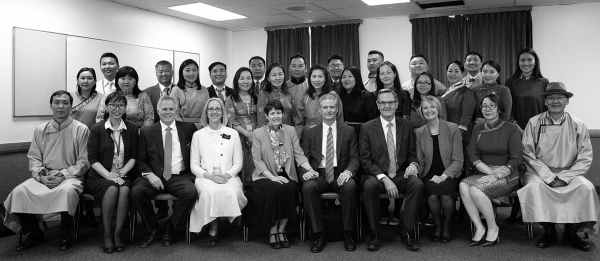 Sister and Elder Bednar (front center) visit Mongolia. Group picture with Mongolia Service Center employees on 19 May 2018. Courtesy of Odgerel Ochirjav.
 Elder and Sister Bednar visit Mongolia. Group picture with traditional Mongolian music band at the Bayanzurkh Building on 19 May 2018. From left to right: Elder and Sister Bednar, Sister Maxine Meurs and Elder Peter Meurs, Sister Kim Harper and President Jeffery Harper. Courtesy of Odgerel Ochirjav.
Chimedbaatar Tseden remembers being at the Central Cultural Palace of Mongolian Trade Union Building and said, “I was a big fan of Elder Bednar even before he came to Mongolia.” He was most impressed when Elder Bednar explained that Sister Bednar looked and observed people to see who needed help and that she then goes right after sacrament meeting to help them.[31]
Many who were full-time missionaries when Elder Holland visited in 2011 were now returned missionaries and with their spouses during Elder Bednar’s visit in 2018. The Church News explained,
In 2011, Elder Jeffrey R. Holland of the Quorum of the Twelve Apostles spoke to a gathering of missionaries in Mongolia that included several native-born elders and sisters. He called them “children of destiny,” envisioning the roles they would play building the gospel in their homeland.
At a May 19 [2018] meeting for returned missionaries and their [spouses] in the capital city of Ulaanbaatar, Elder Bednar was with some of those same young men and young women. They are claiming their destiny as the Church in Mongolia continues to grow “not fast, but steadily.”
[Elder Bednar said] “Many of those returned missionaries now have children of their own, and the cycle continues. It’s an indication of increasing maturity.”[32]
Gankhuyag Tsogoo, who interpreted for Elder Bednar, said, “He is a great leader and taught us that we are agents and should act for ourselves. We can be agents in many ways, in prayer, and so forth.”[33] The Church News reported the following regarding Elder and Sister Bednar’s trip to Mongolia and other countries in Asia:
The well-traveled couple had never been to Mongolia, Cambodia, or India. And each meeting offered them maiden opportunities to listen to individuals ask their own unique queries.
“You invite people to ask questions because their questions help you learn where they are, what they are concerned about, and what they need help with,” Elder Bednar told the Church News. “The greatest beneficiary in a question-and-answer session is not the people posing questions—but the person listening to the questions.”
 All-members devotional with the Bednars at the Central Cultural Palace of Mongolian Trade Union on 22 May 2018. Courtesy of Odgerel Ochirjav.
And there’s the happy paradox.
The Bednars’ Asian travels placed them in some of the most densely populated nations on earth. But their ministering typically happened with “the one”—face to face. . . .
Elder Bednar feels . . . optimism for the Asian countries now writing their maiden chapters of Church history. “There is a Kirtland today, but it’s not just in Ohio. It’s in Cambodia and in Mongolia and in India.”
And in Kirtland-like fashion, the measuring strength of the members in each nation is quality, not quantity.[34]
Enkhbayar Dashdavaa was assigned as a bodyguard to watch over the safety of Elder Bednar and those visiting. He recalled asking during the meeting how to help the members do more family history. Elder Bednar’s suggestion was to involve the youth in this effort.[35] Sister Tselmegsaikhan Sodnomdarjaa also learned much from Elder Bednar’s question-and-answer session. She came to understand that when there is a problem, it’s really an opportunity to be part of the solution.
Elder Bednar would ask a question, then he picked someone to answer the question. Then a member of the Seventy responded, “There are lots of issues facing us in Mongolia, and sometimes we just complain about the problem.” He told us to be part of the solution and invited us to be part of the solution as much as possible.
So now I see things differently; when I see a problem, I try not to murmur and find ways to be part of the solution, and now I see miracles happening. For us to succeed and feel fulfillment in our life, we must turn to him.[36]

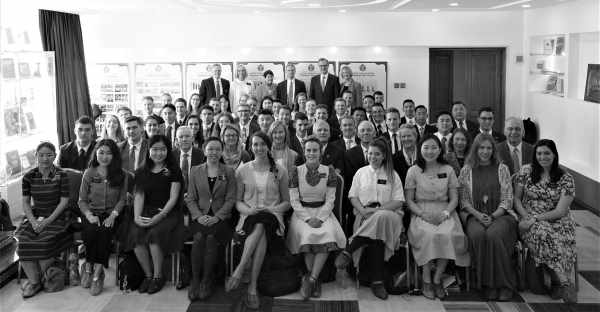 Top: Elder Bednar and others walk from an all-members meeting to Bayanzurkh Building (no-car day in Ulaanbaatar), May 2018. Bottom: Elder and Sister Bednar (back center) at the mission conference at the Central Cultural Palace of Mongolian Trade Union on 19 May 2018. Photos courtesy of Odgerel Ochirjav.
Prepare for the Temple
Bolormaa Ayurzana said that during his visit, “Elder Bednar strengthened us and blessed the future of Mongolia, . . . and I came out of that meeting understanding that we need to prepare ourselves for the temple.” She noted that while all the members in Mongolia want and pray for the day that Mongolia will have a temple, they need to begin now to prepare for it by using FamilySearch, doing genealogy work, and growing spiritually.[37] “Elder Bednar’s visit was unique and told us we needed to prepare ourselves for the temple,” said Sister Tselmegsaikhan Sodnomdarjaa.[38] President Harper said, “Elder Bednar taught us the doctrine of Christ . . . [and] promised that if the members remained faithful and prepared for the blessings of the temple, then the Church would flourish in Mongolia.”[39]
Purevjargal Dorj was among the members who had the opportunity to shake hands with Elder Bednar during his visit. She said, “I shook his hand and watched him move, and I felt the Spirit so strong and knew that he was an apostle of the Lord.” In addition, she learned from Elder Bednar that although the Saints in Mongolia were far away from Church headquarters, the Church leaders loved them. Following her experience with Elder Bednar, Sister Purevjargal felt that she needed to prepare herself and others in Mongolia for the blessings of the temple.[40] Ganbold Davaasambuu learned of the importance of eternal families and that “we don’t want to just build a temple, we want the people to be prepared for the temple.”[41] These wonderful Saints in Mongolia continue to prepare and pray for the day when they might have a temple in Mongolia. Following his trip, Elder Bednar concluded that the members in Mongolia and throughout Asia “are engaged in the work, and they are rejoicing in the gospel of Jesus Christ.”[42]
2019 Changes: Come, Follow Me and Asia North Area
 Transition meeting from Asia Area to Asia North Area at Bayanzurkh Building in Ulaanbaatar on 31 July 2019. Front row left to right: Mission President and Sister Hansen, Elder Todd Budge (Seventy, Asia North Area), Elder Peter F. Meurs (Seventy, Asia Area), David Robertson (Asia North Area DTA), and Paul Hansen (Asia Area DTA). Back rows: Service Center employees and OGC team, HR Managers from both areas, and DIC couple. Courtesy of Odgerel Ochirjav.
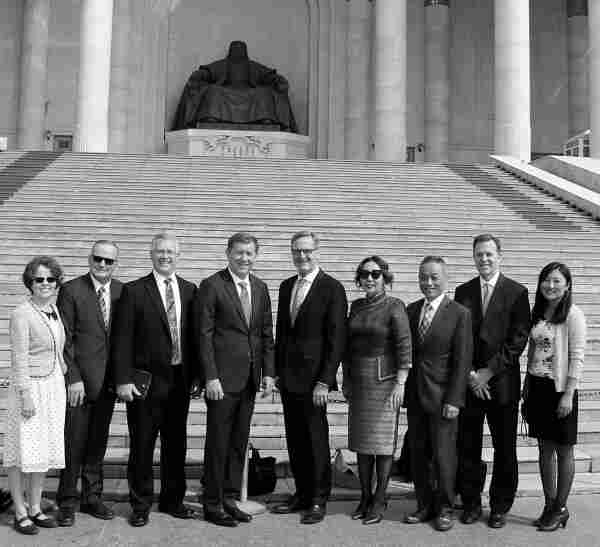 Picture at Sukhbaatar Square in Mongolia on 31 July 2019. From left to right: Claire Dustin and Robert Dustin (DIC country director), David Robertson (Asia North Area DTA), Elder Todd Budge (Seventy, Asia North Area), Elder Peter F. Meurs (Seventy, Asia Area), Tuvshinjargal Gombo (Designated Representative for LDS Church in Mongolia), Joe Kwan (Ger project manager), Steven L. Toronto (Area legal counsel), Odserjmaa (Odmaa) Dorigotov (Mongolia Service Center). Courtesy of Odgerel Ochirjav.
Beginning in January 2019, the Church provided the Come, Follow Me curriculum to emphasize a home-centered, Church-supported approach to gospel living, teaching, and learning. Resources were provided for individuals and families, as well as Sunday School and Primary classes. According to the June 2018 letter from the First Presidency, “Living by and reading the word of God will build faith in Heavenly Father and His plan of salvation and in the Savior Jesus Christ and His Atonement.”[43]
By 1 August 2019, the Church transferred supervision from the Asia Area Presidency in Hong Kong to the Asia North Area Presidency. The Area Presidencies of the Asia Area and Asia North Area sent a letter to local priesthood leaders on 18 June, announcing the realignment and boundary changes regarding Mongolia. Mongolia would unite “with the other parts of Asia North, allowing greater support for the growing Church in Mongolia.”[44] At the time of the realignment, Mongolia had about twelve thousand members along with one mission, two stakes, and one district.

 Top and Bottom: The Church donated 4,000 sanitary kits and 10,000 masks to the Mongolian Ministry of Heath in March 2020 to help with COVID-19 efforts. Photos courtesy of Odgerel Ochirjav.
Elder Yoon Hwan Choi and Sister Bon Kyung Koo Choi visited Mongolia in July before the boundary changes. They attended a For the Strength of Youth conference at the International Children’s Center campsite to express their love, minister, and teach the youth. The youth expressed gratitude for their visit, and their continued commitment to prepare for their temple blessings.[45] Elder Choi returned with Elder L. Todd Budge, both serving in the Asia North Area Presidency, to visit Mongolia. They joined several members to distribute hygiene kits as part of humanitarian efforts in Mongolia.[46] The Church in Mongolia continues their efforts to press forward together in faith and unity to further the work of salvation.
COVID-19
The COVID-19 virus turned into a global pandemic in 2020, impacting governments and businesses, and disrupting the daily routines of individuals and families worldwide. This disruption was widespread, with several countries restricting travel and suspending large gatherings to reduce the spread of this virus. The Church responded by temporarily suspending worship services and activities, making adjustments to missionary work and temple service, and taking steps to follow the best practices and directions from public health officials.
Impact on Meetings and Missionary Work
In January 2020 the Mongolian government placed restrictions on all public gatherings, which included school and places of worship.[47] Mission president A. David Hansen recorded,
All church meetings (sacrament, Sunday School, Young Men/
Young Women, seminary, institute, etc.) were no longer allowed in church facilities. Also, as a result of the government-imposed restrictions, a certain level of fear and caution spread throughout the nation, and many individuals became less willing to invite missionaries into their homes. Where possible, missionaries began teaching lessons and meeting with members and interested individuals via Facebook Messenger video chat, telephone, and other electronic means. . . . Due to fear, heightened concern related to COVID-19, church closures, and inability to meet in homes of interested individuals, missionary work . . . was significantly curtailed. Towards the end of March, the Missionary Department determined that all non-native Mongolian missionaries were to return to their home countries immediately. With only one to two days’ notice for some and three to four days’ notice for others, all non-Mongolian elders and sisters were sent home to self-quarantine for fourteen days before traveling to their stateside assignments.[48]
President Hansen also reported that his family and senior couples also returned to the USA. He said, “In total thirty-eight missionaries were evacuated, with a few being released due to the short duration remaining on their mission.” The missionary force was reduced to thirty-four native Mongolian missionaries, including fourteen elders and twenty sister missionaries. These Mongolian missionaries helped to cover multiple units, while a few smaller cities in the countryside managed without full-time missionaries.[49] President Hansen explained,
As a result of COVID-19, missionaries have relied much more on technology for finding, communication, teaching, missionary trainings, and interviews. The mission began holding daily mission-wide video calls . . . and used video-call technology for all district council meetings, zone conferences, and all other missionary meetings. Daily mission-wide video calls included various missionary-led trainings, studying the scriptures together, and special guest speakers. . . . The decreased general willingness to invite missionaries into homes has resulted in missionaries developing powerful new skills with respect to finding, teaching, and ministering via technology. . . . The missionaries have experienced and testified again and again that the Spirit is unimpeded when technology is used and that the Lord makes up the difference when they can’t meet in person.[50]
New Opportunities to Serve
Church members had many new opportunities to serve before, during, and after the COVID-19 pandemic, building bridges with the community and government officials. Several projects were coordinated and funded by Deseret International Charities and the public affairs office of the Church in Mongolia, with the support of many Helping Hands volunteers. Projects in 2019 before the pandemic included youth making a thousand hygiene kits, Relief Society sisters sewing 110 newborn baby blankets, members serving people with disabilities at the Achilles International’s Hope of Possibility marathon, or members cleaning, insulating gers, preserving food, and so forth. Many events were covered by multiple local and national media outlets. Two stories from the public affairs office illustrate these efforts:
 Elders L. Todd Budge and Yoon Hwan Choi (Asia North Area Presidency) with Helping Hands volunteers, delivering hygine kits in Mongolia, in 2020. Courtesy of Odgerel Ochirjav.
The Mongolian Ger Insulation Project was successfully launched at a presentation in Ulaanbaatar. More than 130 persons attended, including politicians supporting the project and representatives of Deseret International Charities. It was covered by 10 to 15 local and national media outlets. . . .
Several gers were insulated using local materials as part of a BYU Engineering Capstone Project. Insulated gers, utilizing felt, an air gap, and reflective material, costing about $300 USD, were found to maintain a constant warm temperature despite rapidly falling temperatures last winter. The gers were heated with a small electric heater. This is an effort to significantly reduce air pollution in Ulaanbaatar by reducing the number of gers heated with coal stoves. About 150 gers will be insulated during Phase 2. If it is successful, plans are to retrofit from 5,000 to 10,000 gers next year.
Food Preservation Study—A delegation of 12 government, business, and agricultural leaders from Mongolia visited Provo and Idaho last month to learn about food preservation. This was done as part of a research study being undertaken by . . . a professor at BYU. Food preservation has become an issue in Ulaanbaatar, as hundreds of thousands of nomads have been forced to leave their traditional homes [and go] into the city to find employment. Past diets relied heavily on meat and dairy products. With the short growing season in Mongolia, obtaining fresh vegetables has been a problem. A more diversified diet is needed for proper nutrition. Learning these techniques will help Mongolia overcome this social need.[51]
During the pandemic, 250 fleece blankets were made by members in their homes (due to gathering restrictions) and collected by the Relief Society for the needy.[52] The public affairs office also reported other projects during COVID-19:
In March 2020, Latter-day Saints in Mongolia prepared 5,000 sanitation kits that are being donated to those in need. On March 30, 4,000 kits, 100 blankets, and 30 newborn blanket kits were donated to Ms. Amarjargal, state secretary of the Ministry of Health, to be given to various hospitals and clinics. The blankets and newborn kits were made by local Church members. Government leaders expressed appreciation for the donations. Nine media sources have broadcasted this event.
On 15 April 2020, Mongolian Public Affairs team donated 10,000 masks from Salt Lake City to Ms. Byambasuren, deputy minister of the Ministry of Health to be distributed to doctors and other medical workers. This event has been broadcasted by one TV station and 2 websites.[53]
Summary
The efforts of Helping Hands and the “Light the World” campaign, in collaboration with the public affairs office, brought additional exposure for the Church across various communities and cities in Mongolia. In 2018, when the Church in Mongolia celebrated its twenty-fifth anniversary, it had more than eleven thousand members in twenty-five wards and branches, with four family history centers, two stakes, one district, and one mission. Elder Bednar’s visit in 2018 helped to further strengthen the members and give them a vision about the importance of preparing for the temple. The Saints in Mongolia continue to prepare and pray for the day when they will be blessed to have a temple in their country.
In 2019 the Church introduced Come, Follow Me, a new home-centered resource to improve gospel living and learning. During this year, realignment and boundary changes resulted in Mongolia’s administrative transfer from the Asia Area to the Asia North Area, just before the challenges of the global pandemic in 2020. Despite new challenges and a worldwide pandemic, members in Mongolia continued to serve the community, grow and mature spiritually, and face the future with faith while preparing for a temple. The history of the Church in Mongolia has passed its early years, and its future will continue to be written with the same faith and sacrifice of its early missionaries and pioneering converts. President Harper wrote in 2016, “The establishment of the Church in Mongolia will continue to bless the hearty citizens of this country. And as the Church becomes a dominant influence in this country, the dedicatory prayer of Elder Neal A. Maxwell will be fully realized. This country will remain a place for the gathering of Israel. Is there another country on this planet where patriarchs declare lineage for every tribe of Israel?”[54]
When President Russell M. Nelson was sustained as the President of the Church in 2018, he said,
Keep on the covenant path. Your commitment to follow the Savior by making covenants with Him and then keeping those covenants will open the door to every spiritual blessing and privilege. . . . The ordinances of the temple and the covenants you make there are key to strengthening your life, your future marriage and family. . . . Your worship in the temple and your service there for your ancestors will bless you with increased personal revelation and peace and will fortify your commitment to stay on the covenant path. . . .
As the Church moves forward, we wish for people everywhere to have the opportunity to hear the positive message of the restored gospel of Jesus Christ because we declare that it has the answers to the most compelling and complicated challenges facing us today. I give you my assurance that regardless of the world’s condition and your personal circumstances, you can face the future with optimism and joy if you have faith in the Lord Jesus Christ and His gospel. . . .
I encourage each of us to go forward with faith in Jesus Christ. . . . The Church of Jesus Christ of Latter-day Saints will continue to go forward to bless every nation, kindred, tongue, and people.[55]
Notes
[1] Adiyabold Namkhai and Tuul Puntsagtseden, interview by Po Nien (Felipe) Chou and Petra Chou, 19 June 2018, Ulaanbaatar, Mongolia.
[2] Namkhai and Puntsagtseden, interview.
[3] Namkhai and Puntsagtseden, interview.
[4] Namkhai and Puntsagtseden, interview.
[5] Namkhai and Puntsagtseden, interview.
[6] Namkhai and Puntsagtseden, interview.
[7] Jeffrey C. Harper, interview by Po Nien (Felipe) Chou and Petra Chou, 21 June 2018, Ulaanbaatar, Mongolia.
[8] Tuvshinjargal Gombo, interview by Po Nien (Felipe) Chou and Petra Chou, 19 June 2018, Ulaanbaatar, Mongolia.
[9] Chou, “Mormon Helping Hands Feeds Over 750 People at Mongolian Marathon.”
[10] Chou, “Mormon Helping Hands Feeds Over 750 People at Mongolian Marathon.”
[11] Chou, “Mormon Helping Hands Feeds Over 750 People at Mongolian Marathon.”
[12] Chou, “Mormon Helping Hands Feeds Over 750 People at Mongolian Marathon.”
[13] “Report for ‘Light the World’ Campaign” (Mongolian Public Affairs report, 28 December 2017, copy in possession of authors).
[14] “Report for ‘Light the World’ Campaign.”
[15] “Report for ‘Light the World’ Campaign.”
[16] Tserennyam Sukhbaatar, interview by Po Nien (Felipe) Chou, 20 June 2018, Ulaanbaatar, Mongolia.
[17] Sukhbaatar, interview.
[18] Sukhbaatar, interview.
[19] Odgerel Ochirjav and Ariunchimeg Tserenjav, interview by Po Nien (Felipe) Chou and Petra Chou, 18 June 2018, Ulaanbaatar, Mongolia.
[20] Benjamin M. Z. Tai, interview by Po Nien (Felipe) Chou and Petra Chou, 13 June 2018, Hong Kong, China.
[21] Altankhuu Namnandorj and Erkhbilguun Bayardelger, interview by Po Nien (Felipe) Chou and Petra Chou, 20 June 2018, Ulaanbaatar, Mongolia.
[22] Purevjargal Dorj, interview by Po Nien (Felipe) Chou and Petra Chou, 19 June 2018, Ulaanbaatar, Mongolia.
[23] Gombo, interview; Mongolia Public Affairs report, “LDS Church Participation at ‘The National Day of Tree Planting,’” 12 May 2018.
[24] Tai, interview.
[25] Harper, interview.
[26] Swensen, “New ‘Kirtlands’ Emerging in Asia,” 16–17.
[27] Odserjmaa Dorjgotov, interview by Po Nien (Felipe) Chou and Petra Chou, 19 June 2018, Ulaanbaatar, Mongolia.
[28] Tselmegsaikhan Sodnomdarjaa, interview by Po Nien (Felipe) Chou and Petra Chou, 19 June 2018, Ulaanbaatar, Mongolia.
[29] Gankhuyag Tsogoo, interview by Po Nien (Felipe) Chou and Petra Chou, 19 June 2018, Ulaanbaatar, Mongolia.
[30] Sodnomdarjaa, interview by Po Nien (Felipe) Chou and Petra Chou, 19 June 2018, Ulaanbaatar, Mongolia.
[31] Chimedbaatar Tseden, interview by Po Nien (Felipe) Chou and Petra Chou, 20 June 2018, Ulaanbaatar, Mongolia. Translated by Ariunchimeg Tserenjav.
[32] Swensen, “New ‘Kirtlands’ Emerging in Asia,” 16–17.
[33] Tsogoo, interview.
[34] Swensen, “New ‘Kirtlands’ Emerging in Asia,” 16–17.
[35] Enkhbayar Dashdavaa, interview by Po Nien (Felipe) Chou and Petra Chou, 20 June 2018, Ulaanbaatar, Mongolia, translated by Ariunchimeg Tserenjav.
[36] Sodnomdarjaa, interview.
[37] Bolormaa Ayurzana, interview by Po Nien (Felipe) Chou and Petra Chou, 19 June 2018, Ulaanbaatar, Mongolia.
[38] Sodnomdarjaa, interview.
[39] Jeffrey C. Harpre, interview by Po Nien (Felipe) Chou and Petra Chou, 21 June 2018, Ulaanbaatar, Mongolia.
[40] Purevjargal Dorj, interview by Po Nien (Felipe) Chou and Petra Chou, 19 June 2018, Ulaanbaatar, Mongolia.
[41] Ganbold Davaasambuu, interview by Po Nien (Felipe) Chou and Petra Chou, 20 June 2018, Ulaanbaatar, Mongolia.
[42] Swensen, “New ‘Kirtlands’ Emerging in Asia,” 16–17.
[43] “Come, Follow Me Resources for Individuals and Families, Primary, and Sunday School,” First Presidency letter, 29 June 2018.
[44] Asia Area Presidency and Asia North Area Presidency letter, 28 June 2019; “The Growing Church in Mongolia—Now Part of the Asia North Area,” Church Newsroom (local Japan site), 25 July 2019.
[45] “Growing Church in Mongolia—Now Part of the Asia North Area,” 25 July 2019.
[46] Odgerel Ochirjav, interview by Po Nien (Felipe) Chou, 8 May 2020.
[47] A. David Hansen, email message to Odgerel Ochirjav, 11 May 2020.
[48] Hansen, email message.
[49] Hansen, email message.
[50] Hansen, email message.
[51] “Asia North Area, Public Affairs Monthly Report for Mongolia, August to November 2019” (copy in possession of authors).
[52] Odgerel Ochirjav, email message to Alisa Bates and Takanori Mochizuki, 25 February 2020.
[53] Odgerel Ochirjav, interview; “Asia North Area, Public Affairs Monthly Report for Mongolia, April 2020.”
[54] Harper, “Mission Historical Summary 2016—Mongolia Ulaanbaatar Mission.”
[55] Nelson, “Look Forward to the Future with Faith,” 2–5.
