
 menu icon in the top, right corner of the screen.
 icon above to close this box.
 icon at the bottom of the screen below the browser—if you don't see it, swipe up to unhide it.
Gathering the Saints
First District and Temple Trips (1996-97)
Po Nien (Felipe) Chou and Petra Chou, "Gathering the Saints: First District and Temple Trips (1996-97)," in Voice of the Saints in Mongolia (Provo, UT: Religious Studies Center, Brigham Young University; Salt Lake City: Deseret Book), 111‒30.
“And it came to pass that . . . the people gathered themselves together throughout all the land, that they might go up to the temple” (Mosiah 2:1).
The Asia Area Presidency in 1995 said, “The Mongolian people are very hungry for gospel knowledge, and missionaries spend most of their time answering referrals and teaching discussions. The Lord is blessing our efforts [in Mongolia].”[1] Following the establishment of the Mongolia Ulaanbaatar Mission, missionary work was expanded to help gather the Saints in other parts of the country, leading to the establishment of additional branches and the creation of the first district in Mongolia in 1996. In 1996, Gary E. Cox became the second mission president in Mongolia, and Church membership that year reached 623 members.
Although the Church was still new and relatively small in Mongolia, many new converts were taught about the temple and were eager to receive their temple blessings. The Saints gathered regularly in their branches throughout the district and mission to partake of the sacrament, preparing to go to the temple of the Lord one day to receive their temple blessings. During this time of preparation, Elder Joseph B. Wirthlin of the Quorum of the Twelve Apostles visited Mongolia, and records indicated the Church had 1,144 members in 1997.
Ulaanbaatar Mongolia District
On 1 July 1996 Gary and Joyce Cox arrived in Mongolia to replace the Cooks and preside over the forty full-time missionaries, including eight missionary couples, eighteen elders, and six sister missionaries. In 1996 there were more than six hundred members in Mongolia, and the Church had small branches in Erdenet and Darkhan. By then, the Church had two local brothers serving as branch presidents. In addition, local members were serving in various callings, and twenty-five members had been called or were serving as full-time missionaries in Mongolia and various parts of the world, including the United States, Canada, Korea, and Russia.[2]
On 15 September 1996 the Ulaanbaatar Mongolia District was created. Enkhtuvshin Togtokh was called to serve as the first district president in Mongolia.[3] His prior experience as a branch president of the Selbe Branch was an important preparation for his call as district president.[4] However, his preparation really began years earlier.
Conversion of Enkhtuvshin Togtokh
Enkhtuvshin Togtokh remembered that without religion, moral values declined in Mongolia and “drinking, smoking, and moral sin became accepted.” He further recalled, “When I was a little boy, . . . my grandmother taught me about God. She was a Buddhist, but she told me about Jesus Christ. I felt that religion could unite our people and help them progress.” So he prayed for something that would help him and his country. He said, “I didn’t know what God I was praying to, . . . but my parents said that if there was a God, he would help me.”[5]
 Enkhtuvshin Togtokh is baptized in June 1993, in Germany. Courtesy of Enkhtuvshin Togtokh and Dashgerel Doyod.
In 1992 Dashgerel Doyod, Enkhtuvshin’s wife, was introduced to a movie that her sister saw at an evangelical church. When Dashgerel and Enkhtuvshin watched this movie together, they liked it and learned about prayer and Jesus Christ. Around this time, Mongolia was transitioning from a communist to a democratic government. There was much turmoil in the market and economic situation in the country, resulting in very little food in the stores. Dashgerel recalled crying in the midst of these difficulties and saying a prayer for the economy and her children. The next morning, her husband brought home a package that was sent to the family from Germany. When they opened it, they found sweets, soups, chocolate, and so forth. They did not know who sent them the package but found out that Dashgerel’s sister received a similar package. It turned out a Christian church had asked for addresses for the poor in Mongolia so that the members could send food packages. Dashgerel felt this was a direct answer to her prayer.[6]
When Enkhtuvshin had an opportunity to study abroad for three months in April 1993, he chose to go to Germany. While in Germany, he couldn’t understand his German teachers, so they suggested he take some German classes. He also met many people while visiting various churches in Germany, but he didn’t like any of them because these church members would often go to the bar to get drunk. However, when he met the missionaries from The Church of Jesus Christ of Latter-day Saints, he was interested in a free copy of the Book of Mormon. Enkhtuvshin said, “They gave me Russian and German copies of the Book of Mormon. . . . I read the book in one day and one night. I love this book.” He took the six missionary discussion lessons and two days after he attended church, he was baptized in Germany in June 1993. He wrote a letter to his wife in Mongolia and invited her to join the Church. Dashgerel’s sister was upset to learn this and told them to stay away from the Church because she felt it was bad.[7]
After three months in Germany, Enkhtuvshin prepared to return to Mongolia in 1993 but “was concerned about returning home and not having the Church.” He did not know then that the Church had already arrived in Mongolia the previous year, and that there were a few new Mongolian converts baptized before him. He had returned to his country in the same month that six young missionary elders had arrived in Mongolia. When he saw the missionaries at a local department store, he said, “At that time I knew that God was helping me. . . . I was very excited to find that I was not alone.”[8]
On August 24, two of the elders were shopping in the department store when a man came up to them trying to tell them something. He did not speak English and they only spoke a little Russian, so they were having a hard time finding out what he wanted. They soon discovered that he also spoke German, which Elder Hansen spoke as well (the only one of the elders who could speak German). Between their Russian and German, the Elders found that he was a member of the church. He had been baptized in Germany where he had been for the summer months. The branch had received a letter from Germany telling us about him, but we had not yet been able to find him. His name is Enkhtuvshin and his story is truly a miracle in action.[9]
 Enkhtuvshin Togtokh's wife, Dashgerel Doyod, and children are baptized in November 1993, in Ulaanbaatar. Courtesy of Enkhtuvshin Togtokh and Dashgerel Doyod.
Enkhtuvshin met with Elders Brent A. Hansen and Duane L. Blanchard. The missionaries were originally called to Russia before transferring to Mongolia, so they taught the discussion lessons in Russian, and Enkhtuvshin translated into Mongolian for his wife and children. On 13 November 1993, Enkhtuvshin baptized his wife, and Elder Hansen baptized three of his five children (two of the children were not old enough to be baptized).[10]
As discussed below, they became the first Mongolian family to be sealed. They also met Elder Wirthlin during his visit to Mongolia in June 1997, and Brother Enkhtuvshin was later called as a stake patriarch for the Ulaanbaatar Mongolia East Stake when it was organized in 2016.[11]
District Relief Society and Young Women
After they returned from their missions in January 1997, Batchimeg Magsar and Soyolmaa Urtnasan were called and served as district Relief Society and Young Women presidents, respectively. Sister Batchimeg said, “The members need a lot of support because the Church is so new here.”[12] She explained that she traveled to all the branches throughout the district to help conduct trainings for each of the branch Relief Society presidencies and sisters. They paid plenty of taxi fare to go around to each of the branches. “We had a lot of fun learning together and were just trying to do our best,” said Batchimeg.[13] Sister Soyolmaa remembered, “I was first called as a Young Women president after I was baptized. I had six to seven young women and Sister Cook served as my counselor to help me. Then after my mission, I was called as the district Young Women president. I was overwhelmed and had much pressure as a returned missionary. I was called upon to do everything, to teach, to give talks, and so forth.”[14]
Tsatsral Eukhtuvshin, who also served as a district Relief Society president years later, confirmed the challenge it was to travel to teach and train. “As a district Relief Society president, I traveled a lot to visit different branches on Sundays, to train other Relief Society presidents. . . . We didn’t have many manuals translated, so it was hard to read Relief Society manuals in Mongolian.” Nevertheless, despite those challenges, these pioneer sisters moved forth in faith to fulfill their calling to serve and bless other sisters in their district.[15]
Oyun Altangerel, who later served as a Relief Society president, explained the importance of this women’s organization in helping the sisters learn how to be the best mothers and influence their family for good. She said, “The mothers and women in the family have so much impact on their family. I love Relief Society activities because they help us to learn from each other, and how to be self-reliant and how to serve.” During her time as Relief Society president, Oyun provided various activities for the sisters, including sewing and many different cooking lessons. During the cold winters, they would make blankets and do other sewing projects to help minister to other sisters.[16]
Dividing and Renaming the Ulaanbaatar East District
The Ulaanbaatar Mongolia District, organized with Enkhtuvshin Togtokh as its first president in 1996, continued to grow and expand. Thereafter, Gary E. Cox served as acting president from 1997 to 1999. President Cox was followed by other district presidents including Batbayar Tserendorj called in 1999, Ganbold Davaasambuu in 2004, and Odgerel Ochirjav in 2006.
When President Odgerel Ochirjav was called as the first stake president of the Ulaanbaatar Mongolia West Stake in 2009, the Ulaanbaatar Mongolia District became the Ulaanbaatar Mongolia East District, with Tserennyam Sukhbaatar as the new district president. He was followed by Altansukh Jamsranjav called in 2010, Gankhuyag Tsogoo in 2012, and Adiyabold Namkhai in 2014.
The Darkhan District (Formerly the Ulaanbaatar North District)
In August 2000, before the first stake was organized, the Ulaanbaatar Mongolia North District became the second district organized in Mongolia, with Ganbold Davaasambuu called as district president.[17] It was later reorganized with Soronzonbold Alyeksandr as district president and renamed the Darkhan Mongolia District in 2004. In 2004 this district included about 1,300 members in five branches: Darkhan First and Second, Erdenet, Selenge, and Zuun Kharaa.[18] Other district presidents for the Darkhan Mongolia District included Zorigt Sundui called in 2006, Tserenbat Jamiyan in 2009, Purevjav Dorjzodov in 2011, and Yolk Bayasal in 2018. Some Mongolians are mine workers and nomads, living in a ger or yurt (a portable, round tent covered with felt or animal skins). For mine workers such as those working in the Erdenet copper mines, attending church on Sundays can be a challenge.
Ganbold Davaasambuu was baptized in 1998 and called to serve as a second counselor in the Ulaanbaatar Mongolia District in the same year. He was then called to serve as the first district president of the Ulaanbaatar Mongolia North District in 2000, only a couple of years after his baptism. His wife, Ouynbileg Yadamsuren, was a new convert baptized in 2000.[19] Brother Ganbold was humbled by such a calling and recalled his call as follows:
The mission president [G. Harlan Clark] interviewed me and called me to be the president of the North District.
He came to my business shop and he talked to me personally about this issue. I told him that I would accept it, even though I was only a two-year member of the Church. But I was very busy and wondered how can I serve? He told me, “The Lord will bless your family.” So I accepted.
The next day, he asked me and my wife to come to his office and my wife was scared. If my wife said “No,” then the calling would disappear, but my wife said “OK.”
In my four years as district president, there was much travel. I never traveled like that before. I met lots of people in the countryside and in ger. . . . They were very humble. Even today, I still remember all these people. . . . I remember calling a mine worker to be in a leadership position and helping the poor to build them up.[20]
Gankhuyag Tsogoo remembers attending a district conference in the Darkhan Mongolia District with President Kent D. Watson, then a member of the Asia Area Presidency. “I translated for Elder Watson . . . when I was a missionary in 2008. . . . He quoted a lot of scriptures, and each time he quoted a scripture, it would go to their heart.” The members of the district were blessed when they were visited and instructed by members of the Asia Area Presidency.[21]
Seeking Their Temple Blessings
While the Church was relatively new in Mongolia, there was a great spiritual hunger in the land for the fullness of the gospel and the blessings of the temple. Sister Carol B. Thomas, then first counselor in the Young Women General Presidency, shared the following:
Our youngest son, Spencer, now serving a mission in Mongolia, wrote that his mission president was addressing the missionaries and members concerning their duty in building up the Church there. “As President Cox opened the discussion for questions, the first response was, ‘When is Mongolia going to have a temple?’ These people,” Spencer said, “are hungering for the gospel to play a greater part in their lives. They don’t even have a Book of Mormon yet, and they want a temple.”[22]
First Family Sealed in the Temple
 Enkhtuvshin Togtokh with his wife, Dashgerel Doyod, and children became the first Mongolian fmaily to be sealed when they were sealed in the Hong Kong China Temple in October 1996. Courtesy of Enkhtuvshin Togtokh and Dashgerel Doyod.
On 25 October 1996, Enkhtuvshin Togtokh, his wife, Dashgerel Doyod, and their five children became the first Mongolian family sealed for time and eternity when they visited the recently completed Hong Kong China Temple. Mission records indicated it was “a significant milestone in both the histories of the mission, and of the Church [in Mongolia].”[23] As noted, Brother Enkhtuvshin had been baptized in Germany in June 1993, and after he returned to Mongolia, his wife and children were baptized in November 1993.[24]
Three years later they took a long flight from Ulaanbaatar to Hong Kong to attend the temple for the first time. Dashgerel said, “In 1996, on October 25th, we went to the Hong Kong temple. . . . We were the first Mongolian family sealed together as an eternal family in the Hong Kong temple, my husband and I and our five children. Also, we had our sixth child born later in 1999, a girl, who was the first Mongolian child born in the covenant.”[25] Enkhtuvshin added, “We were blessed to enter the holy temple of God to make eternal covenants. My wife, Dashgerel, and I did a temple sealing with our children Tamir, Selenge, Anand, Uyanga, and Nomungerel, . . . and my daughter Gegeennaran is the first child who was born in the covenant.”[26] Like many of the first Mongolian members, they received their temple ordinances in a language different than their native Mongolian.
Temple Trips
 Enkhtuvshin Togtokh with his wife, Dashgerel Doyod, and children outside a church building. Courtesy of Enkhtuvshin Togtokh and Dashgerel Doyod.
Since there wasn’t a temple in Mongolia, most members were endowed during their mission or when they went to be sealed in the temple with their family. This would happen in Hong Kong, Hawaii, the United States, or other places. The temple patron fund was a blessing to many Saints, even though it also required much sacrifice by each individual and family.
Gankhuyag Tsogoo recalled that while he served as a full-time missionary and branch president, he went with a group of about ten missionaries to Hong Kong to attend the temple. “It was all new and a great experience for me!”[27] Enkhtuul Damdinjav was serving as a missionary in the Russia Moscow Mission in 1998 when “ten to fifteen missionaries from Mongolia were in Russia and went together to attend the Stockholm Sweden [Temple], where she received her temple endowment in English.”[28] Bolormaa Ayurzana received her temple endowment at the Provo Utah Temple while at the Missionary Training Center (MTC). She explained that most members went to the Hong Kong China Temple, but it was hard to go due to time and financial constraints. As such, the temple patron fund was a blessing to many members going to the temple for the first time.[29]
Odserjmaa Dorjgotov explained that generally the members tried to go to the temple as a group. However, regular temple attendance was a challenge and dependent on individual or family finances. Many went on the train through Beijing to Hong Kong, while others went by plane.[30] Ganbold Namsrai, Adiyabold Namkhai, and others helped to coordinate many temple trips to the Hong Kong China Temple. Ganbold explained the following.[31]
The Church proposed . . . to help many different members to go to Hong Kong. From UB [Ulaanbaatar] to the Hong Kong Temple. There were many different routes. Some began on the train many days from UB to Hong Kong, staying overnight in Beijing. It was a fourteen-day travel, or seven days on the train or on the road and seven days in the temple.
Then in 2011 we began to have direct flights from UB to Hong Kong. It was a seven-day trip with one day travel and six days in the temple, staying in patron housing.
From 2006 to 2014, I was coordinating about four temple trips per year, and each trip had 20–40 people in the group. But from 2014 on, I only organized two temple trips per year because many were going by themselves. Some still by train because it is cheaper.[32]
 Many Saints from Mongolia traveled to the Hong Kong China Temple for their temple blessings. Photo taken 2018, courtesy of Po Nien (Felipe) Chou.
Altankhuu Namnandorj and Erkhbilguun Bayardelger began dating after meeting at a returned missionary activity. They dated for three months, got engaged, and were married two months later. They were sealed together as husband and wife in the Hong Kong China Temple in October 2009. They recalled traveling by train for about six days both ways, or a two-week round trip, with a group of twenty people to attend the temple. Brother Altankhuu said, “It was exciting to go to be sealed in the Hong Kong temple. As a missionary I had a goal to be sealed in the temple and I made my goal.” Sister Erkhbilguun added, “I was excited to achieve this longtime goal. I am so grateful. When I was young, I wanted my family to go together, . . . and my parents also went [to the temple with us].”[33]
“My parents didn’t know about this Church before they passed away,” said Tserenbat Jamiyan. He explained that Mongolians honor their parents and owe them a great deal. “We can’t ever repay them [parents] for all they have done for us. . . . But doing their ordinances in the temple, I felt I did something for them they can’t do it for themselves. Literally, I felt I helped to release them from the spirit prison.” In addition, although his son passed away after returning from a full-time mission, Brother Tserenbat is grateful they were sealed in the temple in 2004 as a family. “I have a great and special feeling when I learned about the resurrection. . . . I feel God’s presence and his love for me.”[34]
Oyun Altangerel received her own temple endowment in the Laie Hawaii Temple. She related the following feelings and experience:
I never saw a place so beautiful. We went together as a family, and I felt a calm feeling there. I did work for our ancestors, . . . and after a session at night, I had a beautiful dream. I saw the spirit of my ancestors smiling at me.
The next day also, I did more saving work and felt great. During the discussion lessons with the missionaries, they told me we can live together again. My dad and little brother passed away before, so I wanted to do their work.
My mom has also passed away, but I was able to do her endowment in the Hong Kong temple. So we are connected to each other now. I love the temple.[35]
Bayartsogt Lkhagvajav and Munkhgerel Purev met each other while attending seminary together in Ulaanbaatar during their last year of high school. They served as full-time missionaries in Mongolia, Bayartsogt in 2011 and Munkhgerel in 2015. After Munkhgerel returned from her mission in 2017, they began dating. Sister Munkhgerel explained that she wanted to get married quickly, but Bayartsogt wanted to wait because “we had no job, no money, and no place to live.” After they discussed the matter and counseled together, they decided that they would move forward in faith and get married. She added, “Two months after my mission, we got married. Heavenly Father helped us and everything worked out.” It took faith, but they found a place to live and money to go to the Hong Kong temple to be sealed together. They shared their testimony that “eternal marriage is the most important choice and blessing” one can receive. They had a wonderful experience in the temple, and they hope and pray for a temple in Mongolia in the future.[36]
Another example comes from the first native branch president in Darkhan, Ganbaatar Dunkhig. After joining the Church, Ganbaatar had a dream to go with his family to be sealed in the temple. He first went to the Seoul Korea Temple with his wife and one daughter in June 2001, but his other kids did not go with them. But in 2011 their older daughter, who was living in Korea, and their younger daughter, who finished her mission in Czech Republic, were home along with their son. Their years of planning and the temple patron fund provided them with the opportunity to go to the temple together. After overcoming some challenges, they were finally able to make the trip. Ganbaatar recalled, “Heavenly Father works through miracles. We love Him so much and will never forget this wonderful time in Hong Kong.” He added that after a three-day trip on the train they arrived in Hong Kong and that “when we saw the temple, [we thought] everything was worth it.” The time together in the temple was amazing, “especially when [they] were in the sealing room and knelt together” to be sealed as an eternal family.[37]
A Christmas Fast
In December 1996 a group of about thirty families, about 130 people, requested an urgent meeting with President Cox. They were from the small town of Gordok, about forty-five minutes outside Ulaanbaatar. Mission records explained the following:[38]
They had come to the city in hopes of getting in touch with “Christians,” whatever they were, and learning about our God.
They had been traditionally Buddhist, but . . . came to the conclusion that Buddha had not helped them, nor was he a god that they further desired to worship. They wanted to see what Jesus Christ could do for them, and if he could prove more effective in providing relief and solace from their difficult lives than Buddha had been, they would then worship him as their God. These needs were not only spiritual in nature, but also temporal.
They lived in old, run-down, drafty apartments that had been abandoned by the Russian Government. . . . They had a very immediate, pressing need for temporal assistance, and that was the urgent matter they came to President Cox and President Enkhtushin to discuss.
Both Presidents decided that the district would hold a fast for the families, and would buy as many supplies as possible with the resulting funds, and deliver these gifts on Christmas Eve to those families in Gordok that had requested assistance from the Church. There was an amazing response by the members, the missionaries, as well as those missionaries that had already returned to their homes, having finished honorable missions.[39]
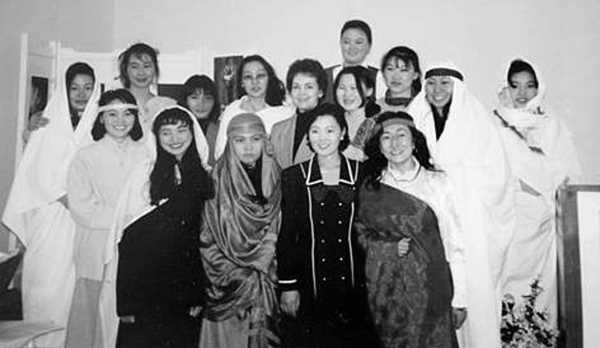 "Women in Christ's life" play in Mongolia, in 1996. Courtesy of Enkhtuvshin Togtokh and Dashgerel Doyod.
The funds for this special “Christmas Fast” were gathered and supplies were purchased. These included “100s of pounds of flour, 16 sheep carcasses, clothes, and other useful items” that were purchased and delivered to these families. This effort was organized by the local members and leaders, and blessed these families, who were deeply grateful for the Church and those who participated and contributed to this “Christmas Fast.”[40] By the following April, several baptisms and the first sacrament meeting were held in Gordok.[41]
Elder Wirthlin’s Visit
In 1996 the Church sponsored several humanitarian projects in Mongolia, including the support of the Mongolian Scout Association. These humanitarian projects also included “training of professional accountants, cold weather housing, teaching English, and relief for victims of grass fires.” In June 1997 Elder Wirthlin visited Mongolia and met with Dr. Gonchigdorj, who thanked the humanitarian assistance the Church had provided Mongolia.[42] Mission records provided the following entry:
Elder Joseph B. Wirthlin, Council of the Twelve Apostles, paid a courtesy call on Dr. R. Gonchigdorj on June 12, 1997, during his visit to Mongolia. Dr. Gonchigdorj is the chairman of the State Great Rural (Parliament) of Mongolia. The meeting took place in the capital city of Ulaanbaatar. Mr. Gonchigdorj, who visited Salt Lake City, BYU and met Church leaders in February of 1995 warmly welcomed Elder Wirthlin to Mongolia, asked questions about his visit and wished him well during his stay. He also expressed appreciation for the assistance the Church had provided: books, educational materials, fire relief, and English teachers. Mr. Gonchigdorj said, “These services are very important to Mongolia.”
Elder Wirthlin pledged the Church’s continued interest and support for serving the needs of the people of Mongolia through the Church’s Welfare Services Program. He also expressed appreciation to the support and assistance given to the teachers and humanitarian service volunteers sent here by the Church. Mr. Gonchigdorj passed on a request from Mongolia’s Oncology Center for assistance in upgrading their cancer-treating equipment. Elder Wirthlin accepted it and left instructions for us to submit it for consideration. Accompanying Elder Wirthlin during his visit were Elder Tai, Asia Area President, President Gary E. Cox, president of the Mongolia Ulaanbaatar Mission, and T. Enktuvshin, president of the Mongolia Ulaanbaatar District.[43]
 Elder and Sister Wirthlin visit with Enkhtuvshin Togtokh and Dashgerel Doyod and their children during their visit to Mongolia in 1997. Courtesy of Enkhtuvshin Togtokh and Dashgerel Doyod.
Elder Joseph B. Wirthlin was accompanied by Elder Tai Kwok Yuen, the Asia Area President, and their spouses, during their 10–13 June 1997 visit. President Cox reported that they “visited a rural family who lived in a ger, drove to the city of Darkhan, conducted two fireside meetings for the members and had a missionary conference meeting with the missionaries in the Ulaanbaatar area.” They also reviewed the progress of the work in Mongolia. Elder Wirthlin had some concerns about placing missionaries in Hovd, which was about eight hundred miles away from Ulaanbaatar. Nevertheless, Elder Wirthlin “was very impressed with the quality, dedication, and maturity” of the missionaries and was pleased with all they had seen during this trip.[44]
Ganbaatar Dunkhig recalled that Elder Wirthlin was accompanied by Elder Tai and district president Enkhtuvshin during the visit to Darkhan on 11 June 1997. The conference in Darkhan was held at the Women’s Palace. After the meeting, as Elder Wirthlin was coming out of the Women’s Palace, he pointed to a nearby area and said that “the Church [meetinghouse] will be built right there.” At the time, Ganbaatar wondered to himself how someone could be so sure since they didn’t even know if they would get the land or permission from the government for a church building. However, in 1999, just a couple of years later, the church was built. Ganbaatar said that this experience helped him to gain a testimony that these Apostles were also seers and revelators.[45]
Summary
In September 1996 the Ulaanbaatar Mongolia District was organized, followed by the first district conference in 1997, when the Church in Mongolia surpassed a thousand baptisms. The Church continued to grow in the Tuul, Selbe, and Erdenet Branches. The Enkhtaivan Branch was created in 1996, and missionaries were sent to open missionary work in the cities of Hovd and Baganuur in 1997. In addition, the mission acquired an apartment in the same building as the mission home and established a mission office. President Cox reported, “This new facility became the mission home, allowing the mission president and his wife more privacy. This also allowed the office to expand, giving the office staff a small workplace.”[46]
After Sister Elaine L. Jack, then Relief Society General President, visited Mongolia in 1996, she reflected on her experience with the Church in Mongolia as follows:
This fall I visited Mongolia. There are more than 600 Saints building the kingdom of God in a country that until recently was, to me, only a name on a map—a country at the end of the earth. These people are accepting the gospel, and the Spirit is with them. They, too, sing “all is well.” They have no chapel and no stakes. There are a handful of proselyting missionaries and some wonderful couples helping establish the work through teaching English at the universities. The Mongolian Saints are just beginning their journey to Zion.
The most exciting part of the gospel in Mongolia is that there are already 23 elders and sisters from that country serving as missionaries in many other parts of the world. Think of the surge of strength these missionaries will bring back to their fellow members when they return with their experience and knowledge. Now is their time for patience—patience of hope in Jesus Christ.[47]
As the gathering of Israel continued in Mongolia, these faithful Saints immediately prepared for a temple trip with their families. In addition, Elder Wirthlin’s visit in 1997 also helped to highlight the Church service and humanitarian efforts in Mongolia. The growth of the Church, the creation of the first district, the temple trips, and the visit by Elder Wirthlin helped the Saints feel that the love of the Savior for his sheep found throughout Mongolia.
Notes
[1] “Conversation with the Asia Area Presidency,” Ensign, June 1995, 76–77.
[2] Britsch, From the East, 314.
[3] “Mongolia,” Church Almanac: 2013 (Salt Lake City: Deseret News, 2013), 525–26; Cox, “Mission Historical Summary 1996—Mongolia Ulaanbaatar Mission.”
[4] Daschgerel Doyod, interview by Po Nien (Felipe) Chou and Petra Chou, 21 June 2018, Ulaanbaatar, Mongolia.
[5] Cook, “Mighty Change in Mongolia,” 75–76.
[6] Doyod, interview.
[7] Cook, “Mighty Change in Mongolia,” 75–76; Doyod, interview.
[8] Cook, “Mighty Change in Mongolia,” 75–76.
[9] Smith and Smith, “History of the Ulaanbaatar Branch,” 8–9.
[10] Doyod, interview; Mongolia mission area: local member directory, as of 19 February 1994. Copy in possession of the authors.
[11] Doyod, interview.
[12] Cook, “Mighty Change in Mongolia,” 75–76.
[13] Batchimeg Magsar, interview by Po Nien (Felipe) Chou and Petra Chou, 19 June 2018, Ulaanbaatar, Mongolia.
[14] Soyolmaa Urtnasan, interview by Po Nien (Felipe) Chou and Petra Chou, 19 June 2018, Ulaanbaatar, Mongolia.
[15] Tsatsral Eukhtuvshin, interview by Po Nien (Felipe) Chou and Petra Chou, 19 June 2018, Ulaanbaatar, Mongolia.
[16] Oyun Altangerel, interview by Po Nien (Felipe) Chou, 20 June 2018, Ulaanbaatar, Mongolia. Translated by Ariunchimeg Tserenjav.
[17] “Darkhan Mongolia District Annual Historical Report” (Darkhan Mongolia District, Mongolia Ulaanbaatar Mission, 2000), Church History Library Archives LR 368040-3.
[18] “Darkhan Mongolia District Annual Historical Report.”
[19] Ganbold Davaasambuu, interview by Po Nien (Felipe) Chou and Petra Chou, 20 June 2018, Ulaanbaatar, Mongolia.
[20] Davaasambuu, interview.
[21] Gankhuyag Tsogoo, interview by Po Nien (Felipe) Chou and Petra Chou, 19 June 2018, Ulaanbaatar, Mongolia.
[22] Thomas, “Preparing Our Families for the Temple,” 12–14.
[23] Cox, “Mission Historical Summary 1996—Mongolia Ulaanbaatar Mission.”
[24] Doyod, interview.
[25] Doyod, interview.
[26] Enkhtuvshin Togtokh, email message to Odgerel Ochirjav and Po Nien (Felipe) Chou, 29 August 2019.
[27] Tsogoo, interview.
[28] Enkhtuul Damdinjav, interview by Po Nien (Felipe) Chou and Petra Chou, 21 June 2018, Ulaanbaatar, Mongolia.
[29] Bolormaa Ayurzana, interview by Po Nien (Felipe) Chou and Petra Chou, 19 June 2018, Ulaanbaatar, Mongolia.
[30] Odserjmaa Dorjgotov, interview by Po Nien (Felipe) Chou and Petra Chou, 19 June 2018, Ulaanbaatar, Mongolia.
[31] Ganbold Namsrai, interview by Po Nien (Felipe) Chou and Petra Chou, 20 June 2018, Ulaanbaatar, Mongolia. Translated by Ariunchimeg Tserenjav.
[32] Namsrai, interview.
[33] Altankhuu Namnandorj and Erkhbilguun Bayardelger, interview by Po Nien (Felipe) Chou and Petra Chou, 20 June 2018, Ulaanbaatar, Mongolia.
[34] Tserenbat Jamiyan, interview by Po Nien (Felipe) Chou and Petra Chou, 20 June 2018, Ulaanbaatar, Mongolia. Translated by Ariunchimeg Tserenjav.
[35] Altangerel, interview.
[36] Bayartsogt Lkhagvajav and Munkhgerel Purev, interview by Po Nien (Felipe) Chou and Petra Chou, 21 June 2018, Ulaanbaatar, Mongolia.
[37] “Darkhan Mongolia District Annual Historical Report.”
[38] Cox, “Mission Historical Summary 1996—Mongolia Ulaanbaatar Mission.”
[39] Cox, “Mission Historical Summary 1996—Mongolia Ulaanbaatar Mission.”
[40] Cox, “Mission Historical Summary 1996—Mongolia Ulaanbaatar Mission.”
[41] Cox, “Mission Historical Summary 1996—Mongolia Ulaanbaatar Mission.”
[42] “Mongolia,” Church Almanac: 2013, 525–26; “Country Information: Mongolia,” Church News, updated 29 January 2010.
[43] Cox, “Mission Historical Summary 1996—Mongolia Ulaanbaatar Mission.”
[44] Cox, “Mission Historical Summary 1996—Mongolia Ulaanbaatar Mission.”
[45] Ganbaatar Dunkhig and Nerguii Dorjpalam, interview by Matthew K. Heiss, 10 September 2001, Darkhan, Mongolia, James H. Moyle Oral History Program, Church History Library, OH 2729.
[46] Cox, “Mission Historical Summary 1996—Mongolia Ulaanbaatar Mission”; Gary E. Cox, “Mission Historical Summary 199—Mongolia Ulaanbaatar Mission.”
[47] Jack, “All This Way for That?,” 5 January 1997.
