
 menu icon in the top, right corner of the screen.
 icon above to close this box.
 icon at the bottom of the screen below the browser—if you don't see it, swipe up to unhide it.
A Gathering Place
Church Buildings and Service Center (1997-2001)
Po Nien (Felipe) Chou and Petra Chou, "A Gathering Place: Church Buildings and Service Center (1997-2001)," in Voice of the Saints in Mongolia (Provo, UT: Religious Studies Center, Brigham Young University; Salt Lake City: Deseret Book), 131‒48.
“Wherefore the decree hath gone forth from the Father that they shall be gathered in unto one place” (Doctrine and Covenants 29:8).
When the Church entered Mongolia, meetings were held at the apartments of the senior couple missionaries. As Church membership began to grow, the missionaries rented other locations, but the Church continued to outgrow its meeting places. They rented a room in the State Central Library for a season, followed by the Peace and Friendship Palace. However, these were all temporary gathering places for the growing membership in Ulaanbaatar. In September 1998, Bishop Richard C. Edgley, then First Counselor in the Presiding Bishopric, visited Mongolia with Alan Lister, the director of Temporal Affairs in the Manila, Philippines, administrative office. The purpose of their visit was to consider temporal affairs issues and review possible building sites.[1] During this time, Church membership grew from 1,144 in 1997 to 3,521 in 2001.
The Church would eventually purchase a building and later build chapels to provide gathering places to accommodate the ever-increasing number of members, which grew as additional full-time missionaries arrived and new branches were created throughout Mongolia. In 1998, during President Cox’s second year as mission president, the Church would add the Mongolian Service Center to support local Church leaders and members in Mongolia.[2] Various Church materials and resources were translated into Mongolian, including the ordinances of the temple. Then in June 2001, during President G. Harlan Clark’s second year serving as the mission president, the Darkhan chapel, the first chapel built by the Church in Mongolia, was dedicated by President Richard Cook, then a counselor in the Asia Area Presidency.[3]
Children’s Cinema or Central Building
As the Church became legally registered, efforts were also underway to find and purchase a place that could serve as a meetinghouse for the growing membership. By 1996 the Church negotiated the purchase of a building. This building in Ulaanbaatar was an important historical landmark and known as the Children’s Cinema.[4] According to the Church News, the foundation of this well-known building dates back to the 1890s.[5]
This building was remodeled and was also referred to as the Central Building by members.[6] Enkhtuul Damdinjav said, “When the Children’s Cinema or Central Building was being renovated, I helped others with the painting and renovation of the building into a chapel.”[7] Buyanaa Lamjav recalled the following,
The Central Building or old Children’s Cinema building was bought by the Church, and it was a very old meetinghouse. The members helped with the renovation. A couple missionary came and three or four of us worked with them painting it. I think the renovation was . . . about five to six months.
We had Church meetings during the renovation. . . . There were classrooms, the chapel for sacrament, kitchen, restrooms, more classrooms, and a bishop’s office. . . . We had rented places in other buildings, but this was the first chapel for us purchased by the Church. After the renovation it looked new![8]
 The Central Building (previously the "Children's Cinema," a historical landmark) was the first Church-owned meetinghouse in Mongolia. It was purchased by the Church in 1996, remodeled and dedicated on 6 June 1999 by President Richard E. Cook, counselor in the Asia Area Presidency. Courtesy of Mongolia Service Center.
Ganbold Davaasambuu remembered going to the Children’s Cinema building with his family as a child to watch movies or attend government-sponsored classes. This building was a historic structure, and Brother Davaasambuu was grateful the Church had purchased it and renovated it.[9] Bayardelger Jamsran explained, “We grew up in UB [Ulaanbaatar] and our home was in the center of the city, behind the Children’s Cinema in 1960s. We moved to a new district, joined the Church, and learned that our Church owned the old Children’s Cinema.” He continued, “We held sacrament meeting in the old movie hall. This was the first building owned by the Church. The Central Building ha[d] a very special meaning to me as a child, and today it is a special building for the Church in Mongolia.”[10]
A two-day open house was organized for members and visitors a week before its dedication. On the first night of the open house, a classical concert provided music for visitors and special guests. Dignitaries, including business and civic leaders, were given a tour of the renovated building. They saw several displays that shared the various programs of the Church.[11]
On 6 June 1999, 650 members and friends attended the dedication of this historic building. Elder Richard E. Cook, a member of the Asia Area Presidency, dedicated this first Church meetinghouse in Mongolia. Enkhtuvshin Togtokh, the Ulaanbaatar Mongolia District president, spoke during the dedication and said that the “members of the Church in Mongolia are like this new chapel. . . . We must have a firm foundation in the gospel for the Church to grow and our country to prosper.”[12] The Church News reported the following:
Pres. Enkhtuvshin recounted the history of the building and its significance to the Mongolian people. A historical landmark, it had been featured on postage stamps and in magazines. The building had served as a bank and government offices, but most Mongolians have fond memories of it as the “Children’s Cinema” where they went with their parents to watch movies.
In 1968, the building was to be demolished in order to erect an art and design center. When the foundation was reached, however, it was so strong it could not be removed. The new structure had to be built on the existing foundation.
This building has undergone a major renovation the past two years to accommodate a chapel, baptismal font, multi-purpose room and classrooms, but it still stands on the first “firm foundation” that was laid. It will not only serve members but also will continue to serve the community, where English classes will be taught by some of the nearly 70 full-time missionaries.[13]
President Cox spoke of the “painful process to make an old structure new, strong and attractive.” He indicated that the members in Mongolia had to undergo a similar process to change their lives, but this process would be beautiful, like the newly renovated building. Elder Cook expressed gratitude for the first missionaries and converts who helped to lay the foundation in Mongolia. He acknowledged the first Mongolian converts, Purevsuren Lamjav and Bat-Ulzii Tsendkhuu, who were present for the dedication.[14] By 1999 there were 1,850 members in nine branches throughout Mongolia, including three units housed in the Central Building.[15]
Darkhan Chapel
Ganbaatar Dunkhig, then the Darkhan Branch president, reported about 115 members attending sacrament meeting in Darkhan in January 1999. When a groundbreaking ceremony for the Darkhan chapel was held on 16 July 1999, he explained that the number of people attending had continued to increase. President Ganbaatar said the foundation was dug up, and concrete began pouring on 4 August. He was assigned to represent the Church and monitor this construction project. Ganbaatar remembered that exactly five years after his family was baptized on 9 June 1996, the first building in Darkhan was dedicated.[16]
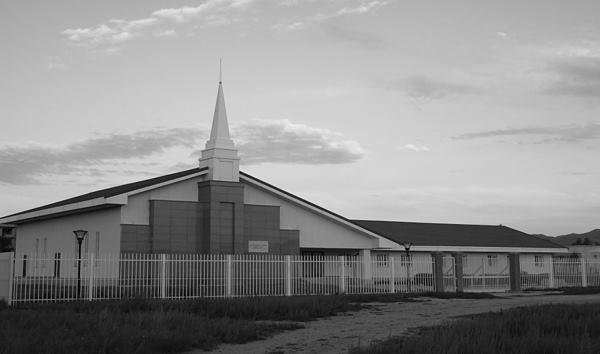 The Darkhan chapel was the first Church building built in Mongolia. It was built and dedicated on 9 June 2001 by President Richard E. Cook, Counselor in the Asia Area Presidency. Courtesy of Mongolia Service Center.
On 9 June 2001 President Cook returned for the dedication of the Darkhan chapel. Sister Purevjargal Dorj explained that it was a wonderful and beautiful building.[17] Ganbaatar said, “It was very important to have a Church building in Mongolia. We had been praying for a long time and waited for so many days to have this building. We were so blessed to have it.”[18]
Tuul Puntsagtseden was working as an administrative assistant in 2001 and recalled traveling from Ulaanbaatar to Darkhan for the dedication. She said, “President Cook from the Area Presidency came for the dedication, and he was there with President Ganbold Davaasambuu, the district president of the North District [renamed the Darkhan District in 2004].” She expressed her feelings at the meeting as follows: “Everything was very good, and I felt excited! The Spirit was very strong, and we all just wanted to stay in church forever. . . . There was a great Spirit.”[19]
President Davaasambuu’s recollection of the Darkhan chapel included the following:
The Darkhan chapel was the first one built by the Church in Mongolia, and it was built by a Japanese company. President Cook came to dedicate this building.
I went to the dedication in my car with my family. There were several members who drove there or took the train. It was a very wonderful dedication, very spiritual. I think we had over one hundred people there. It was full and the members were very happy!
Before we rented the “Wedding Palace” in Darkhan and later our second rental hall in Darkhan was the “Women’s Palace,” where we shared the chapel with the “Rock Church.”
So it was very exciting to have our own building for us to meet.[20]
President Clark recalled, “During the dedication a giant windstorm occurred, and you couldn’t see out the window.” However, he also noted that by the end of the dedication of the Darkhan chapel, “the weather was fair, and we took [a] picture out in front.” He added that the members in Darkhan “will treasure it, and others will be attracted to the Church because of its beauty.”[21]
While serving as a full-time missionary, Gankhuyag Tsogoo regularly traveled with mission president D. Allen Andersen to visit Darkhan. Gankhuyag said, “Darkhan chapel was the first one built in Mongolia by the Church, and President Andersen loved going there.”[22] President Andersen’s feelings are shared by the members in Darkhan and throughout Mongolia. As the Church continued to grow in Darkhan, Elder Donald L. Halstrom from the Asia Area Presidency would dedicate another building in Darkhan in January 2007.[23]
Service Center Organized by Elder Groberg
Back in July 1998 President John H. Groberg, then Asia Area President, came to Mongolia to organize the Mongolian Service Center. Mission records noted the following:
 Elder John A. Groberg, Asia Area President, organizes the Mongolia Service Center in July 1998.
Elder John H. Groberg conducted a mission tour, . . . [and] he also inaugurated a Mongolian Service Center and assigned Elder and Sister Lewis Miller to be the first directors of the center.
A small space was portioned from the largest room in the mission office for the service center. It provided a secure semi-private space in which Elder and Sister Miller could work and initiate the service center function.[24]
Soyolmaa Urtnasan had only been home from her mission about a year when she got a call from President Cox.[25] She recounted the following experience:
In 1997 I came back as a returned missionary and was called as the district young women president. I was overwhelmed and felt much pressure as the only returned missionary. I had to do everything like teach, give talks, and so forth. So when I was hired by a company in 1998, I stopped going to church even though I still had contact with my mission president.
The mission president called me. President Cox told me they were creating the service center and said, . . . “The service center manager [needs] a secretary. Can you come and interview?”
The salary with the Church was part-time and one-third of the supervisor job I had with the other company. I was thinking about it, but it was not very appealing. But I had a younger brother who was becoming a “street boy.” My other job was demanding, so I thought that part-time might give me more personal time and allow me to spend time with my brother to help him. So I accepted the job with the Church service center.[26]
Soyolmaa said that she was not active at the time when President Cook came to interview her. He told her, “You should start coming to church again.” She obeyed the invitation and returned to activity. She began as a part-time secretary in 1999, followed by the Materials Management supervisor in 2001, and finally has been the Mongolia Service Center manager since 2009. She was the first woman to become a service center manager in the Church. In 2018, Soyolmaa explained that as the service center manager, she oversaw the various operations of the service center, including the Publishing Service Department (PSD) and translation, Self-Reliance Services (SRS), Materials Management (MM), Membership Statistical Records (MSR), and Finance.[27]
According to Soyolmaa, the Mongolian Service Center (along with the mission home and office) was first located in a rented space in the Mongolian National Insurance Company building in 1998. Then around 2001 it moved to a new rented space in Bayangiin, until it was relocated in 2004 to the new Church multistory building, the Bayanzurkh building in Ulaanbaatar.[28]
The Mongolian Service Center has continued to grow and progress to meet the new challenges and demands of a growing church in Mongolia. For example, MSR started with paper printouts for units until computers were provided that facilitated the tracking of membership records. With the establishment of PSD and translation services, additional translated Church materials and resources became available to members, including additional translated sessions of general conference. Soyolmaa summarized by saying, “The work at the temporal affairs office or the Mongolian Service Center is challenging. There are many issues we face with missionary visas, etc. . . . But we are just instruments in his Hands, and we see miracles every day because Heavenly Father is in charge.”[29]
According to Odserjmaa Dorjgotov, who has worked as a secretary at the service center since 2006, when Michael Nolan was the service center manager, the service center has played an important role in working with the Mongolian government and supporting Church leaders and members throughout Mongolia by providing materials translated into Mongolian. Odserjmaa commented on the changes in Mongolia since 1998: “In the past, those who joined the Church relied on what the missionaries said or [relied on] a person. Now they are less converted to a person, [and] they can study the Church materials [in Mongolian] themselves and make their own choices.”[30] Key translated resources included the scriptures, hymnbook, Liahona magazine, and other materials.
Hymnbook
Nancy Myers Hopkins, assigned to music for the mission, reported that she participated in a project with early missionaries in Mongolia to translate and compile a small Mongolian hymnbook with twenty-seven hymns. She had to repair and reconstruct some of the old pages with tape and had to renumber some pages as well. There were also newly translated hymns like “I Believe in Christ” and others that needed to be incorporated. Jared Lowther was proficient with the language and helped translate hymns like “O My Father” and others into Mongolian. After the translation, the missionaries would ask several Mongolian members to revise and approve the translated hymns. Hopkins noted that “each new hymn that [was] added to the small hymnbook [was] a victory and cause for celebration.”[31]
We asked the Assistants to the President for the master copy of the hymns so we could contract with a printer to print them.
One of the elders dropped the folder off, and I suddenly became aware of the tremendous task performed by the original translators, typists, and compositors. First, each translated hymn was photocopied form the original church hymnal. Then, the translators had to fit the Mongolian words to the meter and measures of the music. Next, the typist had to select the font and pitch to match the words to the notes with the appropriate breaks, etc. Finally, the lyrics had to be cut into strips and pasted over the English words. They even included all the small musical notations of meter, mood, and scriptural references; all were translated, typed, and cut into tiny pieces that were then taped or glued in the appropriate places. Then, of course, the compilers had to compose the pages to take into consideration those hymns which required two pages, etc. They were true to the hymnbook and included a translated message from the First Presidency in the front.[32]
Hopkins explained that setting the words to music in their proper meter was a significant challenge. “I sat down at our ‘dining room’ table and prayed that Heavenly Father would help me,” she recalled. Concerned with her ability to do this work, she finished praying and began to set the words to the music, but someone knocked on her door. Sister Sosor, a Mongolian member, asked, “Sister Hopkins, may I please come in?” Sosor provided many good insights. For example, she explained to Hopkins that in Mongolian, when talking about heaven, the notes had to go up and not down. “The Spirit touched both of us,” explained Hopkins. Nine hours later on that day, these two sisters were exhausted but grateful to work together on this project. Sister Sosor was laughing and said, “You don’t know Mongolian, and I don’t know [music] notes.” Nevertheless, the Spirit touched both of these sisters to accomplish this wonderful project, and thereafter the first Church hymns translated into Mongolian were being sung in a Mongolian meetinghouse.[33]
Liahona
 The Liahona in Mongolian. Courtesy of Po Nein (Felipe) Chou.
In October 2000 the Liahona magazine was published in Mongolian for the first time.[34] Sister Purevjargal Dorj explained that the Book of Mormon was not yet translated into Mongolian, so when the Liahona first came out “it was a great resource to help teach at church.” She noted that “it was so good to read it and be able to give a copy to other people.”[35] Sister Tsatsral Eukhtuvshin said, “I collected every issue of the Liahona. It was easy to read and increased my testimony and understanding of the Church.”[36]
Galsanjamts Dashdavaa said, “When I read the Liahona, I know how fortunate I am to be part of this great work of the Lord. The Liahona helps me be a good member of the Church.” He added, “I know the Liahona can be a great tool for missionary work. As members we can use it to help others come unto Christ. The Liahona is one of my best friends.”[37] “We love the Liahona because the Liahona gives example[s] of members around the world. It provides many answers to our issues today,” said Ganbold Namsrai.[38]
 Various Church publications available to Church members in Mongolia. Courtesy of Po Nein (Felipe) Chou.
Other Materials
The Mongolian Service Center also employed several individuals to help translate various Church materials and resources. Sister Tselmegsaikhan Sodnomdarjaa, who worked for the translation department at the Mongolian Service Center at the Bayanzurkh building, loved translating the Liahona, general conference talks, seminary and institute manuals, videos, and other curriculum materials. “Translating for the Church is the best job in the world. . . . You read the words of the prophets before they are published. . . . It is a sacred job.”[39]
Bayardelger Jamsran explained, “Church materials were very important for new members, [especially] the scriptures.” He explained that these resources were “such a blessing for the members of the Church [because] they could [learn] for themselves without help from others, and so they could gain their own testimony.” Bayardelger also noted that “other materials important for us included manuals, handbooks, etc. . . . to help us with our callings. Especially for the older people, we don’t know English, so we need to be able to read the materials in our own language.”[40]
Temple Film Team
As additional individuals and families from Mongolia continued to travel to the Hong Kong China Temple or other temples for their temple blessings, there was a need to translate the temple ordinances into Mongolian. Batchimeg Magsar was studying at Utah Valley University (UVU) in Utah when she was asked to assist with the Mongolian translation of the temple ceremony script in 2000. When she learned the temple ordinances would be translated into Mongolian, she knew “how much God cared for us [Mongolian Saints].” She added, “We were blessed from head to toe, both physically and spiritually to help with the translation.”[41] Khavtgai Shar, then second counselor in the Ulaanbaatar Mongolia District, went to Salt Lake City in March 2000 to work on this important translation project. Brother Khavtgai and Sister Batchimeg worked together to translate the temple ordinances and temple film from English into Mongolian in March 2000.[42] Munkhtsetseg (Monica) Dugarsuren assisted with the review and then worked with the team who was voicing the temple ceremony.[43]
 Temple film recording team in front of the Salt Lake Temple, October 2000, Salt Lake City, Utah. Front row from the left: Nyamsuren Norovsuren, Khavtgai Shar, Sister Porath, Munktsetseg Dugarsuren, Enkhtuvshin Togtokh, and Galbadrakh Tsambasuren. Back row from the left: Enkhbaatar Tsend, Batbayar Tserendorj, Elder Porath, Dashdavaa Baljindondog, Ganbaatar Dunkchig. Courtesy of Nyamsuren Norovsuren.
Once the script was translated, eight Mongolian members were invited to create a team to help voice the temple ceremony. In October 2000 in Utah, Enkhbaatar Tsend felt it was a privilege to be part of this team and was joined by other early pioneers of the Church in Mongolia, including Batbayar Tserendorj, Khavtgai Shar, Enktuvshin Togtokh, Dashdavaa Dashdondog, Galbadrakh Tsambaasuren, Ganbaatar Dunkhig, and Nyamsuren.[44] Ganbaatar Dunkhig said, “I am home,” when he walked in the temple to help with the translation. The temple was so familiar to him because he had previously seen it in a dream as a child.[45]
Munkhtsetseg (Monica) Dugarsuren was in Utah and helped take the team to the Provo Utah Temple. She also took the team to the Joseph Smith Memorial Building in Salt Lake City to attend the Eighteenth Ward for church, hoping to have the team meet President Gordon B. Hinckley after church. She said, “President Hinckley was at the meeting and we caught him after the meeting. . . . He was very nice. We brought him a gift from Mongolia and took pictures with him.” Then Batbayar Tserendorj, the district president leading the team, shook hands with President Hinckley and asked him, “When can we have a temple in Mongolia?” President Hinckley replied, “Not yet. Not until you bring more people to church.” President Batbayar affirmed, “I will.”[46]
Ganbaatar also shook the prophet’s hand and said, “I got my testimony that Gordon B. Hinckley was the true prophet of God, who receives revelations from God. . . . Our families and all Mongolians were blessed . . . [to have] the temple ordinances [translated].”[47] Brother Khavtgai shared the following:
We met our living prophet, God’s prophet, and got to shake his hands, [have] a short conversation, and [take] a picture with him. It was the most unforgettable experience [of] my life. . . .
President Gordon B. Hinckley is our church’s prophet, seer, and revelator. I know that by the Spirit. I felt such a strong Spirit, His Holy Spirit when I met him, . . . when I shook his hands, and when I had a short conversation with him. I would never forget that.
That was the best and most important experience that happened in my life.[48]
A decade later, in 2011, Enkhbaatar Tsend would travel with another team to Hong Kong for a second temple ceremony recording. He said, “We helped with a new recording from May 30 to June 8, 2011 in Hong Kong. . . . It was hard to get into the role the first time in 2000. But in 2011, we had a younger group that had already been to the temple. So it was easy because we understood the temple ceremony.” Enkhbaatar added, “When I attended my first general conference in October 2000, President Hinckley said that ‘prayers, offered in humility and sincerity, are heard and answered.’ So we offer[ed] our prayers in faith for the temple.”[49]
 Temple film recording team, October 2000, Provo, Utah. Mongolian team after they recieved their own endowment in the Provo Temple. From left: Galbadrakh Tsambasuren, Batbayar Tserendorj, Khavtgai Shar, Enkhbaatar Tsend, Dashdavaa Baljindondog, Nyamsuren Norovsuren, Ganbaatar Dunkhchig, and Enkhtuvshin Togtokh. Courtesy of Nyamsuren Norovsuren.
Summary
As Church membership continued to grow, additional branches were opened and organized throughout Mongolia. The increased number of converts also resulted in additional gathering places, including the first Church-purchased and Church-built meetinghouses in Mongolia, namely the Children’s Cinema (or Central Building) and the Darkham chapel, respectively.
Moreover, as the number of members and units increased, there was an increased need for translated materials and resources. The Mongolian Service Center and its employees helped to organize and manage the temporal affairs and needs of the ever-expanding membership. A key event during this time was the temple translation team that traveled to Utah to record the temple ordinances in Mongolian.
Notes
[1] Cox, “Mission Historical Summary 1998—Mongolia Ulaanbaatar Mission.”
[2] Cox, “Mission Historical Summary 1998—Mongolia Ulaanbaatar Mission.”
[3] Clark, “Mission Historical Summary 2001—Mongolia Ulaanbaatar Mission.”
[4] Church Newsroom, Facts and Statistics: Mongolia, 15 March 2017; Odgerel Ochirjav, interview by Po Nien (Felipe) Chou, March 2017.
[5] Cook, “Well-Known Building Is First Meetinghouse in Mongolia.”
[6] Purevjargal Dorj, interview by Po Nien (Felipe) Chou and Petra Chou, 19 June 2018, Ulaanbaatar, Mongolia.
[7] Enkhtuul Damdinjav, interview by Po Nien (Felipe) Chou and Petra Chou, 21 June 2018, Ulaanbaatar, Mongolia.
[8] Buyanaa Lamjav, interview by Po Nien (Felipe) Chou and Petra Chou, 19 June 2018, Ulaanbaatar, Mongolia.
[9] Ganbold Davaasambuu, interview by Po Nien (Felipe) Chou and Petra Chou, 20 June 2018, Ulaanbaatar, Mongolia.
[10] Bayardelger Jamsran, interview by Po Nien (Felipe) Chou and Petra Chou, 20 June 2018, Ulaanbaatar, Mongolia, translated by Ariunchimeg Tserenjav.
[11] Cook, “Well-Known Building Is First Meetinghouse in Mongolia.”
[12] Cook, “Well-Known Building Is First Meetinghouse in Mongolia.”
[13] Cook, “Well-Known Building Is First Meetinghouse in Mongolia.”
[14] Cook, “Well-Known Building Is First Meetinghouse in Mongolia.”
[15] “Mongolia,” Church Almanac: 2013, 525–26.
[16] Ganbaatar Dunkhig and Nerguii Dorjpalam, interview by Matthew K. Heiss, 10 September 2001, Darkhan, Mongolia, James H. Moyle Oral History Program, Church History Library, OH 2729, The Church of Jesus Christ of Latter-day Saints, Salt Lake City.
[17] Purevjargal Dorj, interview by Po Nien (Felipe) Chou and Petra Chou, 19 June 2018, Ulaanbaatar, Mongolia.
[18] Dunkhig and Dorjpalam, interview.
[19] Adiyabold Namkhai and Tuul Puntsagtseden, interview by Po Nien (Felipe) Chou and Petra Chou, 19 June 2018, Ulaanbaatar, Mongolia.
[20] Davaasambuu, interview.
[21] Clark, “Mission Historical Summary 2001—Mongolia Ulaanbaatar Mission.”
[22] Gankhuyag Tsogoo, interview by Po Nien (Felipe) Chou and Petra Chou, 19 June 2018, Ulaanbaatar, Mongolia.
[23] “Darkhan Mongolia District Annual Historical Report” (Darkhan Mongolia District, Mongolia Ulaanbaatar Mission, 2007).
[24] Cox, “Mission Historical Summary 1998—Mongolia Ulaanbaatar Mission.”
[25] Soyolmaa Urtnasan, interview by Po Nien (Felipe) Chou and Petra Chou, 19 June 2018, Ulaanbaatar, Mongolia.
[26] Urtnasan, interview.
[27] Urtnasan, interview.
[28] Urtnasan, interview.
[29] Urtnasan, interview.
[30] Odserjmaa Dorjgotov, interview by Po Nien (Felipe) Chou and Petra Chou, 19 June 2018, Ulaanbaatar, Mongolia.
[31] Hopkins, “Translation of the Hymns into Mongolian File.”
[32] Hopkins, “Translation of the Hymns into Mongolian File.”
[33] Hopkins, “Translation of the Hymns into Mongolian File.”
[34] “Darkhan Mongolia District Annual Historical Report.”
[35] Purevjargal Dorj, interview by Po Nien (Felipe) Chou and Petra Chou, 19 June 2018, Ulaanbaatar, Mongolia.
[36] Tsatsral Eukhtuvshin, interview by Po Nien (Felipe) Chou and Petra Chou, 19 June 2018, Ulaanbaatar, Mongolia.
[37] Galsanjamts Dashdavaa, “Comment: Liahona Is a Friend,” Liahona, October 2008, 48.
[38] Namsrai, interview.
[39] Tselmegsaikhan Sodnomdarjaa, interview by Po Nien (Felipe) Chou and Petra Chou, 19 June 2018, Ulaanbaatar, Mongolia.
[40] Jamsran, interview.
[41] Batchimeg Magsar, interview by Po Nien (Felipe) Chou and Petra Chou, 19 June 2018, Ulaanbaatar, Mongolia.
[42] “Darkhan Mongolia District Annual Historical Report.”
[43] Munkhtsetseg Dugarsuren, interview by Po Nien (Felipe) Chou, 27 February 2018, Salt Lake City.
[44] Enkhbaatar Tsend, interview by Po Nien (Felipe) Chou, 2 August 2018, Salt Lake City, translated by Munkhtsetseg (Monica) Dugarsuren; “Darkhan Mongolia District Annual Historical Report.”
[45] Dunkhig and Dorjpalam, interview.
[46] Munkhtsetseg (Monica) Dugarsuren, interview by Po Nien (Felipe) Chou, 2 August 2018, Salt Lake City, Utah.
[47] Dunkhig and Dorjpalam, interview.
[48] Khavtgai Shar, interview by Matthew K. Heiss, 12 September 2001, Ulaanbaatar, Mongolia, James H. Moyle Oral History Program, Church History Library, OH 2723, The Church of Jesus Christ of Latter-day Saints, Salt Lake City.
[49] Enkhbaatar Tsend, interview; Hinckley, “An Humble and a Contrite Heart,” 88–89.
