
 menu icon in the top, right corner of the screen.
 icon above to close this box.
 icon at the bottom of the screen below the browser—if you don't see it, swipe up to unhide it.
Establishing a Stake of Zion
The First Stake in Mongolia (2007-10)
Po Nien (Felipe) Chou and Petra Chou, "Establishing a Stake of Zion: The First Stake in Mongolia (2007-10)," in Voice of the Saints in Mongolia (Provo, UT: Religious Studies Center, Brigham Young University; Salt Lake City: Deseret Book), 199‒218.
“We ask thee to appoint unto Zion other stakes” (Doctrine and Covenants 109:59).
President Donald L. Hallstrom, then serving in the Asia Area Presidency, visited Mongolia to dedicate two new buildings on 20 and 21 January 2007, the new Chingeltei and Darkhan 1 chapels, respectively. Then in July D. Allen and Jill Andersen arrived to preside over the mission. They were busy that first year, welcoming several visitors from Church headquarters. These visitors included President Earl C. Tingey, then serving in the Presidency of the Seventy, and his wife, Joanne, in August 2007; followed by Bishop Keith B. McMullin, then in the Presiding Bishopric of the Church, and his wife, Carolyn, in October 2007. In December 2007 the first Mongolian triple combination was also published.[1]
Two years later, in 2009, several significant events occurred. Elder Russell M. Nelson, then a member of the Quorum of the Twelve, visited Mongolia, and the first stake in Mongolia was organized with Odgerel Ochirjav as its stake president. The first stake also had the first Mongolian brothers ordained to the offices of bishop and patriarch. As the Church reached these important milestones, it continued to experience organizational growth and maturity. Church membership grew from 7,721 in 2007 to 9,896 in 2010. President Kris J. Mecham served briefly in 2010 as the mission president, then President Jay D. Clark arrived later in 2010 to preside over the mission.
Elder Russell M. Nelson’s Visit
 Elder Russell M. and Sister Wendy Nelson visit with members in the ger district, February 2009. Courtesy of Ogderel Ochirjav.
Elder Nelson visited Mongolia on 15–17 February 2009. Elder and Sister Nelson were accompanied by Elder and Sister Hallstrom. They spoke at a mission conference, visited ger districts and historical sites, and held an evening fireside. At the mission conference, a missionary choir sang and signed “Called to Serve.” Elder Nelson answered questions from the missionaries, provided training, and taught life lessons using the scriptures.[2] Jill Andersen recalled the following:
We went to visit two member families who live[d] in ger districts. Sister Nelson was particularly impressed with the lives of these families. She took lots of photos. One of the women said she had lived in her ger all of her life, 57 years. It had been her parents’ ger before her. While we were visiting her family of three, the door kept opening to admit another family member or a friend. They wanted to share this incredible experience with others. By the time we left, the small room was bulging with people. Elder Nelson gave a prayer at each home.
After visiting [these] members we went to Zaisan Hill where Elder Nelson read Elder Maxwell’s dedicatory prayer. He read with a lot of feeling.
Then we drove to the large Genghis Khan [also spelled Chinggis Khan] statue. Rather than taking the elevator, we opted to climb the roughly 140 winding stairs to the viewing area at the top of the horse’s head. Elder Nelson was not winded in the least by the climb. At 84 years of age, he was in excellent physical condition.[3]
 Elder Russell M. Nelson visits Mongolia, February 15-18, 2009. From left to right: Sister Wendy Nelson and Elder Russell M. Nelson, Odgerel Ochirjav, Elder Donald L. Hallstrom, and Sister Diane Hallstrom. Courtesy of Odgerel Ochirjav.
Church members attended a meeting with Elder Nelson at the Central Cultural Palace of the Mongolian Trade Union, which was often used by the Church for large gatherings. Mission president D. Allen Andersen asked Gankhuyag Tsogoo, a recently returned missionary, to translate for Elder Nelson. Gankhuyag said, “I was nervous and scared to interpret for Elder Nelson. But once I went up to interpret, I was calm. It wasn’t me, but it was the Spirit that did it.”[4]
Gankhuyag noted that the Central Cultural Palace of the Mongolian Trade Union building was filled to capacity. Elder Nelson talked about the Church in Mongolia and encouraged those attending to write in their journals about what they felt during the meeting and then compare these journal entries with their feelings about the Church in ten years. He added that in ten to twenty years, they would see great change in Mongolia. Gankhuyag said, “It was a special meeting. There were no stakes then, only districts. . . . But [afterward] there [we]re stakes in Mongolia.”[5]
Chimedbaatar Tseden had the opportunity to meet Elder Nelson and “felt his strength and energy, even at his advanced age.” Chimedbaatar was amazed and had a special feeling attending the meeting with Elder Nelson at the Central Cultural Palace of the Mongolian Trade Union.[6] Purevjargal Dorj said that when she looked at Elder Nelson, she felt the Spirit strongly, especially when “he asked them to read the Book of Mormon more, as some of us did not have the habit of reading.”[7]
President Andersen hoped the attendance would mirror a stake, and it did: the thousand-seat hall was filled beyond capacity, with the choir sitting on stage and people standing in the aisles. The final count was between 1,300 to 1,400 people. Sister Andersen recalled that Elder Nelson told those attending “what they needed to do to have a temple. . . . [and] that they were of the blood of Israel and entitled to the blessings of the Abrahamic covenant.” She added, “He pronounced a lengthy Apostolic blessing. . . . [and] reiterated certain statements from Elder Maxwell’s dedicatory prayer.”[8] Gankhuyag, who translated for Elder Nelson, recalled the apostolic blessing left upon the members in Mongolia, which said,
I bless you with a desire to know more about God.
I bless you to pray daily and know that you were created in the image of God.
I bless you that you will learn more about Jesus Christ, love Him, and live after the pattern of His life.
I bless you that you will love your families and that your homes may become sanctuaries of peace and love, and that Jesus Christ and His apostles may always be welcome.
I bless you that you will study the scriptures daily and teach and learn from it daily.
I bless you that you will have the necessities of life, and that God may provide you with food, warmth, and clothes to wear.
I bless you with enough health and strength to provide for your needs.
I bless you that you will love your ancestors and that you will be able to perform ordinances for them in the temple.
I bless the country of Mongolia that it may prosper according to the will of God.
I bless your country to become a lighthouse to other nations so that the promise made by Elder Maxwell might be fulfilled.
I bless you and bear witness that this is the work of the almighty God. In the name of Jesus Christ, amen.[9]
Organizing the First Stake
Odgerel Ochirjav was called as the president of the Ulaanbaatar Mongolia District in May 2006. At the time, it was a large district with twelve branches. By 2007 the new mission president, D. Allen Andersen, arrived with a vision to increase the Ulaanbaatar Mongolia District. “President Andersen called on us to work towards and pray to get a stake of Zion in our country, in Mongolia,” said Odgerel. All the members and missionaries prayed and worked hard for the next two years to increase the district and prepare for the day when the first stake would be created in Mongolia.[10]
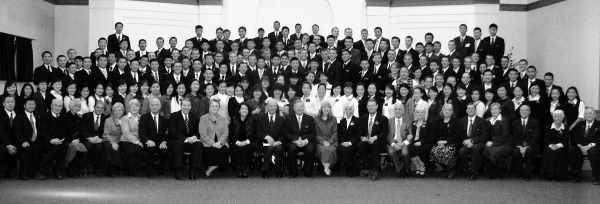 Mission conference in Ulaanbaatar, February 2009. Elder and Sister Nelson (front center) with Elder and Sister Hallstrom (front center left) and Mission President D. Allen and Sister Anderson (front center right). Courtesy of Odgerel Ochirjav.
In June 2009 Baatarchuluun Tumurbaatar was serving as the executive secretary for the Ulaanbaatar Mongolia District when President Hallstrom came to visit Mongolia. Baatarchuluun was asked to arrange fifteen-minute interviews with five-minute breaks in between to allow President Hallstrom to interview about twenty-seven brothers. “I was instructed to ask these brothers to wait on the third floor until it was their turn to come up to the fourth floor of the office for their interview,” said Baatarchuluun. “Your job is to keep quiet so we can hear the Spirit,” instructed President Hallstrom, who took the time between each interview to pray and listen to the Spirit for direction.[11] Odgerel Ochirjav, then the district president in Mongolia, was also asked to visit with President Hallstrom. Odgerel and his wife, Ariunchimeg Tserenjav, were returning from a Seminaries and Institutes convention in Kuala Lumpur, Malaysia.[12] Sister Ariunchimeg explained,
We were asked to visit with President Hallstrom, but after flying from KL [Kuala Lumpur], Malaysia to Singapore, our flight was delayed for one day in Singapore.
We changed our flights and went from Singapore to Beijing to Mongolia. We met with President Hallstrom in Mongolia on Saturday. My husband was the last person interviewed before the district conference on Sunday.
President Hallstrom interviewed with my husband [alone] on Saturday, then at night we had a couple’s interview to extend the calling for my husband to serve as the stake president. I was shopping with my daughter when we got a call to come in for the couple’s interview. I was in jeans and wanted to change, but I was told to come like that. I was told, “It is good you are in jeans, which means you weren’t prepared for or expect[ing] this calling.”[13]
President Odgerel said that after President Hallstrom met with him and his wife to extend the call, they then reviewed a list of all the brothers interviewed to choose two counselors for the new stake presidency. After President Hallstrom extended the calls, he said to President Odgerel, “Now you don’t call to receive direction from the mission president. Instead, you contact the Area Presidency directly.” District presidents were directed by the mission president, but things changed with the call of a stake presidency. Six branches became wards as part of the new stake, resulting in the call of the first bishops in Mongolia.[14]
 Odgerel Ochirjav and Ariunchimeg (Ariuna) Tserenjav with their children, ca. 2016. Courtesy of Odgerel Ochirjav and Ariuna Tserenjav.
On Saturday a priesthood meeting and a general meeting was held in the afternoon and evening, respectively, at the Bayanzurkh Building. The next day about 1,500 members attended the Sunday general session, where President Hallstrom taught about priesthood keys.[15] Brother Baatarchuluun recalled attending the general session of the conference at a rented building, wherein President Hallstrom organized the first stake in Mongolia, the Ulaanbaatar Mongolia West Stake, on 7 June 2009, with Odgerel Ochirjav as stake president. Baatarchuluun recalled that “it was very exciting for Mongolia. We had prepared for over two years and worked really hard for this. Everyone was emotional and very excited.” He explained that the Ulaanbaatar (UB) District had twelve units, “and it was split into one district or UB East District with six units and one stake or UB West Stake with six units.”[16]
Soyolmaa Urtnasan said that when the first stake in Mongolia was organized in 2009, it was a blessing. She said, “Wow, God’s work was moving forwards and I was witnessing history, and the Church is growing.” She added, “This was the most important spiritual growth for the Church and members in Mongolia then. People grew and developed faith. . . . We grew and were maturing as a Church.”[17] Sister Tsatsral Eukhtuvshin said, “When the district became a stake in Mongolia, we all felt good recognizing that the Church was growing in Mongolia.”[18]
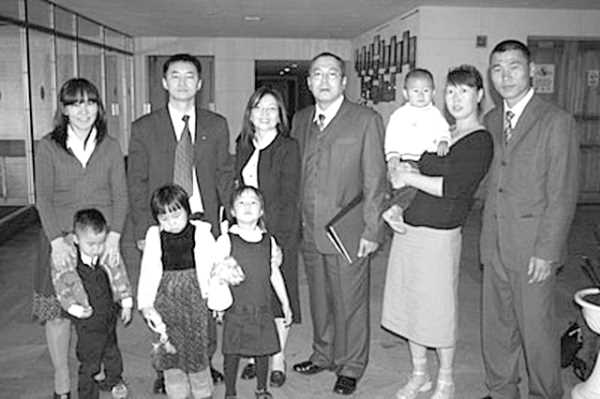 The first stake in Mongolia, the Mongolia Ulaanbaatar Stake (later renamed the Mongolia Ulaanbaatar West Stake) was organized on 7 June 2009. Courtesy of Odgerel Ochirjav.
Altankhuu Namnandorj, who later served as a counselor in the stake presidency of the Ulaanbaatar West Stake, indicated that “it was a learning process for everyone” in the stake presidency. He recalled, “I tried to be more confident, tried to be friends with all the bishops, and tried to be a good example.” He added, “We encouraged the bishops and other leaders, and had monthly training for the bishoprics. We were growing spiritually.”[19] His wife, Erkhbilguun Bayardelger, who later served as a stake Relief Society president, shared the following:
We conducted training meeting[s] every two months and also went to train each ward[’s] Relief Society. We shared goals and help[ed] Relief Societies know how to do and accomplish the[ir] goals. We later had annual Relief Society conferences as well.
We have beautiful and strong sisters in [our] Relief Societ[ies]. One sister shared her testimony in a training and shared about how visiting teaching [renamed ministering] affected her. She taught us and inspired us about visiting teaching and ministering.
Mongolian sisters are very hospitable and generous. As our motto for [the] Relief Society, we minister to each other.
For Relief Society activities, we made blankets for families that can’t afford it to help them [1]n the cold winters. We made baby blankets for newborn babies. We celebrated Relief Society birthdays in March. We also had date activities for married couples, [and at one such activity] a sister invited her inactive husband.[20]
Bishops
Along with the organization of the first stake, several branches became wards, which were then presided over by the first bishops ordained in Mongolia. Chimedbaatar Tseden was one of the first six brothers called and ordained as bishops in 2009 for the first stake of Mongolia. He said, “I was called as a bishop of the Unur Ward and [was] blessed and ordained a bishop by President Odgerel Ochirjav.”[21] Bayardelger Jamsran, who joined the Church in 2002 and who had recently been sealed to his family, was also among the first Mongolian brothers called and ordained to the office of a bishop.[22] He recounts the following:
We were in the “Central Building.” After we were sealed, we [came] back to a new stake and our branch became a ward. President Odgerel called me as the bishop of the Enkhtaivan Ward on 21 June 2009. . . .
When the first stake was organized, I was one of the first bishops. It was a blessing to me and my family. It was not easy to be a bishop, everything was new, but the stake leaders helped us a lot and we had lots of training. Every month bishops were interviewed by the stake president and learned much. Our ward had 110–140 members attending. We had many good members. . . . We had three wards in the “Central Building.”[23]
Another brother called as a bishop was Enkhbaatar Tsend. He was baptized with his family in 1998 and was serving as a branch president when the first stake was organized. He said, “When I heard of the requirement to organize a stake, I thought that someday we’ll get there. When the stake was organized, I was really excited. . . . but I didn’t dream I’d ever be a bishop.” In June 2009 Enkhbaatar was interviewed, called, ordained, and set apart as one of the first bishops in Mongolia by the new stake president, Odgerel Orchirjav. Sacrament attendance in his unit tripled from 40–50 people to about 150 people during Enkhbaatar’s time as a branch president and as a bishop.[24]
Patriarchs
Batbayar Tserendorj from the Selbe Ward, who had joined the Church with his wife in September 1998 and who had served previously as a district president of the Mongolia Ulaanbaatar District from 1999 to 2004, was called as the first patriarch for the Ulaanbaatar West Stake on 13 September 2009.[25] He was very observant and worked hard in his calling until he became too sick.[26] His wife, Buted Altangerel, a famous opera singer who later sang with The Tabernacle Choir at Temple Square, shared the following about her husband’s call and service as the first stake patriarch in Mongolia:[27]
 Batbayar Tserendorj (first stake patriarch in Mongolia) and his wife, Buted Altangerel (famous Mongolian opera singer), April 2013, in Ulaanbaatar. Courtesy of Odgerel Ochirjav.
My husband was the first patriarch when he was called in 2009 by President Odgerel after the first stake was organized in 2009. . . .
Elder Carl B. Pratt, a counselor in the Area Presidency, assigned President Odgerel to ordain and set apart my husband as a patriarch, which was done in the seminary and institute office in the basement of the BZ Building. When he got the calling, I worried if he knew enough about patriarchal blessings. He said in response, “God will take care of it.”
He would interview members coming in for their patriarchal blessing, some done at our home while I cooked for them. He had two or three interviews before giving a blessing, and he did a lot of praying too. Several members have shared with me their feelings of receiving their patriarchal blessing from my husband. He told me he had given more than three hundred patriarchal blessings to members.
Sister Oyuna was his secretary, and they had an office at the church to give patriarchal blessings. Later, as his health declined, he performed those blessings at home.[28]
 Batbayar Tserendorj and his wife, Buted Altangerel, at their baptism in September 1998, in Ulaanbaatar. Courtesy of Odgerel Ochirjav.
After Brother Batbayar, Chimedbaatar Tseden was called as the second patriarch for the Ulaanbaatar Mongolia West Stake. Brother Chimedbaatar explained, “When President Odgerel called me to be a patriarch [in 2015], I was afraid and had doubts. It was a big calling, and I was worried that I wouldn’t be able to do it.” Since then, he has felt more confident after giving over 160 patriarchal blessings. He added, “I feel in this calling that I am a part of helping and directing the children of God on their path back to Heavenly Father.” Besides members in his stake, he has also provided patriarchal blessings for those in the Darkhan District and the Ulaanbaatar East District before it became a stake. He said that most of the patriarchal blessings he has given “are for the tribes of Ephraim and Manasseh, and a few for Judah, Naphtali, and Isaachar.”[29]
Bolormaa Ayurzana, who served as the patriarch’s secretary in 2018 in the Ulaanbaatar Mongolia West Stake, recalled that many members would come to receive their patriarchal blessing. The patriarch would give the blessings and record each blessing. Then she would get on the computer to transcribe the blessing on the recording and send it to get translated. She would review it and correct the grammar in consultation with the patriarch. It was a unique experience to write and type for the patriarch.[30]
New Hymnbook and Handbook
Accompanying the historic organization of the first stake in Mongolia in 2009 was the publication of the updated Church hymnbook in 2009, as well as the arrival of the translated Church Handbook of Instructions in 2010.[31] In addition, an All-Mongolia Choir Festival was held in 2010 to introduce the members to the new hymnbook.
All-Mongolia Choir Festival
When the updated hymnbook was published in 2009, it was a blessing to the members of the Church in Mongolia. It had about forty to fifty translated hymns, according to Tsatsral Eukhtuvshin. She visited a cousin in Ulaanbaatar who had taught her how to conduct the music, and then she began conducting music when she got home. She had little musical background but began to learn how to play the piano by herself. She would listen to the music and learn the hymns in Mongolian, and she was later called to serve as a music conductor and pianist.[32]
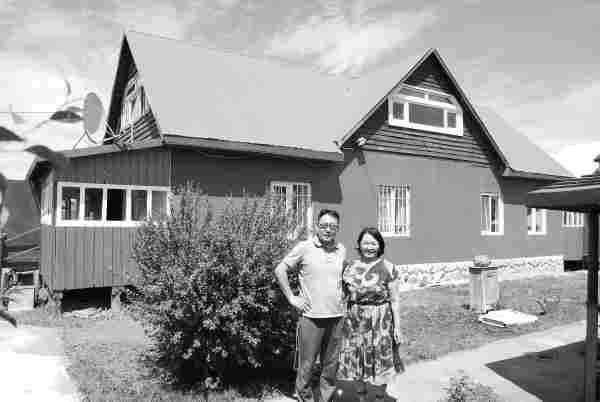 Home of the first patriarch in Mongolia. Sister Buted Altangerel and her son by their home in Mongolia in June 2018. Courtesy of Po Nien (Felipe) and Petra Chou.
Members commemorated the dedication of Mongolia with an All-Mongolia Choir Festival on 17 April 2010. Mission president D. Allen Andersen reported that “it was a day of rejoicing for Latter-day Saints in Mongolia today as we celebrated the 17th anniversary of the dedication of Mongolia for the preaching of the gospel by holding a choir festival.” He added that “it was held in the finest performance center in Ulaanbaatar and there was standing room only.” Carol Lasson was the chair of the choir festival and reported the following:[33]
Each unit was asked to sing one familiar hymn from the current hymnbook of forty-six hymns and children’s songs, and one hymn from the forthcoming, expanded hymnbook. One of the purposes of the Choir Festival was to help Mongolians become familiar with the hymns that would be included in the new hymnbook.
The choir committee planned to have all of the choirs join together to sing “The Spirit of God” in parts at the end of the program, but most of the choir participants had never sung parts before. So the committee recorded the parts separately and sent a copy of the CD to each choir director. Many of the choirs diligently practiced this hymn in parts, and as a result of this challenge, many Mongolian choir members discovered the joy, satisfaction, and beauty of singing in parts. President Andersen reported, “Every choir was well prepared. The concert was concluded with all 715-choir members coming together on the stage, in the aisles, and surrounding the first and second balconies to sing ‘The Spirit of God,’ with the audience joining in the last verse. Truly a joyful sound!”[34]
In total, eighteen choirs from the various wards and branches were organized and participated in this choir festival. President Andersen said, “Erdenet, the grandfather of all the branch/
Handbook
Tsatsral Eukhtuvshin recalled how difficult it was to teach and train without translated manuals and resources, and they often depended on the missionaries to help translate English content into Mongolian.[36] Ganbold Namsrai explained that having the Church Handbook of Instructions and training materials translated was important to help with their callings. He explained than when he had question in the past, he asked the district president who didn’t know the answer. Then when he asked two different couple missionaries, he got two different answers; “but now we all have the same manual in our language, and we can see and find the answers ourselves.”[37]
The new handbook was a blessing to priesthood leaders as well as to Relief Society leaders and leaders of other organizations. For example, when Tsatsral Eukhtuvshin served as a district Relief Society president, she traveled often to train and teach others and was so grateful when the handbook was translated into Mongolian. It provided instructions and policies to assist leaders and members. Tsatsral said that learning how the Church was organized helped her a lot too, and she bore witness that “all that is taught in the Church is true!”[38]
Mission President Changes
President Kris J. Mecham and his wife, Stephanie, arrived in Ulaanbaatar to preside over the mission in July 2010. Unfortunately, within a few months, Sister Mecham was diagnosed with some health problems, requiring her to return to the United States for treatment. Since it would be a six-month treatment and at least another year for follow-up care, President Mecham was released to be with his wife. Glad Powell, a senior missionary in Mongolia, took on President Mecham’s duties until Jay D. Clark and his wife, Patricia, arrived in Mongolia in December 2010 to preside over the mission.[39]
Sealing Families Together
The creation of the first stake in Mongolia and the availability of the handbook were important milestones. However, the purpose of the Lord’s restored church and the focus of the Saints in Mongolia remained steady and firm in following the Savior and sealing families together for time and eternity. Battsetseg Naranbat from Ulaanbaatar explained how the darkest time in her family was turned into the happiest and brightest day of their lives because of the sealing ordinances in the temple.[40]
In 1999 our family consisted of my parents and seven children. My mother Altantsetseg and father Naranbat were anxiously awaiting the birth of another daughter . . . [but] my sister died before she was born. . . . That was one of my family’s darkest times. . . .
[In 2002] my brother [Battulga] was on his way home with his friends when some hooligans attacked and killed him. . . . When he passed away, it brought our family more dark days, months and years. . . . One day my parents noticed a Book of Mormon in his belongings . . . and in order to honor him, they decided to find out where the book came from. They discovered that the book was about Jesus Christ and they read the name of a church, The Church of Jesus Christ of Latter-day Saints. . . . My mother found the missionaries . . . [and] the missionaries taught us about the Plan of Salvation.[41]
 Church materials in Mongolia used for temple preparation classes. Courtesy of Po Nein (Felipe) Chou.
In 2004 she, her mother, and her youngest brothers, Bat-Erdene and Batkhuyag, were baptized, followed by a younger sister, Batchimeg, in 2005, and another younger brother, Batgal, in 2006. Her father was baptized in 2007 and another younger brother, Batdul, in 2009, after much fasting and praying by the family. After her mission, Battsetseg married Munkhdorj, and they set a goal to be sealed in the temple. Her whole family set a goal to go to the temple in 2010 to be sealed to each other and to her deceased brother and sister. They immediately started to save money. However, although they worked hard to save as much as they could, it wasn’t enough to pay for the trip for their large family. However, the Temple Patron Fund helped to cover the difference and on 10 September 2010, “[Battsetseg’s] family began this long and most important journey to the LDS Temple in Hong Kong.” The journey took sixty-four hours on two different trains, and they were exhausted when they arrived at night in Hong Kong. Nevertheless, Battsetseg said that “as we walked toward Patron Housing from the metro station, we spotted the beautiful Hong Kong Temple. It was a happy moment for my family.”[42]
On the morning of 14 September 2010, Battsetseg and her family entered the Hong Kong China Temple, “excited and anxious to be sealed as a family.” Her parents and a brother received their own endowments. She recalled,[43]
In the afternoon, my whole family went to a beautiful sealing room to be sealed. . . . President D. Allen and Sister Jill Andersen, Elder Richard and Sister Carol Lasson, Sister Taylor, and Erica and Josh Wheatley joined us in the sealing room to share our family’s happiest day.
The first sealing was to seal my parents and their children [together] and the other was for my own family, which included my husband and myself. During the first sealing, my husband acted as proxy for my oldest brother Battulga and my former mission companion, Erica Wheatley, acted as proxy for my youngest sister. When they knelt with the rest of the family around [the] altar in the sealing room to be sealed for time and all eternity, we strongly felt the Spirit. We also felt our brother and sister’s presence in the sealing room. We felt that they were really happy, because someday we can again be united as a family and live together forever. After that, my husband Munkhdorj and I were sealed. I felt overjoyed to know that the baby we were expecting would now be born in the covenant. Our family will never ever forget this wonderful experience. It was the most memorable and happiest day of our lives. . . .
We performed the ordinances for all of the family names we [had] prepared, including my dear grandparents. . . . While we were in the temple, we tried to save as many people as we could by doing their ordinances. . . . Everyone enjoyed the experience in the temple and was sad when the time came for us to leave the temple. . . . Even though traveling back to our home in Ulaanbaatar took a long 75 hours, we were really happy because we had accomplished what we had desired for over six years.[44]
Summary
In 2009 Elder Nelson visited the Church in Mongolia. In addition, the first stake in Mongolia was created in that same year. The arrival of a new handbook was timely for the new stake, and the Church in Mongolia continued to be strengthened as more families were sealed together in the temple. Oyun Altangerel, a convert since 1994 and mother of the first stake president in Mongolia, shared her observation of the changes in the Church during these years:
I have seen many changes in the Church over the years.
First, all activities and meetings were done by the missionaries early on. But later as more families joined, we could no longer fit all in one building, [and] we added new buildings and districts, as well as branches in the countryside with local leaders.
I am so grateful to see that the gospel is spreading. The gospel is the best and most correct and right thing for the Mongolian people. I have seen many religions, but our Church is the most active in building our people.
I am grateful I joined the Church. Democracy has allowed the gospel to be brought to Mongolia. . . . There were many churches after the democratic revolution, but I was able to find the most correct one. I found the gospel, and it has had a great impact on me and brought me peaceful feelings.
I am so grateful to join the Church . . . and see that the gospel is spreading.[45]
Notes
[1] Andersen, “Mission Historical Summary 2007—Mongolia Ulaanbaatar Mission.”
[2] Jill Andersen, email message to Odgerel Ochirjav, 27 September 2019.
[3] Jill Andersen, email message to Odgerel Ochirjav, 27 September 2019.
[4] Gankhuyag Tsogoo, interview by Po Nien (Felipe) Chou and Petra Chou, 19 June 2018, Ulaanbaatar, Mongolia.
[5] Tsogoo, interview; Andersen, “Mission Historical Summary 2007—Mongolia Ulaanbaatar Mission.”
[6] Chimedbaatar Tseden, interview by Po Nien (Felipe) Chou and Petra Chou, 20 June 2018, Ulaanbaatar, Mongolia, translated by Ariunchimeg Tserenjav.
[7] Purevjargal Dorj, interview by Po Nien (Felipe) Chou and Petra Chou, 19 June 2018, Ulaanbaatar, Mongolia.
[8] Dorj, interview.
[9] Gankhuyag Tsogoo, personal notes: “An Apostolic Blessing by Elder Russell M. Nelson of the Quorum of the Twelve Apostles,” 17 February 2009; Dorj, interview.
[10] Odgerel Ochirjav and Ariunchimeg Tserenjav, interview by Po Nien (Felipe) Chou, 24 October 2016, Taipei, Taiwan.
[11] Baatarchuluun Tumurbaatar, interview by Po Nien (Felipe) Chou and Petra Chou, 19 June 2018, Ulaanbaatar, Mongolia.
[12] Ochirjav and Tserenjav, interview.
[13] Ochirjav and Tserenjav, interview.
[14] Ochirjav and Tserenjav, interview.
[15] Malan and Linda Jackson, family letter, 7 June 2009.
[16] Tumurbaatar, interview.
[17] Soyolmaa Urtnasan, interview by Po Nien (Felipe) Chou and Petra Chou, 19 June 2018, Ulaanbaatar, Mongolia.
[18] Tsatsral Eukhtuvshin, interview by Po Nien (Felipe) Chou and Petra Chou, 19 June 2018, Ulaanbaatar, Mongolia.
[19] Altankhuu Namnandorj and Erkhbilguun Bayardelger, interview by Po Nien (Felipe) Chou and Petra Chou, 20 June 2018, Ulaanbaatar, Mongolia.
[20] Namnandorj and Bayardelger, interview.
[21] Tseden, interview.
[22] Bayardelger Jamsran, interview by Po Nien (Felipe) Chou and Petra Chou, 20 June 2018, Ulaanbaatar, Mongolia, translated by Ariunchimeg Tserenjav.
[23] Jamsran, interview.
[24] Enkhbaatar Tsend, interview by Po Nien (Felipe) Chou, 2 August 2018, Salt Lake City, translated by Munkhtsetseg (Monica) Dugarsuren Stewart.
[25] Ulaanbaatar Mongolia West Stake, “Ulaanbaatar Mongolia West Stake Annual Historical Report, 2009,” in Andersen, “Mission Historical Summary 2009—Mongolia Ulaanbaatar Mission.”
[26] Tseden, interview.
[27] Buted Altangerel, interview by Po Nien (Felipe) Chou and Petra Chou, 20 June 2018, Ulaanbaatar, Mongolia, translated by Ariunchimeg Tserenjav.
[28] Altangerel, interview.
[29] Tseden, interview.
[30] Bolormaa Ayurzana, interview by Po Nien (Felipe) Chou and Petra Chou, 19 June 2018, Ulaanbaatar, Mongolia.
[31] Andersen, “Mission Historical Summary 2009—Mongolia Ulaanbaatar Mission.”
[32] Tsatsral Eukhtuvshin, interview by Po Nien (Felipe) Chou and Petra Chou, 19 June 2018, Ulaanbaatar, Mongolia.
[33] Clark, “Mission Historical Summary 2010—Mongolia Ulaanbaatar Mission”; Lasson and Lasson, “All-Mongolia Choir Festival, 2010.”
[34] Clark, “Mission Historical Summary 2010—Mongolia Ulaanbaatar Mission”; Lasson and Lasson, “All-Mongolia Choir Festival, 2010.”
[35] Clark, “Mission Historical Summary 2010—Mongolia Ulaanbaatar Mission”; Lasson and Lasson, “All-Mongolia Choir Festival, 2010.”
[36] Eukhtuvshin, interview.
[37] Ganbold Namsrai, interview by Po Nien (Felipe) Chou and Petra Chou, 20 June 2018, Ulaanbaatar, Mongolia, translated by Ariunchimeg Tserenjav.
[38] Eukhtuvshin, interview.
[39] Clark, “Mission Historical Summary 2010—Mongolia Ulaanbaatar Mission.”
[40] Battsetseg Naranbat, “The Naranbat Family’s Temple Story,” 10 October 2010; Clark, “Mission Historical Summary 2010—Mongolia Ulaanbaatar Mission.”
[41] Naranbat, “The Naranbat Family’s Temple Story,” 10 October 2010; Clark, “Mission Historical Summary 2010—Mongolia Ulaanbaatar Mission.”
[42] Naranbat, “The Naranbat Family’s Temple Story,” 10 October 2010; Clark, “Mission Historical Summary 2010—Mongolia Ulaanbaatar Mission.”
[43] Naranbat, “The Naranbat Family’s Temple Story,” 10 October 2010; Clark, “Mission Historical Summary 2010—Mongolia Ulaanbaatar Mission.”
[44] Naranbat, “The Naranbat Family’s Temple Story,” 10 October 2010; Clark, “Mission Historical Summary 2010—Mongolia Ulaanbaatar Mission.”
[45] Oyun Altangerel, interview by Po Nien (Felipe) Chou, 20 June 2018, Ulaanbaatar, Mongolia, translated by Ariunchimeg Tserenjav.
