
 menu icon in the top, right corner of the screen.
 icon above to close this box.
 icon at the bottom of the screen below the browser—if you don't see it, swipe up to unhide it.
The Church Educational System
Weekday Religious Education
Po Nien (Felipe) Chou and Petra Chou, "The Church Educational System: Weekday Religious Education," in Voice of the Saints in Mongolia (Provo, UT: Religious Studies Center, Brigham Young University; Salt Lake City: Deseret Book), 91‒110.
“And as all have not faith, seek ye diligently and teach one another words of wisdom; yea, seek ye out of the best books words of wisdom; seek learning, even by study and also by faith” (Doctrine and Covenants 88:118).
In the summer of 1912, the first full-time seminary teacher was hired as the Church built the first seminary building across the street from Granite High School in Utah.[1] Then in the 1970s the Seminaries and Institutes (S&I) programs experienced tremendous global expansion outside the United States after “the Church Board of Education made the decision that seminaries and institutes would follow the Church as it became established in countries throughout the world.” In other words, after the establishment of missionary work in the various countries and nations around the world, weekday religious education classes would follow closely behind.[2]
This global vision and expansion started in Mongolia in the 1990s. After the first missionaries entered Mongolia and began to hold Sunday meetings, the Church Educational System (CES) followed suit to establish weekday religious education, strengthening and blessing many new converts during the week as they sought learning, “even by study and also by faith.”
Establishing the First Seminary and Institute Classes
As in the case of various other countries, S&I would begin in Mongolia through the service and sacrifice of senior missionary couples. Thereafter, as the program grew and the number of students increased, the Church would later hire someone to coordinate these programs.
Understanding the important role and function that seminary and institute classes played in furthering gospel knowledge and scholarship, President and Sister Cook sought to start these weekday religious education classes as soon as possible. Their efforts in 1995 paved the way for these important classes in Mongolia. Their great relationship with the members, leaders, and youth facilitated the establishment of the first seminary classes in Mongolia. The S&I annual reports indicated that in 1996, the first official seminary and institute classes began in Mongolia.[3] The CES programs began in Mongolia with a class of about eighteen students, who met during their lunchtime. Although the Book of Mormon was not yet translated, the teacher would often quote portions of it to the students.[4]
When zone administrator Ross H. Cole visited the class, he discovered that all of the students were members of the Church but only a few had been members for at least a year. He asked them how many had a testimony of the Book of Mormon. Every student raised a hand. Brother Cole asked for the students’ thoughts about the Book of Mormon, and one boy said, “I believe the Book of Mormon is the word of God.” When asked how he had a testimony without reading the book, the boy responded, “It’s kind of like cake. If you have a bite of cake and it’s good, you know what the rest of the cake tastes like, right?” He continued, “My seminary teacher gave us a few verses of the Book of Mormon that they are working on in translation. . . . I studied them, and I went home and prayed about them. So I felt really good about them. I know they are true.”[5]
 Brother Gankhuu Ganzoright (left) and his mother Tsagaankuu D., after he was hirede as the first CES/
These young converts, like others throughout Mongolia, illustrate the simple faith that S&I sought to nurture through weekday religious education. With the help of the mission and missionary couples, teachers were called, many of them new converts themselves, to provide these classes. By 1999, there were eighty-six seminary and one hundred institute students enrolled by 1999.[6]
Gankhuu Ganzorigt
As the number of students participating in these programs grew, a search started to identify and hire a CES coordinator to supervise the S&I programs in Mongolia. S&I leaders in Hong Kong and Salt Lake City worked with the mission president in Mongolia, who recommended a young recently returned missionary, Gankhuu Ganzorigt, as a potential candidate for this position. Tim Kwok, then the Asia area director, recalled traveling with Steve Iba, then the S&I zone administrator, to interview Gankhuu following this recommendation. They met with and had a job interview with Gankhuu at a local meetinghouse. Then, with approval from the Church Board of Education, Gankhuu was hired and became the first CES coordinator and S&I employee in Mongolia. When he was hired in the later part of the 1990s to supervise all S&I classes in Mongolia, Gankhuu started as a part-time S&I employee because he was still going to school.[7]
Gankhuu attended a series of professional development programs along with other new CES coordinators throughout Asia. One such training was conducted in Penang, Malaysia, under the direction of Ross Cole, then S&I zone administrator for Asia. Gankhuu participated in the training, which introduced him to the characteristics and the “heart of a religious educator,” along with teaching skills and training tips to help volunteer teachers. After the training, he returned to Mongolia to continue his efforts to help and supervise the young S&I programs that were just starting to grow in his country.[8]
Odgerel Ochirjav, then serving as a branch president, remembered working with Gankhuu to organize seminary classes in his branch. Gankhuu had served a full-time mission in the Moscow Russia Mission and spoke Russian. He was young but developed a good relationship with local Church leaders in Mongolia, which helped him to organize S&I classes in various branches throughout Mongolia from 1999 to 2001.[9] By 2001, there were 125 seminary and 314 institute students enrolled in classes across the few branches in Mongolia.[10]
Purevsuren Sharav
Purevsuren Sharav was hired as the new coordinator to replace Gankhuu in 2001.[11] Gankhuu was younger and single when he worked as a CES coordinator in Mongolia. After Gankhuu left and it was time to hire a new CES coordinator, S&I hired Purevsuren, who was older and married. Purevsuren was a graduate from Moscow University and also spoke Russian. He was first introduced to Christianity during his university studies, when he purchased a Bible from another student to learn English. This Bible had Russian on one page and English on the next page.[12]
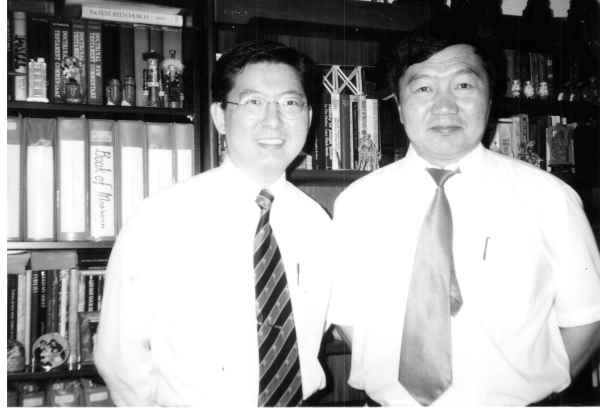 Purevsuren Sharav (right) with Tim Kwok, then S&I Area director in the early 2000s. Courtesy of Odgerel Ochirjav.
Following his return to Mongolia, he was married and became a university professor, giving him the opportunity to visit India.
During this time, a Christian acquaintance gave him a Bible and shared his testimony of the divinity of the Lord Jesus Christ. This caused Purevsuren to reflect on his father’s teachings about life and God. He recalled, “I had a fundamental belief about God from my father.”[13]
As the head of a consortium of Mongolian educators, Purevsuren was invited to visit the United States, where he first saw the Book of Mormon. In Utah, a Church member who hosted the tour group gave him a copy of the book. Purevsuren read in it briefly, then put it aside.
In September 2000, his family came into contact with LDS missionaries in Mongolia and listened to the missionary discussions. This time he read the Book of Mormon with new eyes and found truth he had been seeking. He and his wife were baptized and confirmed that November. Only a week or two later, he was called as branch president. . . . Eventually, both [of their] children were baptized and confirmed.[14]
Tim Kwok and Ross Cole, then S&I Asia area director and zone administrator, respectively, interviewed Purevsuren, who was then a new convert serving as a branch president in Mongolia. Purevsuren was working for a nongovernmental organization. According to Kwok, Purevsuren’s experience working with young people and his English language skills made him a good candidate to coordinate S&I programs in Mongolia. Purevsuren accepted the opportunity to work as a CES coordinator, with his office at a Church meetinghouse in Ulaanbaatar.[15]

 Top: Purevsuren Sharav (front, far right) with mission president G. Harlan Clark, senior missionaries, and volunteer teachers, 2002. Bottom: Purevsuren Sharav (front center) with volunteer S&I teachers, circa 2001 or 2002. Photos courtesy of Odgerel Ochirjav.
Purevsuren worked to further establish S&I programs throughout Mongolia. Sister Bolormaa Ayurzana, who began working as the S&I secretary in 2003, said that Brother Purevsuren “inspired seminary and institute teachers during his class visits, which included three or four seminary classes each week along with institute at night.” The program began with young single adults and those over thirty years old. As the program matured, institute was later held just for the young single adults. The program began with Book of Mormon classes, then Old Testament and New Testament classes. The CES office was then located in the “Central Building.”[16]
Po Nien (Felipe) Chou, then a CES coordinator in Taiwan, recalled attending an area training meeting, where Purevsuren talked about Mongolian shepherds caring for a young lamb in a warm pouch and how important it was to give the same care to new converts of the Church in Mongolia.[17] During his time as a coordinator, Purevsuren visited S&I teachers and students in the various branches throughout Mongolia. Most of these teachers and students were new converts to the Church and appreciated his visit and support. However, he had several health challenges and later left CES employment. Still, he assisted in building a strong young single adult program that helped to make institute a success in Mongolia. Kwok reported visiting one class of fifty to sixty institute students gathered in the chapel, eager to learn the gospel in these classes.[18]
Purevsuren coordinated with local priesthood leaders and helped to build a good foundation of seminary in every unit, including daytime or afternoon classes, until around 2006.[19] An Ensign article in 2007 reported that “there were about 600 institute students in Mongolia and some 700 in seminary.” The article explained, “Those numbers have grown by about 300 percent since 2001, even though students often face opposition from family members, and the cost of attendance, in time and transportation, is high.” Asked then about the most rewarding part of his job as a CES coordinator, Purevsuren said, “The best thing, I think, is seeing so many kids joining the Church through seminary.”[20]
Senior missionary couples also helped to visit classes, and train and supervise volunteer teachers. Don and Sharon Platt provide some insights into their assignment and experience as a senior missionary couple in 2005.[21]
 S&I teachers, and institute and seminary students in Mongolia in 2002. Courtesy of Odgerel Ochirjav.
We arrived in Mongolia on Sept. 3rd and in Darkhan on September 7th. We visited all the seminary classes (7); Institute (5) and Mission Prep classes (4) and delivered supplies to them and gave them an oral evaluation. In November we held Inservice for the 16 teachers and all came except the 3 from Erdenet.
Since then in CES we have added a home seminary in Shamaar; combined the mission prep class in Darkhan 1st and 2nd; had 4 teacher changes; and eliminated one seminary class in Darkhan 1st (combined the two classes). The first CES student manuals in Mongolian were printed the end of this year and are being delivered to all seminary classes. . . .
Each month we have visited a branch weekly (Darkhan 1st and 2nd; Zuunhaara and Selenge). We have spoken in Sacrament twice in every branch.
Elder Platt has attended their weekly branch presidency meetings. I have worked with the District Relief Society Presidency who are doing very well on their own because they have American experience and English to read the handbooks. Elder Platt attends the weekly District Presidency meetings.[22]
Another senior missionary couple, Charles and Helen Seaman, served in the Choibalsan Branch and reported that their branch had an institute class each week, held on Saturday afternoon. This class was taught by a sister who “has a radiant smile” with an average attendance of around ten individuals. The seminary class, taught by Sister Nasanjargal, the Young Women president, “met at 6:30 a.m. Monday through Thursday and then again on Saturday at 6:30 a.m.” The Seamans added that “her class sometimes had one student and sometimes 5 or 6 young people who braved the dark, cold winter weather to walk to the church.”[23]
Odgerel Ochirjav
In September 2006 Odgerel Ochirjav became the third person hired to coordinate the S&I programs in Mongolia. While working on the global history of the S&I programs, Casey P. Griffiths and Robert A. Ewer wrote the following about Odgerel,
Though he was born to Mongolian parents, Brother [Odgerel] Ochirjav spent nearly all his school years in Soviet schools in both his native country and the Soviet Union and was a true believer in the philosophy of Communism; he even aspired to become a leader in the Communist Party. When the Soviet Union collapsed in the early 1990s, he found himself in the midst of a democratic revolution in Mongolia. He later remembered, “I had prepared myself to be a communist and my country was a democracy, which I really didn’t understand.”[24]
 Odgerel Ochirjav at his S&I office in 2018. Courtesy of Po Nein (Felipe) Chou and Petra Chou.
During this time, Odgerel concluded that he “needed a new dream, a new ideology.” Soon thereafter, his mother invited him to attend church with her. However, he initially felt this was a strange request since his ideology included the belief that there was no God. He had been taught the Communist maxim that “religion is the opiate of the people.” Nevertheless, as an obedient son and out of respect for his mother, he agreed to go once, but only once. Odgerel said there were about seventy people at the sacrament meeting, and he was very impressed with the American missionaries.[25]
Griffiths wrote, He was repulsed by the sight of a man becoming emotional while blessing his newborn child. Brother [Odgerel] Ochirjav remembered, “He was emotional and he was crying. Embarrassed and a little angry I thought to myself why is he acting like this. He is not behaving like a man.” But he returned to church when his mother told him about free English classes being offered by American missionaries there. Intrigued by how energetic and happy his 70-year-old teacher was, he reluctantly accepted his invitation to be taught the gospel. After eight months and ten different missionaries, he was finally baptized.[26]
Meanwhile, Ariunchimeg (Ariuna) Tserenjav was baptized in October 1994, a couple of months after going with a friend to an English class taught by the missionaries. After serving as a missionary in the Salt Lake City mission, she went to BYU–Hawaii to study. Odgerel went there a year later. They had known each other before, but they dated and got to know each other better. They were married after they returned to Mongolia in 2003, and they made a trip to the Hong Kong China Temple to be sealed in 2004, while Ariuna was pregnant; she wanted to be sealed before she had the baby so their child would be “born in the covenant.”[27]
Hired to Plant Gospel Seeds
After Odgerel received a PhD in forestry in Mongolia and was working as a forest engineer, H. Dennis Gibbons asked Odgerel to work as a full-time CES coordinator. Gibbons was a former CES area director and was serving at the time as a CES missionary in Mongolia. Odgerel said he had a job and loved working in the countryside, and as such, he was not interested in an office job. Gibbons knew Odgerel was very good with young people, so Gibbons kept praying and persisting while also asking Ariuna to talk to her husband. Gibbons asked her for a copy of Odgerel’s certificate and diploma and quietly sent them to the Asia area office to check his qualifications.[28] Odgerel said,
Brother Gibbons asked me twice, “Why don’t you do it [become a full-time CES coordinator]?” I said, “No.” Then he asked a third time, “Why don’t you do it part-time?” I was not interested and responded, “If I work, I work full-time.” Then I left for the countryside, to the range, to go hunt. . . . I love being in the countryside.
When I came back and was getting ready to go to the college where I teach, President Allen Andersen, the Second Counselor in the Area Presidency, contacted me because he wanted to have a worthiness interview. I wondered why and what was going on. Then Patrick Cheuk, the CES area director in Hong Kong, called me to check if I had accepted. I didn’t know what was going on, so I asked my wife and she said, “You said only full-time.” Then I said, “No. . . . [I meant] if I work, I work full-time.”[29]
Elder Gibbons asked Odgerel, “Why plant trees if the earth will be totally burned [at the Second Coming]?” In other words, why not plant gospel seeds instead? Ariuna felt her husband was great with the youth and could be a small but important tool in God’s hand.[30] So she encouraged him by saying, “You have planted lots of trees. Now it is time for you to plant gospel seeds in the young peoples’ minds and hearts.”[31] His wife’s words really touched him, so he changed his mind and accepted the job as a calling, more than as a job.[32] Bolormaa Ayurzana, the S&I secretary, said that Brother Odgerel was very energetic and had great enthusiasm to motivate others.[33]
Odgerel initially accepted the assignment for one year, but it was hard and overwhelming, and after only a couple of months, he thought about returning to forestry. He recalls how hard it was for him to teach his first institute class of returned missionaries—there were about eighty returned missionaries. He wondered, “I am not a returned missionary. How can I teach them?” By then, a new CES missionary couple, Michael and Margaret Stroud, had arrived to replace the Gibbons. Elder Stroud had thirty-five years of CES experience and helped Odgerel by giving him one-on-one training and teaching him how to identify principles in the scriptures. Odgerel said, “Our lessons became, for me, spiritual experiences. . . . The desire to teach the kids blossomed and the students receive the teachings very well. We rejoiced together in our classes.” He added, “I had taught forest classes at the university, and felt they were important, but when I taught the gospel, I really began to feel that this was the most important thing to teach in my life.”[34]
Early-Morning Seminary
Next, Odgerel was asked to start early-morning seminary in Mongolia, which was yet another test of faith and taught him to follow the inspired counsel of Church leaders rather than trying to “steady the ark” (see 2 Samuel 6:6). Griffiths shared the following story:
In November 2008, Brother [Odgerel] Ochirjav and Brother Cheuk had a meeting with the mission president while Brother Cheuk was visiting Mongolia. The mission president, Allen . . . Andersen, asked Brother [Odgerel] Ochirjav why early-morning seminary classes weren’t being held in Mongolia. Brother [Odgerel] Ochirjav replied, “President, this is Mongolia. Cold, dark, dogs and no public transportation.” A year later the three of them met again and the mission president asked the same question. Brother [Odgerel] Ochirjav again replied, “Cold, dark, dogs and no public transportation.” After the meeting, Brother Cheuk took Brother [Odgerel] Ochirjav aside and said, “Odgerel, when your priesthood leader asks you [to do] something you need to work on it!” In reply, Brother Odgerel said, “Patrick, you don’t understand Mongolian dark, Mongolian cold, Mongolian dogs, and no public transportation!” So ended the conversation.[35]
However, Odgerel soon had an experience that softened and changed his heart regarding early morning seminary. While he was reading Doctrine and Covenants 85:8, his attention was drawn to the words “steady the ark.” As he studied other commentaries and the institute manual, he learned that President David O. McKay taught that those who “steadied the ark” soon died spiritually. So, “not wanting to lose the spirit,” he started to establish early-morning seminary programs in Mongolia. He didn’t think the local priesthood leaders would support it, so he was surprised at how enthusiastic they were about it. He later noted that “by October, 200 students were attending and by March, 352 came, braving Mongolia’s coldest winter in 30 years.” He added that “everyone was so excited at our success and all felt to acknowledge the hand of the Lord in this effort.”[36]
Brother Bayartsogt Lkhagvajav and Sister Munkhgerel Purev were both sixteen years old when they were baptized and began attending seminary in 2008. Bayartsogt attended seminary in Ulaanbaatar, and Munkhgerel began attending in Erdenet until her family moved to Ulaanbaatar. When they started, seminary was held at 4:00 p.m., four days a week. When early morning seminary began in 2009, it was held at 6:00 a.m., five days a week. Bayartsogt said that it was almost impossible to have early-morning seminary, since the winters in Mongolia were very cold with temperatures dropping to -40°C (or -40°F). Nevertheless, the students loved early-morning seminary because it taught them important gospel principles and helped to build their faith. Local priesthood leaders would remind the students that early-morning seminary students were the future leaders of the Church in Mongolia. Bayartsogt and Munkhgerel dated after their respective missions and were sealed together in the Hong Kong China Temple on 17 May 2017, five days after their civil marriage. Munkhgerel explained that early-morning seminary helped the youth prepare to go on missions and focus on the temple.[37]
Learning While Teaching
Many stake seminary and institute teachers were new converts, and some wondered how they would be qualified to teach while they were still learning the gospel themselves. However, those who were called to teach felt they were blessed by the Lord, and they learned while they taught. Sister Ariuna Tserenjav served as a volunteer seminary teacher. She learned and grew in her knowledge of the gospel with her students. She said, “I am so grateful for seminary. It is the key to help the young people gain an eternal perspective.” Whether teaching Sunday School or Young Women’s classes or seminary, she has loved working with and teaching the youth of the Church in Mongolia.[38]
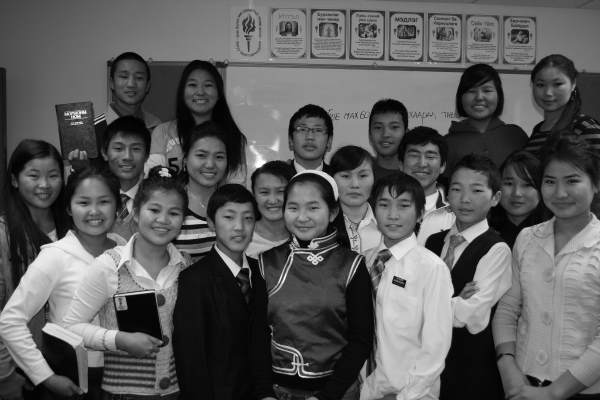 Choibalsan Branch's seminary class, 20 December 2009, in Choibalsan, Mongolia. Courtesy of Odgerel Ochirjav.
Odserjmaa Dorjgotov joined the church in 1998. Like many others, she taught seminary while concurrently attending and learning the gospel at institute. After her father had passed away, she was responsible for supporting her mother and caring for her four siblings. This was a significant responsibility for her. As she considered her family responsibilities and desire to serve a mission, an institute lesson touched her deeply one day. Odserjmaa said, “I pondered about the lesson and knew I don’t need to worry and should go on a mission.” She felt the love of the Savior and his help to be able to serve a mission. While she taught seminary, a year before her mission, Odserjamaa said, “Seminary and institute helped me a lot to prepare for my mission and service in the Church.”[39]
Purevjargal Dorj, who served as an institute teacher, said that she had been called to teach a Church history course in institute right after her mission and had about forty students. She taught once a week, but often felt she was learning more than teaching: “I didn’t know much about Church history, so I would learn and read the manual in English, until the manual was translated into Mongolian.”[40] Sister Tselmegsaikhan Sodnomdarjaa had a similar experience learning while teaching an eternal marriage course in institute: “I learned not to search Google for answers but to search Church materials, scriptures, and words of the prophets on how a marriage works.”[41]
Another institute teacher, Bolormaa Ayurzana, said, “I had twenty or more students, and I loved talking with these young single adults and hav[ing] them share their feelings and experiences.” Since 2010, when she was first called to teach institute, she has loved teaching and learning together with these young single adults. Bolormaa has also seen many changes since she began working as the S&I secretary in 2003. When institute started, there was only the Book of Mormon class manual that was printed and translated. Since then additional institute courses and materials have been translated into Mongolian and made available online. In addition, the CES office located in the Central Building in 2003 was moved in 2005 to the basement of the Bayanzurkh, or BZ, building.[42]
Impact of Seminary and Institute
Seminary and institute classes had a tremendous impact in the lives of the Mongolian Saints. These were heaven-sent programs that helped to strengthen the youth and young adults, as well as the new converts, of the Church in Mongolia. Its impact cannot be adequately measured, but a few experiences help to illustrate the wonderful blessing that these S&I classes had on the members of the Church in Mongolia.
 Joint seminary class for Khan Uul and Tuul Wards, 12 November 2018, in Ulaanbaatar. Courtesy of Odgerel Ochirjav.
Tsatsral Enkhtuvshin’s life, for example, has been blessed by participating in seminary and institute classes. While visiting a cousin in Ulaanbaatar, she attended a few seminary classes for the first time. When she returned to her branch, the Choibalsan Branch, she attended three years of seminary followed by four years of institute until she received her institute diploma. She said, “Seminary and institute helped me stay strong in the Church by reading and understanding the scriptures well. We discussed a lot of topics and learned from each other, meeting many friends. This has helped me on my mission and allowed me to find and understand the scriptures easier and faster.”[43]
Altankhuu Namnandorj explained, “I was fifteen years old when I joined the Church. . . . I attended seminary, which set a foundation for me. I attended seminary after school at 6 p.m., Monday through Friday. Then I attended institute one day per week.” He later served in the Mongolia Ulaanbaatar Mission and was sealed to his wife in the Hong Kong China Temple. He also served as a seminary and institute teacher, teaching both the Old Testament and the New Testament. Later, while serving as a counselor in the stake presidency, he recalled that being a seminary teacher had been a good experience and a learning process for him. It helped him grow in his gospel knowledge, expand his understanding of the doctrine, and prepare him for further service in the church.[44]
Summary
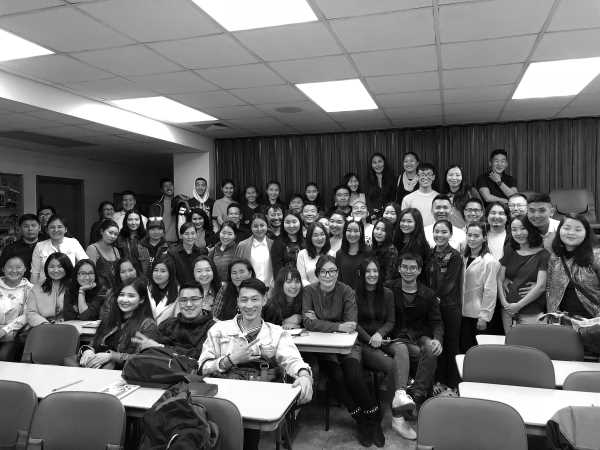
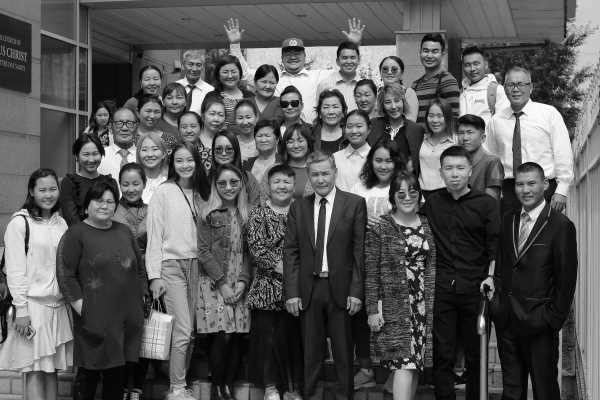 Foundations of the Restoration YSA institute class, 2 May 2018, in Ulaanbaatar. Courtesy of Odgerel Ochirjav.
The inspired efforts and foresight of President and Sister Cook in Mongolia helped to lay a foundation for weekday religious education, leading to the establishment of seminary and institute classes in the various branches of the Church throughout Mongolia. In turn, these classes helped to prepare future native missionaries and church leaders in Mongolia. The seminary and institute programs had their humble beginnings with thirty-eight seminary and 126 institute students enrolled in 1996–97. That number gradually increased over the years, and its full impact will continue to bless individuals and families throughout the coming years.
Subsequent efforts by full-time coordinators and numerous volunteer seminary and institute teachers also helped to prepare many converts and future missionaries with an increased understanding of the doctrine of the gospel of Jesus Christ. Despite a variety of challenges, the seminary and institute programs of The Church of Jesus Christ of Latter-day Saints have continued to play an important role in strengthening the faith and testimonies of the youth and young adults of the Church throughout Mongolia and in preparing them for missions and temple blessings.
Notes
[1] By Study and Also by Faith, 36–39.
[2] By Study and Also by Faith, 234.
[3] Seminaries and Institutes of Religion, Seminaries and Institutes of Religion: Annual Report for 2016. A version of this chapter appears in Chou and Chou, “History of Seminaries and Institutes in Mongolia.”
[4] By Study and Also by Faith, 396–97; see also Ross H. Cole, interview by Jeffrey L. Anderson, 24 December 2003, 19, James H. Moyle Oral History Program, Church History Library, The Church of Jesus Christ of Latter-day Saints, Salt Lake City.
[5] By Study and Also by Faith, 396–97; see also Cole, interview.
[6] Seminaries and Institutes of Religion, Seminaries and Institutes of Religion: Annual Report for 2016.
[7] Kam Tim Kwok, interview by Po Nien (Felipe) Chou, 20 October 2016, Hong Kong, China.
[8] Po Nien (Felipe) Chou, personal history and journal entries, 2000–2003.
[9] Odgerel Ochirjav and Ariunchimeg Tserenjav, interview by Po Nien (Felipe) Chou, 24 October 2016, Taiwan.
[10] Ochirjav and Tserenjav, interview.
[11] Ochirjav and Tserenjav, interview.
[12] Searle, “Mongolia: Steppes of Faith,” 54–55.
[13] Searle, “Mongolia: Steppes of Faith,” 54–55.
[14] Searle, “Mongolia: Steppes of Faith,” 54–55.
[15] Kwok, interview.
[16] Bolormaa Ayurzana, interview by Po Nien (Felipe) Chou and Petra Chou, 19 June 2018, Ulaanbaatar, Mongolia.
[17] Po Nien (Felipe) Chou, personal history and journal entries, 2001–2005.
[18] Kwok, interview.
[19] Ochirjav and Tserenjav, interview.
[20] Searle, “Mongolia Steppes of Faith,” 54–55.
[21] Steven J. Sorensen, “Mission Historical Summary 2004—Mongolia Ulaanbaatar Mission”; Don and Sharon Platt, email message to Sister Sorensen, 14 January 2005.
[22] Sorensen, “Mission Historical Summary 2004—Mongolia Ulaanbaatar Mission”; Don and Sharon Platt, email to Sister Sorensen, 14 January 2005.
[23] Wallace F. Bryner, “Mission Historical Summary 2006—Mongolia Ulaanbaatar Mission”; Charles and Helen Seaman, “Choibalsan Branch 2006 Annual Report—Elder Charles and Sister Helen Seaman—Senior Couple.”
[24] By Study and Also By Faith, 397–98.
[25] Ochirjav and Tserenjav, interview.
[26] By Study and Also by Faith, 397–98.
[27] Ochirjav and Tserenjav, interview.
[28] Ochirjav and Tserenjav, interview.
[29] Ochirjav and Tserenjav, interview.
[30] Ochirjav and Tserenjav, interview.
[31] By Study and Also By Faith, 397–99.
[32] Ochirjav and Tserenjav, interview.
[33] Ayurzana, interview.
[34] By Study and Also by Faith, 397–99; Ochirjav and Tserenjav, interview.
[35] By Study and Also by Faith, 397–99.
[36] By Study and Also by Faith, 397–99.
[37] Bayartsogt Lkhagvajav and Munkhgerel Purev, interview by Po Nien (Felipe) Chou and Petra Chou, 21 June 2018, Ulaanbaatar, Mongolia.
[38] Ochirjav and Tserenjav, interview.
[39] Odserjmaa Dorjgotov, interview by Po Nien (Felipe) Chou and Petra Chou, 19 June 2018, Ulaanbaatar, Mongolia.
[40] Purevjargal Dorj, interview by Po Nien (Felipe) Chou and Petra Chou, 19 June 2018, Ulaanbaatar, Mongolia.
[41] Tselmegsaikhan Sodnomdarjaa, interview by Po Nien (Felipe) Chou and Petra Chou, 19 June 2018, Ulaanbaatar, Mongolia.
[42] Ayurzana, interview.
[43] Tsatsral Enkhtuvshin, interview by Po Nien (Felipe) Chou and Petra Chou, 19 June 2018, Ulaanbaatar, Mongolia.
[44] Altankhuu Namnandorj and Erkhbilguun Bayardelger, interview by Po Nien (Felipe) Chou and Petra Chou, 20 June 2018, Ulaanbaatar, Mongolia.
