
 menu icon in the top, right corner of the screen.
 icon above to close this box.
 icon at the bottom of the screen below the browser—if you don't see it, swipe up to unhide it.
Caring for the Poor and Needy
Deseret International Charities
Po Nien (Felipe) Chou and Petra Chou, "Caring for the Poor and Needy: Deseret International Charities," in Voice of the Saints in Mongolia (Provo, UT: Religious Studies Center, Brigham Young University; Salt Lake City: Deseret Book), 219‒42.
“And they shall look to the poor and the needy, and administer to their relief that they shall not suffer” (Doctrine and Covenants 38:35).
The Church’s humanitarian efforts have blessed thousands of people throughout the world with its various initiatives including clean water, wheelchairs, vision care, neonatal resuscitation training, food programs, and so forth. President Thomas S. Monson said, “I am deeply grateful that as a church we continue to extend humanitarian aid where there is great need.” He added, “We have done much in this regard and have blessed the lives of thousands upon thousands of our Father’s children who are not of our faith as well as those who are.”[1]
The Church’s humanitarian efforts in Mongolia began early and continued to grow and expand over the years. These humanitarian efforts, for example, provided aid assistance for the severe winter in 2000, the flooding in 2003, the drought in 2010, and numerous local projects and ongoing initiatives.[2] During the flooding in 2003, for example, Church members distributed 2,500 pounds of clothing, household items, and hygiene kits to affected Mongolians.[3] Despite various challenges and visa restrictions throughout these times, the Church continued to press forward with its ongoing humanitarian efforts in Mongolia through Deseret International Charities (DIC).
Establishing Deseret International Charities in Mongolia
DIC is the charity arm of The Church of Jesus Christ of Latter-day Saints. It is a nonprofit organization supported by unpaid volunteers who give services and goods for the benefit of poor and needy people.[4] A guiding purpose of DIC is “to relieve suffering, help people help themselves and to provide opportunities for service.” Moreover, DIC’s goals include “foster[ing] self-reliance by strengthening the capacity of local organizations to help others help themselves.”[5]
When Elder Joseph B. Wirthlin of the Quorum of the Twelve visited Mongolia in June 1997, he met with Dr. Gonchigdorj, then chair of the State Great Khural Parliament of Mongolia. Dr. Gonchigdorj thanked the Church for its humanitarian service in Mongolia. Despite visa issues between the Ministry of Justice and DIC in 1997, two important events helped establish DIC’s humanitarian efforts in Mongolia. These included area manager Garry Flake’s visit in September 1997 with Elder and Sister McSwain from Hong Kong and the resulting approval for DIC to begin shipping donated goods every other month. Mission records explained that DIC was now “able to begin providing humanitarian aid of a direct sort, in addition to the skills of the senior couples who are and have been serving in Mongolia.”[6]
Over the years, DIC has brought many large containers into the country full of wheelchairs, clothing, winter coats and boots, hygiene kits, medical and dental equipment, newborn kits, powdered milk, orphanage items, books and educational supplies, blankets, and so forth. Recipients of these donations have included government-related organizations, NGOs, churches, universities, schools, hospitals, orphanages, police departments, prisons, and other organizations. DIC’s annual report in 2005 explained the following:[7]
Thousands of Mongolians joined with these volunteers to offer one-on-one contact to innumerable citizens and their families throughout the country. These services reach even to those living in countryside gers and small villages that are near the country borders. Many deliver goods during their visits . . . to relieve suffering and stress of the poor if available. [B]ut more frequently volunteers share experiences and teach principles to individuals and their families which will help them become self-reliant and independent of outside help for food, clothing, shelter and other necessities of life. We also help Mongolians with more opportunities to serve one another and to assist the society to advance [everyone’s] prosperity.[8]
The DIC 2006 Annual Report noted that during the relatively short time DIC has been in Mongolia, “approximately one hundred and twenty projects have been funded.”[9] Past and subsequent projects have continued to be provided by DIC over the years to help care for people who are poor and needy in Mongolia.
The Call to Serve a Humanitarian Mission
Many senior missionary couples have been called to assist with DIC’s humanitarian efforts. For example, Gary and Molly Dolana had always planned to serve a mission, but they couldn’t believe it when they read their mission call and saw that they were called on a humanitarian mission to Ulaanbaatar. Sister Dolana said, “We were knocked off our feet by the call. . . . It was a complete shock. But we went to the temple. We prayed and fasted. We thought about it, and there was no question that we would go. We knew it was a call from the Lord.” They packed their bags, got on a plane, and traveled to other side of the world. Brother Dolana said, “What a tragedy if we had missed this opportunity. . . . This was a life-altering experience. Our marriage was strengthened, and our children and their families were affected [positively] as well.”[10] The Dolanas and other missionary couples representing the Lord and his Church followed the counsel of the Prophet Joseph Smith “to feed the hungry, to clothe the naked, to provide for the widow, to dry up the tear of the orphan, [and] to comfort the afflicted, whether in this church, or in any other, or in no church at all, wherever [the Lord] finds them.”[11]
DIC’s Humanitarian Projects
Senior missionary couples called to Mongolia have participated in many projects and initiatives there, including DIC’s major initiatives: the English project, wheelchairs, clean water, vision care, and neonatal resuscitation training. The DIC also participated in various other projects as needed. For example, Glenn and Marilyn Goodrich reported the following in 2003.[12]
English teaching as foreign language—supervised by Elder and Sister Radmall: . . . 3700 students taught winter/
spring, 1200 students [in the] summer, 2500 in the fall. . . . Social services program—Sisters Fletcher and Hengly . . . [helped with] family counseling, orphanages, women’s prison, boys’ prison, police ID center, street children’s refuge center, etc. . . .
Dental training program—Elder and Sister Janis [taught] higher cosmetic dental techniques to faculties. . . .
English skill and training program [has continued].
Container shipments—six full containers from the humanitarian center in SLC . . . [arrived with] clothing, food, medical supplies, equipment for orphanages, hospitals, clinics, [and] prisons, etc.
Clean water—[helped with a] water line for hot water to [an] orphanage in Darkhan . . . [and] two wells drilled for two schools.
Wheelchair program—250 wheelchairs received and distributed.[13]
In 2004 DIC distributed food and clothing to many who were affected by serious forest fires. Furthermore, after a tornado in Darkhan destroyed and badly damaged dozens of home, two tons of relief supplies were distributed with the help of the town council and fire department, including six million tugriks (Mongolian currency) furnished to help with new gers and 14.4 million tugriks to help the Darkhan Orphanage. There were also several containers delivered full of clothing, shoes, boots, medical supplies, and equipment as well as about one thousand toys that were given to orphanages and primary children. DIC reported that some of the supplies “were distributed far away to the Reindeer People west of Murun,” with the last few miles being traversed on horseback in order to reach them.[14]
DIC’s 2005 annual report recorded seventy-five English-speaking volunteers teaching 4,900 students that year and 250 wheelchairs distributed. Moreover, DIC provided dental equipment and supplies as part of its Dental Training Program, along with medical equipment, supplies, and books for medical laboratories in Mongolia. Also in 2005, “a Vision Screening team came from America and screened over 3,000 people,” fitting many “with used glasses that were donated for the project.” Finally, the Employment Resource Centers in Ulaanbaatar, Erdenet, and Darkhan logged 4,800 volunteer hours of service provided to workshops for 409 people, helping around 100 people find jobs.[15]
Other examples of DIC projects included giving aid to prisons, juvenile detention centers, orphanages, kindergartens, hospitals, and so forth. DIC projects brought water closer to thirty-two families living in the Habitat for Humanity housing in Darkhan and built tables and chairs for the Big Family Crisis Center in Sukhbaatar, Selenge. DIC also purchased and installed washing machines for an orphanage in Old Darkhan “to wash bedding and clothing for the 132 children that live in the school dormitory.” Moreover, in Ulaanbaatar, DIC provided materials for a school for children who are intellectually disabled and also provided materials for refurbished bathrooms for the Capital City Police Department Detention Center.[16] In addition, projects to create gardens and wells were completed, and the orphanage “in New Darkhan was supplied [with] powdered milk for the children,” as well as “potatoes, plants and seeds for planting their garden where they raised their own food.”[17]
Richard and Carol Lasson, DIC country directors in 2010, reported DIC’s continual multifaceted efforts in Mongolia. These efforts included emergency relief support; the donation and distribution of food, clothing, fuel, sanitary items, and hay and fodder for livestock; the repair of schools and dormitories; and aid given to the Mongolia State Emergency Commission and Mongolian Ministry of Education. The humanitarian aid provided in 2010 was especially needed due to the harsh summer drought and strong winter snowstorm that killed millions of livestock. Other aid given by DIC also included vision care, water wells, clean water stations, wheelchairs, antidrug teaching in high schools, English teaching, neonatal resuscitation training, interactive language laboratory, math book donations, garden projects, homeless center assistance, and so forth.[18]
English Project and Employment Resource Center
DIC’s English Project was a tremendous undertaking. The missionary couples sought to help teach English in schools and in other locations throughout Mongolia. Elder and Sister Galbraith reported that in 2011, the English project logged forty to fifty thousand hours of volunteer service in Ulaanbaatar, Hovd, Murun, Choibalsan, Erdenet, Darkhan, Sukhbaatar, Zuun Kharaa Haara, Nalaikh, Gordoc, and Baganuur. Elder and Sister Galbraith also traveled about ten thousand kilometers by air, rail, and road to visit and meet with teachers and school officials. They reported, “The impact of this English Project is immeasurable. . . . [And] the example set by the missionary teachers and [the] spirit they bring into the classroom has an influence that has [long-term] effects.[19]
 Deseret International Charities organized the English conference for 300 staff and teachers from government, NGO, secondary school, institutes, and universities in May 2017. Courtesy of Mongolia public affairs office.
Kent and Joan Pulsipher reported that there was a high interest in the LDS Employment Resource Center (ERC) and English classes after the dedication of the Bayanzurkh Building.[20]
The LDS Employment Resource Services has served 1,000’s since April. Thanks to volunteers . . . [we] taught weekly Career Workshops, biweekly English classes and pre-Michigan [exam] training. More than 20 of our trained students are now self-employed in their own English teaching business[es]. We have a complete office setup and translation of the Self-Employment Workshop manuals.
We have had more than 100 [people] that we know of [who] have received employment since April. We have 2 office [computers] and 6 training computers that are kept busy everyday helping with [teaching] enhanced employment skills, [résumés], correspondence and other computer knowledge. . . .
In September 2004, the Open House was held in the Bayanzurkh Building. There was strong interest in English Classes. 350-400 students attended 10 classes.[21]
The ERC in the Bayanzurkh Building had a small computer lab, offered workshops, and encouraged young people to take English placement tests and continue their education. There were also two other ERCs, one in Erdenet and another in Darkhan. Dale and Bonita Romrell, the senior missionary couple at the ERC in the Bayanzurkh Building in 2006, explained that the ERC’s purpose was to help people get an education and to train them so they could find jobs and become self-reliant. The training included career workshops, self-employment workshops, and individual training on interviewing skills and writing résumés. After the training, participants received a certificate of completion.[22]
Elder and Sister Bailey, the couple over the English project in Mongolia, reported that in December 2005, DIC taught English in 62 locations, including in 37 schools, 6 language training centers, 11 government offices (like police stations), and 8 other locations. In 2006 DIC increased its scope and taught English in 126 locations, including in fifty-four schools, eleven language centers, twenty-five government locations, eighteen businesses, and four medical facilities. English was also taught in most Church-owned facilities. Moreover, since most schoolteachers began teaching English to their students, DIC’s English project gradually shifted to teaching more adults in offices and increasing the average teaching hours from seven to ten hours per week.[23]
Wheelchairs
The Church wheelchair initiative provided wheelchairs, crutches, canes, and walkers to people with physical disabilities, which helped them to become more mobile and to improve their health and economic opportunities. DIC collaborated with government welfare leaders from the Social Welfare Service Department of Mongolia to distribute these wheelchairs and walking aids.[24] Glenn Goodrich reported that “375 wheelchairs were distributed in 2004, for a total of 520 during the [last] 18 months.” He added that “distribution included high profile ceremonies with members of Parliament and national TV coverage.”[25] Another 1,250 wheelchairs were donated in 2005 alone.[26] Between 2004 and 2011, the Church donated about 4,500 wheelchairs. In 2011 the Mongolian government recognized the Church for these wheelchairs.[27]
Dr. Munkhbaatar Delger, director general of the National Rehabilitation Center in Ulaanbaatar, Mongolia, expressed gratitude on behalf of the recipients. “Your donation is of great benefit to improve the poor health condition of [people with physical disabilities].”
A new donation of 900 wheelchairs has been approved for delivery to Mongolia during this year and the first part of 2012. DIC will continue to work with the Social Welfare Service Department and the National Rehabilitation Center, helping to train people in fitting a person for a wheelchair and in how to use and take care of a wheelchair.[28]
Water Projects
There were many DIC water projects that were carried out in Mongolia, which included building wells and providing clean water for people. In 2004, for example, “two wells for clean water were drilled, one at the Lotus Children’s School and the other at the Ger Suburban District School.” These wells “furnished potable water on site which allowed indoor plumbing,” and also provided “outlets to benefit the neighboring ger districts.”[29]
Another example comes from Derwin and Luana Merrill, who worked to bring clean water to the ger districts. Mission records reported that the Merrills met with Ulaanbaatar mayor Tsogtyn Batbayar on 1 November 2005 to promote the clean water initiative sponsored by the Church through DIC. They explained that humanitarian volunteers were anxious and eager “to help some of the poor people living in the ger districts” because their homes were “located beyond the city water lines” and thus did not have access to clean water.[30] The DIC worked on this and many other water projects to help bring clean water to many communities throughout Mongolia.
Vision Care and Neonatal Resuscitation Training
The Church’s vision care initiative provided assessment for vision treatment, vision clinics, eye surgery, and many used and new glasses donated to those in need. This initiative helped to prevent some of the eye problems and blindness in the world by providing medical equipment and training to local medical professionals around the world, including those in Mongolia. In addition, the neonatal resuscitation training helped train doctors, nurses, and other medical professionals in Mongolia on emergency procedures to improve the survival rate of newborn babies.[31] Mission records provided examples of how vision care and neonatal resuscitation training blessed many medical professionals and patients in Mongolia:[32]
 Circa 2017, Mongolia. Helping Hands and Relief Society sisters help to make newborn kits. Courtesy of Mongolia public affiars office.
A vision clinic was held in July 2004. 3,000 pairs of used prescription eye glasses were collected in the US and shipped to Mongolia. Over a period of four days 1,400 people were tested and about 80% received some degree of improvement. . . . Dr. Roger Harrie, SLC, went early and assisted with several eye surgery cases. . . .
A neonatal clinic was held in August of 2004. A team of doctors and nurses, all LDS, came to Mongolia and trained over 100 people in three cities in the technical procedure of saving babies born with respiratory problems. Those 100 will train another 800.[33]
In 2010 Dr. Roger Harrie and his wife, Beverly Harrie, returned to Ulaanbaatar to provide further assistance. The Ensign magazine reported the following:
The hospital hallways echo from the music of a Buddhist festival across the street. Today is also a celebration of sorts for Dr. Roger Harrie and his wife, Beverly. They have presented their medical colleagues in Ulaanbaatar, Mongolia, with a special camera and are teaching them how to use it to diagnose and prescribe treatments for certain vision problems, such as diabetic retinopathy, a leading cause of blindness in adults with diabetes. . . .
In Mongolia . . . local medical personnel trained through the vision treatment initiative are now performing free diabetic retinopathy screenings.[34]
BYU–Hawaii’s Efforts
In the early 2000s, Keith Roberts, then BYU–Hawaii vice president for Academics, gathered a team to visit various Mongolian universities to explore ways to support the people of Mongolia.[35] Peter Chan reported the following:
 Peter Chan (front center) and the Mongolian medical faculty and students, 2004, Ulaanbaatar. Courtesy of Peter Chan.
Of all the universities [visited], the Health Sciences University of Mongolia (HSUM) saw immediately how [BYU–Hawaii] might make a difference. Due to high mortality rates associated with pregnancy and delivery in Mongolia, HSUM medical experts determined that instructional OB/
GYN [obstetric/ gynecology] materials was their highest priority. Professors Peter Chan, Carl Harris, and David Wade of BYUH led a team of Mongolian student interns in creating multimedia video ethnographies of actual examinations during pregnancy and procedures during delivery. The footage was organized into instructional units with audio commentary by medical professionals both in Mongolian and in English. When this project was completed, further units were produced for several other medical procedures, including Appendectomy, Cholecystectomy, Thyroidectomy, and Nursing. The CD/ DVD-ROM based materials were then widely used in their medical training programs. Subsequent efforts by Peter, Carl, and their student interns focused on training HSUM personnel in the use of the technology so that they could independently carry on the development of instructional materials in the future.[36]
In recognition of BYU–Hawaii’s contributions, HSUM awarded Chan with an honorary visiting professorship. However, Chan’s most humbling recognition was when a Mongolian student told him, “Brother Chan, thank you for saving the lives of our people by creating these medical training materials.” Ambassador Ravdan Bold, the Mongolian ambassador to the USA, would later host Chan and his wife, Joyce, for dinner at his official residence in Washington, DC. In 2005 BYU–Hawaii president Eric Shumway welcomed the president of Mongolia, His Excellency Nambaryn Enkhbayar, with a complete set of the training DVDs during his visit to BYU–Hawaii to address the fifty-four Mongolian students on campus.[37]
Afterward, HSUM and BYU–Hawaii signed a Memorandum of Understanding that led to a long-term plan to support HSUM faculty and students with English instruction. BYU–Hawaii professor Mark James helped to establish a summer English camp series on the HSUM campus in 2008. James returned to Mongolia in 2014 and worked with mission president Joseph Benson on a needs analysis to address challenges with English instruction by young missionary volunteer teachers. James reported,[38]
The chief recommendation was for the immediate calling of a senior missionary couple with teaching experience, who could oversee the English teaching duties of the missionaries and provide continuing observation and in-servicing. Such a couple would take a huge load of the mission president’s plate.
It was also recommended that Prof. Norm Evans (then BYU’s coordinator of the MTC teacher training module for Mongolia-bound missionaries) be funded to travel to Mongolia to observe firsthand what the teaching contexts were so as to better shape the nature of the MTC experience.
Several months later, Elder Sam Wong, 2nd Counselor in the Asia Area Presidency, coordinated the calling, orientation, and arrival of Elder Thomas and Sister Kathleen Taylor. Elder Taylor had years of experience teaching Welsh at BYU (Provo) and together with his wife had taught ESL in China for a year via BYU’s Kennedy Center several years prior to their call to serve in Mongolia. Their work almost immediately improved teaching abilities, missionary morale, and allowed the mission president to focus his energies on the work of building the kingdom.
Subsequent efforts by Prof. Neil Anderson (BYU–Hawaii), Norm Evans (BYU), Susan Gong (BYU), and Michael Paul (BYU–Idaho) have increased volunteer teacher missionaries’ efficacy, as well as raised the church’s profile via engagements with professional teachers’ organizations and government organizations in Mongolia, Laos, and Vietnam.[39]
Public Affairs
DIC’s humanitarian efforts were closely coordinated with the Church’s Public Affairs Office in Mongolia. In 2005 a Public Affairs Committee was called “to arrange meetings with local dignitaries” to help them learn about DIC’s humanitarian efforts in Mongolia and that the charity is an arm of The Church of Jesus Christ of Latter-day Saints. One committee member was a local TV anchor and the other members also had jobs with good media exposure. Mission records note that this committee was created “after the Church received great exposure following the President of Mongolia’s visit to BYU—Hawaii” to visit sixty Mongolian students studying there.[40]
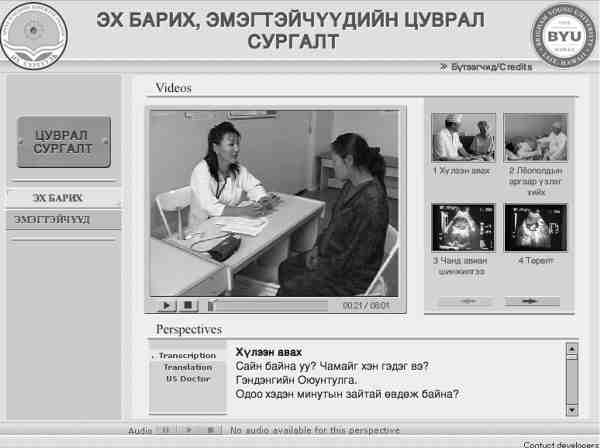 Basic interface of the Obsteric and Gynecological Training DVD-ROM created by Professor Peter Chan and his team at BYU-Hawaii, 2005, Ulaanbaatar. Courtesy of Peter Chan.
Besides building relationships with Mongolian officials, bridges were also built with others. In November 2006 President and Sister Bryner were invited to the United States Embassy in Mongolia to attend an address by US president George W. Bush at the Parliament House. Mission records noted that “this was President Bush’s first visit to Mongolia and the only time an American President has ever visited Mongolia. He was received with great enthusiasm by the country.”[41] In addition, the US ambassador to Mongolia was invited to visit and learn about the Church and DIC. President Bryner wrote,
We had a wonderful meeting with the new US Ambassador to Mongolia, Mark Minton. . . . We began with a tour of the Bayanzurkh Building and introduced them to all the service center employees. They met the Romrells, the senior couple over employment, President Odgerel, the district president and the country CES director, and all of our mission staff. . . . I invited Burd, my secretary and the one who spends a lot of time obtaining Visas, Soyolmaa, the materials manager and ICS director from the service center and also the [chair] of the public affairs committee, Mike Nolan (service center manager) and his wife, and the Romrells. The ambassador was very impressed and even amazed at all we do in Mongolia. He had no idea what the LDS Church and DIC did in Mongolia. . . .
He was overwhelmed at what DIC had done during the past year—we just finished dedicating the fourth well in the ger districts in UB. We told them about 2,500 wheelchairs that had been donated and about the neonatal training and ophthalmologic training that has been provided. We told him that if he ever needed emergency translation in any of the cities where we had missionaries[,] he could call the missionaries for help. It was hard for him to understand how the missionaries learned fluent Mongolian in such a short time.
It was also difficult for him to understand that the senior couples, President and Sister Bryner included, received no pay and, in fact, they all paid for their missions personally. And then, when we told him that the missionaries also receive no pay and provide their English teaching services [for] free, he couldn’t believe it. He wrote a very nice thank you letter to me and assured me that if the mission ever needed anything, which he could provide, to call him. It was a very positive experience.[42]
Changes to Number of Missionaries
Missionary work in Mongolia was affected, at least in part, by the excitement among new converts to serve missions, as well as the visa changes and restrictions that affected the entry of volunteers or missionaries into Mongolia. The service center and public affairs office worked diligently to address these visa issues. These and other issues affected the number of native Mongolian missionaries called from Mongolia, as well as the numbers of missionaries (native and foreign) serving in Mongolia.
Surge and Increase before 2009
For native missionaries called from Mongolia, records indicate that there were two surges where the numbers rose to 160 in 2002 and 158 in 2009. One reason for the first surge was the excitement of many early Mongolian converts in the 1990s to serve full-time missions, which also included the opportunity to serve outside of Mongolia and learn a different language. The subsequent decrease after the first surge was partly related to the changes in the required military service for male Mongolian nationals. The reason for the second surge (in 2009) of native missionaries was different according to Odgerel Ochirjav:[43]
 2005, Laie, Hawaii. BYU-Hawaii President Eric Shumway presents medical training DVD-ROM to His Excellency Nambaryn Enkhbayar of Mongolia. Courtesy of BYU-Hawaii University Communications, Laura Tevaga.
In 2009 we had a different cause for the increase of the number of missionaries. The new mission president, D. Allen Andersen, arrived in Mongolia and started to organize firesides for all arriving and departing missionaries. . . . On average, 250 people participated [in] these firesides. All the friends of those who were called to serve saw their friends leaving to serve a full-time mission, and they were motivated and decide[0] to serve a full-time mission like their friends. We had big groups of young people saying, “We just want to serve in Mongolia.” I was the district president at that time and was later called as the stake president, so I was faced with this large group of young people who wanted [to] and became the main group of local missionaries when the visas of all foreign missionaries were terminated by the Mongolian government during this time.[44]
Visa Challenges and Restrictions
When the first missionaries came to Mongolia in the 1990s, the government welcomed them and provided visas for them to come teach English and perform missionary work. The number of missionaries serving in Mongolia reached as many as 193 missionaries in 2009, with many local missionaries serving alongside foreign missionaries.[45] However, beginning in 2009, misunderstandings, changes in the government’s visa laws, and a system of quotas significantly reduced the number of visas for foreigners allowed into the country.
Gankhuyag Tsogoo, who served as a young missionary from 2006 to 2008, noted that after his mission, President D. Allen Andersen noticed some difficulties in acquiring visas, resulting in the reduction of the number of missionaries in Mongolia to less than seventy for most of the 2010s.[46] Batbold Khishigdorj also noted that after the Church in Mongolia experienced amazing growth, visa issues began to surface in 2009, and foreign missionaries had to leave. “One day, I took twenty-five missionaries to the airport due to the government visa problem,” said Batbold. During this time, many local members responded to the call to serve and some of the Mongolian missionaries serving overseas were called back to finish their missions in Mongolia.[47] Mission historical reports noted,
Visa problems delayed September and December groups of foreign missionaries. The 12 elders and 6 sisters were temporarily assigned to stateside missions. Only 16 foreign missionaries came to the mission in 2009. . . . Permission was granted by the Mission Department in November for some Mongolian missionaries to extend their missions for a month due to the delay of the foreign missionaries.[48]
Foreign missionaries’ residency permit extensions were denied, and ten missionaries were reassigned to other missions and departed 4 March [2010]. . . .
Six Mongolian missionaries were brought back from overseas mission[s] on 22 April to help fill leadership and translation gaps caused by the reassignment of ten foreign missionaries. . . . Most of the young foreign missionaries departed on 25 May. Six young foreign missionaries remained to help with the transition to the new mission president [and to the] outside sponsors [who were now teaching] English.[49]
Jeffrey C. Harper, who served as a senior missionary and later as the mission president in Mongolia, explained that in 2009, there were almost two hundred full-time missionaries, but due to visa issues, many foreign missionaries serving in Mongolia were reassigned elsewhere, and the Church called Mongolian missionaries serving abroad to come back to serve in Mongolia. In 2016, President Harper said that the Church was only able to maintain around fifty to seventy missionaries.[50]
Public Affairs Efforts to Secure Visas
When Tuvshinjargal Gombo became the Materials Management supervisor for the Mongolia Service Center in 2012, Soyolmaa Urtnasan, the service center manager, told her that “the biggest challenge and most stressful issue for the Church in Mongolia was the effort to secure visas for the missionar[ies].” Since the Mongolian government had issues allowing missionaries to enter the country to teach religion, they had to come in as volunteers to teach English for a sponsoring school in Mongolia. The efforts to work with sponsoring schools was coordinated through DIC.[51]
 Tuvshinjargal Gombo (Church public affairs representative) with her husband Enkhbat Damdin (Mongolia's "master cook"). Tuvshinjargal worked dilligently to help secure visas for the Church in Mongolia. Photo taken in 2018. Courtesy of Po Nein (Felipe) Chou and Petra Chou.
Sister Tuvshinjargal was heavily involved in coordinating DIC’s efforts to identify good sponsors and secure visas for the missionaries. The agreement arranged with the various schools or government organizations stipulated that the “sponsor or inviting organization” would bring in foreigners to work and live, and also be responsible for the required paperwork to apply for and secure their visas. Each volunteer or missionary was responsible to provide sixteen hours per week of English instruction for their sponsor and then was free to serve in the Church for the rest of the time. During this time, DIC was able to acquire about fifty visas for the missionaries, working with forty to forty-five sponsoring organizations. For a time, the law in Mongolia indicated that each school or nongovernmental organization was allowed to sponsor only one or two visas. Later, more visas were allowed, reducing the number of sponsoring or inviting organizations while maintaining the fifty visas.[52]
The visa challenges were constantly evolving and were related to three issues: the teaching skills of the volunteer missionaries, sponsor-related issues, and government issues. Although the few senior couple missionaries taught English well, the young missionaries lacked teaching skills and a systematic approach in English-learning instruction. This created problems in securing sponsors and getting them to extend visas. However, Tuvshinjargal explained that the biggest challenge came in obtaining government approval for the visas.[53] She said,
The government would say that the young missionaries were too young and [that they] didn’t believe they could teach English well. They would also accuse the Church of being dishonest and using different organizations to bring in missionaries. . . . My response was that they are native English speakers, and the Church didn’t sponsor their visas. Instead the schools were the sponsors of their visas and they entered legally to teach English for their sponsors. Although they spent their free [time teaching] others about their church, this was not illegal since the country’s constitution gave freedom of religion, and allowed us to . . . teach others about our church. . . . Although the government officials were against us, because our argument was true and matched the religious freedom provided in our constitution, they couldn’t say anything because we were right.[54]
Being right and having the law on your side, however, did not mean visas were approved automatically. Each visa application had to be signed off by three different government offices—namely, the offices of the Ministry of Education, the Ministry of Labor, and Central Immigration. This was not easy. Sister Tuvshinjargal, called as the public affairs representative for the Church in Mongolia, worked with all three ministries to get visas approved. She explained the challenge and the way the Lord inspired her to respond as follows:[55]
The Church helped [sponsoring organizations] submit the documents and applications to the three [ministry] organizations. Every time we submitted, these three would push back.
The first ministry [of Education] asked about their experience and college degree, and why they could teach college English without a BS or MS degree. We would argue that they were native English speakers, so why couldn’t they teach English? BYU provided a two-week training certificate and we provided the government with those certificates, but they were still not satisfied. . . . So we began to build relationships with the ministry next, showing them how our missionaries are helping the people in Mongolia learn conversational English. . . . We kept meeting with them repeatedly, and the Lord’s tender mercy helped us[. A]nd the government could see that our church was helping and blessing the Mongolian people. . . . [We] assigned two volunteer teachers to help with a local kindergarten for them. . . . The two kindergarten teachers made them happy, so the minister was happy.
Next, Sister Tuvshinjargal met with a woman from the Ministry of Labor to share the many services provided by the DIC volunteers to help the Mongolian people. Tuvshinjargal explained that Christians were not very welcome in Mongolia because of a prevailing misconception that they were coming in to take over the country. To build trust with this official, arrangements were made to send her on a five-day tour of BYU. The trip completely changed her mind and her heart because she met with wonderful people who simply desired to serve others around the world. She became a friend and was willing to help support the Church’s visa efforts. In addition, the Church already employed about twenty-five people at the Mongolian Service Center, and with a 5 percent quota it could get about one extra visa for religious purposes, which did not require teaching English like a sponsor’s visa. This new friend from the Ministry of Labor connected the Church with another person at the ministry to help the Church apply for a special permit to increase this quota to 40 percent, which would eventually provide ten visas for religious purposes besides the sponsors’ visas. Tuvshinjargal said that this was an incredible miracle and a tender mercy from the Lord since she wasn’t even aware this special permit existed.[56]
The final challenge and miracle came working with the Central Immigration Office. Once again, the Church’s public affairs efforts helped to build relationships with this office. Tuvshinjargal learned that there was an issue when a Mongolian had visited the mission office back in 2008 or 2009 to help his son go to BYU. For some reason, the request was not handled well and resulted in a negative relationship with this official from the Central Immigration Office. Consequently, the government cancelled visas and deported sixty to seventy foreign missionaries in 2009.[57]
In 2012, Tuvshinjargal sought to rebuild this relationship, so she met with this official to share how DIC could help the people in Mongolia. She said, “We asked him how we could cooperate and work together on projects important to him, and upon hearing this, he was happy and willing to work with us.” She continued, “He said that there were many outlying areas in need of wells for clean water, so we started to organize that and work [to provide] clean water . . . [and] dig wells.” This new friend in the Central Immigration Office later helped the Church connect with each of the local immigration office branches, which was a blessing. Previously, these local immigration branches often questioned why the missionaries were living in the countryside if their address was registered back in Ulaanbaatar (at the mission office). But now, they are very good friends and helpful to the Church. Sister Tuvshinjargal summarized this experience by saying, “We worked through the Spirit and let the Spirit soften their hearts. I see God’s encouragement and his Holy Spirit helping us through with each government official.”[58]
Summary
Despite the challenges experienced with visa changes and restrictions, the Church continued in its humanitarian efforts to bless people throughout Mongolia who were poor and needy. The Church’s efforts to care for these people, through DIC’s various humanitarian projects, are astonishing in both number and scope. Key DIC initiatives included projects to provide English training, wheelchairs, clean water, vision care, and neonatal resuscitation training, all of which blessed countless people in various Mongolian areas. As of 2017, there were over 4.46 million beneficiaries of the Church’s humanitarian assistance in Mongolia.
In 2018 Patrick Cheuk, then the Asia Area Welfare manager, noted that Mongolia was among the sixteen countries in the Asia Area with active humanitarian and welfare services. With one or more missionary couples serving in each country, including Mongolia, the Church worked through nongovernmental organization partners or other government representatives to provide humanitarian and welfare services. Cheuk added that “these couple missionaries sacrifice[0] time, talent[s], and money . . . despite challenges with language, culture, etc. . . . and [found] joy in serving.”[59] These humanitarian projects have indeed blessed many people in Mongolia and throughout the world.
Notes
[1] Monson, “Until We Meet Again,” 114.
[2] “Mongolia,” Church Almanac, 2013, 525–26.
[3] “Church Provides Relief for Mongolian Flood Victims,” 16 August 2003.
[4] Bryner, “Mission Historical Summary 2005—Mongolia Ulaanbaatar Mission.”
[5] “Deseret International Charities—2006 Annual Report,” in Bryner, “Mission Historical Summary 2006—Mongolia Ulaanbaatar Mission.”
[6] Cox, “Mission Historical Summary 1997—Mongolia Ulaanbaatar Mission.”
[7] Bryner, “Mission Historical Summary 2005—Mongolia Ulaanbaatar Mission.”
[8] Bryner, Mission Historical Summary 2005—Mongolia Ulaanbaatar Mission.”
[9] “Deseret International Charities—2006 Annual Report.”
[10] Newell and Newell, “Power of Compassion,” 21–25.
[11] Joseph Smith, Times and Seasons, 15 March 1842, 732.
[12] Glenn Goodrich and Marilyn Goodrich, “2003 Annual Report: Humanitarian Service in Mongolia,” in Gibbons, “Mission Historical Summary 2003—Mongolia Ulaanbaatar Mission.”
[13] Goodrich and Goodrich, “2003 Annual Report: Humanitarian Service in Mongolia.”
[14] Sorensen, “Mission Historical Summary 2004—Mongolia Ulaanbaatar Mission”; Glenn and Marilyn Goodrich, email to Sister Sorensen, RE: 2004 Report, 17 January 2005.
[15] Bryner, “Mission Historical Summary 2005—Mongolia Ulaanbaatar Mission.”
[16] Mendoar Nelson and Loren Nelson, “2005 Activity Report—Deseret International Charities (DIC), 2005”; Bryner, “Mission Historical Summary 2005—Mongolia Ulaanbaatar Mission.”
[17] Corwin Ogborn and Peggy Ogborn, “DIC Humanitarian Projects—Darkhan Area—2005”; Bryner, “Mission Historical Summary 2005—Mongolia Ulaanbaatar Mission.”
[18] Lasson and Lasson, “Summary of Deseret International Charities Project in 2010,” 20 December 2010; Clark, “Mission Historical Summary 2010—Mongolia Ulaanbaatar Mission.”
[19] Clark, “Mission Historical Summary 2001—Mongolia Ulaanbaatar Mission.”
[20] Sorensen, “Mission Historical Summary 2004—Mongolia Ulaanbaatar Mission”; Pulsipher and Pulsipher, “Mongolia History April—December 2004.”
[21] Sorensen, “Mission Historical Summary 2004—Mongolia Ulaanbaatar Mission”; Pulsipher and Pulsipher, “Mongolia History April—December 2004.”
[22] Romrell and Romrell, “Employment Resource Center Annual Report—Ulaanbaatar, Mongolia 2006”; Sorensen, “Mission Historical Summary 2004—Mongolia Ulaanbaatar Mission.”
[23] “Deseret International Charities: English Project Report—Elder and Sister Bailey,” in Bryner, “Mission Historical Summary 2006—Mongolia Ulaanbaatar Mission.”
[24] David Porter, “Mongolia Honors Church for Wheelchair Donation,” Church Newsroom, 29 April 2011.
[25] Sorensen, “Mission Historical Summary 2004—Mongolia Ulaanbaatar Mission”; Glenn and Marilyn Goodrich, email to Sister Sorenson, 17 January 2005.
[26] Bryner, “Mission Historical Summary 2005—Mongolia Ulaanbaatar Mission.”
[27] Porter, “Mongolia Honors Church for Wheelchair Donation.”
[28] Porter, “Mongolia Honors Church for Wheelchair Donation.”
[29] Sorensen, “Mission Historical Summary 2004—Mongolia Ulaanbaatar Mission”; Glenn and Marilyn Goodrich, email message to Sister Sorenson RE: 2004 Report, 17 January 2005.
[30] Merrill and Merrill, “Elder Derwin C. Merrill and Sister Luana P. Merrill History—August 16 to December 31, 2005,” in Bryner, “Mission Historical Summary 2005—Mongolia Ulaanbaatar Mission.”
[31] Nelson and Nelson, “2005 Activity Report—Deseret International Charities (DIC)”; Stock and Hiller, “Church’s Humanitarian Efforts: Discipleship in Action,” 62–66.
[32] Sorensen, “Mission Historical Summary 2004—Mongolia Ulaanbaatar Mission”; Glenn and Marilyn Goodrich, email to Sister Sorenson, RE: 2004 Report, 17 January 2005.
[33] Sorensen, “Mission Historical Summary 2004—Mongolia Ulaanbaatar Mission”; Glenn and Marilyn Goodrich, email to Sister Sorenson, 17 January 2005.
[34] Stock and Hiller, “Church’s Humanitarian Efforts: Discipleship in Action,” 62–66.
[35] Peter Chan, email to Po Nien (Felipe) Chou and Petra Chou, 24 March 2020.
[36] Chan, email.
[37] Chan, email.
[38] Mark James, email to Po Nien (Felipe) Chou and Petra Chou, 24 March 2020.
[39] James, email.
[40] Bryner, “Mission Historical Summary 2005—Mongolia Ulaanbaatar Mission.”
[41] Bryner, “Mission Historical Summary 2005—Mongolia Ulaanbaatar Mission.”
[42] Bryner, “Mission Historical Summary 2006—Mongolia Ulaanbaatar Mission.”
[43] Odgerel Ochirjav, email to Po Nien (Felipe) Chou, 5 June 2020.
[44] Odgerel Ochirjav, email to Po Nien (Felipe) Chou, 5 June 2020.
[45] Gankhuyag Tsogoo, interview by Po Nien (Felipe) Chou and Petra Chou, 19 June 2018, Ulaanbaatar, Mongolia.
[46] Tsogoo, interview.
[47] Batbold Khishigdorj, interview by Po Nien (Felipe) Chou and Petra Chou, 19 June 2018, Ulaanbaatar, Mongolia.
[48] Andersen, “Mission Historical Summary 2009—Mongolia Ulaanbaatar Mission.”
[49] Clark, “Mission Historical Summary 2010—Mongolia Ulaanbaatar Mission.”
[50] Jeffrey C. Harper, interview by Po Nien (Felipe) Chou and Petra Chou, 21 June 2018, Ulaanbaatar, Mongolia.
[51] Tuvshinjargal Gombo, interview by Po Nien (Felipe) Chou, 29 May 2020, Ulaanbaatar, Mongolia and Cedar Hills, Utah. Interview notes in possession of authors.
[52] Gombo, interview.
[53] Gombo, interview.
[54] Gombo, interview.
[55] Gombo, interview.
[56] Gombo, interview.
[57] Gombo, interview.
[58] Gombo, interview.
[59] Patrick Cheuk, interview by Po Nien (Felipe) Chou and Petra Chou, 14 June 2018, Hong Kong.
