
 menu icon in the top, right corner of the screen.
 icon above to close this box.
 icon at the bottom of the screen below the browser—if you don't see it, swipe up to unhide it.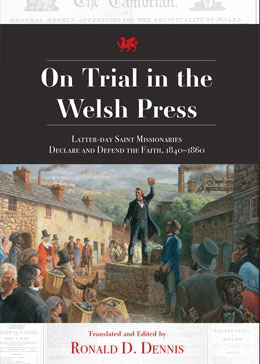
Introduction
Religious Background of the Welsh
The Church of England, set up in 1534 by King Henry VIII, continued to be the state religion in Britain until 1689, at which point the Toleration Act permitted other churches to exist. But the “Nonconformists,” those who chose not to conform with the doctrine and practices of the government-ruled church, were not allowed to hold most public offices and were required to pay local taxes to the Church of England. And it was not until the early 1800s that such restrictions ceased to be imposed on these “Nonconformists.”
According to the 1851 British religious census, about 75 percent of the Welsh identified themselves as Nonconformists—the Baptists, Methodists, Congregationalists, Wesleyans, Independents, Unitarians, and Quakers being the principal religions of nonconformity. Members of the Church of England, known as Anglicans, were at this point in the minority in Wales.
The Welsh Nonconformists disagreed with one another regarding the mode of baptism and various points of doctrine and practice. But when the missionaries for The Church of Jesus Christ of Latter-day Saints began preaching their message in Wales in 1840, all the Nonconformists seemed agree with one another that they should oppose the Saints and their teachings. The Latter-day Saints were, after all, siphoning off their parishioners to strengthen their own ranks.
Opposition of the Welsh Clergy to the Latter-day Saints
The opposition from the leaders of other religions in Wales came not only from their sermons but also from their parishioners and their children. At the instigation of their ministers, they shouted at the Latter-day Saint preachers on the street corners and threw pebbles at them as they walked along the streets. All were encouraged to disturb the meetings of the evil Latter-day “Satanists” and never to listen to them lest they be beguiled. Even violence was sometimes encouraged, such as the violence toward David Jeremy and Daniel Thomas as they preached the new doctrine out in the open on Sunday, 1 October 1854, near the town of Brechfa, Carmarthenshire. That day a group of worshippers led by an innkeeper named John Davies came out of the Saron Chapel and began harassing the two missionaries. The harassment was followed by physical attacks. Jeremy later reported to Dan Jones that the angry mob would most certainly have killed him had it not been for the intervention of Mr. Dafydd Evans, who came by and shouted at the mob, “You’ll not kill him before killing me, leave him alone.”[1] This “philanthropic friend” helped Elder Jeremy to a nearby farmhouse, “Treolmawr,” where a Mr. H. Howells took care of him and “showed every kindness he could.” Jeremy recuperated and eventually married, but he was unable to father children as a result of the battering he received from some ordinary, churchgoing citizens who permitted themselves to become outraged over a difference in religion.
Some of the converts said they were motivated in an unintentional way by their ministers to learn about the Latter-day Saints. Job Rowland, who was once a Baptist in the Dowlais congregation of the Rev. W. R. Davies, wrote the following about his conversion:
As soon as the Saints came to these areas our teachers, especially Mr. W. R. Davies, began to persecute them and hate them, saying all manner of evil against them. Mr. Davies said one time in our house that his desire was to do the same with their elders as was done to Joseph Smith, that is to kill them. That, together with many other things prompted me to look into their principles; and after having the honor of associating with the Saints, I saw that they were not the way Mr. Davies and others had described them. I saw also that their doctrine was harmonious with the doctrine in the scriptures; and when I heard their testimony, I decided immediately that it was true.
The most unrelenting opposition, however, came through the press. During the 1840s and 1850s in Wales, more than four hundred articles appeared in over twenty religious periodicals condemning “Mormonism” and all things related to it. And nearly seven hundred articles—varying in length, but nearly always denouncing the hated “Mormonites” and their teachings—were printed in fifteen newspapers during this time period. The Latter-day Saints, however, did their utmost to defend and propagate their beliefs in whatever way possible. And that way was preaching in the open air, in the homes of converts, and in the long rooms of pubs, since the clergy refused the use of their own chapels for what they considered to be such a nefarious purpose. The modest building dedicated in Llanelli by Dan Jones in 1849 was the only purpose-built chapel in Wales during the nineteenth century.
Success of the Early Latter-day Saint Missionaries in Wales
North Wales
Elder Henry Royle and his companion Frederick Cook were the first to preach the gospel in North Wales. At the 6 October 1840 conference held in Manchester, England, they were called to “go to Cly [Cloy] in Flintshire.” Cloy was very near the town of Overton, located just over the border from England. By the end of October, Royle and Cook had established a branch of thirty-two new converts in Overton.
The 15 August 1848 Millennial Star shows 170 members in Wales as of 6 April 1841. But no statistics are presented for Wales for the years of 1842, 1843, or 1844. Perhaps this absence of information could be attributed to a reorganization of boundaries that placed the branches in Wales under a different heading. For 1845, a total of 316 members in Wales is given.
South Wales
Elder John Needham appears to have been the first missionary to serve in South Wales. He wrote the following in his personal history: “In the year 1840 I went to Monmouthshire and Wales and with God’s blessing was able to do great work there, for a people was quite ready to receive the Gospel, and I had a blessed, happy time with them.” He reports having organized “many branches of the church in Monmouth and in Wales, getting help from other Elders and many that I ordained and sent out to preach.” The Millennial Star has no specific report of baptisms in 1840 for Monmouth or for Wales, so perhaps Needham’s converts were included in the numbers for the Herefordshire Conference.
Heartland Wales
In 1842, Elder William Henshaw, a Cornishman, was doing missionary work in Wolverhampton when he was called on a new mission by Elder Lorenzo Snow. Henshaw was to take his wife and children to the heartland of Wales to preach the restored gospel there. He had his first baptisms in Merthyr Tydfil on 19 February 1843. Henshaw had married Mary Ann Lewis eight years earlier in Breconshire. His being in Wales at that time suggests that he probably had gone there from Cornwall to work in the mines. And his having a Welsh wife, one who most likely spoke the Welsh language, may have influenced Lorenzo Snow to send Henshaw, a monoglot English-speaker, on a mission to the heartland of industrial Wales.
In April 1845, a little over two years since his first baptisms, Henshaw reported a total of 316 members of the Church in South Wales—an increase of about twelve baptisms per month during that time period. By December 1845, nine months later, the number of members had grown to 493, a growth rate of nearly twenty baptisms per month.
Dan Jones in North Wales
Though William Henshaw had success in the Merthyr Tydfil area, Dan Jones had been preaching the entire year of 1845 in North Wales and had baptized but three converts. After one year of what must have been a period of great frustration, Dan was transferred to Merthyr Tydfil to assume the reins of the entire Welsh Mission.
Dan Jones and William Henshaw Join Forces
The following chart shows the growth of the Church in Wales during the three years (1843, 1844, and 1845) that William Henshaw was by himself in South Wales, followed by the three years (1846, 1847, and 1848) that Jones and Henshaw were together in South Wales:[2]
| Date of report | # of members | # of months | Increase | Average converts per month |
|---|---|---|---|---|
| 18 Feb 1843 | 0 | |||
| 6 Apr 1845 | 316 | ~ 26 | 316 | ~ 12 |
| 14 Dec 1845 | 493 | ~ 9 | 177 | ~ 20 |
| 1 Jan 1847 | 979 | ~ 12 | 486 | ~ 40 |
| 27 Dec 1847 | 1,933 | ~ 12 | 954 | ~ 80 |
| 31 Dec 1848 | 3,603 | ~ 12 | 1,670 | ~ 140 |
In a 3 December 1845 letter to Brigham Young, Dan Jones sums up the situation of the Church in Wales at that time:
The number of the Welsh Saints are about 600 north & South; in the latter place a very worthy Bro. Henshaw has been preaching in English successfully, & converts Welsh who understand no English; another new thing under the Sun! This caps Solomons wisdom, a noble Bro. God bless him, he has a Mormon Soul, that’s the secret of his success.
The Conversion of DanJones
Welsh-born Dan Jones first learned of The Church of Jesus Christ of Latter-day Saints at some point in the fall of 1842 as he hauled people and goods up and down the Mississippi River on the Maid of Iowa, a small steamboat he and his partner, Levi Moffat, had built during the summer of 1842. Thomas Sharp, the editor of the Warsaw Signal, penned vicious articles about the hated “Mormons,” and these articles had piqued Jones’s curiosity. Jones later wrote:
For our part, we should thank this Sharp for the information we got about the Saints; for it was by reading his and others’ accusations that our attention was drawn to them before we saw them, while living in that country. . . . My mind was not satisfied then until I got hold of one of the Mormons, and, once I had found him, it was not just two or three nights that we sat up to investigate the differences of opinion that existed between us about the gospel; and to my great surprise, I perceived that I was almost a full-fledged Mormon already, which when I realized it frightened me greatly; for I could foresee my popularity at an end the minute I had this despicable name; and consequently, my livelihood and my all.[3]
After a deep and thorough investigation into this new religion, Jones became a believer and was baptized on 19 January 1843 in what must have been a frigid Mississippi River, very probably in the shadow of the Maid of Iowa. In April of that same year, he took a load of British Latter-day Saints from St. Louis upriver to Nauvoo where he first met Joseph Smith, a meeting that promptly resulted in a close friendship between the two.
Upon learning that Jones’s partner, Levi Moffit, was concerned that business would plummet because the Maid of Iowa had become a “Mormon” boat, Joseph soon thereafter purchased Moffit’s half of the boat for $1,375.[4] Thus, Joseph and Dan Jones became business partners.
A Press in Wales
In a letter written several years later, Jones quotes Joseph as having said the following to him just a few days before the martyrdom:
I have a check in the house for $1200; as soon as I can get it cashed you shall have $1100 of it, and the start for Wales, not with your fingers in your mouth but prepared to buy a Press; and do business aright.[5]
From Joseph’s comment, it is clear that Dan Jones fully intended to have his own press during his mission to spread the word in Welsh to his compatriots. Furthermore, Joseph’s final recorded prophecy has to do with Dan’s mission in Wales. The night before the Prophet Joseph Smith was murdered, he heard gunfire outside the window of Carthage Jail, so he chose to sleep on the floor. Near him was Dan Jones. The Prophet asked Dan if he was afraid to die. Dan replied, “Has that time come, think you? Engaged in such a cause I do not think that death would have many terrors.” Then Joseph prophesied, “You will yet see Wales, and fulfill the mission appointed you before you die.”
Unfortunately, because of the confusion that resulted from the martyrdom, Dan Jones did not ever receive the $1,100 that Joseph promised to give him for his half of the steamboat. Consequently, Jones could not purchase his own press and was forced to use others’ presses in Wales to get his message out. The first such hired press was that of William Bayley in Wrexham, whom Jones employed in April 1845 to print his forty-eight-page pamphlet entitled Y Farw Wedi ei Chyfodi yn fyw! neu yr Hen Grefydd Newydd (The Dead Raised to Life! or the Ancient Religion Anew).
How Elder Jones Spread the Message of the Gospel
Curiously, nowhere in his first pamphlet does Jones mention the name of The Church of Jesus Christ of Latter-day Saints, nor does he ever use the word “Mormon.” Despite having this Welsh-language publication to support his proselytizing, Jones managed only three baptisms during the entire year he spent in North Wales. But the story became different when in December 1845, the captain was transferred to South Wales where his older brother John lived. John was a Congregationalist minister, and he owned a press in Rhydybont, a village near the market town of Llanybydder in Carmarthenshire. Unlike other press owners, John had no qualms about printing his brother’s religious ideas during the week and preaching against them on Sunday. In April 1854, Dan had the pleasure of baptizing the three ladies in his brother’s life—John’s wife, Jane; their twenty-one-year-old daughter, Sarah; and their nineteen-year-old daughter, Elizabeth. Although there was a rumor that the Reverend John Jones himself had also been baptized, Dan stated in his periodical that such was not the case.[6]
Because Dan Jones’s brother agreed to print the “dull and idiotic” writings of the “Mormons,” his colleagues of the cloth accused him of operating a “prostitute press.”[7] The Reverend Jones’s reaction to such accusations was calm: “Our work in printing their books proves nothing more than the fact that our press is made of iron and its owner is a free craftsman.”[8]
While in Rhydybont, Dan became acquainted with John S. Davis, a brilliant young man who had completed an apprenticeship as a printer and had worked not only for Dan’s brother but also for the editor of a Baptist periodical (Seren Gomer, or Star of Gomer) in Carmarthen. Within weeks Davis converted, and he worked side by side with Dan Jones in all his printing activities during the next three years. And it was Davis who would later translate the Latter-day Saint scriptures into Welsh.
In December 1845, Dan Jones printed his second pamphlet, this time on the Rhydybont press—the Welsh translation of the Proclamation of the Twelve Apostles in the Church of Jesus Christ of Latter-day Saints. A few weeks later he printed a twenty-four-page pamphlet entitled Reply to the Objections which are most commonly brought throughout the country against the Latter-day Saints, and the doctrine which they profess. He borrowed heavily from the writings of Orson Pratt, and the content was purely doctrinal.
Jones’s next publication was a sixteen-page pamphlet entitled The Scales, by which are seen David Weighing Williams, and Williams weighing David; or David Williams, from Abercanaid, contradicting himself, caught in his deceit, and proved deistic. It was a direct response to a thirty-two-page pamphlet which David Williams had published a few weeks earlier, entitled The Deception of the Latter-day Saints revealed in short notes on a treatise recently written by Capt. D. Jones, entitled “A Treatise on the Immutability of the Kingdom of God.” This latest publication of Dan Jones launched his career as a polemicist and revealed his remarkable gift to readily engage in verbal combat with anyone who might dare to make nasty observations about the religion he revered and wished fervently to defend.
The First Non-English-Language Latter-day Saint Periodical
Jones’s first four publications served as a prelude to Prophet of the Jubilee, the Welsh-language periodical Jones launched in July 1846. The curious title probably came as a result of his seeing issues of The Prophet, a newspaper initiated in New York on 18 May 1844 to promote the presidential campaign of Joseph Smith. Following Joseph’s death, the focus of the publication changed to Church events and doctrine. Dan Jones visited New York en route to his mission in the fall of 1844. He no doubt became acquainted with The Prophet at that time and may well have decided to use the name as part of the title of his own periodical several months later.
A number of periodical articles were published against the Latter-day Saints during the first several months that Jones was in South Wales. The editors systematically refused to print the responses Jones sent them. No wonder that a frustrated Dan Jones wrote the following in the first issue (July 1846) of his periodical to the subscribers:
Is everyone allowed to put out his magazine but us? Is the press locked against us? Is that the freedom of Wales in the nineteenth century? Have the monthlies been locked? We shall open our own monthly, then. Has the press been polluted by libeling us? We shall cleanse it by defending ourselves then.[9]
And defend his religion, he did! In addition to the constant use of his new periodical and numerous pamphlets, Elder Jones traveled up and down the country preaching to all who would listen, often engaging in verbal combat by debating all comers. He would often send advance word by town criers to announce that he would be speaking at a certain time in the next town and that his objective was to baptize the entire population!
But just as relentless as Dan Jones and the missionaries he sent to various parts of Wales were the Nonconformist and Anglican ministers, who were aghast and perplexed at their parishioners who left them by the scores for a religion that championed miracles, healings, angels, and even migration to another continent. The ministers gave stern warnings from their pulpits of the danger of even listening to the “Latter-day devils.” They presented lectures about Joseph Smith and his “true” history of fraudulent practices, his lies, his evildoing, and his pact with the devil to get gain.
A Change of Name and Editor for Prophet of the Jubilee
On 26 February 1849, the Buena Vista was towed out to sea from the Waterloo Dock in Liverpool. On board were 249 Welsh converts to The Church of Jesus Christ of Latter-day Saints, the first group from among the Welsh to sail to America. Their leader was Captain Dan Jones. The eighty-three other Welsh converts who wanted to be with the group on the Buena Vista had to wait until the following week when they sailed away on board the Hartley.[10]
Replacing Dan Jones at this time as mission president in Wales was William S. Phillips. And replacing Jones as editor of the mission periodical was young but very able John S. Davis, who by then had purchased his own press. He had produced the final two issues of Prophet of the Jubilee (November and December 1848) in Carmarthen and the first two issues (January and February 1849) of the newly named Zion’s Trumpet, also in Carmarthen. Sometime before the printing of the March 1849 issue of the periodical, Davis had moved himself and his press to Nantygwenith Street in the area of Merthyr Tydfil known as Georgetown.
Davis produced six volumes of Zion’s Trumpet over the next five years. The periodical appeared monthly during 1849 and 1850. During 1851 and 1852, it was published semi-monthly. And two more volumes were printed on a weekly basis during 1853.
Printer John S. Davis and President William S. Phillips were released from their ecclesiastical duties at the end of 1853 and sailed together with their families to New Orleans on board the Golconda. Back in Wales on his second mission to take both their places as editor and mission president was Dan Jones. Zion’s Trumpet continued as a weekly publication until September 1854, at which time it was printed every other week. The 29 March 1856 issue would be the last for Dan Jones because he was being released to take a group of 707 Latter-day Saints—over five hundred of them Welsh converts—on the S. Curling to Boston. At this point his close friend Daniel Daniels became mission president and editor of the periodical until the end of 1857.
Benjamin P. Evans replaced Daniel Daniels in January of 1858, and once again the periodical began to appear weekly and continued to do so until its demise in April 1862. When Evans was released after three years as editor (1857, 1858, and 1859), the entire printing operation was transported to Liverpool, the headquarters of the Church in Britain. The press was loaded onto the steamer Sovereign on 24 March 1861 at Swansea and reached Liverpool three days later.[11] The move was effected in order to cut costs and increase efficiency. George Q. Cannon, president of the Church in Great Britain, became the official editor. Since he spoke no Welsh, twenty-nine-year-old William Ajax was assigned to move to Liverpool and took on the responsibility of publishing Zion’s Trumpet. The last issue to be printed, according to William Ajax’s journal entry for 9 April 1862, was the fourteenth for that year, most likely one dated 5 April 1862. For its final years of publication (1859, 1860, 1861, and part of 1862), only seventeen isolated issues of Zion’s Trumpet are extant.
By combining calculated figures with known figures, it appears that 7,792 pages of Zion’s Trumpet were produced during the thirteen years and three months of its existence. Adding the 580 pages of its predecessor—Prophet of the Jubilee—to all those of Zion’s Trumpet brings the combined total number of pages of the Welsh-language periodical under both names to 8,372 pages—truly a remarkable accomplishment in view of its limited audience and the small number of qualified persons who could assist in its publication.
Other Publications by Dan Jones and John S. Davis
Dan Jones and John S. Davis published several other items in addition to the periodical.[12]
During his first mission (1845–48), Jones published the following:
• Thirty full issues of Prophet of the Jubilee, a total of 580 pages.
• Fourteen pamphlets ranging in size from 4 to 104 pages, a total of 328 pages.
• A scriptural commentary in defense of Latter-day Saint doctrine, a total of 288 pages.
• A hymnal containing 133 hymns, a total of 64 pages.
During his second mission (1852–56), Jones published the following:
• Twenty-one pamphlets ranging in size from 2 to 52 pages, a total of 274 pages.
• Seventy-two full issues of Zion’s Trumpet, a total of 1,152 pages.
During John S. Davis’s five years (1849–53) as editor of Zion’s Trumpet, he published the following:
• Twenty-five pamphlets ranging in size from 2 to 72 pages, a total of 302 pages.
• One-hundred-twenty-nine issues of Zion’s Trumpet, a total of 2,352 pages.
• Fifteen poems ranging in size from 1 to 4 pages, a total of 28 pages.
• Three hymnals:
- The 1849 hymnal, containing 194 hymns, a total of 112 pages
- The 1851 hymnal, a second edition of the 1846 hymnal, a total of 64 pages.
- The 1852 hymnal, containing 575 hymns, a total of 384 pages.
• A register book for recording membership information, a total of 184 pages.
• A new edition of the Testament of the Twelve Patriarchs, a total of 74 pages.
• Six translations from English into Welsh:
- The First General Epistle, a total of 12 pages.
- Lectures on Faith, a total of 40 pages.
- The Great First Cause, a total of 28 pages.
- The Book of Doctrine and Covenants, a total of 320 pages.
- The Book of Mormon, a total of 496 pages.
- The Pearl of Great Price, a total of 85 pages
The combined efforts of Dan Jones and John Davis spanned an eleven-year period and resulted in the publication of an impressive total of 7,167 pages—2,686 by Jones and 4,481 by Davis.
Publications by Others—An Additional 4,778 Pages
During his time as editor of Zion’s Trumpet (1856–57) Daniel Daniels published a total of 982 pages—744 pages of the periodical, 224 pages of the Welsh translation of the Orson Pratt True Faith series, plus a fourteen-page Welsh translation of Marriage and Morals in Utah by Parley P. Pratt. Benjamin P. Evans published 2,750 pages of Zion’s Trumpet during the three years (1858–60) he was editor of Zion’s Trumpet, and William Ajax, as managing editor, published 1,056 pages of the periodical from January 1861 until its demise in April 1862. These 4,778 pages combined with the 7,167 pages of Dan Jones and John S. Davis come to a grand total of 11,955 pages of publications during a period of just over seventeen years.
An Example of the Impact of Welsh Latter-day Saint Publications
Just how much of an impact all these pages had on the approximately one million Welsh speakers in Wales would be impossible to measure; however, there is no doubt that the publications played an extremely significant role in the growth of The Church of Jesus Christ of Latter-day Saints in mid-nineteenth-century Wales. One lay Baptist minister in Aberdare by the name of William Howells ascribed full credit for his conversion to an 1847 pamphlet by Dan Jones.[13] Characterizing himself as “too bashful” to approach any of the Latter-day Saints directly for information concerning their religion, Howell later wrote:
A poor widow, supported with her family by the poor fare of the parish, found means to get a tract, which she gave me; which, like the little captive maid of Israel, in the house of Naaman the leper, convinced me of the poverty of my religion.[14]
Certain ministers thought the tract William Howells referred to was “an odious patchwork,” “dull and idiotic,” “blasphemous to the common sense of the Welsh,” and “presumptuous rubbish” which had been printed on a “prostitute press” at Rhydybont. But to Howells, the pamphlet was the ambrosia-like catalyst which prompted him to seek out its author in Merthyr Tydfil and request baptism at his hands. Following a long conversation, Dan Jones baptized William Howells that same evening.
Dan Jones expressed elation in a letter to his file leader in Liverpool about the impromptu visit he received one evening in the fall of 1847:
Last evening, I baptized a gentleman who is now, and has been, a Baptist minister for the last eighteen years. He preached to his flock last Sunday, and has an appointment for the successive Sunday. He came four miles purposely to be baptized, though he had never heard a sermon, only reading my publications; especially my last reply . . . finished him entirely, and he came in as good a spirit as anyone that I ever saw, and has just returned on his way rejoicing.[15]
Howells spread his rejoicing to family, friends, and former parishioners following his baptism. On 19 March 1849, he reported his success in a letter to Orson Spencer:
I have in the course of the last twelve months, baptized about one hundred, which I consider a fair commencement.[16]
Howells has the distinction of being the first Latter-day Saint missionary to preach the gospel in France. He went on his first journey to France to Le Havre in July 1849, taking with him a supply of English tracts plus L’Evangile (The Gospel), a two-page leaflet in French printed on John S. Davis’s press in Merthyr Tydfil. Howells returned to Wales after one month to check on his family. On his second missionary journey to France (August to October 1849), he took with him his nine-year-old daughter Ann, thinking that she could learn French quickly and assist him in communicating with the French. They were mainly in the Dinan area. His third journey (February to May 1850) was without his daughter and lasted about three months in the Boulogne area. And on his fourth and final journey (June to September 1850), Howells escorted Elder John Taylor, Curtis Bolton and John Pack to France for their missions. Howells was present on the seashore of Boulogne when Elder Taylor offered the dedicatory prayer for the preaching of the gospel in France.
William Howells began his next journey in Liverpool on 4 March 1851 on board the New Orleans–bound Olympus. Nearly three weeks into the voyage, on Sunday, 23 March, a storm of hurricane force threatened to sink the ship. The captain ordered his second mate to go below and tell Howells, the presiding elder of the Latter-day Saints on board, that “if the God of the Mormons can do anything to save the ship and the people, they had better be calling on him to do so.” When approached, Howells immediately called about a dozen brethren to form a prayer circle and instructed that each man in the circle take a turn to pray vocally that the Lord would spare the vessel. Elder Howells prayed last, and, when he had finished, the storm suddenly abated. Sunday services were held the following day, and twenty-one of the sixty passengers who were not Latter-day Saints requested to be baptized. Before the end of the journey, a total of fifty had been converted and baptized. Howells rejoiced at this increase, in much the same way over three years earlier he had rejoiced after reading a pamphlet that had propelled him toward baptism, a baptism that was administered by Dan Jones, the author of the pamphlet.
From Obscurity to Prominence
Most of the few articles about the Latter-day Saints in the newspapers and periodicals in Wales during the first half of the 1840s were of a general and negative nature. But the Rev. W. R. Davies, having lost at least two of his parishioners to the proselytizing of Elder William Henshaw, was very specific in his attacks in The Baptist on the Latter-day Saints. Using such noms de plume as “Tobit” and “T. ab Ieuan” while referring to Elder Henshaw with such monikers as “Quack H-n-s-h-w” and “the dolt Billy,” Davies mocked Henshaw’s efforts to heal the sick. And he even went so far as to send for publication in the July 1844 issue of The Baptist an “epistle” signed by George Rees, “an apostle of the Saints in Abersychan.” The Latter-day Saints believed that Davies was actually the author of what they claimed to be a forged letter, but the editor of The Baptist refused to print any of the Saints’ letters in his periodical.
This battle ceased to be one-sided, however, with the arrival of Dan Jones in South Wales in December 1845. Within six months Jones had launched his own monthly periodical, Prophet of the Jubilee, and took obvious pleasure in combatting the opposition of the Rev. W. R. Davies and his colleagues of the cloth. With his own publication, Jones was finally able to answer whatever charges and accusations were leveled against the religion he dearly cherished. Over the next two-and-a-half years (July 1846 to December 1848), his periodical and pamphlets combined with his proselytizing, and that of a small cadre of members-turned-missionaries, to result in a staggering three thousand convert baptisms—an average of one hundred new members per month.
Why Latter-day Saint Publications Were Ignored for So Long
Since the mid-nineteenth century, only a modicum of attention has been given to the amazing success of the Latter-day Saint missionary effort in Wales. A number of letters in English by Dan Jones, William Phillips, and Daniel Daniels were printed in the Millennial Star and have some excellent information, but the vast majority of the story is told from the Latter-day Saint view in their own periodicals and pamphlets—all in Welsh!
The converts who left Wales to join the body of the Church in Utah had every intention of preserving and perpetuating their native tongue; however, their descendants failed to have the same enthusiasm for speaking their ancestral tongue in an environment in which English reigned supreme and had infinitely more practical value. Initially the gatherings and celebrations of the Welsh immigrants to Utah and Idaho were in their native tongue, but with the advent of the twentieth century, the Welsh language ceased to be used as a means of communication.
My Modified Personal Quest
A half century ago, I began writing a biography of my great-great grandfather, Captain Dan Jones, knowing only of his letters printed in various issues of the Millennial Star. My quest at the time was to find among his other descendants any of his papers and especially his journals which he had mentioned in one of his letters—a quest that has proven fruitless to this day. One good thing that emerged from the search is the cane that Dan Jones had made out of the first coffin of Joseph Smith.[17] And one other good thing is Dan Jones’s spyglass.[18]
In 1971, I happened across an unbound volume that contained all thirty issues of Prophwyd y Jubili. I learned from its owner that the editor of this small periodical had been my ancestor, Dan Jones. Eventually I persuaded the owner to sell it to me, and at that point my quest became one of getting all 580 pages of it translated into English. I set about to find some speakers of Welsh in Utah, where I lived, but after taking one look at the literary brand of Welsh used in the periodical, they all sadly informed me that their ability in Welsh did not go past the conversational level.
Having professional translators perform the task far exceeded my means as an assistant professor of Portuguese at Brigham Young University. Consequently, I decided to take on the task of learning Welsh myself in order to do the translating. The accomplishment of this goal was made possible by my receiving a six-month sabbatical leave from BYU, during which I took my wife and five children to live in Aberystwyth, Wales. I immersed myself in the language and made considerable progress. Subsequent summer visits to Wales on my own eventually brought me to the level of being able to translate the periodical myself. I did, however, obtain the help of some student assistants whom I hired to solve my numerous “translation traumas.”
Thinking it a pity for readers of the translation not to be able to experience the “flavor” of the original volume, I decided to publish it as a “facsimile translation”—i.e., a matching, to the extent possible, of the page-by-page arrangement and the typesetting of the original. I increased the size of the pages of the book by about 30 percent so that readers would not need a magnifying glass to navigate their way through it. I also added a section titled “Annotated Contents” to explain the various items throughout and put them into the historical context of the 1840s. Twenty-five years after beginning my quest to share Prophwyd y Jubili (Prophet of the Jubilee) with the aficionados of Latter-day Saint history, I experienced the immense satisfaction of holding its English “facsimile translation” in my hand.[19]
Also, to add to the body of knowledge about the history of the Latter-day Saints in Wales, I have prepared “facsimile translations” of all ten of the extant volumes of Udgorn Seion (Zion’s Trumpet) from 1849 through 1857.[20]
Using the same translation approach for Dan Jones’s thirty-five pamphlets and John S. Davis’s twenty-one pamphlets and fifteen poems, I put together a book entitled Defending the Faith: Early Welsh Missionary Publications.[21]
My Most Recent Quest
Having published the foregoing, my new quest became that of identifying all the articles that opposed the Latter-day Saints in the periodicals and newspapers during the 1840s and 1850s. This goal became possible when the National Library of Wales posted online the digitization of nineteenth-century Welsh-language periodicals. And when the British Newspaper Archive appeared online, the digitized copies of the nineteenth-century Welsh newspapers became accessible.
Use of the search tool for these amazing resources brought to light over five hundred periodical articles, the vast majority in Welsh, and nearly seven hundred newspaper articles, the vast majority in English. These are all mentioned in the chronological commentary. The respective translations and transcriptions of all these can now be accessed on Google Drive.
My Objective
This book provides historical context and the publication history of The Church of Jesus Christ of Latter-day Saints in the Principality of Wales during the 1840s and 1850s—the Church’s beginnings, its growth, and its progress amid the constant opposition and allegations from other religious persons and organizations that felt threatened by the doctrine and proselytizing of Latter-day Saint missionaries.
Nearly a Half Century of Gathering
I began collecting material for this book in 1976 during a six-month sabbatical leave from Brigham Young University. I lived with my family in the seaside town of Borth, located about eight miles north of the National Library of Wales in Aberystywyth, mid-Wales. My purpose was twofold: to acquire proficiency in reading nineteenth-century Welsh and to identify all the publications of Dan Jones, John S. Davis, and other “defenders of the faith.” My findings were published by the Brigham Young University Religious Studies Center in 1988 with the title Welsh Mormon Writings from 1844 to 1862: A Historical Bibliography.
Latter-day Saint Periodicals and Pamphlets
The first non-English Latter-day Saint periodical was published by Dan Jones in Welsh beginning in July 1846 and continuing through December 1848, during his first mission in his native land. This monthly publication, Prophwyd y Jubili (Prophet of the Jubilee), provided an instrument for Jones not only to communicate with Welsh converts to the Church but also to defend his adopted religion from the heavy stream of vicious opposition that issued forth from the various Nonconformist religions in Wales—the Baptists, the Methodists, the Congregationalists, the Wesleyans, the Independents, and the Unitarians—as well as from the Anglicans. The entire thirty issues (580 pages) of Prophet of the Jubilee were published in an English “facsimile translation” in 1997 by the Brigham Young University Religious Studies Center. (My definition of “facsimile translation” is a translated document typeset to make it look as much like the original as possible, including the original pagination.)
In 1849, the periodical was renamed Udgorn Seion (Zion’s Trumpet) and was published until April 1862. All ten of its extant volumes (1849–57) have been published as facsimile translations by the Brigham Young University Religious Studies Center. Also, the thirty-five pamphlets by Dan Jones and the thirty-six pamphlets and poems by John S. Davis were published in 2003 as facsimile translations in one volume entitled Defending the Faith: Early Welsh Missionary Publications, again published by the Brigham Young University Religious Studies Center.
Early Methodology
To research the oppositional literature stimulated by the proselytizing and publishing efforts of the Welsh Latter-day Saints, I arranged for students in Wales to peruse nineteenth-century Welsh-language periodicals in search of articles that had anything to do with The Church of Jesus Christ of Latter-day Saints, or the “Mormons,” as they were then called, by their opponents as well as by their converts. English translations were then prepared from the copies made of the nearly three hundred articles identified. Because many similar searches had already been performed for newspapers, the students did not search for newspaper articles at the time.
Recent Methodology
Many years later, digitized versions of the nineteenth-century Welsh-language periodicals were posted on the National Library of Wales website. Computer searches of these periodicals nearly doubled the number of articles previously identified. The English translations for all these articles are available on JSTOR.
Also, thanks to the recent digitization of English-language newspapers by the British Newspaper Archive, searches brought to light several hundred more articles about the nineteenth-century Welsh Latter-day Saints. The transcriptions for these articles are available in the original English on JSTOR.
Dan Jones and John S. Davis: Main Responders
Oppositional items printed during the 1840s and 1850s were published in numerous periodicals and newspapers. Essentially all of the printed responses prompted by the opposition were launched from the Latter-day Saint periodical along with several pamphlets. From January 1846 to mid-1856, the two principal responders were Captain Dan Jones and John S. Davis, the two editors of Prophet of the Jubilee and Zion’s Trumpet during this time period. Because of the momentous contributions Jones and Davis made through their writings to the success of the Church they represented and cherished, I have devoted the entire first chapter of this publication to acquainting the reader with these men and their work.
Items
I use the term item to refer to each entry of information about The Church of Jesus Christ of Latter-day Saints in the periodicals as well as in the newspapers. These items range in length from a few words to multiple pages. Items focused mainly on events and people in Wales are discussed in some detail throughout the chronological commentary. Items with little or no focus on events or people in Wales are included in this study because they constitute an important part of the information made available to the Welsh people about a religion that carried potential importance for them; however, these items receive little or no discussion in the overall commentary.
Chronological Commentary
Beginning with chapter 2, quotations and discussions are presented in chronological order for all the periodical and newspaper items as well as for the pamphlets and the poems. The basic pattern for the discussions is as follows:
- Entry headings are formatted as follows:
- Year: Day Month, Welsh Periodical Title (English Periodical Title), page number, (word count). “Article Title.”
- The Welsh title for a publication that contains an item is followed by an English translation of the title, an indication that the original item is in the Welsh language.
- An English title by itself is an indication that the item was originally in English and that it has simply been transcribed. Unless otherwise indicated, emphasis such as italics is as in the original.
- An approximate word count is given in the listing for each item to provide the reader with some idea as to the item’s length.
- Brief items are given in their entirety in the chronological commentary.
- Longer items are discussed in the chronological commentary with varying amounts of detail.
- All items are housed in their entirety on JSTOR, where the translations/
transcriptions are grouped chronologically according to the periodical or newspaper of origin. - Some items (as well as other documents of interest to this book’s topic) are also available on the Welsh Saints Project website (http://
www.welshsaints.byu.edu/). Such documents are identified in endnotes. - Unless otherwise stated, all emphases (italics or underline) are as in the original text.
Episodes
The term episode refers to a group of several items that focus on one person or on one event, collected under one heading. The beginning and end of the episode are indicated in italics. All other items that are not part of an episode are chronologically ordered before and after each of the episodes. A list of the relevant episodes is given at the start of each chapter.
Pamphlets
Section 2—Pamphlets, has the following:
The facsimile translations for fourteen of the nineteen identified oppositional pamphlets.
The facsimile translations of the segments of Pamphlets 9 and 13 that are focused on the Latter-day Saints.
The title pages for Pamphlets 17, 18, and 19.
Discussions for all nineteen pamphlets are in Section 1—Commentary, according to their chronological appearance.
Poems
Section 3—Poems, has the following:
Nonpoetic English translations for twenty-two oppositional poems published in Wales from 1846 to 1854 in Welsh-language periodicals.
Nonpoetic English translations for four oppositional poems published as separate items in mid-nineteenth-century Wales.
A facsimile of “Saints of a Latter-day: A Rhyme for the Principality of Wales,” the only English-language poem thus far identified as published in mid-nineteenth-century Wales.
JSTOR
The JSTOR online database has the English translations for all the articles originally printed in Welsh and the transcriptions for all the articles originally printed in English. If a translation is located elsewhere, it is stated in a footnote appending the relevant text. To access any of these documents, visit https://
Notes
[1] Zion’s Trumpet 1854: 569–70.
[2] Dates and numbers in the first two columns are from the Millennial Star.
[3] History of the Latter-day Saints, 60.
[4] “Steamboat Maid of Iowa,” Whitney Collection.
[5] 20 December 1855 letter from Dan Jones to Thomas Bullock.
[6] Zion’s Trumpet 1854:226–27.
[7] Seren Gomer (Star of Gomer), December 1847, 375.
[8] Y Golygydd (The Editor), January 1846, page 2 of the wrapper.
[9] Prophet of the Jubilee July 1846, page 2 of the wrapper.
[10] See The Call of Zion.
[11] William Ajax Journal, typescript copy, 57–59, BYU Library.
[12] All these are discussed in Welsh Mormon Writings, published in 1988 by the Religious Studies Center at Brigham Young University, http://
[13] Review of the Lectures of the Rev. E. Roberts – Item 17 in Welsh Mormon Writings.
[14] See 2 Kings 5:1–19.
[15] Millennial Star 9:363.
[16] Millennial Star 11:121.
[17] A picture is at http://
[18] A picture is at http://
[19] A PDF file of this unique translation is at http://
[20] PDF files for these volumes are available on the website “Welsh Mormon History” at http://
[21] A PDF file is at https://
