
 menu icon in the top, right corner of the screen.
 icon above to close this box.
 icon at the bottom of the screen below the browser—if you don't see it, swipe up to unhide it.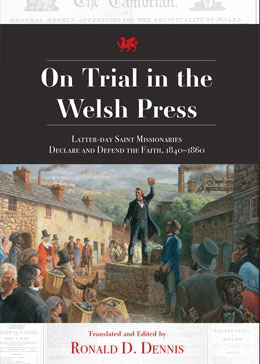
Foreword
Aaron C. Eastley
Dan Jones enjoys wide name recognition among members of The Church of Jesus Christ of Latter-day Saints. He is legendary—but in another sense largely unknown. As newly called missionaries open Preach My Gospel, the Church’s guide to missionary service, they are greeted on page 1 of chapter 1 by Clark Kelley Price’s painting Dan Jones Awakens Wales. The caption reads: “Dan Jones, one of the greatest missionaries in this dispensation, preaches the gospel in Wales.” The painting depicts Jones standing on a stonework platform addressing townspeople while boldly holding aloft The Book of Mormon. Mud and water cover the street, industrial chimneys belch smoke in the background, and the gathered onlookers range from gentle folk in fashionable attire to coal miners in their pit dirt. But Preach My Gospel only includes a portion of Price’s original painting. Perhaps in order to serve as more of a banner atop the opening page, the bottom half of the original scene—where many of the onlookers are depicted—has been cut off.
What is missing from the picture is what is abundantly revealed in this volume: the inner workings of the spirited mid-nineteenth century struggle for the souls of the people of Wales. Price imagines this by surrounding Jones with what appear to be earnest listeners, among whom are two particularly interesting figures, situated opposite each other in the bottom corners of the original. The first is an elderly gentleman, clearly agitated, who looks as if he might be a minister. The other is a wide-eyed miner. The ministerial figure is remonstrating with a well-dressed and serious-looking man next to him, while the miner is seemingly beckoning to a fellow. One can easily imagine the miner as a member of the minister’s congregation—one in real danger of being drawn away by the message of miracles and modern-day martyrdom brought back by Jones from America to Merthyr Tydfil (a town itself named for an early Christian martyr, or “merthyr”). The minister seems about as happy under the circumstances as one might expect. Even in the silence of a painting, the tenor of his discourse to the man next to him we can readily guess. But how much more interesting would it be to have his very words? And again, to have Jones’s words in reply? As Price’s complete image rightly portrays, Jones was both a magnet and an agitator, and he was so, notably, both in person and in print. Beyond his proselytizing on street corners, he was an incredibly prolific writer, publishing literally thousands of pages in defense of the Restored Gospel of Jesus Christ.
Here, then, is the great value of this collection. It offers a remarkably comprehensive view of an era and area of the history of The Church of Jesus Christ of Latter-day Saints (not to mention the history of Wales) that has long effectively been under erasure. For while many today might recognize Dan Jones’s name or image and know something of his success in converting his countrymen, how many can tell what he actually had to say? What was the substance of his sermons, the details of his written discourses? And what was said against him and the Church by others, inciting his responses? These particulars have been largely lost to time and curtained off from all but a relative few by that familiar but formidable barrier: language. For Jones’s missionary work in Wales was, quite naturally, conducted almost entirely in Welsh. Hence, most people even in the Church that he championed have long been unable to become familiar with the particulars of it. Wonderfully, in recent years this has changed. Thanks to several previous volumes also brought to us by Ronald Dennis, we have come to appreciate that Jones’s published periodicals, Prophwyd y Jubili and Udgorn Seion (Prophet of the Jubilee and Zion’s Trumpet), may rightly be seen as Welsh counterparts to the well-known English language Millennial Star. What Parley P. Pratt, Orson Hyde, Orson Pratt, and others famously did in Liverpool beginning in 1840 was matched by the Welsh-language work of Dan Jones, John S. Davis, Daniel Daniels, Benjamin P. Evans, and William Ajax from 1846 to1862.
Yet even in Dennis’s previous volumes, as in the portion of Price’s painting included in Preach My Gospel, we find an incomplete picture. For a great deal of what Jones and his Welsh successors had to say came in response to newspaper articles and pamphlets published by the Church’s many critics. The lengthy complete collections of the Welsh Latter-day Saint periodicals are still only half the story. Here in this volume, for the first time, we get the full broadside of the invective of Jones’s enemies. These enemies found the claim of Church members to be latter-day saints “so presumptuous as if it had been written by the fingers of the devil, who had dipped his pen in the venom of dragons or the fiery furnace itself, and had it printed in the gates of hell.” Such sentiments led one particularly persistent and virulent assailant to contend that converts to the new religion should be known not as “saints” but “Satanists.” Though this detractor staged his assault from behind a mask of anonymity, the plucky Jones quickly brought things into the open: “His name—no need to ask; who does not know that it is the Rev. W. R. Davies who is the father of this name?” Davies, a Baptist minister, emerged as Jones’s great antagonist in print: self-appointed spokesman for a surprisingly unified contingent of both Nonconformist and Anglican opponents who feared the missionaries’ “constant assaults on believers and unbelievers in the areas of the Works, and the fact that they have beguiled many children and weak-minded people.” In their likely sincere but frantic and often mean-spirited anxiety, these critics flooded the streets with lengthy printed condemnations, writing derisively of “Joe Smith,” spouting the now-tired-but-then-novel theories surrounding Solomon Spaulding and the Book of Mormon, mocking reported healings and speaking in tongues, and engaging in relentless juvenile name-calling of the sort Davies displays above. The scene painted by Price seems apt indeed!
Having the words of their critics alongside the responses of the Welsh latter-day faithful creates a dynamic and detailed portrait of the times. This portrait is gratifyingly augmented by Dennis’s interwoven commentaries, which consistently put the various “episodes” of conflict in context for us as readers. This format also allows Dennis to give either shorter or longer excerpts from the original documents in order to best tell the story of each discursive encounter. What is necessarily left out is covered by the commentaries, and what is included is analyzed. The final product, panoramic in its details, is thought-provoking and inspiring.
It is particularly so for me personally as William Harmon, my ancestor, could well have been the humble coal miner depicted in Price’s painting. Born in Merthyr in 1820, William heard the gospel message preached by Jones and others in the mid-1840s and quickly joined the Church. It is fascinating and deeply moving for me to think of him doing so amid the vociferous war of words that I now know was taking place all around him. Of course, I see him not as weak-minded or childish but clear thinking and courageous. As readers of this book will quickly see, tremendous personal courage and clarity of conviction was absolutely necessary. For the contests carried on both in person and in print, reproduced and commented on in the pages that follow, were not demure or deferential discussions. They were knock-down, drag-out debates—what Dennis rightly labels classic examples of “nineteenth-century polemic.” We do not often argue in this way today, unless perhaps it is in the largely anonymous environment of online exchanges. But no such distance separated miner, minister, and missionary in the 1840s.
This brings up my final thought regarding the relevance of this volume for us today. We are now in a moment, it seems clear to me, when courage and plain speaking are again particularly needful. As I complete this foreword, my thoughts echo with the words of two leaders of The Church of Jesus Christ of Latter-day Saints who just delivered messages. President Dallin H. Oaks, First Counselor in the First Presidency of the Church, on September 13, 2022, urged the Brigham Young University community to “dare to be different.” This phrase was in reference to a recent article by Elder Clark G. Gilbert, commissioner of the Church Educational System, in which he asserted the tremendous potential he sees for religious institutions like BYU, “but only if they dare to continue with and strengthen their religious identity—only if they dare to be different from their peers . . . in ways that are true to [their] distinctive light.” Both talks follow up on an address by Elder Jeffrey R. Holland to the faculty and staff of Brigham Young University in August of 2021, in which he urged faithful member-scholars to remember “the builders of the temple in Nauvoo, who worked with a trowel in one hand and a musket in the other.” The point of this metaphor was, I believe, to confirm the need not only to do as the Apostle Peter urged and “be ready always to give an answer to every man that asketh you a reason of the hope that is in you” (1 Peter 3:15) but also to defend against the misrepresentations of those who assail us. This ought to be done in “meekness,” as Peter goes on to affirm, but it must not be left undone. In this I can think of no better role models than Dan Jones and his Welsh fellows: early Latter-day Saints who would likely have found our increasingly argumentative present environment rather familiar and would—I have no doubt—eagerly have sought opportunities to add their deeply compassionate but fearless and hope-filled voices to the ongoing polemics that will certainly continue and increase in fervor until the long-awaited Second Coming of our Savior Jesus Christ.
