
 menu icon in the top, right corner of the screen.
 icon above to close this box.
 icon at the bottom of the screen below the browser—if you don't see it, swipe up to unhide it.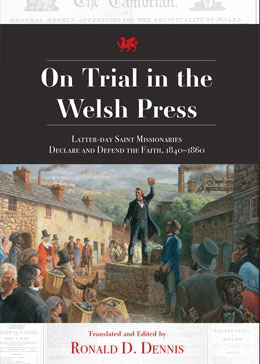
Dan Jones and John S. Davis
There were many opponents to the Latter-day Saints and their religion during the 1840s and 1850s. These antagonists principally expressed their opposition from the pulpit, in the press, and through the disruption of meetings, which were held in buildings or as open-air gatherings where missionaries shouted out their message to all who would listen. Hundreds of newspaper and periodical articles about Latter-day Saint meetings have survived in abundance and are currently available online.
In July 1846, the growing group of Latter-day Saints in Wales were elated when the first issue of their own periodical came off the press in the village of Rhydybont, near the market town of Llanybydder in Carmarthenshire. At last, they had a monthly means of circulating their message and defending it against the assaults of their numerous adversaries. Dan Jones was the founding editor of this monthly publication, and young John S. Davis provided valuable assistance. After twenty-eight issues, John S. Davis became the editor of Prophwyd y Jubili (Prophet of the Jubilee) for its final two issues—November and December of 1848. And in January 1849, the name of the periodical was changed to Udgorn Seion (Zion’s Trumpet). For the following five years, Davis served as the editor of this periodical. During this time, he also translated into Welsh the Doctrine and Covenants, the Book of Mormon, and the Pearl of Great Price.
By the beginning of 1854, Dan Jones was back on his second mission to Wales and became editor of Zion’s Trumpet in place of John S. Davis, who left a few weeks later with a group of Latter-day Saints headed for Salt Lake City.
Because of the prominent roles Jones and Davis played in challenging the opposition through the printed word, it seems appropriate to present, in this first chapter, the details of their publishing activities over a full decade—all in defense of the religion and set of beliefs they both loved. From the mid-1840s to the mid-1850s, the attacks on the “Latter-day Satanists,” as their many enemies frequently called them, were relentless and vicious. Throughout the remaining chapters of this study, a chronological array of the barrage of attacks, along with the response of Jones and Davis to many of them, will be presented.
On 19 January 1843, Dan Jones, the captain of a small riverboat, received his baptism by immersion in the Mississippi River near St. Louis, Missouri. At the time, he was living on board the Maid of Iowa, a steamboat he, Levi Moffat, and some partners had built the previous summer in Augusta, Iowa, just twenty miles north of Nauvoo, Illinois (the “City of Joseph”). Dan Jones’s baptism into The Church of Jesus Christ of Latter-day Saints brought to a successful close his lifelong search for the true religion. He would spend over half his remaining years on this earth proselytizing in Wales to proclaim the good news of the Restoration to his compatriots.
Born in the little town of Halkyn, Denbighshire, North Wales, in 1810, just five years before Napoleon’s defeat at Waterloo, Dan spent his formative years in a very religious home with a father who was an elder in the Methodist church. Dan most likely spent time in the local lead mines with his father and older brothers; the ever-present dust he inhaled in the mines as a boy was likely to have created the chronic lung affliction that plagued him until his death at age fifty-one.
While on the Mississippi River, Dan began to focus his attention toward the vicious printed attacks on Joseph Smith and the religion Joseph had founded nearly thirteen years earlier. These attacks appeared in the Warsaw Signal, whose editor was Thomas Sharp—an avowed enemy of “Mormonism,” as the religion was often called. While Jones was in his native Wales, serving a mission for his new faith four years after his conversion, he reflected on the attacks in the Warsaw Signal:
For our part, we should thank this Sharp for the information we got about the Saints; for it was by reading his and others’ accusations that our attention was drawn to them before we saw them, while living in that country.[1]
On 12 April 1843, not quite three months following his baptism in St. Louis, Dan made the personal acquaintance of Joseph Smith in Nauvoo, where Dan had taken a group of English converts up the Mississippi River from St. Louis. On May 12, exactly one month later, Dan and Joseph became business partners when Joseph presented Levi Moffat with $1,375 for Levi’s half of the steamboat. The mission call to Wales that Dan Jones had received one day earlier, on 11 May 1843, was not answered until sixteen months later because Joseph gave Dan numerous assignments having to do with the Maid of Iowa.
The strong friendship that developed between Dan and Joseph was interrupted on 27 June 1844, when Joseph was martyred in the jail at Carthage. Dan had been with him in the jail until that same morning, when Joseph had requested that Dan report the gunshots heard during the night to Governor Ford at the Hamilton Hotel.
In 1855, while back in his native Wales on a second mission, Dan responded to a request from the Church historian by writing an account of the martyrdom from his perspective. In Dan’s lengthy letter to Thomas Bullock, he recalled:
A few days previous to being arrested [Joseph] told me “I have a check in the house for $1200; as soon as I can get it cashed you shall have $1100 of it, and the start for Wales, not with your fingers in your mouth but prepared to buy a Press; and do business aright.[2]
The phrase “buy a Press” is a clear indication that Dan intended to inform his Welsh compatriots of the true gospel of Jesus Christ using the same method by which he learned of it—through publications—but with a more positive approach. However, he did not receive the promised money because of the confusion following Joseph’s death. As a result, Dan was obliged to make use of two presses during his first mission to Wales from 1845 to 1849. The first one was owned by William Bayley in Wrexham, North Wales, and the second was that of Dan’s older brother John, who lived in South Wales. On the first press, Dan printed his first pamphlet, and on the second all his other publications during his first mission.
Dan spent nearly all of 1845, the first year of his mission, in North Wales where his parents still lived at that time. But during that entire year, his first pamphlet helped to convince only three persons to receive the baptism he offered them. Those who were baptized were not his family members or people he had known during his formative years.
Jones printed his second pamphlet, his Welsh translation of the Proclamation of the Twelve Apostles, on the press owned by his older brother, the Reverend John Jones. John was the pastor of the Congregationalist church in the village of Rhydybont, Carmarthenshire, and his press was located in his home next to the church. At the time, a young man by the name of John Sylvanus Davis was employed as a typesetter for the pastor’s publications. Having learned his trade as a printer’s apprentice during his youth, Davis also had the advantage of being fluent in English as well as his native Welsh.
By setting the type for the Proclamation of the Twelve Apostles, Davis was introduced to a religion that claimed to be the true church of God, restored through the Prophet Joseph Smith. Furthermore, Davis was able to converse with Dan Jones, who had been a friend and business partner of the Prophet of the Restoration for a year’s time prior to the martyrdom. As a result, Davis converted to the new religion and was baptized on 19 April 1846.
At this point The Church of Jesus Christ of Latter-day Saints had two highly skilled publishers and polemicists to propagate its doctrines and to engage in written battles with its many opponents: twenty-three-year-old John S. Davis and thirty-six-year-old Dan Jones. Logically, these battles would have taken place in the numerous religious periodicals and newspapers, with one side responding to the other side in typical polemic fashion. Lamentably, with but few exceptions, only the side of the opponents of Dan Jones was printed.
But, as of July 1846, Dan Jones finally had a means of responding to the assaults from his enemies. That means came in the form of a periodical entitled Prophet of the Jubilee, the first non-English periodical of the Church of Jesus Christ. In the first issue, Dan explained to his subscribers the frustration he had previously experienced by not having a way to defend himself and the Church he represented:
We had no way of keeping our characters above all invention, libel, and lies, except, like you, through the medium of the printing press. You know how we have been accused of every evil, trickery, yes, and of every foolishness. We sent, in the mildest manner, to the monthlies which accused us, letters asserting our innocence. But, were they allowed to appear? No! Were we accused in the Times, Star of Gomer, Instructor, Baptist, etc.? Yes, yes. Was space provided for us to clear ourselves? No, no! rather every poor excuse was sought.[3]
He then triumphantly declared:
Is everyone allowed to put out his magazine but us? Is the press locked against us? Is that the freedom of Wales in the nineteenth century? Have the monthlies been locked? We shall open our own monthly, then. Has the press been polluted by libeling us? We shall cleanse it by defending ourselves, then.[4]
Under the editorship of Dan Jones, Prophet of the Jubilee appeared monthly from July 1846 through October 1848. John S. Davis assumed the editorship for the final two issues—November and December 1848—while Dan was preparing to escort the first group of Welsh converts to Utah. In January 1849, the name of the periodical was changed to Zion’s Trumpet, and the editor from that date until December 1853 was John S. Davis. By then, Dan Jones was back in Wales on his second mission, and he was the editor from January 1854 until issue number 7, dated 5 April 1856, after which he returned to Utah. At that point, Daniel Daniels became editor of the periodical until the end of 1857. The periodical’s final issue was in April 1862, but no complete volume is extant from 1858 until then.
Even though the issues of Prophet of the Jubilee and Zion’s Trumpet were the main conduit through which the Saints were able to defend themselves against the constant opposition from other Christian religions, the Saints also made use of pamphlets. Of the thirty-five pamphlets Dan Jones published during his two missions to Wales, seven of them are directed at specific individuals who had attacked or opposed the Church of Jesus Christ in some way.[5]
- The Scales (1846) is Jones’s sixteen-page response to The Deception of the Latter-day Saints, a thirty-two-page pamphlet by David Williams.
- Defense of the Saints versus the Accusations of Thomas Jones, Merthyr, and Others (1846) is Jones’s eight-page response to Thomas Jones, an apostate who had attacked his former church.
- Defense of the Saints, against the False Accusations of Those Who Call Themselves “Cuckoo of Ton,” in the “Star of Gomer,” January 1847 is Jones’s twelve-page response to an article in the Baptist periodical Star of Gomer.
- “Haman” Hanging from His Own Gallows! (1847) is Jones’s eight-page response to The Correct Image, Wherein One Can Perceive Clearly the Deceit of the Mormons, a twelve-page pamphlet by Daniel Jones, a blind man.
- A Review of the Lectures of the Reverend E. Roberts (1847) is Jones’s forty-two-page response to the lectures of Edward Roberts.
- A Review of the Last Lecture (1848) is Jones’s response to another lecture by Edward Roberts.
- A Defense of the Saints; Refutations of the False and Malicious Accusations of a Man by the Name of Rees Davies, from New Orleans, against the Saints is Jones’s twelve-page response to Rees Davies.
Of the twenty-one pamphlets authored by John S. Davis during his five years as editor of Zion’s Trumpet, four of them are directed at specific individuals who had lectured or published against the Church of Jesus Christ.
- An Anti-Mormon sermon. To the Rev. T. Williams, Ebenezer, near Carmarthen (1849) is Davis’s four-page response to a lecture by Thomas Williams.
- Observations on a Sermon about “The Latter-day Saints and Miraculous Gifts” (1849) is Davis’s eight-page response to a lecture by David Evans.
- A Review of the Treatise of W. Jones, Bethesda (1851) is Davis’s sixteen-page response to Principles of the Latter-day Saints Weighed on the Scales of Reason and Scriptures, a twenty-four-page pamphlet by William Jones.
- Treatises on Miracles, Containing a Review of the Lectures of the Rev. J. Jones, Llangollen, and the Pamphlet of the Rev. J. Davies, Llanelli, on the Same Subject is Davis’s seventy-two-page (six different pamphlets) response to his former employer, the Reverend John Jones, and also to a sixty-page pamphlet by John Davies.
Much more numerous than pamphlet responses to the opposition are the numerous and frequent articles in Prophet of the Jubilee and Zion’s Trumpet.[6]
Although Dan Jones was a well-known and vociferous proponent and defender of his religious beliefs, John S. Davis for many months kept secret his conversion and baptism into The Church of Jesus Christ of Latter-day Saints. In a 28 March 1847 letter to “Dear Brother” (possibly Thomas Jeremy), Davis wrote:
There are hardly any yet who know that I am one of the Saints. They can know slowly and peacefully.[7]
Since his baptism had occurred nearly a year earlier, Davis was obviously in no hurry for word of his conversion to become generally known. He wrote this letter from Llanelli in the “Office of the Revivalist,” a periodical of the Independents for which he had recently been invited to work. He had also been employed for two years by the Star of Gomer, a Baptist periodical in the town of Carmarthen.
Davis made his debut in polemics with an article entitled “The Nature of Miracles” in the October 1846 issue of Star of Gomer.[8] Using the nom de plume “I. M.,” Davis wrote this 2,500-word article as a response to an even longer article that had appeared two months earlier in the August 1846 issue of Star of Gomer.[9] The longer article was also entitled “The Nature of Miracles” by someone who called himself Gwilym ab Dewi.
For most of his article, Gwilym ab Dewi provides general information about the miracles of the New Testament. He states that he sees no need for miracles “for the purpose of proving the truth of the Christian religion” and that he believes the Christian religion without having seen a single miracle. “But,” he writes, “perhaps, since Christianity has split into a number of branches, a miracle would be necessary to prove which one of these branches is founded on the witness of Christ, the evangelists, and the apostles.” At this point, since The Church of Jesus Christ of Latter-day Saints claims to be the only branch of Christianity in which miracles are performed, he extends the following invitation to members of this Church:
If Captain Jones, or any others of the prophets of these Saints, will present themselves within the confines of Abersychan or Talywain, and have it in their mind to work a Miracle, I will set before them five loaves and two fishes, at my own expense; and if they can, by giving thanks, feed five thousand, besides women and children, and take up twelve baskets of fragments, then I will think it obvious that they are built on the foundation of prophets and apostles. If they will send their announcement here, I am confident that we can have a multitude of five thousand, besides women and children, to partake of the loaves and the fish, and to be witnesses of the Miracle.[10]
Compared to other writers such as David Williams and the Reverend W. R. Davies, Gwilym ab Dewi is actually quite civil in his comments about the Latter-day Saints and their teachings. He does not lower himself to ad hominem assaults, as Williams and Davies do constantly in their writings. Instead, by using syllogistic reasoning and scriptures, Gwilym ab Dewi puts forth his arguments against the Saints’ ideas about such phenomena as the working of miracles and the casting out of evil spirits, and he comes forth as being a rather polite and well-mannered person. In his August 1846 article, Gwilym writes:
Now, if the Latter-day Saints can perform miracles, let them raise someone from the dead—let them give eyes to some blind man—ears to a deaf man—speech to a mute—and let them hold back the Atlantic Ocean, so that they might go through it on dry land to their new Jerusalem.[11]
“I. M.” (John S. Davis), in his October 1846 article, responds:
Here he is again very eager for a sign; and a very large, but totally pointless, sign is the one he wishes to receive, that is for us to hold back the Atlantic Ocean, and walk on dry land to America. It would be far wiser to take boats to cross over, for it would be very wearisome to walk such a long way.[12]
Amazingly, Davis was but twenty-four years old when his article appeared in the October 1846 issue of Star of Gomer. He had already worked for two years at this Baptist periodical in Carmarthen, his hometown, before going twenty miles to the northeast to work for the Reverend John Jones in Rhydybont.[13]
Because John S. Davis was such a central figure during some of the most impactful years of the establishment of The Church of Jesus Christ of Latter-day Saints in Wales, perhaps the following timeline will assist the reader in identifying important events in his association with the press:
JOHN S. DAVIS (1822–82): TIMELINE
1835–1842: Apprentice printer – age 13 to 20
1842–1843: In Carmarthen working for the Star of Gomer press
1844–1845: In Haverfordwest working at The Herald – 13 Dec 1845 letter from John S. Davis to Joseph Potter
1845–1846: In Rhydybont working for the press of the Reverend John Jones
1846 Apr 19: Baptized by Thomas Harries in Llanybydder, Carmarthenshire
Aug: Meurig’s article in Star of Gomer – Miracle of the pig, discussed in Chapter 3
Aug: “Nature of Miracles” by Gwilym ab Dewi in Star of Gomer
Oct: “Nature of Miracles” by John S. Davis (“I. M.”) in Star of Gomer
Nov: “Zeal without Knowledge” by John S. Davis in Star of Gomer
Dec: Question of “Meurig” in Star of Gomer
1847Jan – “Nature of Miracles Again” by Davis (“I. M.”) in Star of Gomer
March 28 letter to Thomas Jeremy written from Llanelli
Mar to May – In Llanelli working for the Revivalist press
June to Sep 1848 – In Carmarthen working for the Star of Gomer press
June – “Speaking with Tongues” by John S. Davis in Star of Gomer
Aug – Davis’s critique of the Williams sermon – Prophet of the Jubilee
Sep – Challenge of H. Tegai to defend Mormonism in Star of Gomer
Dec – “Speaking with Tongues” by John S. Davis in Prophet of the Jubilee
1848May – “What is to be done with the editor of Star of Gomer?” Prophet of the Jubilee
Aug – “Anti-Mormon Sermon” by John S. Davis in Prophet of the Jubilee
Oct – “Review of Mormonism” by Anti-Humbug in Star of Gomer
Nov & Dec – In Carmarthen – Davis is the printer for the final two issues
of Prophet of the Jubilee (Davis had purchased “an old Caledonian printing
press, second-hand type, and fitted up an office of his own at his father’s
house in Tanerdy” [an area of Carmarthen])[14]
1849Jan & Feb – In Carmarthen – Davis is the printer for the first two issues
of Zion’s Trumpet on his own press
1849–1853In Merthyr as editor of six volumes of Zion’s Trumpet (a total of 2,352 pages)
(For a list of all his publications, see Welsh Mormon Writings, p. x–xi)
Davis’s third article to be published in Star of Gomer (January 1847) is entitled “Nature of Miracles Again” and was in response to the “Meurig” query in the December 1846 article in Seren Gomer:
To Mr. I. M., Glanteifi
Sir—In your notes about the article of Mr. W. Davies, you said that the disciples of Christ could be listed, who were the workers of the true miracles, and on the same ground as the Latter-day Saints, who are nothing but the workers of false miracles; and your reason for that was because the disciples failed to cast out the evil spirit mentioned in Matthew 17:14–21; Mark 9:17–29; Luke 9:39–42. We wish to know from you whether it was a lack of power or a lack of faith that was the cause of their lack of success? If the former, why did their Teacher chastise them for failing to fulfill that which was impossible for them to do?
Glan yr un Teifi[15]
In the January 1847 issue of Star of Gomer, Davis responds to Meurig that the disciples’ “power depended on their faith,” and that they failed because they “were lacking faith.” [16]
Davis worked in Llanelli for the Revivalist, a Congregationalist periodical, for only a few weeks during April and May of 1847 before receiving an offer to return to Carmarthen to work for Star of Gomer. In an unpublished article among his papers, Davis explains the welcome he received from Samuel Evans, the editor:
But permit me now to tell of the kind favor which the Editor did for me when I arrived there. A few months before that, I sent an article to the Star, on “Speaking with tongues.”[17] But I saw no sign that it had been published. But with my entrance to the office, the first thing I saw was the article under scrutiny on the press, set to appear in the June 1847 issue. He did that, I believe, only to please “Satan.”[18]
In his rather brief article titled “Speaking with Tongues” in the June 1847 issue of Star of Gomer, Davis presents a scripturally based discussion about this New Testament gift of the Spirit and concludes:
This, and all other things, show clearly, then, that speaking with tongues and the interpretations were only for the edifying of the church, and that such was done when the spirit of God was resting on those who were speaking. [19]
This was Davis’s fourth and also his last article to be published in Star of Gomer. Samuel Evans, the editor, may not have known about Davis’s conversion to the Church of Jesus Christ when he approved both the October 1846 article about the nature of miracles and Davis’s January 1847 follow-up article on the same topic. In March 1847, Davis clearly indicates his religious status in a letter to Thomas Jeremy: “There is no one who knows that I am one of the Saints. They can find out slowly and quietly.” But by the time Evans allowed Davis’s article “Speaking with Tongues” to appear in the June 1847 issue of Star of Gomer, Evans definitely knew about his coworker’s new religion.
Reacting to Davis’s June 1847 article, the Reverend Hugh Hughes, using the nom de plume “H. Tegai,”[20] issues the following challenge to Davis in the September 1847 issue of Star of Gomer:
I saw in the June Star an article of one J. D., on “Speaking with Tongues.” If J. D. wishes to come forth to defend Mormonism, let him come to the root of the debate at once, by answering, 1. Did Christ and his apostles work public miracles? If they did, 2. Do the Mormons do so in the same way? Let J. D. answer as he may, and then I shall have a word to say to him. H. T.[21]
Davis wrote a response to H. Tegai’s questions and fully expected that it would be printed in Star of Gomer. When the response was refused publication in that periodical, Davis submitted it to Dan Jones, who was pleased to publish it in the December 1847 issue of Prophet of the Jubilee. Davis explains the article’s trajectory in an introductory paragraph addressed to Dan Jones:
Some questions were directed at me in the September Star, by one Independent Reverend from the North, and I wrote an answer for them, being sure in my mind that I would receive the same fair play that the inquirer received; but to my disappointment, I was told that it was too poor, that there was none of the “cleverness” in this article that I had shown on other occasions, and that the aforementioned Reverend would take no notice of it. The only thing I shall say is, that I did my best. Now, I set my cause before you, and begging the fair play that was denied me in the place where it should have been received.[22]
Davis has a much more argumentative tone in this article than he used in his four articles that were allowed to appear in Star of Gomer. Addressing the editor of the periodical, Davis responds to the accusation that he had “come forth to defend Mormonism:”
About last February when I sent you an article on “Speaking with Tongues,” which appeared in the Star for June, little did I think that anyone would be so perceptive as to see that it was defending Mormonism; for it was nothing more than an investigation into the New Testament to know what is to be understood by “speaking with tongues.”[23]
To Tegai’s statement, “Let J. D. answer as he may, and then I shall have a word to say to him,” Davis writes:
This thing looks like a trap or a net; and if the words are taken “spiritually,” they mean, in my opinion, that Mr. Tegai has determined beforehand what he will say; yes, even if I were to convince him of the complete opposite. But that makes no difference, for I hope, that when our friend lifts his net, that a miracle will take place (as in the time of Christ), and instead of capturing me, he will have captured the truth, and that as it is in Christ. Amen.[24]
For an understanding of the ensuing battle between John S. Davis and Samuel Evans, Davis’s senior by nearly thirty years and the editor of Star of Gomer, five items are essential to bear in mind:
- An article by Benjamin Jones in the May 1848 issue of Prophet of the Jubilee entitled “What is to be done with the Editor of the Star of Gomer?”[25]
- An article by John S. Davis in the August 1848 issue of Prophet of the Jubilee entitled “Anti-Mormon Sermon by T. Williams, Ebenezer.”[26]
- An article by “Anti-Humbug” (Samuel Evans) in the October 1848 issue of Star of Gomer entitled “A review of Mormonism, and the Rev. T. Williams.”[27]
- An article by John S. Davis in the December 1848 issue of Prophet of the Jubilee entitled “Observations on a Sermon about ‘The Latter-day Saints and Miraculous Gifts.”[28]
- An unpublished article entitled “The Editor of Star of Gomer, Anti-Humbug, and J. Davis,” written by John S. Davis on 6 October 1848.[29]
In the first item, Benjamin Jones from Carmarthen expresses mock concern about the state of the editor of the Star of Gomer in light of his recent excommunication from the Baptists and asks in feigned bewilderment, “What is to be done with the Editor of the Star of Gomer?” Benjamin Jones muses:
For the sake of his soul, poor thing, he ought to get some religion yet; but which one, is the question. As the religion of the Satanists is the closest one to the Baptists, who knows whether he might obtain a place with those? . . . But what good is it to speak like this? for the Satanists are “very soon” to come to request their place with the Baptists; consequently, what good would it be for the Editor to join with the Satanists, and then be considered unworthy to be received back along with the Satanists?[30]
The second item is Davis’s review of an “Anti-Mormon” sermon given by the Rev. Thomas Williams on 2 July 1848 from his pulpit at the Ebenezer Chapel of the Independents in Llangynog. John S. Davis was in attendance during the sermon and took copious notes. Four days later he had composed his critique, which was published in the August 1848 issue of Prophet of the Jubilee.[31] According to Davis, among the various inconsistencies in Williams’s sermon was his stance concerning more than one baptism:
But one thing you said about the Mormons baptizing more than once, requires particular attention. If it is unscriptural for the Mormons to baptize after the Baptists, it is unscriptural also for the Baptists to baptize after the Mormons, as was done with two women in Llwyni, according to the account given in a recent issue of the Baptist.[32]
The third item appeared in Star of Gomer in the October 1848 issue. The editor, now excommunicated from the Baptist faith, published a vicious, ad hominem, two-thousand-word review of Davis’s article. Using the nom de plume “Anti-Humbug,” Samuel Evans has nothing but praise for the Reverend Thomas Williams and his sermon. But for Davis, his former co-worker, Evans has nothing but derision and ridicule, and he even—possibly intentionally—misspelled his coworker’s surname, using Davies instead of Davis.[33] Here are some examples of Evans’s style:
This J. Davies indicates that he will write again. It would be as well for him to slow down, until he can write some sense, and form more decent and respectful expressions for his fellow creatures. Seeing some ignorant and selfish dwarf of a man inflate with self-importance is a scandal to humanity. . . . It is a beautiful characteristic in everyone that they know their place. Mr. Gomer, what consistency is there between a minister who preaches the faith of the Independents on the one hand, and prints the Latter-day Saints’ books on the other?[34]
The fourth item is Davis’s eight-page review, in the December 1848 issue of Prophet of the Jubilee, of a twenty-page pamphlet entitled The Latter-day Saints and Miraculous Gifts by the Reverend David Evans, a curate in the Anglican Church. Evans gave a sermon by the same title on 27 August 1848 in the St. David’s Church in Carmarthen and had the sermon printed a few weeks later. The editor of The Sun reacted to David Evans’s pamphlet in the December 1848 issue:
In our time the Mormons, or the Latter-day Saints, and their beliefs, are too despicable to take any note of them; but the common folk are paying attention to them; and the apostles of this blasphemous heresy are deceiving many of the people and putting their salvation at risk. The Sermon under scrutiny is an excellent antidote to this deadly poison; but for it to have effect, it would be better for the reverend author to devise some way of bringing it off the press more cheaply, in order to disseminate it generally.[35]
Not surprisingly, John S. Davis’s reaction was considerably different. In the opening paragraph of his response, Davis explains his motive for focusing on the twenty-page pamphlet:
The name attached to the sermon is the only reason I consider making comments on it. The great task Capt. Jones has in looking after about three thousand Saints, prevents him from commenting on everything that may be published against our religion; but somehow or other, it happens most often that the books that are published against the Saints, especially Mr. Evans’s sermon, have already been answered by him in various books.[36]
Although the Anglican curate accuses the leaders of The Church of Jesus Christ of Latter-day Saints of being false prophets, he presents scriptures and arguments to substantiate his statements and this conclusion. On page 15 of his pamphlet, he throws out the following challenge:
Let the deaf be shown whose ears have been opened through the power of the Saints. Who of them has loosened the tongue-strings of the mute, causing him to speak the praises of God?
Davis is pleased to respond:
We answer that Mr. Evans can see a person who came to hear and speak—yes, speak the praises of God, after being baptized by the Saints, and that recently, and also in Wales.[37]
He then refers Evans to the November 1848 issue of Prophet of the Jubilee, which has the account of Reuben Brinkworth, who had been deaf and mute for eight years prior to the night of 22 September 1848. It was on that night that Brinkworth received his baptism into the Church of Jesus Christ and on coming up out of the water he cried out, “Thank the Lord, I can speak and hear again, as well as any of you!”[38]
Toward the end of 1848, because Dan Jones was busy organizing the emigration of over three hundred Welsh converts to sail from Liverpool to New Orleans in February, one could safely assume that he had probably assigned Davis to prepare an answer to the curate’s pamphlet. And likely because Davis used Prophet of the Jubilee to respond, his attention was diverted from taking his own personal revenge against the excommunicated Baptist minister at the time of the minister’s attack on Jones in the October 1848 article in Star of Gomer.
The fifth item, the 6 October 1848 letter of defense by John S. Davis, was precipitated by Samuel Evans’s barrage of personalized and targeted aggression in the October 1848 Star of Gomer article. To be so verbally maligned to the point of being sarcastically called “the great apostle” by a colleague of several years over a difference of religious allegiance no doubt caused considerable anguish and frustration for John S. Davis, as well as a desire to defend himself and his religion. He did exactly that by writing out his frustrations to send to Star of Gomer. He must certainly have known that the letter would not be allowed publication in his hometown periodical. Nevertheless, his feelings were soon on display on ten sheets of paper:
Then I sat “the great apostle down, and I gave birth” to the article by the name of “Speaking with Tongues, The New Testament, and Mormonism,” [which was published in the December 1848 issue of Prophet of the Jubilee] being sure in my mind that I would receive the same fair play which the asker of the question received; but to my disappointment, I was told by the editor [Samuel Evans] that there was none of the “cleverness” in that article that I had shown on other occasions, and that H. Tegai had made no mention of that. That was proof, then, that the work of the Editor was not to give fair play.[39]
In contrast, Davis tells of his relationship with two other work colleagues:
I continued in this office for another week or two after printing the September [1848] Star, when I left as a result of the notice I had given to the printer a month before that because of some words between us a month earlier. I left in a very peaceful and gentlemanly way, and I have every respect for the printer, and for the publisher, the Reverend H. W. Jones. It was these two who recommended writing to me in the first place, and as I left them, I can testify that they treated me in an honest and Christian-like manner.[40]
Davis also reflects on the verbal attacks aimed at him by the editor who had a few months before been expelled from the Baptist religion:
Now, I wish for all to put common sense into operation. Is it not just envy and jealousy that have caused this excommunicated Editor to attack me in the manner described? And what have I ever done to him? Is it for revenge because I did not loan three pounds to his wise and clever wife when she asked it of me? If that is the reason, he should forgive me; for he ought to know that a “Satan” like me is as clever as she in determining to whom money should be lent. But I think that the reason for these attacks is in the temperament of the Editor.[41]
Very hurtful to Davis was the advice “Anti-Humbug” offered him in his vicious article:
It would be wisdom for J. Davies to follow the profession that is most familiar to him, and leave teaching the people to those who have received the gift.[42]
To this offensive counsel given by the fifty-five-year-old veteran Samuel Evans, the twenty-six-year-old Davis offered the following defiant challenge:
Now, if Anti-Humbug or Gomer wish to debate with me about Mormonism, let them declare that the columns of the Star are free; or if those columns are too pure, let them come and face me on the soapbox.[43]
Notes
[1] “History of the Latter-day Saints,” in Ronald D. Dennis, ed., Defending the Faith: Early Welsh Missionary Publications (Provo: Religious Studies Center, Brigham Young Universitiy, 2003), 59.
[2] Letter from Dan Jones to Thomas Bullock, January 20, 1855.
[3] Prophet of the Jubilee, July 1846, wrapper, 2.
[4] Ibid.
[5] See Dennis, Defending the Faith: Early Welsh Missionary Publications, for the English translations of all the pamphlets and poetry authored by Dan Jones and John S. Davis from 1845 to 1856.
[6] The English translations of the three volumes of Prophet of the Jubilee (1846–48) and of the ten extant volumes of Zion’s Trumpet (1849–57) can be accessed through the Welsh Saints Project.
[7] John S. Davis papers, in private hands.
[8] Star of Gomer, October 1846, 301–303.
[9] Star of Gomer, August 1846, 233–35.
[10] Ibid., 233.
[11] Ibid., 234.
[12] Star of Gomer, October 1846, 302.
[13] 6 October 1848, unpublished article in the John S. Davis papers, pg. 2. “I worked for years in the office of Star of Gomer. Originally, after spending two years there, I left because I was not content with my pay.”
[14] Biography of John S. Davis on website_________.
[15] Star of Gomer, December 1846, 378. A bit of a joke about John S. Davis being from “Glanteifi” which means “along the bank of the Tovey River”—Meurig indicates his home as being on the “Bank of the same river Tovey.”
[16] Star of Gomer, January 1847, 17.
[17] Star of Gomer, June 1847, 173–74.
[18] 6 October 1848 unpublished article in the John S. Davis Papers.
[19] Star of Gomer, June 1847, 174.
[20] Tegai is the name of a fifth-century Welsh saint. There is a small village in North Wales near Bangor named after him—Llanadygai.
[21] Star of Gomer, September 1847, 258.
[22] Prophet of the Jubilee, December 1847, 181–85.
[23] Ibid., 181.
[24] Ibid., 185.
[25] Prophet of the Jubilee, May 1848, 76.
[26] Prophet of the Jubilee, August 1848, 118–22.
[27] Star of Gomer, October 1848, 304–5.
[28] Prophet of the Jubilee, December 1848, 176–83.
[29] John S. Davis papers, in private hands.
[30] Prophet of the Jubilee, May 1848, 76.
[31] Prophet of the Jubilee, August 1848, 118–22.
[32] Ibid., 121.
[33] In Wales, Davies and Davis are pronounced identically.
[34] Star of Gomer, October 1848, 305. The “minister” is a reference to the Rev. John Jones, the older brother of Dan Jones.
[35] Sun, December 1848, 402.
[36] Prophet of the Jubilee, December 1848, 176–83.
[37] Ibid., 182.
[38] Prophet of the Jubilee, November 1848, 163–65.
[39] Unpublished 6 October 1848 letter, 4.
[40] Ibid., 5.
[41] Ibid., 6.
[42] Star of Gomer, October 1848, 305.
[43] Unpublished 6 October 1848 letter, 10.
