
 menu icon in the top, right corner of the screen.
 icon above to close this box.
 icon at the bottom of the screen below the browser—if you don't see it, swipe up to unhide it.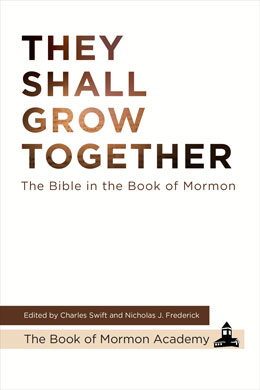
The Rhetoric of Self-Reference in Deuteronomy and the Book of Mormon
David Rolph Seely
David Rolph Seely, "The Rhetoric of Self-Reference in Deuteronomy and the Book of Mormon," in They Shall Grow Together: The Bible in the Book of Mormon, ed. Charles Swift and Nicholas J. Frederick (Provo, UT: Religious Studies Center, Brigham Young University; Salt Lake City: Deseret Book), 29‒48.
David Rolph Seely is a professor of ancient scripture at Brigham Young University.
The Book of Mormon originates in Jerusalem in 600 BC from the time following Josiah and the discovery in the temple of the “book of the law,” which scholars believe represents some early form of the book of Deuteronomy. Scholars of the Book of Mormon have noted many echoes of the book of Deuteronomy in the Book of Mormon. This study proposes to look at a common feature of Deuteronomy and the Book of Mormon that has not previously been discussed. Both Deuteronomy and the Book of Mormon present themselves as self-referential texts—that is, both texts refer to themselves in their respective narratives and are consciously aware of their function with respect to their future readers.
From the time of the publication of the Book of Mormon in 1830, one of the issues raised was the relationship between the Book of Mormon and the Bible. Critics and defenders alike have noted that the Book of Mormon contains many quotations from and allusions to the Old and New Testaments. Many studies, for example, have been made of the extensive use of Isaianic passages in the Book of Mormon. Lehi and his family relied on the brass plates for their knowledge of their scriptural heritage, and according to the Book of Mormon, those plates contained “the five books of Moses” (1 Nephi 5:11). Lehi and his family almost certainly experienced firsthand Josiah’s reforms in Jerusalem, which began in 622 BC (see 2 Kings 22–23), and the coming forth of the book of the law,” which was very likely some form of the book of Deuteronomy. That book is described in 2 Kings as “the book of the law [torah]” (22:8, 11),[1] which is similar to the phrase “this book of the law [torah]” noted in reference to Moses’s words preserved in Deuteronomy (Deuteronomy 29:21; 30:10; 31:26). The curses mentioned in this book of the law by Huldah (see 2 Kings 22:13) may be the curses found in Deuteronomy 28, the reforms enacted by Josiah to destroy the high places and Baal and Asherah worship (see 2 Kings 23) are expressed in terms similar to Deuteronomy 13, and the centralization of worship in Jerusalem (see 2 Kings 23) that was the focal point of Josiah’s reforms parallels the injunctions in Deuteronomy 12. Thus, many scholars believe that Josiah’s “book of the law” is some early form of Deuteronomy.[2]
Considering the fact that Josiah’s reforms and the discovery of this book occurred two decades before Lehi left Jerusalem, it seems logical to search for evidence in the text of the Book of Mormon that reflects a knowledge and use of Deuteronomy. For several years I have been working on a comprehensive study of the references in the Book of Mormon to Deuteronomy.
Evidence of Deuteronomy in the Book of Mormon
Let us review here some of the echoes of Deuteronomy in the Book of Mormon that have already been noted and studied. Remarkably, the Book of Mormon never directly quotes a passage from Deuteronomy. One example is the reference to the coming of a prophet like Moses found in Deuteronomy 18:15 and alluded to in 1 Nephi 22:20 and 3 Nephi 20:23. And yet the quotation in the Book of Mormon is almost word-for-word from Acts 3:22–23. Another passage that seems to be a direct allusion to Deuteronomy is the account of Moses’s death/
The Book of Mormon, however, contains numerous instances of words and phrases from Deuteronomy, as well as prominent themes that are distinctive to Deuteronomy. Many of these have already been noted in studies by Latter-day Saint scholars and commentators. For example, one of the central themes of the Book of Mormon is the theological idea in the phrase “If ye keep my commandments, ye shall prosper in the land.” This is illustrated by the following passages:
Deuteronomy 28:15, 29
15 But it shall come to pass, if thou wilt not hearken unto the voice of the Lord thy God, to observe to do all his commandments and his statutes which I command thee this day; that all these curses shall come upon thee, and overtake thee:
29 And thou shalt grope at noonday, as the blind gropeth in darkness, and thou shalt not prosper in thy ways: and thou shalt be only oppressed and spoiled evermore, and no man shall save thee.
Deuteronomy 29:9
9 Keep therefore the words of this covenant, and do them, that ye may prosper in all that ye do.
1 Nephi 2:20–21
20 And inasmuch as ye shall keep my commandments, ye shall prosper, and shall be led to a land of promise; yea, even a land which I have prepared for you; yea, a land which is choice above all other lands.
21 And inasmuch as thy brethren shall rebel against thee, they shall be cut off from the presence of the Lord.
1 Ne 4:14
14 And now, when I, Nephi, had heard these words, I remembered the words of the Lord which he spake unto me in the wilderness, saying that: Inasmuch as thy seed shall keep my commandments, they shall prosper in the land of promise.
The theology first expressed by Nephi as “inasmuch as ye shall keep my commandments, ye shall prosper” is repeated throughout the Book of Mormon and fits very well within the Deuteronomic theology of blessings and curses, especially as illustrated in Deuteronomy 27–30. In addition, Latter-day Saint scholars have demonstrated the many elements of Book of Mormon depictions of Moses that resonate with Deuteronomic language, themes, and types.[3] Similarly, the image of the way of life and the way of death is distinctive to Deuteronomy in the scene where Moses presented it to Israel on the plains of Moab: “See, I have set before thee this day life and good, and death and evil; . . . I call heaven and earth to record this day against you, that I have set before you life and death, blessing and cursing: therefore choose life, that both thou and thy seed may live” (30:15, 19). This same image with similar language is found in the Book of Mormon where Lehi says, “And they are free to choose liberty and eternal life, through the great Mediator of all men, or to choose captivity and death” (2 Nephi 2:27), and Jacob later adds, “Therefore, cheer up your hearts, and remember that ye are free to act for yourselves—to choose the way of everlasting death or the way of eternal life” (10:23).[4]
Biblical scholars have long noted the similarities between Hittite and Neo-Assyrian treaties to covenants and covenant rituals in the Hebrew Bible. These treaties are most closely related to the structure, content, and language in Deuteronomy. The basic structure of the covenant consists of seven parts: preamble, historical prologue, stipulations, deposit and public reading, witnesses, blessings and curses, and a covenant oath ceremony.[5]
Latter-day Saints have applied the results of this scholarship to studies of Book of Mormon texts. For example, writers have identified the elements of the ancient Near Eastern treaty/
The Rhetoric of Self-Reference in Literature and Art
As I have studied the citations, allusions, and echoes of Deuteronomy in the Book of Mormon, there is one similarity that has not received enough attention. Both texts present themselves in various ways with the rhetoric of self-reference. A self-referential text is one in which an author in that text refers to his or her own text in the context of the text itself. There are many examples of this in ancient and modern texts. A simple example can be found in the poem “When You Are Old” by Yeats:
When you are old and grey and full of sleep,
And nodding by the fire, take down this book,
And slowly read, and dream of the soft look
Your eyes had once, and of their shadows deep. . . .
Here we see that the text refers to itself as an object in the future and also to its impact on its future reader. Modern examples include Cervantes’s Don Quixote and Diderot’s Jacques the Fatalist. The device of self-representation is also present in artistic works in which a painting or other image depicts itself. Art historians describe such depictions as containing “self-portraits of the objects” themselves. There are also several examples of ancient Near Eastern art that contain depictions of themselves. See, for example, the Uruk Vase (3000 BC), which portrays two vessels resembling it; the Great Lyre of Ur (ca. 2600–2400 BC), which contains a panel depicting a donkey playing the lyre; and the altar of Tukulti-Ninurta (1243–1207 BC), which depicts a scene in which the altar is functioning as an altar.[8]
The Rhetoric of Self-Representation in Ancient Texts
Several ancient Near Eastern texts, especially treaty texts, employ self-referential rhetoric similar to that employed in Deuteronomy.[9] Let us look at two literary texts to see how they employ self-referential rhetoric. The Epic of Gilgamesh opens with a description of itself as a text written on lapis lazuli, hidden in a copper box, and recounting the exploits of Gilgamesh:
Full understanding of it all he gained,
He saw what was secret and revealed what was hidden
He brought back tidings from before the flood,
From a distant journey came home, weary, at peace,
Engraved all his hardships on a monument of stone . . .
[Search out] the foundation box of copper
[Release] its lock of bronze,
Raise the lid upon its hidden contents,
Take up and read from the lapis tablet
Of him, Gilgamesh, who underwent many hardships.
(Epic of Gilgamesh, tablet 1, lines 6–10, 25–29)[10]
The colophon to the Erra Epic poem describes its author, how the poem was recorded on a tablet and was to be preserved, how it was to be chanted, and its intention to endure forever.
The composer of its text was Kabti-ilani-Marduk,
of the family Dabibi.
He revealed it at night, and, just as he (the gods?)
had discoursed it while he (K.) was coming awake
he (K.) omitted nothing at all,
Not one line did he add. . . .
Let the singer who chants (it) not die from pestilence
The house in which this tablet is placed, though Erra be angry and the Seven be murderous,
The sword of pestilence shall not approach it,
safety abides upon it.
Let this poem stand forever, let it endure till eternity
Let all lands hear it and praise my valor,
Let all inhabitants witness and extol my name.
(The Erra Epic, lines 38–61)[11]
This colophon contains a passage forbidding addition to or deletion of the text, similar to this caution in Deuteronomy 4:2: “Ye shall not add unto the word which I command you, neither shall ye diminish ought from it” (repeated in 12:32).
The rhetoric of self-reference is also common in ancient legal codes and treaties. Considering the fact that Deuteronomy is constructed as a covenantal document modeled on ancient treaties, these devices of self-reference often closely resemble those found in Deuteronomy. A simple example can be found in the well-known Laws of Hammurabi, which includes the following text in the epilogue:
I am Hammurabi, noble king. . . . The great gods having chosen me, I am indeed the shepherd who brings peace, whose scepter is just. . . . In order that the mighty not wrong the weak, to provide just ways for the waif and the widow, I have inscribed my precious pronouncements upon my stela and set it up before the statue of me . . . in order to render the judgments of the land. . . . Let any wronged man who has a lawsuit come before the statue of me, the king of justice and let him have my inscribed stela read aloud to him, thus may he hear my precious pronouncements and let my stela reveal the lawsuit for him.” (Laws of Hammurabi, xlvii 9–xlviii 19)[12]
Similar to the literary texts, these self-referential passages in a legal text describe the origin and form of the text, the function and authority of the laws they contain, and how these laws are to be read aloud and implemented.
From the well-attested Succession Treaty of the Neo-Assyrian emperor Esarhaddon (690–669 BC), we can see a further example of the rhetoric of self-reference. From the copy of treaty 94, we see various phrases (marked in italics) referring to the object and text of the treaty itself:
10–11: with you, with your sons and your grandsons who will be in the days to come after (this) treaty
41: This is the treaty which Esarhaddon, King of Assyria, has concluded with you.
58: You shall neither change nor alter the word of Esarhaddon.
95, 105, 132: On whose behalf Esarhaddon has concluded his treaty with you
291–93: Guard this treaty, do not transgress your treaty, (or) you will lose your life.
472–74: May the great gods, . . . as many as are mentioned by name in this tablet, strike you.[13]
Political treaties were written on tablets. Copies of the treaties were given to each party as evidence of the agreements made and the consequences of not living up to the conditions. These treaties were often accompanied by detailed descriptions of the associated blessings and curses, similar to the blessings and curses in Deuteronomy 28. These treaties were to be deposited in the temples of the parties involved.
A copy of the treaty of Esarhaddon found at Tell Tayinat contains these protective curses:
Whoever changes, neglects, violates, or voids the oath of this tablet (and) transgresses against the father, the lord, (and) the adê of the great gods(?) (and) breaks their entire oath, or whoever discards this adê-tablet, a tablet of Aššur, king of the gods, and the great gods, my lords . . . May Aramiš, lord of the city and land of Qarnê (and) lord of the city and land of Azaʾi, fill you with green water. May Adad (and) Šāla of Kurbaʾil create piercing pain and ill health everywhere in your land. May Šarrat-Ekron make a worm fall from your insides.[14]
This tablet included the injunction to put this tablet in the temple: “You will guard like your god this sealed tablet of the great ruler on which is written the adê of Assurbanipal, the great crown prince designate, the son of Esarhaddon, king of Assyria, your lord, which is sealed with the seal of Aššur, king of the gods, and which is set up before you.”[15] The phrase “before you” means that the treaty was to be put in the presence of the god. In 2009 the Tayinat Archaeological Project discovered a new exemplar of a tablet containing Esarhaddon’s Succession Treaty in the inner sanctum of Building XVI—a Neo-Assyrian temple at Tell Tayinat.[16]
In summary, the rhetoric of self-representation in these ancient Near Eastern texts includes the following items:
1. Self-referential texts describe for their future readers their origin and often the form of their preservation—written on tablets, or stelae, and, in the case of Gilgamesh, put into a copper box.
2. They describe their significance and their function for future readers—preserving the significant past for the future. Legal texts present laws that are to be observed.
3. Self-referential texts often describe how they are to be used—for example, chanted and read aloud.
4. Often these texts protect themselves against the threat of additions or deletions with curses. In addition, some of these texts attempt to protect themselves against theft or defacement with curses.
5. Treaties refer to themselves as objects, often represented by more than one copy and often to be placed in a temple setting guaranteeing the treaty relationship and the terms of the agreement. Legal treaties often included instructions about public readings of the texts as a reminder to the vassals of their allegiance to their sovereigns.
Many scholars have recognized the similarities between Deuteronomy and ancient Near Eastern treaties and have argued that Deuteronomy shares the form, structure, and many details of these ancient treaties. While the predominant view is that Deuteronomy closely reflects the Neo-Assyrian treaties of Esarhaddon, a minority opinion is that a better case can be made for the similarities with the Hittite treaties of the second millennium, and some scholars argue that the biblical covenants are similar to both traditions.[17] While the parallel structures were first noted in comparison with the Hittite treaties in the fourteenth–thirteenth centuries BC, which is the time period roughly contemporary with Moses, many scholars have argued that many specific details in Deuteronomy match better with the well-attested Assyrian treaties—especially those of Esarhaddon in the seventh century BC. The dating of the similarities are significant in terms of determining the date of the original core of the book of Deuteronomy—whether the covenant structure derives from the time of Moses or whether this structure was imposed on the text at a later date, influenced by the structure reflected in the Neo-Assyrian treaties. In either case, it is the book discovered by Josiah that scholars believe became the biblical book of Deuteronomy, and whether its structure is more similar to the fourteenth–thirteenth centuries or the seventh century, this is the book being compared with the Book of Mormon in this study.
The Book of Deuteronomy and the Rhetoric of Self-Reference
The book of Deuteronomy contains three sermons delivered by Moses at the plains of Moab (1:1–4:43; 4:44–29:1; 29:2–30:20), with a series of appendixes in chapters 31–34. Several passages throughout the book contain self-referential passages referring to the words of Moses that were to be written down and transmitted to the future. In particular there are four phrases that indicate self-reference to the passages in Deuteronomy: “these words,” “this law,” “in this scroll/
Let us look at a few of these examples of self-referential rhetoric. The opening five verses of the book of Deuteronomy establish its origin, form, and authority: “These be the words which Moses spake” (1:1) and “On this side Jordan, in the land of Moab, began Moses to declare this law, saying . . .” (v. 5). The final form of Deuteronomy is structured with a series of inclusios, and the collection of the laws ends with “all the words of this law that are written in this book” (28:58).
Similar to the self-references in ancient treaties, the curses of the covenant in Deuteronomy 28 and 29 also reflect self-referential passages: “If you do not diligently observe all the words of this law that are written in this book, fearing this glorious and awesome name, the Lord your God . . .” (28:58 New Revised Standard Version); “Every other malady and affliction, even though not recorded in the book of this law, the Lord will inflict on you until you are destroyed” (28:61 NRSV); “The Lord will single them out from all the tribes of Israel for calamity, in accordance with all the curses of the covenant written in this book of the law” (29:21 NRSV).[20]
And again similar to what we find in treaties, there is a warning in Deuteronomy to not add or take away from the words of the text: “You must neither add anything to what I command you nor take away anything from it, but keep the commandments of the Lord your God with which I am charging you” (Deuteronomy 4:2 NRSV; compare 12:32).
As recorded in Deuteronomy 29, Moses delivered these “words of the covenant” to the children of Israel on the plains of Moab: “These are the words of the covenant, which the Lord commanded Moses to make with the children of Israel in the land of Moab, beside the covenant which he made with them in Horeb” (v. 1). There on the plains of Moab the children of Israel accepted the covenant expressed in “the words of the covenant,” eventually recorded in the book of Deuteronomy.
At the end of the three sermons, Deuteronomy records, “Moses wrote this law, and delivered it unto the priests,” and he commanded the priests to gather the people together every seven years in conjunction with the Feast of Tabernacles and “read this law before all Israel in their hearing . . . that they may hear, and that they may learn, and fear the Lord your God, and observe to do all the words of this law” (31:9–12). In addition, Moses was to write down the words of a song: “Now therefore write ye this song for you, and teach it the children of Israel: put it in their mouths, that this song may be a witness for me against the children of Israel” (v. 19). The words of the song are found in the Song of Moses in Deuteronomy 32.
And finally, Moses was commanded to write down the words he spoke into a book that was to be put beside the ark of the covenant: “When Moses had finished writing down in a book the words of this law to the very end, Moses commanded . . . , ‘Take this book of the law and put it beside the ark of the covenant of the Lord your God; let it remain there as a witness against you’” (Deuteronomy 31:24–26 NRSV).
As instructed in Deuteronomy 27, after the children of Israel arrived in the promised land they were to read the law, renew the covenant, and write the words of the law in Deuteronomy on stones as a future witness of the covenantal promises: “You shall write on the stones all the words of this law very clearly”; “‘Cursed be anyone who does not uphold the words of this law by observing them.’ All the people shall say, ‘Amen!’” (vv. 8, 26 NRSV).
The rhetoric of self-reference is complicated in Deuteronomy since we are not always clear if these references refer to the spoken words of Moses or to one or more intermediate editions of the book or scroll that would become Deuteronomy. One scholar who has studied self-reference in Deuteronomy notes that since the actual words being referred to are the spoken ones, the self-referential phrases often refer to them and not necessarily to the book of Deuteronomy exactly. Arie Versluis explains:
Yet as Jean-Pierre Sonnet has argued, Deuteronomy does communicate with its readers about this “book.” While Moses’s book is not directly available, it is available indirectly; by letting its reader hear its content before it is written down. Moses transmits YHWH’s words to Israel, as Deuteronomy does to its readers; both are directed toward the same goal, Israel’s descendants and the implied readers of Deuteronomy almost merge (although in narratological terms their “world,” within or outside the text, remains different). The book of Moses is not identical to Deuteronomy; at the same time, it is available nowhere else than within this book. “In the readers’ world Moses’ Torah “book” is never “read” outside of the Book of Deuteronomy. The aim of the inset “book”—to be read to the sons—is thus fulfilled by the reading of the framing book.[21]
In these examples from Deuteronomy, we find that the self-reference passages address all the same issues found in the other ancient Near Eastern examples. These passages describe the origin of the “words of Moses” in the three sermons, which were a spoken form of the law that he later wrote down in the book of the law. We learn that the function of these speeches was to convey the covenant to Israel and that these words and the commandments they convey are not to be added to or deleted and are protected by blessings and curses. Finally, we learn that these words were written in a book by Moses and put next to the ark of the covenant (presumably eventually in the temple), and also that the children of Israel were to accept them by covenant at the plains of Moab and hear them read every seven years at the Feast of Tabernacles to remind them of their covenantal relationship with God.
The Book of Mormon as a Self-Referential Text
It is well known that the Book of Mormon authors anciently knew of its future purpose and often explicitly discussed their intentions in their writing of the record, the process by which the plates were written and compiled, and their prophetic view of the purpose and function of this record for its future readers.[22] Thus, from the beginning to the end, the Book of Mormon presents itself as a self-referential text.
At the beginning of the small plates, Nephi explains his role as record keeper: “And after I had made these plates by way of commandment, I, Nephi, received a commandment that the ministry and the prophecies, the more plain and precious parts of them, should be written upon these plates; and that the things which were written should be kept for the instruction of my people, who should possess the land, and also for other wise purposes, which purposes are known unto the Lord” (1 Nephi 19:3).
Other authors of the small plates likewise note the value of their records for their own people in the future. Jacob writes, “If there were preaching which was sacred, or revelation which was great, or prophesying, that I should engraven the heads of them upon these plates, and touch upon them as much as it were possible, for Christ’s sake, and for the sake of our people” (Jacob 1:4). And he closes his record with a self-referential note: “I make an end of my writing upon these plates, which writing has been small; and to the reader I bid farewell, hoping that many of my brethren may read my words. Brethren, adieu” (7:27). Enos and Jarom express hope that their records will be of future benefit to the Lamanites (see Enos 1:13; Jarom 1:2).
Mormon describes the small plates (which the modern reader will have read in 1 Nephi through Omni) that he will insert into the gold plates: “And I, Mormon pray to God that they may be preserved from this time henceforth” (Words of Mormon 1:11). Of his own abridgment of the large plates, he writes, “Now these things are written unto the remnant of the house of Jacob; . . . and they are to be hid up unto the Lord that they may come forth in his own due time” (Mormon 5:12), and later, “Therefore I made this record out of the plates of Nephi, and hid up in the hill Cumorah all the records which had been entrusted to me” (6:6). Mormon often describes his work of editing the Book of Mormon, notes the various plates he has used as source material, and identifies the hoped-for function of his record in the future.
At the end of his larger record Mormon writes, “And now I, Mormon, make a record of the things which I have both seen and heard, and call it the Book of Mormon” (Mormon 1:1). He identifies the hoped-for function of his larger record thus: “Therefore repent, and be baptized in the name of Jesus, and lay hold upon the gospel of Christ, which shall be set before you, not only in this record but also in the record which shall come unto the Gentiles from the Jews, which record shall come from the Gentiles unto you” (7:8).
Both Mormon and Moroni finish their records by referring to the texts they are writing and their future readers. Moroni continues and completes his father’s work with a plea: “And whoso receiveth this record, and shall not condemn it because of the imperfections which are in it, the same shall know of greater things than these. Behold, I am Moroni; and were it possible, I would make all things known unto you. . . . And I am the same who hideth up this record unto the Lord; the plates thereof are of no worth, because of the commandment of the Lord. For he truly saith that no one shall have them to get gain; but the record thereof is of great worth; and whoso shall bring it to light, him will the Lord bless” (Moroni 8:12, 14).
And at the end of the Book of Mormon, Moroni addresses its future readers and provides a self-referential guide for them emphasizing the significance of the text he is sending forth into the future:
And I seal up these records, after I have spoken a few words by way of exhortation to you. Behold, I would exhort you that when ye shall read these things, if it be wisdom in God that ye should read them, that ye would remember how merciful the Lord hath been unto the children of men, from the creation of Adam even down until the time that ye shall receive these things, and ponder it in your hearts. And when ye shall receive these things, I would exhort you that ye would ask God, the Eternal Father, in the name of Christ, if these things are not true; and if ye shall ask with a sincere heart, with real intent, having faith in Christ, he will manifest the truth of it unto you, by the power of the Holy Ghost. And by the power of the Holy Ghost ye may know the truth of all things. (Moroni 10:2–5)
The title page of the Book of Mormon serves as a collation and summary of all the self-referential passages throughout the Book of Mormon and describes itself—as the Book of Mormon—with all the same kind of self-referential information known from ancient Near Eastern texts, including Deuteronomy. The text describes its origins as an abridgment of the Nephite and Jaredite records, its form in terms of the plates, its authority (“written by way of commandment, and also by the spirit of prophecy and of revelation”), the future intended audiences (the remnant of the house of Israel, Jews and Gentiles), and its purposes: to “show unto the remnant of the house of Israel what great things the Lord hath done for their fathers; and that they may know the covenants of the Lord, that they are not cast off forever—And also to the convincing of the Jew and Gentile that Jesus is the Christ.” In addition, the title page explains the process by which the text it introduces will be transmitted to its future readers: it will be “sealed by the hand of Moroni, and hid up unto the Lord, to come forth in due time by way of the Gentile.” The title page even explains how this ancient text is to be understood by its future modern readers—“the interpretation thereof by the gift of God.” Instead of containing curses for adding or deleting from the text, as in ancient treaties and Deuteronomy, the title page, in a similar gesture to indicate the importance of the text to future readers, presents a solemn yet gentle warning not to take this text lightly because of perceived faults in the text: “And now, if there are faults they are the mistakes of men; wherefore condemn not the things of God, that ye may be found spotless at the judgment-seat of Christ.”
The Book of Mormon and Deuteronomy as Self-Referential Texts
As we have seen, the Book of Mormon shares a significant similarity with the book of Deuteronomy in that both present themselves as self-referential texts with regard to their function concerning their future readers. Both texts share the fact that they were hidden for a time: the book of Deuteronomy hidden in the temple and discovered in the course of Josiah’s reforms and renovation of the temple (see 2 Kings 22), and the Book of Mormon “sealed by the hand of Moroni, and hid up unto the Lord, to come forth in due time by way of the Gentile” (title page).
In terms of the rhetoric of self-reference, both texts acknowledge their origins, form, authority, future function and significance, and the process by which they were prepared to be sent into the future—the words of Moses written in a book and the words of Nephite prophets and record keepers inscribed on plates to be hidden and revealed in the future. Both texts attest to their divine origins and their significance to their future readers. The self-references in Deuteronomy are almost all directed to covenant Israel, exhorting them to keep the commandments of the law as contained in that book. The self-references in the Book of Mormon are directed to the future remnant of the house of Israel as well as to Jews and Gentiles, while Deuteronomy envisions itself being read by future members of the covenant. Whereas Deuteronomy warns about adding or taking away from the record, the Book of Mormon authors warn against taking the Book of Mormon lightly because of its imperfections.
The rhetoric of self-reference in the two texts does show some significant difference. For example, Deuteronomy is the record of a speech event that is to be recorded, in whole or in part, in some form in writing—first by Moses in a sepher (a roll or a document), then written on stones by the Israelites when upon arrival in the promised land—and in the future to be read by covenant Israel every seven years.
The Book of Mormon, on the other hand, presents itself as a record written throughout time on various sets of plates by various authors. Their methods of writing, selection of data, and editing are described in some detail throughout the text. Whereas Deuteronomy has a long and somewhat shadowed transmission (perhaps through several editions) through time, the Book of Mormon was finished by Mormon and Moroni and then sealed in its pristine form to be brought forth by Joseph Smith in one translated text as the Book of Mormon.
The rhetoric of self-representation in all the texts treated above highlights their significance as conveyors of wisdom or law from the past to the future. Deuteronomy and the Book of Mormon employ it to engage their readers through time in recognizing the significance of these texts in establishing and strengthening a covenant relationship with God.
Notes
[1] All Bible quotations are to the King James Version unless otherwise noted.
[2] For a discussion of this identification, see John J. Collins, “Deuteronomy and the Invention of the Torah,” in The Invention of Judaism: Torah and Jewish Identity from Deuteronomy to Paul (Oakland, CA: University of California Press, 2017), 21–43.
[3] See, e.g., Noel B. Reynolds, “Lehi as Moses,” Journal of Book of Mormon Studies 9, no. 2 (2000): 26–35, 81–82; and Reynolds “The Israelite Background of Moses Typology in the Book of Mormon,” BYU Studies Quarterly 44, no. 2 (2005): 5–23.
[4] This image and theme have been developed by Mack C. Stirling, “The Way of Life and the Way of Death in the Book of Mormon,” Journal of Book of Mormon Studies 6, no. 2 (1997): 152–204; and Noel B. Reynold, “The Ancient Doctrine of the Two Ways and the Book of Mormon,” BYU Studies Quarterly 56, no. 3 (2017): 49–78.
[5] See George E. Mendenhall, Law and Covenant in Israel and the Ancient Near East (Pittsburgh: Biblical Colloquium, 1955); and Moshe Weinfeld, Deuteronomy and the Deuteronomic School (Oxford: Oxford University Press, 1972), 59–157.
[6] See Stephen D. Ricks, “The Treaty/
[7] See David J. Whittaker, “A Covenant People: Old Testament Light on Modern Covenants,” Ensign, August 1980, 36–40; and David Rolph Seely, “The Restoration as Covenant Renewal,” in Sperry Symposium Classics: The Old Testament, ed. Paul Y. Hoskisson (Provo, UT: Religious Studies Center, Brigham Young University; Salt Lake City: Deseret Book, 2005), 311–36.
[8] See Jack Cheng, “Self-Portraits of Objects,” in Ancient Near Eastern Art in Context: Studies in Honor of Irene J. Winter by Her Students, ed. Jack Cheng and Marian H. Feldman (Leiden: Brill, 2007), 437–48.
[9] For a list and brief discussion of some of these texts, see Jean-Pierre Sonnet, The Book within the Book: Writing in Deuteronomy (Leiden: Brill, 1997), 254–56.
[10] Benjamin R. Foster, trans., The Epic of Gilgamesh (New York: W. W. Norton, 2001), 3.
[11] Benjamin R. Foster, trans., Before the Muses: An Anthology of Akkadian Literature (Bethesda, MD: CDL Press, 1993), 804–5.
[12] Martha T. Roth, Law Collections from Mesopotamia and Asia Minor (Atlanta, GA: Scholars Press, 1995), 133–34.
[13] Kenneth A. Kitchen, Paul J. N. Lawrence, trans., Treaty, Law and Covenant in the Ancient Near East, vol. 1, The Texts (Wiesbaen: Harrassowitz Verlag, 2012), 953–102.
[14] Jacob Lauinger, “Esarhaddon’s Succession Treaty at Tell Tayinat: Text and commentary,” Journal of Cuneiform Studies 64, no. 1 (2012), 112–13.
[15] Lauinger, “Esarhaddon’s Succession Treaty,” 112; emphasis added.
[16] See Jacob Lauinger, “Some Preliminary Thoughts on the Tablet Collection in Building XVI from Tell Tayinat,” Journal of the Canadian Society for Mesopotamian Studies 6 (2011): 5–14.
[17] For a recent discussion, see Bernard M. Levinson and Jeffrey Stackert, “Between the Covenant Code and Esarhaddon’s Succession Treaty: Deuteronomy 13 and the Composition of Deuteronomy,” Journal of Ancient Judaism 3 (2012): 123–40; and Joshua A. Berman, “Histories Twice Told: Deuteronomy 1–3 and the Hittite Treaty Prologue Tradition,” Journal of Biblical Literature 132, no. 2 (2013): 229–50. For the argument that there is evidence for both traditions in biblical covenants, see Moshe Weinfeld, “Covenant Making in Anatolia and Mesopotamia,” Journal of Ancient Near Eastern Studies 22, no. 1 (1993): 135–39.
[18] For example, reference throughout Deuteronomy is made with four phrases: (1) “these words” (1:1; 5:22; 6:6; 11:18; 12:28; 29:1; 31:1; 31:28; 32:45); (2) “this law” (1:5; 4:8; 4:44; 17:18, 19; 27:3, 8, 26; 28:58, 61; 29:29; 31:9, 11, 12, 24; 32:46); (3) “in this scroll/
[19] See Sonnet, Book within the Book, 254–56; Mark Lester, “Deuteronomy 28:58, CTH 53, and the Rhetoric of Self-Reference,” Vetus Testamentum 70, fasc. 4 (2020): 645–66; and Bill T. Arnold, “Deuteronomy’s Book and Hammurapi’s Stela: The Referent of ‘This Seper’ in Deuteronomy 28:58,” Vetus Testamentum 71, fasc. 1 (2021): 1–18.
[20] Lester, “Deuteronomy 28:58,” 645–66.
[21] Arie Versluis, “‘And Moses Wrote This Torah’: Canon Formulas and the Theology of Writing in Deuteronomy,” in Sola Scriptura: Biblical and Theological Perspectives on Scripture, Authority and Hermeneutics, ed. Hans Burger, Arnold Huijgen, and Eric Peels (Leiden: Brill, 2018), 137–58. For Sonnet’s analysis, see Sonnet, Book within the Book, 235–67 (esp. 260–61).
[22] I have also pointed out that the Book of Moses employs the rhetoric of self-reference. See my article “The Book of Moses: Exploring the World of the Text,” in Tracing Ancient Threads in the Book of Moses: Inspired Origins, Temple Contexts, and Literary Qualities, ed. Jeffrey M. Bradshaw et al. (Orem, UT: Interpreter Foundation; Salt Lake City: Eborn, 2021), 597–630.
