
 menu icon in the top, right corner of the screen.
 icon above to close this box.
 icon at the bottom of the screen below the browser—if you don't see it, swipe up to unhide it.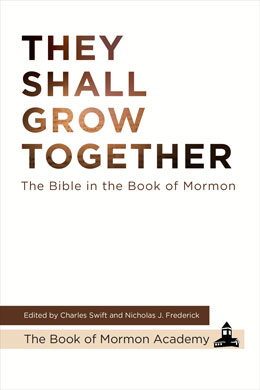
The Language of Paul in the Book of Mormon
Nicholas J. Frederick
Nicholas J. Frederick, "The Language of Paul in the Book of Mormon," in They Shall Grow Together: The Bible in the Book of Mormon, ed. Charles Swift and Nicholas J. Frederick (Provo, UT: Religious Studies Center, Brigham Young University; Salt Lake City: Deseret Book), 205‒34.
Nicholas J. Frederick is an associate professor of ancient scripture at Brigham Young University.
The language of the King James Bible ripples through the Book of Mormon, a text originally composed in some form of Egyptian (see 1 Nephi 1:2; Mormon 9:32). Joseph Smith’s translation of the Book of Mormon rendered the two-millennia-old text into the vernacular of nineteenth-century biblical scripture.[1] But this companionship between scriptures ancient and modern extends beyond the type of English present in both, for the Book of Mormon also contains hundreds, if not thousands, of quotations from and allusions to the King James Bible.[2] From the legal language of Leviticus and Deuteronomy to the hymnic language of the Psalms,[3] as well as the lengthy excerpts from Isaiah[4] and Malachi,[5] language from the King James Old Testament can easily be found within the pages of the Book of Mormon. The answer for why the Book of Mormon would reduplicate so much of the Old Testament text is not necessarily a complicated one, as readers are told that Nephi obtained the brass plates, the text of which mirrored much of our Old Testament (see 1 Nephi 5:10–16; 13:23). Readers should expect to find Old Testament material in the Book of Mormon because the Old Testament became a critical source for Nephite scripture and learning.
What can be at times jarring for readers of the Book of Mormon is the presence therein of the King James New Testament. While the incorporation of the King James Old Testament can be explained by Nephite access to the brass plates, it is more difficult to understand how the text of the New Testament, which was composed centuries after the Lehite migration to the Americas, could be found in the Book of Mormon. Yet there it appears. Passages mirroring the Gospel of Matthew, the Gospel of John, and the book of Revelation can easily be identified in the writings of Nephi, Alma, and Ether.[6] Like the Old Testament quotations and allusions, New Testament language in the Book of Mormon is more often found in phrasal form, but it also appears in much lengthier quotations such as Matthew 5–7 in 3 Nephi 12–14[7] and 1 Corinthians 13 in Moroni 7.[8] Both of those full-length (although not verbatim) quotations from the King James New Testament have drawn the attention of scholars, and much has been written about the implications of their appearance in the Book of Mormon. What has been less studied, however, and what I intend to devote most of this essay to, is the presence of shorter phrases from the letters of Paul in the Book of Mormon text. Elsewhere I have discussed how this type of New Testament biblical language may have come into the Book of Mormon as we have it today, but here I’m more interested in what these carefully integrated phrases are doing and how reading the pertinent Book of Mormon verses through a Pauline lens (and vice versa) may add to our reading and understanding of the Book of Mormon. I am also interested in what the Book of Mormon’s use of Paul (or lack thereof) may say about how the Book of Mormon positions itself in the nineteenth-century American religious conversation, a question I will return to in the conclusion.
This essay will proceed as follows. From the roughly one hundred or so identifiable Pauline phrases in the Book of Mormon (a full list is provided in the appendix at the end), I have selected ten phrases (or groups of phrases), one from each of ten Pauline letters: Romans, 1 Corinthians, 2 Corinthians, Galatians, Ephesians, Philippians, Colossians, 1 Thessalonians, 1 Timothy, and Philemon.[9] I am omitting 2 Thessalonians, 2 Timothy, and Titus because of their apparent absence from the Book of Mormon in a clearly identifiable state (I am interested in more than just echoes here). I’ve also omitted discussion of phrases from the Epistle to the Hebrews because of the unlikelihood that Paul was the author.[10] For each section, I will provide a short intertextual analysis of each passage with an eye toward what an awareness of the Pauline source may add to a reading of the Book of Mormon verse. Following this discussion, I will offer some concluding thoughts on the presence of Paul in the Book of Mormon.
A note on methodology: In each section I will list the Pauline verse(s) and Book of Mormon verse(s) that I will be exploring in this essay. Words in bold italics indicate shared language. Words in just italics indicate synonymous language. Because of the close connections between the KJV Bible and the Book of Mormon, I will use the KJV Bible when discussing the specific verses that are being quoted or alluded to in the Book of Mormon. However, in the more general discussions of Pauline context, I prefer to use the NRSV, since it is a more accessible English translation. Any uses of the NRSV will be indicated parenthetically.
Paul in the Book of Mormon
Romans 7:24 and 2 Nephi 4:17
O wretched man that I am! who shall deliver me from the body of this death? (Romans 7:24)
Nevertheless, notwithstanding the great goodness of the Lord, in showing me his great and marvelous works, my heart exclaimeth: O wretched man that I am! Yea, my heart sorroweth because of my flesh; my soul grieveth because of mine iniquities. (2 Nephi 4:17)
Both Nephi and Paul understand what it means to struggle with sin, a struggle that seemingly hits a climax with the somewhat theatrical exclamation “O wretched man that I am!” The catalyst for Nephi’s self-reckoning appears to be the death of his father, a loss that leads Nephi to question how he will continue to tread the spiritual path while leading his fractured family. Though readers often focus on Nephi’s honest and open-hearted confession, we could also ask what such a scene says about the impact of Lehi in Nephi’s life. Is it possible that Nephi is questioning how he will continue to live righteously now that he finds himself suddenly removed from Lehi’s stalwart presence, realizing that this transition will be successful only if he places every ounce of his trust in the Lord? There is, without a doubt, a remarkable pathos in Nephi’s spiritual self-critique. The young man who has accomplished an incredible amount of spiritual and personal growth through the chapters of 1 Nephi now dares to ask whether, in the end, it is Nephi that will lead to Nephi’s downfall, for, as he laments, “my heart sorroweth because of my flesh; my soul grieveth because of mine iniquities” (2 Nephi 4:17).
Paul evokes a similar sentiment in Romans 7, but with a slightly different catalyst. For Paul it is the question of how to understand the law of Moses. Now that he has found salvation through Christ, where does that leave the law? Is it flawed, something to be cast off by the converted? Or is it still God’s law, and thus something to be prized? Paul’s conclusion is to see the law not as a millstone around one’s neck but as a beacon to be sought after. It is the law, after all, that identifies for us where sin can be found. It is not the fault of the law that we find sin so widespread within us; rather, we owe a debt to the law because it has shone a light on where we need to look. Paul’s exoneration of the law leads him to only one conclusion—sin existed within himself, lying dormant as it waited for a decree against which it could rebel. Such is human nature. Paul’s situation becomes bleaker as he speaks of being “sold into slavery under sin” (Romans 7:14 NRSV) and “captive to the law of sin that dwells in my members” (v. 23). Like Nephi, Paul is forced to grapple with his own internal conflict: “with my mind I am a slave to the law of God, but with my flesh I am a slave to the law of sin” (v. 25).
Second Nephi 4 and Romans 7 present Nephi and Paul at a spiritual crossroads. How will each respond to the new situation he finds himself in (Nephi leading the family without his father, Paul moving from his “blameless” [Philippians 3:6 NRSV] life in Judaism to the more uncertain world of Christian discipleship)? Both respond with serious introspection and a firm commitment to the saving power of Jesus Christ. “Who will rescue me from this body of death?” (Romans 7:24 NRSV), asks Paul. “Thanks be to God through Jesus Christ our Lord!” (v. 25). Likewise, Nephi declares that while his “heart groaneth because of [his] sins,” his faith remains sure: “I know in whom I have trusted” (2 Nephi 4:19). But, perhaps most impressively, both Paul and Nephi accept responsibility for their own actions. The “sins which do so easily beset” Nephi are ultimately his sins (vv. 18–19). At times Paul seems to be close to passing responsibility for his actions on the sin “that dwells within [him],” yet he ends with the assertion that “with my flesh I am a slave to the law of sin” (Romans 7:20, 25 NRSV; emphasis added).
This acceptance of responsibility for actions is a critical moment on the path to discipleship and serves to drive home the power and poignancy of the declaration “O wretched man that I am.” Both Nephi and Paul can reach this point in their spiritual journeys because they are willing to take the responsibility for their own actions. Rather than find an excuse for the mistakes they made, they own them. Only then can they approach the Savior and commit themselves. And while it is true that 2 Nephi 4 and Romans 7 provide critical examples of spiritual giants admitting that they, like everyone else, have made and continue to make mistakes even after choosing the life of discipleship, we also must remember that such admissions come only after one has achieved a certain spiritual maturity. New Testament scholar Leon Morris summarizes well the potency that can be found in Nephi and Paul’s declaration: “It is all too easy to take our Christian status for granted. We so readily remember our victories and gloss over our defeats. We slip into a routine and refuse to allow ourselves to be disturbed by what we see as occasional and minor slips. But a sensitive conscience and a genuine sorrow for every sin are the prerequisites of spiritual depth.”[11] Yes, Nephi and Paul provide examples of how they’re just like us, but perhaps more importantly, they provide examples of what it looks like to be better (spiritually speaking) than us. Sin is not left behind after conversion; rather, sin occurs despite conversion. Nephi and Paul accepted that, and so must we. But also like them, we must not let a mindfulness of our sinful nature become a spiritual stumbling block, one that leaves us crushed under the weight of our own self-awareness. We admit who we are, we strive to be better, and we move on.
1 Corinthians 12:31 and Ether 12:11
But covet earnestly the best gifts: and yet shew I unto you a more excellent way. (1 Corinthians 12:31)
Wherefore, by faith was the law of Moses given. But in the gift of his Son hath God prepared a more excellent way; and it is by faith that it hath been fulfilled. (Ether 12:11)
First Corinthians 12:31 comes at the end of an admonishment to the Christians at Corinth to be mindful in how they are pursuing spiritual gifts. Apparently, many in the congregation were seeking spiritual gifts that would elevate their social status among other Christians, gifts that would serve to mark them as spiritually elite. In 12:25–26, Paul emphasizes that a congregation functions best when there is a diversity of gifts, and if a member receives an honorable gift or calling, “all rejoice together with it” (v. 26 NRSV). Paul continues in the next verses to emphasize this diversity: “Are all apostles? Are all prophets? Are all teachers? Do all work miracles? Do all possess gifts of healing? Do all speak in tongues? Do all interpret?” (vv. 29–30). These rhetorical questions lead to Paul’s final instruction that all should “covet earnestly the best gifts.”[12] The intriguing question, though, is what Paul means by “a more excellent way.” In the following chapter, Paul’s sublime hymn to charity in 1 Corinthians 13, Paul will help his audience understand that the best gifts “are not those that minister to status or to self, but those which serve the good of others and build the community. I now show you that what is an even greater way still is the way of love.”[13] Does Paul here mean that the “more excellent way” to receive “the best gifts” is to exercise charity, or does he mean that he will present them with a “more excellent way” that goes beyond the seeking of gifts at all?[14] The full meaning of Paul’s words in 12:31 remains a mystery.
For readers of the Book of Mormon, Moroni provides some hermeneutical assistance. In Ether 12, Moroni interrupts the Jaredite narrative to provide a powerful discourse on the divine nature of faith, hope, and charity. Beginning at Ether 12:7, Moroni presents a somewhat lengthy catalog of faith, providing examples of when, because of faith, God provided blessings for humanity such as the reception of priesthood and the law of Moses, or the miraculous escapes from prison of Alma and Amulek, Nephi and Lehi, and others. Amid this catalog Moroni states, “But in the gift of his Son hath God prepared a more excellent way; and it is by faith that it hath been fulfilled” (Ether 12:11). Here we see the Book of Mormon alluding to the language of Paul in 1 Corinthians 12:31, with its mention of “gift” and “a more excellent way.” Unlike Paul, however, Moroni is very clear as to how he sees the relationship between “gift” and that “more excellent way.” Whereas Paul intended “gifts” to refer generally to various gifts of the Spirit, Moroni limits his discussion to one gift, the “gift of his Son,” presumably meaning the condescension, ministry, atonement, and crucifixion of Jesus. Interpreted through the lens of Moroni’s language, the “more excellent way” would refer to finding salvation through faith on the name of Jesus Christ. In this instance, the Book of Mormon takes a statement by Paul, a statement with a fair amount of ambiguity, and offers clarification. Additionally, if we bear in mind Moroni’s clarification and return to 1 Corinthians 12:31, Moroni’s reading of the “more excellent way” as “the gift of his Son” acts as a wonderful segue into 1 Corinthians 13, with its discussion of charity, the “pure love of Christ.”
2 Corinthians 11:14 and 2 Nephi 9:9
And no marvel; for Satan himself is transformed into an angel of light. (2 Corinthians 11:14)
And our spirits must have become like unto him, and we become devils, angels to a devil, to be shut out from the presence of our God, and to remain with the father of lies, in misery, like unto himself; yea, to that being who beguiled our first parents, who transformeth himself nigh unto an angel of light, and stirreth up the children of men unto secret combinations of murder and all manner of secret works of darkness. (2 Nephi 9:9)
Here we find two writers, Paul and Jacob, referring to Satan as “an angel of light.” In 2 Corinthians, Paul is waging a war of words with a group of Christians who are interfering with his ministry in Corinth. While little is known of these opponents, scholars often refer to them as “super-apostles” or “false apostles” based on Paul’s vague description.[15] The surmised mission of these “false apostles” was to come into Corinth and undermine Paul’s authority, apparently by criticizing his physical appearance and his determination not to accept money from his converts, both of which are seen as liabilities. In 2 Corinthians 11:13, Paul accuses the “false apostles” of being “deceitful workers” who are “transforming themselves into the apostles of Christ.” This deceit, Paul argues, is no surprise because their master, Satan, is also full of deceit in that he himself “is transformed into an angel of light” when in truth he is the opposite of light just as they, the “false apostles,” are the opposite of true disciples of Christ.
In 2 Nephi 9:9, Jacob also addresses those who are the servants of Satan, but he widens the scope considerably. For Jacob, the pertinent question is how would humanity’s fate have changed if there were to be no physical resurrection from the dead. In other words, if there were no Jesus, no messiah who would rise from the dead, what would happen to the millions of mortals who would live their lives as sinners but have no hope of atonement? Jacob’s answer is that all those who chose to follow Satan by giving into temptation and sin (i.e., everyone, even the most righteous of us) would have no path in the eternities other than being “devils, angels to a devil, . . . to remain with the father of lies, in misery.”
For me, what is so very intriguing (from a historical perspective) about this intertextual pairing comes from what Jacob says next: Satan “stirreth up the children of men unto secret combinations of murder and all manner of secret works of darkness” (2 Nephi 9:9). This association of Satan as an “angel of light” with secret combinations raises the very interesting question of what to do with the “false apostles” in Corinth. If we impose Jacob’s language on Paul’s setting, can we possibly see the “false apostles” as an early Christian example of a “secret combination”? Paul describes the “false apostles” as preaching “another Jesus,” receiving “a different spirit,” and declaring “a different gospel” (2 Corinthians 11:4 NRSV). In other words, the “false apostles” look at first glance like legitimate disciples of Jesus Christ (just as Satan can appear as an “angel of light”), but looking closer we can see how they are deviating from the truth. One need only compare the letter from Giddianhi to Lachoneus in 3 Nephi 3 to see the same type of deception. There the leader of the Gadianton band writes a letter to the Nephite leader Lachoneus that, at first glance, seems to promote a Zion-like society that may very well be compatible with Nephite society. However, a closer reading of 3 Nephi 3 shows just how devious Giddianhi can be, for he consistently alternates optimism and hope with threat and despair. As with the “false apostles,” the Gadianton band may, at first glance, look like legitimate disciples, but something sinister rests just beyond the surface.[16] To see the “false apostles” as a first-century Christian secret combination led by the satanic “angel of light” is a tempting idea, especially as we consider how quickly the New Testament church seems to find itself in apostasy, with many of the churches forsaking leaders such as Paul and John.[17] But the broader message, one that speaks to disciples in every dispensation, is that we must be watchful for the ways the adversary blurs the lines between authenticity and dissension.
Galatians 3:28 and 2 Nephi 10:16
There is neither Jew nor Greek, there is neither bond nor free, there is neither male nor female: for ye are all one in Christ Jesus. (Galatians 3:28)
Wherefore, he that fighteth against Zion, both Jew and Gentile, both bond and free, both male and female, shall perish; for they are they who are the whore of all the earth; for they who are not for me are against me, saith our God. (2 Nephi 10:16)[18]
Paul’s mention of these three critical categories—those persons separated by ethnicity, social status, and gender—comes at a critical point in his fiery letter to the Galatians. As best as scholars can reconstruct, Paul had earlier converted a number of Galatians into the Christian faith before continuing on with his missionary endeavors. Following his departure, a debate arose regarding the need for gentile converts to be circumcised as part of the conversion process. In other words, did gentile converts to the Christian faith need to become Jews in the process of becoming Christians?[19] Paul’s response shows his frustration as he castigates the Galatians for even entertaining the idea that salvation comes by any means other than “through faith in Jesus Christ” (Galatians 3:22 NRSV). The lines of partition that may have served to separate God’s people from the unbelieving nations, such as circumcision, have been done away with in Jesus’s actions. Paul emphasizes that those who “were baptized into Christ have clothed yourselves with Christ” (v. 27), and once this process has occurred every person, regardless of gender, ethnicity, or social station, has a place in Christ’s church as a body united in him. Paul is not arguing that those lines of separation disappear—women remain women, men remain men—but the fact that these differences exist are by no means an excuse to exclude one from access to the blessings of Abraham’s seed, to which all are entitled.[20] The Savior does not discriminate, and neither should those who call themselves by his name.
In 2 Nephi 10, Jacob is also dealing with the topic of covenant status, although in this instance he’s concerned with the covenant status of the Jews “at Jerusalem” (2 Nephi 10:5) who won’t convert to the Christian faith following the Crucifixion. What of them? Are they still heirs of the Abrahamic covenant? Jacob quotes the Lord as saying that the Jews will be restored once “they shall believe in me, that I am Christ” (v. 7). Jacob further teaches that the Gentiles of “this land” (vv. 10, 11) will have a particular role to play in the restoration of the Jews to their blessings. Beginning in v. 12, Jacob subtly changes topic to deal with those who would stand in the way of the Lord’s fulfilling his covenant promises. The Lord will let no one and no thing stand in his way: “I must needs destroy the secret works of darkness, and of murders, and of abomination” (v. 15). The following verse is where we encounter the language of Paul—“Jew and Gentile,” “bond and free,” “male and female.” As Paul did, Jacob uses these three categories to indicate a comprehensiveness—everyone on the earth is either a slave or a freeman, a Jew or a Gentile, a man or a woman. But the interesting element of Jacob’s sermon is that he inverts the context of Paul’s language while preserving the meaning. In Galatians, Paul had stressed that the Lord doesn’t discriminate when it comes to whom he invites into his kingdom. Jacob preserves the meaning that God doesn’t discriminate, but recontextualizes it so that he now speaks of whom God destroys rather than whom God saves. Jacob’s point is that anyone, regardless of gender, social status, or ethnicity, will perish if he or she “fighteth against Zion” (v. 13). God truly is no respecter of persons—he will save any who seek him, and he will leave to perish those who threaten his work.
Ephesians 6:16–17 and 1 Nephi 15:24
Above all, taking the shield of faith, wherewith ye shall be able to quench all the fiery darts of the wicked. And take the helmet of salvation, and the sword of the Spirit, which is the word of God. (Ephesians 6:16–17)
And I said unto them that it was the word of God; and whoso would hearken unto the word of God, and would hold fast unto it, they would never perish; neither could the temptations and the fiery darts of the adversary overpower them unto blindness, to lead them away to destruction. (1 Nephi 15:24)
The first-century Christians lived in a world where cosmic forces, both good and evil, existed on a very real level. God and Jesus have their angels who enforce God’s will in the world, and Satan has his angels who act in a malignant fashion to impede God’s work. Elsewhere in Ephesians, Paul has referred to Satan as “the ruler of the power of the air” (2:2 NRSV) and cautioned his Ephesian audience to “not make room for the devil” (4:27). When Paul states that “we wrestle not against flesh and blood, but against principalities, against powers, against the rulers of the darkness of this world, against spiritual wickedness in high places,” he is likely alluding to the angelic or cosmic foes that do Satan’s bidding (6:12; see 1:21; 3:10).[21] In order to urge defense against such an imposing foe, Paul introduces one of his most famous and powerful images, putting on the “whole armor of God” (6:11). Just as one would need certain armor and weapons to defend against, for example, soldiers in the Roman army, one needs the same implements to defend against a cosmic army. Such items include “the breastplate of righteousness” (v. 14), “the shield of faith” (v. 16), the “helmet of salvation,” and “the sword of the Spirit” (v. 17). Two of these items are notable. First, the “shield of faith” has a fixed purpose attached to it, namely to “quench all the fiery darts of the wicked [one]” (v. 16 KJV).[22] Second, Paul specifically attaches a meaning to the “sword of the Spirit”; it is “the word of God” (v. 17 NRSV). (It is also the only offensive weapon in Paul’s illustration.) Through this imagery, Paul reminds his Ephesians audience that Satan and his forces are a very real threat, and only through a firm reliance on “the word of God” can the Christian prevail.
First Nephi 15 finds Nephi engaged in a theological dialogue with Laman and Lemuel. Nephi’s older brothers had questions regarding the teachings of their father Lehi, many of which, such as the meaning of the natural branches of the olive tree or the proper interpretation of Lehi’s dream of the tree of life, were “hard to be understood” (v. 3). When asked specifically about the rod of iron described by Lehi that led to the tree of life, Nephi responds, “And I said unto them that it was the word of God; and whoso would hearken unto the word of God, and would hold fast unto it, they would never perish; neither could the temptations and the fiery darts of the adversary overpower them unto blindness, to lead them away to destruction” (v. 24). Nephi’s response shares much with Paul’s imagery of the armor of God, such as mention of “the word of God” and reference to “the fiery darts of the adversary.” While some of the language may be the same, the context could hardly be more different, as Lehi’s pastoral field and beautiful tree have replaced the violent images of Paul’s military metaphor. It is no longer possessing the “sword of the Spirit” that is key to maintaining the “word of God,” but grasping the “rod of iron” (although a sword is itself, in a way, a rod of iron). One doesn’t even need the “shield of faith,” because the rod of iron acts sufficiently as protection against not only Satan’s “fiery darts” but also his “temptations.” In a fashion, what Nephi has done is to simplify Paul’s imagery, as if concerned that some people may get swept up in the complexity of Paul’s metaphors of breastplates, swords, and shields, of providing offense and maintaining defense, and think they need more than they actually do. The solution for Nephi is to keep it as simple as possible—all the true disciple needs is to “give heed to the word of God and remember to keep his commandments always in all things” (1 Nephi 15:25).
Philippians 2:12 and Mormon 9:27[23]
Wherefore, my beloved, as ye have always obeyed, not as in my presence only, but now much more in my absence, work out your own salvation with fear and trembling. (Philippians 2:12)
O then despise not, and wonder not, but hearken unto the words of the Lord, and ask the Father in the name of Jesus for what things soever ye shall stand in need. Doubt not, but be believing, and begin as in times of old, and come unto the Lord with all your heart, and work out your own salvation with fear and trembling before him. (Mormon 9:27)
Paul’s injunction to the church at Philippi that they “work out [their] own salvation with fear and trembling” comes at the end of one of the more christologically significant passages in the New Testament, the Christ hymn in Philippians 2:5–11. There Paul uses Jesus’s trajectory of a premortal God who was humble enough to “not regard equality with God as something to be exploited” (v. 6 NRSV), but instead “emptied himself” and took “the form of a slave” (v. 7). Following the Crucifixion, Jesus was “highly exalted” by the Father and given “the name that is above every name” (v. 9 NRSV). Beginning in 2:12, Paul moves away from theology and looks to find a practical application of what he has just taught. Just as Christ was obedient and demonstrated humility in the choices that he made, so must the Christian community demonstrate similar devotion. Paul reminds his audience that they “have always obeyed,” both when he was there and when he was absent, and that they must continue this level of discipleship moving forward.
What tends to be troubling about Paul’s language in Philippians 2:12 is the verb work out linked with salvation. How can Paul, who so often speaks of justification through faith now be emphasizing works? The verb Paul uses here, the imperative κατεργάζεσθε, technically means “to cause a state or condition, bring about, produce, or create.”[24] Significantly, the verb is in the plural form, as is the pronoun your (ἑαυτῶν) that precedes salvation. Paul does not have in mind here the idea that the actions of a single believer can “produce” her or his own salvation, but that the church as a whole has an obligation to “bring about” or “produce” their salvation. Paul’s injunction is thus not theological but ecclesiological; it is “a call for the whole community to rebuild social harmony.”[25] If we read the entire verse in context, Paul is saying something like “Just as you all have always strived to be obedient, regardless of whether I was there or not, you must continue to be obedient, just as Jesus was continually obedient.” The final phrase, “with fear and trembling,” serves to emphasize how the Philippians should approach their situation as disciples of Christ. Paul has used this phrase “fear and trembling” elsewhere (see 1 Corinthians 2:3; 2 Corinthians 7:15; Ephesians 6:5), and similar phrases do appear at times in the Hebrew Bible (see Exodus 15:16; Isaiah 19:16; Psalm 55:5). With these words, Paul impresses on his audience the grandeur of the salvation act. This is not a fear tactic—he isn’t saying that we should “fear and tremble” when we think of our relationship with God. Rather, he is emphasizing the seriousness with which we should take our role as disciples. As one scholar has written, “One does not live out the gospel casually or lightly, but as one who knows what it means to stand in awe of the living God.”[26]
The presence of this phrase in Mormon 9 can be just as striking for readers of the Book of Mormon as it is for New Testament readers of Philippians. What is Moroni trying to say here? The power and reality of grace has been part of the Book of Mormon’s message ever since 2 Nephi 10:24 (compare 25:23), and Moroni himself will teach that “by the grace of God ye are perfect in Christ” (Moroni 10:32), so it seems doubtful that we should see him as advocating something of a works-righteousness in this passage. Much of Mormon 9 is Moroni speaking to his latter-day readers, as if trying to help them work through some of the issues they may encounter when the Book of Mormon comes forth. By the time he reaches verse 26, he is challenging those who will “stand against the works of the Lord” and “deny his sayings,” warning them that they will inevitably “wonder and perish.” Verse, 27 finds Moroni enjoining his readers to “hearken unto the words of the Lord,” to “ask the Father,” to “doubt not, but be believing,” and to “come unto the Lord with all your heart.” In the following verse, he continues with this theme: “be wise,” “strip yourself of all uncleanness,” “ask with a firmness,” and “yield to no temptation” (v. 28).
There is little in Moroni’s words to suggest “work out” in the modern sense that we often assign it. Much like Paul, Moroni is instructing his latter-day readers that they must take seriously the charge of discipleship. The Book of Mormon will come forth in a secular age, a time when miracles will be questioned and the existence of God scorned (see Mormon 9:18–20). Even believers may, at times, doubt. Amid these challenges, all we can do is “come unto the Lord with all [our] heart” (v. 27). All we can do is be as honest and resolute as we can about just how much we need God, about how we cannot find our way home alone. As the invitation to “come unto the Lord with all your heart” directly precedes “work out your own salvation with fear and trembling,” I think we can fairly read the former as finding fulfillment in the latter. Can we push one step further and find Paul’s corporate emphasis in Moroni’s words? Moroni seems to recognize that the challenges that the latter-day church will face will come from a corporate body (“all ye who are despisers of the words of the Lord,” v. 26), and it is certainly possible that he hopes that his instructions will lead to a deepening of bonds within the community of the faithful, that the disciples will strengthen each other and foster an environment of faith and obedience, as Paul had hoped to do in Philippi. We have seen how the Book of Mormon helps clarify the New Testament. Here we see the opposite—the context and meaning of Philippians 2:12 can assist in helping readers grapple with Mormon 9:27 and hopefully make better sense of what is certainly a difficult passage.
Colossians 2:17 and Mosiah 16:14
Which are a shadow of things to come; but the body is of Christ. (Colossians 2:17)
Therefore, if ye teach the law of Moses, also teach that it is a shadow of those things which are to come. (Mosiah 16:14)
The Christian congregation located in Colossae was beset by serious doctrinal issues that have perplexed scholars for centuries. As near as can be reconstructed, a “Colossian heresy” had arisen among the Christians that was, in some form, a synthesis of Christianity, Judaism, and Hellenism. In the verses preceding Colossians 2:17, Paul suggests that some of the Christians are being criticized for their choices regarding “food and drink or for observing festivals, new moons, or sabbaths” (v. 16 NRSV). Likely what has happened is that the Jewish members of the Christian congregation are criticizing the gentiles members for not observing more strictly (or at all) certain elements of the law of Moses, such as eating only clean foods, observing Jewish festivals, and honoring the Sabbath. For the Jews, these were important boundary markers of their faith, but the gentile Christians would have little invested in observing Jewish regulations. Paul sides with the gentile Christians, telling them, “Therefore do not let anyone condemn you” (v. 16). In the next verse he explains why the gentile Christians should feel no obligation to Jewish boundary markers. Although maintaining kosher food regulations, observing festivals, and honoring the Sabbath were critical parts of the law of Moses, the law was better understood as “a shadow” of what was to come, namely the sacrifice of Jesus Christ—he is the “body” that casts the “shadow” back into the past. Before Christ’s resurrection, all who worshipped Jehovah had certain things required of them in order to maintain a separation from the Gentiles. However, once Jesus had been raised from the dead, there was little need to continue following those regulations. Paul seems to have no problem with those Jewish Christians who desire to continue adhering to the Mosaic law in addition to practicing Christianity, but where he draws the line is in imposing these Jewish observances on the gentile Christians.
This context, can, I think, be helpful in better understanding the story of Abinadi and the priests of King Noah. Beginning in Mosiah 12, Abinadi is interrogated by the priests of King Noah because of his condemnatory statement against the king and his subjects (see vv. 3–8). While the priests’ conduct and manner of living seems worthy of condemnation, I think at times we overlook their own theological position. They are not irreligious, for they justify their temporal success with a reference to the Lehite covenant—that is, they have “prospered in the land” (v. 15), so they must be righteous. Their “righteousness,” like that of the Jewish Christians at Colossae, is based on adherence to the law of Moses (or at least they claim to, at the very least, teach it; compare v. 28). Their problem (in addition to their hypocrisy) is that their promotion of the law of Moses extends to their belief that it can, in fact, provide salvation outside the atonement of Jesus Christ (compare Mosiah 13:28), although just how altruistic this claim to belief in the law actually is can certainly be debated. In this sense, they are a step or two behind the Jewish Christians in Colossae, who (presumably) do accept that salvation comes only through the Atonement but still desire to hold on to tradition.
Reading the account of Abinadi’s trial through the lens of Colossians helps us understand that a lot of us, even faithful disciples, at times may struggle to rely fully on the reality of the Atonement. After all, we cannot see the Atonement; there is no indisputable evidence that it happened. What we encounter are types and shadows. There is something enticing about finding other things we can do to supplement our faith and obedience, and there is certainly nothing wrong with this, unless we start to put more emphasis on what we do rather than on what the Savior did. Further, it should be noted that neither Paul nor Abinadi condemns those who choose to follow the law of Moses. Paul chastises those who impose the law on other Christians, while Abinadi condemns those who profess to teach the law of Moses but who do not live it themselves (see Mosiah 12:29). It is not the law of Moses that is the problem, as if it was defective or failed in fulfilling its purpose; rather, it is substituting the law of Moses for the atonement of Jesus Christ that both Paul and Abinadi emphasize in their messages.
1 Thessalonians 5:12, 17–18 and Mosiah 26:39
And we beseech you, brethren, to know them which labour among you, and are over you in the Lord, and admonish you; . . . Pray without ceasing. In every thing give thanks: for this is the will of God in Christ Jesus concerning you. (1 Thessalonians 5:12, 17–18)
And they did admonish their brethren; and they were also admonished, every one by the word of God, according to his sins, or to the sins which he had committed, being commanded of God to pray without ceasing, and to give thanks in all things. (Mosiah 26:39)
First Thessalonians is one of Paul’s earliest, if not the earliest, extant letter (depending on how one dates Galatians). Likely written in the early 50’s AD, the letter addresses Christians Paul had converted in the Greek city of Thessalonica. Paul’s time in Thessalonica was interrupted by a series of charges brought against him for disturbing the peace. He was forced to flee the city after a few weeks, eventually finding himself in Corinth, and it was in Corinth that he would pen this letter.[27] The primary focus of the letter, what 1 Thessalonians is most well-known for, is Paul’s explication of the Second Coming in 1 Thessalonians 4. The next chapter finds Paul making a series of appeals to his converts, outlining for them the expectation he has for this new branch—namely, become acquainted with and love their leaders, comfort each other, support the weak, promote the spirit, and so on. The three verses under examination here, 1 Thessalonians 5:12, 17–18, are part of this lengthy appeal.
The Nephite church of Mosiah 26 shares much with the Thessalonian congregation. Owing to the arrival of the parties of Alma and Limhi, the church at Zarahemla had undergone a rather significant transformation and was, in many ways, as fresh and inexperienced as Paul’s. Furthermore, verse 38 relays that the people in Alma’s church suffered “all manner of afflictions, being persecuted by all those who did not belong to the church of God.” According to 1 Thessalonians 2:14–16, the newly baptized Thessalonian Christians endured a great deal of persecution as well. By reading these passages together, we are reminded of what the respective ecclesiastical leaders found important to emphasize as foundational practices in these newly formed branches. Leadership is critical—a strong hand is needed to guide the church through its early phrase. Prayer is a necessity—fledgling members need that connection with the divine to remind themselves of why they were baptized in the first place. Finally, giving thanks is fundamental—the message at the heart of Christianity is a joyful, sublime one. Jesus has conquered sin and death, and all who follow him can find rest. It’s important that we continue to express our gratitude for this, for our benefit and the benefit of those around us.
1 Timothy 1:18 and Alma 1:1
This charge I commit unto thee, son Timothy, according to the prophecies which went before on thee, that thou by them mightest war a good warfare. (1 Timothy 1:18)
Now it came to pass that in the first year of the reign of the judges over the people of Nephi, from this time forward, king Mosiah having gone the way of all the earth, having warred a good warfare, walking uprightly before God, leaving none to reign in his stead; nevertheless he had established laws, and they were acknowledged by the people; therefore they were obliged to abide by the laws which he had made. (Alma 1:1)
The son of a Jewish mother and a gentile father (see Acts 16:1), Timothy had, by the time 1 Timothy was written, served as Paul’s companion for more than a decade, in many cases serving as his right-hand man. According to tradition, 1 Timothy was written by Paul during his imprisonment in Rome. The epistle is addressed to Timothy, who was serving as the bishop of Ephesus (see 1 Timothy 1:3).[28] Ephesus had become something of a hotbed for heresy, and Paul may have stationed Timothy there for just this reason—he needed someone there he could rely on, someone who could counter the false teachers who had arrived in Ephesus and were promoting some very problematic heretical teachings (see 1 Timothy 1:3–4; compare Acts 20:28–30).[29] It is under these stressful circumstances that Paul tells Timothy to “war a good warfare,” again employing a military metaphor, similar to what he had done in Ephesians 6. But there is a spiritual element at work as well, for Paul reminds Timothy of the “prophecies made earlier about you” (1 Timothy 1:18 NRSV). The war Timothy is fighting, that of a Christian leader fighting for the truth, is a “good” one.[30] Paul wants to encourage Timothy to persevere in the face of heresy, and his choice of a military metaphor here “seeks to elevate the urgency of the action to be taken by Timothy.”[31]
In Alma 1:1, where we find this phrase in the Book of Mormon, the context seems very different. Whereas Paul was encouraging Timothy to continue on in the face of adversity, Mormon uses it of Mosiah2 in almost a eulogistic fashion, describing the deeds of the great Nephite king who has now passed on. Furthermore, 1 Timothy is written at a time when the church was at a crisis point as it moved closer and closer to apostasy. In Alma, the church has recently become more and more successful, and while the Nephites will certainly face struggles throughout the book of Alma, it isn’t until the book of Helaman that the Nephite church will have to endure its own serous apostasy in the wake of the Gadianton robbers.
So what insights can we gain by reading these two stories through the same lens? One provocative option is to see “war the good warfare” as a signifier of the heterodox threat facing the church in Ephesus and Zarahemla. While Timothy was charged with countering the impact that false teachers were having in Ephesus, Mosiah2 had his own encounter with a wave of false teachers in the church. Mosiah 26 tells us that the “rising generation . . . did not believe what had been said concerning the resurrection of the dead, neither did they believe concerning the coming of Christ” (vv. 1–2). Most famously, Alma the Younger and the sons of Mosiah were numbered among those who were promoting these ideas and “seeking to destroy the church” (Mosiah 27:10). Perhaps it is here, with threat of doctrinal heresy, that the stories of Timothy and Mosiah2 merge. Fortunately for Mosiah2, his situation appears to have ended much more successfully than Timothy’s.
Philemon 1:19 and 1 Nephi 1:3
I Paul have written it with mine own hand, I will repay it: albeit I do not say to thee how thou owest unto me even thine own self besides. (Philemon 1:19)
And I know that the record which I make is true; and I make it with mine own hand; and I make it according to my knowledge. (1 Nephi 1:3)
Paul’s letter to Philemon is his briefest extant letter. The occasion for the correspondence concerns Onesimus, a slave who has run away from his owner, a member of the Colossian church named Philemon. Paul doesn’t tell us why Onesimus has left Philemon’s household, but apparently Onesimus has had second thoughts and desires to return to Colossae. The punishment meted out to runaway slaves in the ancient world was often brutal, so Onesimus may have approached Paul in order for Paul to write Philemon a letter facilitating Onesimus’s return.[32] Paul’s letter is a masterpiece of rhetoric, at one moment meekly interceding on behalf of Onesimus while at the next reminding Philemon that he owes Paul a big favor (his baptism).[33] Paul even ends the letter with the not-so-subtle request that Philemon prepare a place for Paul in case Paul (who was currently in prison) should have the opportunity to come visit Philemon and personally be able to check up on the status of Onesimus.[34] The verse in question, verse 19, suggests that Paul is, at this point in the letter, inserting his own personal voice. The normal process for writing letters was to hire a scribe and dictate to the scribe what one wanted to say, often followed by the sender of the letter taking the pen and signing his or her own name at the end (compare Galatians 6:17; Colossians 4:18; 1 Corinthians 16:21). But here in verse 19 Paul apparently takes up the pen and writes this verse himself, stressing his personal involvement in the safe return of Onesimus. Whatever financial repercussions Philemon has suffered owing to Onesimus’s flight, Paul promises, in his own hand, that he will repay it himself.[35]
A similar notion is a work in 1 Nephi 1:3, where Nephi announces to his readers three things about the small plates: they are true, they are written in his own hand, and they are written according to his knowledge. Nephi could have simply said that the record was true and that it was prepared according to his knowledge. Unlike the letters of Paul, there is no sense in the Book of Mormon that our authors relied on scribes or other parties when writing on the plates. However, the inclusion of “I make it with my own hand” relays a critical personal element to the gold plates. If Paul’s taking up the pen to write in his own hand acts as a sort of “promissory note,”[36] Nephi’s same claim likewise acts as a promissory note for the small plates (or at least Nephi’s own record). Just as Philemon can rest assured that Paul will cover any expenses, Nephi assures his readers that what they are about to read is both true and represents Nephi’s knowledge of these events. When we read 1 Nephi 1:3 with Paul’s heartfelt plea to Philemon in mind, we can see the extraordinary personal effort that Nephi invested in this project and how dearly he wants us, his latter-day readers, to invest ourselves in it.
Conclusion
In this essay we have explored several different ways that the language of Paul was incorporated into the Book of Mormon. In some cases—such as Romans 7:24/
However, one thing that surprises me as a student of both Paul’s epistles and the Book of Mormon is just how minor of a presence Paul’s voice has in the Book of Mormon text. The voices of the Gospel of Matthew, the Gospel of John, and the book of Revelation appear fairly frequently throughout the Book of Mormon, but aside from two chapters at the end of the book—Moroni 7 and 10—readers are hard-pressed to find much of Paul’s voice beyond a few short phrases, several of which were explored in this essay. One need only read the sermons and writings of Jonathan Edwards, Gilbert Tennent,[37] or George Whitefield to see the impact that Paul’s writings had in America in the years prior to the publication of the Book of Mormon. The United States was, after all, a Protestant nation, with the letters of Paul providing an authoritative theological voice. Disputes, such as those between Calvinists and Arminians, primarily occurred when interpretations of Pauline text differed.[38]
Yet the Book of Mormon, with all its similarities and adaptations of the Bible, sidelines Paul to a surprising extent. One could certainly argue that his theology is present—justification, sanctification, faith, and grace all make appearances, and one can find much in common between King Benjamin’s address and the Epistle to the Romans. But the language is a different story. One cannot help but wonder if this is an intentional move by the Book of Mormon translator(s). In the New Testament, nearly half of the twenty-seven documents (more if one considers Hebrews Pauline) are attributed to Paul, and Paul is considered by some to be the founder of the Christian movement.[39] Yet he remains a peripheral voice in a very polyphonic text. Is it possible that the Book of Mormon is offering something of a corrective, reclaiming Christianity for Jesus through the voices of Matthew and John? In an interesting twist, while the Book of Mormon translator(s) may have relied on the language of the King James Bible to provide a sense of scriptural authenticity and authority, tethering the two together on a textual level, by placing Paul firmly on the sidelines these same translator(s) likewise provided the Book of Mormon with its own independence from contemporary theological debate. Protestants may have needed the letters of Paul to help them find their way through the theological quagmires, but the Book of Mormon emphatically does not.
I hope this essay has demonstrated that one need not be chary (or even wary) of finding the New Testament in the Book of Mormon. The Book of Mormon is a divine text, its language inspired (however one understands that process). Ignoring the intersections between the Book of Mormon and the Bible only serves to cut ourselves off from additional avenues of inquiry, limiting in some respect just how much this wonderful book can offer us. I offer the invitation and the encouragement to all who want to come to a greater, deeper understanding of the Book of Mormon—seek out those places where the Book of Mormon intersects with the Bible, whether that be in narrative, language, or doctrine, and strive to understand what the Book of Mormon is trying to teach. Ignoring the Bible’s role in the Book of Mormon is like listening in on a conversation between two people but covering your ears every time one of them speaks. What you hear may be entertaining, and perhaps even useful, but you’ll find yourself missing an important part of the story.
Appendix 1: Full List of Pauline Phrases in the Book of Mormon[40]
Romans 1:20/
Romans 1:21/
Romans 3:12/
Romans 3:20/
Romans 4:3/
Romans 5:5/
Romans 5:12/
Romans 6:23/
Romans 7:24/
Romans 8:6/
Romans 8:39/
Romans 9:6/
Romans 10:21/
Romans 11:13/
Romans 11:17/
Romans 11:24/
Romans 11:25/
Romans 11:33/
Romans 12:19/
1 Corinthians 3:15/
1 Corinthians 4:1/
1 Corinthians 11:29/
1 Corinthians 12:4–7/
1 Corinthians 12:7/
1 Corinthians 12:8/
1 Corinthians 12:9/
1 Corinthians 12:10/
1 Corinthians 12:11/
1 Corinthians 12:31/
1 Corinthians 13:2, 8, 13/
1 Corinthians 13:2/
1 Corinthians 13:3/
1 Corinthians 13:4–7/
1 Corinthians 13:13/
1 Corinthians 13:13/
1 Corinthians 13:13/
1 Corinthians 15:14, 55/
1 Corinthians 15:42/
1 Corinthians 15:51–53/
1 Corinthians 15:53/
1 Corinthians 15:54/
1 Corinthians 15:55/
1 Corinthians 15:55–56/
1 Corinthians 15:58/
1 Corinthians 15:58/
1 Corinthians 16:13/
2 Corinthians 5:10/
2 Corinthians 5:10/
2 Corinthians 5:17/
2 Corinthians 6:7/
2 Corinthians 6:17/
2 Corinthians 9:8/
2 Corinthians 11:14/
2 Corinthians 12:2, 4/
2 Corinthians 12:2/
2 Corinthians 12:4/
2 Corinthians 12:9–10/
Galatians 2:16/
Galatians 3:28/
Galatians 5:1/
Ephesians 4:5/
Ephesians 5:5/
Ephesians 6:4/
Ephesians 6:16/
Philippians 2:6–7/
Philippians 2:10/
Philippians 2:12/
Colossians 2:2/
Colossians 2:17/
1 Thessalonians 3:12/
1 Thessalonians 5:12, 17–18/
1 Timothy 1:18/
Philemon 1:19/
Notes
[1] Recent work by Royal Skousen (and Stanford Carmack) argues that the nature of the language of the Book of Mormon is better understood as Early Modern English. Skousen’s argument is convincing, and at the very least there should be a healthy concern to not speak of the Book of Mormon language as simply a reproduction or imitation of King James English. See his The Nature of the Original Language, parts 3 and 4 of The History of the Text of the Book of Mormon (Provo, UT: Foundation for Ancient Research and Mormon Studies, 2018). See also Royal Skousen, “The Language of the Original Text of the Book of Mormon,” BYU Studies Quarterly 57, no. 3, (2018): 81–110.
[2] See Nicholas J. Frederick, “The Book of Mormon and the Redaction of the King James New Testament,” Journal of Book of Mormon Studies 27 (2018): 44–87. See also discussion in Philip L. Barlow, Mormons and the Bible: The Place of the Latter-day Saints in American Religion, 2nd ed. (New York: Oxford University Press, 2013), 26–40; and Grant Hardy, Understanding the Book of Mormon: A Reader’s Guide (New York: Oxford University Press, 2010), 248–67.
[3] See John Hilton III, “Old Testament Psalms in the Book of Mormon,” in Ascending the Mountain of the Lord: Temple, Praise and Worship in the Old Testament, ed. David Rolph Seely, Jeffrey R. Chadwick, and Matthew J. Grey (Provo, UT: Religious Studies Center, Brigham Young University, 2013), 291–311. See also Steven P. Sondrup, “The Psalm of Nephi: A Lyric Reading,” BYU Studies Quarterly 21, no. 3 (1981): 357–72.
[4] There are numerous studies on the issue of Isaiah in the Book of Mormon. See, e.g.,
David P. Wright, “Isaiah in the Book of Mormon: Or Joseph Smith in Isaiah,” in American Apocrypha: Essays on the Book of Mormon, ed. Dan Vogel and Brent Metcalfe (Salt Lake City: Signature Books, 2002), 157–234; and Kent P. Jackson, “Isaiah in the Book of Mormon,” in A Reason for Faith: Navigating LDS Doctrine and Church History, ed. Laura Harris Hales (Provo, UT: Religious Studies Center, Brigham Young University, 2016), 69–78. For volume-length treatments of the role Isaiah plays in the Book of Mormon, see Joseph M. Spencer, The Vision of All: Twenty-Five Lectures on Isaiah in Nephi’s Record (Draper, UT: Greg Kofford Books, 2016); and Isaiah in the Book of Mormon, ed. Donald W. Parry and John W. Welch (Provo, UT: FARMS, 1998).
[5] See Aaron P. Schade and David Rolph Seely, “The Writings of Malachi in 3 Nephi: A Foundation for Zion in the Past and Present,” in Third Nephi: An Incomparable Scripture, ed. Andrew C. Skinner and Gaye Strathearn (Provo, UT: Religious Studies Center, Brigham Young University, 2012), 261–80; and Colby J. Townsend, “‘Behold, Other Scriptures I would That Ye Should Write’: Malachi in the Book of Mormon,” Dialogue 51, no. 2 (2018): 103–37.
[6] For a lengthy list of New Testament quotations and allusions in the Book of Mormon, see Frederick, “Redaction of the King James New Testament,” 73–87.
[7] See, e.g., Krister Stendahl, “The Sermon on the Mount and Third Nephi,” in Reflections on Mormonism, ed. Truman G. Madsen (Salt Lake City: Bookcraft, 1978), 139–54; John W. Welch, The Sermon at the Temple and the Sermon on the Mount (Salt Lake City: Deseret Book; Provo, UT: FARMS, 1990); and Stan Larson, “The Historicity of the Matthean Sermon on the Mount in 3 Nephi,” in New Approaches to the Book of Mormon: Explorations in Critical Methodology, ed. Brent Lee Metcalfe (Salt Lake City: Signature Books, 1993), 115–63.
[8] See Sidney B. Sperry, The Problems of the Book of Mormon (Salt Lake City: Bookcraft, 1964), 116–18; Bruce R. McConkie, “The Doctrinal Restoration,” in The Joseph Smith Translation: The Restoration of Plain and Precious Things, ed. Monte S. Nyman and Robert L. Millet (Salt Lake City: Bookcraft, 1985), 18; and Joseph Fielding McConkie, Robert L. Millet, and Brent L. Top, Doctrinal Commentary on the Book of Mormon, vol. 4, Third Nephi through Moroni (Salt Lake City: Bookcraft, 1992), 343. Of 1 Corinthians 13 in Moroni 7, Brant Gardner writes: “Undoubtedly 1 Corinthians 13:4–7 is the model upon which Moroni 7:45 is written. Obviously, the same reason for similarity of language exists here as on other occasions where New Testament passages appear in the context of the Book of Mormon text. Joseph’s familiarity with King James Language has supplied the vocabulary for this concept.” Brant A. Gardner, Second Witness: Analytical and Contextual Commentary on the Book of Mormon, 6 vols. (Sandy, UT: Greg Kofford Books, 2007), 6:381.
[9] I am aware that Ephesians and Colossians, along with 2 Thessalonians, are considered “Deutero-Pauline” by many, if not most, Pauline scholars. Additionally, most scholars would more or less exclude the three pastoral Epistles—1 Timothy, 2 Timothy, and Titus—from the Pauline corpus. I include them in this discussion because these distinctions did not necessarily exist when the Book of Mormon was published in 1830, and because Pauline authorship is asserted by these letters (which it is not for Hebrews), and so I am comfortable discussing them as “Pauline,” even if Paul himself was not the actual author. For a useful introduction as to why the three letters treated in this essay (Colossians, Ephesians, and 1 Timothy) are categorized as they are, see Raymond E. Brown, An Introduction to the New Testament (New York: Doubleday, 1997), 610–15, 626–30, 662–70.
[10] On the authorship of Hebrews, see Brown, Introduction to the New Testament, 693–97.
[11] Leon Morris, The Epistle to the Romans (Grand Rapids, MI: Eerdmans, 1988), 296.
[12] There is some disagreement as to whether covet (ζηλοῦτε) is in the indicative or imperative mood. While the King James Version translates it in the imperative, it actually makes more sense to see Paul saying, “You covet earnestly the best gifts,” in this case a statement of fact rather than a command. However, in two other places (1 Corinthians 14:1, 39) the same verb occurs, and in both cases it is clearly an imperative, so most commentators choose to translate 1 Corinthians 12:31 as “covet” rather than “You covet.”
[13] Anthony C. Thistleton, The First Epistle to the Corinthians: A Commentary on the Greek Text (Grand Rapids, MI: Eerdmans, 2000), 1024.
[14] Two scholars answer this question with “It seems best not to think that Paul was talking about pursuing love as a way to gain greater gifts rather than the way to live and prioritize life, but as one uses one’s gifts in constant loving service to others, God may see fit to provide further enablements to allow one’s service to be even more creative and effective.” Roy E. Ciampa and Brian S. Rosner, The First Letter to the Corinthians (Grand Rapids, MI: Eerdmans, 2010), 617.
[15] For discussion of the pertinent issues and speculation on the identity of the “super-apostles,” see Frank J. Matera, II Corinthians: A Commentary (Louisville, KY: Westminster John Knox, 2003), 244–54.
[16] Daniel C. Peterson gives what I consider one of the best definitions of the Gadianton movement (and its appeal) in the Book of Mormon: “The authors of the Book of Mormon themselves repeatedly declare that they are deliberately withholding information about the Gadiantons, presumably because of the seductive nature of Gadiantonism. It was, plainly, an alternate religious and political vision, a revolutionary ideology, that many Nephites and Lamanites found attractive. It had its own canonical texts, which, the Book of Mormon insists, were revealed by the devil.” “Gadianton Robbers and Historical Parallels,” Deseret News, November 5, 2010.
[17] Regarding the abandonment by the early Christian church of leaders such as Paul and John, I have in mind such passages as 2 Timothy 1:2 and 3 John 1:9–10.
[18] “Jew and Gentile,” “bond and free,” and “male and female” also appear in 2 Nephi 26:33, although in a different order than in 2 Nephi 10:16. The phrase “bond and free” also appears in Alma 1:30 and 4 Nephi 1:3, with the former also containing “male and female.” However, I’m limiting this discussion to 2 Nephi 10:16 because it comes closest to the language and order of Galatians 3:28.
[19] For more on this, see James D. G. Dunn, Christianity in the Making, vol. 2, Beginning from Jerusalem (Grand Rapids, MI: Eerdmans, 2009), 438–69.
[20] As F. F. Bruce has put it, “It is not their distinctiveness, but their inequality of religious role, that is abolished ‘in Christ Jesus.’” The Epistle to the Galatians: A Commentary on the Greek Text (Grand Rapids, MI: Eerdmans, 1982), 189.
[21] Of the terms thrones, dominions, principalities, and powers that appear at various places in the New Testament (as well, interestingly enough, in Doctrine and Covenants 121:29 and 132:13) one commentator writes: “The fact that all four terms thus refer only to the invisible, heavenly realm and the repeated emphasis on Christ’s supremacy and triumph over the ‘principalities and powers’ . . . adds a further reference to Christ’s superiority over all beings in heaven as well as on earth. . . . The most obvious inference . . . is that these powers are understood as somehow threatening or hostile to God’s cosmos.” James D. G. Dunn, The Epistles to the Colossians and to Philemon: A Commentary on the Greek Text (Grand Rapids, MI: Eerdmans, 1996), 92–93. Another commentator adds, “The ‘world rulers of this darkness,’ then, are the evil spiritual powers who preside over the chaos that those alienated from God have brought on themselves.” Frank Thielman, Ephesians (Grand Rapids, MI: Baker Academic, 2010), 421. For the possibility that these terms refer to human institutions, see the argument in Marcus Barth and Helmut Blanke, Colossians: A New Translation with Introduction and Commentary, trans. Astrid B. Beck (New Haven: Yale University Press, 2008), 201–3.
[22] The Greek adjective τοῦ πονηροῦ is likely meant substantively, referring to the “wicked one” rather than more generally to “wicked” people or to “wickedness.”
[23] A similar allusion to Philippians 2:12 is found in Alma 34:37. I’m choosing to explore Mormon 9:27 because it has more terminology in common with Philippians 2:12.
[24] Frederick William Danker, A Greek-English Lexicon of the New Testament and other Early Christian Literature, 3rd ed. (Chicago: University of Chicago Press, 2000), 531.
[25] G. Walter Hansen, The Letter to the Philippians (Grand Rapids, MI: Eerdmans, 2009), 173.
[26] Gordon D. Fee, Paul’s Letter to the Philippians (Grand Rapids, MI: Eerdmans, 1995), 237.
[27] A useful introduction to the dating and context of the 1 Thessalonians letter can be found in Brown, Introduction to the New Testament, 456–59.
[28] For the problems associated with viewing 1 Timothy as a genuinely Pauline letter, see note 9.
[29] A useful discussion of what these heretical teachings may have been is provided in George W. Knight III, The Pastoral Epistles: A Commentary on the Greek Text (Grand Rapids, MI: Eerdmans, 1992), 11–12. See also Luke Timothy Johnson, The First and Second Letters to Timothy: A New Translation with Introduction and Commentary (New Haven, CT: Yale University Press, 2008), 162–64.
[30] “Paul makes clear that the ‘fight’ is a good and noble task and in accord with the gospel. The context depicts the fight in terms of a warfare against opponents such as Satan (v. 20) and, more concretely, those who abandon a good conscience and faith, who blaspheme (vv. 19 and 20), and who teach heterodoxy (vv. 4ff.). In his use of soldier imagery in 2 Tim. 2:3, Paul elaborates, in effect, on what is involved in such a fight, namely, willingness to suffer hardship and to be completely faithful to one’s commander.” Knight, Pastoral Epistles, 108–9.
[31] Philip H. Towner, The Letters to Timothy and Titus (Grand Rapids, MI: Eerdmans, 2006), 157.
[32] “Severe penalties were permitted by law to be carried out against a runaway slave: he could be sold by his master to another, perhaps harsher slave owner; he could be scourged, branded, mutilated, or fitted with a metal collar, perhaps even be crucified, thrown to beasts, or killed.” Joseph A. Fitzmyer, The Letter to Philemon: A New Translation with Introduction and Commentary (New Haven, CT: Yale University Press, 2008), 28.
[33] “Philemon apparently became a Christian through the evangelization of Paul so that he has become Philemon’s spiritual father and patron, as well as that of Onesimus; he is saying, in fact, that Philemon is quite indebted to him.” Fitzmyer, Philemon, 119.
[34] “In thus speaking of a coming visit, Paul again is applying subtle pressure; he may soon be on hand to see how Philemon has reacted to this letter and to his appeal for Onesimus.” Fitzmyer, Philemon, 121.
[35] “English translations cannot quite convey the emphasis on Paul’s own involvement that we find in the Greek text: both ‘I’s are expressed in Greek with a pronoun (not strictly required), and the ‘my’ may also be emphatic.” Douglas J. Moo, The Letters to the Colossians and to Philemon (Grand Rapids, MI: Eerdmans, 2008), 429.
[36] M. J. Harris, Colossians and Ephesians (Grand Rapids, MI: Eerdmans, 1991), 273.
[37] Students of American religious history may recognized that Gilbert Tennent ended what was likely his most famous sermon, “The Danger of an Unconverted Ministry” (1740), with the same passage from 2 Corinthians 11:14 discussed earlier in this essay.
[38] For example, in his discussion of William White, E. Brooks Holifield observes that “White was one of the first American theologians to decide that the contest between Calvinists and Arminians during the previous two centuries had rested on a misreading of Paul by both parties.” Theology in America: Christian Thought from the Age of the Puritans to the Civil War (New Haven, CT: Yale University Press, 2003), 239.
[39] See, e.g., Gerd Ludemann, Paul: The Founder of Christianity (Amherst, MA: Prometheus Books, 2002); and A. N. Wilson, Paul: The Mind of the Apostle (New York: W. W. Norton, 1997). For a critique of this view, see Tom Wright, What St. Paul Really Said (Oxford: Lion, 1997), esp. 167–84.
[40] For the methodology I used to identify these intertextual connections, see Nicholas J. Frederick, “Evaluating the Interaction between the New Testament and the Book of Mormon: A Proposed Methodology,” Journal of Book of Mormon Studies 24, no. 1 (2015): 2–31.
