
 menu icon in the top, right corner of the screen.
 icon above to close this box.
 icon at the bottom of the screen below the browser—if you don't see it, swipe up to unhide it.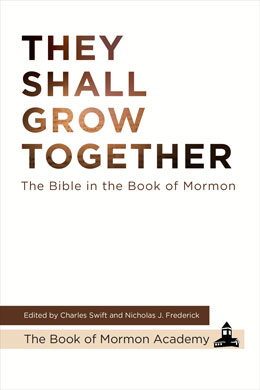
Ryan Sharp, "'Except Some Man Should Guide Me': Studying Isaiah with Nephi and Jacob," in They Shall Grow Together: The Bible in the Book of Mormon, ed. Charles Swift and Nicholas J. Frederick (Provo, UT: Religious Studies Center, Brigham Young University; Salt Lake City: Deseret Book), 327‒64.
Ryan Sharp is an assistant teaching professor of ancient scripture at Brigham Young University.
Introduction
In the book of Acts a man is sitting in his chariot studying the words of Isaiah. Entrusted with the task of overseeing the queen’s treasure, this “man of Ethiopia” would seem to be a competent and responsible man. He appears to be a religious man as well, worshipping in Jerusalem and immersing himself in a study of scripture (see Acts 8:27–28). However, when it came to his study of Isaiah, he, like many of us, lacked understanding. In this moment, the Spirit prompts Philip, a church administrator, to “go near, and join thyself to this chariot” (v. 29). Approaching the chariot, and hearing this man reading aloud the words of Isaiah, Philip asks, “Understandest thou what thou readest?” (v. 30), to which this diligent student humbly responds, “How can I, except some man should guide me?” (v. 31). Philip then sits with this inquiring student, walks him through these difficult passages, and “preache[s] unto him Jesus” (v. 35).
Like the man in this story, many readers of the Book of Mormon have sat puzzled as they have tried to understand the writings of Isaiah.[1] Often teachers approach their students and ask in their own way, “Understandest thou what thou readest?” And, like the Ethiopian man in Acts 8, the students’ responses are the same, “How can I, except [someone] should guide me?” The purpose of this study is to demonstrate how Nephi and Jacob function as just such guides. A close reading of the texts shows that as they drew on the writings of Isaiah, these two authors attempted to help their initial audience (and, by extension, readers of the Book of Mormon) understand how they were using and interpreting Isaiah.
Approaching and Teaching Scripture
One of the great opportunities and challenges facing those with the responsibility to teach the scriptures, particularly ancient scripture, is helping students find what Elder Neal A. Maxwell once called “relevancy within antiquity.”[2] Teachers can help students develop the tools, skills, and techniques to dig deeper into the text in a way that makes the scriptures more meaningful. This requires not only an exercise of faith but also an exercise of our minds. Speaking of such intellectual calisthenics, Truman Madsen once said that when it comes to gospel study, he could “find nothing in the scriptures, ancient or modern, to excuse anyone from brain sweat and from the arduous lifetime burden of seeking.”[3]
This so-called brain sweat requires each student of the scriptures to “read more slowly and more carefully and with more questions in mind.”[4] We have likely all had impactful experiences—even revelatory experiences—studying the scriptures in a way that asks personal questions from the text (e.g., How does this apply to me?). However, to help students enhance their experience in the scriptures, we can help them learn to ask questions of the text. In biblical studies, asking critical questions of a text is called exegesis (from the Greek ex, “out,” and hēgéomai, “lead”—meaning “to lead out of”). Exegesis requires that before we can find application of a principle to “us, here and now,” we first need to know how it applied to “them, there and then.” Eric Huntsman, professor of ancient scripture, suggests that this approach “allows scripture, and the gospel more generally, to serve as both a window into the ancient world and a mirror to our current experience, which makes it more interesting.”[5]
When the early Nephites discussed scripture, they most often referred to their study of the brass plates.[6] Consequently, Book of Mormon scholar Daniel L. Belnap argues, “On one level the Nephites’ concept of scripture was similar to ours: a collection of texts gathered together into one source.” However, Belnap goes on to write that “the concept of scripture as a closed canon is not present in the Book of Mormon. . . . Scripture was understood to be an ongoing, organic structure that was added to when new material was provided.”[7] With this understanding, Nephi is a remarkable example of someone who diligently asked thoughtful questions of the scriptures. Having “great desires to know the mysteries of God” (1 Nephi 2:16), he worked diligently to understand and believe the initial teachings of the prophet Lehi. After Lehi shared his vision of the tree of life and provided his subsequent sermon on the scattering and gathering of Israel, Nephi “desired to know the things that [his] father had seen” (11:1). In both instances his knowledge, understanding, and belief in the words of the prophet were magnified. Also in both instances, Nephi did not just keep these learnings to himself; rather, he also attempted to help his brothers learn them. The following analysis describes how Nephi and Jacob taught scripture in a way that was relevant to their audiences.
Nephi as a Teacher
“I, Nephi, having been born of goodly parents . . .” (1 Nephi 1:1). This is perhaps the most familiar phrase in the Book of Mormon. What may be less familiar is the fact that the first two words in the Book of Mormon, “I, Nephi,” introduce an important approach to taking a serious look at the text. In his groundbreaking work Understanding the Book of Mormon, Grant Hardy notes: “Latter-day Saints are attuned to how the Book of Mormon resembles the Bible, but just as important are the ways in which the two books are dissimilar. . . . A narrator-centered approach immediately highlights one crucial difference.” From its opening statement, the reader of the Book of Mormon understands who its initial author is. They know his name. As Hardy explains, “It may appear that both works are library-like collections of distinct books written over time by various authors, but where scholarly scrutiny suggests that many of the biblical books as we have them today were produced by multiple self-effacing redactors, the Book of Mormon presents itself as the work of known abridgers with precise dates, life stories, and motivations. . . . They do not hesitate to address readers directly to explain their intentions, their writing processes, their editorial decisions, and the emotional responses to the events they recount.”[8]
In his own writing, Nephi often provides signposts for his audience, writing things like “I, Nephi, will show unto you that . . .” (1 Nephi 1:20) or “for the fulness of mine intent is . . .” (6:4). Additionally, while Nephi does not use Mormon’s favorite phrase (“and thus we see”) to summarize important lessons he wants the reader to understand, he is constantly showing cause and effect relationships in his writing. For example, of the 417 times the word wherefore (meaning “as a result of which”) is used in the Book of Mormon, over half of those references come from Nephi. He seems to focus overtly on helping his audience see important connections in the text and is regularly transparent regarding authorial intent. Indeed, in the first eighteen chapters of his record, the reader almost gets the sense that Nephi is speaking directly to him or her as he summarizes the narrative of the journey to the promised land.
However, upon the family’s arrival in the promised land, the nature of Nephi’s record seems to shift slightly. As Grant Hardy summarizes, “‘Story-time’ has caught up with ‘discourse-time.’”[9] Beginning in 1 Nephi 1, Nephi introduces his audience to the second set of plates stating that his writings “should be kept for the instruction of my people” (v. 3).[10] While there are several ways to analyze Nephi’s pedagogical tendencies, one common thread throughout both his writings and his discourses is his almost constant reliance on what he simply calls “the words of the prophets” (3:18).
Nephi and the Words of the Prophets
From the beginning of his record Nephi demonstrates both a commitment to and a reliance on the words of the prophets. He testifies, “It is wisdom in God that we should obtain these records. . . that we may preserve unto them the words which have been spoken by the mouth of all the holy prophets” (1 Nephi 3:19–20). He seems to use the words of prophets in a few consistent ways throughout his record. First, for Nephi, the words of the prophets represent the commandments of the Lord, and how one responds to these words becomes a sign of righteousness or wickedness (e.g., 3:18; 7:14). Second, he draws on a prophetic narrative to encourage obedience. On two separate occasions Nephi points his brethren to the life of Moses to inspire righteous action (see 4:1–4; 17:18–55).[11]
A third way he uses the words of prophets seems to be as a means of establishing authority in his own teaching: he is going to regularly draw authority from the words of others, including previous prophets. For example, consider the number of times in 1 Nephi 19 alone that Nephi weaves the words of prophets into his own writing with the attribution “according to the words of” (1 Nephi 19:8–10) or “for thus saith the prophet” (vv. 11–17). These phrases are repeated with such regularity that they illustrate Nephi’s willingness to draw liberally from the words of these prophets in establishing his own prophetic voice. The fourth stylistic pattern we see in Nephi’s inclusion of the words of prophets is his acting as a guide to interpreting and understanding these writings, which is, of course, at the heart of the purpose of this study.
Teaching and interpreting the words of prophets
Nephi is a teacher. While he is writing “unto all the house of Israel, if it so be that they should obtain these things” (1 Nephi 19:19), his immediate audience is his own family. He tells the reader, “Now it came to pass that I, Nephi, did teach my brethren these things; and it came to pass that I did read many things to them, which were engraven upon the plates of brass” (v. 22). Nephi tells us that he “spake unto them” (v. 24). The words he captured in writing may be beneficial to a broader audience, but in their initial context they were actually spoken as a message to his brethren. In many instances, we as modern readers of the text are overhearing how ancient prophets ministered to their people and how they collectively engaged with the sacred. Throughout his record, Nephi, like Philip, functions as a guide who helps his students engage in, understand, and apply the words of prophets. By extension, he acts as a guide for teachers, demonstrating how to provide content from prophetic teachings (the window) while moving the students toward application and relevance (the mirror). Consider how Nephi first uses the teachings of a contemporary prophet, his father Lehi, to teach his brothers.
After Lehi’s vision in 1 Nephi 8 and his exhortation concerning the captivity of the Jews and their return out of Babylon (see 1 Nephi 8; 10:1–15), Nephi was “desirous also that [he] might see, and hear, and know of these things” (10:17). He was willing to engage in the process of seeking. The Lord rewarded his efforts with a vision, or visions, of his own, wherein he was provided with an in-depth interpretation of part of what his father had seen. Laman and Lemuel, on the other hand, “were disputing one with another concerning the things which [Lehi] had spoken unto them” (15:2). They wanted to know what he had meant “concerning the natural branches of the olive tree” (v. 7). Like any great gospel teacher, Nephi asked the important question: “Have ye inquired of the Lord?” (v. 8). “We have not,” they said, “for the Lord maketh no such thing known unto us” (v. 9). Teachers can help students note the contrast between the experience of Nephi and that of Laman and Lemuel. They can help students identify the price required to be paid to know and understand the words of the prophets.
However, my purpose is not to highlight Nephi’s diligence against what we perceive as Laman and Lemuel’s apathy. Rather, consider how Laman and Lemuel are, in their own way, like the Ethiopian man discussed earlier, sitting puzzled in their figurative chariot hoping for someone to guide them. In his efforts to provide such guidance, Nephi first summarizes one of the primary points his father was making: “The house of Israel was compared unto an olive tree” (1 Nephi 15:12). Lehi taught that its “branches should be broken off and should be scattered upon all the face of the earth” (10:12). Nephi adds a second prophetic voice when he rehearses “unto them the words of Isaiah, who spake concerning the restoration of the Jews, or of the house of Israel; and after they were restored they should no more be confounded, neither should they be scattered again” (15:20). Then Nephi, as their guide, helps Laman and Lemuel identify the relevance of these prophetic words, saying, “Behold, are we not broken off from the house of Israel, and are we not a branch of the house of Israel?” (v. 12). Nephi is saying that the story of the scattering of the house of Israel and of their subsequent restoration is, in fact, also the story of Lehi and his family.
Nephi’s pattern of recognizing the original context of the prophetic teaching and then helping his learners find relevance and application is regularly followed throughout his record. But what is even more compelling is the level of comfort Nephi seems to have in both adapting and interpreting the words of the prophets for his people. Perhaps it is his own prophetic calling that provides him such confidence. Consider the previous example regarding the house of Israel. In Nephi’s prophetic vision, he learns of the future destiny of his people (see 1 Nephi 12). This allows him to take the writings of other prophets, make relevant connections to his people, and add his own layer of prophecy to what is being taught. Specifically, while both Lehi and Isaiah speak of Israel being scattered and “gathered together again” (10:14), it is Nephi who provides an expanded interpretation. Nephi prophesies that while their seed will be scattered, which he seems to define as “dwindling in unbelief” (15:13), after many generations they will be gathered again, “know that they are of the house of Israel, and that they are the covenant people of the Lord,” and “come to the knowledge of the gospel of their Redeemer” (v. 14). It is his development of this interpretation throughout the conversation that ultimately leads Laman and Lemuel to be “pacified” and to “humble themselves before the Lord” (v. 20). In this example we see that, for Nephi, “scripture was not set in stone; it could be rearranged for the needs of a particular audience.”[12]
Nephi as a Guide through the Writings of Isaiah
Before proceeding to our study of the Isaiah chapters in the Book of Mormon, it is important to mention that this study is not intended to be a commentary on the writings of Isaiah. Many faithful scholars have already provided in-depth analyses of Isaiah’s writings, and readers seeking such commentary would do well to study these resources.[13] The scope of this article, rather, is focused specifically on how Nephi and Jacob, as teachers, engage with the words of Isaiah and how they help their audience understand and apply them.
The first time readers come across a large block of Isaiah’s writings is in 1 Nephi 20–21. Nephi established a pattern in these chapters that is followed throughout the small plates. For the purposes of simplicity, the pattern can be summarized as follows:
- The setup: Before Nephi or Jacob draw on the writings of Isaiah, they prepare their audience by stating their purposes in including the quotations, thus giving their audience a few things to look for in the text.
- The passages from Isaiah: Nephi and Jacob quote large sections from the writings of Isaiah.
- The follow-up: After quoting from Isaiah, Nephi and Jacob provide commentary. In this section, we see them interpreting and likening the text from Isaiah to their own people (with both stated and implied applications).
In the Book of Mormon, we are getting the words of Isaiah, to be sure. But remember that we are actually receiving them through the editorial lens of the narrator—in this case Nephi. And, as we have already established, Nephi has his own approach to these writings, his own purposes in including them, and he does not hesitate to “address readers directly to explain [his] intentions, [his] writing processes, [or his] editorial decisions.”[14] Consequently, understanding the pattern mentioned above allows for a close reading of the text and can help students read Isaiah with Nephi.
Learning to “liken”
When Nephi engages with the writings of Isaiah, he is quite comfortable adapting the prophetic record while also adding in his own prophecies. Lest the reader find such an approach inappropriate, consider the following statement from President Dallin H. Oaks:
The book of Isaiah contains numerous prophecies that seem to have multiple fulfillments. One seems to involve the people of Isaiah’s day or the circumstances of the next generation. Another meaning, often symbolic, seems to refer to events in the meridian of time, when Jerusalem was destroyed and her people scattered after the crucifixion of the Son of God. Still another meaning or fulfillment of the same prophecy seems to relate to the events attending the Second Coming of the Savior.[15]
For the purposes of this study, we could add that Nephi sees yet another meaning in Isaiah’s prophecies and seems intent on helping his people understand how these writings may relate to them. They are, as he previously taught, “broken off from the house of Israel” (1 Nephi 15:12). Book of Mormon scholar Terryl Givens suggests, “It is imperative to remember that Nephi is deliberately reading Isaiah so as to make him relevant; ‘I will liken his word unto my people,’ he explains (2 Ne. 11:2). He does not claim that Isaiah had the Nephites in mind but rather that the prophet’s words can be adapted to his time and place in history.”[16] Speaking of this approach, Joseph Spencer, assistant professor of ancient scripture, suggests, “On my reading, Nephi explicitly tells his readers that he’s reading Isaiah inventively. I believe this is what he tries to signal with the word ‘likening’ (e.g., 1 Ne. 19:23). He sees Isaiah’s prophecies as having a meaning of their own, which we might call their immediate meaning. But then he sees the possibility of finding in Isaiah’s prophecies a basic pattern that’s replicated in Israel’s history at times and in places where Isaiah wasn’t himself focused.”[17] Teachers can utilize these insights to help students become more comfortable following Nephi as their guide and, again, reading the Isaiah passages with him.
1 Nephi 20–21: A Case Study
The setup (1 Nephi 19:22–24)
“Hearken and hear this, O house of Jacob, who are called by the name of Israel” (1 Nephi 20:1). So begins Nephi’s first long quotation of Isaiah. But remember, if we are to help students truly read these passages through Nephi’s lens, they need to remember the pattern of first looking at how he sets up the quotation. Thus, our study of 1 Nephi 20 should actually begin in 1 Nephi 19, where in this instance Nephi overtly states his purpose in drawing on Isaiah’s writings: “Now it came to pass that I, Nephi, did teach my brethren these things; and it came to pass that I did read many things to them, which were engraven upon the plates of brass, that they might know concerning the doings of the Lord” (v. 22).
Nephi is using these writings to highlight the Lord’s engagement with his people. He continues, “And I did read many things unto them which were written in the books of Moses; but . . .” (v. 23). Because his focus seems to be on preparing his audience to receive the words of Isaiah, Nephi simply mentions in passing that he read from other parts of the brass plates as well. “But,” he says, “that I might more fully persuade them to believe in the Lord their Redeemer, I did read unto them that which was written by the prophet Isaiah” (v. 23). There it is. Nephi’s primary purpose in drawing heavily on Isaiah 48–49 is that he wants to help his people believe in their Redeemer. Consequently, if teachers are training students to read 1 Nephi 20 exegetically through the lens of Nephi, they can invite students to pay attention to (1) how the Lord engaged with Isaiah and (2) how Isaiah’s writings inspired a belief in Christ as their Redeemer.
Nephi reminds us that he “did liken all scripture unto [his people], that it might be for [their] profit and learning” (1 Nephi 19:23). Again, Spencer sees this term—likening—as vital. He suggests it is a way in which “Nephi actually recognizes this tension between his creative use of Isaiah and Isaiah’s writings in themselves.”[18] It is significant that the first words Nephi actually says to his brethren in this discourse are “Hear ye the words of the prophet, ye who are a remnant of the house of Israel, a branch who have been broken off” (v. 24). For Nephi, it is an imperative starting point that as they hear the words of Isaiah, they must remember that, as he has previously taught them, they themselves are “broken off from the house of Israel” and are thus “a branch of the house of Israel” (15:12).
Here we see an effective exegetical approach to teaching. Nephi shares with his students some of the most poignant passages that capture the dedication of the Lord to his covenant people in their original context. Lehi has previously taught his family that when Jerusalem was destroyed, many would “be carried away captive into Babylon” (1 Nephi 10:3). Nephi seems to understand that Isaiah 48 and 49 were originally directed to an Israelite group that is cut off and isolated. They would have been in a strange land and would surely have felt distant from their God. Indeed, they would likely have felt that he had forsaken them.
Conscious that his family is likely experiencing similar feelings, Nephi ensures that they see themselves in this story. He insists that they read it this way when he says, “Hear ye the words of the prophet, which were written unto all the house of Israel, and liken them unto yourselves, that ye may have hope as well as your brethren from whom ye have been broken off” (1 Nephi 19:24). Another stated purpose in Nephi’s inclusion of these chapters is to underscore that just as the Lord provided consoling words to the Israelites who would struggle in exile, Lehi’s family can have that same hope in knowing that they too will never be forgotten by their God, “for after this manner has the prophet written” (v. 24). As Belnap summarizes, “No matter what future fulfillment the Isaiah passage may have, its express purpose here is to provide security and peace for the Nephites.”[19]
As they begin their study of these two Isaiah chapters, it may be helpful for students to mark each of these stated purposes: (1) “That they might know concerning the doings of the Lord in other lands, among people of old” (1 Nephi 19:22), (2) “That I might more fully persuade them to believe in the Lord their Redeemer” (v. 23), and (3) “That ye may have hope” (v. 24). Having these purposes in mind as they read the words of Isaiah will help students remember that they are following Nephi as their guide.
The passages from Isaiah (1 Nephi 20–21)
As students study the passages from Isaiah, teachers can provide them with a few tools and approaches that can greatly enhance their experience. One such tool is an understanding of the concept of textual criticism. Textual criticism is an attempt to identify the earliest wording of a text and then trace any changes that may have been made throughout its later editions. When readers of the Book of Mormon begin 1 Nephi 20–21, there is often an assumption that they are reading an exact copy of what is found in the King James Version (KJV) of Isaiah 48–49. This false assumption could keep a reader from seeing an important insight regarding Nephi’s use of Isaiah. In our current edition of the scriptures, these two chapters combine for forty-eight total verses. Of those forty-eight verses, thirty-two of them (or 67 percent) read differently in the Book of Mormon than they do in the KJV. Even though many of these variants represent minor textual changes, the fact that there is such a high frequency suggests the need to take them seriously.
There are several possible explanations—or combinations of explanations—for the variants we see between these two texts. Sidney Sperry, John A. Tvedtnes, and Robert Parsons suggest that many of the variants we see in our current editions could be there because Nephi is drawing directly from the brass plates, which, they argue, is a more authentically ancient version of Isaiah than what is found in the KJV.[20] Sperry suggests that Nephi’s record “hews an independent course for itself, as might be expected of a truly ancient and authentic record. It makes additions to the present [King James] text in certain places, omits material in others, transposes, makes grammatical changes, [and] finds support at times for its unusual readings in the ancient Greek, Syriac, and Latin versions.”[21] Thus, one explanation for these variants is that the brass plates contain a more accurate record of Isaiah’s writings and Nephi was copying directly from them.
A second possibility lies in the fact that at least one textual variant can be accounted for by looking at the work done by Royal Skousen and the critical text project. Skousen’s work shows that Joseph Smith did some editing of the Book of Mormon text between the 1837 and 1840 editions. While almost all the changes were minor grammatical adjustments, there was one change to 1 Nephi 20 that should be mentioned here. Below is a side-by-side comparison of the KJV Isaiah text with the version found in the Book of Mormon. While the phrases in bold appear only in the Book of Mormon and not in the KJV Bible, the italicized phrase “or out of the waters of baptism” was not in the earliest manuscript of the Book of Mormon and is not in the KJV Isaiah text.
Isaiah 48:1
Hear ye this, O house of Jacob, which are called by the name of Israel, and are come forth out of the waters of Judah, which swear by the name of the Lord, and make mention of the God of Israel, but not in truth, nor in righteousness.
1 Nephi 20:1
Hearken and hear this, O house of Jacob, who are called by the name of Israel, and are come forth out of the waters of Judah, or out of the waters of baptism, who swear by the name of the Lord, and make mention of the God of Israel, yet they swear not in truth nor in righteousness.
According to Skousen, this phrase “can be considered a marginal note since it appears within parentheses in [the 1840] edition. This parenthetical phrase continued in the early RLDS textual tradition, but was removed from the 1908 RLDS edition since the phrase does not appear in the printer’s manuscript.”[22] This all begs the question of how this phrase ended up in our current edition of the Book of Mormon. Again, from Skousen, the Latter-day Saint text “did not adopt this phrase until the 1920 edition, but in that edition the parentheses were replaced by commas.” “This change,” Skousen continues, “can mislead the reader into thinking that this parenthetical comment was actually part of the original text. . . . Joseph Smith’s probable intention was to provide an interpretive reading. There is no evidence to suggest in any way that he was restoring the original text of the Book of Mormon.”[23] By taking the time to seriously engage with the critical text, we are able to identify any textual changes that came after the translation, thus making it easier to understand any insights in comparing Nephi’s record with the KJV of Isaiah’s writings.
Another possible reason for the variations is that Nephi is deliberately making changes to the text. Exploring this possibility, Spencer writes:
Much of what Nephi gives us from Isaiah is littered with variants, sometimes more frequent, sometimes less. . . . But then when Abinadi quotes the whole of Isaiah 53, it’s more or less without any (significant) variants. Does that suggest that the Nephites are supposed to have had an Isaiah text rather like what we have in our Bibles, but that Nephi was inventive in his rendition of the text. . . . Something like a reworking of the text is suggested by the fact that Christ himself, in Third Nephi, quotes a passage from Isaiah 52 twice, first quite faithfully to what you find in the biblical version and then with some clearly deliberate alterations.[24]
While Spencer is careful not to draw a definitive conclusion as a blanket explanation, he does remind his readers that “Nephi manipulates Isaiah 29 extensively and unmistakably in 2 Nephi 27.”[25] Thus, one could assume that some of these variations could be attributed to Nephi’s adapting (read likening) the brass plates for his own people. Additionally, it should be noted that we are not just limited to comparing the biblical version with what we find in the Book of Mormon. For example, we can study three different versions of Isaiah 48: the biblical version, Nephi’s version, and Jacob’s version. As we compare and contrast these three versions, we can see that in each case, Nephi and Jacob are adding to the text. While a thorough study of the variants found in these two chapters is beyond the scope of this study, the following examples could be used as a pedagogical tool for teachers. Assuming the possibility that Nephi may have adapted at least some of these passages, students could be invited to study the verses found in table 1 in an effort to understand why Nephi may have made the change and how, by extension, it could have applied to his family. (The differences between the two accounts are in bold.)[26]
Table 1
Isaiah 48:14–16 14 All ye, assemble yourselves, and hear; which among them hath declared these things? The Lord hath loved him: he will do his pleasure on Babylon, and his arm shall be on the Chaldeans. 15 I, even I, have spoken; yea, I have called him: I have brought him, and he shall make his way prosperous. 16 Come ye near unto me, hear ye this; I have not spoken in secret from the beginning; from the time that it was, there am I: and now the Lord God, and his Spirit, hath sent me. | 1 Nephi 20:14–16 14 All ye, assemble yourselves, and hear; who among them hath declared these things unto them? The Lord hath loved him; yea, and he will fulfil his word which he hath declared by them; and he will do his pleasure on Babylon, and his arm shall come upon the Chaldeans. 15 Also, saith the Lord; I the Lord, yea, I have spoken; yea, I have called him to declare, I have brought him, and he shall make his way prosperous. 16 Come ye near unto me; I have not spoken in secret; from the beginning, from the time that it was declared have I spoken; and the Lord God, and his Spirit, hath sent me. |
Isaiah 49:1 1 Listen, O isles, unto me; and hearken, ye people, from far; The Lord hath called me from the womb; from the bowels of my mother hath he made mention of my name. | 1 Nephi 21:1 1 And again: Hearken, O ye house of Israel, all ye that are broken off and are driven out because of the wickedness of the pastors of my people; yea, all ye that are broken off, that are scattered abroad, who are of my people, O house of Israel. Listen, O isles, unto me, and hearken ye people from far; the Lord hath called me from the womb; from the bowels of my mother hath he made mention of my name. |
Isaiah 49:13–15 13 Sing, O heavens; and be joyful, O earth; and break forth into singing, O mountains: for the Lord hath comforted his people, and will have mercy upon his afflicted. 14 But Zion said, the Lord hath forsaken me, and my Lord hath forgotten me. 15 Can a woman forget her sucking child, that she should not have compassion on the son of her womb? yea, they may forget, yet will I not forget thee. | 1 Nephi 21:13–15 13 Sing, O heavens; and be joyful, O earth; for the feet of those who are in the east shall be established; and break forth into singing, O mountains; for they shall be smitten no more; for the Lord hath comforted his people, and will have mercy upon his afflicted. 14 But, behold, Zion hath said: The Lord hath forsaken me, and my Lord hath forgotten me—but he will show that he hath not. 15 For can a woman forget her sucking child, that she should not have compassion on the son of her womb? Yea, they may forget, yet will I not forget thee, O house of Israel. |
This section has demonstrated that when Nephi draws on the writings of Isaiah, there are a significant number of variants between his account as we currently have it in the Book of Mormon and the KJV Isaiah text. The three possible explanations we have looked at are as follows: (1) Nephi had access to a more authentic and accurate version of Isaiah on the brass plates; (2) as the critical text project shows, a variant may be the results of later scribal changes; and (3) some variants are the result of Nephi actively working to help his people find relevance and application in the words of the prophet. Speaking to this last possibility, Belnap writes, “While it is possible that the bolded text was found on the brass plates version of Isaiah, later textual changes in the discourse suggest that maybe Nephi himself added to the text to tailor the message specifically to his community. These people had literally been driven out by the wicked in Jerusalem and scattered abroad.”[27] Consequently, as students pay the price to study each of these changes, they will get a clearer picture of how Nephi was reading, interpreting, and likening the words of the Isaiah.
The follow-up (1 Nephi 22)
Grant Hardy insightfully observes that “Nephi’s general pattern for interpreting scripture is to follow a direct quote—often rather lengthy—with a discussion that incorporates a few key phrases but does not provide a comprehensive or detailed commentary. Instead, the phrases fit into a fresh prophecy that recontextualizes and expands the meaning of the original, always with particular reference to his own people.”[28] First Nephi 22 provides an example of this approach. In discussing what it means to read the writings of Isaiah with Nephi, I suggested that students pay close attention to the chapter immediately preceding the Isaiah passages. We then looked at how some of the textual changes can help us see how Nephi is reading and likening these passages to his people. Both of these study methods will help students gain more from their study of the Isaiah chapters in the Book of Mormon. However, as Hardy alluded, perhaps the most important key to understanding Nephi’s reading of these texts is to spend considerable time in a close reading of the passages that immediately follow the Isaiah verses. Sometimes Nephi provides an overt application to his people by using direct phrases from the Isaianic text, whereas at other times his interpretation and the way in which he is likening it is more implied.
Identifying the stated application
Nephi’s commentary on Isaiah 48–49 (found in 1 Nephi 22) is framed in a dialogue with his brothers. He writes, “And now it came to pass that after I, Nephi, had read these things which were engraven upon the plates of brass, my brethren came unto me and said unto me: What meaneth these things which ye have read?” (1 Nephi 22:1). Specifically, they want to know if Isaiah’s writings are “to be understood according to things which are spiritual, which shall come to pass according to the spirit and not the flesh” (v. 1). Students of the Book of Mormon are indebted to Laman and Lemuel because it is this question that allows us to peek behind the editorial curtain to see how Nephi is engaging with the Isaianic text found on the brass plates.
Nephi’s response to the question posed is “The things of which I have read are things pertaining to things both temporal and spiritual; for it appears that the house of Israel, sooner or later, will be scattered upon all the face of the earth” (1 Nephi 22:3). He then essentially summarizes what his father taught in 1 Nephi 10, what he unpacked for them in 1 Nephi 15, and what Isaiah was alluding to in 1 Nephi 20–21 regarding the exile and the subsequent restoration of the Jews. This, Nephi seems to be saying, is the “temporal” interpretation of the text. To help them more clearly see these connections, Nephi weaves many statements from Isaiah into his answer to his brothers. In the passage below (1 Nephi 22:4–6), the words in bold letters are taken directly from Isaiah’s writings:
And behold, there are many who are already lost from the knowledge of those who are at Jerusalem. Yea, the more part of all the tribes have been led away; and they are scattered to and fro upon the isles of the sea; and whither they are none of us knoweth, save that we know that they have been led away.
And since they have been led away, these things have been prophesied concerning them, and also concerning all those who shall hereafter be scattered and be confounded, because of the Holy One of Israel; for against him will they harden their hearts; wherefore, they shall be scattered among all nations and shall be hated of all men.
Nevertheless, after they shall be nursed by the Gentiles, and the Lord has lifted up his hand upon the Gentiles and set them up for a standard, and their children have been carried in their arms, and their daughters have been carried upon their shoulders . . .
Rather than incorporating his own textual changes to the writings of Isaiah, here we see almost a reversal as Nephi absorbs Isaiah’s writings into his own text. His writings to this point in the chapter seem to be a relatively straightforward treatment of the events the Lord has shown him, his father, and Isaiah. Remembering that the question was whether these things are to be understood temporally or spiritually, Nephi seems to indicate that what he has written thus far demonstrates events “which shall come upon the children of men according to the flesh” (1 Nephi 22:2). Further, as he concludes his summary of these events, he writes, “Behold these things of which are spoken are temporal; for thus are the covenants of the Lord with our fathers” (v. 6).
The pivot to the second part of the answer appears to start in the next phrase: “and it meaneth us in the days to come, and also all our brethren who are of the house of Israel” (1 Nephi 22:6). The focus of his writing is now going to shift to application and relevance as he will demonstrate how he sees these prophecies interacting with his own prophecies in a way that puts his people onto center stage in this story. He writes, “The time cometh that after all the house of Israel have been scattered and confounded, that the Lord God will raise up a mighty nation among the Gentiles, yea, even upon the face of this land; and by them shall our seed be scattered. And after our seed is scattered the Lord God will proceed to do a marvelous work among the Gentiles, which shall be of great worth unto our seed” (vv. 7–8). This is no longer a story that is only about the Jews who were driven from their homeland and into Babylonian exile. Rather, we see Nephi intentionally using the context of the Isaiah passages to incorporate his own prophecies and those things that he had seen in vision (see 1 Nephi 13–14). To make the connection even more overt, notice how he again uses language from Isaiah: “Wherefore, it is likened unto their being nourished by the Gentiles and being carried in their arms and upon their shoulders” (1 Nephi 22:8; Isaiah text in bold).
Nephi desperately wants them to know that the Lord’s promise to both his covenant people in Babylonian captivity and to his covenant people who have been “broken off” and led to a new promised land—Lehi’s family—is the same: “He will bring them again out of captivity, and they shall be gathered together to the lands of their inheritance; and they shall be brought out of obscurity and out of darkness; and they shall know that the Lord is their Savior and their Redeemer, the Mighty One of Israel” (1 Nephi 22:12; Isaiah text in bold).[29]
After helping his brethren find relevance in the stated language of Isaiah’s prophecies, Nephi makes one final important point: “I would that ye should consider that the things which have been written upon the brass plates are true. . . . Wherefore, ye need not suppose that I and my father are the only ones that have testified, and also taught them” (1 Nephi 22:30–31). Once again it seems that he is using the words of prophets to help provide authority to his own teachings and writings. In a brilliant pedagogical move, Nephi shows how the writings of Isaiah are relevant to him and his family while, in the same passages, also demonstrating that the authority upon which he and his father have been teaching and ministering to their family is built on the prophetic tradition. As Elder Jeffrey R. Holland summarizes, “Nephi felt such unity within the brotherhood of the prophets that he generously included in his own text substantial portions of the writings of . . . Isaiah.”[30]
Identifying the implied application
In 1 Nephi 22, Nephi provides commentary on Isaiah’s writings as well as application for his own people. While authorial intent can be identified in the instances where Nephi is more overt about his purposes, it can also be inferred by looking at how uses specific passages in teaching his brethren. For example, while the tone in Isaiah 48 (1 Nephi 20) is sharp and includes a rebuke to his covenant people, the Lord also provides words of consolation. Remember, Nephi stated that one of his purposes in using this chapter was to provide hope. If that is what he wanted his family to hear in this message, teachers can also help students look for passages where the Lord speaks words of hope and comfort to his people. While there are many others that students could identify, the following examples can help them see what Nephi may have seen when he selected these chapters.
In 1 Nephi 20:10 the Lord says, “For, behold, I have refined thee, I have chosen thee in the furnace of affliction.” Analyzing what Nephi may have seen in this passage, Book of Mormon scholar Brant Gardner observes, “For both Israel and the Lehites, their journeys in the wilderness are a ‘furnace of affliction.’ The exodus remained a significant part of the Israelite consciousness. The Lehites were keenly conscious of their personal struggles in the wilderness, only a few years in the past. Yahweh reminds them that the trials have spiritual benefits, if they are willing to find them.”[31] Nephi may be reminding his people that there is often purpose in suffering and that they can trust that the Lord can, as Lehi would say, “consecrate [their] afflictions for [their] gain” (2 Nephi 2:2).
A second example is in 1 Nephi 21:8–9 (compare Isaiah 49:8–9). In reading these passages with Nephi, consider what he might see or what he might be trying to emphasize in the following:
Thus saith the Lord: In an acceptable time have I heard thee, O isles of the sea, and in a day of salvation have I helped thee; and I will preserve thee, and give thee my servant for a covenant of the people, to establish the earth, to cause to inherit the desolate heritages. That thou mayest say to the prisoners: go forth; to them that sit in darkness: show yourselves. They shall feed in the ways, and their pastures shall be in all high places.
While in its original context this passage is likely offering consolation to the Jews in Babylonian captivity, Gardner again suggests how Nephi might have read it: “Nephi would hear ‘isles of the sea’ as a direct address. Nephi quotes this passage to his people to make explicit the application of this covenant to them.” Gardner continues, “Nephi would see his people as these distant ‘prisoners’ awaiting a redeemer. The darkness refers to both the spiritual state and to their dispersion, which has made them hidden as it were in darkness. Their ultimate reward is to again be in the glory of Yahweh’s presence—in favored places.”[32] Nephi wants them to feel secure in the covenant while also foreshadowing the millennial day when, as he prophesies, “there shall be one fold and one shepherd; and he shall feed his sheep, and in him they shall find pasture” (1 Nephi 22:25).
The final passage we will look at is perhaps the one our students may be most familiar with. Again, it is important to remember the very real and very raw emotions those exiled Jews would likely have been feeling. To his initial audience, Isaiah said:
Sing, O heavens; and be joyous, O earth. . . . The Lord hath comforted his people, and will have mercy upon his afflicted. But, behold, Zion hath said: the Lord hath forsaken me, and my Lord hath forgotten me—but he will show that he hath not. For can a woman forget her sucking child, that she should not have compassion on the son of her womb? Yea, they may forget, yet will I not forget thee, O house of Israel. Behold, I have graven thee upon the palms of my hands; thy walls are continually before me. (1 Nephi 21:13–16)
Sing? Be joyous? To a people in captivity, what is there to be joyous about? Or, in Nephi’s case, with a people who are wandering as strangers in a new land, how can they sing? They have felt abandoned and afflicted and, at times, perhaps even thought that the Lord had forsaken them. “But,” Nephi writes, “he will show that he hath not” (1 Nephi 21:14). The Lord’s promise becomes even more poignant when we remember that this phrase was not in the KJV Isaiah text. Was this simply an example of the brass plates restoring a more authentic version of Isaiah?[33] Perhaps. But it is also possible, perhaps even probable, that the Lord inspired Nephi to intentionally add these words as his people’s own unique divine assurance, as evidence that the Lord will yet guide his people. As Elder Holland explains, the Lord “comforts his people and shows mercy when they are afflicted, as any loving father or mother would toward a child, but, as Nephi here reminds us through Isaiah, much more than any mortal father and mother could do. Although a mother may forget her sucking child (as unlikely as any parent might think that could be), Christ will not forget the children he has redeemed or the covenant he has made with them for salvation in Zion.”[34] Like the ancient Israelites and the Nephites, one of the greatest desires in the hearts of our students is to know and feel that they are not forgotten. They want to know that God remembers them, particularly in those moments when they feel separated from him. Surely this is at least part of what our students can find and feel when we help them read Isaiah with Nephi.
Summarizing the pattern
To this point we have looked primarily at how Nephi is reading and interpreting the writings of Isaiah. In the process I have tried to provide a few pedagogical tools to help teachers train students to walk through the text with Nephi as their guide. Our analysis of 1 Nephi 19–22 has been an effort to demonstrate an approach to Isaiah that involves studying his words through Nephi’s lens. This use of Isaiah is consistent throughout the small plates, and we see similar tendencies in Jacob’s writing. Thus, while not providing a detailed assessment of each of the examples, the balance of this study will look at how Nephi and Jacob continue to follow this pattern throughout their teaching and writing.
2 Nephi 6
Shortly after Lehi passed away, Nephi reminds us that he had been a “teacher, according to the commandments of the Lord” (2 Nephi 5:19). Then, following the division between Nephites and the Lamanites, Nephi consecrated “Jacob and Joseph, that they should be priests and teachers” (v. 26). As a teacher, Jacob was deeply invested in the lives of his people, being “desirous for the welfare of [their] souls” (6:3). He had taught them the words of his father and had “spoken unto [them] concerning all things which are written, from the creation of the world” (v. 3). He continued his efforts by providing a two-day discourse to his people (see 2 Nephi 6–10).
The setup (2 Nephi 6:3–5)
Like Nephi, Jacob is often overt in articulating his own editorial choices. For example, in 2 Nephi 6, Jacob provides two signposts that alert his audience to his purposes. The first one is the statement “I speak unto you for your sakes, that ye may learn and glorify the name of your God” (v. 4). Again, if I am going to read the Isaiah passages with Jacob, I am going to pay close attention to what they say that could lead the Nephites to learn and glorify the name of their God. For the second signpost, note the language Jacob uses as he introduces the words of Isaiah: “And now, behold, I would speak unto you concerning”—he is going to tell his audience why he is quoting from Isaiah—“things which are, and which are to come; wherefore, I will read you the words of Isaiah” (v. 4). His use of the word wherefore seems to imply that he is reading the words of Isaiah because of his emphasis on “things which are, and which are to come.” The way he phrases this is interesting, particularly in light of President Oaks’s suggestion that “Isaiah contains numerous prophecies that seem to have multiple fulfillments.”[35] Perhaps this is what Jacob has in mind when he says, “The words which I shall read are they which Isaiah spake concerning all the house of Israel; wherefore, they may be likened unto you, for ye are of the house of Israel” (v. 5). Indeed, we will see that Jacob is going to use Isaiah’s words to capture both things which are currently happening to Israel and things which will yet happen in its future. Interestingly, in many ways he is going to pick up right where Nephi left off. In fact, we know that Nephi wanted Jacob to repeat and build on these passages because, as Jacob tells us, “they are the words which [Nephi] has desired that I should speak unto you” (v. 4).
The passages from Isaiah (2 Nephi 6:6–7; compare Isaiah 49:22–23)
You will recall that Nephi previously quoted and then likened Isaiah 49 to his people. Jacob begins his sermon by again reciting part of that chapter:
And now, these are the words: Thus saith the Lord God: Behold, I will lift up mine hand to the Gentiles, and set up my standard to the people; and they shall bring thy sons in their arms, and thy daughters shall be carried upon their shoulders.
And kings shall be thy nursing fathers, and their queens thy nursing mothers; they shall bow down to thee with their faces towards the earth, and lick up the dust of thy feet; and thou shalt know that I am the Lord; for they shall not be ashamed that wait for me. (2 Nephi 6:6–7)
The follow-up (2 Nephi 6:8–18)
“And now I, Jacob, would speak somewhat concerning these words” (2 Nephi 6:8). Again, note the signposting. He explains that those in Jerusalem have already “been slain and carried away captive” (v. 8)—things as they are—and that “the Lord has shown unto [him] that they should return again” (v. 9)—things that are to come. He then interprets the Isaiah passage, telling his brethren that Christ will manifest himself to “those who were at Jerusalem” (v. 8) but that some will reject and crucify him, leading them to be “smitten and afflicted” (v. 10). But it is actually their redemption, not their captivity, that Jacob wants to emphasize. Drawing from the words of an angel, he tells them that “the Lord will be merciful unto them, that when they shall come to the knowledge of their Redeemer, they shall be gathered together again” (v. 11). Further, Jacob says that if the Gentiles repent, they shall likewise “be saved” (v. 12).
After underscoring the mercy of the Lord toward both Jew and Gentile, and seemingly to make his interpretation and understanding of Isaiah clear, Jacob writes, “For the Lord God will fulfill his covenants which he has made unto his children; and for this cause the prophet has written these things” (2 Nephi 6:12). It appears that Jacob sees Isaiah’s primary purpose in writing these things as demonstrating the mercy of the Lord and his commitment to fulfill his covenants to all his children. Thus, Jacob—again relying on the language of Isaiah—says, “the Messiah will set himself again the second time to recover them” and to “manifest himself unto them in power and great glory” (v. 14).[36]
The chapter concludes with Jacob quoting the rest of Isaiah 49 (see 2 Nephi 6:16–18), which then segues into his recitation of Isaiah 50–52:2 (see 7:1–8:25). Note that immediately following these passages, Jacob is again going to guide his audience through his reading of Isaiah: “And now, my beloved brethren, I have read these things that ye might know concerning the covenants of the Lord that he has covenanted with all the house of Israel” (2 Nephi 9:1). He continues, “Behold, my beloved brethren, I speak unto you these things that ye may rejoice, and lift up your heads forever, because of the blessings which the Lord God shall bestow upon your children” (v. 3). His commentary, interpretation, and likening of Isaiah continues in 2 Nephi 10, but suffice it to say, Jacob has a specific lens in his reading of Isaiah, and he uses language that makes clear to his readers what his purposes are.
In summary, if we are to read Isaiah with Jacob, we should be looking for, among other things, the following:
1. What Isaiah says “concerning things which are, and which are to come” (2 Nephi 6:4)
2. Ways that the Nephites can “learn and glorify the name of [their] God” (v. 4)
3. Evidence of “the covenants of the Lord that he has covenanted with all the house of Israel” (9:1)
4. Reasons for the Nephites to “rejoice, and lift up [their] heads forever” (v. 3)
5. Expressions indicating that “God will be merciful unto many; . . . that they may come to that which will give them the true knowledge of their Redeemer” (10:2)
Now that we have identified this pattern in Nephi’s and Jacob’s writings, the following section will demonstrate how it maps onto the “Isaiah chapters” found in 2 Nephi 12–24.
The Isaiah Chapters (2 Nephi 12–24)
The setup (2 Nephi 11)
If the approach espoused by this article holds up for the larger Isaiah block, we should expect to see some introductory comments in the chapter immediately preceding the first Isaiah chapter. In other words, before studying 2 Nephi 12, teachers and students should analyze what Nephi says in 2 Nephi 11, specifically as it relates to his purposes in the coming chapters.
Nephi begins, “I, Nephi, write more of the words of Isaiah, for my soul delighteth in his words” (2 Nephi 11:2). This would be the first point to analyze. There is something about the words of Isaiah that bring Nephi delight. While that may seem difficult for some readers to understand, students could use that as an initial filter in their studies. For example, after reading several passages, teachers could ask their students, “What is it in these verses that might have profoundly affected Nephi, causing him to delight in them?” Nephi gives us at least one answer to this question in the next part of that same verse. He says that he is likening the words of Isaiah to his people and sending them forth because Isaiah “verily saw my Redeemer, even as I have seen him” (v. 2). Students could look for indicators that Isaiah was having his own experiences with Christ in some of these passages (hint: pay particular attention to 2 Nephi 16) and consider how those passage may have influenced Nephi.
Another way to help students identify Nephi’s purposes in including the large Isaiah block is to identify the passages that say “my soul delighteth” found throughout chapter 11. In so doing, the reader gets a sense for why Nephi is going to be spending so much time in Isaiah and, by extension, what they can look for throughout 2 Nephi 12–24. Consider the following examples:
“My soul delighteth in proving unto my people the truth of the coming of Christ” (2 Nephi 11:4).
“My soul delighteth in the covenants of the Lord” (v. 5).
“My soul delighteth in his grace, and in his justice, and power, and mercy” (v. 5).
“My soul delighteth in proving unto my people that save Christ should come all men must perish” (v. 6).
Teachers can help students approach the Isaiah chapters looking for these things as they begin their studies. As has been demonstrated throughout the study, the words of Isaiah consistently emphasize the covenantal theme and demonstrate the Lord’s mercy and willingness to fulfill his promises. Additionally, Nephi provides one more signpost that readers can look for as they study the text. In his last statement of introduction, Nephi says, “And now I write some of the words of Isaiah, that whoso of my people shall see these words may lift up their hearts and rejoice for all men” (2 Nephi 11:8). Again, there is something Nephi sees in the chapters that follow that he feels should invite his people to lift up their hearts and rejoice. Students can read these passages looking for what Nephi might be referring to, how these words could be likened to his people, and, as he invites, how they could also be likened “unto all men” (v. 8)—modern students included.
The passages from Isaiah (2 Nephi 12–24; compare Isaiah 2–14)
While copying the entire Isaiah block into this section would be unwieldy, it might be worthwhile for students to spend some time identifying any variants in these chapters and to analyze possible explanations. Additionally, teachers could encourage students to have their Bibles open during this study since many of its helpful footnotes are not found in the Book of Mormon. For example, recognizing that Isaiah was originally written in Hebrew, students can refer to the additional English words provided in the footnotes that aid in analyzing the Hebrew text.
It could be helpful to explain to students that the chapter breaks and versification they are accustomed to in the Book of Mormon are the product of Orson Pratt’s preparation of the 1879 edition. Before then, the content in the thirteen chapters we refer to as “the Isaiah chapters” was actually captured in only three chapters (imagine handling one of these chapters in your family scripture study!):
| Chapter VIII | 2 Nephi 11–15 (Isaiah 2–5) |
| Chapter IX | 2 Nephi 16–22 (Isaiah 6–12) |
| Chapter X | 2 Nephi 23–24 (Isaiah 13–14) |
While students may find this division interesting, the real value is found in the actual work of studying and analyzing the chapter breaks. These divisions suggest how the authors structured their writing and can also reveal potential connections.[37] Commenting further on the value for students, Spencer writes, “What Joseph originally dictated follows relatively close to the structure recognized by modern scholars.” He continues:
We won’t get far in the “Isaiah chapters” if we don’t have an eye on the fact that Nephi seems to want us to see these chapters of Isaiah as telling us three successive stories. And we can say something about what’s to be found in each of these stories. First, Isaiah 2–5 tells of Israel’s waywardness, of a general abandonment on Israel’s part of their covenantal responsibility, and the consequence of all this announced to be chaos within and oppression from without. Second, Isaiah 6–12 tells of how God plans to do something with this situation, aiming to use Israel’s ill-timed waywardness to reduce the covenant people to just a remnant—a people within the people who will be prepared to pursue righteousness and the fulfillment of Israel’s covenant obligation. Third, Isaiah 13–14 tells of the subsequent fall of Israel’s enemies, an event that makes way for the full redemption of the covenant people. . . . Nephi seems to have chosen out these thirteen chapters of Isaiah and divided them into three sequences in order to tell this three-part story. In fact, we’ll see that he himself makes this three-part story perfectly clear in 2 Nephi 25. All this is clearly intentional.[38]
Perhaps now would be a good time for teachers to remind students of the need for diligence and that “brain sweat” mentioned earlier. Even though studying Isaiah with Nephi and Jacob can simplify and clarify their study, it in no way absolves students of the need to engage in a serious study of the text. Indeed, in many ways it invites them to more deeply love God with all their minds in addition to their hearts (see Matthew 22:37). As one Christian scholar summarizes, “Whether we are nine years old or ninety, whether students or professors or lifelong students, our job is to think more deeply, observe more alertly, research more thoroughly, and write more clearly—all in the service of loving God.”[39] Surely the Isaiah chapters are a prime location for this act of thinking, seeking, and demonstrating our willingness to consecrate our minds to the Lord.
The follow-up (2 Nephi 25–30)
As we have seen, the passages Nephi includes are not randomly chosen or dropped in without explanation. Immediately after the end of the Isaiah block, he begins, “Now I, Nephi, do speak somewhat concerning the words which I have written, which have been spoken by the mouth of Isaiah” (2 Nephi 25:1). Being the empathetic guide that he is, Nephi is not going to leave his audience alone to try to discern his intent. “Wherefore,” he continues, “I write unto my people, unto all those that shall receive hereafter these things which I write” (v. 3). Before proceeding to one of his stated purposes in including the Isaiah chapters, Nephi wants to ensure that the latter-day reader of the text—“those that shall receive hereafter these things which I write”—is included in his audience. So what does he want both audiences to take from these chapters? Among other things, he wants them to “know the judgments of God, that they come upon all nations, according to the word which he hath spoken” (v. 3). In his post-quotation commentary, Nephi includes several so-called keys to understanding Isaiah, identified by Hebrew scholar Donald W. Parry and presented with slight modification here: (1) understand the “manner of prophesying among the Jews” (v. 1), (2) do not do “works of darkness” or “doings of abominations” (v. 2), (3) be “filled with the spirit of prophecy” (v. 4), (4) be familiar with “the regions round about” Jerusalem” (v. 6), and (5) live “in the days that the prophecies of Isaiah shall be fulfilled” (v. 7).[40]
While these keys are insightful and demonstrate Nephi’s interest in engaging with the text of Isaiah, teachers should also help students note that Nephi’s primary interest appears to be to use the writings of Isaiah as a springboard into his own prophecies. He invites his people to “give ear unto [his] words” and acknowledges that “the words of Isaiah are not plain unto [them]” (2 Nephi 25:4). His wording after this concession is interesting. “But,” he says, “I give unto you a prophecy, according to the spirit which is in me” (v. 4). Furthermore, after acknowledging the usefulness of understanding “the manner of the things of the Jews” (v. 5) in interpreting the writings of Isaiah, Nephi confides that he had “not taught [his] children after the manner of the Jews” (v. 6). Why? Because, as he states, “I proceed with mine own prophecy, according to my plainness; in the which I know that no man can err” (v. 7).
Even though he is still speaking to his brethren, Nephi’s audience has expanded. Remember, he knows that these words “shall be of great worth unto them in the last days” (2 Nephi 25:8). What follows in verses 9–19 is Nephi’s interpretation and expansion of Isaiah’s writings. However, if we limit Nephi’s commentary and analysis of the Isaiah chapters to the handful of verses in 2 Nephi 25, we will miss Nephi’s broader project. Consequently, 2 Nephi 26–30 should be read as building from the Isaiah chapters. Grant Hardy demonstrated this connection when he wrote:
In 2 Nephi 25–30, Nephi interprets “plainly” this pattern of judgment at the heart of Israel’s story, likening the oppression of the Egyptians to the subsequent destructions wrought against Israel in the Old World by the Assyrians, the Babylonians, and eventually the Romans; and against an Israelite remnant in the New World first by God himself at the time of the “great and terrible storm” of Jesus’s crucifixion, then by the Lamanites about AD 400, and finally by the Gentile nations in the latter days. But central to Nephi’s argument is that, at every iteration, Isaiah’s pattern also includes the salvation of a remnant. And he prophesies here that in the case of the Lehites, this remnant will include a text as well as a people. Someday, the very record that Nephi is composing—with its emphatic testimony of Jesus Christ—will be instrumental in bringing both unity and salvation to latter-day Israel.[41]
In Nephi’s analysis found in chapters 25–30, a careful reader will find many words and phrases taken from the Isaiah passages and woven into Nephi’s own text.[42] Indeed, as Grant Hardy summarizes, “In the postnarrative chapters we come to know Nephi as a reader—poring over ancient texts, offering alternative interpretations, interweaving his own revelations with the words of past prophets, reading himself back into existing scripture, and envisioning himself as the author of future scripture.”[43] Nowhere is this more dramatically evident than in 2 Nephi 27.
The chapter heading in 2 Nephi 27 encourages readers to “compare Isaiah 29.” While this language is used for each of the Isaiah chapters quoted in the Book of Mormon, perhaps here more than any other chapter, this statement should be taken literally. In other words, if one wants to get a sense of how Nephi engages with Isaiah, comparing this chapter with the words of Isaiah is especially fruitful. What will be quickly apparent to students who heed this advice is that, as Daniel Belnap observes, Nephi “had no compunction about rearranging, altering, or even excising passages of scripture to emphasize specific doctrinal points.”[44] Joseph Spencer suggests that Nephi, rather than just quoting from and commenting on Isaiah’s words, “reads Isaiah prophetically, imposing unity, looking for patterns.”[45] Similar to how other scholars see Nephi working on this chapter, [46] Spencer adds, “Nephi allows the shape of Isaiah’s text to give form and meaning to his own spirit of prophecy. Likening, in this sense, is a question of taking the material letter of the text as a kind of template for making sense of one’s own experience and vision. This process is neither exegetical nor hermeneutic; rather, reading in this sense involves taking a past text as a guide for faithfully recasting the present.”[47] Students can use Nephi as their guide through this chapter by identifying where he quotes directly from Isaiah 29, but they can also look for places where he reorders the verses, asking themselves why he might be doing this. Teachers can point out how Nephi weaves a phrase from Isaiah into his own writing, and they can especially train their students to notice when he expounds on his own interpretation of these words. In short, teachers can help students read Isaiah with Nephi.
In his introductory comments to the Isaiah chapters, Nephi states, “My soul delighteth in proving unto my people the truth of the coming of Christ” (2 Nephi 11:4), then adds in apparent explanation “that save Christ should come all men must perish” (v. 6). After briefly commenting on some of the themes found in the Isaiah chapters, he says, “And now this I speak because of the spirit which is in me” (25:11). He then prophesies that after the Jews have been scattered, “they shall be persuaded to believe in Christ . . . and the atonement . . . and worship the Father in his name” (v. 16). In what could be read as a follow-up to Isaiah’s writings, Nephi again states his primary purpose when he says, “For we labor diligently to write, to persuade our children, and also our brethren, to believe in Christ, and to be reconciled to God” (v. 23). To help students read Isaiah with Nephi is to ensure that they come away with absolute clarity that “Christ is the Holy One of Israel” and that they “must bow down before him with all [their] might, mind, and strength, and [their] whole soul” (v. 29). In so doing, they can, like the Nephites, be “made alive in Christ because of [their] faith” (v. 25).
Conclusion
The Prophet Joseph Smith famously taught, “I told the brethren that the Book of Mormon was the most correct of any book on earth, and the keystone of our religion, and a man would get nearer to God by abiding by its precepts, than by any other book” (Introduction to the Book of Mormon). For Joseph, the book itself is an instrument by which the Lord can connect with and speak to his covenant people. It is a record of prophets who, like Nephi, “labor[ed] diligently to write, to persuade [their] children and also [their] brethren, to believe in Christ, and to be reconciled to God” (2 Nephi 25:23). In a moment of reflection and transparency, Nephi confided in his record, “And upon these I write the things of my soul, and many of the scriptures which are engraven upon the plates of brass. For my soul delighteth in the scriptures, and my heart pondereth them, and writeth them for the learning and the profit of my children” (4:15). He delighted in and pondered the words he read from the prophets. “For the learning and the profit of [their] children” (v. 15), both he and Jacob quoted extensively from Isaiah. This is, in part, because as teachers of their people, they felt the sacred responsibility to “teach them the word of God with all diligence” (Jacob 1:19).
Recognizing that at least some of the words of the prophets were not plain to their audience, Nephi and Jacob faithfully functioned as guides through their own writings that drew on the teachings of past prophets. In so doing they worked to ensure that both their families and their latter-day readers would understand the prophetic word. In teaching scripture, Nephi and Jacob regularly laid an exegetical foundation by highlighting implications for their intended audience—most often the broader house of Israel. However, when speaking to their people, the Nephites, they taught that the words “may be likened unto you, because ye are of the house of Israel” (2 Nephi 6:5; see 1 Nephi 19:23–24; 2 Nephi 11:8). To this end, Nephi wrote, “For the fulness of mine intent is that I may persuade men to come unto the God of Abraham, and the God of Isaac, and the God of Jacob, and be saved” (1 Nephi 6:4). Recognizing this focus as the primary filter through which both Nephi and Jacob approached their teaching and writing in the small plates, the reader can see how they faithfully interpreted scripture to help their people to find meaning and relevance and, above all, to “be reconciled unto [God] through the atonement of Christ” (Jacob 4:11). As Daniel Belnap observes, “Nephi and his brother Jacob did not apologize for the way they used scripture passages either.”[48] Why would they? With inspiring consistency, their likened words show this “remnant of the house of Israel what great things the Lord hath done for their fathers; and that they may know the covenants of the Lord, that they are not cast off forever.”[49]
I end with a final implied application. In light of how Nephi and Jacob approach scripture, they stand to be disappointed if the only thing our latter-day students take from these prophets’ citation and interpretation of Isaiah’s writings is the application to ancient Israel and the likening to the Nephite remnant. As teachers approach these passages, they can take comfort and direction from President Henry B. Eyring:
Many are more skilled than I am at putting scriptures in their historic context. There are wonderful techniques of understanding metaphor, simile, and allegory in the scriptures, and I hope you will learn as much about that as you can. But I hope you will learn one more thing. As you read Isaiah . . . try to believe . . . that I, without worrying about the imagery, could take [it] directly to my heart as if the Lord were speaking to me. . . . I will make you this promise about reading [Isaiah]. . . .You will be drawn to it as you understand that the Lord has embedded in it His message to you.[50]
From what we have read of Nephi and Jacob, it would seem that if we cannot help our students find themselves in the great story of the gathering of Israel, then we will have failed to truly learn from those prophets’ examples. We can follow their lead in recognizing that, even as we do the hard work of helping students understand the original context of scripture and what it might mean exegetically, the ultimate purpose of the word of God is, in the words of a latter-day prophet, “to enlarge man’s spiritual endowments and to reveal and intensify the bond of relationship between him and his God.”[51] Like Nephi and Jacob, teachers of the restored gospel have the sacred responsibility to help students use scripture in a way that leads them to “learn and glorify the name of [their] God” (2 Nephi 6:4). They can help them “to ponder, to examine every word, every scriptural gem[,] . . . to hold it up to the light and turn it, look and see what’s reflected and refracted there.”[52] As our students engage in a serious study of the Book of Mormon, as they learn to read the prophetic words of Isaiah through the lens of Nephi and Jacob, and as they themselves are inspired to repent and “rely on this Redeemer” (1 Nephi 10:6) spoken of throughout these writings, they will draw strength from him and will begin to “look forward unto that life which is in Christ” (2 Nephi 25:27). But how can they do this, except someone should guide them?
Notes
[1] This challenge is compounded when we consider how often writers in the Book of Mormon drew on the words of Isaiah. Consider, for example, that “of the 1,292 verses in Isaiah, about 430 are quoted in the Book of Mormon, some of them more than once (for a total of nearly 600). If all of the quotations from Isaiah in the Book of Mormon were moved into one place and called the book of Isaiah, it would constitute the fourth largest book in the Book of Mormon.” John Hilton III, “The Isaiah Map: An Approach to Teaching Isaiah,” Religious Educator 21, no. 1 (2020): 55.
[2] Neal A. Maxwell, “The Old Testament: Relevancy within Antiquity,” in A Symposium on the Old Testament (Salt Lake City: The Church of Jesus Christ of Latter-day Saints, 1979), 9.
[3] Truman G. Madsen, Defender of the Faith: The B. H. Roberts Story (Salt Lake City: Bookcraft, 1980), 387.
[4] Jeffrey R. Holland, “Students Need Teachers to Guide Them” (CES satellite broadcast, June 20, 1992), 4.
[5] Erica Ostergar, “Cougar Query: ‘I Am a Big Advocate of Exegesis,’” BYU News, https://
[6] See Daniel L. Belnap, “The Bible, the Book of Mormon, and the Concept of Scripture,” in No Weapon Shall Prosper: New Light on Sensitive Issues, ed. Robert L. Millet (Provo, UT: Religious Studies Center, Brigham Young University; Salt Lake City: Deseret Book, 2011), 141–70: “The term scripture is found thirty-nine times in the Book of Mormon, the large majority of these in reference to the texts found on the brass plates, the primary record of scripture for the thousand-year history outlined in the Book of Mormon taken by Nephi and his family when they left the Old World.”
[7] Belnap, “Bible, the Book of Mormon, and the Concept of Scripture,” 147.
[8] Grant Hardy, Understanding the Book of Mormon: A Reader’s Guide (New York: Oxford University Press, 2010), 14–15.
[9] Hardy, Understanding the Book of Mormon, 12.
[10] The use of italics for emphasis in scripture citations are my additions unless otherwise stated.
[11] For more on these connections, see Noel B. Reynolds, “Lehi as Moses,” Journal of Book of Mormon Studies 9, no. 2 (2000): 27–35, 81–82; and S. Kent Brown, “The Exodus Pattern in the Book of Mormon,” BYU Studies Quarterly 30, no. 3 (1990): 111–26.
[12] Belnap, “Bible, the Book of Mormon, and the Concept of Scripture,” 158.
[13] See Donald Parry and Jay Parry, Understanding Isaiah (Salt Lake City: Deseret Book, 2009); Terry Ball and Nathan Winn, Making Sense of Isaiah (Salt Lake City: Deseret Book, 2009); Joseph Spencer, The Vision of All: Twenty-Five Lectures on Isaiah in Nephi’s Record (Salt Lake City: Greg Kofford Books, 2016); and Ann Madsen and Shon Hopkin, Opening Isaiah: A Harmony (Provo, UT: Religious Studies Center, Brigham Young University, 2018).
[14] Hardy, Understanding the Book of Mormon, 14–15.
[15] Dallin H. Oaks, “Scripture Reading and Revelation,” Ensign, January 1995, 8.
[16] Terryl Givens, 2 Nephi: a brief theological introduction (Provo, UT: Neal A. Maxwell Institute for Religious Scholarship, 2020), 41–42.
[17] “Q&A with Joseph Spencer for The Vision of All,” Greg Kofford Book News, February 27, 2017, https://
[18] Joseph M. Spencer, Reading Nephi Reading Isaiah: 2 Nephi 26–27 (Provo, UT: Neal A. Maxwell Institute for Religious Scholarship, 2016), 64.
[19] Belnap, “Bible, the Book of Mormon, and the Concept of Scripture,” 144.
[20] See Sidney B. Sperry, Answers to Book of Mormon Questions (Salt Lake City: Bookcraft, 1967), 91–97; John A. Tvedtnes, “Isaiah Variants in the Book of Mormon: Inspired Voices from the Old Testament,” in Isaiah and the Prophets, ed. Monte S. Nyman (Provo, UT: Religious Studies Center, Brigham Young University, 1984), 165–78; and Grant R. Hardy and Robert E. Parsons, “Book of Mormon Plates and Records,” in Encyclopedia of Mormonism, ed. Daniel H. Ludlow (New York: Macmillan, 1992), 1:195–201.
[21] Sperry, Answers, 97.
[22] Royal Skousen, Analysis of Textual Variants of the Book of Mormon, Part One: 1 Nephi 1–2 Nephi 10 (Provo, UT: FARMS, 2004), 427.
[23] Skousen, Analysis of Textual Variants of the Book of Mormon, Part One, 427.
[24] Spencer, Vision of All, 97.
[25] Spencer, Vision of All, 97
[26] One resource that can be helpful in this analysis is the Maxwell Study Edition of the Book of Mormon. See The Book of Mormon: Another Testament of Jesus Christ, Maxwell Institute Study Edition, ed. Grant Hardy (Provo, UT: Neal A. Maxwell Institute for Religious Scholarship, 2018).
[27] Belnap, “Bible, the Book of Mormon, and the Concept of Scripture,” 159.
[28] Hardy, Understanding the Book of Mormon, 59.
[29] See Isaiah 1:24.
[30] Jeffrey R. Holland, Christ and the New Covenant: The Messianic Message of the Book of Mormon (Salt Lake City: Deseret Book, 1997), 45.
[31] Brant A. Gardner, Second Witness: Analytical and Contextual Commentary on the Book of Mormon, vol. 1, First Nephi (Salt Lake City: Greg Kofford Books, 2007–2008), 390.
[32] Gardner, Second Witness, 1:401.
[33] See Dana Pike and David R. Seely, “‘Upon All the Ships of the Sea, and Upon All the Ships of Tarshish’: Revisiting 2 Nephi 12:16 and Isaiah 2:16,” Journal of Book of Mormon Studies 14, no. 2 (2005): 67–71.
[34] Holland, Christ and the New Covenant, 84.
[35] Oaks, “Scripture Reading and Revelation,” 8.
[36] “The Lord shall set his hand again a second time to recover the remnant of his people” (Isaiah 11:11).
[37] E.g., the chapter break in 1 Nephi 20 ensures that the reader understands Jacob’s introduction.
[38] Spencer, Vision of All, 145–46.
[39] Cornelius Plantinga, “Pray the Lord My Mind to Keep,” Christianity Today, August 10, 1998, 50–52.
[40] See Book of Mormon Central Team, “How Does Nephi Help Us Understand Isaiah?,” https://
[41] Joseph M. Spencer and Jenny Webb, eds., Reading Nephi Reading Isaiah: Reading 2 Nephi 26–27 (Salem, UT: Salt Press, 2011), 46. Another way of viewing this is to consider that the three sections of Isaiah in 2 Nephi reflect three time periods as well. Jacob uses Isaiah for the present, his time period and the needs of his people, and the large Isaiah block is used to describe God as redeemer in the past, while Nephi’s use of Isaiah reflects the principles of redemption in the future. Thus, Isaiah is used for past, present, and future, each one acting as a witness of the truth.
[42] Again, the Maxwell Study Edition is very useful in this comparison.
[43] Hardy, Understanding the Book of Mormon, 59.
[44] Belnap, No Weapon Shall Prosper, 158.
[45] Spencer and Webb, Reading Nephi Reading Isaiah, 6.
[46] See Belnap, No Weapon Shall Prosper; Hardy, Understanding the Book of Mormon; Robert A. Cloward, “Isaiah 29 and the Book of Mormon,” in Isaiah in the Book of Mormon, ed. Donald W. Parry and John W. Welch (Provo, UT: FARMS, 1998), 191. Also see Gardner, Second Witness, 2:360–65 (commenting on 2 Nephi 26:15–16) and 2:376–97 (commenting on 2 Nephi 27).
[47] Spencer and Webb, Reading Nephi Reading Isaiah, 6.
[48] Belnap, No Weapon Shall Prosper, 158.
[49] Book of Mormon title page.
[50] Henry B. Eyring, “The Book of Mormon Will Change Your Life,” Ensign, February 2004.
[51] Joseph Fielding Smith, Juvenile Instructor, April 1912, 204.
[52] Holland, “Students Need Teachers to Guide Them,” 4.
