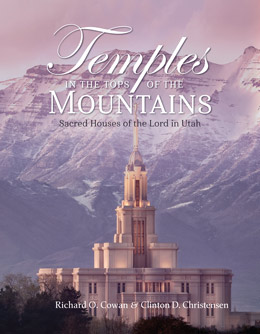
Temples in the Tops of the Mountains

Richard O. Cowan and Clinton D. Christensen, "Temples in the Tops of the Mountains," in Temples in the Tops of the Mountains: Sacred Houses of the Lord in Utah (Provo, UT: Religious Studies Center, Brigham Young University; Salt Lake City: Deseret Book), 625.

map of nineteenth century utah templeEndowment House and announced Utah temples of the nineteenth century. Courtesy of Lee R. Cowan.

When the Latter-day Saints left Nauvoo and headed toward the Rockies, they were forced to leave their nearly completed temple behind. Their interest in temple service did not diminish, however. If anything, it became stronger as they were deprived of the opportunity to receive these blessings. At Winter Quarters, for example, President Brigham Young said that when the Saints should reach their resting place in the mountains, his intention was to labor hard to build another temple. This matter was constantly on the pioneers’ minds during their trek across the plains.[1]

Preparations for Building a Temple in the Salt Lake Valley

Brigham YoungBrigham Young. Courtesy of Church History Library.

Within two days of President Young’s arrival in the Salt Lake Valley, he designated the site for the future temple. On July 26, 1847, he and a few others were walking across the area that one day would be Temple Square. He stopped between the two forks of City Creek as he saw the future Salt Lake Temple in vision, struck the ground with his cane, and declared, “Here will be the Temple of our God.” Wilford Woodruff placed a stake in the ground to mark the spot that would become the center of the future building. Many years later President Woodruff would call the construction of the temple on the designated site “a monument to President Young’s foresight and prophetic accuracy.”[2]

Marshalling Resources

Truman O. AngellTruman O. Angell. Courtesy of Church History Library.

As early as December 23, 1847, an official circular letter from the Twelve invited the Saints to gather and bring precious metals and other materials “for the exaltation . . . of the living and the dead,” for the time had come to build the Lord’s house “upon the tops of the mountains.”[3] Soon afterward, Brigham Young named Truman O. Angell as temple architect, a post he would hold until his death in 1887. His previous work as a wood joiner on both the Kirtland and Nauvoo Temples provided useful background for his new assignment. He would have an able assistant, William Ward, who received his architectural training in England and was skilled in stone construction (Angell’s experience was primarily with wooden structures). A skilled draftsman, Ward prepared the drawings for the Salt Lake Temple under Angell’s direction.[4]

To aid with this and other building projects in the valley, Church authorities established the Department of Public Works in January 1851, with Daniel H. Wells (a military and civic leader and future member of the First Presidency) as superintendent. Soon carpentry, paint, stonecutting, and blacksmith shops were set up in the northeast corner of the temple block where they could get power by means of a waterwheel in City Creek. Public Works provided an immediate job for newly arrived immigrants and channeled their skills into building the community. During the 1850s, as many as five hundred workers were employed on various projects.[5]

Meeting in the Bowery on Temple Square in April 1851, the general conference accepted by acclamation the resolution “to build a Temple to the name of the Lord our God” and appointed Daniel H. Wells as building superintendent specifically for the temple.[6] Because of a lack of materials and manpower––fewer than five thousand Saints lived in the immediate area of the projected temple––construction could not commence immediately. In 1852 Public Works put men to work building a fourteen-foot wall of sandstone and adobe around the temple block. This project not only provided security for the construction site but also created worthwhile employment for men who otherwise would have been idle.

The general conference of October 1852 considered which material would be best for building the temple. Some favored sandstone from nearby Red Butte Canyon. Brother Brigham suggested adobe, because brickmaking materials were readily available; he observed, perhaps tongue in cheek, that harder rock had already reached its zenith of perfection and so was now subject to the processes of decay.[7] Heber C. Kimball, Brigham Young’s first counselor, asked the conference whether they should build the temple of sandstone, of adobe, or of “the best stone we can find in these mountains.” The congregation unanimously voted that “we build a temple of the best materials that can be furnished in the mountains of North America, and that the Presidency dictate where the stone and other materials shall be obtained.”[8]

Salt Lake Temple cornerstone ceremonySalt Lake Temple cornerstone ceremony. Courtesy of Church History Library.

Elder James E. Talmage later concluded that this significant decision reflected the faith and determination of the Saints: “The Temple they were about to rear should be in every particular the best the people could produce. This modern House of the Lord was to be no temporary structure, nor of small proportions, nor of poor material, nor of mean or inadequate design.” The Saints knew that the temple would not be finished for many years. By that time “the few would have grown to a multitude of souls. The Temple was to be worthy of the great future.”[9]

Site Dedicated and Cornerstones Laid

The temple site was dedicated on a chilly Monday, February 14, 1853. Standing in a small buggy, President Brigham Young addressed the crowd of several thousand who had gathered for the occasion. The band played “Auld Lang Syne,” and then Heber C. Kimball offered the dedicatory prayer. Because the ground was frozen, it had to be broken with a pick. President Young then declared the ground officially broken for the temple.[10]

Salt Lake Towers drawingTower sections, Salt Lake Temple architectural drawings by Truman O. Angell. Courtesy of Church History Library.

During the next several weeks, trenches twenty feet wide and up to sixteen feet deep were excavated for the temple’s foundation. Cornerstones were laid on April 6, 1853, the twenty-third anniversary of the Church’s organization. Large stones, measuring approximately two by three by six feet, had been placed in convenient positions ahead of time. They were of “firestone,” quarried in nearby Red Butte Canyon. On this beautiful spring day in the valley, general conference convened in the old adobe tabernacle on the southwest corner of the temple block.

Accompanied by military honor guards and the music of three bands, a procession headed by Church leaders marched to the spot where the First Presidency and patriarch laid the southeast cornerstone. President Brigham Young then spoke, explaining that the temple had to be built in order that the Lord “may have a place where he can lay his head, and not only spend a night or a day, but find a place of peace.”[11] The southwest cornerstone was next laid by the Presiding Bishopric, representing the Lesser Priesthood. The presidency of the high priests, the stake presidency, and the high council then placed the northwest cornerstone. Finally, the northeast cornerstone was laid by the Twelve and representatives of the seventies and the elders. The laying of each stone was accompanied by special music, speeches, and a prayer. On this occasion, Elder Parley P. Pratt perceived “by the power of the Spirit” that Joseph Smith and others “hovered about us.”[12] These proceedings lasted from 10:00 a.m. through 2:00 p.m., at which time President Brigham Young blessed the assembled congregation “in the name of Jesus Christ of Nazareth,” and prayed that God would “encircle you in the arms of His love and mercy, and protect us until we have finished this Temple, received the fullness of our endowments therein, and built many more.”[13]

Old and New TabernaclesOld and New Tabernacles, Salt Lake City. Courtesy of Church History Library.

How the Temple Was Designed

After a one-hour break, the April 6 conference resumed in the Old Tabernacle. Concerning the future temple, President Young declared,

I scarcely ever say much about revelations, or visions, but suffice it to say, five years ago last July [1847] I was here, and saw in the Spirit the Temple not ten feet from where we have laid the Chief Corner Stone. I have not inquired what kind of a Temple we should build. Why? Because it was represented before me. I have never looked upon that ground, but the vision of it was there. I see it as plainly as if it was in reality before me. Wait until it is done. I will say, however, that it will have six towers, to begin with, instead of one. Now do not any of you apostatize because it will have six towers, and Joseph only built one. It is easier for us to build sixteen, than it was for him to build one. The time will come when there will be one in the centre of Temples we shall build, and on the top, groves and fish ponds. But we shall not see them here, at present.[14]

Some temples built in the twentieth century, including Hawaii, Los Angeles, and Oakland, would represent a fulfillment of President Young’s prophecy, as would the Conference Center across the street from Temple Square.

William Ward, Angell’s assistant, later recalled how the prophet shared his vision: “Brigham Young drew upon a slate in the architect’s office a sketch, and said to Truman O. Angell: ‘There will be three towers on the east, representing the President and his two counselors; also three similar towers on the west representing the Presiding Bishop and his two counselors; the towers on the east the Melchisedek priesthood, those on the west the Aaronic priesthood. The centre towers will be higher than those on the sides, and the west towers a little lower than those on the east end’.”[15] Then Angell sketched “a rough vertical section” as President Young described his concept of the temple’s interior.[16]

In 1854 Angell published a detailed description of the future temple. Measurements of the towers match the building as it ultimately was completed. Brigham Young’s original plan for the interior, however, was different. It followed the Kirtland and Nauvoo pattern, having two large halls for general meetings. A font and rooms for other ordinances all would be confined to the basement.[17] Three decades later, this concept would be modified (see chapter 5).

The great temple would not be completed for forty years. In the meantime, the Saints would need to have access to temple blessings, so temporary facilities needed to be provided.

Ensign PeakEnsign Peak. Courtesy of Church History Library.

Temporary Accommodations for Sacred Blessings

At Various Locations

During the pioneers’ early years in the Salt Lake Valley, the endowment was given in a variety of places. In the fall of 1849, Elder Addison Pratt, who had served as a missionary for several years in the South Pacific, was appointed to a second mission in that same area. Before his departure he received his endowment on Ensign Peak, just north of the center of Salt Lake City.[18] This action was consistent with the Prophet Joseph Smith’s earlier instructions that under certain circumstances these sacred blessings could be received on mountain tops, as had been the case with Moses.[19]

Council houseCouncil House. Courtesy of Church History Library.

Beginning in February 1851, the endowment was again given to living members on a regular basis, but these blessings continued to be received at various locations. Some temple ordinances during this time were administered in Brigham Young’s office, for example. By 1852 endowments were being given in the Council House, located on the southwest corner of what are now South Temple and Main Streets. This two-story structure measured forty-five feet square. The outer walls of the first story were of red sandstone, while those above were adobe. The building was surmounted by a square tower. There was a large hall and two offices on each floor. The large room on the second floor was divided by white canvas screens into sections representing the various stages of humankind’s eternal progression, much as had been done in the upper room of the Nauvoo Temple. During the years 1851, 1852, and 1854, more than two thousand received their endowment here. (None were recorded in 1853.) Because the Council House also was the site for a variety of ecclesiastical and governmental gatherings and the Deseret News was even printed there, there was a need for a separate building where endowment blessings could be given in seclusion without interruption.[20]

The Endowment House, a Temporary Temple

Endowment house floor plansEndowment House floor plans. Courtesy of Lee R. Cowan.

Construction on the “new endowment rooms” or “Endowment House,” as the structure soon came to be called, commenced during the summer of 1854. The building’s architect, Truman O. Angell, referred to it as a “temple pro tem,” reflecting how the Saints regarded this new structure. Located in the northwest corner of the temple block, the Endowment House was a two-story adobe structure that measured forty-four by thirty-four feet and had a twenty-by-twenty-foot one-story annex on its north side. Construction was relatively simple and thus progressed rapidly. The building was completed by the spring of the following year.

The Endowment House was dedicated May 5, 1855. President Brigham Young declared that “the house was clean and named it ‘The House of the Lord’” and explained that “the spirit of the Lord would be in it, for no one would be permitted to go into it to pollute it.” Over the years this prophetic statement would be confirmed by repeated spiritual experiences in the Endowment House. The dedicatory prayer was offered by Heber C. Kimball, who would preside over the work in this holy house. The first endowments and sealings were performed that same day.[21]

Black and white photo, Endowment houseEndowment House. Courtesy of Church History Library.

The ground floor had an area for initiatory ordinances, rooms representing the Garden of Eden and the “lone and dreary world,” and a room with an altar for special prayers—each room one step higher than the preceding one. Those receiving the endowment would then proceed up a wide staircase to an instruction room and then through the veil into the celestial room. There was also a sealing room on this upper floor. A few months after the building’s dedication, William Ward painted a beautiful mural depicting animals, birds, trees, and flowers on the north wall in the garden room. Thus, the Endowment House had several “firsts” that anticipated features that would be familiar in many temples—separate rooms, some with murals, in an ascending series suggesting upward progress. In 1856, the year after the building opened, a large addition on the west provided a baptismal font, which was dedicated on October 2.[22]

For the next three decades, the Endowment House would be an influence for good in the lives of thousands of Latter-day Saints. Here the Saints renewed their covenants through rebaptism as they prepared to enter important new phases of their lives; baptisms for the dead would also be performed here. From six hundred to over three thousand received the endowment each year, between twenty-five and thirty people receiving these blessings on a typical day.[23] Outgoing missionaries received instructions from Church leaders and were set apart here. The Endowment House also provided the setting for as many as 2,500 eternal marriages annually. President Heber C. Kimball continued to have general supervision of this work until his death in 1868. Elder Wilford Woodruff was also heavily involved, spending from thirty to sixty days each year helping to administer the sacred ordinances in the Endowment House.

basement level construction on the salt lake templeEarly stonework on basement level of the Salt Lake Temple. Courtesy of Church History Library.

Work Continues on the Salt Lake Temple

Meanwhile, the Saints maintained their interest in constructing the temple. The temple’s footings, composed of large rough-hewn red sandstone blocks called “ashlars,” were completed in July 1855. This particular sandstone was very dense and therefore strong. The footings diminished in width from sixteen feet at the base to ten feet at the top and were seven and one-half feet high. The next step was to build the eight-foot-thick basement walls, which would be composed mostly of carefully cut and fitted granite blocks. Sources of this stone had just been discovered in the canyons twenty-three miles southeast of the temple site, and President Young directed that the temple be built of this material. A unique feature of these walls was inverted arches that distributed the temple’s massive weight more evenly.[24]

In the spring of 1856, President Young sent architect Truman O. Angell on a special mission to Europe. “You shall have power and means to go from place to place, from country to country, and view the various specimens of architecture,” President Young blessed him. “You will be quick to comprehend the architectural designs of men in various ages. . . . You will increase in knowledge upon the Temple and other buildings, and many will wonder at the knowledge you possess.” Specifically, President Young instructed him to make sketches of important architectural works in order to become better qualified to continue his work on the temple and other buildings.[25] It is possible, for example, that Angell refined his idea for the four corner stairways with their supporting central columns after he had seen the Nelson Monument at Trafalgar Square in London.

The Coming of the Utah Expedition

On July 23, 1857, as the Latter-day Saints were preparing to celebrate the tenth anniversary of their entrance into the Salt Lake Valley, they received the disturbing word that a potentially hostile United States Army force was heading toward Utah. Not knowing the army’s intentions, the Saints were concerned that the temple foundation, which by this time included the beginnings of the granite basement walls, might be in danger. On August 13 President Young placed some important records in a stone box in the temple foundation.[26] The following spring, President Young directed that dirt be hauled in to fill the excavation and cover the foundation walls. When the army arrived in June 1858, the entire temple block looked like a freshly plowed field, and there was no visible evidence of the temple’s construction. As it turned out, the army marched through the city without harming any property and set up its camp some thirty miles to the southwest near Utah Lake. With the outbreak of the American Civil War in 1861, the army was needed elsewhere, and it departed from Utah in December of that year.

The Saints had been eager to resume work on the temple. By late 1859, while the army was still in Utah, enough of the foundation was uncovered to reveal that its upper surface was not level. Then during the spring of 1862, after the army had left, the site was fully reexcavated and the temple footings uncovered, allowing them to be inspected more thoroughly. There were cracks in some of the large sandstone ashlars, and some were not adequately set in mortar. There were gaps between some of the more roughly shaped blocks, filled with rubble or even wooden rollers to lift the stones up. Brigham Young was alarmed by this condition. While today, many believe that the sandstone foundation was ripped out and replaced, the Salt Lake Temple renovation project in 2020 uncovered existing sandstone as part of the foundation. After the pioneer workmen found the cracked stones, they replaced the defective stones in the footings, made the top of the footings perfectly level, and then recommenced laying the blocks for the granite walls. “I want to see the Temple built in a manner that it will endure through the Millennium,” President Young declared.[27] The work of rebuilding moved more carefully, and the walls did not reach ground level until the end of the construction season in 1867, fourteen years after the cornerstones had been laid.[28]

Tabernacle trusses during constructionTrusses during the Tabernacle construction. In the foreground are granite blocks for building the Salt Lake Temple. Courtesy of Church History Library.

The Salt Lake Tabernacle

As mentioned in chapter 1, the Kirtland Temple’s main use was as a meeting hall. In many of the communities founded in Utah, a large meetinghouse, called a “tabernacle,” was built in the center of town. The term was borrowed and adapted from the language of the Old Testament, where the tabernacle was a movable temple at the center of the camp of Israel and the twelve tribes wandered for forty years in the desert. Centuries after settling in the promised land, the Israelites sought for a more permanent structure than the tabernacle. King Solomon directed the construction of a temple in Jerusalem that would become the focal point for worship in Israel (1 Kings 5–8).

For modern Israel, the Latter-day Saints focused on construction of a temple in the center of Salt Lake City, but in this case a tabernacle would also become a fixture of Temple Square. There was a need for a meeting hall and, in particular, a place to hold general conference. However, the first structures erected to provide for meetings of the Saints were outdoor boweries with open sides and a network of leafy branches overhead to provide shade. They were replaced in 1852 by an adobe “tabernacle.” Though it was enclosed, its capacity was limited and the numerous support columns blocked a clear view of the stand. Eventually, a permanent tabernacle was erected just west of the temple site and would become a permanent fixture of Temple Square.

Eager to have a more adequate meeting place for the Saints, Brigham Young in 1863 directed William Folsom to draw up preliminary plans for a new tabernacle, 250 feet long by 150 feet wide, that would seat up to ten thousand persons. Henry Grow, an experienced bridge builder, designed and supervised the construction of huge elliptical wooden trusses that would span the full width of the structure without any center supports, “an innovation without parallel for a building of these dimensions.”[29] The domed building was completed and entered service in 1867. When the 3,000-seat balcony was added during 1869–70, the auditorium’s acoustics were improved to their widely admired quality. The Salt Lake Tabernacle truly was “one of the most impressive achievements of Latter-day Saint architectural design and engineering skill.”[30] The building was officially dedicated in 1875 and would be the home for general conference until the twenty-first century. From the Tabernacle’s pulpit, Church leaders gave encouragement and direction to the Saints’ temple activity.

Completed tabernacleCompleted Tabernacle with men standing on Salt Lake Temple construction site. Courtesy of Church History Library.

Renewed Emphasis on Vicarious Service

While the Saints were struggling to get established in the Rocky Mountains, Church-sponsored activities were limited. Emphasis in temple work was on providing needed ordinances for the living, and work for the dead virtually ceased following the exodus from Nauvoo. Even with the opening of the Endowment House in 1855, this pattern did not change. Official records indicate that only thirty-three deceased couples were sealed vicariously during the pre–Endowment House period, and no such ordinances at all were performed during the following decade. Similarly, there is a record of only one baptism for the dead in 1855, of only two in 1857, and of no others during the Saints’ first two decades in Utah.

In the mid-1860s, however, ordinance work for the dead resumed. Sealings of six deceased couples were recorded in 1865 and two baptisms for the dead the following year. In 1869, more than four hundred deceased couples were sealed, and more than five thousand vicarious baptisms were recorded. Available records do not state why these ordinances resumed at this time, but several factors may have been involved. The Saints understood that endowments for the dead could be performed only in a temple and may have supposed that this restriction applied to other vicarious ordinances as well. Nevertheless, the Saints who had participated in baptisms for the dead at Nauvoo were growing older. They, together with more recent immigrants, undoubtedly voiced their anxiety to have further opportunity vicariously to provide the saving ordinances for their departed loved ones.

Where would the Saints perform such ordinances? Most looked forward to returning to Jackson County, Missouri, and anticipated that they would have the privilege of building the great temple there in the not-too-distant future. In 1862, for example, Brigham Young felt the Saints would be going back within a few years and wanted to largely complete the Salt Lake Temple before that time. Nevertheless, he believed that no other temple would be completed before the one in Jackson County.[31] Some may have thought that the American Civil War would open the way for the Saints’ return. When the war ended in 1865 without having wrought the expected changes in Missouri, however, attention shifted to the possibility of performing vicarious ordinances in Utah.

By this time the pioneers were sufficiently well established to take on additional religious activities. In 1867, for instance, President Brigham Young directed that steps be taken to establish Relief Societies and Sunday Schools in all branches of the Church for the first time. It was at this same time that vicarious ordinances were being performed in increasing numbers under the direction of inspired leaders. Elder Wilford Woodruff recorded in his journal that during 1870 he had personally witnessed 4,400 baptisms for the dead performed by Elders Joseph F. Smith and Samuel H. B. Smith.[32]

The Need for a Temple

The lack of a temple limited the ordinances that could be performed. For example, Brigham Young specified “no one can receive endowments for another, until a Temple is prepared in which to administer them.”[33] In 1872 he pointed out, “We are now baptizing for the dead, and we are sealing [couples] for the dead, and if we had a temple prepared, we should be giving endowments for the dead—for our fathers, mothers, grandfathers, grandmothers, uncles, aunts, relatives, friends and old associates.” President Young testified that the Lord was “stirring up the hearts” of many people to search out their pedigrees and that “it will continue and run on from father to father, father to father, until they get the genealogy of their forefathers as far as they possibly can.”[34]

unidentified pioneer familyUnidentified pioneer family, ca. 1860s. Was this family sealed? Couples that were not sealed when first married often had children who were not sealed to them during their lifetime. The sealing of children to parents would not begin until the dedication of the St. George Temple in 1877 and the Logan Temple in 1884. Courtesy of Church History Library.

President Brigham Young had explained that “there are some of the sealing ordinances that cannot be administered in the [Endowment House] that we are now using; We can only administer in it some of the first ordinances of the Priesthood pertaining to the endowment. There are more advanced ordinances that cannot be administered there.” [35] He later explained that ordinances designed “to connect the chain of the Holy Priesthood from Father Adam until now, by sealing children to their parents, being sealed for our forefathers, etc., they cannot be done without a Temple. . . . Neither will children be sealed to their living parents in any other place than a Temple.”[36] In 1865 he therefore urged couples to be endowed before their marriage and to be sealed by proper authority so that their children would be “born in the covenant.” Otherwise the children could not be theirs as “heirs to the priesthood.”[37]

An 1876 circular letter from the First Presidency and the Twelve acknowledged these restrictions but challenged the Saints to overcome them: “We feel led to say to the Latter-day Saints throughout these mountains: Let us arise and build Temples unto our God at such places as He shall designate, into which we and our children can enter and receive those blessings that He has in store for us.” The Presidency now called for the construction of two temples in addition to those already under way in Salt Lake City and St. George and called on ward bishops to provide donated labor for this task.[38] While ground would be broken for the Logan and Manti Temples the following year, construction on the temple in St. George had begun five years earlier.

Salt Lake Temple at nightSalt Lake Temple at Christmastime, by Michael Hart/Unsplash.

Notes

[1] Matthias F. Cowley, Wilford Woodruff: History of His Life and Labors (Salt Lake City: Bookcraft, 1964), 255.

[2] Cowley, Wilford Woodruff, 619–20; early published accounts of this event place it on July 28, but a study of diaries suggests that it happened two days earlier.

[3] James R. Clark, comp., Messages of the First Presidency (Salt Lake City: Bookcraft, 1965), 1:333.

[4] C. Mark Hamilton, The Salt Lake Temple: A Monument to a People (Salt Lake City: University Services, 1983), 51–53.

[5] Leonard J. Arrington, Great Basin Kingdom (Cambridge, MA: Harvard University Press, 1958), 109–12.

[6] Deseret News Weekly, April 19, 1851, 1.

[7] Brigham Young, in Journal of Discourses (London: Latter-day Saints’ Book Depot, 1854), 1:218–20.

[8] Heber C. Kimball, in Journal of Discourses, 1:160, 162.

[9] James E. Talmage, The House of the Lord (Salt Lake City: Bookcraft, 1962), 142.

[10] James H. Anderson, “The Salt Lake Temple,” Contributor, April 1893, 250–58; Scott G. Kenney, ed., Wilford Woodruff’s Journal, February 14, 1853 (Midvale, UT: Signature Book, 1984), 4:195–199.

[11] Brigham Young, in Journal of Discourses (London: Latter-day Saints’ Book Depot, 1854), 2:33, April 6, 1853; James H. Anderson, “The Salt Lake Temple,” Contributor. April 1893, 252–59.

[12] Parley P. Pratt, in Journal of Discourses,1:14, April 7, 1853.

[13] Anderson, “Salt Lake Temple,” 257.

[14] Brigham Young, in Journal of Discourses, 1:133.

[15] William Ward, “Who Designed the Temple?,” Deseret News Weekly, April 23, 1892, 8.

[16] Ward, “Who Designed the Temple?,” 8.

[17] Truman O. Angell, “The Temple,” Deseret News, August 17, 1854.

[18] Brigham H. Roberts, A Comprehensive History of The Church of Jesus Christ of Latter-day Saints (Provo, UT: BYU Press, 1965), 3:386.

[19] “Discourse, 1 May 1842, as Reported by Willard Richards,” p. 94, The Joseph Smith Papers, https://www.josephsmithpapers.org/paper-summary/discourse-1-may-1842-as-reported-by-willard-richards/1.

[20] Andrew Jenson, Encyclopedic History of the Church (Salt Lake City: Deseret News, 1941), 161; Roberts, Comprehensive History of the Church, 4:12–14; Journal History July 7, 1852, 1, MS, Church History Library. Elder Roberts’s statement that the endowment was given in 1852 for the first time since the expulsion from Nauvoo is in error.

[21] Journal History, May 5, 1855, 1–2.

[22] Lisle G. Brown, “‘Temple Pro Tempore’: The Salt Lake City Endowment House,” Journal of Mormon History, 34, no. 4 (Fall 2008): 1–68.

[23] James Dwight Tingen, The Endowment House, 1855–1889, (Provo, UT: BYU, 1974), 13–15.

[24] Paul C. Richards, “The Salt Lake Temple Infrastructure: Studying It Out in Their Own Minds,” Brigham Young University Studies, 36, no. 2 (1996–97): 207–9.

[25] Richard Neitzel Holzapfel, Every Stone a Sermon (Salt Lake City: Bookcraft, 1992), 17; see also Marvin E. Smith, “The Builder,” Improvement Era, October 1942, 630.

[26] Mark Henshaw, Forty Years: The Saga of Building the Salt Lake Temple (Salt Lake City: Deseret Book, 2020), 142–43; Richards, “Salt Lake Temple Infrastructure,” 208.

[27] Brigham Young, in Journal of Discourses, 10:254; see also Kenney, Wilford Woodruff’s Journal, 6:71, August 23, 1862.

[28] Henshaw, Forty Years, 172­–74, 190–97, 234–35.

[29] Paul L. Anderson, “Tabernacle, Salt Lake City,” in Encyclopedia of Mormonism, ed. Daniel H. Ludlow (New York: Macmillan, 1992), 4:1433.

[30] Anderson, “Tabernacle, Salt Lake City,” 4:1433.

[31] Kenney, Wilford Woodruff’s Journal, 6:71, August 23, 1862.

[32] Kenney, Wilford Woodruff’s Journal, 6:586.

[33] Brigham Young, in Journal of Discourses, 16:186–87, September 4, 1873; Kenney, Wilford Woodruff’s Journal, 6:232, July 13, 1865.

[34] Kenney, Brigham Young, in Journal of Discourses, 15:138, August 24, 1872.

[35] Brigham Young, in Journal of Discourses, 10:254, October 6, 1863.

[36] Brigham Young, in Journal of Discourses, 16:186–87, September 4, 1873.

[37] Kenney, Wilford Woodruff’s Journal, 6:232, July 13, 1865.

[38] James R. Clark, comp., Messages of the First Presidency, 2:278–80.