
 menu icon in the top, right corner of the screen.
 icon above to close this box.
 icon at the bottom of the screen below the browser—if you don't see it, swipe up to unhide it.
From Tabernacles to Temples
The Vernal Utah and Provo City Center Temples
Richard O. Cowan and Clinton D. Christensen, "From Tabernacles to Temples," in Temples in the Tops of the Mountains: Sacred Houses of the Lord in Utah (Provo, UT: Religious Studies Center, Brigham Young University; Salt Lake City: Deseret Book), 188–217.
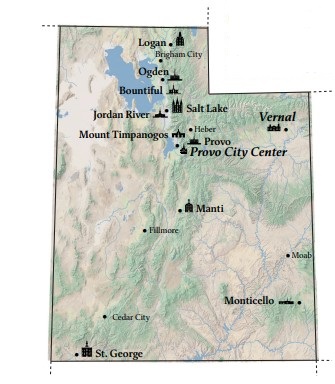 Utah temples as of 2000, including the Vernal Utah and Provo City Center Temples. Courtesy of Lee R. Cowan.
Two of Utah’s temples are different from all others. They were constructed within the shells of earlier tabernacles and thus do not have the appearance of most other temples. Tabernacles were imposing buildings constructed in earlier decades at the heart of several Latter-day Saint communities to accommodate stake or multistake conferences and administration. In addition to their primary religious function, they typically also served as community centers, providing the setting for cultural, educational, and even political gatherings. Rather different circumstances led to the construction of these two unique temples, one located at Vernal in rural northeastern Utah and the other at Provo on the densely populated Wasatch Front.
The Vernal Utah Temple
The Saints in Northeastern Utah and Their Tabernacle
After the pioneers reached the Salt Lake Valley, three decades would pass before Latter-day Saint settlement commenced in the relatively isolated Uintah Basin of northeastern Utah. The first Church-sponsored colonists arrived in the basin in 1877 and began establishing small settlements in Ashley Valley. The winters were often quite harsh. Snows piled up, many animals froze to death, and food supplies were scarce. The settlements barely survived, and such hardships contributed to the rugged heritage of devoted determination among the Uintah Basin Saints.
Still, the settlements continued to grow. By 1887 the Latter-day Saint population in the area had passed one thousand and the Uintah Stake was organized with headquarters at Ashley Center (renamed Vernal when the post office was established there and incorporated in 1897). When areas of the Uintah Indian Reservation to the west were opened for non-Native American settlement in 1905, one of the last land rushes in the nation resulted as newcomers flocked to homestead.
 Dedication of the Uintah Stake Tabernacle, 1907. Courtesy of Church History Library.
For about a decade, stake leaders had been planning an adequate venue for conferences and other meetings.[1] In 1897 the tabernacle site selection committee chose a lot at the edge of town where it could be seen from the adjacent highway. The Church purchased the site from the Jacob Workman family for four hundred dollars; the family then donated the money to the building fund. Stake president Samuel Bennion asked T. T. Davies, an architect from Provo, to design the building. Within thirty days he provided preliminary plans for a building over one hundred feet long.
William H. Siddoway, a member of the high council, became the building overseer. Most of the labor was contributed by volunteers who put in full days on their farms or places of employment and then worked on the tabernacle at night, on weekends, or other free days. Excavation for the foundations was accomplished by horse-drawn scrapers and by men with picks and axes. The sandstone foundation blocks, quarried north of town, had to be large enough to support the brick walls, but small enough to be hauled in by wagon. Most blocks measured six by three by two and one-half feet. To provide structural support, workmen created large arches in the foundation under the building’s north, west, and south entrances. All the lumber for heavy beams and finished woodwork was native pine brought from the surrounding mountains.
The bricks had to be laid three to five layers across so the walls would be stable and would support the roof. The bricks were of local red clay and were fired in the kilns of Abnar and Nick Swain. They donated one-fourth of the bricks outright and provided the rest at half their normal rate. Aaronic Priesthood young men were the hod carriers who took bricks and mortar up ramps in the scaffolding to the brick layers.
As the walls were nearing completion, William Cook of Vernal, who had been a builder of Brigham Young’s Gardo House, drew the plans for finishing the building. Some beams for roof trusses were spliced without nails. The octagonal tower above the west facade was surmounted by a tin dome like those on the Kirtland and Nauvoo Temples. Inside, the stand was on the east with entrances and a U-shaped balcony on the other three sides. The pine pillars supporting the balcony were painted to look like marble, and the pine pews were finished to have the appearance of oak. The seating capacity was about 1,800. The total cash outlay for the building was $37,058.15 (nearly a million dollars in the twenty-first century).[2]
In 1907 Church President Joseph F. Smith traveled to Vernal by train and buggy to dedicate the tabernacle as part of the two-day stake quarterly conference. An overflow congregation gathered reverently into the tabernacle on Saturday morning, August 24, for the opening session. The local newspaper reported, “No former religious gathering in the county has even approached this one. There were people present from all parts of the valley . . . to witness the ceremonies.”[3] President Joseph F. Smith was the concluding speaker in the afternoon session. He commended the Saints for their sacrifice in building the tabernacle and then offered the prayer dedicating it to the Lord.
The conference continued the following day. During the Sunday morning session, President Smith spoke particularly to the youth, encouraging them to look forward to and prepare for temple marriages. He added that he “would not be surprised if the day would come when a temple would be built in your own midst here.”[4] Probably none present realized how literally his prophetic words would be fulfilled.
For the next three-quarters of a century, the tabernacle was used mostly for stake quarterly conferences and other church meetings. In 1924 a sixty-foot lumber rear addition was added to house seminary classes. The tabernacle also served a variety of other functions including high school and seminary graduations, Easter and Christmas pageants, weddings, funerals, and musical performances.
Still, by the 1970s the need for the tabernacle was lessening. Newer stake centers nearby could accommodate more people for conferences. They also had classrooms for the Church’s growing instructional programs, as well as cultural halls to serve dance, drama, athletic, and other activities—all facilities which the tabernacle lacked. Furthermore, the tabernacle’s heating system was not adequate for the Uintah Basin’s cold winters, and there were no functioning restrooms, nor air-conditioning. In all, the Church had erected about a hundred tabernacles, but as they increasingly could not accommodate the Church’s expanding programs, the majority had been torn down.[5] The Saints in Vernal naturally wondered about the future of their own historic and beloved tabernacle.
On June 20, 1983, the Vernal Utah Stake was divided to form the Vernal Utah Glines and Vernal Utah Uintah Stakes. The Glines stake received jurisdiction over the tabernacle, but this was the last stake conference held there. When the adjoining stake center was remodeled, heat and water were permanently cut off from the tabernacle, and the Church Physical Facilities department considered the building now to be unsafe, discouraging further meetings there. The property was even briefly put up for sale, but no suitable buyers appeared. By now all the stakes in the area had their own stake centers and thus did not need the old tabernacle.[6]
The Unexpected Announcement
Between 1984 and 1986, President Gayle McKeachnie and his counselors in the Glines stake presidency confidentially submitted proposals to general Church leaders about the possibility of building a temple within the walls of the old tabernacle. At this time the nearest temple was in Provo, so people in the Vernal area had to travel over 150 miles to get there. Because the roads through the mountains were often icy during the winter, travel on them was quite dangerous. The First Presidency ultimately rejected the proposal for a temple and asked for other ideas for the building. However, the stake presidency decided to bide their time.[7]
Stake leaders again considered renovating the tabernacle in 1988, but the million-dollar cost was too great for the building’s projected limited use. Four years later, Laird Hartman succeeded McKeachnie as president of the Glines stake. When the stake presidency began receiving requests from various groups to use the tabernacle for activities they believed were not appropriate for a dedicated building, they were prompted once again to raise the question of the tabernacle’s future.
On Friday, November 5, 1993, President Hartman received a startling phone call from the Presiding Bishopric indicating that Presidents Hinckley and Monson, counselors to Church President Benson, would come to Vernal one week later to consider what should be done with the tabernacle and inviting him to show them through the building. Following the tour on November 12, President Hinckley quipped, “I don’t know what we are going to do with this beautiful old building. It’s kind of like me—its bolts are getting old and rusty.”[8] Only twelve days later (fittingly, the day before Thanksgiving), President Hinckley called President Hartman stating that “after much prayer and consideration,” the First Presidency was “impressed to renovate the tabernacle into a temple” and wanted to know if the stake president felt that “the people in the area would support that decision.” President Hartman assured him that “the great majority of people would rejoice in this decision and that we would support it with all our hearts.”[9] Church leaders asked him not to discuss this matter with anybody. All the other stake presidents in the area received the news a month and a half later in a meeting at Church headquarters on January 16. This would be the first time an older building would be rebuilt into a temple, and at that time it would be the only temple constructed of red brick rather than the more traditional off-white building materials.
Finally, in a letter to the Uintah Basin area Saints dated February 9, 1994, the First Presidency announced the following:
Dear Brothers and Sisters,
As you are aware, there has been much discussion over a period of many years concerning what to do with the old Uintah Tabernacle in Vernal. The building has not been occupied for a long period and is in serious disrepair.
There is much sentiment attached to the building. However, extensive engineering and architectural study has indicated that it would be extremely costly to restore and that no ecclesiastical need exists for it.
After giving prayerful consideration to the matter and following extensive study, we have concluded to use the shell of the building, restoring its original outside appearance, and creating within it, a beautiful temple. Additional needed space will be gained by excavating the area around the east end of the Tabernacle. By so doing the original aspect of the historic structure will be preserved.
Under this proposal the temple needs of the faithful Saints in the area will be met and the exterior of the old building will be preserved as a memorial to the faithful people who built it with much sacrifice almost a century ago.
We have discussed this proposal with the stake presidents of the area who have expressed their endorsement of it. We hope that it will be warmly received by members of the Church and the entire community.[10]
This letter was read in meetings throughout the area on Sunday, February 13. The surprising and wonderful news was received with excitement and tears of gratitude.[11]
Transforming the Tabernacle into a Temple
 Vernal Utah Temple. Courtesy of Intellectual Reserve, Inc.
Just one week before the First Presidency’s official announcement, the Temple Department turned to Roger Jackson of the firm of FFKR Architects to plan and supervise this momentous and unprecedented project. Immediately after he had received his Master of Architecture degree from the University of Utah in 1984, Jackson had gone to work with FFKR. Important projects included the remodeling of various school buildings and the expansion of the Utah State Capitol. He had become the lead architect for the remodel of the Hotel Utah into the Joseph Smith Memorial Building. This experience with older buildings would be valuable in Vernal.
When asked if it was a challenge to fit a temple into the tabernacle, Jackson responded with an emphatic “Yes!” The original thought was to have two stand-alone endowment rooms, but the flow would have been difficult within the tabernacle’s walls. Instead, a new concept of “two-stage endowment room” was designed, allowing progression from one room to the other.[12] This plan was adopted for the Vernal Utah Temple and the St. Louis Missouri Temple, which was also under construction. Only the first room in the sequence would need projection equipment, and this plan could accommodate as many patrons as two independent fully equipped rooms. Ultimately, this two-stage endowment room would be commonly used in smaller temples throughout the Church.
In 1999 Roger Jackson would also become the lead architect in rebuilding the historic Nauvoo Temple. He received the same assignment for the 2005–7 renovation of the iconic Salt Lake Tabernacle. He remarked that these latter projects were “not once in a lifetime but once in ten thousand lifetimes experiences,” marveling that he had two of them.
 Gordon B. Hinckley with groundbreaking shovel. Courtesy of Kathleen Murphy Irving.
Preparations were also moving forward in Vernal. Local Church leaders organized a special open house so members of the community could visit the tabernacle one last time before its transformation began. During this five-day event, April 28 through May 2, 1994, more than 18,000 interested people walked through the building. There was never any opposition expressed from community leaders or residents regarding the new temple project. Where possible, equipment and furnishings were removed from the tabernacle. Fifty pews were set aside to be used in the future temple. Other items were donated to local historical societies and museums.
As groundbreaking approached, the weather had been showery. Saturday, May 13, 1995, however, dawned brisk but sunny. President Hinckley, who had become President of the Church just two months earlier, presided. He remarked that the approximately twelve thousand persons who had gathered for the groundbreaking were “a tremendous tribute to the faith of the Latter-day Saints in the work that goes on in the Houses of the Lord.” He acknowledged that if the Church had thought of tearing down the tabernacle, “there would be a great shout go out across this entire valley.” But the Church didn’t want it “used for profane purposes of any kind. It was sacred. It had been dedicated.” Therefore, “members will feel deeply grateful and profoundly touched by that which [will be] created out of this historic, dedicated, sacred structure. It will be beautiful.”
It “will become a great spiritual center.”[13] President Hinckley’s second counselor, James E. Faust, affirmed that he “felt a special spirit and spiritual legacy of the devotion of the Saints who in their great poverty erected this magnificent building.”[14] Elder W. Eugene Hansen of the Seventy, chair of the Temple Department, wondered “if any of those hardy souls who labored so diligently to construct this beautiful edifice ever had an inkling that one day it would be a temple.”[15] President Hinckley offered the prayer dedicating the site. Then, at its southeast corner, the visitors from Church headquarters, local leaders, and others took their turn formally breaking ground for the Vernal Temple, which would “interlock pioneer craftsmanship with modern technology.”[16]
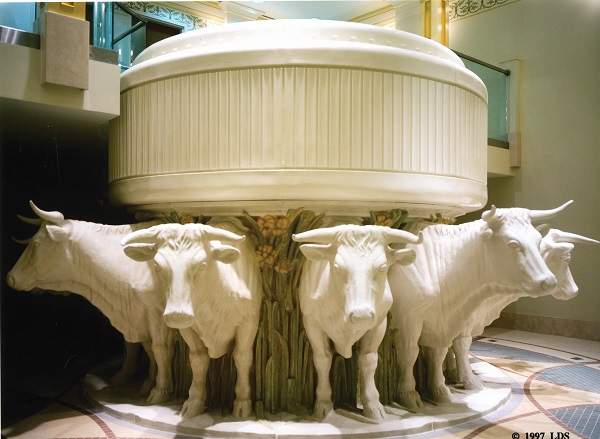 Baptismal font, Vernal Utah Temple. Courtesy of Kathleen Murphy Irving.
First, the existing walls had to be stabilized by removing the inner wythe or layer of bricks and then spraying strong shotcrete onto the wall and around steel reinforcing rods, forming a layer several inches thick. Because all damaged bricks in the temple’s exterior would be replaced, a source of period bricks was sought. Only at the pioneer-era Reader home were bricks with matching markings found, so they probably had come from the same clay pit and kiln and would match precisely. The owner, Nick J. Meagher, was a member of another faith. He had planned to tear down the old home but agreed to donate it to the Church. For the next two months, volunteers painstakingly dismantled the structure and cleaned sixteen thousand bricks, more than enough to restore the temple’s walls. During this same time, the seminary addition to the east was removed, and the new annex was being constructed. The original plan was for it to be entirely underground, but when water was found at a depth of fourteen feet, the annex was raised to a depth of only nine feet. Thus, the upper ten feet of its block wall was above ground and was covered with a veneer of new bricks that closely matched the old.
With the original walls stabilized, the next step was to excavate inside for the baptistry. This required going down to twenty-two feet below ground level in an area measuring forty by fifty feet. To keep ground water out, the floor and walls of this area were surrounded by a heavy-duty membrane, like a giant bathtub. The plan had been for the excavating equipment to be brought in through an opening created in the east wall, but this would delay construction on the annex for several months until work in the baptistry was completed. However, when the arch in the north wall was uncovered, it was wide enough for the machinery to pass through, thus avoiding the delay. Steel columns and horizontal beams were next erected within the former tabernacle to support the three reinforced concrete floors.
In mid-July 1996, the steel font was placed in the baptistry. The supporting oxen and exterior shroud were added the following spring, being the first in the Church to be made of fiberglass. For nearly two decades they had been part of an exhibit in the South Visitors’ Center on Temple Square in Salt Lake City and became available for use in Vernal after the exhibit was changed. LaVar Walgren had pioneered the process of producing sculptures with fiberglass. He studied living oxen to assure that his reproductions would be realistic. The oxen and font had a “cultured marble” finish created by coating their surface with epoxy and ground marble.[17]
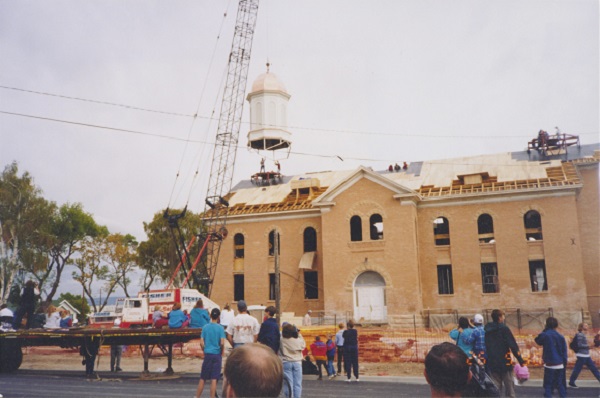 Dome placed on the Vernal Utah Temple. Courtesy of Kathleen Murphy Irving.
During the summer of 1996, the old roof was removed, the five original timber trusses were reinforced with steel, and the building was covered with a new green slate roof. The original plan had been to simply renovate the single twenty-four-foot tower atop the tabernacle’s western facade. When President Gordon B. Hinckley was in Vernal for the groundbreaking, however, he expressed the concern that the steeple of the neighboring stake center would appear taller than the temple, so asked the architects to propose a new design. The decision was to add a thirty-two-foot tower topped by the angel Moroni to the east end and to reproduce the west tower using new lighter materials. In early September 1995, therefore, the old tower was removed, and Vernal City made it into a gazebo in Ashley Valley Community Park. Chad Munns of Garland, Utah, received the contract to produce the new towers. He had fabricated many steeples for Latter-day Saint chapels but never for a temple. He would make them of Reynobond, stiff plastic laminated with a thin layer of aluminum. He calculated that he needed thirty sheets of this material, but the manufacturer indicated they had only twenty-four on hand and that no more would be produced in time to meet his schedule. Munns asked them to double-check by physically counting the sheets; they corrected their count to thirty-two. He bought them all. When he had finished the project, he had only a half sheet left over. The domes were fashioned of copper, which would weather to a dark green color.[18]
LaVar Walgren fabricated the eight-foot fiberglass statue of Moroni. The towers, midroof ventilation cupola, and Moroni were set in place atop the temple on Thursday, September 26, 1996. There was no public announcement, but the news spread quickly by word of mouth. An estimated crowd of four thousand interested observers filled the surrounding streets, singing hymns as they watched.[19] For the first time, the angel was simply painted gold rather than being gold-leafed. This was an experiment to test the weathering durability of this more economical alternative at the time the Church would be building scores of temples worldwide. The results were not as good as hoped. Therefore, during two weeks in February 1997, the angel was taken back off the temple, returned to Salt Lake City, thoroughly stripped down to the fiberglass surface, and then covered with 1,250 three-inch squares of 23 carat gold leaf. After the statue was back in place, even observers from a distance could discern the difference in brilliance: “it just looked more heavenly.”[20]
Windows were installed late in 1996, enclosing the building so work could go forward during the winter. Most had patterned glass that afforded seclusion but also admitted natural light. The celestial room had eighteen windows; patrons were struck by the amount of light in this room.
 Vernal Utah Temple brochure. Courtesy of the Church History Library.
Another striking feature of the building is the grand staircase at the east end of the former tabernacle. After three of the four newel post caps in the building were gone, Lloyd Hess was impressed to save the remaining one. It was in excellent condition so was refurbished to grace the banister at the base of the new stairway. A beautiful stained glass window was placed in the opening above the stairs. It depicted Christ as the Good Shepherd and was created by an unknown artist for the Mount Olivet Methodist Episcopal Church of Hollywood. The Church of Jesus Christ of Latter-day Saints purchased that building in 1937, and for decades it served as the Hollywood Ward chapel. When the old structure was torn down to make way for a more adequate meetinghouse, the window was saved for possible temple use. In Vernal, it was positioned so it appears at the end of the upper hallway serving the sealing rooms.
Pews saved from the tabernacle were stripped down to bare wood. They then were refinished, upholstered, and used in the temple chapel. A marker on the temple’s exterior bears two dates—1907 and 1997—the years when the building was dedicated as a tabernacle and then as a temple.
Open House and Dedication
The open house took place in October 1997. Immediate neighbors and then VIPs were invited to come first. An estimated 118,700 visited during the two-weeks public open house from the 18th through the 25th. Approximately 25,000 volunteers assisted. A display on temple service and on the history of the Vernal Temple was set up in the cultural hall of the neighboring Glines Stake Center; workers connected that building with the temple by walkways enclosed with tent-like covers to help visitors reach the temple with cleaner shoes. Almost constant music was provided near the temple’s entrance by various groups including ward choirs, children’s choruses, quartets, and even family choirs. For example, descendants of William B. Smart, the stake president when the tabernacle was dedicated in 1907, scheduled a family reunion on the last day of the open house; a Smart family choir was one of the groups performing that day.
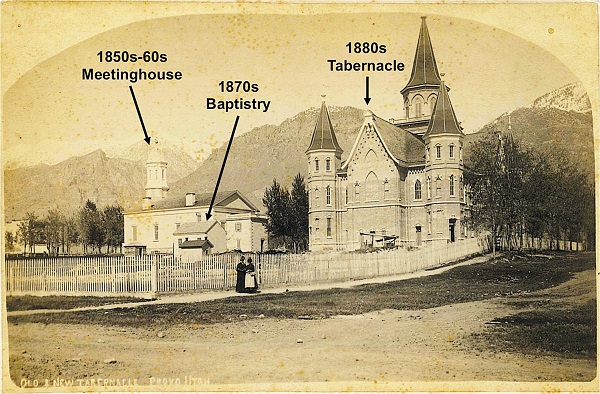 Provo Tabernacle around 1885. Courtesy of Richard O. Cowan.
Following the open house, volunteers thoroughly cleaned the temple. It was then dedicated in eleven sessions from Sunday, November 2, through Tuesday, November 4, 1997. President Hinckley presided and offered the dedicatory prayer: “We are grateful for this beautiful new structure which utilizes the historic tabernacle built by Thy people nearly a century ago. The original tabernacle came of a great spirit of faith and sacrifice on the part of those Saints who settled in this area. It was built as an offering unto Thee, and was held in the affections of the people long after it was used as a house of worship. Now that old and much-loved building has become the center piece of a new and beautiful House of the Lord. It has a quiet luster all its own.”[21] He conducted the cornerstone ceremony in connection with the first dedicatory session on Sunday morning at 8 a.m. A large crowd had gathered at the southeast corner of the temple even before sunrise on this brisk fall morning to be part of this event.
Even though Lloyd Hess, the project manager in Vernal, had insisted that building the new temple in the shell of the former tabernacle had been less expensive than starting over and building from scratch,[22] many predicted that the Church would not undertake such a task ever again. Still, a devastating fire in Provo, Utah, just over a decade later would lead to a similar project once again.
The Provo City Center Temple
Another Historic Tabernacle
Fort Utah was established on the banks of the Provo River in 1849. Soon the settlement expanded beyond the fort and came to be known as Provo. By the early 1880s, the growing community needed an adequate place to worship.
The Provo Tabernacle was designed by William Harrison Folsom, one of the finest Latter-day Saint architects of the nineteenth century. He was born in Portsmouth, New Hampshire, on March 25, 1815. He worked with his father in a construction contracting business until he became a Latter-day Saint and moved to Nauvoo. He was sustained as Church architect in 1861 and became an assistant to Truman O. Angell Sr.[23] Folsom was an architect and construction superintendent on important projects throughout the territory—including the Salt Lake Theater, Salt Lake Tabernacle, and Manti Temple. He was asked to pattern the new tabernacle in Provo “after the Salt Lake Assembly Hall.” The Provo Tabernacle’s architecture was Eastlake or late Victorian, noted for many colors and a variety of design details. The building’s interior hardly had a plain surface, even having wallpaper on the ceiling. The tabernacle reflected Gothic Revival architecture, which was popular during the late nineteenth century; the upper windows and corner towers have been described as pioneer Gothic.
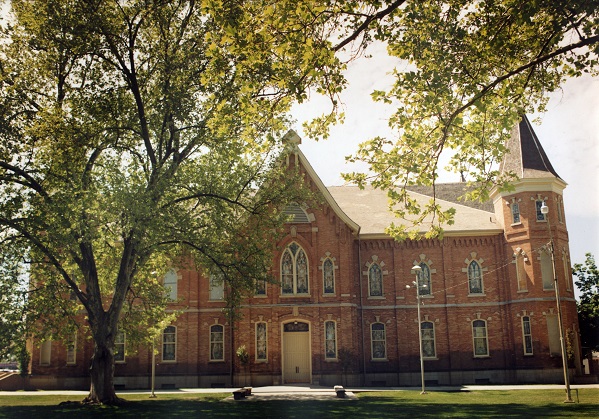 The Provo Tabernacle in 1997. Courtesy of Intellectual Reserve, Inc.
 Interior of the Provo Tabernacle after restoration, 1986. Courtesy of the Deseret News/
Construction began in 1883, and the first major meeting in the yet unfinished building convened two years later—a memorial service for the late Ulysses S. Grant, eighteenth president of the United States. The audience of two thousand people sat in temporary seats, as the unfurnished tabernacle did not yet have permanent floors, pews, doors, or windows. It continued to be completed and used in various stages.[24]
Because of the antipolygamy raids of the 1880s, many Latter-day Saint men—including some Church leaders—went into hiding to avoid arrest. For this same reason, five general conferences convened at locations away from Salt Lake City: both the April and October conferences of 1885 met in Logan, and it was rumored that the April 1886 conference was going to be held at the new tabernacle at Provo.[25] While the building would still not be completed, construction accelerated to accommodate the large crowds sure to gather at the upcoming spring conference. After a race against time, the 56th Annual General Conference was held in the nearly completed tabernacle on April 4, 1886. Large crowds gathered to the point that the tabernacle overflowed and “hundreds of persons surrounded the building.” The October conference that year convened in Coalville, Summit County, Utah. The April conference of 1887 met once again in the Provo Tabernacle.[26]
While these conferences in Provo were a success, the tabernacle suffered serious financial setbacks, causing the building to remain unfinished for several ensuing years. On March 6, 1895, Abraham O. Smoot—former president of the Utah Stake and perhaps the most vocal champion for the tabernacle—passed away. His son Reed, a future member of the Quorum of the Twelve Apostles and United States senator, became a member of the Utah Stake presidency and helped to complete the struggle to raise the hundred thousand dollars (about $2.8 million in today’s money) needed to finish the tabernacle. It was finally dedicated on April 16, 1898, by President George Q. Cannon, first counselor in the First Presidency. The ornate interior was beautified by heavy ingrain wallpaper, ceiling panels, grained oak woodwork, and three chandeliers, “each holding twenty-four incandescent bulbs.”
Due to structural deficiencies and winters of heavy snow, eventually the central tower began to cause the roof to sag. As a result, the upper octagonal part of the tower was removed in 1907—a difficult project for the period. Because this did not completely solve the problem, the remaining square base of the tower with its promenade walk was removed and the central part of the roof rebuilt in 1917. In this latter year, stained glass replaced the semifrosted glass in the windows, perhaps to help compensate for the loss of the tower. These changes significantly altered the exterior design as well as the interior ambient lighting.
A variety of community events took place in the Provo Tabernacle, including graduation ceremonies for Brigham Young University.[27] It also provided the setting for various civic meetings and hosted a variety of cultural activities, including lyceums and concerts. Still, over the years, stake conferences were the most common meetings held in the tabernacle.
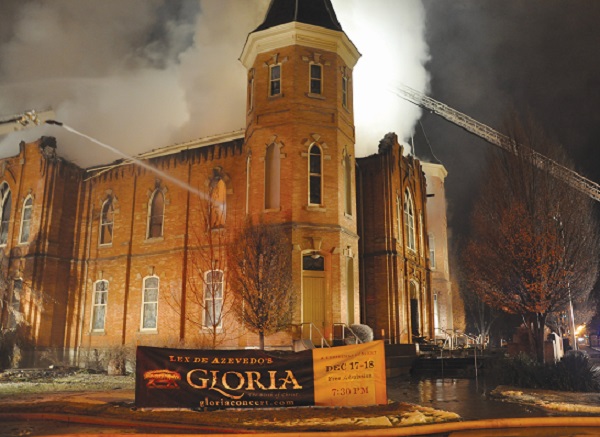
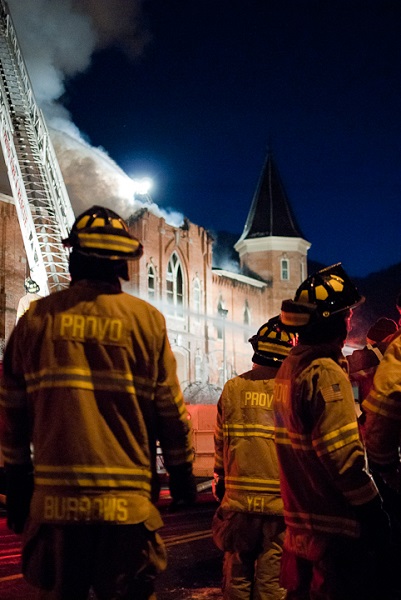 The Provo Tabernacle on fire, December 2010. Courtesy of Shawn Beardall and the Church History Library (top) and Trevor Christensen (bottom).
From time to time, the tabernacle had needed maintenance and upgrades. A major renovation beginning in 1982 restored the interior to its original appearance, including treating woodwork to bring out its natural grain. Following this latest upgrade, the tabernacle was rededicated on September 21, 1986, with a capacity crowd present. President Benson presided and spoke at the meeting. “Husbands and wives must love and cherish one another. Selfish attitudes must be overcome. Faults must be overlooked. Contention must cease. Husbands and wives must be true and loyal to each other and to the sacred covenant of marriage.” President Benson asked President Monson, his second counselor, to offer the dedicatory prayer. In his prayer, President Monson acknowledged, “We feel the spiritual influence of those who have preceded us in standing at this pulpit. Their lives become a living witness and testimony of thy work and we want to dedicate our lives that we might be true to the pioneer tradition of this building.”[28]
An event in December 2010 would change the tabernacle forever. On Thursday evening the 16th, a full orchestra, members of the Millennial Choir, and several outstanding soloists gathered for a dress rehearsal of Gloria, a musical production by noted Latter-day Saint composer Lex de Azevedo that featured events surrounding the birth of the Savior. The usual “church configuration” of the stand was modified to accommodate the production. Large lightweight arches had the appearance of stone. The hall was decorated with flowers, wreaths, garlands, and evergreen trees with twinkling lights. Even the building’s stained glass windows were backlit by BYU Television, which planned to broadcast the production through its worldwide facilities. “It had the feel of old Jerusalem, with the modern-day Christmas. Just gorgeous. It really felt celestial,” Kim Egginton, the event’s producer, reflected. “I can’t imagine that the . . . Provo Tabernacle could ever have looked more beautiful. . . . Everything just shone.”[29]
During the night a fire broke out in the attic. By 3:30 a.m. flames broke through the roof, and at about 6 a.m. the entire roof collapsed with a thundering roar. The fire continued to burn for over a day and a half, leaving only the exterior brick walls standing. Normally such walls are toppled promptly as a safety precaution, but on this occasion the firemen inexplicably were instructed to leave them standing.
On Saturday afternoon, LeGrand “Buddy” Richards, president of the Provo South Stake, within whose boundaries the tabernacle was located, was among those taken by fire officials to visit the still-smoldering building. As he looked through one of the front windows, he could see a reprint of Harry Anderson’s painting The Second Coming. He recalled that he could “clearly see the image of the Savior among the charred rubble.” Even the wall that had supported the picture was gone. Nearly all of the material goods within the structure, some of significant value, had been destroyed, but that image stood as a clear reminder. The painting didn’t make it through the ordeal without damage; it had been charred all around the edges except for the image portraying the Savior with outstretched arms. To Richards it seemed to say, “You know whose house this is. . . . What’s it to you if I want to remodel it?” Immediately, Richards’s spirit was lifted, and he was reminded “why there remains great reason to hope, even in the midst of smoking rubble.” He left the experience confident that the Lord would yet do something spectacular there. He reminded his stake members, “Our faith does not reside in the house, but in its owner, and if He decides it is time to remodel His house or our lives, we should find great reason to rejoice and be grateful.”[30]
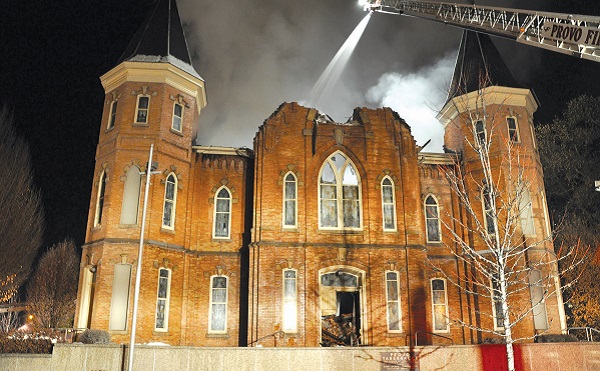 Provo Tabernacle fire. Courtesy of Shawn Beardall and the Church History Library.
Rebuilding the Tabernacle
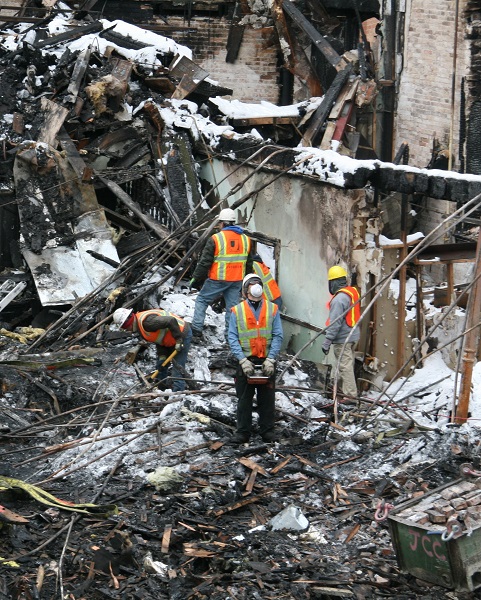 Less than a moth after the fire, workers comb through burned debris for anything salvageable. Courtesy of Intellectual Reserve, Inc. All rights reserved.
John Emery, a project manager employed by Jacobsen Construction of Salt Lake City for a dozen years, received an order to head to Provo Friday morning while the building was still engulfed in flames. His assignment was to cooperate with the firefighters and to give attention to possibly preserving any parts of the building. Once the fire was put out, an immediate goal was to stabilize the brick walls of the tabernacle, making it safe for investigators to go inside to look for clues. On Monday, December 20, Jacobsen Construction began installing steel bracing around the building to preserve the brick walls as completely as possible.[31]
Like so many others, architect Roger Jackson was shocked by news of the Provo Tabernacle fire. During that weekend, at the urging of an architectural historian friend, he contacted Church officials with whom he had been working on the Vernal Temple and other projects and urged them not to allow the building to be torn down. Although the flames had gutted the wooden interior, the brick walls had likely remained sound. He reminded them that “we had done the same thing to the Uintah Stake Tabernacle except that we didn’t use fire but tore everything out on our own.” He was able to display a photo of the future Vernal Temple when there were only gutted brick walls and point out that enough remained in Provo to allow the structure to be rebuilt. Emery invited Jackson to examine the brick walls with him because he valued his “knowledge of old masonry.”[32] “After preliminary analysis” only four days after the fire, they concluded, “The masonry system is in very good condition. We feel very strongly that this building can be renovated to its original grandeur.”[33]
 The exterior walls of the Provo Tabernacle are secured for the construction of the Provo City Center Temple. Courtesy of Intellectual Reserve, Inc. All rights reserved.
Church leaders were eager to proceed with this project and within a few days appointed Roger Jackson of FFKR to be the architect. He would work closely with the Special Projects Department of the Church.
Andy Kirby, a native of Provo who had earned a degree in civil engineering at BYU, became the Church’s site project manager. He worked closely with Emily Utt, Historic Sites curator with the Church History Department. She had received a bachelor of arts in both history and religious studies with a minor in sociology at Case Western Reserve University in Cleveland, Ohio. Church officials needed to know what had survived the fire. Kirby and Utt spent endless hours sifting through the tabernacle’s remains. “We wanted to look through every inch of debris,” Utt recalled. Andy remembered seeing Emily covered with soot as she sifted through buckets of material. This work was done during the winter. “It was really cold,” she reflected. Even four or five months after the fire, they uncovered items encased in ice formed from the water used to fight the flames. The found a wide variety of items, including newel posts, pieces of railing or wooden molding, hardware from doors, hundreds of nails, and much more. In some cases, the fire had uncovered features hidden for decades. It burned away layers of later paint or remodeling to reveal original colors of paint or designs of wallpaper. The goal was to re-create a basic floor plan as well as detailed plans for specific features. “My favorite discovery,” Emily Utt concluded, was some original stenciling that had been hidden behind two temporary walls, some mechanical equipment, and four layers of wallpaper—all burned away by the fire. The investigators took photographs and had architects prepare careful drawings of these items that would provide keys to an understanding of the building’s original architecture and character.
They spent an interesting six months meeting with the architect and others, exploring possible options for what could be done with the Provo Tabernacle. Initial discussions during the winter and spring of 2011 had focused on restoring the Provo structure as a tabernacle. Several civic organizations and many residents in the community looked forward to its possible return as a venue for cultural as well as religious events. During June of that year, however, these plans changed. President Monson and Presiding Bishop H. David Burton confidentially discussed the possibility of rebuilding the tabernacle as a temple.
As had become the custom in recent years, in his opening remarks at the October 2011 general conference President Monson announced plans for several new temples. “First, may I mention that no Church-built facility is more important than a temple,” the prophet emphasized. “Temples are places where relationships are sealed together to last through the eternities. We are grateful for all the many temples across the world and for the blessing they are in the lives of our members.” Then he continued, “Late last year the Provo Tabernacle in Utah County was seriously damaged by a terrible fire. This wonderful building, much beloved by generations of Latter-day Saints, was left with only the exterior walls standing. After careful study, we have decided to rebuild it with full preservation and restoration of the exterior, to be come the second temple of the Church in the city of Provo. The existing Provo Temple is one of the busiest in the Church, and a second temple there will accommodate the increasing numbers of faithful Church members who are attending the temple from Provo and the surrounding communities.” [34] This announcement brought an audible gasp in the Conference Center and an outburst of emotions some forty miles to the south.
A great deal of planning had preceded President Monson’s momentous announcement. A Church press release indicated “church leaders have worked with architects, engineers and historical experts to determine the future of the building.” The new structure will include “a complete restoration of the original exterior,” including even the tall central spire that had been gone for nearly a century.[35] With careful planning, architect Roger Jackson was able to fit most ordinance facilities into the historic building. Because plans called for restoring the tabernacle’s exterior to its familiar appearance (of course with the addition of the original tall central spire), there were to be no above-ground additions to the building. Therefore, some of the space needed for a temple would have to be below the surface. Dressing rooms would be on a lower level to the north, and underground parking was planned on the south. The baptistry would be on the lower level directly below the east end of the tabernacle. The temple’s chapel and two endowment instruction rooms, with one hundred sixteen seats each, would be on the ground floor. Temple patrons would begin their endowment experience in one or the other of these rooms before ascending the spiral stairs in one of the temple’s corner towers to the second floor. They would then complete the endowment in the single large instruction room at the east end of that floor. A new session could begin once every hour. The celestial room and five sealing rooms were also on this upper floor.
The First Presidency instructed that the temple’s interior should reflect elements of the tabernacle’s original architecture—Eastlake Victorian on the main floor and pioneer Gothic on the second. The architect therefore examined objects which had survived the tabernacle fire and studied the interior of the Manti Temple, another building designed by William H. Folsom. The goal was to imagine how Folsom might have designed the Provo Tabernacle as a temple in the 1880s and then design the new structure accordingly. The architect also incorporated many specific features of the former tabernacle into the new temple. Newel posts and railings from the tabernacle’s rostrum and details of the balcony are seen in the temple’s grand staircase. The tabernacle’s original elliptical ceiling is reproduced in the upper endowment room. The intricate Victorian stenciling, discovered following the fire, are featured in the brides’ room. Before the production of Gloria, the tabernacle’s pulpit had been removed from the podium and placed in storage; it therefore escaped destruction during the fire and was used in the temple chapel.
 Provo Tabernacle shell on stilts. Courtesy of Church Newsroom/
Construction Begins
Ground was broken by Elder Jeffrey R. Holland of the Quorum of the Twelve on a beautiful Saturday morning, May 12, 2012. He believed that the faithful 5,600 who had crowded onto the site was the largest group that had ever or would ever gather at that place. Elder Cecil O. Samuelson, Emeritus General Authority and president of Brigham Young University, rejoiced in “the rebirth of the iconic Provo Tabernacle, literally rising from the ashes of a horrible fire to become a temple of the Lord.”[36] He insisted that a “BYU education is really not complete nor has it reached its heaven-intended potential unless it is joined with a consistent pattern of temple worship and service.” He therefore felt it was fitting that the campus “be bracketed on the northeast and southwest by houses of the Lord.”[37]
 The baptismal font under construction, Provo City Center Temple, January 2014. Courtesy of Intellectual Reserve, Inc.
Elder Holland acknowledged the Utah Valley Saints’ faithfulness. Speaking of the tabernacle, he asserted that “no other structure in this county has been such an integral part of the religious and civic life here.” Therefore, he was grateful that the Brethren made their “inspired decision truly, to build this temple out of the ashes of this beloved tabernacle.” He then offered the prayer dedicating “already sacred ground for an even more sacred purpose.”[38] Ground was then broken using gold shovels taken from a rack constructed with timbers salvaged from the tabernacle.
Jacobsen Construction received the contract to rebuild the tabernacle, and John Emery became their senior project manager. Plans called for some temple facilities to occupy two levels beneath the historic tabernacle. Excavating for this basement directly beneath the original brick walls while preserving them intact posed “a significant challenge.” The original lime mortar was soft, so the walls would probably not have survived the digging. Furthermore, they would likely have crumbled easily in an earthquake. How could the walls be preserved? Andy Kirby believed the solution came through following spiritual promptings which resulted in “an engineering construction marvel.”[39] This plan would unfold dramatically during the latter half of 2012 and first half of the following year. The first major step was to reinforce the walls by lining them on the inside with reinforced concrete several inches thick. Piles were then driven ninety feet into the ground, some inside the walls and others next to them just outside. Each pair of piles was connected by a short steel beam that would support the walls above, an estimated total of 6.8 million pounds, while dirt was excavated below them. By the early spring of 2013, the tabernacle’s shell appeared to be supported on stilts in midair.
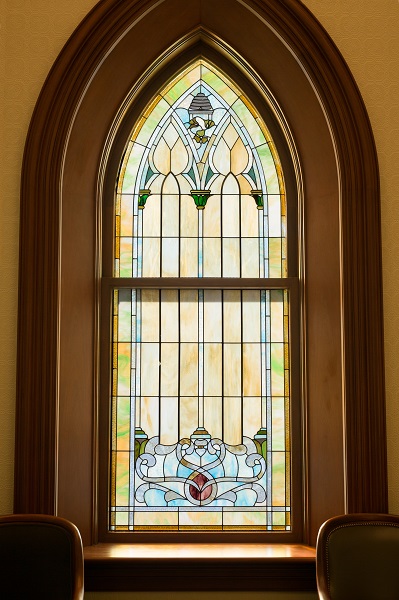 Stained-glass window, Provo City Center Temple. Courtesy of Intellectual Reserve, Inc.
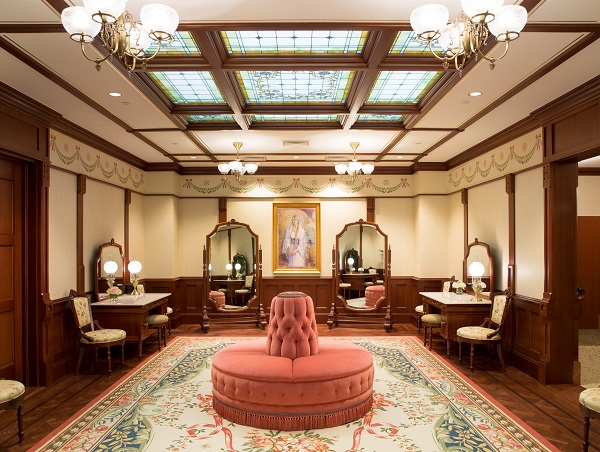 Brides' room, Provo City Center Temple. Courtesy of Intellectual Reserve, Inc.
The construction phase then began with pouring concrete for basement floors and walls. This provided a permanent new foundation for the walls, permitting removal of most of the piles. Once they were out of the way, the new temple could be constructed within the tabernacle’s shell. The first steel beam was put into place on August 20, and the steel framework was “topped out” when the steel skeleton of the tall center tower was lifted into place on December 5, 2013.
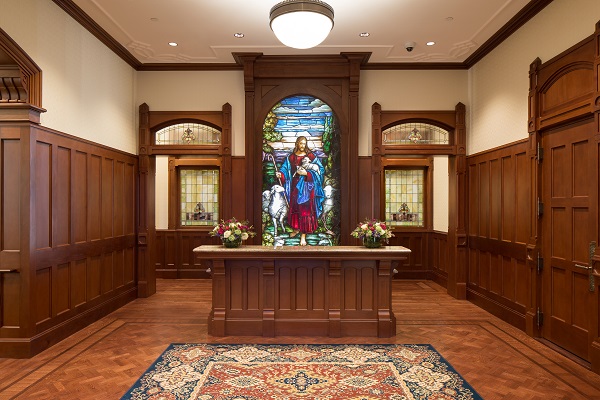
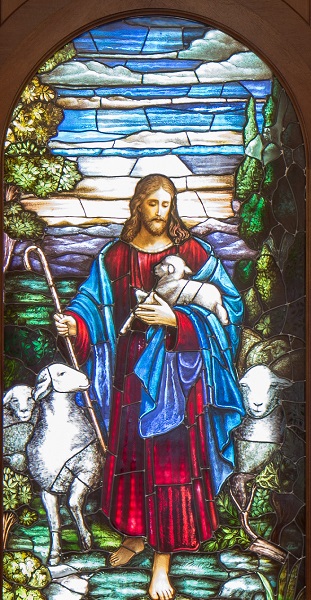 Left and Right: Detail of stained glass window of Christ holding a lamb. Courtesy of Church Newsroom/
Placing the statue of the angel Moroni typically represented a major milestone in temple construction. This occasion in Provo was not announced publicly, perhaps because the temple was located on a major thoroughfare. Still, about a thousand people had gathered on the afternoon of March 31, 2014, to witness the event. As a large overhead crane lifted the figure into place atop the center tower, the gathered throng sang “An Angel from on High” and “I Love to See the Temple.” During the summer, the roof was completed—of fireproof and durable slate rather than the original wooden shingles. Thus, the temple began to take on its completed appearance.
Since 1917, beautiful stained glass windows had been a beloved feature of the Provo Tabernacle. These would be restored in the new temple. In 1995 and 1996 the windows had been thoroughly cleaned and repaired as needed. The same local company who had done this work now received the contract to create the new windows. Fortunately, they had made detailed drawings of each window. While most of the new windows were recreations of those which had existed before, some, including ceilings in the brides’ room and celestial room, were new. Another outstanding addition was the transom above the main ground-floor entrance; this is the only temple in which the familiar “Holiness to the Lord” is proclaimed in stained glass.
The temple’s interior was also progressing. Several recent temples presented the endowment in a series of two rooms. In many cases, murals on the walls of the first room depicted landscapes typical of the area where the temple was located. Murals for the two main floor instruction rooms of the Provo City Center Temple, however, set a new pattern. Each depicted scenes from the creation, the Garden of Eden, and the present world. By late fall, the temple was furnished and ready for dedication.
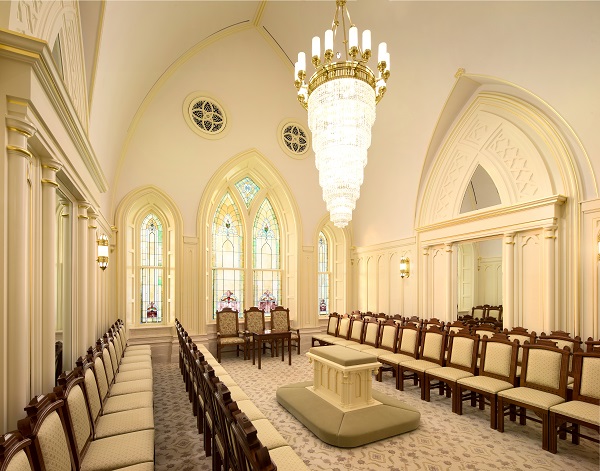
 Top: Sealing room, Provo City Center Temple. Bottom: Stained glass window. Courtesy of Intellectual Reserve, Inc.

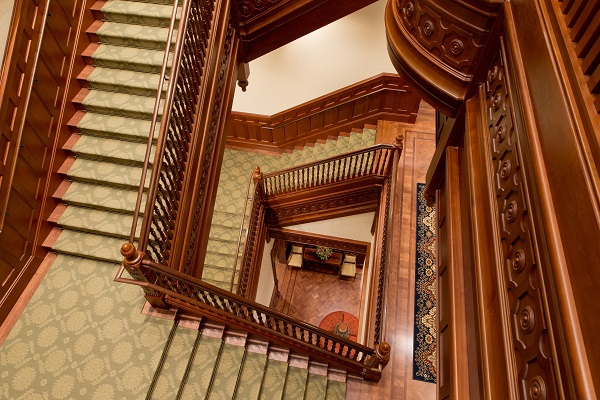 Top: Provo City Center Temple. Bottom: Three-story staircase inside the temple. Courtesy of Church Newsroom/
Dedicatory Events
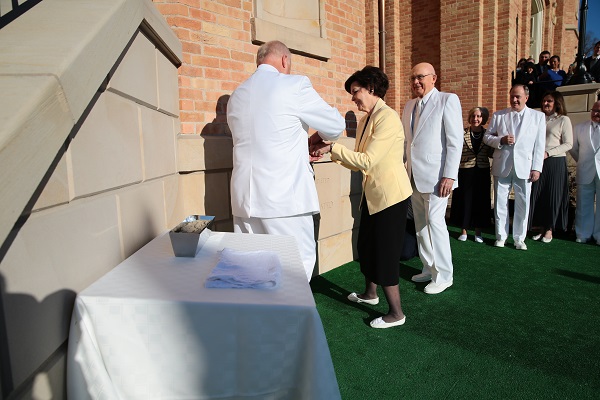 Provo City Center Temple cornerstone ceremony with Kristen Oaks and Dallin H. Oaks. Courtesy of Church Newsroom/
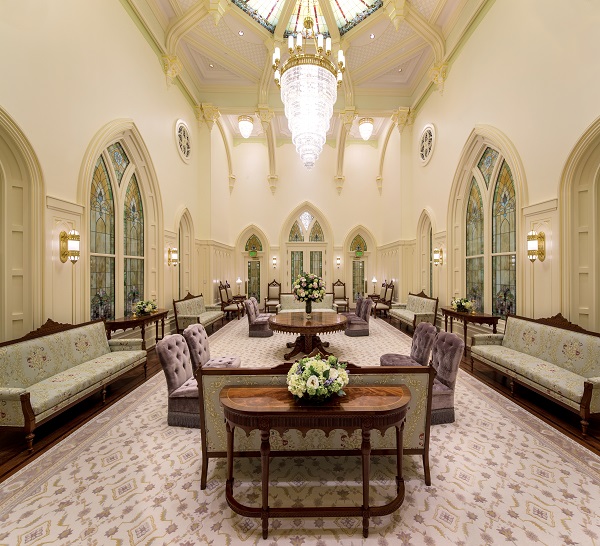 Celestial room, Provo City Center Temple. Courtesy of Intellectual Reserve, Inc.
Elder Steven J. Lund, who was the executive chairman of NuSkin Enterprises as well as a former mission president, Area Seventy, and future Young Men general president, chaired the committee responsible for the open house, cultural celebration, and logistics related to the dedication. Because of the Provo Tabernacle’s historical significance and because thousands of Brigham Young University students and local Saints had fond memories of the building, Church leaders anticipated a greater-than-usual interest in the tabernacle’s being rebuilt as a temple and scheduled an unusually long two-month open house. They were not disappointed. More than 800,000 persons attended the open house early in 2016. There were special tours for young women and their mothers on Sunday mornings when they could visit the brides’ room, which could not be part of the normal itinerary. As individuals visited the beautifully restored building, they experienced countless special experiences or “tender mercies” (1 Nephi 1:20). The cultural celebration was staged in the Marriott Center on the BYU campus on the Saturday evening before the temple’s dedication. Some five thousand youth participated. The hour-long program focused on the revered Tabernacle and its story. The Lord’s promise “to give unto them beauty for ashes” (Isaiah 61:3) became the inspired theme.
The temple was dedicated in three sessions on a beautiful spring day, Sunday, March 20, 2016. Presiding was Elder Dallin H. Oaks, a senior member of the Quorum of the Twelve and native of Provo. Proceedings were carried to stake centers throughout Utah. In his dedicatory prayer, Elder Oaks expressed gratitude for “the members of Thy Church whose faithful tithes and offerings have made possible the extensive restoration of this honored stake tabernacle that we now present unto thee as Thy house.” He then petitioned blessings for “all who come within these walls that they may come in worthiness and participate with joy and understanding of the great teachings and ordinances and blessings of This house.” The prayer asked for blessings upon all parts of the temple “and that Thy Spirit will ever be present to enlighten those who are present here.”[40]
When the original Provo Temple was dedicated in 1972, it had become the 15th operating temple in the Church. Interestingly and significantly, the Provo City Center Temple became the 150th functioning temple. Hence, during the four decades between the dedications of these two neighboring temples there had been precisely a tenfold increase in the number of temples worldwide.
Notes
[1] Kathleen M. Irving and John D. Barton, From Tabernacle to Temple (Vernal, UT: S. T. Tabernacle Enterprises, 1998), 2–6.
[2] Irving and Barton, From Tabernacle to Temple, 7–19.
[3] Vernal Express, August 30, 1907, quoted in Irving and Barton, From Tabernacle to Temple, 21.
[4] Irving and Barton, From Tabernacle to Temple, 24.
[5] Emily Utt communication, November 15, 2022, in possession of authors.
[6] Irving and Barton, From Tabernacle to Temple, 28–30.
[7] . Irving and Barton, From Tabernacle to Temple, 29–30.
[8] Irving and Barton, From Tabernacle to Temple, 32.
[9] Irving and Barton, From Tabernacle to Temple, 32.
[10] Quoted in Irving and Barton, From Tabernacle to Temple, 31.
[11] Gerry Avant, “Shell of Old Tabernacle to House a New Temple in Eastern Utah,” Church News, February 19, 1994, 3, 11.
[12] Irving and Barton, From Tabernacle to Temple, 35.
[13] John L. Hart, “Transformation Begins for Temple,” Church News, May 20, 1995, 3.
[14] Hart, “Transformation Begins,” 3–4.
[15] Hart, “Transformation Begins,” 4.
[16] Hart, “Transformation Begins,” 3–4.
[17] Irving and Barton, From Tabernacle to Temple, 62–63.
[18] Irving and Barton, From Tabernacle to Temple, 57–58.
[19] Gerry Avant, “Angel Moroni Tops Vernal Utah Temple Tower,” Church News, October 5, 1996, 5.
[20] Irving and Barton, From Tabernacle to Temple, 61.
[21] Gordon B. Hinckley, in “We Thank Thee for This Sacred Structure,” Church News, November 8, 1997, 4; Julie A. Dockstader, “Symbol of Heritage, Testimony,” Church News, November 8, 1997, 3, 8–9.
[22] Lloyd Hess, remarks, in possession of Richard O. Cowan.
[23] See Nina Folsom Moss, A History of William Harrison Folsom: March 25, 1815 to March 19, 1901 (Salt Lake City: William Harrison Folsom Family Organization, 1973).
[24] Christensen, Provo’s Two Tabernacles, 120, 123.
[25] Andrew Jensen, Church Chronology: A Record of Important Events Pertaining to the History of the Church of Jesus Christ of Latter-day Saints (Salt Lake City: Deseret News, 1899), 119, 124.
[26] Jenson, Church Chronology, 131, 138, 146.
[27] Christensen, Provo’s Two Tabernacles, 147.
[28] “Provo Tabernacle Rededicated,” Ensign, December 1986, 70; “Members Admonished to ‘Refurbish’ Their Lives,” Church News, September 28, 1986, 3, 7.
[29] Kim Egginton, interview by Richard O. Cowan, December 17, 2011.
[30] Richards, “Reflections on the Provo Tabernacle,” 2 (typescript in Richard O. Cowan’s possession).
[31] Jim Dalrymple, “Crews Work to Remove Debris and Stabilize Sections of Building,” Daily Herald, December 29, 2010, A1–A2.
[32] John Emery, statement to Richard Cowan, May 12, 2015.
[33] Statement to John Emery by David Brenchley, December 21, 2010 (copy in Richard O. Cowan’s possession).
[34] Thomas S. Monson, “And So We Meet Again,” Ensign, November 2011, 4–5.
[35] Joseph Walker, “Temple to Rise from Ashes of Tabernacle,” Deseret News,October 2, 2011, B1, B4.
[36] Weaver, “Out of Ashes,” 4.
[37] Groundbreaking video.
[38] Groundbreaking video; see also Weaver, “Out of Ashes,” 4.
[39] Andy Kirby, remarks at the Provo City Library, June 13, 2014 (notes in Richard O. Cowan’s possession).
[40] “Sacred Thanks of Our Souls,” Church News, March 27, 2016, 5.
