
 menu icon in the top, right corner of the screen.
 icon above to close this box.
 icon at the bottom of the screen below the browser—if you don't see it, swipe up to unhide it.
Small Temples
The Monticello Utah Temple
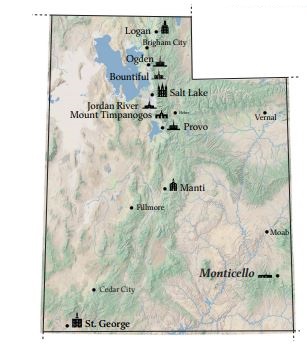
Richard O. Cowan and Clinton D. Christensen, "Small Temples," in Temples in the Tops of the Mountains: Sacred Houses of the Lord in Utah (Provo, UT: Religious Studies Center, Brigham Young University; Salt Lake City: Deseret Book), 170–87.
 Monticello Utah Temple, first small temple in Utah. Courtesy of Lee R. Cowan.
The Monticello Utah Temple, dedicated in 1998, was one of the first small temples erected by the Church at the end of the twentieth century. The story of its construction begins far beyond the Beehive State.
President Hinckley’s Inspiration
For at least two decades, President Gordon B. Hinckley had been concerned with making temple blessings more readily available to the Saints scattered globally. “Too many times he had organized stakes in various areas of the world in which few of the brethren interviewed for leadership positions had been to the temple. He found himself wondering if there weren’t a way to build smaller, less expensive temples and to build more of them throughout the world.”[1] He discussed these concerns with President Harold B. Lee as early as the 1970s.
In June 1997 President Hinckley visited the Mormon colonies in northern Mexico to participate in the celebration of the centennial of the Church-sponsored academy, or high school, there. He was impressed when he learned that this small group of faithful Latter-day Saints had contributed more than one hundred mission presidents over the years. Meredith I. Romney, president of the Colonia Juārez Stake, met him at the El Paso airport. During the three-hour drive to the colonies, the prophet talked “quite a bit about temples. One of his concerns for the people here was the distance they traveled to attend the temple.” President Romney described how stake members typically made a three- to four-day excursion to the temple in Mesa, Arizona. Only a few months earlier, however, a change in the immigration policy had made it impossible for members without passports to attend the Mesa Arizona Temple, a privilege they had previously enjoyed. The complicated and expensive procedure for obtaining passports effectively prevented many Mexican Saints from going to the temple because they could not afford to obtain the needed documents. The prophet indicated that he was concerned about getting temples closer to the members.
On Thursday evening, June 5, as President Hinckley arrived at the special fireside on the Academia Juārez campus, “he was impressed at the reverence and respect of the people assembled under the large tent, as everyone was in their seats ten to fifteen minutes early, quietly awaiting his arrival,” President Romney noted. “This was also the first opportunity that many people had of seeing and hearing a prophet speak in person.”
Elder Eran A. Call of the Seventy spoke first. He reminisced about his experiences growing up in nearby Colonia Dublán and attending the Juārez Stake Academy. He also recounted how the colonies had produced hundreds of missionaries and scores of mission presidents—a record unequaled by any other Church units of their size. This caught President Hinckley’s attention, President Romney recalled.[2]
 Gordon B. Hinkley's sketch of a small temple. Courtesy of Church History Library.
President Hinckley was the principal speaker. After reviewing the history of the colonies and praising the Saints for their faithfulness, the prophet surprised his listeners with an unexpected idea: “This is the greatest era in the history of the Church and in the world for temple building. I would like to see the time come when all of our people throughout the world could get to a temple without too much inconvenience. I think you are about as far away as anybody and I don’t quite know what to do about you. There aren’t enough of you to justify a temple. Now, if you’d multiply the membership here and get about 20,000 members of the Church here, or 30,000, we’d build a beautiful temple. That’s a challenge for you.” Many who were in attendance commented that they had never before even contemplated the possibility of a temple in the colonies, so they were electrified by this totally unexpected yet wonderful suggestion.
The next morning President Hinckley spoke again at the academy’s commencement exercises. Immediately following the meeting, President Meredith Romney again had the privilege of driving him back to the airport in El Paso. “On the way into Mexico, President Hinckley was sitting beside me in the front seat and was quite talkative,” President Romney recalled. “However, on the way back he sat in the back seat and seemed to be resting and meditating. He commented several times on how impressed he was with the people at the fireside, the musical numbers presented, and the sweet spirit that was there. He also commented on the graduating class.”[3]
President Hinckley later described what was going on in his mind during the drive back to the airport: “As we were riding to El Paso, I reflected on what we could do to help these people in the Church colonies in Mexico. They’ve been so very faithful over the years. They’ve kept the faith. They’ve gone on missions in large numbers. These [two small] stakes have produced very many mission presidents who served faithfully and well. They’ve been the very epitome of faithfulness. And yet, they’ve had to travel all the way to Mesa, Arizona, to go to a temple. . . . I thought of these things and what could be done. The concept of . . . smaller temples came into my mind. I concluded we didn’t need the laundry. We didn’t need to rent temple clothing. We didn’t need eating facilities. These have been added for the convenience of the people but are not necessary.” President Hinckley noted that a smaller temple could be built more quickly and yet include all the essential facilities needed for temple ordinances. After boarding the airplane, he recalled, “I took a piece of paper” and “sketched out the plan, and turned it over to the architects to refine it.” He concluded, “The concept is beautiful. It’s a very workable concept.”[4]
 Illustration of smaller temple. Courtesy of Lee R. Cowan.
Later, at a regional conference in Chihuahua City, President Hinckley also spoke of his experience following the visit to Colonia Juārez: “There came to my mind an idea I’d never thought of before. It was inspired of the Lord to build a temple there, a small one, very small, six thousand square feet with facilities.” He emphasized, “Every faithful member needs access to the house of the Lord. The gospel is not complete without the ordinances of the temple.”[5] Later, in the temple’s dedicatory prayer, the prophet specifically used the word revelation to describe the source of the small temples concept. “It was here in Northern Mexico, that Thou didst reveal the idea and the plan of a smaller temple, complete in every necessary detail, but suited in size to the needs and circumstances of the Church membership in this area of Thy vineyard. That revelation came of a desire and a prayer to help Thy people of these colonies who have been true and loyal during the century and more that they have lived here. They are deserving of this sacred edifice in which to labor for themselves and their forebears.”[6]
The Surprising Announcement
During the October 1997 general conference, in the Saturday evening priesthood session, the construction of these temples was announced publicly for the first time. “There are many areas of the Church that are remote, where the membership is small and not likely to grow very much in the near future,” President Hinckley began. “Are those who live in these places to be denied forever the blessings of the temple ordinances? While visiting such an area a few months ago, we prayerfully pondered this question. The answer, we believe, came bright and clear. We will construct small temples in some of these areas, buildings with all of the facilities to administer all of the ordinances.” He explained that they would be built “to temple standards, which are much higher than meetinghouse standards. They would accommodate baptisms for the dead, the endowment service, sealings, and all other ordinances to be had in the Lord’s house for both the living and the dead.” A local man would be called to preside over each of these temples; his first counselor would be the temple recorder, and his second counselor would serve as temple engineer. Because patrons would bring their own temple clothes, no expensive laundry facilities would be needed (except for baptismal clothing). Then came the stunning news: “We are planning such structures immediately in Anchorage, Alaska, in the LDS colonies in northern Mexico, and in Monticello, Utah.” Like the Mexican colonies, members in the other two locations had to travel relatively long distances to reach a temple. The nearest temple to Monticello, for example, was Manti, a four-hour drive. President Hinckley declared that the Church was determined “to take the temple to the people and afford them every opportunity for the very precious blessings that come of temple worship.”[7]
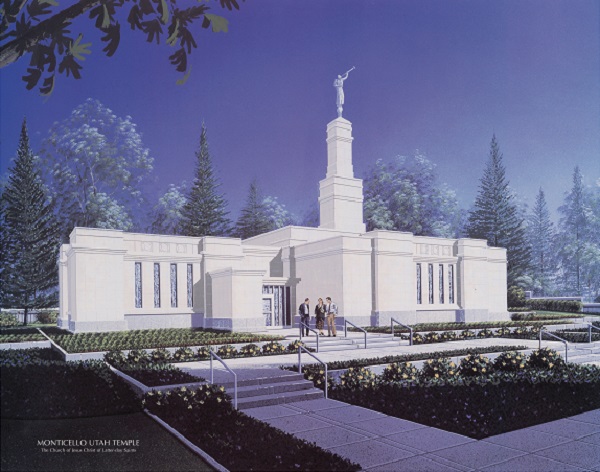 Architectural rendering of small temples announced in October 1997. Note the white angel Moroni called for in early plans. Courtesy of Church News.
President Jed Ervin Lyman of the Blanding Stake was listening to the priesthood session of general conference on that momentous Saturday evening, October 4, 1997. When he heard that a temple would be built in nearby Monticello, he “almost jumped up and shouted!” He and his members were “just absolutely thrilled.”[8]
The Saints in the Monticello Area
The history of the Church in southeastern Utah goes back to 1855, just eight years after Brigham Young and the first pioneers reached the Salt Lake Valley. President Young called a group in the Manti area to take the gospel to Native Americans in the region. These Elk Mountain missionaries built a fort on the Colorado River at the present site of Moab, but after just a few months, an Indian uprising forced them to discontinue their efforts. The next Latter-day Saint activity would not come until nearly a quarter century later. In 1879 President John Taylor appointed a group from the Parowan and Cedar City area to develop a road and establish a colony on the San Juan River in southeastern Utah. During the fall of that year, several families set out, expecting to reach their destination in about six weeks. A major obstacle was the two-thousand-foot Colorado River Gorge. The only way down was through a narrow slot canyon, scarcely wide enough for the wagons. After chiseling a road through this Hole-in-the-Rock, the men locked the wheels of the wagons and attached chains with which they held the wagons back as they skidded down the steep descent. They then needed to float the wagons across the river and build a road up the other side. By this time, bitter winter weather had set in. Building the road through the broken up country was an ongoing challenge. After six months, they finally reached the location of their future colony, which they named Bluff City. Church historian Andrew Jenson concluded that “these pioneer settlers experienced more hardships than any other colony known in the history of the Church.”[9] Many present-day Church members in the area are descendants of these sturdy Hole-in-the-Rock pioneers. Soon other settlements were established, and in 1883 they were organized into the San Juan Stake. At a stake conference in 1894, Elder Brigham Young Jr. of the Quorum of the Twelve spoke on the importance of performing vicarious ordinances on behalf of the dead and prophesied that “in the near future a Temple would be built in this County.”[10]
Over the years, the Church has continued to grow in southeastern Utah. The name of the San Juan Stake was changed in 1974 to the Monticello Utah Stake. At the time the temple was built, the district also included the Moab, Blanding, and Blanding West Stakes in Utah as well as the Durango Colorado Stake.
 Monticello Utah Temple construction. Courtesy of Robin Ramsay.
Construction of the Monticello Utah Temple
At first Church leaders considered a downtown site but decided to place it adjacent to the north chapel. The 1.33-acre plot was donated by a father and son, Ernest and Paul Sondregger of Monticello. Being on a gentle rise, the temple would be easily visible to those approaching the town from the north on Highway 191.
Since the concept of these small temples was new, Church leaders wanted the temple at Monticello to be built first, as it would be more accessible to Church headquarters and therefore easier to inspect. President Hinckley explained, “We wanted to build one we could get to, that we could observe. This is somewhat new ground we were treading, and we wanted to be able to examine it and see how things fit together.[11]”
Church leaders broke ground at Monticello just six weeks after plans for this temple were announced. Elder Ben B. Banks of the Seventy, who was serving as Utah South Area President, presided at the ceremony on November 17, 1997. On this sunny Saturday, an estimated 2,550 persons, about double the number expected, gathered on the site. Many stood on piles of dirt, construction equipment, and truck beds to have a better view. A choir of seminary students from Monticello and Blanding performed “High on the Mountain Top,” “We Love Thy House, O Lord,” and “Now Let Us Rejoice.” Elder Banks affirmed that “We have the opportunity to live in the greatest day in the history of the Church in building temples to our Father in Heaven.” Elder Banks’s counselors in the Area Presidency who likewise were of the Seventy also spoke; Elder Dennis B. Neuenschwander declared, “Though the temple might be of a smaller dimension, there is no small dimension to what occurs here and what will occur within the walls of the temple. All the essential ordinances of and for the salvation of God’s children that are performed in the largest of the temples will be performed also in the smallest of the temples.” Elder Neil L. Andersen correctly predicted that this temple “would be the first of a flood of small temples that will dot the earth.”[12]
 Exterior with sunstones. Courtesy of Robin Ramsey.
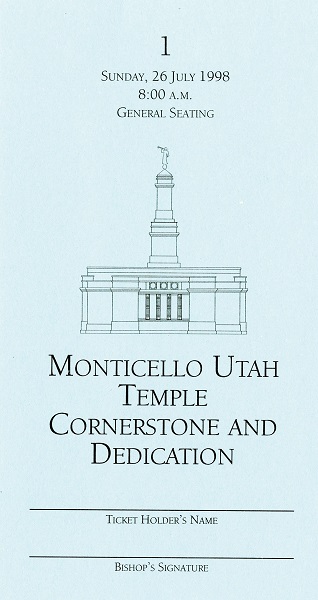 Dedication ticket. Courtesy of the Temple Department.
The 7,000 square feet of floor area was less than half that of a typical meetinghouse. For example, the ward chapel next to the temple had an area of 18,000 square feet. Though it was small, this temple was constructed according to the same higher standards as any other temple. President Hinckley affirmed that the Monticello Utah Temple “contains all the features necessary for the work of the Lord to be done in this holy house. It lacks some features to be found in larger temples, but those are not of an essential nature. All of the essential qualities are there, all of the facilities are here. This is a beautiful building. It has been well constructed. There’s been no scrimping anywhere. This building can take its place among the great temples of the Church, smaller, but of the same beauty and the same quality.”[13]
The exterior was “Noah’s Crème,” or off-white marble imported from Turkey. Local members noted that “the hue of the temple seems to change with the weather conditions and time of the day” and that “the color of the marble perfectly complements the color of the local landscape.” This exterior surface would also withstand the sandstorms typical of the Four-Corners region. Windows featured art glass from Germany.[14]
Placing the figure of the angel Moroni atop the temple was an eagerly anticipated milestone. A crowd of about one thousand gathered on Thursday, May 14, to see the six-foot statue be hoisted to the top of the temple’s fifty-foot spire. This was the first time one of the statues designed particularly for the small temples was seen publicly. They were each six feet tall and formed in white acrylic fiberglass. Sculpted by Karl Quilter and reproduced in fiberglass by LaVar Wallgren, the figure depicted a younger angel blowing a trumpet in his right hand and holding out a scroll symbolizing the gospel in his left. It represented the fulfillment of John’s vision of a latter-day angel bringing “the everlasting gospel to preach unto them that dwell on the earth, and to every nation, and kindred, and tongue, and people” (Revelation 14:6). The statue was placed under the supervision of project architect Mark Shaffer.[15]
Dedication Events
The Monticello Utah Temple was constructed faster than any other in the Church. It required less than eight months to be completed and to be ready for the open house. J. Sperry Eardley, president of the Monticello Utah Stake, affirmed that the temple had been “very well received in the community” of which 30–40 percent were not Latter-day Saints. “Our people are very excited and elated to have a temple in the area.”[16]
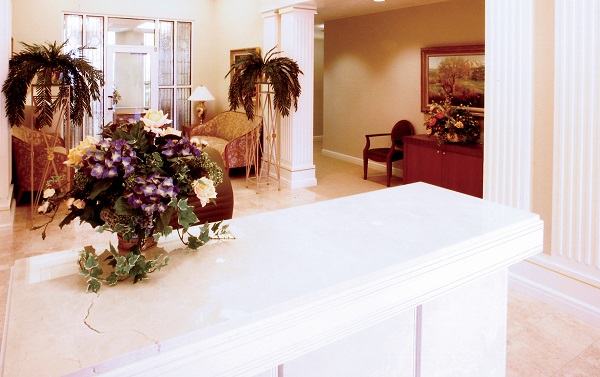 Recommend desk in the Monticello Utah Temple. Courtesy of Deseret News and Church History Library.
VIP tours were offered on Wednesday, July 15. Speaking to dignitaries gathered in the chapel next door to the temple, Elder Banks pointed out, “As nice as this chapel is, . . . temples are different. . . . They are built as close to perfection and precision as possible because at the dedication, a temple does become a House of the Lord.”[17] Coming to the temple impressed Jim Dyer, a state legislator from neighboring Colorado. He stated that he had “two very touching experiences in the last week.” First, as a veteran of Marine service in southeast Asia, he had seen the traveling Vietnam War Memorial on which he saw the names of three friends who had paid the ultimate price in combat. The second experience was his visit to the temple’s celestial room. “There was something about that last room that gave me the most peaceful feeling. I don’t know what it was, and I don’t know how to explain it.”[18]
During the three-day public open house July 16–18, a total of 20,348 persons viewed the new temple. An interesting problem took place on the last morning of the open house. Thousands of moths covered the lawns, sidewalks, and walls of the temple. At the same time, starlings were creating a mess as they built nests on the meetinghouse next door. As the custodian was removing the moths with a leaf blower, “the starlings swooped in and began to devour the moths in midair,” and they were mostly gone in twenty minutes. Observers were reminded of how seagulls had saved the pioneers’ crops in 1848.[19]

 Monticello Utah Temple Interior. Top: Celestial Room. Bottom: Baptismal font. Courtesy of Deseret News and Church History Library.
The temple was dedicated by President Hinckley in eight sessions on July 26 and 27, 1998. The 8 a.m. cornerstone session was followed by three dedicatory sessions on Sunday and four more on Monday. Proceedings were carried by closed-circuit television to the ward chapel next door and to the stake center downtown. A total of 8,108 were able to attend.
The Sunday morning cornerstone ceremony represented the completion of the temple. Some 1,300 persons gathered outside the temple to witness the proceedings. The cornerstone choir’s sixty-six singers came from all five stakes in the temple district. Their eagerness to participate was exemplified by eighteen-year-old Suzanne Eardley of Monticello, who had knee surgery just six days before; “regardless of the surgery, she said she was going to be singing in the choir.”[20] As President Hinckley arrived fifteen minutes before the 8 a.m. opening session, the cornerstone choir sang “We Thank Thee, O God, for a Prophet.” After President Hinckley and other dignitaries applied mortar to the plaque covering the cornerstone box, others from the congregation—children and adults—took their turns. One of those applying mortar was Agnes Hurst of Blanding, who was ninety-six years old. “I wanted to ask President Hinckley how I did,” she later quipped. “I think the temple is one of the most marvelous things in our area,” she asserted. “It was something we had hoped for but never expected in our lifetime.”[21]
“This is a very happy day for me,” declared President Hinckley at the dedication of the first of the smaller temples he had envisioned while returning from Mexico the year before. “It’s taken a long time to fulfill Brigham Young Jr.’s prophetic statement. I’m glad to be in harmony with Brigham Young Jr. The inspiration of the Spirit is strong, clear, and certain that this is where the house of the Lord should be built,” the prophet testified. “No one could be happier than I am.”[22] In addition to President Hinckley, other speakers during the dedication included second counselor President James E. Faust, Elder Joseph B. Wirthlin of the Quorum of the Twelve, W. Eugene Hansen of the Presidency of the Seventy and executive director of the Temple Department, and all three members of the Utah South Area Presidency.
 Majorie Hinckley and Gordon B. Hinckley at the Monticello Utah Temple cornerstone ceremony. Courtesy of Robin Ramsey.
Lyle G. Adams of Monticello, the new temple’s first president, was a great-grandson of one of the original pioneers. “I feel like the Hole-in-the-Rock trip really sanctified him, President Adams insisted, speaking of his ancestor. “It put his descendants on the road to being faithful Latter-day Saints. The blessings [of the temple] are indescribable. The feeling in this whole area is one of deep, deep gratitude.” He noted that seven couples had already scheduled weddings in their new temple.[23]
President Jed Ervin Lyman of the Blanding Utah Stake, another grandson of one of the early leaders, had similar feelings: “I had heard all my life that a temple someday would be built in the area, but I didn’t know it would happen in my lifetime. Having the temple in the area is pretty overwhelming.”[24]
Later Developments
One of the most visible changes at the Monticello Temple occurred less than a year after its dedication. Unfortunately, the white statues of the angel Moroni tended to blend in with the sky on cloudy days and therefore seemed to disappear. This problem would likely be made even worse by the snowy landscape in Anchorage, Alaska. When President Gordon B. Hinckley visited Monticello on July 6, 1998, just before the dedication, he expressed the feeling that the Church should return to the golden statues.[25] Hence, the figure of Moroni delivered in October of that year for the Colonia Juārez Mexico Temple was gold. Then in December, a gold-colored statue was placed on the Anchorage Alaska Temple. Finally, on May 25, 1999, a seven-foot gold-leafed angel was substituted on the Monticello Utah Temple’s spire.
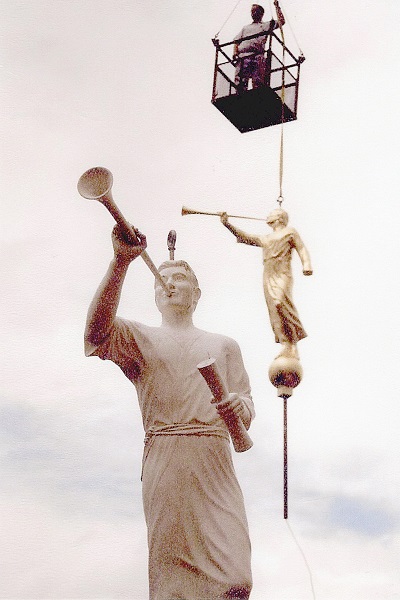 Changing the angel Moroni statues on the Monitcello Utah Temple (from white to gold). Courtesy of Robin Ramsey.
The original three small temples (Monticello, Anchorage, and Colonia Juārez) all had a floor area of about 7,000 square feet and included just one room for presenting the endowment; this meant that a new session could begin only every two hours. Only a few weeks after the dedication of the Monticello Utah Temple, construction of a second generation of small temples commenced, beginning in Columbus, Ohio, and Spokane, Washington. Their plan was enlarged to about 11,000 square feet, adding a second ordinance room plus some other facilities, and enlarging the dressing room area; now sessions could begin about every hour and a quarter. With the announcement of these temples, as well as temples in such locations as the Minneapolis–St. Paul, Detroit, and Edmonton areas, it was apparent that these smaller structures would also be built in some larger centers of Church population. A third generation of these smaller temples, beginning with Columbia River, Washington, in 2001, enlarged the plan to about 16,000 square feet, further enhancing their efficiency. In light of this experience, two of the original three small temples were enlarged; only the Colonia Juārez Temple would remain unchanged.
The Monticello Utah Temple was closed during most of 2002 for its renovation. A new celestial room was constructed on the north end of the temple, allowing a second endowment room to be created in the area of the former celestial room. The temple’s floor area was enlarged to 11,225 square feet. The two-room sequence of presenting the endowment, originally developed for the St. Louis and Vernal Temples, was instituted at Monticello, allowing sessions to begin more frequently. When these changes were completed, there was another public open house, November 2–9, and the temple was rededicated November 17, 2002, once again by President Hinckley.
 The first three small temples: (1) Larger Monticello Utah Temple. Courtesy of Intellectual Reserve, Inc.
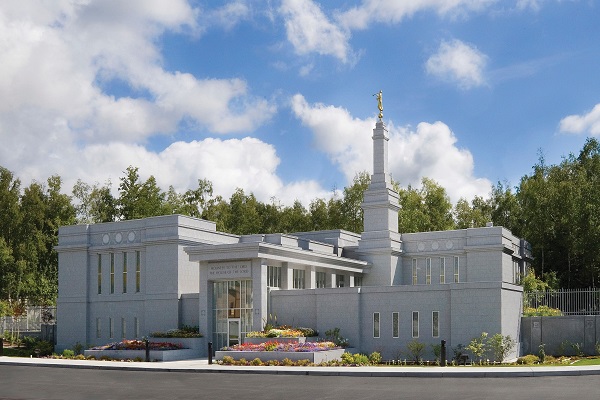 (2) Anchorage Alaska Temple. Courtesy of Intellectual Reserve, Inc.
 (3) Colonia Juárez Chihuahua Mexico Temple. Courtesy of Intellectual Reserve, Inc.
Legacy of the Monticello Temple
President Gordon B. Hinckley announced the goal of having one hundred temples in service by the end of the year 2000. This goal was more than met—on December 17, 2000, the Church’s 102nd temple was dedicated, in Porto Alegre, Brazil. Thirty-four, exactly one-third of all the Church’s existing temples and almost all of the small variety, had been dedicated during that year alone. Within a decade of Monticello’s dedication, over sixty of these smaller temples (having an area of less than 20,000 square feet) would be constructed. They would be found on nearly every continent.

 Monticello Utah Temple sign (top) and entrance (bottom). Courtesy of Intellectual Reserve, Inc.
The Saints regarded some of these smaller temples as specific fulfillments of prophecy. Speaking at a conference at Grants Pass, Oregon, in 1924, for example, Elder Melvin J. Ballard of the Quorum of the Twelve declared that a temple would be built one day in the Rogue River Valley.[26] A small temple was dedicated at nearby Medford in 2000. Then when a chapel was dedicated in the Columbus area in 1991, the stake president emphasized the importance of temple attendance (at that time, requiring an overnight drive to Washington, D.C.), and prayed, “Help us to realize that as we attend more regularly, the temple could move closer, even to our doorsteps.”[27] Another small temple, also dedicated in 2000, was built next door to this chapel.
Thus, the pattern of smaller temples, first seen in Monticello, Utah, spread to bless Latter-day Saints all over the world.
Notes
[1] Sheri L. Dew, Gordon B. Hinckley: Go Forward with Faith (Salt Lake City: Deseret Book, 1996), 325.
[2] Meredith Romney, interview by Richard O. Cowan, November 17, 2006, in author’s possession.
[3] Meredith Romney, interview by Richard O. Cowan, November 17, 2006, in author’s possession.
[4] Dell Van Orden, “Inspiration Came for Smaller Temples on Trip to Mexico,” Church News, August 1, 1998, 3 and 12.
[5] Based on notes taken by Mona Cluff, wife of Chihuahua Mission president, at Chihuahua regional conference, March 13, 1998, typescript in Virginia H. Romney, “History of the Colonia Juarez Chihuahua Temple,” (1999), 1:54–55, notes in author’s possession.
[6] Gordon B. Hinckley, “This Is a Day Long Looked Forward To,” Church News, March 13, 1999, 7.
[7] Gordon B. Hinckley, in Conference Report, October 1997, 68–69.
[8] Dell Van Orden, “President Hinckley Dedicates the First of Smaller Temples,” Church News, August 1, 1998, 3, 11.
[9] Andrew Jenson, Encyclopedic History of the Church (Salt Lake City: Deseret News, 1941), 772–73.
[10] San Juan Stake general minutes, November 25, 1894, Church History Library.
[11] Van Orden, “Inspiration,” 3, 12.
[12] R. Scott Lloyd, “Ground Broken for the First of Church’s New ‘Small’ Temples,” Church News, November 22, 1997, 3.
[13] Van Orden, “Inspiration,” 12.
[14] Chad S. Hawkins, The First 100 Temples (Salt Lake City: Deseret Book, 2001), 146.
[15] Bill Boyle, “Statue of Angel Moroni Placed on Top of Temple,” Church News, May 23, 1998, 4.
[16] Van Orden, “President Hinckley Dedicates the First,” 12.
[17] Lloyd, “Monticello Temple Opens Doors to Public,” Church News, July 18, 1998, 3}
[18] Lloyd, “20,000 Tour New Temple Prior to Its Dedication,” Church News, July 25, 1998, 12.
[19] R. Scott Lloyd, “20,000 Tour New Temple Prior to Its Dedication,” Church News, July 25, 1998.
[20] Van Orden, “President Hinckley Dedicates the First,” 3, 11.
[21] Van Orden, “President Hinckley Dedicates the First,” 11.
[22] Van Orden, “President Hinckley Dedicates the First,” 3; Hawkins, First 100 Temples, 148.
[23] Van Orden, “President Hinckley Dedicates the First,” 11.
[24] Van Orden, “President Hinckley Dedicates the First,” 11.
[25] Mark Shaffer, quoted in Virginia H. Romney and Richard O. Cowan, The Colonia Juārez Temple: A Prophet’s Vision (Provo, UT: Religious Studies Center, Brigham Young University, 2009), 60.
[26] “Promise Fulfilled,” Church News, November 6, 1999, 16.
[27] Hawkins, First 100 Temples, 164.
