
 menu icon in the top, right corner of the screen.
 icon above to close this box.
 icon at the bottom of the screen below the browser—if you don't see it, swipe up to unhide it.
The Salt Lake Temple Completed
Richard O. Cowan and Clinton D. Christensen, "The Salt Lake Temple Completed," in Temples in the Tops of the Mountains: Sacred Houses of the Lord in Utah (Provo, UT: Religious Studies Center, Brigham Young University; Salt Lake City: Deseret Book), 66–93.
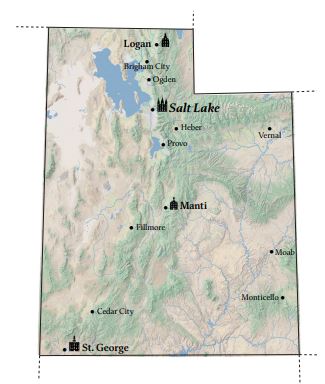 Four temples dedicated in Utah during the nineteenth century. Courtesy of Lee R. Cowan.
Even though the construction and dedication of the temples at St. George, Logan, and Manti attracted a great deal of attention and placed substantial demands on the people’s energies and resources, the Saints never lost sight of the objective of erecting the great temple at Church headquarters in Salt Lake City. Even during the years when the potentially hostile army was in Utah and the Salt Lake Temple’s foundation was covered with dirt, draftsmen in the architect’s office were busy planning the exact size and shape for each of the thousands of stones that would be needed for the temple.

 Top and Bottom: Working at the temple quarry, preparing stones for the temple. Courtesy of Deseret News and Church History Library.
Construction Accelerates
As construction resumed during the early 1860s, builders needed to obtain granite from the mountains southeast of the city immediately. Generally, it was not necessary to quarry the rock from the mountainsides because huge granite boulders were strewn thickly along the canyon floor. Using hammers, chisels, and sometimes explosives, the workmen split these boulders into the specified sizes and shapes of stones for the temple. The work moved slowly because there were only a few stonecutters with sufficient skill. These men worked grueling, ten-hour days beginning at 7:00 a.m. but took time for prayer and for spiritual discussions in the evenings. As the work expanded, a village of small cottages sprang up in a grove of trees near the canyon’s mouth.
Transporting the granite some twenty miles from the quarry to Temple Square posed a major challenge. Four to six oxen struggling to pull a heavy wagon hauling only a single monstrous stone, or perhaps two medium ones, was a common sight on the streets of Salt Lake City. Some of the individual stones for the temple weighed as much as three tons. Special low-slung wagons were designed to facilitate loading and unloading. The journey from the quarry took three to four days. As a result, progress on the temple seemed to be painfully slow. As late as 1867, the walls were still below ground level. Construction on a canal for transporting stone began, but the necessity of crossing uneven terrain and several canyon streams proved to be an insurmountable barrier. Hence, this project was never completed. A further slowdown occurred in 1868 when workmen were diverted from the temple to help finish the transcontinental railroad. Nevertheless, Church leaders knew that the coming of the railroad would ultimately expedite temple construction in a significant way.
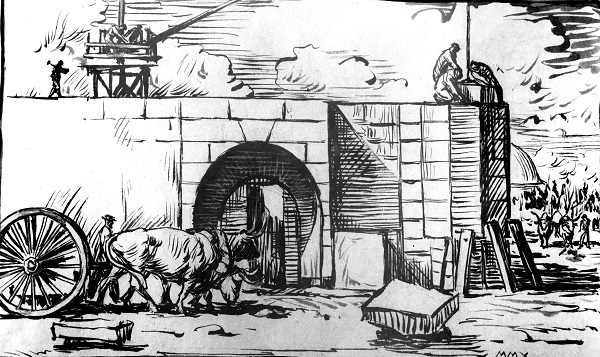 Drawing by Mahonri Young. Courtesy of Deseret News and Church History Library.
The transcontinental rail line was completed through Ogden in 1869, and the following year a branch line reached Salt Lake City. During the early 1870s, tracks of the Utah Southern Railroad (later part of the Union Pacific) pushed southward toward Utah Valley. Rather than following a direct route, they were swung to the southeast to pass closer to the temple quarry. (Over a century and a quarter later, this exact route would be followed by Salt Lake Valley’s Trax light rail system.) In 1873 a narrow-gauge spur was constructed from the main line at Sandy Station to the quarry a few miles to the east. A connection was also made downtown with streetcar tracks from which a rail spur was constructed through the south gate into the temple block. Because these tracks were lightweight, the loaded rail cars had to be pulled by horses the final four blocks along South Temple Street.
A short time later, the tracks along South Temple were replaced with a heavier rail, and steam locomotives took the place of the horses. At the time of President Young’s death in 1877, the temple walls were still only twenty feet high, just a little above the level of the first floor. Thus, most of the temple’s construction was yet to be accomplished, even though twenty-four years of the forty-year building period had already passed. During the next few years, however, with the problems of transportation resolved, the pace would accelerate considerably.


 Left, Top, and Bottom: Temple site with derricks. Courtesy of Deseret News and Church History Library.
Derricks were constructed in each of the temple’s four corners to lift the heavy stones into place. Unfortunately, there was only one steam-hoisting engine available. It powered the derrick in one corner to lay five courses, or levels, of rock before moving on to the next corner. With the completion of the Logan Temple in 1884, a second engine became available, so construction moved more quickly. The structure was very solid because the builders recalled that President Young had expressed the desire that this temple would stand through the Millennium. Even at their tops, the walls were six feet thick, and the granite blocks were individually and skillfully shaped to fit snugly together. Nearly a century later, Elder Mark E. Petersen attested to the soundness of the temple’s construction. He was in the temple when a rather severe earthquake hit, damaging several buildings around the Salt Lake Valley. “As I sat there in that temple I could feel the sway of the quake and that the whole building groaned.” Afterward, he recalled, the engineers “could not find one semblance of damage” anywhere in the temple.[1]
Many people contributed to the temple’s construction either directly or indirectly. Under the concept of “labor tithing,” able-bodied men were asked to donate one day in ten to working on the temple. Wards in the area were assigned in rotation to provide workmen a week at a time. The women assisted by washing and mending clothing for the workmen and by teaching the children of those working on the temple. President Heber C. Kimball had admonished the sisters to give up costly jewelry and fancy hair ornaments in order to donate to the temple fund.[2] Priesthood quorums, as well as individuals with means, hired mechanics to work on the temple. During the 1880s, each ward was expected to maintain one workman in the quarry. “As a boy,” President Heber J. Grant recalled many years later, “I paid twenty-five cents regularly to help in the erection of the Salt Lake Temple. Subsequently, as my wages became more, I increased my contribution.”[3]
James B. Wilson was typical of the many who contributed to the temple’s construction. As a schoolteacher, his monthly salary was meager, so he had almost no cash to pay his tithing. “I finally decided to give the Church one of the two oxen I had in spite of the fact that it would break a wonderful team.” Shortly afterward, he happened to pass by the temple block. “I noticed two fine oxen working on a drag which moved the giant blocks about. I was so interested in them that I moved closer for a better view and discovered one of them to be my favorite ox, fattened and in perfect condition. I then fully appreciated the significance of tithing. I was building the temple with my ox.”[4]
Symbolism of the Temple’s Exterior
The Salt Lake Temple’s architecture was a blend of the Romanesque (or what some have called the “Round Gothic”) with the castellated style of the other early Utah temples at St. George, Logan, and Manti. The Salt Lake Temple’s exterior, however, had several unique features. As had been the case in ancient times, the physical arrangement was calculated to teach important lessons. The intent of the temple’s design, one architectural historian observed, was “to aid man in his quest to gain entrance back into the presence of God from whence he came.”[5]
As has been seen, William Ward, who had a key role in drafting the plans for the temple, testified that the basic concept of the building’s design had not come from the architects. At the time of the capstone laying in 1892, he recalled how Brigham Young had instructed Truman O. Angell about what would become the temple’s most widely recognized symbolic features: “There will be three towers on the east, representing the President and his two counselors; also three similar towers on the west representing the Presiding Bishop and his two counselors; the towers on the east, the Melchizedek Priesthood, those on the west the Aaronic Priesthood.”[6]
As was the case with the Nauvoo Temple, special ornamental stones were an important feature of the Salt Lake Temple’s exterior. An earthstone formed the base of each of the temple’s fifty buttresses. These were the largest stones in the temple, weighing over six thousand pounds and having on their face a representation of the globe, four feet in diameter. These stones served as a reminder, architect Angell explained, that the gospel message had to go to all the earth.[7] Each buttress had a moonstone about halfway up, and a sunstone near its top. Because the earth is presently in a telestial condition, these three ornamental stones on each buttress might represent the three degrees of glory in ascending order—telestial, terrestrial, and celestial (see 1 Corinthians 15:40–42; Doctrine and Covenants 76:50–113). The starstones on the temple’s towers also reminded Latter-day Saints of the telestial kingdom (see Doctrine and Covenants 76:81).
Architectural scholar Richard Oman has suggested another possible interpretation. Referring to Abraham 3:5, he pointed out, “As we move upward into the heavens, the time sequences become longer. Likewise, the temple stones that communicate time begin with a short period of time, the day, and move toward the eternal present, where time almost ceases to move.” The earthstones at the temple’s base represent our planet, which rotates once every day. Stones about halfway up the building depict the moon’s monthly cycle. Sunstones near the top symbolize yet a longer period of time—the year. The depiction of stars even higher on the building’s towers suggests even longer periods of revolution.[8]
 Architectural drawing of earthstones and moonstones. Courtesy of Church History Library.
The constellation of Ursa Major (the Big Dipper), depicted on the west center tower, is positioned so that the two pointer stars at the end of the dipper are actually aligned with Polaris (the North Star) in the heavens. This star appears to be a fixed point in the sky around which other stars revolve; hence, it might be thought of as representing eternity, or the absence of time.
Architect Truman O. Angell suggested another message to be gained from this constellation on the temple—“that through the priesthood of God, the lost might find their way.”[9] In the twentieth century, Elder Harold B. Lee referred to this statement in conjunction with the introduction of family home evenings and other priesthood-centered programs and likened it to the increasingly important role being given to the priesthood.[10]
An interesting feature on the moonstones is often overlooked. Proceeding from right to left, they successively represent the moon’s new, first-quarter, full, and third-quarter phases. Because the fifty buttresses cannot be divided evenly by these four phases, at some point the cycle must be interrupted. This was done deliberately to provide a starting point. The break occurs on the north wall. If the date of January 1 is assigned to the new moon immediately after this interruption, dates can also be assigned to each of the succeeding phases. The right buttress on the face of the temple’s main east center tower would thus represent April 6, widely associated by Latter-day Saints with the organization of Christ’s church. Gilded letters on this same tower identify April 6 as the date of the temple’s commencement and completion.[11] The left buttress on this tower includes a representation of the full moon. Because Easter is celebrated on the Sunday following the first full moon after the beginning of spring, this moonstone may be a reminder of the Savior’s atoning sacrifice, which was completed with Jesus’s resurrection on that first glorious Easter morning.
 Cross section of the Salt Lake Temple. Courtesy of Lee. R. Cowan.
The buttresses of the east center tower also include cloudstones, which show rays of sunlight penetrating through the clouds. These are representations of the gospel light piercing the dark clouds of superstition and error (Isaiah 60:2–3). They also recall how a cloud of glory filled the ancient temple (1 Kings 8:10) and will rest upon the latter-day temple in the New Jerusalem (Doctrine and Covenants 84:5). On the same tower, the keystone at the top of the lower large window depicts clasped hands. These are reminders of the power that comes from brotherly love and fellowship, and of the unity that must exist among those who would build Zion (Galatians 2:9; Moses 7:18; Doctrine and Covenants 38:24–27, 88:133). The hands also suggest the importance of honoring sacred commitments. President Gordon B. Hinckley declared that the temple is “a house of covenants. Here we promise, solemnly and sacredly, to live the gospel of Jesus Christ in its finest expression. We covenant with God our Eternal Father to live those principles which are the bedrock of all true religion.”[12] The keystone above the east center tower’s upper window depicts God’s “all-seeing eye” which watches over both the righteous and the wicked (1 Kings 9:3; Psalm 33:13–14, 18–19; Proverbs 15:3).[13]
The towers were almost completed in 1887 when President Woodruff approved the architect’s recommendation that they be finished in stone rather than in wood as originally planned. At this time, even more significant changes were being discussed for the interior of the temple.
The Temple’s Interior
The temple’s exterior walls were nearing completion in the mid-1880s when Church leaders considered significant changes in the plans for the yet-unconstructed interior. With his responsibilities for the Logan temple finished in 1884, Truman O. Angell Jr. turned his attention to assisting his elderly father in completing drawings for the Salt Lake Temple. Early the following year, he proposed that rather than having two large assembly rooms with elliptical ceilings, as had been the case in Nauvoo, the Salt Lake Temple should follow the pattern that Presidents Young and Taylor had already approved for Logan and Manti. There would be only one assembly room on the upper floor, and it would have balconies under the elliptical windows along each side. The temple’s main floor would contain spacious rooms for presenting the endowment, while an intermediate floor would provide smaller council rooms for the use of Church leaders and other priesthood groups. This plan would accommodate three hundred persons in the endowment sessions—more than twice the number that could be served in the basement under the original arrangement. These changes were consistent with President Young’s 1860 instructions that the temple would not be designed for general meetings, but rather it would be for the endowments—for the organization and instruction of the priesthood.[14] Thus, even the developing design of the Salt Lake Temple reflected the Saints’ unfolding understanding of temple functions.
Truman O. Angell Sr., however, urged President Taylor to finish the temple according to the original plans. No final decision was made prior to the deaths of President Taylor and architect Angell in 1887. Although the general features of the younger Angell’s proposal were eventually adopted, none of his plans were followed exactly. The final plans for the temple appear to have been drawn under President Wilford Woodruff’s direction by Joseph Don Carlos Young, who became temple architect in early 1888 and architect of the Church in April 1890—just three years before the temple’s completion.[15] All the work on the temple’s interior was accomplished during these last few years of construction. It seemed appropriate that one of President Young’s sons would be responsible for the temple’s completion.
Truman Angell Jr. had proposed placing only the first endowment lecture room in the basement and the rest on the temple’s main floor which would be divided into four quadrants—the garden room in the southeast, the world room in the southwest, the terrestrial room in the northwest, and the celestial room in the northeast. Architect Young moved the garden room to the basement where it could open on the south directly into a “conservatory of living plants.” He also refined the plan by providing that on both floors each room would be a step or two higher than the one preceding it. Patrons therefore followed an upward clockwise progression as they went through the endowment experience. The southeast quadrant of the main floor would be divided into smaller rooms, including the Holy of Holies and sealing rooms.
The first three endowment rooms were to have murals on their walls. Dan Weggeland, a native of Norway who had studied at the Danish Royal Academy of Art in Copenhagen, had painted murals in the first three Utah temples. He encouraged promising young artists to leave the isolation of the Intermountain West and study abroad to expand their talents. He thereby came to be called the “father of Utah art.” In 1890 two of these young artists, John Hafen and Lorus Pratt (son of Elder Orson Pratt), asked the Church for financial help, promising to return and paint murals in the temple and render other art services. In June of that year, the First Presidency approved their proposal. They, together with three others—John B. Fairbanks, Edwin Evans, and Herman Haag—were set apart as “art missionaries” and sent to Paris to study at the Julian Academy.
Some have suggested that in the Salt Lake Temple, shafts were provided for elevators and spaces left throughout the building for electric conduits and heating ducts, even before these technologies were known. Truman Angell Sr., however, certainly would have learned about elevators, which were just coming into use at the time of his 1856 mission to Europe. By the early 1860s, electricity was also being used in Utah for the Deseret telegraph. Hence, these technologies were known long before the temple’s interior was developed. Still, the west center tower proved to be a convenient location for the elevators, and about half of the buttresses on each side of the temple contained a shaft eleven inches in diameter to facilitate ventilation.[16]
The Impact of Revived Persecution
Before his death in 1868, a prophecy was attributed to Heber C. Kimball that “when [the Salt Lake Temple’s] walls reached the square, the powers of evil would rage and the Saints would suffer persecution.”[17] This point of construction was reached in 1885 when the main walls of the temple, excluding the towers, were completed.
Three years earlier, Congress had enacted the Edmunds Anti-Bigamy law, which defined “polygamist cohabitation” as a crime, punishable by stiff fines and prison sentences. Thus, the stage was set for the anti-Mormon crusade that raged during the mid-1880s. Dozens of Church members, including many general and local leaders, were imprisoned “for conscience’s sake.” Others found it necessary to withdraw into “retirement” or to go “on the underground.” Between 1885 and 1887, general conferences were held at locations away from Salt Lake City, and members of the First Presidency did not appear in public for several years.
During this time, there were fears that government officials might attempt to confiscate property held by the Church, even the temples. To avert this, President Taylor directed the formation of the independent nonprofit Logan, Manti, and St. George Temple Associations to hold the titles of these sacred buildings and related properties. Similarly, the Salt Lake Literary and Scientific Association received title to property facing the temple block, including the Council House and Deseret Museum.[18] These unique arrangements would continue into the early years of the twentieth century.
The Logan Temple Association served another function as well. In his 1884 dedicatory prayer, President Taylor had petitioned that, consistent with instructions in the Doctrine and Covenants (88:76–80, 117–119), the Logan Temple “may be indeed a house of learning under Thy guidance, direction and inspiration.”[19] In that same year, President Taylor suggested that Church leaders in Logan follow the pattern set by the Prophet Joseph Smith in Kirtland and make the temple “a house of learning” as well as “a house of God.” Therefore, the association not only received title to the temple but also sponsored monthly lectures in such subjects as theology, civil government, languages, history, natural science, and economics. There was no charge, but only those holding temple recommends could attend. An average of about one hundred persons attended each of these lectures, which convened in the temple recorder’s room on the first Saturday afternoon of the month.[20]
Following the passage of the yet harsher Edmunds-Tucker Law in 1887, government officials seized the partially completed Salt Lake Temple, even though the law specifically exempted houses of worship from such action. This stopped work on the building only temporarily. The Church appealed the seizure but was required to pay one dollar per month for the use of the property. This amount was minimal, but the requirement was intended to be humiliating. The Saints’ enemies boasted that the Mormons would never be allowed to finish the temple but that the “Gentiles” would complete the building for their own purposes. Eventually, however, the Church’s efforts were successful, and by October 1891 the title to Temple Square was regained.[21] These events underscored the difficult circumstances through which the Church and its members had passed.
 Capstone celebration. Courtesy of Deseret News and Church History Library.
The Capstone Celebration
During the dark days of persecution, completing the Salt Lake Temple was one bright objective around which the Saints could rally. They took courage as they saw the great temple nearing completion despite tremendous difficulties. Finally, the decision was made to lay the uppermost stone on the temple in connection with the Sixty-Second Annual General Conference in 1892. “As the sixth of April drew near,” one observer recorded, “the joy which swept over the hearts of the Saints was visible. . . . It was to them a day of triumph for which they had patiently toiled, many of them the greater part of a lifetime.”[22]
On Wednesday morning, April 6, the Saints congregated in the Tabernacle for the concluding conference session. President Woodruff urged the speedy completion of the temple, declaring that “this is the most important work that we have upon our hands.”[23] At 11:30 a.m. the meeting closed, and the congregation, which had been seated by quorums, moved out onto the grounds. As a band played “The Capstone March,” the people gathered south of the temple. An estimated forty thousand crowded into Temple Square, while an additional ten thousand filled the surrounding streets or watched from windows and the roofs of adjacent buildings. This was the largest group of Saints to be met in one place to that date in the history of the Church. With the flag waving overhead, general and stake authorities took their places on an eight-foot-high stand constructed for the occasion.
 Salt Lake Temple construction workers. Courtesy of Deseret News and Church History Library.
Promptly at high noon, President Woodruff stepped to the podium, raised “both hands to heaven,” and proclaimed in a loud voice, “Harken [sic] all ye House of Israel and All Ye Nations of the Earth, we will now lay the top stone of the Temple of our God!” The official capstone was the upper half of the round ball atop the east center spire. It had been hollowed out to accommodate selected books and other historical memorabilia. President Woodruff pressed a button on the stand and an electrically operated device lowered the capstone slowly and securely. As the stone descended into place, Elder Lorenzo Snow led the Hosanna Shout with thousands of white handkerchiefs waving in unison. From high up on the temple, architect Joseph Don Carlos Young called out, “The capstone is duly laid!” With great emotion the huge throng sang “The Spirit of God.” Following this service, the multitude lingered, not wanting to give up the spirit of the occasion.[24]
Later that afternoon, the statue of the angel Moroni was hoisted to its position on top of the capstone. The twelve-and-a-half-foot-tall hammered copper figure had been prepared in Salem, Ohio, from a model by Utah sculptor Cyrus E. Dallin. Dallin was raised in a Latter-day Saint home but was never baptized; however, he later professed that “my ‘Angel Moroni’ brought me nearer to God than anything I ever did. It seemed to me that I came to know what it means to commune with angels from heaven.”[25] Unveiled at a ceremony at 3:00 p.m., the angel Moroni’s gold-leafed surface gleamed in the sun. The statue depicted a heavenly herald sounding his trumpet, representing the latter-day fulfillment of John’s prophecy of an angel bringing “the everlasting gospel to preach unto them that dwell on the earth, and to every nation, and kindred, and tongue, and people” (Revelation 14:6).
Not all temples have had statues of Moroni. Only one of the Church’s previous five temples had an angel on its tower. The Nauvoo Temple featured a weathervane depicting an angel flying in a prone position. This was a common decoration on churches of the time, so whether it was specifically intended to represent Moroni or not is a matter of conjecture. Thus, the Salt Lake Temple was the first to include the familiar vertical figure, which eventually would become a well-known feature of many Latter-day Saint temples. With the statue of Moroni in place, the Salt Lake Temple appeared to be completed, but a great deal of work remained, especially inside the building.
The Final Year of Construction
At the capstone-laying ceremonies on April 6, 1892, Elder Francis M. Lyman of the Quorum of the Twelve issued a challenge to the vast multitude of Saints assembled for the occasion. He spoke to them of President Woodruff’s desire to live long enough to dedicate the temple. He proposed a resolution that those present pledge to provide the funds necessary to complete the building so that it might be dedicated just one year later—the fortieth anniversary of the cornerstone laying. This proposition was adopted unanimously. Elder Lyman wanted to head the list of contributors, so he donated a thousand dollars on the spot.[26]
Fundraising efforts received increased emphasis. The first Sunday in May was designated as a special fast day to thank God for his blessings and to ask for his help in completing the temple. (At this time the regular fast day was on the first Thursday of each month; the change to Sunday would not come until 1896.) The money collected on this special fast day went to the temple fund. By October $175,000 was still needed to complete the building, exclusive of furnishings. A special meeting of priesthood leaders convened in the upper assembly room of the nearly completed temple. When the need for funds was explained, those present pledged some $50,000 within a few minutes.[27]
In April 1892, as the art missionaries were completing their second year of study, the First Presidency wrote them, “We would like to get the benefit of the best artistic skill now in the Church in the decoration of this grand building.” They also sent dimensions of the needed murals for the first three endowment instruction rooms so the artists could begin their preliminary sketches. By the end of the year, all the art missionaries had completed their studies in Paris and were back home. Before their study abroad, the artists’ work had been “unsophisticated with inaccuracies in perspective and proportion.” Following their training by the masters, they “painted with great proficiency,” being influenced by French Impressionism. In October 1892, Weggeland learned that the First Presidency had approved forming “a committee of our home artists” to assist with the work, noting that only five months remained before dedication. As the art missionaries returned home, they went to work painting the temple murals.
Only two of the three rooms were completed at the time of dedication. In the words of Elder James E. Talmage, walls of the garden room depicted “landscape scenes of rare beauty, . . . the earth beautiful as it was before the Fall.” By contrast, the world room murals reflect beasts in “deadly strife,” gnarled and misshapen trees, and “seismic disruption”—the present world in its cursed state. However, the first of the three rooms was “finished and furnished in great plainness.” Elder Talmage called it “the lower lecture room.”[28] In 1915 it would be adorned with a mural painted by F. E. Weberg depicting the organization of the world from swirling masses of matter. It then became known more commonly as the creation room.
The goal of completing the temple within one year was set when most believed that the remaining work would take at least three more years. In fact, as late as March 1893, many still wondered if the temple could be finished by the following month. Nevertheless, those working on the temple made a special effort to complete the project on time. On Thanksgiving Day of 1892, for example, the painters were all at work in the temple. One of the workmen wrote in his diary, “Although sick, I felt strongly impressed to go and do my very best.” He also recalled a personal visit by President Woodruff:
President Woodruff called all of the workmen together. He said he had been told that some of the workmen had stated that it would be impossible to have the temple completed by April 6th. He said when he looked at this body of men he didn’t believe a word of it. “Some of you may be sick and weak” (I thought he was talking to me) he continued, “Some of you may give out at night, but you will be here in the morning if you are faithful. You are not here by accident. You were ordained in the Eternal World to perform this work. Brethren I will be here April 6th to dedicate this building.”[29]
Following the placing of the capstone, visitors to Salt Lake City were given the opportunity of touring the temple. Unfortunately, many did not show proper appreciation for this privilege or respect for the temple. Some broke off pieces of woodwork or defaced the walls by carving initials and scribbling graffiti. As the construction proceeded at an increasingly feverish pace, the privilege of visiting the temple was soon withdrawn.[30]
 Salt Lake Temple dedication ticket. Courtesy of Church History Library.
The temple was completed and ready for dedication by noon on April 5, 1893, just a few hours ahead of the deadline. Between three and five o’clock that afternoon, the temple was opened for the visit of prominent non-Latter-day Saints of the area. Some six hundred responded to the invitation, including clergy, people in business, federal officials, and their families. They were permitted to pass through every room in the temple from the basement to the roof and to examine any portion of the interior they desired. Qualified guides escorted them and answered their questions. Many expressed appreciation to the Church for this hospitable gesture. This inaugurated the custom of conducting a public open house prior to temple dedications.[31]
The Temple Dedicated
 Lorenzo Snow. Courtesy of Church History Library.
At last, the long-anticipated day was at hand—the dedication of the great temple at Salt Lake City following a forty-year period of construction.[32] Of those who had participated in the 1853 cornerstone-laying ceremonies, only a few were still living—one member of the high priests quorum presidency and three members of the Twelve: Wilford Woodruff, Lorenzo Snow, and Franklin D. Richards. The temple’s original architect, Truman Angell Sr., had died in 1887. The supervising architect at the time of dedication, Joseph Don Carlos Young, had been born in 1855, two years after construction had begun.[33] During this period, more than a generation had passed away.
In March 1893 the First Presidency called on Latter-day Saints to prepare for the temple’s dedication by repenting of their sins, keeping all God’s commandments, and seeking forgiveness from one another. “None can for a moment doubt the supreme importance of every member of the congregation being at peace with all his or her brethren and sisters, and at peace with God.”[34] At the Sixty-Third Annual General Conference, which convened in the Tabernacle on Tuesday and Wednesday, April 4 and 5, President Woodruff once again spoke of the need for spiritual preparation: “I have a desire in my heart that every one of you, the night before you go into the Temple, before retiring to rest, will go by yourselves in secret prayer, . . . pray that your sins may not only be forgiven, but that you may all have the Spirit of God and the testimony of the Lord Jesus Christ; that the Spirit of God may be with those who assemble in that Temple.”[35] Thus, the dedication was to be a time for personal introspection and reformation.
Only worthy members holding a dedication ticket signed by their local Church leaders were admitted. The Saints entered the temple through the southwest door, descended to the basement, and then walked through the various rooms on each floor before reaching the main upper assembly room. This room could accommodate about 2,250 persons in each dedicatory session.
The first session, Thursday morning April 6, was for general and stake leaders and their families. The venerable President Woodruff, followed by the other General Authorities, led the group into the temple for this first session. This scene was compared to Joshua’s leading the children of Israel into the promised land.[36]
A terrible storm arose that day. Rain fell in torrents and the wind blew with savage fury. It was as if the forces of evil were lashing out in violent protest against this act of consecration, President Hinckley reflected a century later. “But all was peace and quiet within the thick granite walls.”[37]
The temple’s dedication was a spiritual highlight for those who attended. The thirty-one dedicatory sessions, featuring music by special choirs and talks by the General Authorities, were all regarded as part of the Church’s annual general conference. In each, the dedicatory prayer was followed by the unique Hosanna Shout, led by Elder Lorenzo Snow. The congregation stood as all present shouted in unison: “Hosanna, Hosanna, Hosanna, to God and the Lamb. Amen, Amen, and Amen,” repeated three times. This sacred shout is an expression of joyous praise. The word hosanna literally means “save, we pray.” In ancient times, this shout typically was given out of doors and included the waving of leafy tree branches. On the Savior’s triumphal entry into Jerusalem, for example, the faithful waved pond fronds as they shouted “Hosanna” in praise to him (John 12:13). In modern times, the shout is accompanied by the waving of white handkerchiefs, as it is typically given indoors. [38]
The choirs then sang the “Hosanna Anthem,” composed by Evan Stephens, the conductor of the Tabernacle Choir, especially for this occasion:
The House of the Lord is completed. . . . May our off’ring by him be accepted. Amen, Amen. Rejoice, oh, ye Saints, whose patient faith and labor have reared this house wherein today ye stand; rejoice, ye blest departed saintly spirits, behold, your temple, finished, crowns the land. Rejoice, ye souls awaiting your redemption, the work speeds on to set the captive free; thanks be to God for his eternal mercies, thanks be to God for endless liberty.[39]
At a certain point, the choir director signaled the congregation to join in by singing “The Spirit of God.” This great hymn had been sung at the dedication of every Latter-day Saint temple, beginning with Kirtland. It reflects temple service with such phrases as “the visions and blessings of old are returning,” “the Lord is extending the Saints’ understanding,” “the knowledge and power of God are expanding; the veil o’er the earth is beginning to burst,” and “that we through our faith may begin to inherit the visions and blessings and glories of God.” The hymn’s chorus specifically reflects the wording of the Hosanna Shout. One Saint who had come from Arizona for the dedication was impressed when the vast congregation “spontaneously” arose as the choir began singing “The Spirit of God,” the “melody seemingly enhanced by a heavenly choir.” He noted that many commented on the Hosanna Shout being “commingled with the voices of angels.”[40]
Andrew Smith Jr., a member of the Tabernacle Choir, described his unusual spiritual experience as the dedicatory prayer was read:
I concluded to keep my eyes open and look at [the person offering the prayer] instead of closing them as I had done on previous occasions. On reflection I came to the conclusion that I would pay as strict attention to the prayer with my eyes open as I could when I kept them closed. A few moments after the Apostle began to read, a scale seemed to remove from my eyes, and a bright light appeared above his head from behind his shoulders upward. This light remained in that position a few moments and then raised until I could see the face of a personage in the midst of it. It was the countenance of President Brigham Young. . . . There were, in all, about twelve men whom I saw during the dedicatory prayer. When the prayer was concluded and just before the sacred ‘Hosannah’ shout, I noticed a bright halo of light surrounding several of the brethren, and the speakers during the same services were seemingly encircled by a brightness which appeared to emanate from their own persons.
While President George Q. Cannon was making the concluding remarks during this session, I was overcome and wept for joy. Having bowed my head for a short time I saw nothing for a few moments. On raising it again I saw a brilliant light over the head of each member of the First Presidency while they sat upon the stand.
Whichever way any of the speakers turned while addressing the people, the light followed every movement made by them.
The number of personages seen by me during the services subsequent to the reading of the dedicatory prayer was about twelve, making as near as I can state, about twenty-four in all.[41]
The temple’s dedication was obviously an eagerly anticipated highlight in the life of President Woodruff, who regarded it as the fulfillment of prophetic dreams: “Near 50 years ago while in the city of Boston I had a vision of going with the Saints to the Rocky Mountains, building a Temple, and I dedicated it.” Furthermore, “two nights in succession before John Taylor’s death, President Young gave me the keys of the Temple and told me to go and dedicate it, which I did.”[42]
Following the first day’s sessions, President Woodruff recorded in his journal, “The spirit and Power of God rested upon us. The spirit of Prophecy and Revelation was upon us and the Hearts of the Saints were melted and many things were unfolded to us.”[43] On the following day, President Woodruff told the congregation of a remarkable experience he had had during the night:
If the veil could be taken from our eyes and we could see into the spirit world, we would see that Joseph Smith, Brigham Young and John Taylor had gathered together every spirit that ever dwelt in the flesh in this Church since its organization. We would also see the faithful apostles and elders of the Nephites who dwelt in the flesh in the days of Jesus Christ. In that assembly we would also see Isaiah and every prophet and apostle that ever prophesied of the great work of God. In the midst of these spirits we would see the Son of God, the Savior who presides and guides and controls the preparing of the kingdom of God on the earth and in heaven.
From that body of spirits, when we shout “Hosanna to God and the Lamb!” there is a mighty shout goes up of “Glory to God in the Highest!” that the God of Israel has permitted his people to finish this Temple and prepared it for the great work that lies before the Latter-day Saints. . . .
The spirits on the other side rejoice far more than we do, because they know more of what lies before in the great work of God in this last dispensation than we do.[44]
President George Q. Cannon explained why those in the spirit world would be unusually interested in the dedication of this temple. Because the Saints in the Salt Lake area had come from many nations, he said, “we represent a vast number of the families of the earth,” and each individual is actually “the representative of thousands of souls.”[45]
President Woodruff’s reference that Isaiah was part of the dedication assembly from the other side of the veil is striking and fitting. Over twenty-six hundred years had passed since Isaiah prophesied of a temple in the tops of the mountains that would become an ensign to the nations. It makes sense that Isaiah would be eager to witness the fulfillment of the prophecy and participate in the temple’s dedication.
Morning and afternoon dedicatory sessions continued through April 24 (with one evening session on April 7). Approximately seventy thousand attended. Two special “Sunday School services,” April 21 and 22, were designed for those too young to attend the regular sessions. About twelve thousand children and their teachers attended these meetings. One of those present on Saturday the 22nd was seven-year-old LeGrand Richards, a future Apostle. He remembered seeing his grandfather Franklin D. Richards among those presiding on the stand.[46]
Benjamin and Emma Bennett, a young couple from Provo, would never forget the temple dedication. As the Friday evening session of April 7 concluded, Emma went into labor. She was rushed into an adjoining room and shortly afterward gave birth to a son. For the next week mother and child were cared for in a home near Temple Square. Then, on Saturday evening, April 15, the little family returned to the temple. In the same room where the baby was born, he was blessed by Joseph F. Smith, second counselor in the First Presidency, and was given the name Joseph Temple Bennett.[47]
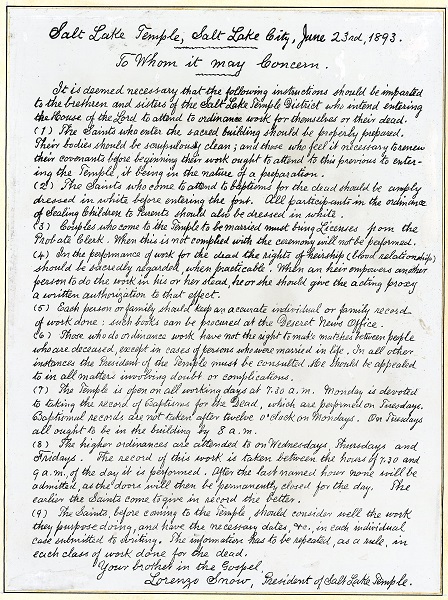 Instructions from Lorenzo Snow as the Salt Lake Temple opened. Courtesy of Church History Library.
On Wednesday, April 19, no regular dedicatory sessions were held, but the General Authorities, stake presidents, and other specially invited brethren gathered for a testimony meeting. The morning session lasted three hours, and the afternoon five. “There was a very heavenly spirit throughout,” Elder B. H. Roberts wrote in his journal, “and many were melted to tears.” The following afternoon, this same group of 115 men, dressed in white, gathered in the celestial room and united in prayer. Elder Roberts noted that “this prayer circle was the first held in the Salt Lake Temple and the largest held in this dispensation.” President Joseph F. Smith, who was voice in the prayer, regarded it as an honor to have been a part of this historic event. Following this experience, the group partook of the sacrament. They then reminisced about Joseph Smith and the early decades of the latter-day work. Of the 115 present, only 36 had witnessed the cornerstone laying for the Salt Lake Temple forty years before; 33 had known the Prophet Joseph Smith, and only 10 had attended meetings in the Kirtland Temple.[48]
The nearly three weeks of inspirational meetings had an impact for good on the Saints. “I believe this Temple Dedication will prove to have a reformatory character among the people,” remarked Elder Anthon H. Lund. “The many thousands of Saints will leave these sacred premises with resolves to serve God better than in the past.”[49] Elder Roberts confided that he had been moved with a desire to reform and humble himself.[50] Speaking at the special meeting of priesthood leaders on April 19, President Woodruff declared, “Heaven has accepted this people and God has forgiven their sins . . . if they sin no more.” He testified that he had felt the influence of the Holy Ghost more powerfully during the dedicatory services than at any other time in his life, excepting the occasion when the Prophet Joseph gave his final charge to the Twelve.[51] Elder Roberts described the dedication as “a Pentecostal time for me” because “the spirit of the Lord has been near.”[52]
 Salt Lake Temple Annex. Courtesy of Church History Library.
The Great Temple Enters Service
Lorenzo Snow, nearly eighty years of age and at the time serving as President of the Quorum of the Twelve, was named to be the first president of the Salt Lake Temple. He was provided an apartment in the temple where he could live and personally supervise the sacred activities.
 Betsy and James Madsen were sealed in the Salt Lake Temple in 1893, one of the first couples married in the new temple. Courtesy of Jena Madsen Stinger.
An annex stood about one hundred feet north of the temple proper. Designed by Joseph Don Carlos Young, its architecture was described as Byzantine or Moorish. It was built of cream-colored oolite stone from the Manti quarry. Thus, the architecture and material of the annex were different from the temple itself. Ground was broken on May 1,1892, and it was dedicated the following year at the same time as the temple. Hence, it was built during the intense last year of temple construction. The annex included a large entry area where patrons presented their temple recommends and where the recorder noted and distributed names of persons for whom ordinances were to be performed. It also included an assembly room seating three hundred where meetings were held for those preparing to enter the temple and where instructions were given to temple workers. [53]
The first ordinances were performed in the Salt Lake Temple on May 23, 1893. Its opening resulted in a more than 50 percent increase in the number of endowments performed for the dead each year. Almost immediately, the temple faced a problem of overcrowding. Temple authorities instructed, “Overcrowding should be especially avoided when work of a sacred character is being performed; otherwise the solemnity which ought always to be attached to it is liable to be depreciated. Conditions in the temple should never contribute to physical discomfort or mental perturbation.” To solve the problem, each stake in the area was assigned certain days when its members were invited to attend the temple.[54] This practice of assigning “stake temple days” would become common during the twentieth century. Interestingly, Emma Ray Riggs and David O. McKay, who would become President of the Church a half century later, were sealed in the Salt Lake Temple on January 2, 1901, the first couple to be sealed there during the twentieth century.[55]
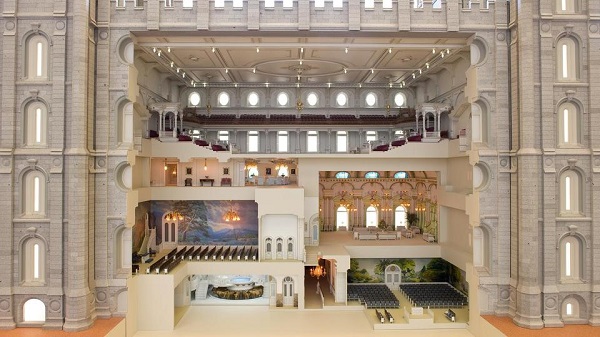 Cutaway model of the Salt Lake Temple before its renovation in the 2020s. Courtesy of Clinton D. Christensen.
Because of its location at Church headquarters, the Salt Lake Temple included some features not found in other temples. Between the endowment rooms and the main assembly room is an intermediate floor with a series of rooms for the use of the General Authorities. Especially important is the council room for the First Presidency and Quorum of the Twelve Apostles. In the front of the room are seats for members of the presidency. Facing them in a semicircle are the chairs occupied by members of the Twelve. This group reaches key decisions following prayerful consideration during their weekly meetings in this special room within the temple. These decisions include such matters as ordaining and setting apart new Presidents of the Church, appointing other General Authorities, creating new Church units, and approving programs. Notable examples have included the 1952 decision to build temples overseas, the determination in 1976 to add what we now know as sections 137 and 138 to the standard works, and the 1978 revelation extending the priesthood to all worthy men (Official Declaration 2). Elder Spencer W. Kimball later described the spirit of the key weekly meetings held in this sacred place:
When in a Thursday temple meeting, after prayer and fasting, important decisions are made, new missions and new stakes are created, new patterns and policies initiated, the news is taken for granted and possibly thought of as mere human calculations. But to those who sit in the intimate circles and hear the prayers of the prophet and the testimony of [this] man of God; to those who see the astuteness of his deliberations and the sagacity of his decisions and pronouncements, to them he is verily a prophet. To hear him conclude important new developments with such solemn expressions as “the Lord is pleased”; “that move is right”; “our Heavenly Father has spoken,” is to know positively.[56]
 Temple Square, Salt Lake City, 1899, by William Henry Jackson/
Another and even more sacred place is located adjacent to the celestial room. Elder James E. Talmage suggested that this “inner room or Holy of Holies of the Temple” corresponds to the most sacred areas of the ancient tabernacle and temple. This room is of circular design, with a domed ceiling containing panels of jeweled glass which admits indirect light of varying colors and hues. On the wall opposite the room’s entrance is a stained glass window depicting the Father and the Son opening the dispensation of the fullness of times as they instructed the youthful prophet Joseph Smith in the Sacred Grove. Elder Talmage explained that this room is reserved “for the higher ordinances in the priesthood relating to the exaltation of both living and dead.”[57]
Elder Boyd K. Packer wrote, “Hidden away in the central part of the temple is the Holy of Holies, where the President of the Church may retire when burdened down with heavy decisions to seek an interview with Him whose Church it is. The prophet holds the keys, the spiritual keys and the very literal key to this one door in that sacred edifice.”[58]
Lorenzo Snow’s Experience
A remarkable experience five years after the temple’s dedication confirmed that the Lord truly regarded this as his house. President Woodruff had instructed that following his death the First Presidency should be reorganized immediately rather than waiting two or three years as had been done in the past. Upon learning of President Woodruff’s death, Elder Lorenzo Snow, the senior Apostle who would become the next President of the Church, went immediately to the Salt Lake Temple. He dressed in his temple robes and knelt at the sacred altar in the Holy of Holies, where he poured out his heart to the Lord: “I have not sought this responsibility but if it be Thy will, I now present myself before Thee for Thy guidance and instruction. I ask that Thou show me what Thou wouldst have me do.” After finishing his prayer, he expected that there might be some special manifestation from the Lord. He waited and waited but there was no reply, no voice, no manifestation.[59]
Disappointed, he left the sacred room and walked through the celestial room out into the large hallway. Here he received a glorious manifestation, which he later described to his granddaughter Allie Young Pond. Her experience was described in an article written by LeRoi Snow, son of President Snow:
One evening while I was visiting grandpa Snow in his room in the Salt Lake Temple, I remained until the door keepers had gone and the night-watchmen had not yet come in, so grandpa said he would take me to the main front entrance and let me out that way. He got his bunch of keys from his dresser. After we left his room and while we were still in the large corridor leading into the celestial room, I was walking several steps ahead of grandpa when he stopped me and said: “Wait a moment, Allie, I want to tell you something. It was right here that the Lord Jesus Christ appeared to me at the time of the death of President Woodruff. He instructed me to go right ahead and reorganize the First Presidency of the Church at once and not wait as had been done after the death of the previous presidents, and that I was to succeed President Woodruff.”
Then grandpa came a step nearer and held out his left hand and said: “He stood right here, about three feet above the floor. It looked as though He stood on a plate of solid gold.”
Grandpa told me what a glorious personage the Savior is and described His hands, feet, countenance and beautiful white robes, all of which were of such a glory of whiteness and brightness that he could hardly gaze upon Him.
Then he came another step nearer and put his right hand on my head and said: “Now granddaughter, I want you to remember that this is the testimony of your grandfather, that he told you with his own lips that he actually saw the Savior, here in the Temple, and talked with Him face to face.”[60]
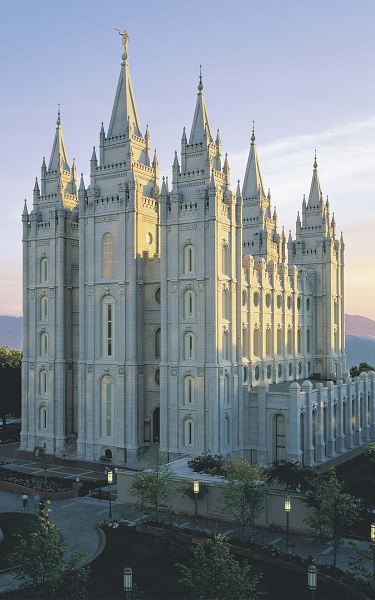 Salt Lake Temple. Courtesy of Intellectual Reserve, Inc.
Not only has the Salt Lake Temple played a unique and significant role in Church governance, but a variety of other factors continued to focus attention on it. With the growth in automobile travel and tourism, the six-towered temple became perhaps the most widely recognized symbol of the restored Church. Furthermore, after the Missionary Home was opened on the adjoining block to the east in 1925, for many years most outgoing missionaries received their endowment in this temple as part of their weeklong orientation (at least until the Missionary Training Center was established at Provo in 1976). Also, a disproportionately large number of Church members over the years have chosen the Salt Lake Temple for their eternal marriages. Thus, as the Church moved into the twentieth century, the Salt Lake Temple has not only taught gospel truths through its richly symbolic exterior but also offered insights and inspiration through the saving ordinances it provides for the living and the dead. In many ways, the Salt Lake Temple has played a key part as God’s kingdom rolled forth to fill the whole earth, and therefore it would continue to occupy an important place in the hearts of Latter-day Saints worldwide.
Notes
[1] Mark E. Petersen, Syllabus of the Ninth Annual Priesthood Genealogy Seminar (Provo, UT: BYU Press, 1974), 510.
[2] Heber C. Kimball, in Journal of Discourses (London: Latter-day Saints’ Book Depot, 1854–86), 10:165–66.
[3] Heber J. Grant, message in Genealogical and Historical Magazine of Arizona, April 1942, 3–4.
[4] The Scoutmaster’s Minute (Salt Lake City: Young Men’s Mutual Improvement Association General Board, 1948), 10.
[5] C. Mark Hamilton, The Salt Lake Temple: Monument to a People (Salt Lake City: University Service Corporation, 1983), 147.
[6] “Who Designed the Salt Lake Temple?” Deseret News Weekly, April 15, 1892.
[7] Truman O. Angell Sr., “A Descriptive Statement of the Temple Now Being Erected in Salt Lake City,” Millennial Star, May 5, 1874, 273–75.
[8] Richard G. Oman, “Exterior Symbolism of the Salt Lake Temple: Reflecting the Faith that Called the Place into Being,” BYU Studies 36, no. 4 (1996–97): 32–34.
[9] Truman O. Angell Sr., “The Temple,” Deseret News, August 17, 1854.
[10] Harold B. Lee, in Conference Report, October 1964, 86.
[11] Hamilton, Salt Lake Temple, 142–43.
[12] Gordon B. Hinckley, “The Salt Lake Temple,” Ensign, March 1993, 6.
[13] Duncan M. McAllister, Description of the Great Temple (Salt Lake City: Bureau of Information, 1912), 7–10; James H. Anderson, “The Salt Lake Temple,” Contributor, April 1893, 276.
[14] Brigham Young, in Journal of Discourses, 8:203, October 8, 1860.
[15] Truman O. Angell Jr. to John Taylor, April 28, 1885, and Angell Sr., to Taylor, March 11, 1885, in Hamilton, Salt Lake Temple, 54–57.
[16] Paul C. Richards, “The Salt Lake Temple Infrastructure: Studying It Out in Their Minds,” BYU Studies 36, no. 2 (1996–97), 202–25.
[17] Orson F. Whitney, Life of Heber C. Kimball (Salt Lake City: Bookcraft, 1967), 397.
[18] Leonard J. Arrington, Great Basin Kingdom (Cambridge, MA: Harvard University Press, 1958), 362–64.
[19] N. B. Lundwall, Temples of the Most High (Salt Lake City: Bookcraft, 1947), 100–101.
[20] Leonard J. Arrington and Wayne K. Hinton, “The Logan Tabernacle and Temple,” Utah Historical Quarterly 41 (Summer 1973): 312–13; Melvin A. Larkin, “The History of the L.D.S. Temple in Logan, Utah” (master’s thesis, Utah State Agricultural College, 1954), 143–155.
[21] Anderson, “Salt Lake Temple,” 269–70.
[22] Anderson, “Salt Lake Temple,” 270.
[23] Anderson, “Salt Lake Temple,” 271.
[24] Scott G. Kenney, ed., Wilford Woodruff’s Journal (Midvale, UT: Signature Books, 1985), 9:192–94, April 6, 1892; compare James E. Talmage, House of the Lord (Salt Lake City: Bookcraft, 1962), 149–52.
[25] Levi Edgar Young, “The Angel Moroni and Cyrus Dallin,” Improvement Era, April 1953, 234; see also J. Michael Hunter, “I Saw Another Angel Fly,” Ensign, January 2000, 30.
[26] Anderson, “Salt Lake Temple,” 274.
[27] Kenney, Wilford Woodruff’s Journal, 9:222, October 10, 1892.
[28] James E. Talmage, The House of the Lord (Salt Lake City: Bookcraft, 1962), 185-87.
[29] William Hurst diary, as cited in Joseph Heinerman, Temple Manifestations (Manti, UT: Mountain Valley Publishers, 1974), 116.
[30] Anderson, “Salt Lake Temple,” 282.
[31] McAllister, “Temples of the Latter-day Saints: Purposes for Which They Are Erected,” Liahona, the Elder’s Journal, February 22, 1927, 417; John R. Winder, “Temples and Temple Work,” Young Woman’s Journal, February 1903, 51.
[32] For a description of these events, see Richard Neitzel Holzapfel, Every Stone a Sermon (Salt Lake City: Bookcraft, 1992), especially chapter 9.
[33] Anderson, “Salt Lake Temple,” 279.
[34] First Presidency circular letter, March 18, 1893, in James R. Clark, comp., Messages of the First Presidency, 6 vols. (Salt Lake City: Bookcraft, 1965–75), 3:241–44.
[35] Anderson, “Salt Lake Temple,” 292.
[36] James E. Talmage, House of the Lord, 159.
[37] Conference Report, April 1993, 92.
[38] See Lael Woodbury, “Origin and Uses of the Sacred Hosanna Shout,” in Sperry Lecture Series 1975 (Provo, UT: BYU Press, 1975), 18–22.
[39] “Hosanna Anthem,” in The Choirbook (Salt Lake City: The Church of Jesus Christ of Latter-day Saints, 1995), 69–71; duplicated phrases have not been repeated.
[40] Frank T. Pomeroy, “Temples of Our Lord, Ancient and Modern,” Genealogical and Historical Magazine of Arizona 2 (April 1925), 34.
[41] “Temple Manifestations,” Contributor, December 1894, 116–17, quoted in Matthew B. Brown and Paul Thomas Smith, Symbols in Stone: Symbolism on the Early Temples of the Restoration. (American Fork, UT: Covenant Communications, 1997), 143–44.
[42] Kenney, Wilford Woodruff’s Journal, 9:279, 1893 summary.
[43] Kenney, Wilford Woodruff’s Journal, 9:246, April 6, 1893.
[44] Quoted in Saviors on Mount Zion (Salt Lake City: Deseret Sunday School Union, 1950), 142–43.
[45] George Q. Cannon, as quoted in Our Lineage (Salt Lake City: Genealogical Society of Utah, 1934), 20.
[46] Lucile C. Tate, LeGrand Richards: Beloved Apostle (Salt Lake City: Bookcraft, 1982), 10–11.
[47] Anderson, “Salt Lake Temple,” 301.
[48] Brigham H. Roberts journals, 1890–1893, entries for April 19 and 20, MS 1430, box 3, folder 6, in the Special Collections of the Harold B. Lee Library at Brigham Young University, 1893; Anthon H. Lund journal, April 20, 1893, Church History Library.
[49] Lund journal, April 18, 1893.
[50] Roberts journal, April 21, 1893.
[51] Quoted in Lund journal, April 19, 1893.
[52] Roberts journal, April 24, 1893.
[53] Hamilton, Salt Lake Temple, 182.
[54] Deseret News Weekly, August 19, 1893, 267.
[55] Francis M. Gibbons, David O. McKay, Apostle to the World, Prophet of God (Salt Lake City: Deseret Book, 1986), 56.
[56] Spencer W. Kimball, “ . . . To His Servants the Prophets,” Instructor, August 1960, 257.
[57] Talmage, House of the Lord, 193–94.
[58] Boyd K. Packer, The Holy Temple (Salt Lake City: Bookcraft, 1980), 4.
[59] LeRoi C. Snow, “An Experience of My Father’s,” Improvement Era, September 1933, 677, 679.
[60] Snow, “An Experience of My Father’s,” 677, 679.
