
 menu icon in the top, right corner of the screen.
 icon above to close this box.
 icon at the bottom of the screen below the browser—if you don't see it, swipe up to unhide it.
Renovating Temples
The St. George, Logan, and Manti Temples
Richard O. Cowan and Clinton D. Christensen, "Renovating Temples," in Temples in the Tops of the Mountains: Sacred Houses of the Lord in Utah (Provo, UT: Religious Studies Center, Brigham Young University; Salt Lake City: Deseret Book), 130–43.
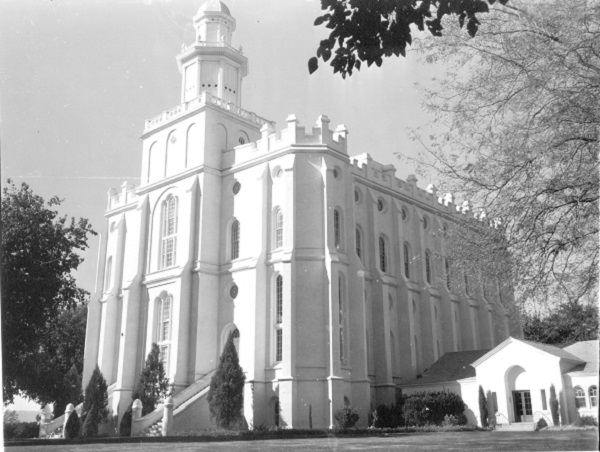 St. George Temple. Courtesy of Deseret News and Church History Library.
With the success of the new Ogden and Provo Temples, Church leaders decided to renovate and refurbish its older temples in the 1970s and ’80s. These included the Arizona Temple at Mesa, the Hawaii Temple at Laie, and three in Utah—St. George, Logan, and Manti. The impact of the decisions to change Logan and Manti had repercussions for decades and influenced how the Church approached renovating temples.
Other Temples Refitted
St. George Temple
On March 2, 1974, the St. George Temple closed for more than a year and a half. A new annex included a chapel, offices, cafeteria, laundry, dressing rooms with 906 lockers for patrons, and a beautifully landscaped main entrance. New electrical, heating, plumbing, air-conditioning, and fire prevention systems were installed in the temple itself.
The three endowment rooms located side by side across the west end of the temple were remodeled to use films in presenting the ordinance. Because these rooms could be used simultaneously, architect Emil B. Fetzer was perplexed by the problem of providing access from the basement dressing rooms in the annex on the north to each of these three new rooms without needing to pass through one of the others.
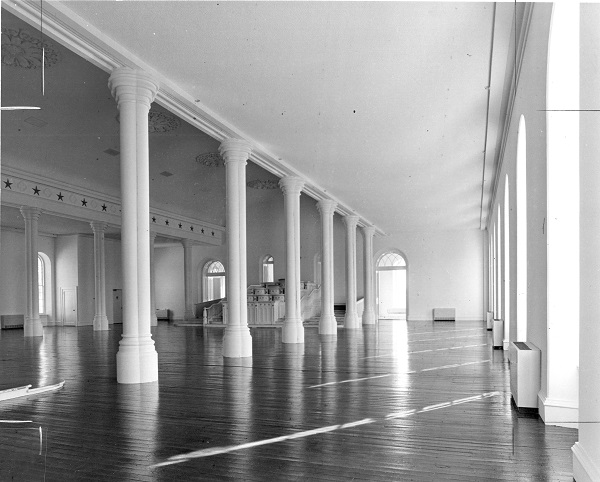 St. George Temple assembly room. Courtesy of Deseret News and Church History Library.
One evening Fetzer was working late in the Architect’s Office on the twenty-eighth floor of the Church Office Building, prayerfully pondering possible solutions but “could not seem to arrive at a satisfactory plan.” He left the office “with the problem firmly in mind.” There wasn’t much traffic at this late hour. He later recalled what happened as he drove under the arches of the famed Eagle Gate: “I heard a voice that was clear and distinct, but it was not a spoken sound, rather a transmission of thought into my mind. . . . ‘If you move the fire tower stairway out away from the west wall of the temple, a lobby space will be created.’” With this inspiration, he was able to design an addition on the west side of the temple with stairways and elevators to reach the three endowment rooms on the ground level as well as facilities on higher floors in the temple. He affirmed that this was “an incredibly marvelous, simple, logical and crucial revelation for needed help.”[1] After receiving most of the endowment presentation in one of these three rooms, patrons would enter a central room for final instructions before concluding the endowment by proceeding into the beautiful celestial room. In these last two rooms, the arched ceiling of the temple’s lower assembly hall can still be seen. Four new sealing rooms brought the total to twelve.
The large assembly room occupying the upper half of the temple has remained almost completely unchanged since the structure was built. Only a sprinkler system for fire prevention was added. Windows still have the original wavy glass brought around Cape Horn to Los Angeles in 1871. Even electric lights remained absent from this room.
This renovation greatly enlarged the St. George Temple’s capacity, enabling it to double the number of ordinances performed. President Spencer W. Kimball rededicated the temple in six sessions on Wednesday and Thursday, October 15–16, 1975.
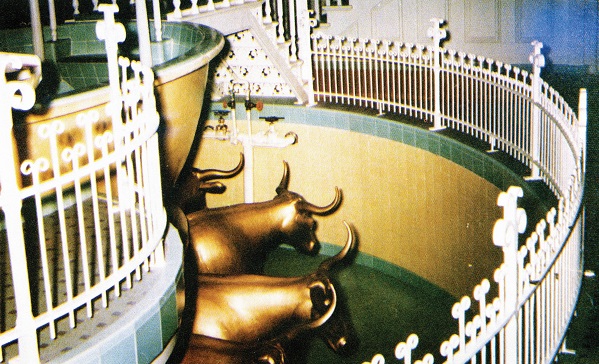 The Logan Temple baptistry pre-1970 renovation. Courtesy of Nolan Olsen.
Logan Temple
As discussed in chapter 6, the First Presidency decided to use funds to build the Ogden and Provo Temples instead of tackling the need to remodel the Logan and Manti Temples. However, by the 1970s the time had come to look at some urgent improvements for the venerable temples. Particularly, the Logan Temple was in a critical condition, according to Fetzer. There were challenges with the outer walls showing signs of buckling, and the footings and basement walls needed concrete to stabilize them because of trenching that had previously been done near the footings for some mechanical needs.

 Top and Bottom: Renovation of Logan Temple. Courtesy of Nolan Olsen.
Members of the Building Committee had also gone through the temple and worried about the congestion and flow of the temple with the multiple narrow stairways that Truman Angell Jr. had created for the progression from room to room. The floors changed for the endowment a few feet with every room, which also made remodeling more difficult for the structure. There were also electrical and mechanical needs. From such a long list of issues, Emil Fetzer concluded that the temple needed to be completely renovated.[2]
Fetzer proposed to the First Presidency in February 1975 the “complete removal of the building interior” and a new plan for the baptismal department, new ordinance rooms, eleven sealing rooms, and administrative offices that he projected would cost five million dollars. Indeed, the renovation was more than the cost of a new temple. Fetzer said, “The First Presidency realized that it was very necessary and urgent that something be done to the Logan Temple, but they appeared astonished and rather dismayed by this drastic and somewhat extreme proposal.”[3] He didn’t hear back from the First Presidency for six months, after which they gave their approval.
 Original Logan Temple assembly room. Courtesy of Intellectual Reserve, Inc.
One interior part of the temple was going to remain, and that was the priesthood assembly room on the top floor of the temple.
But as the renovation continued, the floor supporting the assembly room had “dangerous structural problems,” including a split in the main structural beam. Fetzer feared that if the assembly room was not replaced then there was a risk the floor could collapse. He admitted this plan was not popular with the community: “I had to swallow twice and be very brave to be responsible for such drastic and irreversible decisions. Some of the older Logan Temple patrons and workers, remembering the history and sacred, wonderful times spent in the Logan Temple, complained bitterly against and roundly condemned my proposals for removing the entire Temple interior for this Temple.”
Ultimately, Fetzer focused on a spiritual reason for his alterations to the pioneer temple. The new design allowed for a doubling of temple ordinances. He wrote, “This capability of having so many more Endowments performed in a given time, must be considered of incalculable worth to the work in Our Heavenly Father’s Kingdom. The inspired concepts and designs of my architectural work and decisions were emphatically and unequivocally sustained and upheld by the First Presidency of the Church.”[4] Fetzer stated that the ordinance work was the “important and real worth and purposes of the Temple.”[5]
The temple closed October 2, 1976, for remodeling. Because of the temple’s age, utilities and mechanical systems needed to be updated. The original interior was completely removed, so only the four-foot-thick exterior stone walls remained. The dark gray silica limestone in these walls was so hard that two men working with jackhammers needed a week to cut a doorway through. Inside this shell, four new endowment rooms, simply decorated in different colors and using the filmed presentation, surrounded the beautiful celestial room on the main floor. There were eleven sealing rooms, and the large priesthood room filled the upper floor. On the north, the “extension” was replaced by a new annex with offices, a chapel, nursery, cafeteria, laundry, and dressing rooms. Stone from interior walls was used to construct an exterior elevator shaft. The main walls were cleaned and repaired. Total floor area became about 104,000 square feet. The Okland Construction Company completed this extensive project. Landscaping included eleven varieties of trees and twenty-six varieties of shrubs.[6]
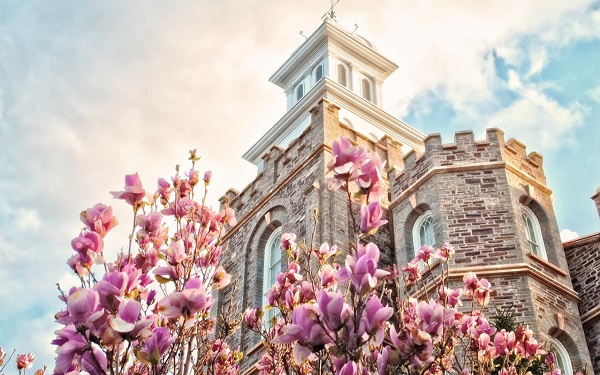 Detail. Logan Temple. Courtesy of Intellectual Reserve, Inc.
Reed Bullen, the newly appointed temple president, was grateful for “an old traditional temple on a scenic site overlooking Cache Valley with a new temple on the inside that will be highly functional.” [7] However, not all were pleased with the changes. According to architect Paul L. Anderson, the mayor’s office in Logan wrote a letter to the First Presidency “accusing the Church of destroying Logan’s religious heritage.” Before the renovation in 1975, the Logan Temple had been placed on the National Register of Historic Places, but after the remodel the Utah State Historical Society considered removing it from the historic register.[8] The feeling was that the pioneer murals, handiwork, and craftsmanship had been replaced by inserting a 1970s-style Ogden or Provo Temple decor into the shell of the pioneer temple. Some of the pulpits, door frames, baptismal font oxen, and stained glass were salvaged by the Church’s Historic Sites division of the Historical Department under the direction of Florence Jacobsen and Paul Anderson. The salvaged pieces were later used in the new Museum of Church History and Art in Salt Lake City built in the 1980s, and also in the Manti renovation.[9] While some physical interior pieces of the temple’s history were preserved, the fact remained that the Architect’s Office did not show a sensitivity toward the pioneer craftsmanship and heritage of the temple, which deeply hurt some members of the Cache Valley community.
Open House and Dedication
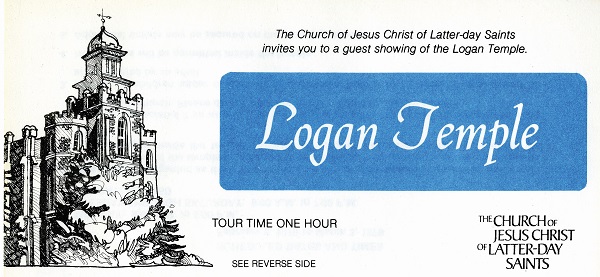 Open house dedication. Courtesy of Church History Library.
At the VIP open house, Monday, February 5, 1979, Elder O. Leslie Stone of the Seventy, executive director of temples, explained that “a new temple has been built inside the walls of the old” and that the temple’s capacity had been expanded 75 percent.[10] The four-week public open house extended from February 6 through March 3. President Bullen believed that this opportunity to visit the temple during the open house “may be a chance of a lifetime in this area.”[11] A temporary visitors’ center, staffed by members of local stake seventies quorums, was set up in a nearby ward chapel; it featured films on temple work in general and the Logan Temple in particular. Some 213,184 persons visited the temple, more than twice the number anticipated. On February 19, Presidents’ Day, a record 19,205 toured the temple, and lines extended as much as seven blocks. Bus groups came from as far away as Boise, Idaho; Richfield, Utah; and Star Valley, Wyoming.[12]
There were nine rededication sessions, three each day Tuesday through Thursday, March 13–15, 1979. President Spencer W. Kimball spoke at and offered the dedicatory prayer in each of these sessions in the large priesthood room, and about 1,250 attended. Another 450 watched by closed-circuit television in other parts of the temple. The proceedings were carried to two overflow locations outside of the temple; 1,700 persons were seated in the Logan Tabernacle, and 350 watched in the nearby ward chapel. President Kimball dedicated the temple as “a lifting symbol of God the Eternal Father and His Son Jesus Christ” and declared that it “stands in all its majesty as a monument to the faith and devotion of our pioneer fathers.” He reported that up to that time, more than 18 percent of all ordinances worldwide had been performed in the Logan Temple. Following the rededication, ordinances were resumed and immediately were increased by over one-third compared to the years just before the reconstruction.
 Logan Temple. Dawning of a New Day, by Alan Fullmer.
A Movement toward Historic Preservation
As the United States of America prepared for its bicentennial in 1976, interest increased in society about what should be done to preserve the historic buildings in the country. In the past many vital heritage sites like Mount Vernon were almost destroyed. In fact, at one point in the 1830s, part of Independence Hall in Philadelphia was torn down, until French general Lafayette implored the people, saying, “Here is the birthplace of freedom in all the world,” which stopped the project.[13] As a new country, the United States was working to establish ways to honor the old while building the new. The National Register of Historic Places was one way for communities to honor past buildings and bring visibility to their history. Some of the oldest and largest structures in the western United States were the temples in Utah, and as they reached their centennials and faced renovation projects, would the Manti Temple face the same drastic change as the interior of the Logan Temple?
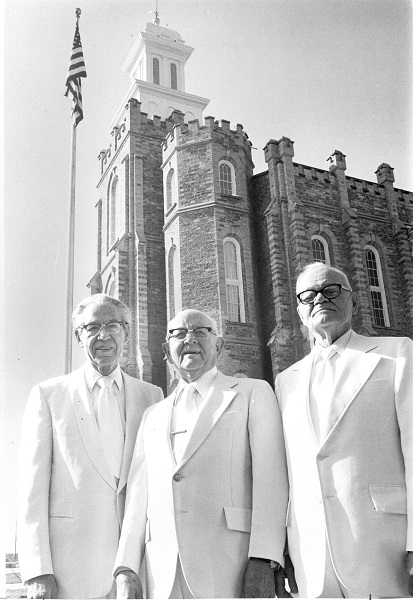 First Presidency at Logan Temple dedication, left to right: N. Eldon Tanner, Spencer W. Kimball, and Marion G. Romney. Courtesy of Deseret News and Church History Library.
As part of the Church’s desire to preserve its history, in 1973, President Harold B. Lee appointed Florence Jacobsen to be the curator for the Church’s Historic Sites. Jacobsen, who had just finished serving as the Young Women General President, was well respected and had a fine eye for preservation. In the years to come, she and her team from the Historical Department demonstrated how historic sites like the Joseph Smith home in Palmyra, New York, could be rebuilt and decorated with artifacts and furniture from the 1820s, capturing the historical time period of the First Vision. Back when Jacobsen was Young Women General President, she had kept the Lion House from being torn down when the Church Office Building was constructed, and she later oversaw its renovation along with the Beehive House.[14] The Historical Department could be a valuable resource in preserving Utah’s temples, if they were allowed to work with the Architect’s Office and the Building Department. [15]
Manti Temple
Emil Fetzer proposed in 1978 that the Manti Temple receive a “complete upgrading and refurbishing.”[16] By 1982 plans were ready to undergo the remodel. However, area Saints were worried that this project “might drastically change the temple” as had happened in Logan.[17] In response, President Gordon B. Hinckley, the newest member of the First Presidency, turned to Jacobsen, placing her in charge of the interior design and refurbishing of the temple. The decision to have the Historic Sites division directly involved in a temple project was unprecedented. Her team worked closely with Jim McCrae of the Building Department, who was appointed as the liaison by Emil Fetzer to work with the Historical Department.[18]
Since the Manti Temple had been dedicated during the height of persecution by the federal government during the days of plural marriage and when the Church was in considerable debt, the temple had been sparsely furnished in the 1880s. Under the direction of Jacobsen, the temple’s interior was refurbished to reflect the Eastlake Victorian design popular at the time of the temple’s construction, and it was decorated more fully as the Saints might have desired at the time.
 Finished celestial room, Manti Temple. Courtesy of Historic LDS Architecture.
Jacobsen’s team located a small part of the original celestial room rug that had 26 colors of thread and a beautiful floral pattern in a Manti home. The rug piece was sent to a manufacturer in England that still had nineteenth-century equipment and was able to reproduce the carpet. Jacobsen also included the community in the temple project. She reached out to several sisters to help with one of the sealing rooms. Sixty-four sisters spent months preparing intricate needlepoint upholstery for one sealing room, and a donated Persian rug adorned another.[19]
Unlike the white color scheme used in the Jordan River, Ogden, and Provo Temples, Jacobsen employed a gray-green wallpaper in the main hallway of the Manti Temple, using antique furniture and wainscotting that matched the original woodwork. Initially skeptical of the interior plan, the employees of the Building Department eventually respected Jacobsen’s choices. Additionally, at the open house one local resident shook Jacobsen’s hand and said, “You didn’t change a thing,” which she felt was a supreme compliment. This showed that the temple still maintained its pioneer heritage in the eyes of the community.
The Manti Temple did still have some major changes, though not nearly to the scale of the Logan Temple. Improvements included the addition of a new kitchen and cafeteria, new dressing rooms, a children’s nursery, and three sealing rooms in the annex. A separate baptistry entry door was cut through the temple’s south wall to accommodate youth coming to participate in baptisms for the dead. Completely new air conditioning, heating, electrical, and plumbing systems were installed. Stone used to remodel the exterior of the annex came from the same nearby quarry as the original temple.
One major issue of concern, raised by temple president Wilbur W. Cox on behalf of the Manti Temple community, was maintaining the live endowment ceremony instead of installing the film as was now common in other temples. Fetzer noted the First Presidency reviewed the request and asked for his opinion. He reported back to the Brethren that due to the rural nature of the temple district, there would not be a significant difference in how many endowments were performed between the live endowment and the film. The First Presidency was sensitive to the interest of the local members and directed that Brother Fetzer accommodate the flow of the temple endowment to support the live presentation. This important decision allowed the Manti Temple to have a unique and special feeling for those who visited the temple to worship in the ensuing decades. Only Manti and the Salt Lake Temple would continue to do the live presentation until their renovations in the 2020s.
 Manti Temple open house. Courtesy of Deseret News and Church History Library.
During a brief open house, Thursday—Saturday, June 6–8, 1985, a total of 40,308 persons toured the refurbished temple. President Gordon B. Hinckley, second counselor in the First Presidency, rededicated it in nine sessions, Friday–Sunday, June 14–16. At the opening of the first session, he commented about his feelings on seeing the restored temple: “I could scarcely hold back the tears. Something happens to me when I go into these [historic] temples. I see the magnificence of the workmanship wrought with rudimentary tools. I have been in most of the great buildings of the world—palaces of kings and houses of parliament—and in none of those places have I had the kind of feeling I get in coming into these early pioneer houses of God.”[20] The rededicatory prayer affirmed, “With great care, its beauty so carefully crafted by its original builders, has been brought back.” Still, President Hinckley noted, “This building was not constructed to be a work of art or museum piece, but to accommodate the work and purposes of the Lord.”[21]
Notes
[1] Blaine M. Yorgason, Richard A. Schmutz, and Douglas D. Alder, All That Was Promised: The St. George Temple and the Unfolding of the Restoration (Salt Lake City: Deseret Book, 2013), 336.
[2] Emil B. Fetzer, Completed Writings of Emil Baer Fetzer (privately published, 2003), 215–16, Church History Library, Salt Lake City; Fred A. Baker, interview, January 12, 2012.
[3] Fetzer, Completed Writings, 216.
[4] Fetzer, Completed Writings, 221.
[5] Fetzer, Completed Writings, 225.
[6] “Logan Temple to Close,” Church News, September 18, 1976, 3; “Temple Renovation Is Almost Complete,” Church News, October 14, 1978, 3.
[7] “Temple Renovation,” 3.
[8] Paul L. Anderson, interview by Jessie Embry, February 13 and 28, 2015, 9, Church History Library.
[9] Anderson, interview, 11.
[10] Lynne Hollstein, “Tours Begin in Logan Temple,” Church News, February 10, 1979, 3.
[11] “Temple Renovation,” 3.
[12] “Temple Tours in Logan Begin,” Church News, February 3, 1979, 3, 8–9; “213,184 Guests
Tour Remodeled Logan Temple,” Church News, March 10, 1979, 3.
[13] Anderson, interview, 6.
[14] Kenneth Mays, “Remembering an interview—Florence Smith Jacobsen, granddaughter of two LDS Church Presidents,” Deseret News, March 15, 2017.
[15] Andersen, interview, 10–12; Florence S. Jacobsen interview by Mary L. Olsen, 2010–2012, Church History Library.
[16] Fetzer, Completed Writings, 229.
[17] Rasmussen, Manti Temple, 76.
[18] Anderson, interview, 31. Peggy Fletcher Stack, “Former Mormon Women’s Leader Florence Jacobsen Dies at 103, but Her Hand in Preserving Historic Sites Lives On,” Salt Lake Tribune, March 29, 2017.
[19] Andersen, interview, 50.
[20] “Glistening ‘New’ at 97, Manti Temple Rededicated,” Church News, June 23, 1985, 3, 11; “Manti Temple Restored to Like-New Status,” Church News, June 9, 1985, 8–9.
[21] “Sanpete Valley Saints Eagerly Await Manti Temple Rededication,” Ensign, June 1985, 72; “Manti Temple Rededicated,” Ensign, August 1985, 73–74.
