
 menu icon in the top, right corner of the screen.
 icon above to close this box.
 icon at the bottom of the screen below the browser—if you don't see it, swipe up to unhide it.
Refreshing, Renovating, and Restoring Pioneer Temples
The St. George, Salt Lake, and Manti Utah Temples
Richard O. Cowan and Clinton D. Christensen, "Refreshing, Renovating, and Restoring Pioneer Temples," in Temples in the Tops of the Mountains: Sacred Houses of the Lord in Utah (Provo, UT: Religious Studies Center, Brigham Young University; Salt Lake City: Deseret Book), 284–309.
While new temples were under construction during the twenty-first century from one end of Utah to another, Church leaders disclosed a major effort to preserve the Beehive State’s four nineteenth-century houses of the Lord. At the October 2018 general conference, President Russell M. Nelson affirmed, “The proper care and maintenance of these temples is very important to us. With the passage of time, temples are inevitably in need of refreshing and renewal. To that end, plans are now being made to renovate and update the Salt Lake Temple and other pioneer generation temples.”[1]
He elaborated on this theme at the conference six months later: “The earliest [temples] stand as monuments to the faith and vision of our beloved pioneers. Each temple constructed by them resulted from their great personal sacrifice and effort. Each one stands as a stunning jewel in the crown of pioneer achievement. Ours is the sacred responsibility to care for them. Therefore, these pioneer temples will soon undergo a period of renewal and refreshing, and for some a major restoration. Efforts will be made to preserve the unique historicity in each temple wherever possible, preserving the inspiring beauty and unique craftsmanship of generations long since past.”[2] Elder David A. Bednar of the Twelve said that the Brethren had known for a long time that these temples had to be brought up to modern building codes, “but the time was not right” because the needed “technology, equipment, and the right team were not yet available” until now.[3]
The temples in St. George and Salt Lake closed in 2019 for renovation. The Manti Temple followed in 2021. With the announcement in April 2021 of a second temple to be built in Cache Valley and located in Smithfield, Utah, the impact of the closing of the Logan Temple will be lessened when its renovation time is announced.
The St. George Temple
 Rendering of St. George Utah Temple exterior. Courtesy of Intellectual Reserve, Inc.
 Rendering of St. George Utah Temple interior recommend desk. Courtesy of Intellectual Reserve, Inc.
For months, experts from the Church’s Special Projects Department thoroughly examined the condition of the St. George Utah Temple inside and out. They could see that the structure needed to be updated and strengthened. Historic Sites curator Emily Utt and architectural historian Elwin Robinson and others had the assignment to carefully document the building’s architectural style and furnishings. They discovered that original construction workers had left their signatures and even bits of poetry in some hidden places within the walls. “It’s been really fun to go back and see those things as we’ve gotten into this project,” Utt admitted.[4]
Representatives of various Church departments traveled to St. George on Wednesday, May 22, 2019, to conduct a news conference announcing details for the upcoming renovation of the temple there. Brent W. Roberts, managing director of the Special Projects Department, started by emphasizing that after the temple closed in November, it would “undergo extensive structural, mechanical, plumbing, and finish work,” and should reopen in about three years. Emily Utt reminded the group that the temple had been built through the “great personal sacrifice of St. George residents” and with “the unified effort of Latter-day Saint communities hundreds of miles apart.” She explained that it had been renovated on several previous occasions and expressed the expectation that the present renovation would honor and build on the “contribution” and “diligence of those who had come before.”
Andy Kirby, director of Historic Temple Renovations, then laid out the scope of the work to be done. The temple would be strengthened from foundation to tower. Original wooden floors, trusses, and joists would be reinforced with steel. The annex on the north and the stairway addition on the west, both built during the 1970s, would be replaced with updated structures whose exteriors “sympathetically” match the architecture of the original temple. Ordinance spaces would be moved into the temple itself, while mechanical facilities would be shifted to the annex. The street on the north would even be raised a few feet, making it more level with the temple’s entrance and thus eliminating the need for steep ramps. Interior furnishings and accessories would be “consistent with the dignity and beauty of the historic temple” and reflect the mid-nineteenth century when it was built. New murals in instruction rooms would be inspired by those that had been in the temple earlier. The large assembly room on the fourth floor would be restored. Enhanced landscaping would include more trees and feature a plaza where bridal parties exiting the temple could greet families and friends. Hence, the project would include “preservation, restoration, renovation, and new construction.” Andy Kirby affirmed that it was “an honor to be entrusted with this important task.”
 In the foreground, steel fabricated stairs stand ready for installation in the St. George Utah Temple as workers prepare the exterior temple for painting. Once completed, the historic temple and the new north and west additions will be seamless in appearance. Courtesy of Intellectual Reserve, Inc.
 Arched doorways of maple and poplar in the north addition of the St. George Utah Temple replicate original millwork in the historic temple, January 2022. Guests will experience a seamless transition from the north addition to the historic part of the temple. Courtesy of Intellectual Reserve, Inc.
Michael Suhaka, who would become managing director of the Temple Department on July 1, explained that the temple presidency and workers would all be released when the temple closed, that Saints in the St. George district were encouraged to attend other temples during the closure, and that the Cedar City and Las Vegas Temples were gearing up for increased activity.
After the St. George Temple closed on November 4, 2019, the temple’s historic east doors were removed for preservation, and plywood filled the openings. Protective plywood coverings were also placed over the long stairways leading up to these doors. The annex on the north and the stairway addition on the west needed to be removed so new construction could begin. Strengthening the temple’s hand-laid stone foundation was an early priority. Trenches along the temple’s walls provided access. At each corner, steel pipes were driven thirty-five to forty feet into the ground, and the load of the temple’s weight would be shored up by these micropiles. The fourteen interior stone support columns were strengthened by having their bases wrapped in resin-infused fiberglass. Timber beams were clad in steel. The temple has stood for nearly a century and a half, noted Eric Jamison, field project manager for the Special Projects Department. “After beefing this up, we’re going to be able to ensure that the foundations last far beyond that.”[5]
In February excavation for the new annex was underway, and soon concrete was being poured for the foundation and basement floor. During the next six months, structural steel girders and beams were put in place for the three-story facility. As the precast concrete exterior cladding was added in September, one could see how the round windows, columns, and battlements in the annex matched those of the temple. While interior walls were being constructed in the annex, four efficient state-of-the-art plumbing, electrical, heating, and air-conditioning systems replaced decades-old equipment throughout the temple itself.
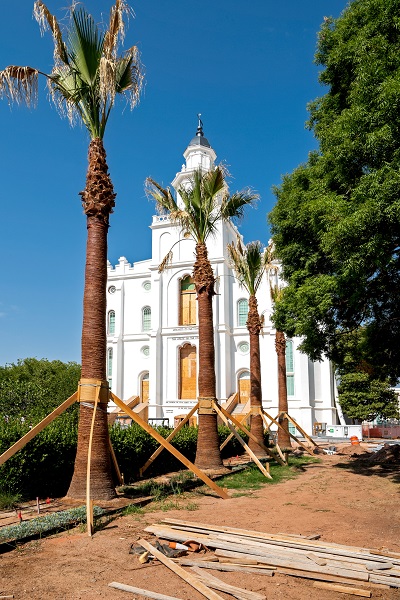 Palm trees outside the temple. Courtesy of Intellectual Reserve, Inc.
Typically, landscaping begins only after most exterior construction is completed. As early as May 2020, however, many new trees and shrubs were being planted to provide additional shade and serenity. The notion that “St. George will blossom like a rose is a very important part of this community,” observed Emily Utt. “This town is very proud of its landscape, of its trees, of its plantings.” The goal was to have the landscaping well established and flourishing by the time the temple was ready for its rededication, Eric Jamison explained. “When people come here for the open house, it will be green and lush and beautiful,” Utt added.[6] Later, two rows of palms were added to frame the iconic view of the historic temple’s east front. The octagonal tower’s dome was also removed and replaced by one of darker metal which was closer to the original.
Groundwater concerns, a problem the pioneer builders also had to overcome, delayed work on the west elevators and stairways extension for over a year. Spring water under the temple needed to be channeled away.[7] By mid 2021, foundations were being poured for this structure, and during the fall its walls began to rise. Completion of this facility was the final major construction in the temple’s renovation. Finishing interior cabinetry, painting, and furnishing as well as final touches on exterior landscaping would complete the project in 2023 and be ready for rededication. “It’s quite beautiful,” Andy Kirby affirmed. “I’m so excited to have people see that beautiful historic temple refreshed and renewed. They’ll recognize their temple when they go back,” he continued. “It will be more functional; it will be easier to get around with the new elevators and stairs.”[8]
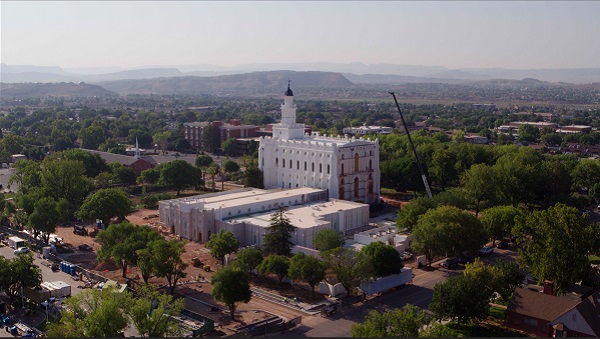 Aerial view, St. George Utah Temple. Courtesy of Intellectual Reserve, Inc.
The Salt Lake Temple
At a news conference conducted in the South Visitors’ Center on Friday, April 19, 2019, President Nelson asserted that the building of temples worldwide is evidence that the Savior’s Church has been restored. “Temples are precious to us,” he continued, “because in them Church members and their families participate in sacred ceremonies and ordinances that are the crowning facet of the gospel of Jesus Christ. The highest blessings that God offers to His faithful children are available only in a temple.” He affirmed that for more than a century and a quarter, the Salt Lake Temple had been “a beacon of light.” Because the pioneer-era temples are outstanding examples of “architectural design, engineering, and the use of materials then available” and because they are among the most heavily utilized temples in the Church, “we have a sincere desire, we have a sacred responsibility to care for them.” Church leaders then announced specific plans to renovate the Salt Lake Temple and its surroundings so they might continue to bless the Saints “for generations to come.” The temple would close at the end of the year and reopen about four years later. At the heart of the project was an extensive seismic upgrade to protect temple patrons as well as the temple itself in the case of a major earthquake. In the process, temple facilities would be enhanced to better accommodate their sacred purposes. At the same time, Bishop Dean M. Davies, first counselor in the Presiding Bishopric, explained that the hope was that visitors would “feel more welcomed and invited to enjoy historic Temple Square.”[9]
The desire was to restore the temple’s interior to its original character. Planners worked closely with Emily Utt, studying the original design, tracing modifications over the years, and analyzing paint samples to return the temple more faithfully to the earlier Victorian palette of colors. Even outside, the grounds were to be returned more to their appearance at the time the temple was built. The plaza over to State Street on the east was to be refurbished with more seating and other changes to enhance the visitor experience; artwork would specifically focus more on Jesus Christ. President Nelson assured the group, “We promise that you will love the results.” Jacobsen Construction, who had built a number of other temples, was appointed to be the general contractor.
Preparation for Renovation
Following the last endowment session on Saturday evening, December 28, 2019, the Salt Lake Temple closed for renovation. Greg and Jill Tingey, who had been temple workers for twenty years, were among those serving on this last day. “There were a lot of tears,” Greg acknowledged. “There were a lot of people who just didn’t want to leave, and neither did we.” Jill concurred: “It felt like home. It was hard to see that come to a close. It was very tender.” Adding to their emotion, that day was their wedding anniversary. Before leaving the temple, they were able to spend a few quiet moments in the very room where they had been sealed thirty-five years earlier.[10]
On a wintry Thursday morning, January 2, 2020, protective fences began going up around the projected construction area. Eventually the plywood fence would be fitted with plexiglass windows so visitors could view the progress of this momentous renovation project.
During this same week, a lesser known but important process was unfolding inside. Known as “decommissioning” the temple, it started with workers removing records, clothing, and other sacred items used in temple ordinances from the building. It technically was transitioning from being a working temple into a construction site. The laundry, offices, and custodial closets were cleaned out. Furniture was removed and placed in storage. Historic stained glass and light fixtures were removed and preserved. Historic surfaces inside the temple were also covered. Emily Utt reflected on how the temple had been carefully protected for over a century and affirmed, “It is a sacred experience to be involved in preparing it for this next important step.” “Even as this temple becomes a construction site,” Andy Kirby assured, “we never lose sight of its sacred purpose and history.”[11]
Outside, monuments, sidewalks, planter boxes, shrubs, and trees needed to be cleared so the project could begin. A prized cedar of Lebanon tree, however, was preserved, its root system carefully protected. On January 15 the South Visitors’ Center was demolished. A portion of the historic wall around Temple Square was also removed so eventually there could be a less obstructed and more inviting view of the temple from busy South Temple Street. As had been done in St. George, the historic doors were also removed from the east and west ends of the temple for preservation, their openings being filled with plywood. Inside, HVAC units were placed throughout the building to regulate temperature and humidity and to protect fine surfaces and historic woodwork.
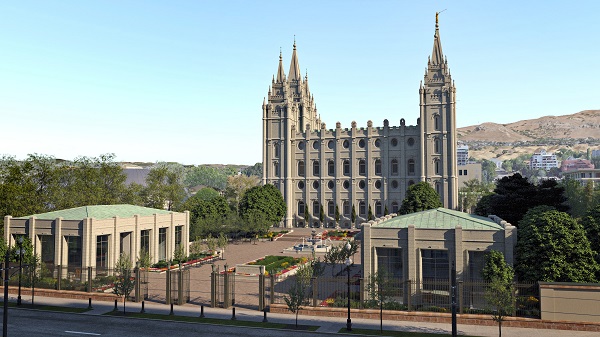 Rendering of the south side of the Salt Lake Temple and future Temple Square. Courtesy of Intellectual Reserve, Inc.
The first devotional for construction workers took place Wednesday morning, March 4, 2020. Emily Utt spoke on “a sense of the sacred” in her devotional address. “High on the east tower of the Salt Lake Temple are carved the words ‘Holiness to the Lord,’” she noted. “That phrase is a reminder to everyone who walks past that it is a holy building. A sacred building. The temple isn’t a common public building. It was built for a higher purpose.” She insisted that “Holiness to the Lord” also was an affirmation by the temple’s builders that they were giving “their very best to Him. The temple was the place where they would make sacred promises, called covenants, with God. It was the place they would create relationships that would last forever. Even if they didn’t live to see it completed, the temple would be a place of holiness for their children and the generations after.” She then told her audience that this same attitude could elevate their own work on the temple. “Keeping a sense of the sacred is giving our very best to the project. It is taking the time to do the job right even if no one sees it. It is asking for God’s help as we work. If we approach our problems with a sense of the sacred, we will be guided to the right solutions. Even though this is a messy and noisy construction site,” she concluded, “we can keep this a holy place. Your daily efforts to keep a sense of the sacred will keep this temple holy until it is rededicated.”[12]
 Emily Utt shows paper items to the First Presidency (left to right: Dallin H. Oaks, Russell M. Nelson, and Henry B. Eyring). Courtesy of Intellectual Reserve, Inc.
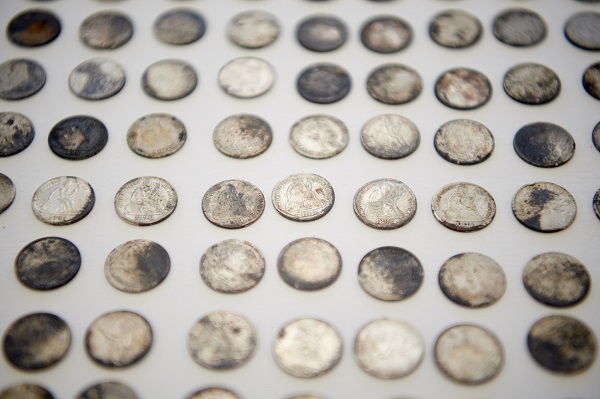 Coins from the Salt Lake Temple capstone. Courtesy of Intellectual Reserve, Inc.
During March 2020 the COVID-19 pandemic swept across the land. Renovation work continued with proper precautions. If that weren’t enough, the Salt Lake Valley had a 5.7 magnitude earthquake early Wednesday morning, March 18. Several Church buildings sustained structural damage, especially in the West Valley and Magna areas, where the quake centered. Damage to the Salt Lake Temple was minor. A few pinnacle stones on the towers were dislodged. Witnesses saw the statue of the angel Moroni swaying back and forth, the suspension system inside the tower doing its job. In the process, the angel’s horn was shaken loose. Within a day or so, workmen had retrieved the crumpled horn from battlements lower on the tower where it had fallen. Church spokesman Daniel Woodruff noted that this event emphasized why the project of renovation “is so necessary to preserve this historic building and create a safer environment for all our patrons and visitors.”[13]
 Angel Moroni and capstone being removed from the Salt Lake Temple. Courtesy of Intellectual Reserve, Inc.
Exactly two months later, on Monday, May 18, the statue and three-foot ball it stood on, together weighing five thousand pounds, were removed from the temple and carefully set on the ground with a huge crane. The plan was for the angel to be stored, refurbished, and eventually returned to its place on the temple’s east center tower. Pinnacles were also removed from the towers and carefully inventoried so they could eventually be returned to their exact same places; inserting steel pins would prevent them from ever sliding out of place again. Conservator Emiline Twitchell and curator Emily Utt were anxious to examine the capstone’s historic contents. They found that the books, photographs, and other paper items were badly deteriorated despite being wrapped in silk oilcloth. Only the approximately four hundred coins were in relatively good condition.[14]
A major goal of the renovation was to strengthen the temple’s foundations. Jacobsen Construction turned to Forell/
The foundations first needed to be uncovered so they could be fortified. The underground tunnel along the temple on the south had been demolished in February 2020, and the sealing room addition on the north was dismantled in July. Great care was taken to protect the historic wall of the temple itself. During that same month, the temple annex on the north, including offices, a chapel, dressing rooms and other support facilities, was also removed. Rubble was carefully sifted so metal, concrete, and other usable materials could be recycled. Once the temple’s foundation was uncovered inside and outside, steps were taken to solidify the sandstone footings. Many three-inch shafts were drilled through the stones at various angles from inside as well as outside and then filled with special high-strength grout which also pushed out to fill voids and joints. Threaded steel rods or “rock anchors” were also drilled through the footings and then fitted with nuts which were tightened to hold the stones together. “Secant walls” of interlocking columns of steel and concrete forty feet deep were constructed against the outside edge of the foundation to keep the soil on which the temple rested in place while adjoining ground was excavated.
 Salt Lake Temple construction site. Courtesy of Intellectual Reserve, Inc.
An Adjustment in Plans
Because the Salt Lake Temple’s historic murals had been painted directly on the lath and plaster walls, they could not be preserved as part of the project. This was a great disappointment to those who had looked forward to the murals remaining in place.[16] Hence, the murals were “carefully photographed and documented,” and some original portions were “preserved in the Church’s archives.”
Another need grew out of the temple’s location at Church headquarters. Saints from all over the world flocked to “the top of the mountains” (Isaiah 2:2) to attend the historic Salt Lake Temple. Hence, the capacity of the temple needed to be greater, and Church leaders wanted visitors to have the same kind of experience as in any other temple, and to enjoy it in their own language, which would be difficult in sessions presented by live actors.
 Rendering of the second baptistry in the Salt Lake Temple. Courtesy of Intellectual Reserve, Inc.
The First Presidency testified, “We have felt the Lord’s hand guiding us in modifying several aspects of the renovation.” On March 12, 2021, the Presidency announced the following changes:
- There would be two baptistries, both located on the lower floor of the new annex.
- Two new endowment instruction rooms in the space formerly occupied by the baptistry would be added, bringing the total to five. Four would be on the first floor, and one on the second. Each would seat 150 patrons. New sessions could begin every twenty or thirty minutes rather than just one each hour.
- Rather than being progressive, moving from room to room, and presented by live actors, all endowment sessions would be conducted in a single room by film (in more than eighty languages). That would greatly reduce the amount of memorization required of temple workers. “There is a desire to ensure that the learning and experience are similar for all who come to the temple from anywhere in the world,” the First Presidency affirmed in their statement. “The same ordinances, covenants, and authority are available in every temple and will now be presented in the same way, and now in more than eighty languages.”
- Ten new sealing rooms would be added, bringing the total to twenty-three. They would be of varying sizes, the largest accommodating seventy-five guests.
- The cafeteria would be discontinued, the space being needed for functions more directly connected with the ordinances.
- Changes would make the temple more readily accessible to patrons with mobility challenges, complying with all government accessibility requirements.
The Work Continues
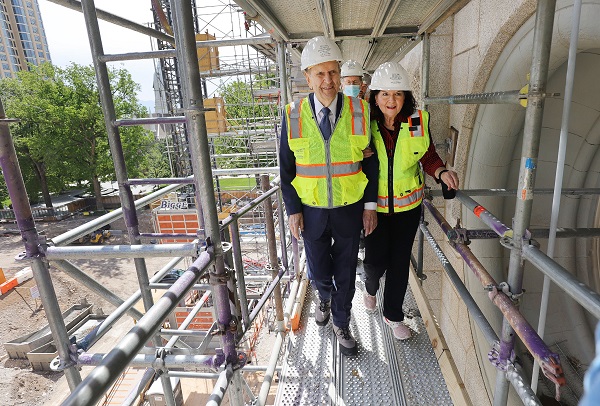 Russell M. Nelson and Wendy Watson Nelson at the Salt Lake Temple site. Courtesy of Intellectual Reserve, Inc.
Because the pioneers had relied primarily on gravity and mortar to hold the temple together, its high masonry walls and towers would be particularly vulnerable in a strong earthquake. The whole building therefore needed to be reinforced to keep it together in a quake. The pioneer foundations had already been bonded and strengthened. Work on the temple’s roof commenced in 2021. A tower crane installed the previous October south of the temple made this possible. It was 250 feet tall—40 feet higher than the temple’s tallest tower. The old copper roof was removed and replaced by a temporary covering, like a heavy tarp. The thousands of stones forming the battlements and buttress caps along the edge of the roof were carefully removed to make way for a structural concrete bonding beam running the length of each wall and completely around the perimeter of the roof, to which new steel trusses would be secured. These new trusses, eighty-eight feet long and weighing thirty-five thousand pounds, were installed next to the original steel trusses. They were added two at a time, filled with crossbeams to provide horizontal stability, and bolted rather than welded to avoid the possibility of fire. Thus, only one section of roof had to be opened at a time, limiting exposure of the interior to weather before the permanent copper roof was put into place. This reinforced roof was a key part of the overall seismic strengthening of the temple. Steel frameworks nicknamed “Christmas trees” were constructed to strengthen the six towers, which were then anchored to the bonding beam surrounding the roof. Next, four-inch-diameter channels were precisely drilled down through the walls, so steel cables could tie or clamp the roof structure to the reinforced foundation eighty feet below.
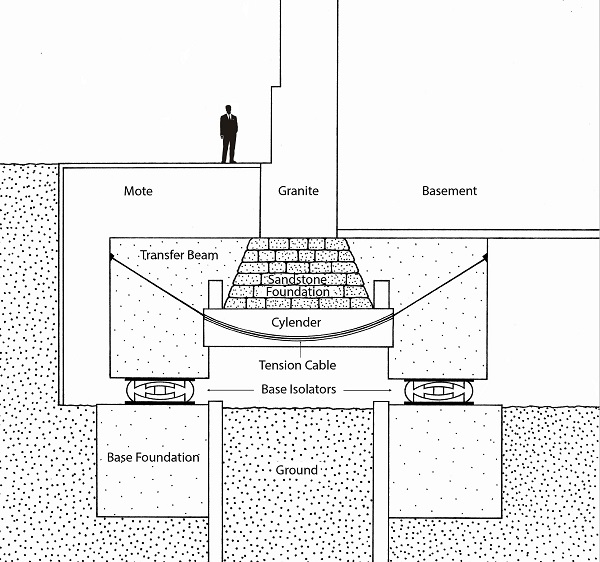 Salt Lake Temple foundation cross section showing seismic upgrades. Courtesy of Lee R. Cowan.
President Nelson toured the construction site Saturday, May 22, 2021. While there, he recorded part of his message for October general conference: “As I examine the craftsmanship of this entire building, I marvel at what the pioneers accomplished.” Nevertheless, he observed, “These many decades later, however, if we examine the foundation closely, we can see the effects of erosion, gaps in the original stonework, and varying stages of stability in the masonry. Now as I witness what modern engineers, architects, and construction experts can do to reinforce that original foundation, I am absolutely amazed. Their work is astonishing!”[17]
 Jack and bore used cylindrical steel casings crosswise under footings around the Salt Lake Temple. Courtesy of Intellectual Reserve, Inc.
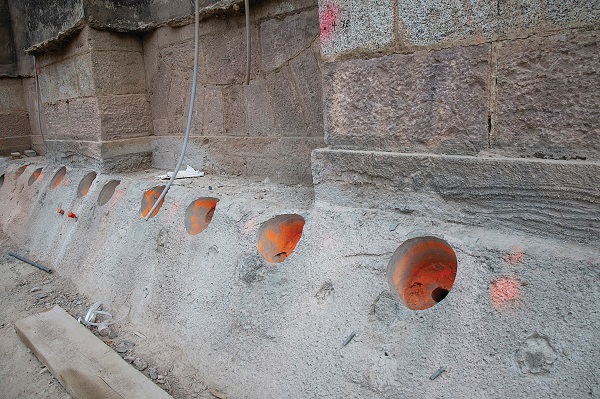 An exposed portion of the original sandstone foundation of the Salt Lake Temple. Holes (shown above) have been drilled preparatory to inserting rod fasteners that will tie the foundation together and give additional support. Courtesy of Church Newsroom.
With the temple’s historic footings thoroughly consolidated, the next step, beginning in late August 2021, was to use a carefully planned “jack and bore” process to insert a row of cylindrical steel casings crosswise under these footings all around the temple. These giant cylinders were four feet in diameter, one inch thick, and long enough to extend out a few feet both inside and outside from under the sandstone footings. A web of heavy No. 18 steel rebar called a “cage,” including conduits for steel tension cables, was inserted. When all were in place, the temple rested on them. An array of laser sensors warned of even the slightest movement in the temple.
The next step was to deepen the excavations next to the foundations and cylinders, both inside under the temple and outside, by an additional sixteen feet. In these huge trenches, new parallel footings of reinforced concrete were then constructed. Ninety-eight base isolators were next placed atop these new footings in pairs, one on the inside and the other on the outside of the temple walls. Each base isolator, all stainless steel, consisted of two disks, one on top of the other, about seven feet in diameter. Their inner surfaces were concave, with something like a giant ball bearing that could roll between them and allow the upper plate to shift from side to side, the whole assembly being about two and one-half feet high.
Huge transfer beams of reinforced concrete, about fifteen feet high and up to fifteen feet wide, were next constructed on top of the base isolators against the inside and outside of the temple’s historic stone foundations. The steel in the cylinders was welded at each end to the steel inside these transfer beams. The maze of steel cables passing through the conduits inside the cylinders was attached to the inside beam and the outside beam; tension was increased, pulling the transfer beams tight against the sandstone and granite blocks and making the whole into a single and larger foundation. The soil was then cut out from underneath the cylindrical casings, thereby transferring the massive weight of the temple atop the support cylinders through the base isolators to the new footings. In effect, the temple was floating above the ground. Thus, the building could remain relatively still if the earth shook beneath it.
The isolator allowed movement up to five feet in any direction, so there needed to be a gap or “moat” up to five feet wide on all sides of the temple. The Salt Lake Temple has six underground entrances bridging this gap. Each was fitted with an accordion-like section that allowed it to flex. Ducts and other utilities that cross the moat were likewise fitted. On the surface, the gap was covered with large metal plates that could slide back and forth during a quake; they in turn were covered with pavers or other landscaping materials.
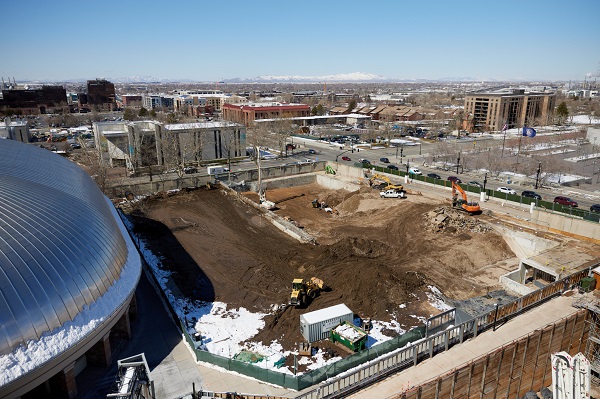 The area where the North Visitors' Center once stood is refilled with soil to build up a level surface and prepare for the construction of additional restrooms for guests of the Tabernacle and Assembly Hall, Salt Lake City, March 2022. Courtesy of Intellectual Reserve, Inc.
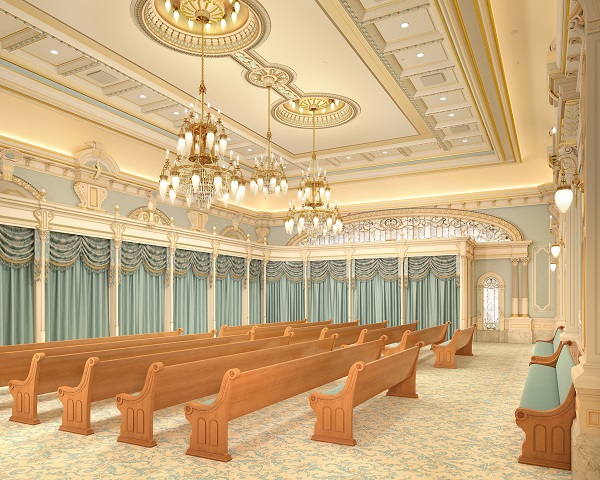
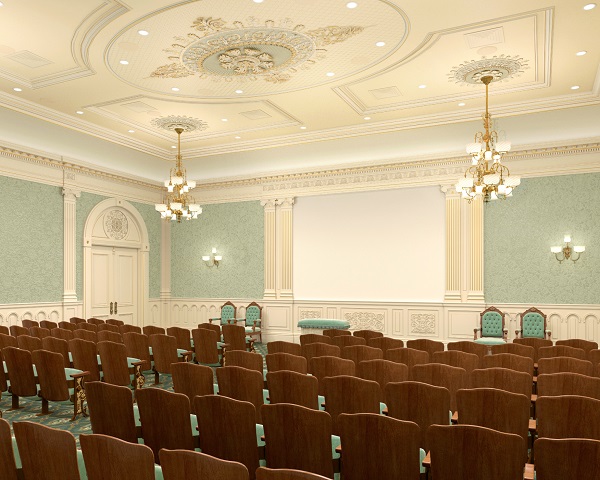
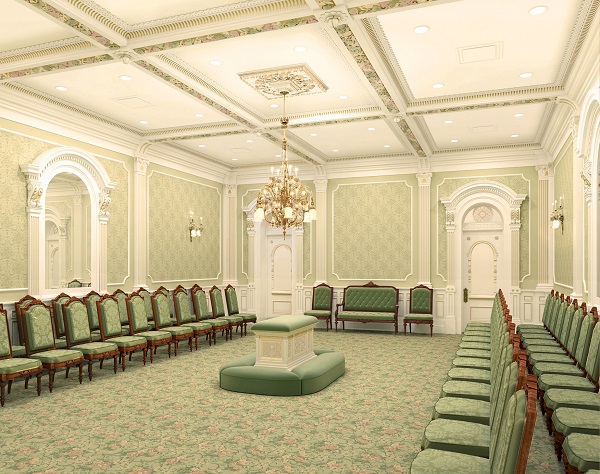 Top to Bottom: Interior renderings of the veil room, and endowment room, and a sealing room in the Salt Lake Temple. Courtesy of Intellectual Reserve, Inc.
Meanwhile, excavation for the new facilities north of the temple also continued during 2021. Steel columns sunk deep into the ground around the perimeter of the excavation and connected by heavy planks kept the outside soil from caving in. As the digging went deeper, more of a heavy secant wall constructed north of the temple was exposed; it needed to be strengthened so it could withstand forces created by the temple’s weight of about 185 million pounds.[18]
When the excavation reached a sufficient depth, a 180-foot-long pedestrian tunnel was constructed under North Temple Street. As the rocks and dirt were removed, steel support arches were inserted every four feet. It would connect the underground parking garage at the Conference Center more safely and conveniently with the grand hall on the middle level of the new entrance to the temple.
In December 2021 the excavation on the north reached its maximum depth of eighty-five feet, and preparations began for construction. A second tower crane had been set up on the north side of the temple to assist. A steel mat was laid down to support the forty-two-inch-thick reinforced concrete mat foundation of the new annex. Three pumper trucks for eight to ten hours delivered eighteen hundred cubic yards—the largest single cement-laying operation of the entire project.[19] This new facility would embrace two entry pavilions on the surface and three stories underground. It would house a waiting room for guests attending temple weddings, a larger chapel, the two new baptistries, dressing rooms, sealing rooms, offices, and other facilities.
Meanwhile, work on the Church Office Building Plaza had begun. After the area between Main and State Streets was closed in February 2021, the fountain, which had leaked into the parking garage below, was removed. Landscaping was then taken out and soil scraped away so the garage’s cement roof could be thoroughly waterproofed before landscaping was reconstructed. The new design called for a crescent-shaped array of bases for the flags of the world, emphasizing the scope of the Church’s mission to share the gospel of Jesus Christ.
In June 2021 the First Presidency announced that the former North Visitors’ Center would be demolished. This area would be replaced “with gardens and contemplative space” offering “a more direct and clear view of the Salt Lake Temple.” This would be consistent with President Nelson’s goal to “enhance, refresh, and beautify the temple and its surrounding grounds.” Additional public restrooms would also be provided in the northwest corner of Temple Square.[20]
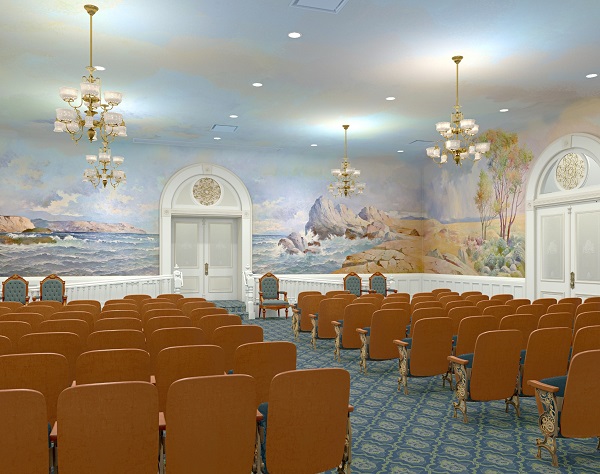
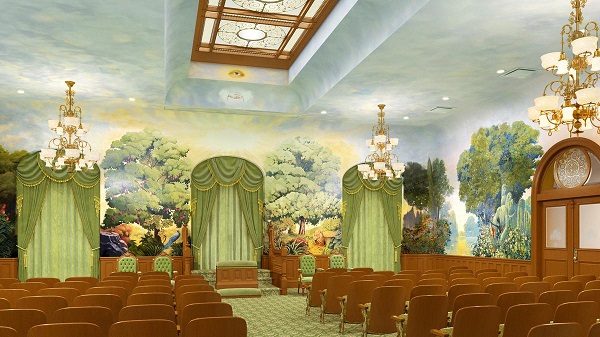 Renderings of the creation room (left) and garden room (right) in the Salt Lake Temple. Courtesy of Intellectual Reserve, Inc.
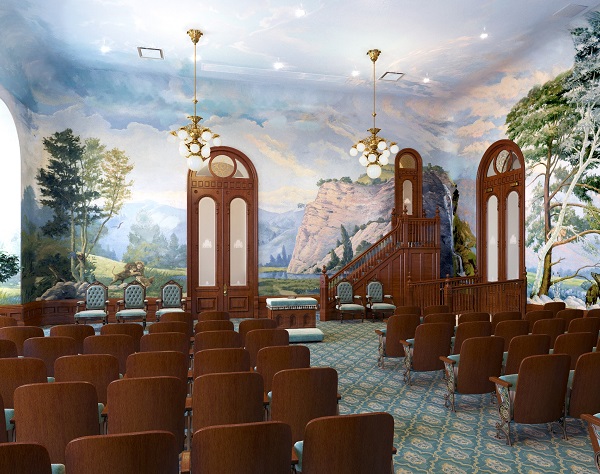 Rendering of the world room, Salt Lake Temple. Courtesy of Intellectual Reserve, Inc.
In May 2022 excavation began for the two new visitors’ pavilions on Temple Square south of the temple. These two buildings, connected by a common underground level, were designed to afford an unobstructed view of the temple from South Temple Street where many visitors passed by. A unique feature of the lower floor would be replicas of rooms in the temple. Thus, visitors could see what the baptismal font, a sealing room, and even what an endowment instruction room were like. Exhibits would focus on eternal families and other doctrinal principles undergirding the work done in temples.
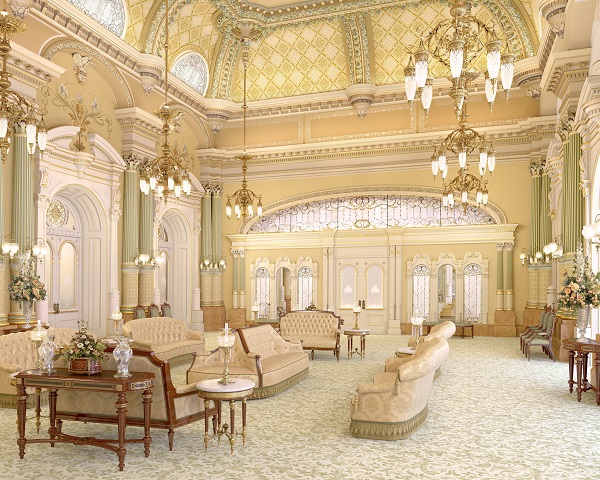 Rendering of Salt Lake Temple celestial room. Courtesy of Intellectual Reserve, Inc.
While all this was being accomplished, another huge project needed to be completed in the historic temple’s interior. This would include not only the renovating and refreshing of the General Authorities’ council rooms and the large priesthood assembly room on the upper floors but also the creation of the five new endowment presentation rooms below. Four would be on the lowest floor in the space formerly occupied by the creation and garden rooms and the baptistry. The fifth would be on the next floor where the world room had been located. The area of the terrestrial room would become the veil room where patrons would complete their endowment instructions. The celestial room would be thoroughly refurbished.
Thus, after the renovation of the Salt Lake Temple had passed its two-year mark, much had been accomplished, but a great deal remained to be completed. The First Presidency insisted that the “seismic strengthening of the Salt Lake Temple and the extensive remodel of the temple and surrounding areas are sacred and significant undertakings.” As the work unfolded, the First Presidency acknowledged that Church leaders had “learned a great deal about the temple and its surroundings.” As a result, “inspired modifications and additions to the project and scope have been made so the temple and Temple Square may serve many generations yet to come.” Therefore, the estimated completion date was pushed back. The Presidency reiterated, “We look forward to welcoming the world at that time to visit, tour, and learn about this sacred temple and The Church of Jesus Christ of Latter-day Saints.”[21] Following this open house, the temple would then be rededicated and resume its service as a consecrated house of the Lord.
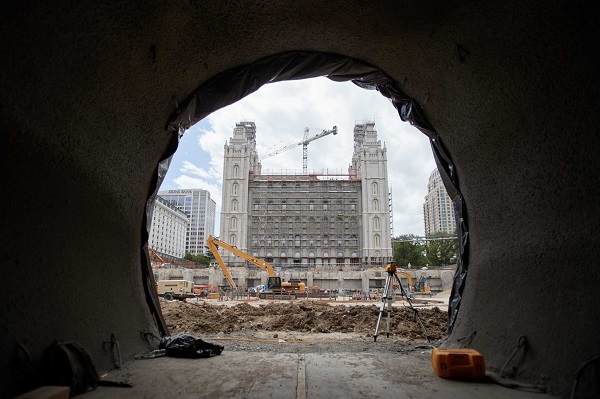 A view of the Sale Lake Temple from the tunnel underneath North Temple Street that will eventually connect the Conference Center parking lot to the temple, June 2021. Courtesy of Intellectual Reserve, Inc.
The Manti Temple
When the First Presidency announced in March 2021 modifications in plans for the renovation of the Salt Lake Temple, they disclosed the first details concerning similar work to be done at Manti: “Beginning later this year, the Manti Temple will begin a multiyear renovation that will include mechanical updates and other changes to prepare the temple to serve for generations.” Plans anticipated that the progressive room-to-room presentation by live actors would transition to single-room presentations by film. Therefore, “some elements of the temple’s structure” would need to be remodeled and “updated to accommodate these changes and improve accessibility for patrons.” The statement assured that “the historic staircases in the Manti Temple are being preserved during the renovation.” These changes, however, meant that the murals painted on the walls of some of the larger rooms could not be saved. The announcement assured that they would be thoroughly photographed and documented before being removed. At least portions of the murals would be preserved and exhibited “in a public setting.” Still, newspapers and the Internet were full of letters or statements decrying their impending removal from the temple. Even a group of marchers in Provo demonstrated their opposition to the plan.
 Manti Utah Temple with scaffolding. Courtesy of Lee R. Cowan.
Members of stake presidencies throughout the Manti Utah Temple district, civic leaders from Manti and neighboring Ephraim, and their wives were invited to a special meeting in the Manti Tabernacle on Saturday morning, May 1, 2021. In a prerecorded statement, President Nelson unfolded a new vision for the Manti Utah Temple. He reiterated that the pioneer temple needed “upgrades and other changes to keep it useful and safe. It also needs to be revised to offer the revealed ordinances and covenants to members who speak languages other than English. That will be made possible by filmed presentations.” However, the endowment presentation in Manti would still be “progressive,” moving from room to room as in a few other recent temples. President Nelson explained, “We have continued to seek the direction of the Lord on this matter,” and, he added, “we have been impressed to modify our earlier plans for the Manti Utah Temple so that the pioneer craftsmanship, artwork, and character will be preserved, including the painted murals loved by so many.” He emphatically announced, “We will leave those murals where they are located now, inside the Manti Utah Temple.” The circumstance of the murals in the Manti temple was different than Salt Lake. While the murals in the garden and world rooms of the Salt Lake Temple were painted directly on the plaster walls in the 1890s, those in Manti were painted on canvas during the 1940s. Thus, their preservation would be easier to accomplish. C. C. A. Christensen’s mural in the Manti Utah Temple’s creation room, however, would need to be redone. The plan was to photograph it carefully and then have artists reproduce it precisely.[22] President Nelson also announced that a new temple would be built in nearby Ephraim (see the following chapter); he explained that this would enable the Church to solve the problems of accessibility and capacity while at the same time “preserve the unique classical character and useful life of the historic Manti Utah Temple.”[23]
Elder Ronald A. Rasband of the Quorum of the Twelve, who had been assigned to preside at the news conference in Manti, insisted that the change was not the result of protests, but rather he testified that it was an example of the Lord revealing “his secret unto his servants the prophets” (Amos 3:7). While the faithful were praying that they might accept the Lord’s will, the prophet was pondering and praying about several options that had been presented to him. He then received one of his during-the-night promptings directing him what to do. He shared his revelation with a small group of Church leaders, and during the next ten days to two weeks, plans came together with what Elder Rasband described as “moving with all due haste or warp speed.” President Nelson wanted the Saints in Manti to be the first to hear, so the matter was kept strictly confidential.[24]
 Manti Utah Temple. Courtesy of Intellectual Reserve, Inc.
This was the first time since Payson, over a decade and a hundred temples earlier, that such an announcement had not come as part of a general conference. Brent W. Roberts, managing director of the Special Projects Department, was grateful that they could get to work right away rather than needing to wait for the next conference. He indicated that much of the planning had already been done. They had researched the history of the original design, soil composition, and limestone strength, as well as waterproofing methodologies. The original plan would have required over three years, but without needing to make such major changes as moving walls, Roberts estimated the work could be done in eighteen months to two years. Waterproofing the foundation and the east wall would be a major task. The interior would be refreshed, protecting historic surfaces including the murals. Thus, as Roberts put it, the project would be a “mix of preservation, restoration, and installation of new equipment.”[25]
W. Christopher Waddell, first counselor in the Presiding Bishopric, called Manti a “jewel of a temple.” He insisted that its renovation will “not only honor the Lord, but will honor our pioneer forebears whose sacrifice and talents will continue to be on display for generations to come as members of the Church worship in this sacred House of the Lord.” Bishop Waddell asserted that “President Nelson truly is a prophet to the world, and his concern is for all of God’s children.” When you think of people speaking over eighty languages, many first-generation pioneers in their own lands, being able to enter these iconic temples and see the beauty of what the early pioneers have done, it “is just a remarkable thing.”[26]
The Manti Utah Temple closed October 2, 2021, so the work could begin. One of the first projects was to stop water from leaking into the temple through its east wall where the building was cut into the mountainside up to the level of the third floor. A deep excavation exposed this wall so improved waterproofing could be inserted. “It has been a very persistent leak for many, many years with several attempts to try to fix it,” Andy Kirby acknowledged. “We hope we will be the final attempt to fix it.” Work can then focus on cleaning and preserving the interior.[27]
While renovation was moving forward in the Manti and Salt Lake Temples, Latter-day Saints in the Cache Valley area awaited further word concerning plans for the Logan Temple. During this same time, there also was a series of announcements of about a dozen new temples for the Beehive State.
Notes
[1] Russell M. Nelson, “Becoming Exemplary Latter-day Saints,” Ensign, November 2018, 114.
[2] Nelson, “Closing Remarks,” Ensign, May 2019, 111.
[3] Rachel Sterzer Gibson, “Five Lessons Learned from Renovation of the Temple,” Church
News, October 25, 2020, 10.
[4] Emily Utt, news conference in St. George, May 22, 2019, recording in Richard O. Cowan’s possession.
[5] “St. George Utah Temple Renovation Hits One-Year Milestone,” November 2020, Church Newsroom (https://
[6] “St. George Utah Temple Hits One-Year Milestone.”
[7] Rick Satterfield, email message to Richard Cowan, June 7, 2021.
[8] Trent Toone, “St. George, Manti Renovations Continue,” Church News, April 2, 2022, 12.
[9] The Church News of April 27, 2019, published a special issue on the Salt Lake Temple renovation.
[10] KSL-TV, The Salt Lake Temple, aired April 3, 2021, recording in authors’ possession.
[11] Sydney Walker, “What It Means to Decommission a Temple,” Church News, January 12, 2020, 3.
[12] “Construction Update,” March 6, 2020, Church Newsroom (https://
[13] Walker, “Salt Lake Temple Sustains Minor Damage in Quake,” Church News, March 22, 2020, 2; Walker, “Church Buildings Damaged in 5.7 Quake,” Church News, March 29, 2020, 21.
[14] Sarah Jane Weaver, “Angel Moroni Statue, Capstone Removed for Preservation, Restoration,” Church News, May 24, 2020, 11; Walker, “What’s Inside the Salt Lake Time Capsule?” Church News, August 2, 2020, 9–11.
[15] “Salt Lake Temple Renovation,” September 25, 2020, Church Newsroom video (https://
[16] Taylor, “First Presidency Announces Salt Lake Temple Changes,” Church News, March 20, 2021, 12–14.
[17] Russell M. Nelson, “The Temple and Your Spiritual Foundation,” Liahona, November 2021, 93.
[18] Trent Toone, “A Look 1 Year into the Salt Lake Temple Renovation,” Church News, January 16, 2021, 14–15.
[19] Christine Rappleye, “Vertical Drilling Above, Pipes Below,” Church News, December 18, 2021, 16.
[20] Scott Taylor, “North Visitors’ Center to be Demolished,” Church News, June 19, 2021, 15.
[21] Sarah Jane Weaver, “Work on Temple Renovation Project ‘Truly Remarkable,’” Church News, December 18, 2021, 15.
[22] Emily Utt and Laura Price Howe, email messages to R. Devan Jensen, November 7, 2022.
[23] Nelson, prerecorded remarks, May 1, 2021.
[24] Quoted in official announcement, May 1, 2021, Church Newsroom (https://
[25] Quoted in official announcement, May 1, 2021.
[26] Quoted in Tad Walch, “How President Nelson Received the Revelation about Two Temples,” Church News, May 6, 2021.
[27] “Update on the Manti Temple,” Church News, April 2, 2022, 12–13.
