
 menu icon in the top, right corner of the screen.
 icon above to close this box.
 icon at the bottom of the screen below the browser—if you don't see it, swipe up to unhide it.
A New Wave of Temples During the Twenty-First Century
The Saratoga Springs, Layton, Red Cliffs, Deseret Peak, Orem, Taylorsville, Ephraim, Syracuse, Lindon, Smithfield, Heber Valley, and Reconstructed Provo Utah Temples
Richard O. Cowan and Clinton D. Christensen, "A New Wave of Temples During the Twenty-First Century," in Temples in the Tops of the Mountains: Sacred Houses of the Lord in Utah (Provo, UT: Religious Studies Center, Brigham Young University; Salt Lake City: Deseret Book), 310–47.
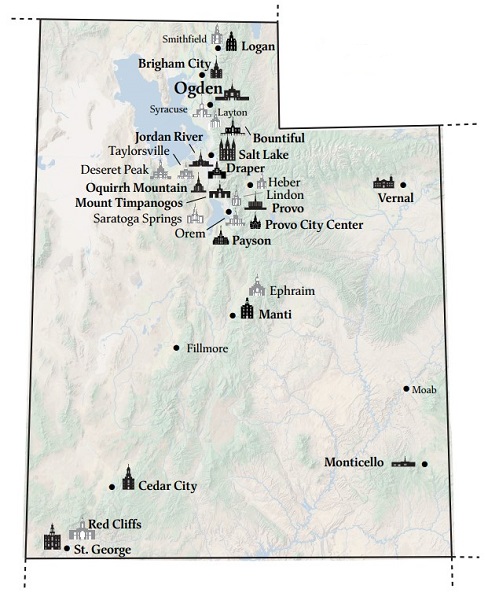 Utah's twenty-eight temples as of February 2023. Courtesy of Lee R. Cowan.
During his brief, nine-month administration (1994–95), President Howard W. Hunter powerfully directed the Latter-day Saints’ attention toward the temple. He challenged them to “establish the temple of the Lord as the great symbol of their membership” and then added, “It would be the deepest desire of my heart to have every member of the Church temple worthy. I would hope that every adult member would be worthy of—and carry—a current temple recommend, even if proximity to a temple does not allow immediate or frequent use of it.”[1] President Gordon B. Hinckley (1995–2008) then became noted for dedicating or rededicating far more temples than all of his predecessors combined. President Thomas S. Monson (2008–18) announced plans for the construction of forty-four new temples.
When Russell M. Nelson became President of the Church in 2018 at age ninety-three, some wondered if he would be able to keep up the pace. He increased it significantly, announcing plans for a hundred more temples during just his first four years as prophet, including temples in India, mainland China, Russia, and eleven in Utah, the latter being the subject of this chapter. He also spoke regularly about the importance of temple worship. At the October 2018 general conference, he announced plans to thoroughly renovate Utah’s four pioneer temples and plans to build twelve new ones in Africa, Asia, South America, Mexico, and in Washington County, Utah. He then commented, “Building and maintaining temples may not change your life, but spending your time in the temple surely will. . . . I invite you to worship in the temple and pray to feel deeply the Savior’s love for you, that each of you may gain your own testimony that He directs this sacred and ageless work.”[2]
During the early months of 2020, a novel coronavirus swept across the world and was declared to be a pandemic. To slow the spread of COVID-19, governments banned most group meetings and required individuals to wear masks. The Church responded by shifting normal Sunday meetings to an online format and closing all temples. After a few months, the Church began a phased reopening of temples, a few at a time according to local conditions, first for only the sealing of living couples and then later for the endowment and other ordinances for living members. A year later, four temples in the Pacific area began the process of reopening temples for limited proxy ordinances. Not until June 2022 did temples in Utah return to a more normal schedule. Even though during these years Latter-day Saints were not allowed normal access to the temples, the Church nevertheless continued to announce plans for constructing more of these sacred structures. This evidenced the importance Church leaders attached to temple worship and service.
The new wave of temples in the Beehive State would fill in the map, making them closer to Church members. All would be moderate in size, those in more populated areas ranging from seventy to ninety-six thousand square feet of floor area. They would not be as large as the Jordan River, Ogden, and Provo Temples, but they would be larger than the Draper and Oquirrh Mountain Temples. Only the Ephraim Utah Temple, located in the more rural Sanpete Valley, would be about the size of the Brigham City Utah Temple, about half as large as the others.
The Saratoga Springs and Layton Temples
Planning for the temples in Saratoga Springs and Layton was underway before President Nelson became President of the Church. Plans for the former had already been disclosed, while the latter was announced just a few weeks after he became the Church’s leader.
The Saratoga Springs Utah Temple
 Saratoga Springs Utah Temple. Courtesy of James Turner.
Thermal springs near the northwest corner of Utah Lake were named for the well-known Saratoga Springs resort in New York, and the area had been a popular fishing place for Native Americans for centuries. Early European explorers to the area included Father Escalante, who visited the shores of Utah Lake in 1776, and Parley P. Pratt, the first Latter-day Saint explorer, in 1847.[3] The city of Saratoga Springs was incorporated in 1997, and it became one of the most rapidly growing areas in the United States during the early twenty-first century. President Thomas S. Monson announced plans to erect a temple there at general conference on April 2, 2017. This would be the fifth temple in Utah Valley.
The Special Projects Department worked closely with Mayor Jim Miller of Saratoga Springs, and he was “very pleased” with how the new structure would “blend in with the community.”[4] The 22.5-acre temple site would be in the Beacon Pointe subdivision, just west of Redwood Road. Situated on a sloping hillside, it afforded a good view of the north end of Utah Lake with Mount Timpanogos beyond. The temple would have approximately eighty-seven thousand square feet of floor area, have a basically square footprint, be three stories high, and be surmounted by a central tower. It would be on a new road to be known as Ensign Drive. A twenty-one-thousand-square-foot meetinghouse would also share the site.[5]
 Audience at Saratoga Springs Utah Temple groundbreaking. Courtesy of Intellectual Reserve, Inc.
About a thousand invited guests were present for the temple’s groundbreaking on a breezy overcast Saturday morning, October 19, 2019. Elder Craig C. Christensen of the Seventy, president of the Utah Area, presided. He recalled how a month earlier he had spent about an hour walking over the site and how he could envision construction of the future temple. “I started to think what will take place within the walls of the temple once it is completed and dedicated. I realized in a more profound way how this particular temple will bless many individuals and families.” Chad Wilkins, a long-term local resident and chairman of the groundbreaking committee, recalled how years earlier Elder Neal A. Maxwell of the Twelve had affirmed that “the Lord would bring people to this area.”[6] He certainly had done so. “As we prepare to break ground for this new temple,” Wilkins urged, “may we silently commit today to prepare the soil of our hearts to do our part to qualify for the powerful promises offered us by the Lord and His holy prophets.” David Durfey, member of one of the stake presidencies, emphasized that this was a very young area with an abundance of children and youth, and that the temple was being built “because of their faith and what they need in order to grow up unto the Lord.” He predicted an abundance of marriages here, saying, “It will be amazing.” In his site dedicatory prayer, Elder Christensen petitioned that the youth would be drawn here and that they would “recognize through Thy spirit that this is truly a special, even holy, gathering place.”[7]
Construction progressed rapidly. By the end of 2020 the temple’s exterior had taken shape, with only the spire needing to be finished. This was completed the following year, and on August 20, the figure of the angel Moroni was placed atop the temple. This was over a year after the spring 2020 decision to no longer include the angel (see the discussion of the temple in Tooele Valley later in this chapter), but architectural plans for the Saratoga Springs Temple had been released in 2019 several months before that decision was made. Because of supply chain problems and delays related to the COVID pandemic, an additional year and a half would pass before the temple was ready for dedication. The First Presidency announced that the public open house would run from April 15 through July 8, 2023—an unusually long time. The temple would then be dedicated by President Henry B. Eyring on August 13 of that year.[8]
The Layton Utah Temple
North Davis County was already densely populated, so a temple located there would relieve pressure on the busy Ogden and Bountiful Temples. Plans for a temple in Layton were announced at the April 2018 general conference, and the specific site was disclosed a year later, on July 15, 2019. It would be built on a beautiful 11.89-acre site at the corner of Oak Hills Drive and Rosewood Lane in southeast Layton.[9]
The community was named for Christopher Layton, an early pioneer in Davis County. In the bench areas next to the foothills, early settlers developed dry farming, the raising of wheat and corn without irrigation. Fruit and vegetables grew in the fertile land lower in the valley.[10] While Layton originally was an agricultural area, it grew steadily in population, especially with the coming of Hill Field (now Hill Air Force Base) near the beginning of World War II. Layton is now the largest community in Davis County.
The design for the Layton Utah Temple was released early in 2020. Like other Utah temples announced at about the same time, it would be a three-story structure and would have a floor area of about eighty-seven-thousand square feet. Its appearance, however, would be unique. Echoing the design of the historic Logan Utah Temple and the more recent Brigham City Utah Temple, it would have two attached towers, one at the east end and the other at the west.[11]
 Layton Utah Temple. Courtesy of Marshall Thompson.
At the time the architectural rendering was released, the First Presidency announced that the groundbreaking would take place on Saturday, May 30. President Thomas K. Checketts, of the Layton Utah Holmes Creek Stake, headed the committee making arrangements for this event. Well over a thousand interested Saints were expected to attend, so careful planning began. Just a few weeks following this announcement, however, the COVID-19 pandemic hit, and gatherings of large groups were prohibited. Plans for the groundbreaking had to change completely. Only twenty people were invited to be present, all wearing masks and maintaining social distance. A video recording would be made available to members in the temple district.
Groundbreaking was quietly moved to May 23, 2020, so the recording could be released on the original appointed day one week later. The video combined music by The Tabernacle Choir and air views of the temple site with a recording of the brief program. Elder Christensen conducted. He likened the small gathering “to the Church’s first meeting in 1830 with just a few people present” and added, “That’s how this feels to me.” The site dedicatory prayer was given by Randy D. Funk, a General Authority Seventy and first counselor in the Utah Area presidency. He emphasized that his prayer dedicated the land, initiated the process of construction, and petitioned blessings for the workers as well as for the people in the district. “It is an opportunity for really all to have the blessing of the Lord as we go forth and construct this beautiful temple in this site.”[12]
As construction moved forward, the temple’s basic form rapidly took shape by the end of 2021. The angel Moroni was added to the west tower on March 10, 2022, with the temple expected to be completed by the middle of 2023 and ready for dedication.
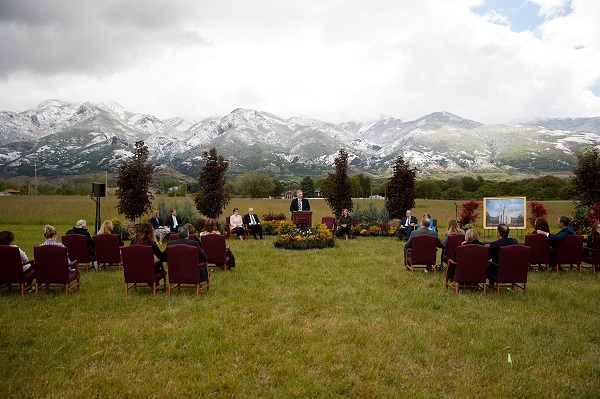 Attendance was limited at the Layton Utah Temple groundbreaking because of the COVID-19 pandemic. Courtesy of Intellectual Reserve, Inc.
Temples in Washington County and Tooele Valley
The next two Utah temples, announced in October 2018 and April 2019, were close to historic centers of Latter-day Saint population. Interestingly, both would be named after broad geographical areas and would subsequently be renamed after specific geographical features.
A Temple in Washington County
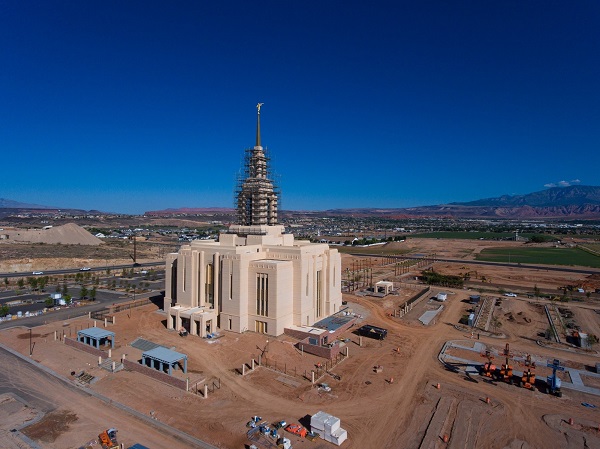 Progress of Red Cliffs Utah Temple in September 2022. Courtesy of Doug Tice.
The St. George Temple, Utah’s first, had been built in Washington County in the extreme southwest corner of the territory and later state. At first this temple had served a broad area, including even southern California. Construction of other temples made the temple district smaller geographically, but more recent population growth in the St. George area has kept this historic temple busy. A second temple in Washington County would ease the pressure. Plans for this temple were announced at the October 2018 general conference. President Daniel K. Frei of the nearby Santa Clara Utah Stake “was grateful that there would be a second temple in the area: We do have a temple, but only so much work can be done. . . . We are already at capacity.” He noted that the new temple would allow more members to serve. “It is also an indication of the Lord’s confidence in the people who live in the area.”[13]
The specific site was announced about a year later. While the original St. George Temple was located close to the center of town west of I-15, the new temple would be built east of the freeway in an area where fields of hay and grain were rapidly being replaced by spreading residential neighborhoods. The fourteen-acre site would be northeast of the intersection of 3000 East and 1580 South.[14] A rendering of the temple’s design was released in April 2020. It would be a three-story structure, having about eighty-eight to ninety thousand square feet, and a central spire.[15]
At first, this temple was simply identified as being in Washington County, Utah. This wouldn’t be the first time the official name of a temple was determined sometime after its initial announcement. For example, the name Provo City Center Temple was adopted several months after plans were announced to rebuild the burned-out Provo Tabernacle. The Church News describes the interesting way the new temple in southern Utah received its name: Elder Jeffrey R. Holland of the Quorum of the Twelve and his wife, Patricia, both of whom had grown up in southern Utah, “were driving in the proposed area of the new temple, knowing the need for a name since St. George has had its namesake temple for nearly a century and a half. He recalled his wife looking north toward Pine Valley and mention[ing] Red Cliffs as a possibility because of the dominating geological feature in the expansive view.” They later suggested this name as an option to the First Presidency, commenting that “the name represents not only the immediate area, but also honors much of the entire temple district that encompasses the Virgin River region.”[16] The Presidency adopted their suggestion.
 Jeffery R. Holland and Patricia Holland at the Red Cliffs Utah Temple groundbreaking. Courtesy of Intellectual Reserve, Inc.
Groundbreaking for the Red Cliffs Utah Temple took place on Saturday, November 7, 2020. For several days the weather had been typical of St. George, pleasant and warm. On the appointed day, however, it turned cold and blustery. The First Presidency assigned Elder Holland to return to his hometown to preside. Elder Christensen conducted. Several dozen church and civic leaders and their wives were invited to be present. All wore masks and observed other precautions related to the COVID-19 virus.
“As we talk about home, safety, peace and people who love you,” Elder Holland remarked, “that is a description of the temple—it is the safest, the most welcoming and reassuring place in the world.” In his site dedicatory prayer, Elder Holland affirmed that the original St. George Temple had stood for a century and a half as a symbol of “the area’s faith and commitment.” He called the land he was dedicating “a sister site.” While present-day Saints do not face the same challenges as the pioneers, Elder Holland insisted that “they have their own modern-day challenges” and that “temple attendance and worship” help us meet them.[17]
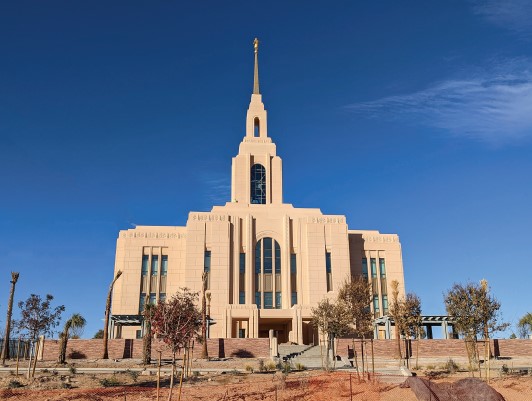 Red Cliffs Utah Temple. Courtesy of Gary Davis.
A Temple in Tooele Valley
Tooele Valley is located over the Oquirrh Mountains just west of the Salt Lake Valley. The origin of the name Tooele is uncertain. It may be the name of an early Goshute chief Tuilla, or it may be derived from the tules or bulrushes growing in a marshy or swampy section of the area.[18] As population along the Wasatch Front continued to expand, it increasingly overflowed into this valley to the west. Saints in this area were assigned to the Salt Lake Temple, some thirty miles away. Then plans for a temple in this area were announced at the general conference in April 2019. Stake president Todd C. Thompson of the Tooele Stake remarked, “This is something we’ve been hoping for but knowing it might not happen in our lifetimes. We were trying to just be patient and humble, and we’re grateful that the Lord is answering those prayers.”[19]
The design for the Deseret Peak Utah Temple (at that time called the Tooele Valley Utah Temple) was released on April 7, 2020. Its three stories would have approximately seventy thousand square feet of floor space. The exterior would be cast stone with a roof of copper shingles. Flowers native to the Tooele Valley—the cliffrose and the silvery lupin—would be featured. Architects drew details from the historic tabernacle in the area.[20] The temple’s central spire reflected a change in policy regarding statues of the Angel Moroni.
 Rendering of Deseret Peak Utah Temple. Courtesy of Intellectual Reserve, Inc.
Since the early 1980s, virtually all new temples included figures of the herald angel atop their chief tower.[21] Some temples were dedicated without the angel because of legal restrictions but added the figure as soon as this became possible; these included Sydney (1984) and Boston (2000). Other temples had omitted the statue because of local sensibilities. Examples include the Freiberg Germany Temple, dedicated in 1985 behind the Iron Curtain in the communist-controlled German Democratic Republic, and the Paris France Temple (2017), located near Versailles, where a golden angel might have been regarded as an attempt to outdo the world-famed palace. A few others omitted the figure for security concerns, especially small temples in less affluent areas where a statue apparently made of gold might be a temptation for vandalism or threaten the safety of patrons who might be viewed as wealthy targets for personal attack. Kinshasa, in the Democratic Republic of the Congo, and the temple in Port-au-Prince, Haiti, (renderings released in 2016 and 2017 respectively) are recent examples. All these instances, however, were regarded as exceptions to the norm of having Moroni on temples.
 New Church logo. Courtesy of Intellectual Reserve, Inc.
The announcement of the Deseret Peak Utah Temple’s design in April 2020 was different, however, as it was the first of a long series of temples planned without the statue of Moroni. This change came at a time of greater emphasis on the Savior. At the October general conference in 2017, President Nelson had emphasized the importance of the Church being known by its revealed name, The Church of Jesus Christ of Latter-day Saints (Doctrine and Covenants 115:4). Then, at the conference in April 2020, he unveiled the Church’s new official logo featuring a depiction of the Savior. Previously, the angel Moroni was used as a symbol on many Church materials. The design for the temple was released just three days later. The last temple design with the familiar angel Moroni (for Durban, South Africa) had been released two months earlier in February 2020.
The original site for the Deseret Peak Utah Temple in Erda had been announced September 25, 2019.[22] In May of the following year, the county approved the Church’s request to zone 167 adjoining acres for a planned community having more than four hundred residences. There were to be thirty-two acres of open space, walking trails, and parks. Still, “some local residents voiced concern about the high-density impact on the small, rural community of Erda,” leading to a divisive controversy. Finally, on August 8, the First Presidency emphasized that there was “a sincere desire on the part of the Church to avoid discord in the community,” so they withdrew their residential zoning request. The Presidency expressed gratitude for the faith and prayers Church members had exhibited during this process and encouraged “all people to treat one another with kindness and Christlike love.”[23]
 Elder Brook P. Hales conducts the Deseret Peak Utah Temple groundbreaking service. Courtesy of Intellectual Reserve, Inc.
Eventually a new location was selected for the temple. In November 2020 President Nelson confidentially made the trip out to Tooele so he could personally inspect several sites the Presiding Bishopric had selected for his consideration. After having been taken to each of them, he asked to return to one. He wanted to be sure. Standing on the spot, he declared, “This is where we build the temple.” Richard Droubay, who would head the local temple committee, later commented, “To have his stamp on this piece of property is amazing!”[24] This 17.98-acre site would be west of the intersection of 2400 North and 400 West in Tooele, about 2.6 miles southwest of the earlier site. It was donated by Perry Homes Utah and was amid a major new suburban housing area being developed by this corporation. Its selection was announced on January 19, 2021. At the same time the Church disclosed a new name, the Deseret Peak Utah Temple.[25] Deseret Peak in the Stansbury Range is probably the most conspicuous landmark in the area.
Ground was broken on a warm and breezy Saturday, May 15, 2021. Richard Droubay believed he had witnessed a series of miracles leading up to the event. Landscaping trees and shrubs, worth thousands of dollars, had been borrowed to beautify the site. On the day before the groundbreaking, a powerful wind-driven storm passed through the area. It seemed to split in two and pass by on either side of the site, thus avoiding potential significant damage. Because the pandemic was easing, 238 church and civic leaders were invited to attend. They were seated where the future temple’s celestial room would be located. Elder Brook P. Hales of the Seventy, secretary to the First Presidency and a longtime resident of Tooele, presided. Previous groundbreakings during the pandemic had been recorded and then made available for viewing within a few days. The groundbreaking in Tooele was the first to be streamed live, so anyone interested could view it in real time. Speakers included Saints from the area. Kim A. Halladay, who had presided over two stakes and was now a sealer in the Salt Lake Temple, described how he had to get up at 3 a.m. in order to be on the road at 4:00 and reach that temple in time for his early shift; he affirmed that this was a privilege rather than a sacrifice. Elder Hales spoke of the factors attracting people to a temple, including its “peaceful, comforting connection between heaven and earth; and the blessing to receive covenants that bind one to God.” In his site dedicatory prayer, he expressed gratitude to the Perry family who had generously donated the ground and then petitioned that the Saints “may feel the godly power” of the future “sacred edifice.”[26] As the program ended, Kim Halladay was observed rushing away even before having the long-anticipated opportunity to take part in turning soil with the gold-colored shovels. “I’ve got to run,” he called out, “I’ve got to fill an assignment in the [Salt Lake] temple.”[27]
 Progress of the Deseret Peak Utah Temple, September 2022. Courtesy of Carolyn Richards Baker.
Temples Adjacent to College Campuses
During the women’s session of general conference in October 2019, President Nelson emphasized that women as well as men may access God’s power through temple ordinances and covenants. As part of this message, he announced plans for eight new temples, including two in Utah—in Orem and Taylorsville.[28] Their sites have two things in common besides the unusual session in which they were announced: both are next to a freeway, and both are located within walking distance of college campuses. The Orem Utah Temple is only a few blocks from Utah Valley University, and the Taylorsville Temple is even closer to a major campus of Salt Lake Community College. Then in 2021, a third temple adjacent to a college was announced, the Ephraim Utah Temple, which will be close to Snow College.
The Orem Utah Temple
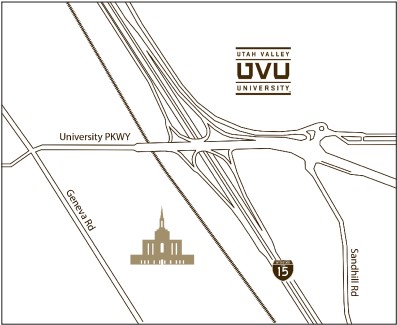 Orem Utah Temple neighborhood. Courtesy of Lee R. Cowan.
The Orem Temple is the sixth in Utah Valley and the third in the Provo-Orem metropolitan area. Orem’s mayor, Richard Brunst, felt “surprise and excitement” when he heard the announcement. “Wow,” he exclaimed, “what a great thing to happen for the residents of Orem and members of the Church throughout Utah County.”[29] Concerning the planning of this and other temples, Brent Roberts, managing director of the Special Projects Department, later explained that this is not done in the same way as most buildings are planned. “We pray and attend the temple. . . . It’s more of a spiritual opportunity” because planners need to know they have “a mandate” from the Lord.[30]
Along with the excitement, there was the inevitable speculation about exactly where the new temple would be located. Church representatives had visited with officials of Vineyard, the community just west of Orem on the shores of Utah Lake, so some regarded this as the chosen site. But on December 11, 2019, just seventy days after the initial announcement, the First Presidency disclosed that the Orem Utah Temple would be built on Geneva Road just south of University Parkway. The promptness of the announcement was unexpected; at this time, site announcements typically took from six months to two years. The sixteen-acre parcel was already owned by the Church, having been purchased several years earlier by Brent Roberts for another purpose when he was president of the Orem Utah Lakeview Stake. The First Presidency’s announcement indicated that a stake center would also be erected on the property.[31]
 Rendering of Orem Utah Temple. Courtesy of Intellectual Reserve, Inc.
A series of meetings resulted in approval of plans to build the temple. In all these gatherings there was no opposition, just curiosity about what the temple would look like and how quickly it would be built. First was a meeting with neighbors on March 5, 2020. Then on April 1 the planning commission addressed some concerns: They adopted the new PD-50 zone, which had been “designed specifically for the temple.” A seven-foot masonry wall would separate the site from the Frontrunner commuter rail right-of-way. Zoning regulations called for a minimum of 280 parking places, but plans provided for 520. Improvements to be made by the Church and the Utah Department of Transportation would handle anticipated traffic without widening Geneva Road, which had been a source of concern to some residents. The planning commission unanimously approved these plans. Finally, on April 14, the city council also gave its unanimous approval.[32]
On June 24, the First Presidency announced that groundbreaking would be on September 5. “The city looks forward to the groundbreaking,” affirmed city manager Jamie Davidson. He noted that “the Church has served as a wonderful partner in addressing concerns and issues associated with the development of the temple site. As a community of faith that prides itself on being family-centered, the temple and associated buildings will be a welcome addition to Orem.” Mayor Brunst added, “The edifice will be a blessing to the community,” and, “We are blessed and lucky to have it.” Referring to the rendering which the First Presidency had released with their announcement, he observed, “it is a beautiful design, even though there is no angel Moroni on top.” He had hoped to see the iconic symbol atop the temple, but he acknowledged that recent designs for other temples had omitted it. Still, he believed the Church had “taken time to understand the history of the area” and that this would be reflected in other features of the design.[33]
 Floral design on the temple spire, Orem Utah Temple. Courtesy of Lee R. Cowan.
Because of the COVID pandemic, only a few people, including church and civic leaders, were invited to be present for the groundbreaking on Saturday, September 5, 2020. Many of the guests had local connections. Utah’s governor, Gary Herbert, for example, was from Orem. Brent Roberts, managing director of the Special Projects Department, had presided over an Orem stake; the Orem Utah Temple would be just one of the fifty-five temple building or renovation projects moving forward under his direction. Proceedings were recorded so they could be viewed later by members in the temple district. Elder Christensen once again presided. Elder Walter F. Gonzáles of the Seventy, who conducted the ceremonies, greeted the audience in English and Spanish, reflecting the diverse composition of Church members in the area. Elder Christensen declared that the temple “will become an added refuge of strength in an increasingly uncertain world—a holy place where we learn and live more fully the great plan of happiness made possible by our Savior, Jesus Christ.” He pointed out that in addition to dedicating the temple’s site, they would also be dedicating “the process of getting it built”; hence, this was a time of gladness and thanksgiving. Elder Evan Schmutz, also of the Seventy, declared that the temple would “act as a beacon, drawing the gaze of millions as they pass by this hallowed ground, and inviting the devoted service of hundreds of thousands of faithful Latter-day Saints as the ordinances of salvation are offered to the living and the dead.”[34]
 Orem Utah Temple, fall 2022. Courtesy of Lee R. Cowan.
As the groundbreaking activities were concluding, Sister Zulma Gonzáles called attention to a small group of people in Sunday dress across the site standing behind the fence in a corn field. They turned out to be three great-grandchildren of Niels Williamson and their spouses. Niels had been the original owner of the temple property, having bought it in 1870. This group felt they should be present to respect the significant event taking place on what had once been their family’s land. Elder Gonzáles remarked, “I like to think that also on the other side of the veil there were witnesses cheering what was taking place.”[35]
After the site was graded, excavation began for the foundation and basement. By February 2021, cement walls could be seen at ground level. On March 1, the first steel beams were delivered to the site, and within days the steel framework was rising, easily seen from the nearby thoroughfares. On December 10, the prefabricated steeple was hoisted to the top of the temple and the finial was installed. A prominent and unique feature on the steeple is a representation of a wild phlox flower prominent in the area. Within a few days the tower was being illuminated and the temple’s exterior appeared to be complete. The significance of this moment was much like the placing of Moroni atop earlier temples.
 Willamson family attendees at the Orem Utah Temple groundbreaking. Courtesy of Intellectual Reserve, Inc. Niels Williamson was the original owner of the property site.
The Taylorsville Utah Temple
 Rendering of the Taylorsville Utah Temple. Courtesy of Intellectual Reserve, Inc.
Taylorsville, near the center of the Salt Lake Valley, had some of the best land for farming and sheep raising in pioneer days. It remained mostly agricultural until the 1940s when suburbs of Salt Lake City began spreading, particularly following World War II. Originally part of the Salt Lake Stake, Church units in Taylorsville multiplied with the growth in population. This growth led to the announcement of a temple in the area. Taylorsville mayor Kristie Steadman Overson was convinced that the future temple would “forever change the city.”[36]
This would become the fifth temple in the Salt Lake Valley. The sites for the Taylorsville and Orem Temples were disclosed at the same time, a scant two months after their initial announcement. The 7.5-acre site in Taylorsville was just west of the I-215 belt route, on the south side of 4700 South, a major east–west artery in the area, only two blocks from a major campus of Salt Lake Community College. A meetinghouse on the property would be removed and not replaced.[37] This took place the following June, after which the site was cleared, graded, and made ready for construction. The future temple would be three stories high with a floor area of about seventy thousand square feet and a central spire. Although this description matched that of the Orem Utah Temple, the two buildings would look quite different.
Groundbreaking took place on October 31, 2020. Presiding was Elder Gerrit W. Gong of the Quorum of the Twelve Apostles, whose wife, Susan Lindsay Gong, grew up in Taylorsville. Elder Gong noted that Latter-day Saints in the community included fifth- or sixth-generation members whose ancestors helped settle the area, as well as “relative newcomers” who were enriching the community. He also recognized “the rich blend of heritages, languages, and cultures that define Taylorsville.” He affirmed that the new temple was “already connecting people ‘in deep ways’ across generations and cultures.” Elder Christensen also spoke during the service. He insisted that “the multiple temples being built in the Utah Area reflect the faithfulness of the Saints.” He believed that watching the Taylorsville Utah Temple being built would be “a foundational piece for the faith of the Saints that live in this area.”[38]

 Right: Susan Gong and Gerrit W. Gong turning soil at the Taylorsville Temple groundbreaking. Left: Current progress on the temple. Both images courtesy of Intellectual Reserve, Inc.
The Ephraim Utah Temple
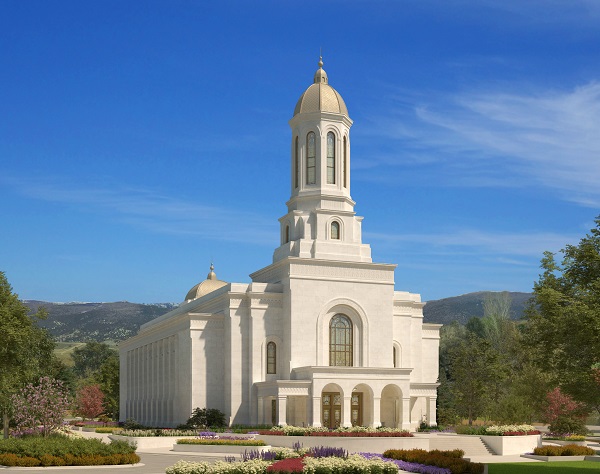 Rendering of the Ephraim Utah Temple. Courtesy of Intellectual Reserve, Inc.
In his prerecorded message at the special meeting in the Manti Tabernacle on May 1, 2021, President Nelson not only disclosed updated plans for renovating the historic Manti Temple (see the preceding chapter) but also indicated that Church leaders had given “prayerful foresight to the growing number of faithful members of the Church who now live or will yet live in this central sector of Utah.” He specifically referred to “the thousands of students who come to Snow College in pursuit of their education” and affirmed, “We care about their well-being and their future.” He then continued, “After much study and prayer, with our deep gratitude for the Lord responding to our pleadings, I am pleased to announce that we have been impressed to build a new temple in Ephraim.”[39] Other General Authorities in attendance at the press conference then provided more information. Elder Kevin R. Duncan of the Seventy, executive director of the Temple Department, indicated that the temple would have four endowment rooms, each seating thirty persons, so a new session could begin about every half hour. There would also be three sealing rooms and a baptismal font. He also affirmed that Church leaders were “especially thrilled” that students at Snow College could now have the blessing of serving as patrons or workers in an accessible nearby temple. One student, Jacob Semadeni, acknowledged that a new temple close to campus would be “a special opportunity” for all the Latter-day Saint students. Abby King, another student, concurred: “That’s because many students at the college are living away from home for the first time and must [consciously] choose to connect with the Church.”[40]
W. Christopher Waddell, first counselor in the Presiding Bishopric, explained that as soon as the site could be secured and necessary approvals obtained, about two years would be needed to build the temple.
 President and Sister Nelson arrive at the Ephraim Utah Temple groundbreaking. Courtesy of Intellectual Reserve, Inc.
Elder Ronald A. Rasband of the Quorum of the Twelve Apostles presided at the meeting. He indicated that half of his ancestors, who were from Denmark, came to Ephraim through great sacrifice. With emotion he affirmed, “I am absolutely positive there is joy on the other side of the veil with this announcement.”[41]
Five months later, Church authorities announced that a three-story temple having an area of thirty-nine thousand square feet would be built in Ephraim on a 9.16-acre site on 400 East at 200 North, just a block northeast of the Snow College campus.[42]
Groundbreaking was on Saturday, August 27, 2022. Because a member of the Seventy usually presides on these occasions, the group gathered in Ephraim was amazed when President Nelson arrived to participate. They greeted him with “reverent, sacred silence and many tears.” The prophet’s roots run deep in Sanpete Valley. He explained, “My dear mother was born in Ephraim, not far from this very temple site. My father was born in Manti. Three of my four grandparents were born here in Ephraim. All eight of my great-grandparents lived in Ephraim.”[43] Also present were Elders Walter F. Gonzáles, president of the Utah South Area, and Kevin R. Duncan, both General Authority Seventies. Utah governor Spencer J. Cox, a native of nearby Fairview, and Ephraim mayor John Scott attended too. Delila Olsen, a longtime resident of Ephraim, celebrated her ninety-eighth birthday and thought the prophet’s coming to dedicate the site was a wonderful present. In his remarks, President Nelson recalled that shortly after the April 2021 general conference, he “received very clear instructions from the Lord that the pioneer craftsmanship of the Manti Utah Temple—set to be renovated by the Church—should be preserved and that a new temple be built in Ephraim.” In his prayer dedicating the site, President Nelson petitioned that the time of construction “be a wonderful time of preparation in the lives of all who live within these precincts. May they literally become thy covenant people.” As he concluded the prayer, raindrops began to fall, which some present likened to tears of gratitude and joy.[44]
Two More Temples for the Wasatch Front
Announced in 2020, these temples would continue to fill in the map of the populated Wasatch Front.
The Syracuse Utah Temple
 Rendering of the Syracuse Utah Temple. Courtesy of Intellectual Reserve, Inc.
Located west of Ogden, Syracuse and its surrounding area had grown substantially during the early twenty-first century. Despite this growth, most local Saints had no thought that there would be a temple in their community and were grateful to have the opportunity to worship in the Ogden Temple which was only about thirteen miles away. Therefore, the announcement at the end of the April 2020 general conference that the third Davis County temple would be in Syracuse came as a real surprise. Only four months later, the specific site for the temple in Syracuse was announced. It would be built on a twelve-acre site at 2500 West and 1025 South.[45] Then on February 16 the following year, the temple’s design was released. It would be a comparatively large three-story building with about eighty-nine thousand square feet.[46]
Groundbreaking for the Syracuse Temple was on Saturday morning, June 12, 2021. Presiding was Elder Duncan, who had grown up less than one mile from the temple site and whose great-grandfather was the first bishop of the Syracuse Ward. Mark S. and Maryanne Thayne supervised arrangements for the event.
 Emily Medina speaks at Syracuse Utah Temple groundbreaking. Courtesy of Intellectual Reserve, Inc.
 Syracuse Utah Temple under construction in November 2022. Courtesy of Steve Miller.
With the easing of COVID restrictions, a group of 150 could be present. In addition to church and civic officials, selected members who were preparing to enter the temple plus others who had just recently received their temple blessings were invited. The Thaynes visited the homes of these special people in order to issue the invitations. Maryanne acknowledged that meeting children who had just been sealed to their parents, as well as couples who were about to be sealed, was a highlight for her. Youth speakers like Emily Medina were a recent addition to the programs at groundbreaking ceremonies and provide the testimony of the rising generation who serve in temples.
Also present was Elder Dean M. Davies of the Seventy, who, as a member of the Presiding Bishopric, had participated in the selection of several temple sites. He testified that “a temple represents the love of the Father and the Son, the love of living prophets and the love of members past, present, and future, all over the world.”[47]
In his remarks, Elder Duncan insisted that “I love this place more than I can describe, and then to understand why we build temples and then to have one right here is indescribable.” And then he emphasized, “God wants you to have this temple. He wants you to be strengthened, to withstand the challenges of life. He wants you to have exaltation and eternal life. He wants you to be saved with your family.”[48]
At the time of groundbreaking, preliminary work had already begun on meeting the water needs at the site, there being a canal along part of its perimeter. Construction trailers and equipment were already present. Brent W. Roberts, managing director of the Special Projects Department, indicated that about two more years would be needed to complete the temple.[49]
The Lindon Utah Temple
 Rendering of Lindon Utah Temple. Courtesy of Intellectual Reserve, Inc.
The scattered homes which lined the highway between neighboring settlements came to be known as “String Town.” A linden tree planted by one of the original settlers became a prominent landmark and gave the community its permanent name. When it was officially incorporated in 1901, a typographical error changed the spelling to Lindon. While surrounding communities grew more rapidly, Lindon retained its more rural character. More recently, however, new neighborhoods had been created and Lindon became increasingly urban. For several years a large bishops’ storehouse and cannery were in Lindon. Following the October 4, 2020, announcement that there would also be a temple there, Mayor Jeff Acerson noted with pleasure, “We’re excited with what they’ve decided to do.” He emphasized that “Lindon residents are all about service,” so the new temple would provide another great opportunity for them.[50]

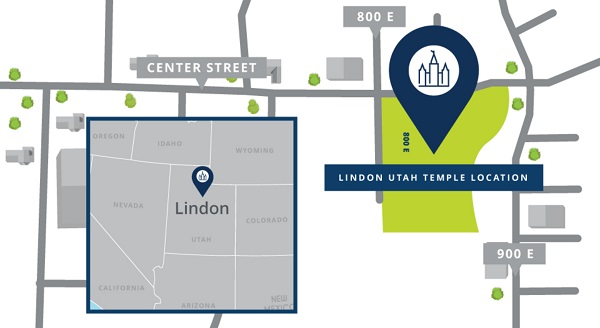 Top and Bottom: Site of the future Lindon Utah Temple. Courtesy of Intellectual Reserve, Inc.
President Michael Lloyd of the Lindon Central Stake was surprised at the announcement because there were several other temples only a short drive away. Still, he noted that the temples in neighboring Utah Valley communities were “filled to capacity once the doors open each morning—and there are always lines of youth.” He felt certain that “news of a future temple offers Lindon residents a sacred opportunity to better themselves and prepare to serve.”[51]
On December 21, 2020, the Church announced that a three-story temple with about eighty-one thousand square feet of floor area would be located at a site near 800 East and Center Streets.[52] This was in a residential area next to a junior high school and just below the Murdock Canal. The rendering released the following June showed a temple with two spires, much like the Layton Utah Temple.[53] The heart-shaped leaf of the linden tree would be a motif throughout the structure.
Church leaders broke ground on Saturday, April 23, 2022. Elder Kevin W. Pearson, a General Authority Seventy and President of the Utah Area, addressed the group meeting in a nearby chapel: “With the dedication of the temple site . . . may each of us rededicate our own lives and recommit ourselves to placing the Lord Jesus Christ and our sacred covenants at the very center of our lives.” He referred to prophecies of temples covering the world and asked: “Why do we need to dot the earth with temples? The answer seems to be clear; the Lord has been hastening His work for some time now” (see Doctrine and Covenants 88:73), and he insisted that temples have “always been the greatest work on the earth.” Following the gathering inside, especially invited guests walked up the hill to the site for the traditional turning of soil with gold-colored shovels. Rain had threatened, but fortunately held off. Kelly Ashburn, a high school senior invited to represent the youth, reflected that when she makes an appointment to perform temple ordinances in the Mount Timpanogos Utah Temple, she feels “as if she is making a doctor’s appointment, and the Lord is the Master Physician.” Eduardo Silva, an elders quorum president who grew up in Rio de Janeiro, Brazil, recalled how he and other Church members there have sacrificed to make the fourteen-hour trip to the temple in São Paulo. Both were grateful that a temple would soon be more readily accessible in Lindon.[54]
 Groundbreaking for the Lindon Utah Temple. Courtesy of Intellectual Reserve, Inc.
Another Temple in Cache Valley
 Rendering of the Smithfield Utah Temple. Courtesy of Intellectual Reserve, Inc.
On Easter Sunday, April 4, 2021, in the afternoon session of general conference, President Nelson made a historic announcement—twenty new temples would be built around the world! One of these would be in Smithfield, Utah, the second-largest city in Cache Valley, just a few miles south of the Idaho border and eight miles north of Logan. Church leaders had already disclosed plans to renovate all four pioneer Utah temples, although no specific date had been announced for beginning work on the Logan Temple. Still, whenever that closure came, the Saints in Cache Valley would be grateful to have a functioning temple in nearby Smithfield. Two months later, Church leaders specified that the temple would be built on a 13.3-acre site on the northeast corner of 100 North and 800 West streets in Smithfield.[55] A rendering was released in November. It would be another three-story structure with a dome-topped tower and an area of eighty-one thousand square feet.[56]
 Lesa Stevenson, Gary E. Stevenson, Quentin L. Cook, and Mary Cook at the Smithfield Utah Temple groundbreaking. Courtesy of Intellectual Reserve, Inc.
Groundbreaking was on a windy Saturday morning, June 18, 2022. Two members of the Quorum of the Twelve Apostles participated—a highly unusual circumstance. Elders Quentin L. Cook and Gary E. Stevenson were natives of Cache Valley and had graduated from nearby Utah State University. Both expressed appreciation for the beauty of Cache Valley, for the pioneers who sacrificed to lay foundations of faith in the valley, and for the strength of the present Latter-day Saints in the area. In his prayer dedicating the site, Elder Cook prayed that the new temple might be “a beacon of light to the communities it serves.” Six hundred invited guests gathered at the site, while thousands of others watched by television in stake centers around the valley.[57]
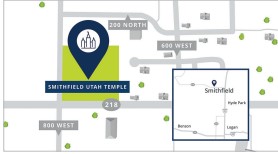 Location of the Smithfield Utah Temple, which will serve patrons of the Logan Temple, which will serve patrons of the Logan Temple when that temple closes for construction. Courtesy of Intellectual Reserve, Inc.
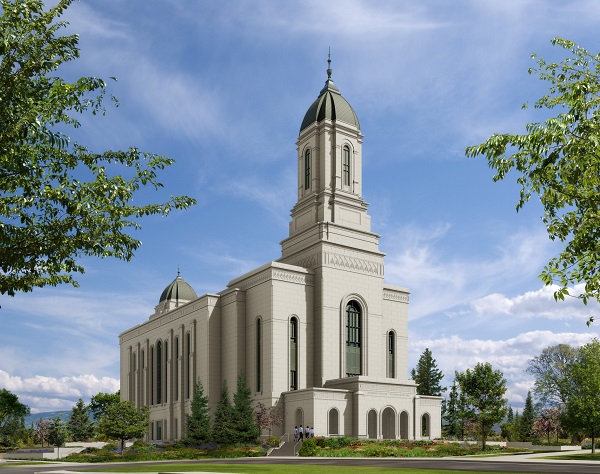 Rendering of the Heber Valley Utah Temple. Courtesy of Intellectual Reserve, Inc.
Temples at Both Ends of Provo Canyon
In the closing moments of the October 2021 general conference, President Nelson announced plans to build thirteen new temples in locations in Asia, Africa, Latin America, and Utah. The latter would be in the Heber Valley at the upper end of Provo Canyon, and then came the surprising announcement that there would be a “reconstruction” of the Provo Utah Temple, located not far from the mouth of this same canyon.[58]
A Temple in Heber Valley
Utah’s population growth was especially evident as more people established their homes along the “Wasatch Back.” Many were employed locally, but a large number commuted every day through the mountains to their jobs. The Heber Valley is connected by Provo Canyon with the Utah Valley, while the Park City resort area, just a few miles to the north, is connected with the Salt Lake Valley by Interstate 80 through Parley’s Canyon. The mushrooming number of Church members in Heber Valley was part of the Provo temple district, and many workers and patrons in that temple came from this area. For them the twenty-five-mile drive through Provo Canyon was often treacherous during the winter. Valley residents therefore received the news of a new temple with excitement. “My heart exploded with so much happiness,” exclaimed Taunya Olsen of Heber City. “My daughter Ellie jumped off the couch saying ‘No way!’—and my phone started blowing up with excitement from friends and family. I’m literally in tears knowing the spirit of the temple of the Lord’s house will be nestled in our valley. It’s like a blanket of hope and peace and love and joy.”[59]
In September 2022 the First Presidency announced that the temple would be built on a 17.9-acre site in a residential neighborhood on Center Street about a mile east of Heber City’s Main Street. The accompanying rendering was of a three-story temple with a floor area of about eighty-eight thousand square feet.[60] Like at least one other new Utah temple, it would have two baptistries. Groundbreaking was on a beautiful Saturday morning, October 8. As had been the case six weeks earlier in Ephraim, President Nelson surprised the group by presiding.[61]
Reconstruction of the Provo Utah Temple
President Nelson’s announcement that the Provo Utah Temple would be reconstructed caught almost everyone by surprise. He indicated the change would take place “after the Orem Utah Temple is dedicated,”[62] about two years later. Ever since the similar temple in Ogden had been rebuilt during the previous decade, many people wondered if the same would be done in Provo. They now questioned the meaning of “reconstruction” and speculated about the future of the building in Utah Valley. Would the Provo Utah Temple be completely rebuilt as had been done in Ogden? Or would there only be needed upgrades to the temple’s interior while the distinctive exterior was left the same? Or would the exterior be made to look more like traditional temples while leaving the efficient interior relatively untouched? Many believed that recent improvements in the temple seemed to suggest that it was here to stay.
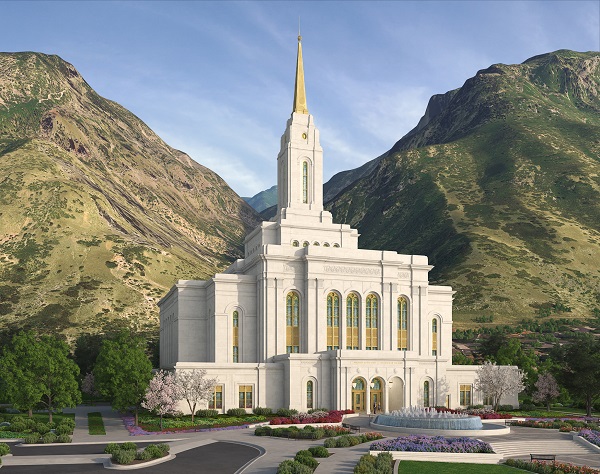 Rendering of the new Provo Utah Temple. Courtesy of Intellectual Reserve, Inc.
This speculation was swirling on November 24 when the First Presidency released a rendering for the temple’s new appearance, just a month and a half after President Nelson’s unexpected announcement. The Church News referred to the rebuilding of the Ogden Utah Temple and added, “Soon, the Provo Utah Temple will go through a similar redesign and reconstruction process, resulting in a very different appearance from its present exterior.”[63] There would continue to be six endowment presentation rooms, now slightly larger than those in the original temple. Like the renovated Salt Lake Temple, it reportedly would have two baptistries. Following the policy made in April 2020 to not place an angel Moroni on temples, the rendering of the new Provo Utah Temple showed that the building will return with a beautiful golden spire and without the angel.
“The Provo Temple has been a place of light and joy to so many,” observed Provo’s mayor Michelle Kaufusi. “The new temple will be bigger and even more beautiful. I have met with representatives of the Church and am eager to help them any way I can,” she added. “This new temple will become one of Provo’s finest gems, set against one of the most stunning backgrounds in the world, the peaks of Rock Canyon.”[64]
In addition to these temples in Utah, there were plans for two others just outside of the Beehive State. The Grand Junction Colorado Temple, announced in 2021, was just over twenty-five miles from the Utah state line. The Montpelier Idaho Temple, announced in 2022, was even closer to the boundary, less than fifteen miles. Both temples would serve Latter-day Saints in Utah.
Thus, as the twenty-first century approached its first-quarter mark, Utah’s map was increasingly filled in by a wave of new temples in the tops of the mountains.
Some Reflections
By the end of the nineteenth century, four temples were prominent landmarks of the Lord, all in Utah. One hundred years later at the turn of the millennium, the number of temples in the Beehive State increased to eleven. Within the next two decades that number has grown to twenty-eight and will continue forward. Many more temples will fill the communities of Utah as the work progresses and the hearts of the children continue to turn to their fathers and mothers. “With the dedication of each new temple,” affirmed President Nelson, “additional godly power comes into the world to strengthen us and counteract the intensifying efforts of the adversary.”[65]
As this book nears publication, the total number of temples in various phases of announcement to completion is at three hundred worldwide. As Brigham Young stepped onto the desert floor of Salt Lake Valley on July 26, 1847, he stuck his cane into the sand and announced the spot where the Salt Lake Temple would be built. Only a prophet could have foreseen what was to come in the Lord’s work. President Young later shared the grander vision of temples when he stated, “To accomplish this work there will have to be not only one temple but thousands of them, and thousands and tens of thousands of men and women will go into those temples and officiate for people who have lived as far back as the Lord shall reveal.”[66] Now that the Church is almost one-third of the way to a thousand temples, that milestone seems possible.
But what is even more important is the impact that the covenant blessings of the gospel is making on God’s children throughout the world and strengthening their relationship with Jesus Christ. For most of the first hundred years of the restoration, Latter-day Saints who wanted the blessings of the gospel needed to do as Isaiah prophesied and go to “the top of the mountains . . . to the mountain of the Lord” in Utah. There they would receive the ordinances of exaltation (Isaiah 2:2–3). That great physical gathering of pioneers is now a chapter in western United States history.
What is just as amazing to see in the twenty-first century is the spiritual gathering in many far and near lands where temples are the crowning blessing as stakes are strengthened and can support the work of a temple. So far in the history of the Church, much work for the living and the dead has occurred in Utah, and this history has shared some of the stories of these temples. Many other books have been written about temple work among the Latter-day Saints. Theologically, the main purpose of temples continues to be for God’s children to make and keep sacred covenants that will allow them to ultimately return to their heavenly parents through the merits and mercy of Christ’s Atonement. This great work in temples is also fulfilling the vision of John the Revelator that the Saints will need to be “sealed in their foreheads” preparatory to the Second Coming of Jesus Christ and the inauguration of His millennial reign (Revelation 7:1–4). President Brigham Young stated,
We are trying to save the living and the dead. The living can have their choice, the dead have not. Millions of them died without the Gospel, without the Priesthood, and without the opportunities that we enjoy. We shall go forth in the name of Israel’s God and attend to the ordinances for them. And through the Millennium, the thousand years that the people will love and serve God, we will build temples and officiate therein for those who have slept for hundreds and thousands of years—those who would have received the truth if they had had the opportunity; and we will bring them up, and form the chain entire, back to Adam.[67]
Notes
[1] “I Pledge My Life and . . . Full Measure of My Soul,” Church News, June 11, 1994, 14.
[2] Russell M. Nelson, “Becoming Exemplary Latter-day Saints,” Ensign, November 2018, 114.
[3] Saratoga Springs Utah Temple groundbreaking history (unpublished manuscript, 2020), 3, Church History Library.
[4] Sydney Walker, “Ground Broken for the Saratoga Springs Temple,” Church News, October 27, 2019, 24–25.
[5] Valerie Johnson, “Construction to Begin on Utah Temple,” Church News, September 15, 2019, 2; Genelle Pugmire, “What You Need to Know about the Saratoga Springs Temple,” Daily Herald (Provo, UT), October 18, 2019, 4.
[6] Saratoga Springs Utah Temple groundbreaking history, 54.
[7] Walker, “Ground Broken,” 24–25; Ashley Stilson, “Digging In,” Daily Herald, October 20, 2019, 1.
[8] Genelle Pugmire, “A Long-Expected Party,” Daily Herald, November 25, 2022, 1.
[9] Sarah Jane Weaver, “Layton Temple Location,” Church News, July 21, 2019, 2.
[10] Andrew Jenson, Encyclopedic History of the Church of Jesus Christ of Latter-day Saints (Salt Lake City: Deseret News, 1941), 419–20.
[11] “Church Announces Groundbreaking for Three Temples,” Church News, February 9, 2020, 2.
[12] Scott Taylor, “A Small-Scale Groundbreaking,” Church News, May 31, 2020, 17.
[13] Danielle Christensen, “Washington County Temple Location Announced,” Church News, November 10, 2019, 2.
[14] Christensen, “Washington County Temple Location,” 2.
[15] Walker, “Renderings Released for Three Temples,” Church News, April 19, 2020, 2.
[16] Taylor, “Groundbreaking Makes Hollands Feel at Home,” Church News, November 15, 2020, 4.
[17] Taylor, “Groundbreaking Makes Hollands Feel at Home,” 3–4.
[18] John W. Van Cott, Utah Place Names (Salt Lake City: University of Utah Press, 1990), 372.
[19] Walker, “Location Announced for Tooele Valley Temple,” Church News, Septermber 29, 2019, 2.
[20] Walker, “Renderings Released for Three Temples, Church News, April 19, 2020, 2; “Announcement Made Regarding 4 Temples,” Church News, May 3, 2020, 2.
[21] See the discussion at the end of chapter 6 on the history of the angel Moroni atop Latter-day Saint temples.
[22] Walker, “Location Announced,” 2.
[23] Taylor, “New Name, Location for the Deseret Peak Utah Temple,” Church News, January 23, 2021, 10.
[24] Tad Walsh, “‘This Is Where We Build the Temple’: How President Nelson Selected the Deseret Peak Temple Site,” Churchbeat, Deseret News, May 27, 2021.
[25] Taylor, “New Name, Location or the Deseret Peak Utah Temple,” Church News, January 23, 2021.
[26] Taylor, “Honoring Faithful, Unified Members in Tooele Valley,” Church News, May 22, 2021, 8–9.
[27] Taylor, “How a Hasty Exit from a Temple Groundbreaking Is Emblematic of Faithful Service,” Church News, May 22, 2021, 24.
[28] Nelson, “Spiritual Treasures,” Ensign, November 2019, 76–79.
[29] Pugmire, “LDS Church Announces Site for Orem Temple,” Daily Herald, December 12, 2019, 1.
[30] Pugmire, “Orem City Council Approves Temple Zone Change,” Daily Herald, April 16, 2020, 1.
[31] Taylor, “Three Temple Sites Announced,” Church News, December 15, 2019, 2; Pugmire, “LDS Church Announces Site,” 1.
[32] Pugmire, “Planning Commission Approves Change,” Daily Herald, April 16, 2020, 1; Pugmire, “Orem City Council.”
[33] Pugmire, “Temple Groundbreaking Date Set,” Daily Herald, June 25, 2020, 1; Taylor, “Renderings of Two New Temples Released,” Church News, June 28, 2020, 2.
[34] Taylor, “Temple Groundbreaking in Orem Links Past, Future,” Church News, September 13, 2020, 6–7.
[35] Taylor, “Temple Groundbreaking,” 6–7.
[36] Rachel Sterver and Walker, “Groundbreakings Set for Two Utah Temples,” Church News, August 23, 2020, 6.
[37] Taylor, “Three Temple Sites,” 2.
[38] Jason Swensen, “Taylorsville Utah Temple Already Connecting People,” Church News, November 8, 2020, 14–15.
[39] Nelson, pre-recorded announcement, May 1, 2021, copy in authors’ possession.
[40] Lindsey Williams, “Rejoicing ‘on Both Sides of the Veil’: 12 Highlights from the Ephraim Temple Announcement and Revision to Manti Renovation Plans,” May 1, 2021, https://
[41] Williams, “Rejoicing.”
[42] “Ephraim Temple Site Announced,” Church News, October 30, 2021, 2.
[43] “President Nelson Presides at Ephraim Utah Temple Groundbreaking, Church Newsroom, August 27, 2022.
[44] Weaver, “Pres. Nelson a Surprise Guest at Ephraim Groundbreaking,” Church News, September 3, 2022, 3–4.
[45] Taylor, “. . . Syracuse Utah Site Announced,” Church News, September 6, 2020, 10.
[46] “See the Just-Released Exterior Rendering of the Syracuse Utah Temple,” Church News, February 27, 2021, 2.
[47] Scott Taylor, “How Connections Became a Theme at Groundbreaking,” Church News, June 19, 2021, 20.
[48] Scott Taylor, “How Connections Became a Theme,” 20.
[49] Scott Taylor, “How Connections Became a Theme,” 20–21.
[50] Pugmire, “Mayor Has High Hopes for Temple,” Daily Herald, October 6, 2020, 1.
[51] Swensen and Taylor, “What Latter-day Saints Are Saying About New Temples,” Church News, October 11, 2020, 14.
[52] Taylor, “Site for Lindon Utah Temple Announced,” Church News, December 27, 2020, 26.
[53] “Milestones for Temples in 4 Western States,” Church News, June 19, 2021, 22.
[54] Mary Richards, “Ground Broken for Lindon Utah Temple,” Church News, April 30, 2022, 19.
[55] “Milestones for Temples,” 22.
[56] “Smithfield Utah Temple Exterior Rendering Released,” Church News, November 27, 2021, 8.
[57] Sarah Jane Weaver, “Two Apostles Recall Roots, Break Ground for Smithfield Temple,” Church News, June 25, 2022, 3–4.
[58] Russell M. Nelson, “Make Time for the Lord,” Liahona, November 2021, 120–21.
[59] Jason Swensen and Scott Taylor, “From Liberia to Bolivia—Reactions to 13 New Temples,” Church News, October 9, 2021, 9.
[60] “Temple Milestones in Puerto Rico, Utah, and Idaho,” Church News, September 24, 2022, 2.
[61] Jon Ryan Jensen, “President Nelson Says ‘More Will Come’ for Heber Valley,” Church News, October 15, 2022, 3–4.
[62] Russell M. Nelson, “Make Time for the Lord,” Liahona, November 2021, 121.
[63] Scott Taylor, “Provo Utah Temple Will Undergo Major Redesign,” Church News, November 27, 2021, 7–8.
[64] Genelle Pugmire, “New Look Incoming,” Daily Herald, November 26, 2021, 1, 5.
[65] Russell M. Nelson, “What Is True,” general conference address, October 2022.
[66] John A. Widtsoe, ed., Discourses of Brigham Young (Salt Lake City: Deseret Book, 1941), 394.
[67] Widtsoe, Discourses of Brigham Young, 404.
