
 menu icon in the top, right corner of the screen.
 icon above to close this box.
 icon at the bottom of the screen below the browser—if you don't see it, swipe up to unhide it.
A New Style of Temple
The Brigham City Utah, Cedar City Utah, Remodeled Ogden Utah, Payson Utah, and Remodeled Jordan River Utah Temples
Richard O. Cowan and Clinton D. Christensen, "A New Style of Temple," in Temples in the Tops of the Mountains: Sacred Houses of the Lord in Utah (Provo, UT: Religious Studies Center, Brigham Young University; Salt Lake City: Deseret Book), 240–83.
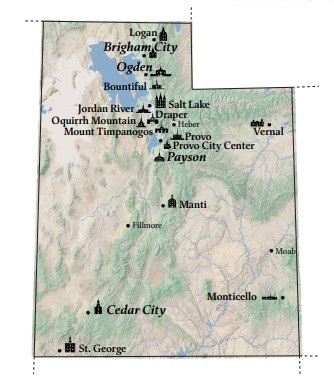 Utah temples with dedication dates from 1877 to 2017. Courtesy of Lee Cowan.
The second decade of the twenty-first century brought four significant temple construction projects to Utah. Two at opposite ends of the state—Brigham City and Cedar City—involved new temples that consciously reflected pioneer architecture. Another—in Ogden—was the unprecedented rebuilding of an existing temple. Then the large temple in Payson used a bold new design. The chapter ends with the renovation of the Jordan River Temple and the end of an era for one traditional dedication event.
The Brigham City Temple
Fifty miles north of Salt Lake City in Box Elder County lies the town of Brigham City, Utah. Latter-day Saint settlement began in 1851 and then expanded in 1853 when Brigham Young directed apostle Lorenzo Snow to move to Box Elder and select fifty families to go with him.[1] As Brigham City developed, the Saints decided to build a tabernacle in the downtown area near Forest Street. Excavations began in 1865. However, on May 4, President Brigham Young visited the site and stated they were building in the wrong place, saying, “This is a commercial center, it is not the spot for your tabernacle.”[2] Walking the workers two blocks south to Sagebrush Square, just outside the platted city, he pointed to the highest spot along Main Street and directed the tabernacle to be built there. Five days later, on May 9, 1865, Brigham Young helped lay the cornerstones for the tabernacle.[3] Work stopped and started over the years. Box Elder Tabernacle was finally dedicated on October 26, 1890, becoming the focal point of the religious community and a prominent building in Box Elder County.
A Century of Learning
Just west of the tabernacle on Second South and Main Street lay a three-acre parcel of land that served as the site for a house of learning until it later became the spot for a house of the Lord. In 1901 the three-story Central School was opened. One child attending elementary school there remembered walking up the dirt path in the 1930s to attend. His name was Boyd K. Packer, a resident of Brigham City and a future Latter-day Saint Apostle. The first school building burned to the ground on August 9, 1947, and then was rebuilt in 1950. The second elementary school served the Brigham City community for the rest of the century, then closed in May 2000.[4]
The building was razed. The land sat vacant. Jeff Packer, a real estate agent and nephew of Boyd K. Packer, tried to negotiate with various buyers, but to no avail. At one point he talked with the Church Real Estate Department about acquiring the land for extra parking for the Box Elder Tabernacle. During the discussions, Jeff mentioned the idea of building a temple there. The Church employee said, “Please don’t use the T word,” and expressed there would never be a temple in Brigham City. It was too close to Ogden and Logan. Yet in 2009, an unknown party became interested in the land. Jeff Packer later learned it was the Special Projects Division, and the Church bought the land.[5]
Announcement
In October 2009 President Thomas S. Monson announced five new temples, including one in Brigham City. Jeff Packer, who attended the general conference and was a member of the Box Elder Utah Stake presidency, went and visited his uncle between conference sessions. At that time Boyd K. Packer was President of the Quorum of the Twelve Apostles. Jeff told his uncle that stake members were texting and emailing him about possible sites for a temple. They were guessing the temple would be built across from the tabernacle. President Packer smiled and replied, “Well, let them speculate.”[6]
Just weeks later, on Tuesday, October 27, President Monson called President Packer about visiting possible temple sites. The prophet said, “I’d like you to come with me. We’re leaving in thirty minutes.” They were joined by President Dieter F. Uchtdorf, second counselor in the First Presidency, and Elder William R. Walker of the Seventy, executive director of the Temple Department. When the foursome arrived at the block west of the Box Elder Tabernacle, President Monson asked Elder Walker where the Brigham City Temple could be situated. He said it would look east, directly facing the tabernacle. Then President Monson asked President Packer’s thoughts about this site. He replied, “I think this is the perfect place for the temple.” President Monson then responded, “That’s good enough for me,” and raised his arm to the square.[7]
This moment captured an unusual beginning to how the Brigham City temple would develop. The First Presidency personally oversees the Temple Executive Committee and temple projects. However, President Monson asked President Packer to direct the design and many aspects of the Brigham City temple even though he was not a member of the committee. Elder Walker was asked why he believed President Monson gave such an honor and responsibility to President Packer. Elder Walker suggested it was because of the love between these two leaders and President Packer’s home ties to Brigham City. He also added that with President Packer serving as President of the Quorum of the Twelve, it was also good training—in case President Packer outlived President Monson.
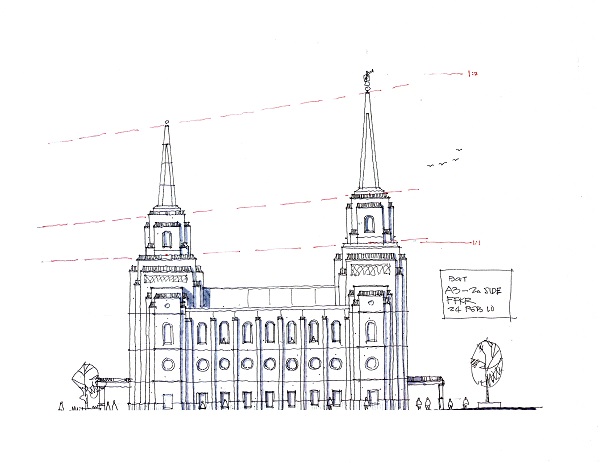 Brigham City Utah Temple design. Courtesy of David Hall.
A Historic and New Temple Design
With President Monson’s assignment, preparations were made for the first group meeting between President Packer, Bishop Keith B. McMullin of the Presiding Bishopric, and David Hall, director of Temple Design Services. Brother Hall was requested to bring photographs of historic temples, including St. George, Manti, Logan, Salt Lake, and Vernal. Additionally, Hall received a prompting to include a rendering of the new Kansas City Missouri Temple with his packet of materials and placed the photo at the bottom of the pile.
David Hall and Bishop McMullin joined Elder Walker for the meeting in President Packer’s office on November 10, 2009. At one point in the discussion, Brother Hall asked permission to show President Packer a drawing of the Kansas City Temple even though it was not a nineteenth-century temple. Seeing the Kansas City rendering changed the course of the conversation. David Hall had asked himself some hypothetical questions about the Kansas City Temple. How would a Missouri temple have looked if the early Saints had been able to stay in the state instead of fleeing west? If the Saints had returned to reclaim Missouri at the end of the nineteenth century as they had hoped, how might a Missouri temple look as a sister to Logan or Manti?[8]

 Details in the Brigham City Utah Temple. Left: Instruction room with landscape murals featuring animals and birds. Above: Peach blossom motif in round windows. Courtesy of Intellectual Reserve, Inc.
Kansas City reimagined the pioneer temples of Logan and Manti into a neoclassical, two-tower temple for the twenty-first century. Brother Hall later added that architecturally, our Church is the only religious tradition that includes two separated towers, with one on the east and one on the west. Comparatively, Catholic cathedrals have two towers that are usually together on one side of the building. Because of Brigham Young’s inspiration for the Salt Lake Temple, Latter-day Saints believe the east and west towers in Latter-day Saint architecture symbolize the Melchizedek and Aaronic Priesthoods. This unique two-tower design was adopted for Brigham City. Similarly in the 2010s, it was employed for two historically significant temples amid strong architectural traditions. The two-tower style was used in Rome, the heart of early Christianity in Europe, and in Philadelphia, the birthplace of the United States Declaration of Independence.
Other pioneer temples and designs also influenced Brigham City. Hall recalled that “the historic precedence of patterns such as Salt Lake’s windows and Manti’s curved towers brought Brigham City closer to its nineteenth century predecessors than even Kansas City.” At the conclusion of the design process, President Packer commented on the stylistic similarity between Brigham City and Salt Lake: “It is like a child to his father.”[9]
President Packer suggested interior design connections to the Box Elder Tabernacle, a peach blossom motif in round windows, an instruction room with murals that have animals and birds in the landscape, a mural of “the Presidency,” mountain peaks above Willard, and an interior of white-painted wood like the Manti and Salt Lake Temples. President Packer also contributed some of his own artwork of birds.
 Linda Curley Christensen and Michael Malm painting Work to Do, Ere the Sun Goes Down on screen during the temple cultural celebration. Courtesy of Clinton D. Christensen.
Building the Temple
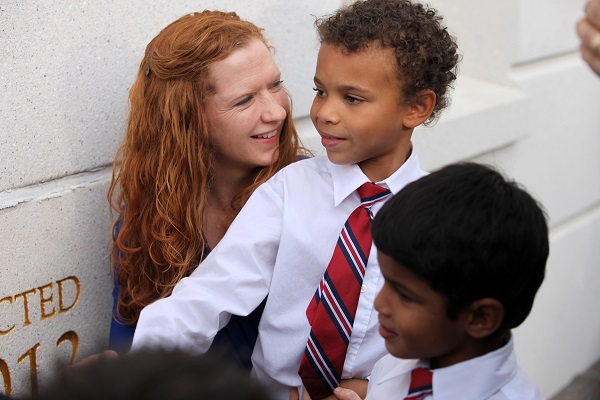 The Christensen family participates in the cornerstone ceremony. Courtesy of Clinton D. Christensen.
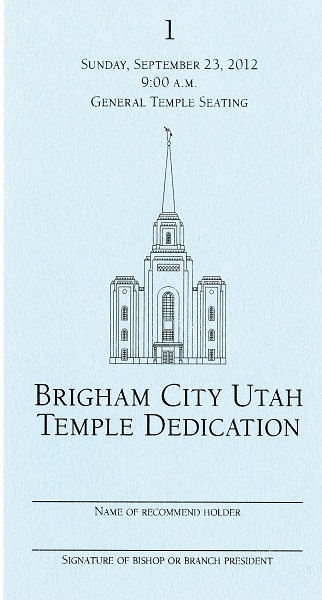 Ticket to the Brigham City Utah Temple dedication. Courtesy of the Temple Department.
Groundbreaking for the temple was held on July 31, 2010. The temple rendering was unveiled for the community displaying a three-story, thirty-six-thousand-square-foot temple. The basement would house the baptistry, mechanical rooms, administration offices, and marriage guest waiting room on the main floor, the dressing rooms and a chapel on the second floor, and two progressive endowment rooms leading to a celestial room and three sealing rooms on the third floor.
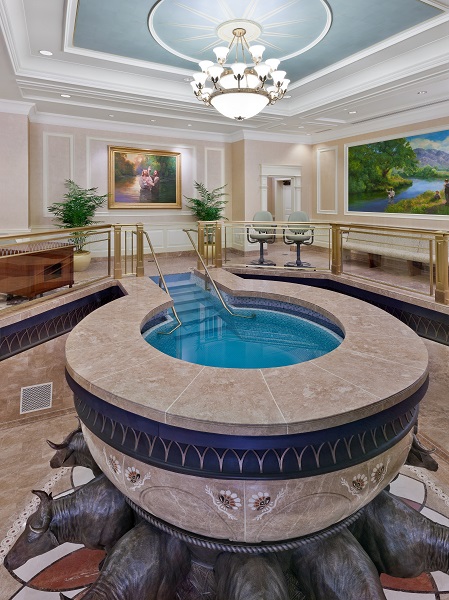 The baptismal font in the Brigham City Utah Temple includes twelve unique bronze oxen. Courtesy of Intellectual Reserve, Inc.
President Packer presided at the groundbreaking and was joined by Elder Russell M. Nelson of the Twelve, who had ties to nearby Perry, Utah, where his first wife, Dantzel, was raised. President Packer began his remarks, “I am home. I can see in my mind’s eye a temple sitting here in about two years’ time. It will be gorgeous; it will be white. You will see in the design of it reflections of previous temples that have been built, particularly the Salt Lake Temple. It will be a beacon from all over the valley.”[10]
Construction proceeded very quickly in a two-year time frame. The interior colors were a desert sage green and blue, tile was from China and Turkey, and a custom-made baptismal font included twelve unique bronze oxen. When President Packer was asked if the oxen should be the same or different, he referenced the twelve sons of Israel and replied, “Asher and Dan were not twins.”[11]
 Grand hallway, Brigham City Utah Temple. The temple interior features white-painted wood like the Manti and Salt Lake Temples. Courtesy of Intellectual Reserve, Inc.
The baptistry also contained a confirmation painting created by Linda Curley Christensen and Michael Malm entitled Work to Do, Ere the Sun Goes Down.[12] The painting shows a Shoshone man being confirmed by missionary George Washington Hill and is based on an event on May 5, 1873, when 101 members of the Shoshone band were baptized in the Bear River north of Brigham City and confirmed until sundown. The painting also includes a half circle of witnesses of the confirmation. All are dressed in different tribal clothing. They symbolize the nearly twelve hundred men, women, and children from nine different tribes that joined the Church throughout Utah, Wyoming, and Idaho between 1873 and 1877.[13] The painting pays tribute to the great contributions of the indigenous peoples of the Americas who were living throughout the West when the Latter-day Saints arrived in the valley. This confirmation painting has been used elsewhere and can be found in the Cedar City Utah Temple, Provo Utah Temple, and Star Valley Wyoming Temple.
 The brides' room in the Brigham City Utah Temple displays the temple's interior colors: desert sage green and blue. Courtesy of Intellectual Reserve, Inc.
A Trio of Apostles at the Dedication
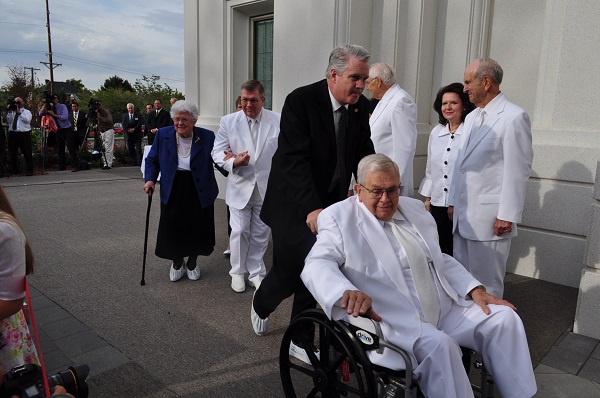 After completing the cornerstone ceremony, President Boyd K. Packer waves toward children (not shown). Courtesy of Clinton D. Christensen.
As the temple reached completion, President Monson deferred from having the First Presidency attend the dedication so that President Packer could return to his hometown and preside. At the time, it was a rare exception for a member of the Quorum of the Twelve to be assigned to dedicate a temple. Early in Church history, Elder Orson Hyde of the Twelve had dedicated the Nauvoo Temple. In 1999, two Canadian temples were dedicated on the same day, November 14. President Packer, as Acting President of the Twelve, was assigned to go to Regina at the same time President Hinckley was in Halifax. President Packer dedicated the Brigham City Utah Temple on September 23, 2012, and was joined by fellow Apostles L. Tom Perry and Russell M. Nelson. In the future this new style of sharing the responsibility with members of the Quorum of the Twelve to dedicate temples would become standard when President Nelson became Church President.
President Packer was eighty-eight when he dedicated the temple and would live almost three more years. He was a living link to early settlers of the Brigham City area. As if to bind together the Saints of today with the pioneers of the past, President Packer exclaimed in the dedicatory prayer, “We honor the memory of those who came to this valley as pioneers and have raised their families to honor the order of the principles and ordinances of the gospel. . . . We sense the presence today of Presidents Brigham Young and Lorenzo Snow and Elder Rudger Clawson, each of whom would be very interested in the dedication of this temple.”[14]
 Brigham City Utah Temple. Spring, by Alan Fullmer.
The Cedar City Temple
 Cedar City Utah Temple. Courtesy of Intellectual Reserve, Inc.
The Cedar City area was first settled by Latter-day Saint pioneers in 1851. In addition to being an agricultural outpost and way station for travelers along the Mormon Trail to Southern California, this Iron Mission sought to develop the mineral resources of the area. The Parowan Stake was organized the following year with Cedar City as one of its wards. In 1923 a rail branch opened to Cedar City, which became a major travel destination as the jumping-off point for tours to southern Utah’s national parks and the North Rim of the Grand Canyon in Arizona. Since 1962 the annual Shakespeare Festival has also made Cedar City a cultural center. In recent decades, the area’s economy has broadened to include manufacturing. This brought growth, and Cedar City became a separate stake which has been divided and redivided. Population grew from fewer than ten thousand in 1970 to more than 30,000 in the second decade of the twenty-first century. Faithful Latter-day Saints in the area understandably looked forward to the time when they might have a temple of their own.
Cedar City is also an educational center. The Branch Normal School, established in 1897, grew over the years, becoming a state college and finally Southern Utah University in 1991. A student stake was organized in 1966, and during the 1990s two more were formed. On December 28, 2009, Elder Daniel M. Jones, the Area Seventy assigned to the Cedar City region (and future temple president), told the leaders of the student stakes that he believed the explosion in the number of SUU students was the factor “that tipped the scales” because it “added a very compelling component” to their petition for a temple to serve thousands of students in the area. Elder Yoshihiko Kikuchi of the Seventy, who was serving with the Temple Department, affirmed that the planning for new temples “often starts with the stirrings of the Spirit among the local leaders.” The other stake presidents in the area were excited when they heard of this conversation, so they drafted a formal request for a temple.[15]
Securing the Site
 Stained glass portrayal of the Savior in the Cedar City Utah Temple. This is one of two stained glass windows in the temple that came from the Astoria Presbyterian Church in Queens, New York, which had been razed a few years earlier. Courtesy of Intellectual Reserve, Inc.
Several steps were necessary before the eventual site for the temple would be ready. For years, the city had planned for Cove Drive to be a major thoroughfare for its western suburbs, connecting Second North with the south interchange accessing the I-15 freeway. However, property for the last key half-mile segment down the hill at the north end was not for sale. A grant from Iron County in 2010 and a swap of state for federal money made funding for the needed canyon route available the following year. The owner could see how the new road would enhance the value of his property and was finally willing to sell the right-of-way. Maureen Einfeldt, who lived in the area, later recalled: “We began to have backhoes come into our neighborhood, which was a dead end at the time. In no time, there was a new, beautiful road leading to the top of the hill. I had the thought that perhaps it was clearing the way for a new temple,” but time passed and nothing was said.[16]
Just three months after the road was completed, three people appeared at the city offices identifying themselves as “developers looking to do their due diligence on several properties they hoped to develop.” About five months later, near the end of August 2012, one of them returned, stated that he was an architect with The Church of Jesus Christ of Latter-day Saints, and asked for a closed-door meeting with city officials. He disclosed that the Church “had chosen a potential site for a possible temple in Cedar City” which had the three needed qualities of being in “a nice area,” and having good visibility and easy access. The Church bought the temple site in November. Plans for a temple in Cedar City were announced at the Church’s general conference in April 2013.[17]
Planning the new temple occupied the next year and a half. As had been the case at Brigham City, this 39,802-square-foot building was intended to be “a tribute to the region’s rich pioneer heritage.” Designed by Architectural Nexus, it incorporated features of the St. George and Manti Temples as well as of other historic buildings in St. George, Beaver, and Fillmore. [18]
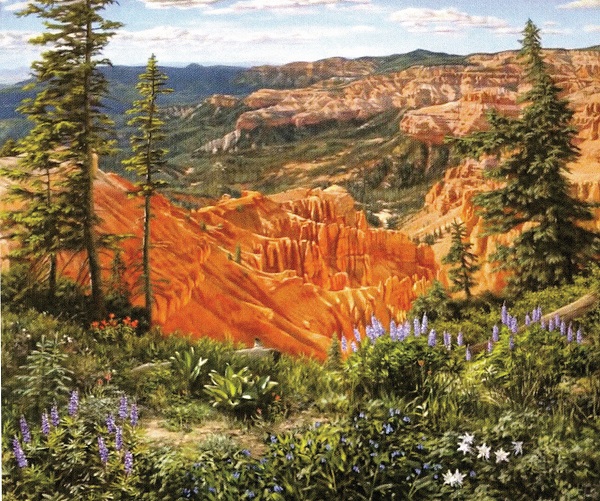 Mural in the endowment room of the Cedar City Utah Temple historical subcommitee.
Construction
The temple district included about forty-five thousand members in seventeen stakes, from Ely, Nevada, on the northwest to Boulder and Escalante in south-central Utah on the east. Each stake had a particular assignment. For example, the Cedar City Stake set up 1,625 folding chairs at the site for the groundbreaking ceremony on Saturday, August 8, 2015. A blowing rain Thursday evening and Friday morning resulted in the chairs being caked with mud. Early Saturday morning, however, dozens of volunteers had them clean and dry for the event.
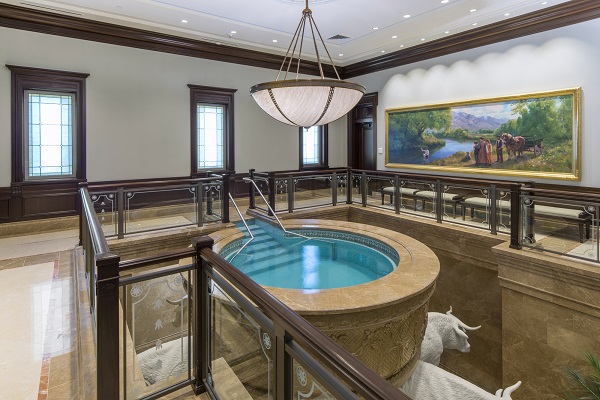 Baptistry in the Cedar City Utah Temple. Courtesy of Intellectual Reserve, Inc.
Two General Authorities participated. Elder L. Whitney Clayton of the Presidency of the Seventy presided over the hour-and-a-half ceremony; Elder Kent F. Richards, executive director of the temple department, conducted. Elder Dane Leavitt, the local Area Seventy, planned the event. Elder Clayton recalled the Apostle Paul’s teachings to the Corinthian Saints that “ye are the temple of God” (1 Corinthians 3:16) and then added, “God intends not to just build this [tangible] temple, but [also] to make us temples.” He challenged the Saints to invigorate their family history work so that the new temple can be kept busy performing ordinances for people identified entirely by those who live in this temple district. Elder Richards referred to Ezekiel’s imagery of water flowing from the temple and giving life to everything it touched (Ezekiel 47:1–12). He then taught, “Just as finding a renewable, sustainable source of water was essential to settlers of this arid region, finding a well of living water is essential to spiritual nourishment.” In his prayer dedicating the site, Elder Clayton affirmed that “by revelation this choice spot of hilltop land has been selected.” Then, in addition to the seventeen stake presidents and other leaders using the traditional gold-colored shovels to break ground, Elders Clayton and Richards used a large track hoe to symbolically begin excavating for the temple.[19]

 Top: Cedar City Utah Temple sealing room. Bottom: Celestial room. Courtesy of Intellectual Reserve, Inc. The red and blue flower in the stained glass window is the columbine flower motif, used both throughout the temple and in the stained glass.
Despite icy weather, concrete for the temple’s three levels was poured beginning in January 2016. As precast concrete panels formed the temple’s walls beginning in March, the building quickly took on a completed appearance. The figure of Moroni was hoisted to the top of the cupola on September 15. Work on the temple’s interior went forward during the winter of 2016–17. Three motifs unified decorations throughout—juniper branches and berries, columbine flowers, and clusters of feathers to honor the area’s indigenous peoples. The color scheme featured deep rusts and blues. Many paintings beautified the temple’s rooms; while most illustrated scenes from the Savior’s ministry, others depicted the red-rock scenery of southern Utah. Two particularly striking features were stained glass windows which came from the Astoria Presbyterian Church in Queens, New York, which had been razed a few years earlier. One showing the Lord in a red robe and with outstretched arms is positioned behind the recommend desk, while the other, depicting him praying in Gethsemane, adorns the temple’s west entrance.
Open House and Dedication
By the fall of 2017, the temple was ready for its open house. VIP tours for special groups began Saturday, October 21. Elder Larry Y. Wilson of the Seventy and executive director of the Temple Department personally led the tour for the press. He declared that the temple had forever changed Cedar City. “It becomes a symbol that there is a House of God—a place more holy than any other—in this community. Every time you drive by it you can’t help but be inspired by its beauty and to have your thoughts drawn toward God and His purposes for this earth and for your life.” He explained that the transition from dark brown woodwork on the lower floors to the white on the floors above “is meant to represent a very literal rising above the earth [to be] closer to heaven.” When the group entered a sealing room at the end of their tour, Elder Wilson told them how as a seven-year-old boy he was sealed to his parents in the Idaho Falls Temple: “It gave me a sense of eternal belonging.”[20]
Other VIP tours were conducted by members of stake presidencies in the temple district. In preparation for this experience, Elder Wilson spent four hours with these leaders and their wives, numbering over one hundred. As they walked through the temple, he taught with an openness most of the group thought was rare and instructed them how to approach the sacred workings within the temple in an appropriate way. Especially striking was their experience in the beautiful celestial room which most in the group were seeing for the first time. “They were filled with pure joy coupled with reverence and awe for what that room represents. The silence of such a large group . . . was powerful.”[21]
Several visitors had rather special experiences at the open house. One had grown up in Queens, New York, where she attended the Astoria Presbyterian Church as a little girl. When she heard about the open house, she made a trip to Cedar City so she could see “her stained glass windows” once again. When she saw them, “she became very emotional and began to weep” and stated, “We were very grateful that the glass had been preserved and was not lost” in the demolition of her old church building.[22]
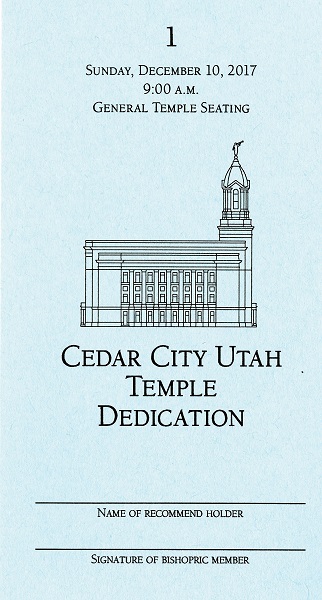 Ticket for the Cedar City Utah Temple dedication. Courtesy of the Temple Department.
A couple from the Phoenix area happened to be traveling through Utah on their vacation. At dusk as they approached Cedar City on the freeway, they saw directions to “event parking” and wondered what event this might be. They decided to check it out. After parking, they boarded a bus, noting that “everyone was so happy.” As they approached the illuminated building, the woman from Arizona asked the lady behind them, “What is this place?” She replied, “This is the temple; it is the house of the Lord.” As they entered the temple, she felt something she had felt at the Mesa Arizona Temple while attending the Easter pageant there. “What is this feeling?” she wondered. In the baptistry she learned about baptisms in behalf of those who had died without this ordinance and thought of her grandmother who had died recently. She had been afraid she might go to hell because she had never been baptized. “Could this be done for my grandma?” the traveler from Arizona pondered. When the tour reached the celestial room, she found a place where she could be alone. “As I looked around the beautiful room, thoughts I previously had in the baptistry came back to me. Then I heard a voice say to me, ‘Now you know what you need to do for me.’” She recognized her grandmother’s voice. Finally, in a sealing room, she learned that couples could be united for eternity. “As I pondered this idea, I heard the same voice say to me, ‘Do this for your grandpa and me.’” In their motel that evening, she reflected: “I could not stop thinking about what had just happened to me. I felt such peace.” The next morning, she told her husband that she wanted to go back to the temple. During the next three days she repeated the tour seven times. “Each time I heard the voice and felt the same way,” she affirmed.[23] The public open house extended from October 27 through November 18. In all, some 187,614 persons were able to visit the temple.
The youth celebration took place Saturday evening, December 9, in the events center on the Southern Utah University campus. President Henry B. Eyring, first counselor in the First Presidency, greeted the four thousand youth and encouraged them to record in their journals how they felt while they participated in this event. “That record will help you when you tell your children and your grandchildren what it meant to you to be a part of the celebration of the completion of a temple of God in Cedar City.” The production, entitled “A Light on a Hill, Iron in the Will,” depicted scenes from the history of the area. It featured two well-known hymns that were written in Cedar Valley: Joel H. Johnson wrote “High on the Mountain Top” two years after the first pioneers had arrived, and John M. Macfarlane later authored “Far, Far Away on Judea’s Plains.” As a result of participating in this event, the youth affirmed that they felt more connected with each other and with their Heavenly Father.[24]
President Eyring dedicated the temple in three sessions on Sunday, December 10, 2017. In his dedicatory prayer, he testified that “the presence of this house is an answer to the prayers of Thy people. We thank Thee for it and ask for Thy Spirit to dwell continuously within its walls. We pray that this beautiful temple will be a haven for all who enter.” He prayed that students in the area might be blessed. He also prayed that the example of faithful Saints may “lead others to seek Thine everlasting truth.” The prayer affirmed that the temple is “our gift to Thee, dear Father, given in acknowledgment of Thy great gifts to us, most notably the gift of Thy beloved Son.”
Rebuilding the Ogden Temple
The Ogden Utah Temple is located downtown, and the Church’s Ensign magazine commented, “Centrally located in downtown Ogden amid the businesses and institutions of man, the Ogden Temple effectively symbolizes the power of the gospel to reach down and out to the daily life of each of us, to bless, guide, and protect us as we walk and work and live in the real workaday world.”[25] This very location, however, also had its downside. Ogden’s downtown was old, and the temple’s immediate surroundings had become dilapidated. The Church took steps to remedy this, notwithstanding some in the community who were reticent of the Church heavily investing in revitalizing downtown Ogden. In 1999 it bought the block to the west, demolished old and often boarded-up houses, and constructed attractive apartments. As President Hinckley dedicated these new housing units, he declared that downtown Ogden would prosper again and become beautiful. The Church later bought portions of the blocks to the north and east to similarly upgrade the temple’s environment.
 Rendering of the remodeled Ogden Utah Temple. Courtesy of Intellectual Reserve, Inc.
Ogden city officials were also sponsoring efforts to beautify downtown. Other investors and developers followed the Church’s example, purchasing hundreds of acres for redevelopment projects valued at hundreds of millions of dollars. The old mall in the block to the south of the temple was demolished and replaced with new office and retail space and entertainment facilities. In the decade after President Hinckley’s prophetic statement, eight thousand new jobs were created and the value of taxable property in the area increased by one-third. This improvement was called “the Ogden miracle.” As early as 2001, Ogden officials discussed possible improvements to the temple itself with the First Presidency and Presiding Bishopric. In October 2009, Mayor Matthew R. Godfrey met with President Thomas S. Monson and his counselors to discuss this matter. An announcement came the following February.[26] The Ogden Temple would be the first temple totally reconstructed in the history of the Church by choice, compared to the Nauvoo and Apia Samoa Temples that were rebuilt due to damage by fire.
The momentous announcement came at a news conference held in the Ogden Tabernacle on Wednesday, February 17, 2010. Elder William R. Walker of the Seventy and Bishop Keith B. McMullin, second counselor in the Presiding Bishopric, disclosed that “a major remodel of the Ogden Temple” would “dramatically change its appearance.” The reshaped exterior would feature new white stone, art glass, and a more timeless design. Some compared the new building to the Bountiful and Draper Temples. The temple’s main entrance would be shifted from the west to the east side where it would face Washington Boulevard, Ogden’s principal business street. Inside, some rooms would be rearranged, “but the core building design” would “remain the same.” “Modern energy-saving equipment” would replace old mechanical, electrical, and plumbing systems. Underground parking would be added, and the entire “Ogden Temple Square” would be completely relandscaped. “This is like Christmas for a mayor to have an announcement like this,” Mayor Godfrey enthusiastically responded. He believed that nothing else attracted so many visitors and that “a more beautiful temple” would boost Ogden’s economy.[27]
Reconstruction
 The brides' room in the Ogden Utah Temple features a unique rug with desert rose and prairie grass motifs.
 Temple entry waiting area. Courtesy of Intellectual Reserve, Inc.
 The celestial room, Ogden Utah Temple. Courtesy of Intellectual Reserve, Inc.
The temple closed Saturday, April 2, 2011. As this date approached, it became increasingly crowded as Church members in the area were eager to serve in their historic and beloved temple just one more time. The final session Saturday evening was an emotional occasion for the capacity group. Everyone in the company who had come with a partner participated in the prayer circle, which “completely encircled the entire room.”[28]
Demolition by Big-D Construction followed quickly. Workmen removed and preserved the temple’s original cornerstone box. Soon only a skeleton of concrete floors and support columns remained. By early 2012 the process of rebuilding had begun, including a new white granite exterior. On Monday, May 6, 2013, a large crane lifted the gleaming white spire into its place. The next day workers placed a fourteen-foot version of the fiberglass statue of the angel Moroni, weighing eight hundred pounds, atop the spire, its gold leafing sparkling in the sun. This brought the total height of the temple to 188 feet 8 inches. On Thursday, May 23, the copper box from the original cornerstone was placed in the southeast corner of the new building. The temple’s exterior now appeared nearly completed.
As has always been the case, the finest materials available were used in the temple’s reconstruction. Mahogany came from Africa. Marble was quarried in Egypt and fabricated in China. Prevailing motifs are the desert rose and prairie grass. These were especially well displayed in a one-of-a-kind rug that adorned the beautiful brides’ room. Both these plants grow wild in the area, and the rose may recall the prophecy that the desert would “blossom as the rose” (Isaiah 35:1). Some artwork from the original Ogden Temple was returned to the new structure. Robert Shepherd’s mural, originally behind the recommend desk in 1976, now occupies a central location on the ground floor; it depicts the Mount of Transfiguration where priesthood keys were conferred, including the power to bind on earth and in heaven. Other pieces were new. One particularly striking print, a copy of an Elspeth Young painting in the Johannesburg South Africa Temple showing an African woman kneeling in fervent prayer, is located at the entrance to the sisters’ dressing room,. Another print, copied from a painting in the El Salvador Temple, portrays the Savior with Native American children, recalling his visit to ancient America. Rather than having a single large chandelier, the celestial room features a lighted etched dome surrounded by four smaller chandeliers.[29] The temple’s floor area was reduced slightly from 115,000 to 112,232 square feet, but architects believed it was used more efficiently. At the same time, the Ogden Tabernacle, located on the north side of the same block, also underwent a renovation. Its steeple was removed because the designers did not want the two buildings to compete.[30]
 The remodeled Ogden Utah Temple, 2022. Courtesy of Intellectual Reserve, Inc.
Rededication Events
 A sealing room in the Ogden Utah Temple. Courtesy of Intellectual Reserve, Inc.
The public open house extended five weeks from Friday, August 1 through Saturday, September 6. An estimated total of 550,000 visitors attended. An usher asked a member of another faith how he had enjoyed the tour. He replied, “Your temple is just beautiful, but the real effect is right here in my heart.”[31] More than sixteen thousand youth participated in the cultural celebration held in the Dee Events Center on the Weber State University campus the day before the temple’s rededication. Because of the large numbers, half of the youth performed on Saturday afternoon and the other half in the evening. Based on the theme “Shine the Light,” the pageant reviewed the area’s history as a lantern was carried from one scene to another. In addition to the costumed performers, a massive chorus of several thousand singers performed. One of their original numbers was “I Am Prepared.” When four youth from Syracuse High School were tragically killed in separate accidents during the weeks just before this event, music director and the song’s composer Brita Miles wrote a fourth verse for this number which inspired the youth as they sang with emotion: “One day in white, I’ll return to His side, Father is waiting for me; Home in His care, with loved ones there, crowned with celestial glory, I am ready!” Near the end of the performance, hundreds of youth seated on the floor held large cards side by side that formed a huge picture of the original Ogden Temple. Then, upon a signal during the climaxing song, all turned their cards over, revealing a picture of the newly rebuilt temple as house lights were turned on bright.[32]
 Youth participate in Ogden Utah Temple cultural celebration before the temple's rededication. Courtesy of Intellectual Reserve, Inc.
President Monson dedicated the rebuilt temple in three sessions on Sunday, September 21, 2014. The proceedings were carried by satellite throughout the state of Utah and into southwestern Wyoming, which was part of the temple district. The customary cornerstone ceremony was not needed because the original unopened cornerstone box was already in place.[33] In his dedicatory prayer President Monson acknowledged, “This beautiful temple has been a haven of peace. It has served well. Showing the effects of such service, it has been necessary to renovate and improve it. We are grateful for this long-awaited day of rededication when the renovations have been completed.”[34]
A Large Temple in Payson
Payson had its beginning late in 1850 when Brigham Young sent settlers to the south end of Utah Valley. Fertile soil enabled this area to become noted for farming, stock raising, and especially fruit growing. It was part of the valley-wide Utah Stake until 1901 when the Nebo Stake was formed with headquarters at Payson.
A Special Site
The first temple in Utah Valley was dedicated in Provo in 1972. The Mount Timpanogos Utah Temple in the north entered service in 1996. Then, as the population in the southern part of the valley exploded during the early twenty-first century, the possibility and necessity of a temple there became more evident. As early as 2009, real estate representatives of the Church’s Special Projects Department began searching for appropriate sites from Springville to Santaquin. Soon they “felt strongly” they should concentrate their efforts in the Payson area. They wanted a site that was visible, accessible, and ideally next to a meetinghouse whose parking lot might be shared. Before long, a piece of land in the southwest corner of the community became their favorite, but it was not for sale.
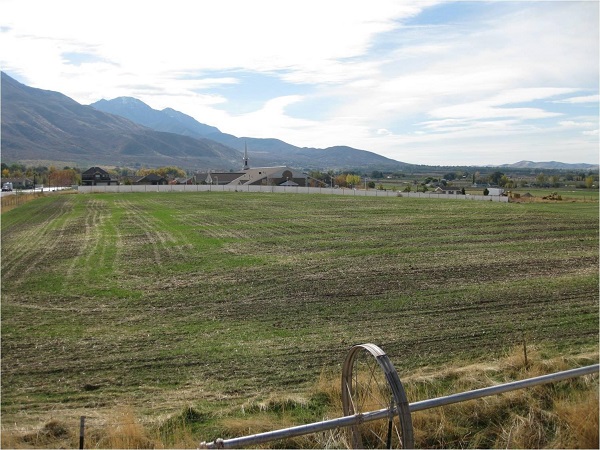 Payson Utah Temple site. Courtesy of Newsroom, Inc.
Mark and Denise Y. (Dee) DeHart had owned their farm since the early 1990s and operated it as part of a sod-producing business. In 2004 they began actively planning to build their dream home on a ten-acre plot that sloped up to a hill at the southeast corner of the farm. They had “stood many times on it and marveled how far we can see from this tiny little rise.” They began working with an architect, but despite repeated attempts, nothing seemed to work out. “Neither the good architect nor we could figure out the problem, so we decided to table the project for a little while. That is when the economy faltered,” so they concluded to begin raising another crop on this piece of land. Wheat seemed to be the best choice because of the rocky and sloping nature of the plot. As the first harvest approached, the family “decided to dedicate the ten acres to the Lord, and grow, harvest, clean, and bag the wheat and give it away” to people in the ward who could not afford to buy it. The next year, the harvest was even more abundant, so the scope was expanded to the whole stake; at this time the farm came to be called “the giving field.”[35] For three years, the family “experienced great joy tending the wheat and anonymously giving it away through the bishops of [the] stake.”
In the fall of 2009, Dean M. Davies, managing director of the Special Projects Department (and future member of the Presiding Bishopric), and Lynn Bailey, real estate manager, contacted the DeHarts and the owners of a few other sites to ascertain whether or not the properties could be purchased. When the intended use of their property was disclosed to the DeHarts, Dee was touched. “Then uncharacteristically for me,” she reflected, “I began to cry as I described the joy involved with the last three years.” The brethren from the Church, also in tears, explained that “the prophet himself would likely come and look at all of the areas being considered and would make the decision.” Dee assured them that “we knew the Lord would put the temple where it should be” but were pretty sure it would be in Spring Lake or Elk Ridge. The DeHarts discussed this possibility with their children Audrey, Emmy, Maddie, their son Ben and his wife Haley, “as it would require them to eventually sacrifice a portion of their inheritance and our retirement. It was a quick and unanimous decision in favor of donating the property to be used for a temple site. We had never been asked to donate the property,” Dee affirmed, and “not one family member has had a problem since then with that decision.”[36]
About two weeks later, in December 2009, Dean Davies brought the First Presidency to personally inspect four sites. They stopped first at the DeHart property. “President Monson just rolled down the window and looked out and didn’t get out of the car.” After they had been to the other sites, he asked the group to return to the first. This time “he walked out onto the ground and said, ‘Brethren, this is where the Lord wants His temple built.’” Presidents Eyring and Uchtdorf concurred. Dee DeHart later reflected, “We had the amazing opportunity to be the stewards of this hallowed piece of ground for eighteen years before returning it to the Lord for a much greater purpose that will benefit many thousands more.”[37] The property was located near the intersection of 930 West and 1550 South, about a mile from the 800 South exit from Interstate 15.
The First Presidency did not wait for general conference to announce plans for the Payson Temple. On Monday afternoon, January 25, 2010, they announced, “A new temple of The Church of Jesus Christ of Latter-day Saints is to be built in Payson, Utah.” The “new temple will help meet the needs of a growing Church membership in the area and will ease the heavy use of the Provo Temple, which is one of the busiest in the Church.” President Monson stated that “temples answer those soul-searching questions of the purpose of life, and why we are here and where we are going. They are sanctuaries from the storms of life and bless the lives of members of the Church who worship within their sacred walls.”[38]
Groundbreaking and Construction
Saturday, October 8, 2011, the day for the temple’s groundbreaking, brought an early taste of winter for the six thousand who braved the elements. Four General Authorities had places on the covered platform, including Elders Dallin H. Oaks of the Quorum of the Twelve, Steven E. Snow of the Presidency of the Seventy, William R. Walker of the Temple Department, and Jay E. Jensen of the Seventy, who was born in nearby Mapleton. Elder Walker conducted the services. He referred to the rich pioneer heritage of the communities in the Payson Temple district, and noted that its twenty-six stakes from Mapleton to Nephi included approximately eighty-nine thousand members and that twenty-nine thousand of them held temple recommends. Two hymns authored by individuals who had lived in Payson were sung during the proceedings—“High on the Mountain Top,” by Joel H. Johnson, and “Sweet Is the Work,” by John J. McClellan.
 Elder Dallin H. Oaks conducts the Payson Utah Temple groundbreaking. Courtesy of Deseret News and Church History Library.
Elder Steven E. Snow, who was responsible for the Church’s Utah areas, pointed out that the Payson Utah Temple would become the sixteenth in the state of Utah. He recalled that when he and his wife, Phyllis, were married, only thirteen operating temples were in all the Church and that they had set a goal of visiting all of them. “Well, President Hinckley and President Monson have ruined all that; we’re not going to make it,” he good-naturedly conceded, noting that there were then 135 temples in service worldwide with many more announced or under construction.
In his remarks, Elder Oaks, a native of Provo, declared that he also regarded Payson as one of the places where he grew up. When he was seven years old, his father died, and Oaks came to live for two years with his Harris grandparents, who had a farm just a half mile south of the present temple site, and he was baptized there. As a teenager, he returned to Payson during the summers to help on the farm; he played the oboe with the high school band and gave his first church talk in Payson. While attending the Brigham Young High School in Provo, he became interested in radio and announced some local basketball games. He gratefully recalled that while broadcasting a game at the high school in Payson, he met his first wife, June Dixon from Spanish Fork; they were married fifteen months later.
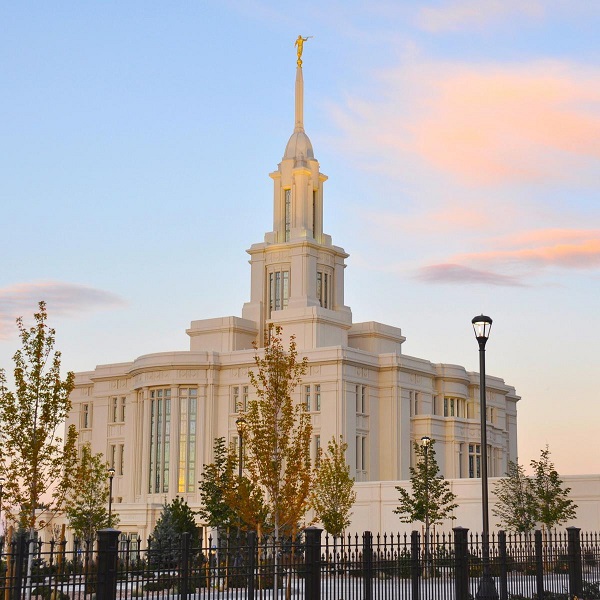 Completed Payson Utah Temple. Courtesy of Intellectual Reserve, Inc.
As part of his groundbreaking remarks, Elder Oaks also quoted what President Monson had taught about temples: “No Church-built facility is more important than a temple,” and “true joy is found in holy temples of our Heavenly Father. I can think of no greater incentive to inspire compliance with God’s commandments and entry into His holy house than the beckoning love of those who have gone ahead and plead for us to follow.” Elder Oaks testified that temples are houses of the Lord, so “this temple will be His house. Here will be exercised the ordinances of His holy priesthood.” Hence, “the ultimate purpose of this temple is the exaltation of the children of God.”[39]
Elder Oaks offered the prayer dedicating the temple site. He expressed gratitude “for the preservation of this land for that purpose, and for the generosity of those who have made it available for Thy work.” He prayed “for angels to watch over and guard this site” from harm. He petitioned that “the workmanship of the House of the Lord will be beautiful and worthy of a house to be dedicated to Thy name and to the work of Thy Son.” He also asked blessings on the people that they might be prepared for the sacred service to be carried out in the temple.[40]
Meanwhile, Architectural Nexus was preparing plans for the new temple, which would follow the floor plan of the temple then being built in Gilbert, Arizona, but with a distinctive bold exterior. The basic arrangement of facilities had symbolic significance: the font, which symbolizes the grave (Doctrine and Covenants 128:13) and where the entry gospel ordinance is received, is the lowest part of the temple. Initiatory ordinances, in preparation for the endowment, are received on the ground floor. Three endowment rooms, each seating about ninety patrons, are on the second floor; each of these rooms offers the complete endowment presentation, so patrons do not progress from room to room before entering the celestial room. Hence, three groups can receive the endowment at the same time, allowing a new session to begin approximately every forty minutes. Seven sealing rooms, in which the climaxing ordinances of the temple are received, are located on the uppermost floor; three of these rooms are large enough to accommodate seventy guests. The floor area of 96,630 square feet makes it one of the larger modern temples.
Construction commenced in May 2012, Wadman being the general contractor. Before concrete could be poured for footings in the deep excavation, 107 geopiers were driven deep into the ground to provide more solid support. Just one year later, concrete for the main roof was poured. A prominent feature of the building is the outward-curving windows on each of its four facades, especially the east, where the celestial room is located. Columns for these radius windows were installed during June. Construction of the tower culminated in the fall, with the completion of the dome and twenty-foot spire at the tower’s top. Then a major event was placing the angel Moroni atop the tower, bringing it to its full height of 208 feet. Thursday morning, October 10, 2013, was cool and misty. When Susan Leavitt caught a glimpse of something gold being taken toward the temple, she “raced to the site to see if it was, in fact, Moroni.” Later, when a construction worker unexpectedly allowed her to stand next to the statue, “she cried uncontrollably.” When Deidre Henderson, a state senator, learned what was happening, “she dropped everything,” loaded her children in the car, and drove to the site. “I thought it was really important for my kids to witness that event.” Even though there was no formal announcement, thousands of people packed the area, cars lined the streets, and even on the freeway people slowed to have a look. Elaine Williams set up a ladder and helped people to climb it for a better view over the construction fence. “It’s absolutely exciting,” exclaimed Margaret Allred, who lived near the temple. “It’s a blessing of the Lord for us. I think it will touch people’s hearts.”[41]
 Grand staircase in Payson Utah Temple. Courtesy of Intellectual Reserve, Inc.
Interior
 Endowment room, Payson Utah Temple. Courtesy of Intellectual Reserve, Inc.
 Celestial room, Payson Utah Temple. Courtesy of Intellectual Reserve, Inc. A prominent feature of this temple is the outward curving windows on each of its four facades, especially the east where the celestial room is located.
 Sealing room, Payson Utah Temple. Courtesy of Intellectual Reserve, Inc.
The rooms were adorned with beautiful woodwork of Sapele mahogany from Africa and Emperador marble from Spain. The pallet of cream, light green, and light burgundy of the temple’s interior reflects “the land and its people.” Two decorative motifs were employed throughout the temple—wheat, in keeping with the recent previous use of the temple site, and the apple blossom, reflecting the numerous fruit orchards in the area. Here again there is an element of progression. On the lowest floor, the blossoms are shown only as buds on the branches. As one ascends through the temple, the blossoms are represented as increasingly open. In the sealing rooms on the upper floor, they are presented as fully open flowers. The beautiful red and green hues in carpeting complemented the apple motif. At least nineteen original paintings would adorn the temple, including works by Ken Stockton and Elspeth Young. Striking art glass features were created by Tom Holdman in his Lehi studio at the other end of Utah Valley.
By March 2015 construction was completed. The temple was then officially turned over from the Special Projects Department, which had built it, to the Temple Department, which would operate it.[42]
Open House, Youth Celebration, and Dedication
Larry Duffin headed the committee in charge of events surrounding the temple’s open house and dedication. The sixteen members of this group headed subcommittees responsible for such matters as history, traffic, security, hospitality, equipment, and the youth celebration; members of these groups totaled about three hundred. In all, some twenty thousand volunteers would then assure the success of these events. As Brother Duffin thought of the temple he was about to present to the public, he asserted confidently, “The inside will take your breath away.” Still, he reflected, it isn’t the building’s beauty or the hectic preparations to exhibit it that matter most. “Our greatest hopes are that individuals will feel closer to their God, which leads them to living better lives. We’ve heard quite a bit from stake presidents, since the temple was announced, that people have felt the need to change their lives. Thousands have been motivated by the presence of the temple.”[43] The temple impacted all those that came during the month-long open house, where a total of 475,542 visitors toured the temple.
The youth cultural celebration filled LaVell Edwards Stadium on the Brigham Young University campus Saturday evening, June 6. More than thirteen thousand youth came together to present their production before the huge audience as an offering of gratitude to God. The youth were dismayed when a “typhoon-like rainstorm” struck just before starting time, pelting the area with hail and destructive winds while thunder and lightning threatened overhead. Participants and spectators were directed to clear the stadium and seek refuge under the stands as the fury raged for over an hour. Finally, the clouds parted, the sun shone, and the program began.[44]
As the program drew to a close, the youth in section after section in the stadium removed their white shirts, revealing T-shirts in coordinated bright colors that created a rainbow that spread across the full length of the stand. Just as the Lord had placed a “bow in the cloud” as a token of His covenant (Genesis 9:13) after a terrible flood in Noah’s time, the youth had endured their own torrential downpour that very day. What had been designed as an event for the youth to unfold the rainbow in the stadium as a sign of their commitment to seek temple blessings took on added meaning after the storm. As the final note of music faded, a light rain began to fall, mingling with tears of reverent gratitude on thousands of upturned faces.[45]
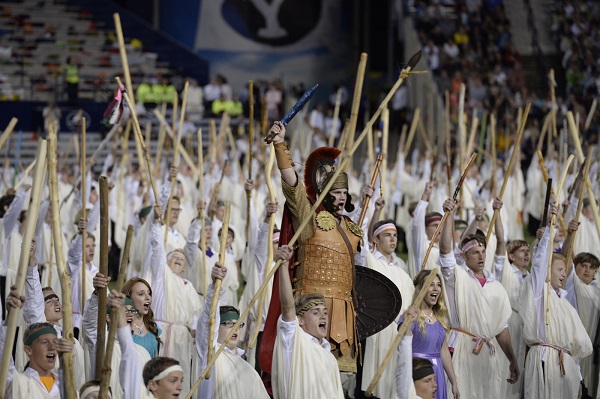 Youth participate in cultural celebration for the Payson Utah Temple. Courtesy of Intellectual Reserve, Inc.
President Eyring conducted the cornerstone ceremony and presided over the three dedicatory sessions the following day, Sunday, June 7, 2015. In addition to those gathered in the temple, thousands of faithful Saints viewed the proceedings in stake centers throughout the temple district.[46] President Eyring’s dedicatory prayer expressed gratitude “for this beautiful edifice which has been erected in our midst. It stands magnificent where it may be seen by all in this community and those who pass by. May it be a constant reminder to those who see it of the obligation of Thy covenant people to walk in righteousness before Thee. . . . May this house be ever sacred to those who enter it and to all who look upon it. May it truly be the House of the Lord, a place of holiness.” The prayer also petitioned blessings for those who would serve in the temple: “May Thy faithful Saints be edified and strengthened through the endowment they will here receive. May Thy servants who go from this Thy House to represent Thee be endowed with power to bear witness before the world of Thy great cause and kingdom restored to the earth for the blessing of Thy sons and daughters, both those living and those beyond the veil of death. May all who kneel at these sacred altars feel the power of Thy binding covenant for them and their posterity through all eternity.”[47]
The temple went into service immediately after its dedication. W. Blake Sonne and his wife, Elizabeth, became the temple’s first president and matron. Youth groups lined up outside of the temple early on Monday morning to be the first to perform baptisms in behalf of the dead. The beautiful sealing rooms were already booked solid for several weeks.
When nine-year-old Kaylee Tervort’s parents asked her and her siblings where they wanted to be married, Kaylee confidently replied, “In the Payson Temple.” This was about six years before anyone knew there would be a Payson Temple. On the day the announcement was made, her parents picked her up from school, told her about the announcement, and drove her to the site of where the Payson Temple would be. Kaylee was in fact married there in 2017.[48] She was just one of the many Saints in the area who were truly anxious to enjoy the blessings available in the new Payson Temple.
 A new locally designed fountain graces the front entrance of the renovated Jordan River Utah Temple. Courtesy of Intellectual Reserve, Inc.
Jordan River Utah Temple Renovated

 Top: The celestial room ceiling in the renovated Jordan River Utah Temple features an art deco motif. Bottom: The brides' room. Courtesy of Intellectual Reserve, Inc.
The Jordan River Utah Temple had closed in February 2016 for extensive renovation. The building was strengthened seismically. All heating, air-conditioning, electrical, and plumbing systems were replaced or upgraded so that future operating and maintenance costs would be reduced. The interior was completely refreshed, including new carpeting, mahogany fluted millwork, Turkish marble floors, interior art glass, and a “new art deco motif” in the celestial room ceiling. Wall finishes were redone and were adorned with “new murals and other art features.” As had been done in the Ogden and Provo Temples years before, escalators were removed from the grand stairway and replaced by fixed stairs supplemented by high-speed elevators. Outside, a new locally designed fountain graced the front entrance. A new exit on the west side enabled newly married couples to greet family and friends without blocking the main entrance. Over two years were needed to complete all these improvements.[49]
Open house and dedication events came in the spring of 2018. On Saturday, March 10, persons with disabilities were given all day to go through the temple at their own speed; this, for example, enabled blind visitors to examine features by touch. More than 452,000 visitors came during the public open house which extended from March 17 to April 28. Those hosting special groups could go off path to spend some time in one of the temple’s seventeen sealing rooms where they discussed temple ordinances, covenants, and worship; individuals having this experience left changed. Many Church members were heard to express the need to become actively involved again. A less-active couple with children said, “I think it’s time we return.” An excommunicated man remarked to his wife, “We’ve got to come back and be sealed here as soon as this repentance process is completed.”[50]
Leaders were anxious to involve all the temple district’s seventeen thousand youth in activities leading up to the temple’s dedication, so they organized a variety of events. There was a special day for the youth during the open house. Then, on a rainy Saturday morning, May 12, the youth discovered how close the temple was as they gathered at their meetinghouses and walked as groups to the temple. They filled the temple’s lawn as they sang hymns and recited scriptures. They felt a spirit of unity as they saw friends from school who they had not realized were fellow Latter-day Saints.[51] The climax was the cultural celebration Saturday evening, May 19, at the Conference Center next to Temple Square downtown. This production, entitled Ready, traced the history of temple building beginning with the Old Testament tabernacle and culminating with the Jordan River Utah Temple. Youth from the temple district nearly filled the huge auditorium. This celebration was different, because those in the orchestra, choir, and dance groups were presenting their program to fellow youth rather than to their parents.[52] This would be the Church’s last youth cultural celebration. At this time Church leaders were stressing that activities and programs should be “home-centered and Church-supported.”[53] The pattern of holding “youth devotionals” instead of cultural celebrations began with the dedication of the Concepción Chile Temple in October of that same year.
 Cultural celebration in the Conference Center. Following the cultural celebration for the Jordan River Utah Temple rededication in 2018, President Russell M. Nelson began the practice of young devotionals prior to temple dedications. Courtesy of Intellectual Reserve, Inc.
President Eyring, second counselor in the First Presidency, rededicated the Jordan River Utah Temple on Sunday, May 20, 2018. He felt that the temple’s 1981 dedicatory prayer by President Spencer W. Kimball was “terrifically appropriate to our time,” so he quoted from it extensively in his prayer of rededication.[54] Worthy members eight years of age and above were able to attend. Regular church meetings throughout the Jordan River Temple district and the adjoining Oquirrh Mountain and Draper Temple districts were cancelled, and the rededicatory proceedings were carried to stake centers so many thousands more could participate. The nine-year-old Baker twins from Sandy were excited that they could personally attend in the temple. “I felt safe and happy,” Daxton remarked. “I’m just glad I attended.” His sister Elsie concurred: “I felt like I was being baptized again. And when President Eyring said the prayer, it felt like the Holy Ghost was there—I thought the room was getting brighter.”
The reconstruction of the Ogden Utah Temple and renewal of the Jordan River Utah Temple foreshadowed a thorough renovation of Utah’s early pioneer temples. This would be a major focus during the 2020s.
Notes
[1] Clinton D. Christensen and Michele Peck, Harvest of Faith: The Brigham City Utah Temple, (n.p.: Temple Department, 2013), 48.
[2] Frederick M. Huchel, A History of Box Elder County (Salt Lake City: Utah State Historical Society, 1999), 148.
[3] Huchel, History, 148.
[4] Christensen and Peck, Harvest of Faith, 17–18.
[5] Christensen and Peck, Harvest of Faith, 21–22.
[6] Christensen and Peck, Harvest of Faith, 23.
[7] Christensen and Peck, Harvest of Faith, 12.
[8] Christensen and Peck, Harvest of Faith, 40.
[9] Christensen and Peck, Harvest of Faith, 39.
[10] Church Newsroom “President Packer Presides at Groundbreaking of Brigham City Utah Temple”, July 31, 2010, https://
[11] Christensen and Peck, Harvest of Faith, 135.
[12] Christensen and Peck, Harvest of Faith, 152.
[13] Christensen and Peck, Harvest of Faith, 143.
[14] “Dedicatory Prayer: Brigham City Utah Temple, 23 September 2013,” https://
[15] Beverly Burgess and historical committee, Come Ye, Let Us Go Up to the Mountain of the Lord: Cedar City Utah Temple History (Salt Lake City: Church of Jesus Christ of Latter-day Saints, 2019), 7.
[16] Burgess and historical committee, Come Ye, 2, 4.
[17] Burgess and historical committee, Come Ye, 4–5.
[18] Jason Swensen, “The Dream Has Now Been Realized,” Church News, October 29, 2017, 5.
[19] Rachel Steizer and Valerie Johnson, “Site Dedicated for New Sacred Edifice,” Church News, August 16, 2015, 3; Burgess and historical committee, Come Ye, 19–25.
[20] Swensen, “The Dream Has Now Been Realized,” 5.
[21] Burgess and historical committee, Come Ye, 56.
[22] Burgess and historical committee, Come Ye, 75.
[23] Burgess and historical committee, Come Ye, 76.
[24] Rachel Sterver, “More Than 3,000 Youth Celebrate,” Church News, December 17, 2017, 6–7.
[25] “The Ogden Temple,” Ensign, February 1978, 80.
[26] “Rededication: The History of the Ogden Utah Temple” (prepared by the Ogden Temple Rededication Committee, 2014), 31–32.
[27] Ogden Standard-Examiner, February 18, 2010; Scott Schwebke, “Renovated Ogden Temple Will Look Similar to Bountiful,” Standard-Examiner (Ogden, UT), September 10, 2010, 2A.
[28] Rededication, 32.
[29] Bryon Saxton, “Ogden Temple Renovation Elicits ‘Oohs’ and ‘Ahhs,’” Standard-Examiner, October 21, 2012; Standard-Examiner, July 30, 2014; R. Scott Lloyd, “Media Tour Newly Renovated Edifice,” Church News, August 3, 2014, 3.
[30] “Rededication,” 43.
[31] Julie Dockstader Heaps, “Ogden Utah Temple,” Church News, September 14, 2014, 11.
[32] Marianne Holman Prescott, “Shine the Light,” Church News September 28, 2014, 6–7; Heaps, “New Verse for Song Memorializes Teens,” Church News, September 28, 2014, 7.
[33] Sarah Jane Weaver, “President Monson Rededicates 14th Temple,” Church News, September 28, 2014, 3–4.
[34] “A Haven of Peace,” Church News, September 28, 2014, 5.
[35] Janene Baadsgaard, “The Payson Utah Temple, 2010–2015” (unpublished manuscript), 7–9.
[36] Baadsgaard, “Payson Utah Temple,” 9.
[37] Baadsgaard, “Payson Utah Temple,” 9.
[38] “Temple in Payson,” Church News, January 30, 2010, 2.
[39] Lloyd, “Construction Begins,” 3.
[40] Baadsgaard, “Payson Utah Temple,” 32–33.
[41] Genelle Pugmire and James Roh, “A Golden Gleam,” Daily Herald, October 11, 2013, 1.
[42] Baadsgaard, “Payson Utah Temple,” 51–90.
[43] Genelle Pugmire, “Payson Temple a Symbol of Faithfulness,” in Payson LDS Temple, 26, 28, in author’s possession.
[44] Baadsgaard, “Payson Utah Temple,” 251.
[45] Marianne Holman Prescott, “Fill the Earth with Love,” Church News, June 14, 2015, 8–9; Pugmire, “Payson Temple,” 35–36; Baaddsgarard, “Payson Utah Temple,” 250–53.
[46] Gerry Avant, “Faith and History Resonate,” Church News, June 14, 2015, 5.
[47] “Accept it as Thy Holy House,” Church News, June 14, 2015, 7.
[48] Yvonne Cheney to Richard O. Cowan, August 14, 2020.
[49] Jason Swensen, “Welcome Back to the Jordan River Utah Temple,” Church News, March 18, 2018, 8–10.
[50] Scott Taylor, “A Call for Unity and Righteousness,” Church News, May 27, 2018, 3–4.
[51] Marianne Holman Prescott, “Youth Walk Outside Their Comfort Zones,” Church News, May 20, 2018, 4–5.
[52] Prescott, “17,000 Youth are ‘Ready’ for Temple,” Church News, May 27, 2018, 6–7.
[53] “Home-Centered, Church-Supported,” Church News, September 2, 2018, 14.
[54] Rededicatory prayer, in “Temple Is an Offering,” Church News, May 27, 2018, 5.
