
 menu icon in the top, right corner of the screen.
 icon above to close this box.
 icon at the bottom of the screen below the browser—if you don't see it, swipe up to unhide it.
Improving Existing Temples
The Logan, St. George, Manti, and Salt Lake Temples
Richard O. Cowan and Clinton D. Christensen, "Improving Existing Temples," in Temples in the Tops of the Mountains: Sacred Houses of the Lord in Utah (Provo, UT: Religious Studies Center, Brigham Young University; Salt Lake City: Deseret Book), 94–107.
No new temples were built in Utah during the first half of the twentieth century, but improvements were made, including many changes that attracted visitors. With the increase in travel, especially by automobile during the early twentieth century, Temple Square in Salt Lake City became a popular destination. During the 1920s approximately 200,000 people visited Temple Square each year, and by the 1960s that total had increased tenfold. Visitors marveled at the acoustics of the domed Tabernacle and gained a greater appreciation for the faith of the Latter-day Saints as they learned about the ceremonies with eternal significance and blessing that are offered in the temple. As a result, the six-towered temple became perhaps the most widely recognized symbol of the restored Church and gospel of Jesus Christ. Different kinds of progress were also taking place at other Utah temples.
Baptizing Children
Today the Saints usually think of baptisms for the dead as the only use for a baptismal font in temples, yet that has not been the case throughout the Church’s history. Tens of thousands of baptisms for the living occurred for children around ages eight and nine from the 1880s to 1970s.[1] A major reason for this practice was that the temple held one of the only fonts in the area. This changed as fonts were added to tabernacles in the 1950s and then became a standard addition to newly built stake centers in the 1960s.
 Logan Temple baptismal certificate of Helen Greaves. Courtesy of Jay Burrup.
According to Church records, children were baptized routinely in the St. George, Logan, Manti, Mesa, and Cardston Temples. Baptisms for the living were not performed in the Salt Lake Temple, but they were done nearby in a special font built in the Salt Lake Tabernacle.[2] The first baptisms occurred in the St. George Temple in 1882. They stopped in the St. George and Logan Temples in the mid-1950s, but they continued in Manti until 1972 and in the Mesa Temple until 1973.[3]
The first child baptized in the Logan Temple was Rachael Roberts, who was baptized June 3, 1884, just weeks after the Logan Temple was dedicated. All ordinances for the almost twenty-four thousand children baptized in the Logan Temple were performed by ordinance workers. Usually, the baptisms occurred on Monday, Friday, and Saturday, with Saturdays having up to sixty children a day.[4] Sometimes a parent would attend, but the ordinance was not the family experience it is today. Helen Greaves is one example. As an eight-year-old, she and other children her age in the Preston, Idaho, area boarded a bus and were driven to the Logan Temple in 1926. None of their parents came on the trip, and just a few ward members were chaperones.[5] However, the opportunity to go into the temple was a special experience for the children. In Manti, Marjorie Mae Tuttle shared with her family that following her baptism in 1936 all the children were permitted to go climb one of the beautiful spiral staircases and see part of the temple.[6] Almost thirteen thousand children were baptized in the Manti Temple in its first fifty years of operation.[7]
While children are no longer baptized in temples, this practice gives an additional perspective on the use of temples in their first decades. Today, a temple baptismal font is most busy on Saturdays and after school hours as the youth keep the font occupied with the work for redeeming the dead. Many youth bring their own family temple names and are focused on performing ordinances for deceased ancestors. However, President Russell M. Nelson has taught that we should “begin with the end in mind,” referencing our goal in getting to the temple. What could have been better for the children of the Church of yesteryear than to begin their journey along the covenant path by being baptized in the temple, laying the foundation for their return for higher temple ordinances!
 Logan Temple with annex, by C.R. Savage. Courtesy of Church History Library.
An Annex
Beginning at Logan and Manti, the one-story annex built on the temples’ north side was an important addition. For example, in Logan the “extension,” as it was called, measured eighty by thirty-six feet and was twenty-three feet high. Just inside the annex’s entrance was a desk where those coming to the temple confirmed their worthiness by presenting their temple recommend. Typically, these structures provided offices for the temple presidency and recorder, a chapel where groups could meet before entering the temple, and dressing rooms with lockers where patrons could change into white clothing in preparation for participating in temple service. An annex was not originally a part of the St. George Temple, but one was built north of the temple during the later 1880s or early 1890s, with access to the temple through one of the entrances in the foundation. Initially it was just a small structure to enclose the water tank and boiler, outdoor supplies, and the custodian’s office. In 1902 a new and larger annex replaced it.
These annexes were improved over the years. Facilities such as a cafeteria, a place where babies and children could be cared for while waiting to participate in sealings, or cloak rooms were added. As the number of patrons coming to the temples increased, dressing rooms needed to be enlarged. In more recent decades, many of these functions have been incorporated into the temples themselves, so a separate annex structure was no longer needed.
Other improvements were within the temples. During 1916 a thorough refurbishing of the Logan Temple included painting or washing all walls, replacing worn wooden floors with new hardwood, and installing new carpets produced by area Relief Societies. Because illumination with electricity was extremely rare when this temple was built, oil lamps or tallow candles were still being used. Therefore, the temple was wired according to “the most modern and approved methods” and fitted with “electroliers” in its rooms.[8] Doors were cut in the temple’s six-foot-thick stone walls on the first floor so that rooms in the towers, previously less accessible, could be used. A remodeling in St. George the following year created two new sealing rooms to the north and south of the celestial room.
Temples Preserved from Destruction
The first three Utah temples all had incidents that could have resulted in the destruction of the buildings. It was later discovered that when the St. George Temple’s tower was struck by lightning in 1878, one of the roof planks had smoldered but fortunately did not ignite. Had it done so, the tar-covered roof would have quickly burned, leading to the destruction of the wooden interior structure below.
On Tuesday evening, December 4, 1917, a short circuit sparked a fire in the utility room under the main stairway in the Logan Temple. Furniture polish stored in the room accelerated the fire which raced up the stairway to the upper floor where most of the damage occurred. The stairway was destroyed; carpets, furnishings, art glass windows, and paintings were ruined. There was also smoke damage throughout the building. Volunteers quickly cleaned the temple. The spiral main staircase was replaced with one having square turns at a cost of forty thousand dollars. Relief Society women produced new carpeting, and the temple reopened after only three months, on March 1, 1918.[9]
Then, on Sunday, August 26, 1928, people in Manti heard a deafening clap of thunder. Within moments, somebody exclaimed, “The temple’s been struck by lightning and is burning. Pass the word!” The east tower had been hit. Men carried hoses connected to the temple’s water supply up one of the famed circular staircases to the roof, but the pressure was insufficient. Not until the hoses were connected with the town’s water system could water be put on the flames. Several witnesses gratefully observed that “it was the slowest burning fire they had ever seen,” and fortunately it was extinguished quickly and damage was minimal. Broken windows were soon replaced, and other damage repaired. Of course, an adequate fire suppression system and lightning rods were also promptly installed.[10]
About three months later, early Tuesday morning, November 20, the furnace was lit in the St. George Temple annex. A short time later, the custodian and night watchman smelled smoke, rushed into the furnace room, and saw flames in a pile of wood and coal. The fire was still small and could have been put out quickly, but volunteer firemen had to pull the firehose on a two-wheel cart several blocks to the temple. By this time the flames had gained headway, and the entire annex was destroyed. Much of the furniture and valuable temple records were safely removed from the burning building. For a time, the temple itself was threatened, but the valiant efforts of the volunteer brigade kept the flames from spreading, so there was just some smoke damage.
Important Improvements at St. George and Manti
 Manti Temple murals in the world room by Minerva Teichert. Courtesy of Intellectual Reserve, Inc. A striking feature in this room is a large Native American chief painted on the west wall.
The need to rebuild the annex provided the occasion for the First Presidency to consider also making significant changes within the temple itself. Rather than the lower main assembly hall only being divided by temporary curtains or screens for presenting the endowment, permanent creation, garden, world, terrestrial, and celestial rooms would be created in this area. The temple was closed for over a year during 1937 and 1938 while the new rooms were constructed. Joseph A. F. Averett and Peter W. Kemp were commissioned to paint murals for the first three of these new ordinance rooms. At this time, an elevator was also installed; only one structural timber needed to be removed to create the shaft.[11]
Because the original murals in the Manti Temple were painted directly on the walls in the 1880s, by 1944 the plaster had deteriorated to the point that the murals were severely delaminated. The creation room mural by C. C. A. Christensen could be touched up and saved, but the two others needed to be redone. Plaster in the garden and world rooms was replaced, and high-quality sail canvas was applied to the walls. In 1945 Joseph Everett began painting a new mural in the garden room. Unfortunately, he died before the work was finished. During 1946 and 1947, Robert L. Shepherd, another noted Latter-day Saint artist, completed the room by painting forest and lake scenes. Murals in the world room were painted in 1947–49 by Minerva Teichert, noted for her art depicting Book of Mormon, western American, and other religious scenes. She depicted the building of the Tower of Babel on the east wall; the Crusades and Columbus’s voyage to America on the north wall; Abraham, Joseph, Moses, and the Pilgrims on the south wall; and the establishment of Zion in North America on the west wall. A striking feature in this room is a large Native American chief painted on the west wall.[12]

 Left and Above: Murals in the world room, painted in 1949 by Minerva Teichert, depict on the north wall a scene of pilgrimage and on the south wall Joseph being sold into Egypt by his brothers. Courtesy of Intellectual Reserve, Inc.
Expansion of the Salt Lake Temple during the 1960s
Construction directly related to the Salt Lake Temple followed ten years of planning by the First Presidency and the Church Building Committee. In addition to a larger and more functional new annex, there would be a sealing room addition constructed against the north side of the temple; these would total 120,000 square feet of floor space, bringing the temple’s total to 253,000. President David O. McKay explained that these improvements would “make it possible for more work to be done by more members of the Church with greater dispatch and comfort.”[13] Specifically, a surprisingly large number of Latter-day Saints selected the Salt Lake Temple as the site for their marriages. Even though there were eleven other temples in service during 1960, nearly 39 percent of all temple marriages were performed in Salt Lake. This created the need for more sealing rooms and accommodations for wedding parties.
Edward O. Anderson was the architect for this project. He was serving as Church Temple Architect and had already designed the Los Angeles and Swiss Temples. He received his training at the Carnegie Institute of Technology (now Carnegie Mellon University) in Pennsylvania.[14]
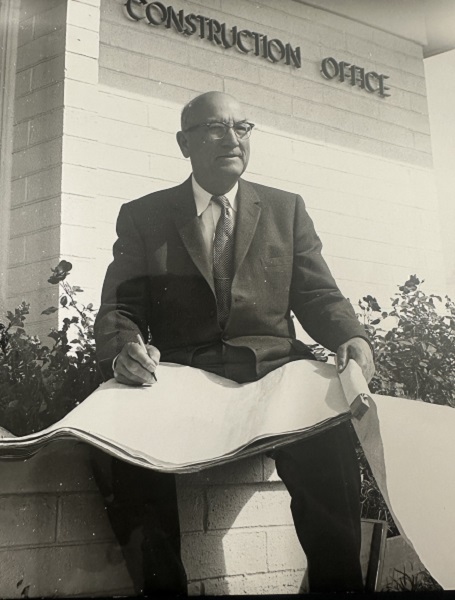 Edward O. Anderson. Courtesy of FamilySearch.
The temple closed on June 29, 1962, so construction could commence that summer.[15] During the next month, the Jensen Construction Company of Salt Lake City won the $2,258,000 contract. Additional contracts for mechanical and electrical work brought the total to about three million dollars. The size of this project was underscored by the fact that at the same time a contract was awarded to build the Oakland Temple for a comparable three and one-half million dollars.[16]
In August the first step was to excavate along the Salt Lake Temple’s south and east sides for foundations, passageways, and other facilities. During the next several months, this digging exposed the temple’s foundations to view for the first time in about a century. This included the temple’s southeast cornerstone, which had been put into place in 1853. As excavations went deeper, they revealed that there were also footings of rough-hewn sandstone sixteen feet wide at their base beneath the finished blocks of the main granite foundation.[17] While this work was going forward, an intruder eluded the night watchman and set off an explosive early on the morning of November 14, 1962, breaking windows and damaging one of the temple’s main east front doors.[18] Needed repairs were quickly made, and the work went forward without any delay.
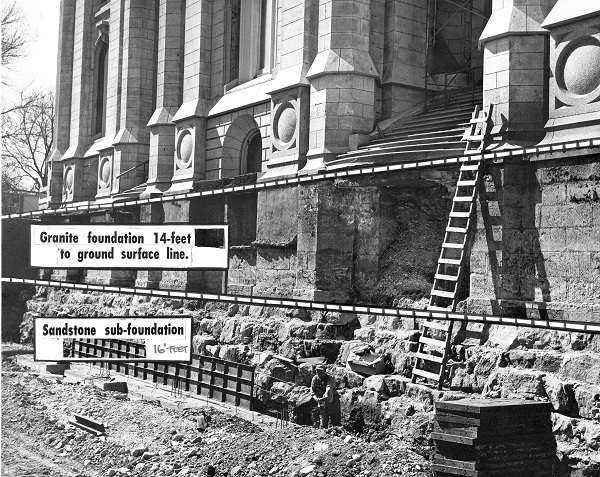 Granite and sandstone foundations of the Salt Lake Temple. Courtesy of Deseret News and Church History Library.
Because some people raised concerns about building an addition on the iconic Salt Lake Temple, steps were taken to make the addition as well as the nearby annex blend in with the existing structure. Anderson designed them with features to match the temple’s original architecture, and they were to be faced with granite from the same quarry in Little Cottonwood Canyon. Even inside the temple itself, improvements in heating, air-conditioning, and fire protection were made while not marring the temple’s interior decorations and architecture. To further protect the temple’s surface and structure, the addition would be completely freestanding with a few-inch gap, connected to the temple only by a thin diaphragm of lead-covered copper to allow for independent expansion with changes in temperature. The addition would have a large sealing room and waiting rooms for adults and for children on the ground floor, while there would be five smaller sealing rooms and the sealing office on the upper level. A window in the temple’s celestial room was transformed into a door to provide access.[19]
Because using blasting powder tends to shatter the stone, granite being removed to form the Church’s genealogy records storage vaults could not be used for the temple project. Workmen therefore cut stone blocks from the quarry by using methods like those employed a century earlier. Holes were drilled in a line, and wooden pegs were tapped in until the stone split along this line. A total of fifty thousand square feet of granite would cover the surfaces of the temple annex and sealing room addition, and only the highest grade would be used. A wire saw with silicon carbide cut the stones to their precise dimensions. Arched stones had to be cut by hand. Such skilled craftsmen were scarce, but the architect was grateful that there were still some who could match the quality of the original artisans.[20]
The temple’s walls had to be cleaned so they would match the new construction. Crews used a mixture of water and black slag sand from Kennecott to remove the century’s worth of patina, changing the temple from its existing dark gray appearance to a much lighter shade. Workmen also replaced damaged mortar and declared the building to be in good condition for its age.[21]
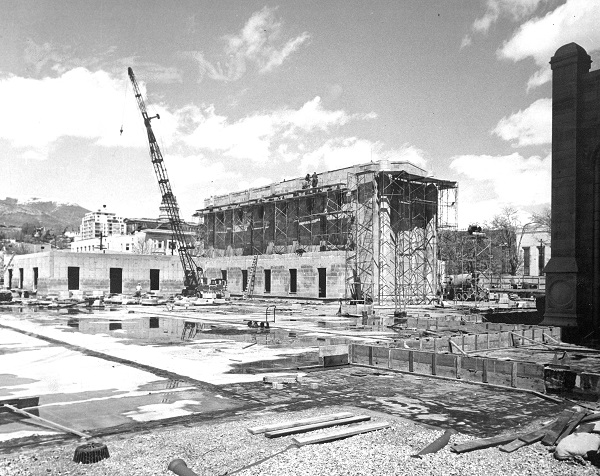 Salt Lake Temple annex project. Courtesy of Deseret News and Church History Library.
Meanwhile, work on the new Bureau of Information was nearing its conclusion. Significant modifications were made for it to serve as the temporary temple annex. A level wooden floor was constructed above the sloping floor of a downstairs theater. Additional plumbing was added in the basement dressing room areas. A kitchen and cafeteria were created on the main floor. Administrative offices and a chapel were also located on this level. Patrons entered through the east entrance, where the recommend desk was located. They received proxy names in the main rotunda before descending an escalator to the dressing rooms in the basement. Here, temple president Willard R. Smith explained, patrons would “engage in ordinances preparatory to entering the temple for endowment work.” They then walked southeast through an underground passageway to the west end of the temple’s basement. These facilities were dedicated by President David O. McKay on Thursday, March 7, 1963, at an inspiring service held in the bureau’s theater. Work inside the temple took about two more months to complete. Then, at a meeting in the temple’s terrestrial room on Tuesday, May 21, 1963, President McKay dedicated the improvements made during the past ten months, paying tribute to the pioneer builders of the temple and describing its refurbished interior as “fitting as well as beautiful.” The temple reopened for ordinance work on Monday, May 27.[22] For the next year and a half, while ordinance work was taking place inside the temple, heavy construction was going forward just outside.
The wall around the northern half of Temple Square had been removed to the Bureau of Information and temple annex sites to provide access for construction equipment.[23] By late 1964 these projects had progressed to the point that the wall could be restored.[24] Two sections of wall on either side of the east gate were replaced by a matching high wrought iron fence, allowing a better view of the new addition and annex as well as the landscaping, which was being restored around the newly constructed facilities.[25]
By 1966 the new temple annex was ready to receive temple patrons. Temple workers moved out of the temporary annex on March 19, and patrons began using the new facilities two days later. Temple president Howard S. McDonald gratefully noted that twenty-eight hundred rather than eighteen hundred patrons could come each day, encouraging more people to attend the temple.[26] With the departure of the temple workers, the Bureau of Information, then coming to be called a visitors’ center, could be transformed to fulfill its intended function. This reconstruction required over a year.[27] After the new visitors’ center had entered service, all these newly constructed facilities were dedicated on October 22, 1967, by Hugh B. Brown, first counselor in the First Presidency, at a meeting in the four-hundred-seat chapel of the new annex. This was fully a year and a half after temple patrons had begun using the new annex and sealing room addition.[28]
 Volunteers in the new temple recorder office. Courtesy of Deseret News and Church History Library.
Even though the underground parking plaza was opened near the end of 1964, the Church Office Building was not constructed until the 1970s. In 1967 the part of this site directly across the street from the Salt Lake Temple became an outdoor theater with four thousand seats facing the temple. A musical production entitled Promised Valley depicted the hopes, tragedies, and triumphs of the pioneers. The object was to share an appealing gospel message with at least some of the estimated twenty-five thousand visitors who came to Temple Square every day during the summer season. With a musical score composed by Crawford Gates, the musical was produced under the direction of the dance, drama, and music committees of the Young Men’s and Young Women’s Mutual Improvement Associations; members of the cast and orchestra all were volunteers. This production was presented on Monday through Saturday evenings during the months of July and August. During most of the play, the temple was dark, but, as the climaxing note of the finale sounded, the lofty temple spires were suddenly and dramatically illuminated in front of the amazed and appreciative audience.[29]
Finishing Touches
When the new temple annex opened, patrons at first entered directly into the foyer through a door in the north wall of Temple Square. In 1970, however, to accommodate the large number of people coming to the temple and to improve security, a covered entrance ramp and spacious waiting room were constructed at the east end of the annex. This, then, became the usual way to enter the temple.[30]
A second visitors’ center opened on Temple Square in 1978. The original Bureau of Information building was razed, and the new South Visitors’ Center took its place. These new facilities were dedicated by President Spencer W. Kimball on June 1, 1978 (the very day he received the momentous revelation extending priesthood and temple blessings to all worthy people; see Official Declaration 2). Speaking at the dedication, Elder Gordon B. Hinckley of the Quorum of the Twelve cited Brigham Young’s prophetic statement to the struggling pioneers that this area “would become the great highway of nations, and that kings and emperors, and the noble and wise of the earth would visit us here.” Elder Hinckley then noted, “It is of singular importance that the beautiful visitors’ center to the north of this square, as large as it is, has become inadequate to accommodate the crowds of visitors who come every day of the year. They include some of the rulers of the earth, and the learned, the noble and the wise.”[31] While the North Visitors’ Center presented exhibits on a variety of topics, the new South Visitors’ Center focused on temple service and the history of the Salt Lake Temple.
These improvements around the temple enriched its message to the world, continuing to fulfill Isaiah’s words, “Many people shall go and say, Come ye, and let us go up to the mountain of the Lord, to the house of the God of Jacob; and he will teach us of his ways, and we will walk in his paths” (Isaiah 2:3). Enhancements to Utah’s historic temples during the first six decades of the twentieth century anticipated a whole new and more efficient concept seen in two temples built in the state during the early 1970s.
Notes
[1] For additional information, see the Special Collections section of the Family History Library. Only active temple recommend holders can use these microfilm collections by appointment in the Family History Library.
[2] Salt Lake Tabernacle records, “Baptisms for the Living, 1907–1960,” Family History Library. Baptisms continued after this period under the direction of the Salt Lake Stake, who used the font for stake baptisms into the early twenty-first century.
[3] St. George Temple records, “Baptisms for the Living, 1882–1956,” Family History Library; Logan Temple records, “Baptisms for the Living, 1884–1957,” Family History Library; Manti Temple records, “Baptisms for the Living, 1888–1972,”Family History Library; Arizona Temple records, “Baptisms for the Living, 1928–1973,” Family History Library.
[4] Logan Temple records, “Baptisms for the Living, 1884–1957,” Family History Library.
[5] Jay Burrup, email message to Clint Christensen, August 25, 2022, in author’s possession.
[6] Jeff Thompson, email message to Clint Christensen, August 19, 2022, in private possession.
[7] “Manti Temple: Golden Jubilee, 1888–1938,” Church History Library.
[8] Edna L. Smith, “Improvements in the Logan Temple,” Improvement Era, March 1916, 458–59.
[9] Nolan P. Olsen, Logan Temple: The First 100 Years (Providence, UT: Keith W. Watkins and Sons, 1978), 176.
[10] Victor J. Rasmussen, The Manti Temple (Provo, UT: Community Press, 1988), 66–67.
[11] Blaine M. Yorgason, Richard A. Schmutz, and Douglas D. Alder, All That Was Promised: The St. George Temple and the Unfolding of the Restoration (Salt Lake City: Deseret Book, 2013), 325–31.
[12] Doris R. Dant, “Minerva Teichert’s Manti Temple Murals,” Brigham Young University Studies 38, no. 3 (Summer 1999): 7–28.
[13] “Extensive Renovation Begins on S. L. Temple,” Church News, August 18, 1962, 3.
[14] “Edward O. Anderson Builder of Temples,” Church News, May 14, 1966, 3.
[15] “Salt Lake Temple Notice,” Church News, June 23, 1962, 2.
[16] “Contracts Awarded for Oakland, S. L. Temples,” Church News, July 21, 1963, 3.
[17] “Digging Uncovers S. L. Footings,” Church News, September 8, 1962, 4; “Excavations Expose Depth of Temple Footings,” Church News, March 30, 1963, 6.
[18] “Detonation of Plastic Explosive Damages Front Door of Salt Lake Temple,” Church News, November 17, 1962, 4.
[19] “Granite Set in Place on Temple Addition,” Church News, October 19, 1963, 3; “Copper Roof Placed on Temple Annex,” Church News, November 23, 1963, 4.
[20] Scott, “New Granite for Temple Square,” Church News, March 9, 1963, 8–9.
[21] Scott, “Salt Lake Temple Looks 100 Years Brighter,” Church News, January 5, 1963, 8–9.
[22] Henry A. Smith, “President McKay Officiates at Special Rites in Salt Lake Temple,” Church News, May 25, 1963, 3.
[23] “Pioneer-Made Masonry Exposed as Power Shovels Level Historic Wall,” Church News, February 9, 1963, 14.
[24] “Wall to Be Restored at Temple Square,” Church News, July 4, 1964, 3; “Veteran Mason at Work on New Wall,” Church News, October 17, 1964, 3; Scott, “Temple Wall Gets New Look,” Church News, December 12, 1964, 12.
[25] “Old Wall Removed: Better View of Temple Afforded,” Church News, January 23, 1965, 13.
[26] Scott, “New S. L. Temple Annex Opens,” Church News, March 19, 1966, 7; “New Annex Aids Work at Temple,” Church News, April 30, 1966, 12.
[27] “General Authorities Tour Visitors’ Center,” Church News, April 22, 1967, 8–9; Joseph Lundstrom, “General Authorities Inspect New Visitors’ Center Facility,” Church News, January 27, 1968, 3.
[28] “Temple Annex Dedicated,” Church News, October 28, 1967, 3.
[29] “Temple as Backdrop,” Church News, April 29, 1967, 6.
[30] “A New Main Entrance to S. L. Temple,” Church News, December 13, 1969, 6.
[31] “New Visitors Center Opens,” Church News, June 10, 1978, 3, 8–9.
