
 menu icon in the top, right corner of the screen.
 icon above to close this box.
 icon at the bottom of the screen below the browser—if you don't see it, swipe up to unhide it.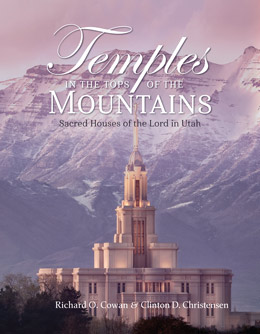
Foreword
Even from ancient times, prophets of God looked forward to the building of temples in the latter days. In the eighth century BC, Isaiah wrote, “And it shall come to pass in the last days, that the mountain of the Lord’s house shall be established in the top of the mountains, and shall be exalted above the hills; and all nations shall flow unto it. And many people shall go and say, Come ye, and let us go up to the mountain of the Lord, to the house of the God of Jacob; and he will teach us of his ways, and we will walk in his paths: for out of Zion shall go forth the law, and the word of the Lord from Jerusalem” (Isaiah 2:2–3). Micah, Isaiah’s contemporary, echoed this prophecy in almost identical language (see Micah 4:1–2). In this book, we see the fulfillment of these prophecies, with the construction of not just one but two dozen houses of the Lord in the mountainous state of Utah. Truly all nations have flowed here, and from this place the law of God has gone forth.
The two authors bring significant but different backgrounds to this project. After earning his doctorate in history at Stanford University in 1961, Richard O. Cowan was a member of the Religious Education faculty at Brigham Young University for over fifty years, retiring in 2014. His research has focused on the Doctrine and Covenants and Latter-day Saint history during the twentieth century. He has authored or coauthored more than a dozen books related to these topics, including five about Latter-day Saint temples. Clinton D. Christensen earned his master’s degree in English at BYU in 1998. While at BYU, Clint was a student in one of Dr. Cowan’s graduate Church history classes. Following graduation with a master’s degree in library and information science at Wayne State University in Michigan, he joined the staff at the Church History Library in 2001. Among other things, he has been assigned by the Temple Department to oversee local committees writing temple histories throughout the world at the time of dedications or rededications. One of these committees he guided and assisted was writing the history of the Provo City Center Temple in 2016; it was chaired by Brother Cowan. Hence, these two authors have experience in working together.
 Utah mountains with the Logan Temple in the foreground, by Nathan Blaylock/
Temples in the Tops of the Mountains shares the story of Utah’s temples, now numbering twenty-eight. The book is organized chronologically. Early chapters treat the iconic pioneer-era temples. Later chapters consider temples built during the twentieth and early twenty-first centuries. These include the unique Provo and Ogden Temples, the first of President Gordon B. Hinckley’s “small temples” at Monticello, older tabernacles that were transformed into temples in Vernal and Provo, the completely reconstructed temple in Ogden, pioneer-style temples built in Brigham City and Cedar City, and several others. Another chapter returns to the pioneer-era temples to describe how they were thoroughly renovated during the 2020s. The final chapter reviews temples that had been announced or were under construction but not yet dedicated at the time of publication.
An important feature of this book is the large number of insightful photographs. The authors are grateful to those that have assisted in the Church History Library, including Ben Whisenant, Jeff Thompson, Jay Burrup, Gary V. Davis, Debra Dixon, and Steven and Alene Dinger. Lee R. Cowan drafted maps and diagrams, contributed a number of original photographs, and provided helpful advice concerning illustrations in this volume. The authors are grateful for a publication grant from the Church History Department that paid for the graphic illustrations.
We also acknowledge Alan Fullmer for the use of his beautiful photographs of Utah’s temples on the covers, at the beginning of the chapters, and throughout the book. His talented eye for creating amazing photographs of temples in their mountainous environments has greatly enriched this project. We thank Carmen Cole for identifying Alan’s work and providing exceptional photographs to create the final touches to the book as she created a masterful graphic design. Further, we acknowledge the additional donors that helped offset the printing costs so that this book could be printed in color, so that the reader’s experience would be visually enhanced.
Several individuals have provided vital information needed for this work. These include Andy Kirby, director of historic temple renovation, and his public relations specialist Georges Bonnet.
Others have made important contributions as well. Scott Esplin was publications director at Brigham Young University’s Religious Studies Center when this manuscript was submitted. He was succeeded in 2021 by Jared Ludlow, who has provided counsel and encouragement as he shepherded this project through the publication process. Devan Jensen, executive editor at the RSC, kindly answered repeated questions regarding style and form as well as many other substantial matters. Brent Nordgren, production supervisor, generously provided technical assistance with illustrations. Carmen Cole is the capable graphic designer of this book. We express thanks to RSC editing interns Erica Smith, Adi Marshall, and Emma Taylor. Richard and Clint are especially grateful for the encouraging and helpful support they have received from their wives, Dawn and Angie, respectively.
We, the authors, hope that you will find this book to be interesting and inspiring. In addition to information about the history of Utah’s temples, we hope you will gain insights that will enrich your service in these or any other Latter-day Saint temples.
