
 menu icon in the top, right corner of the screen.
 icon above to close this box.
 icon at the bottom of the screen below the browser—if you don't see it, swipe up to unhide it.
The First Temple Completed in Utah
The St. George Temple
Richard O. Cowan and Clinton D. Christensen, "The First Temple Completed in Utah," in Temples in the Tops of the Mountains: Sacred Houses of the Lord in Utah (Provo, UT: Religious Studies Center, Brigham Young University; Salt Lake City: Deseret Book), 26–43.
While the Salt Lake Temple was under construction, three other temples were completed. The first of these would be in St. George in southern Utah.
Anticipation of a Temple in St. George
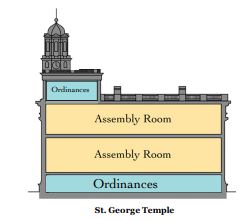 Cutaway view of the St. George Temple. Courtesy of Lee R. Cowan.
The first Latter-day Saint colonists were sent to southern Utah in 1861 to raise needed cotton and also to provide a stopping place along the trail connecting southern California and the central areas of colonization surrounding Salt Lake City. After ten years of struggle to gain a foothold in the desert, St. George’s population had reached only twelve hundred. At a council meeting with local leaders on January 31, 1871, President Brigham Young proposed that a temple be built in the city. This announcement was received with “Glory! Hallelujah!” from Elder Erastus Snow of the Twelve, who had presided in the St. George area. These feelings were shared by all present.[1]
The construction of this temple had been prophesied as early as 1855, six years before the town of St. George was even founded. While he was in the community of Harmony, about forty miles northeast of the future temple site, President Heber C. Kimball declared that “a wagon road would be made from Harmony over the Black Ridge; and a temple would be built in the vicinity of the Rio Virgin.”[2] At that time the construction of such a road and temple seemed highly unlikely.
With such a small population in the area during the early 1870s, many wondered why a temple was to be built in St. George. President John Taylor later pointed out that because “it was found that our Temple in Salt Lake City would take such a long time to build, it was thought best” to erect another one in southern Utah. In the warmer climate, construction could proceed year-round. Furthermore, John Taylor would later say, “There was a people living here who were more worthy than any others. . . . God inspired President Young to build a Temple here because of the fidelity and self-abnegation of the people.”[3]
Locating the Site
Brigham Young directed local Church leaders to consider possible sites where the temple might be built. Two hilltop locations were proposed. Nevertheless, the group could not agree on which to recommend. A young man who was present later described what happened. When President Young arrived, he “somewhat impatiently chided them, and at the same time asked them to get into their wagons, or whatever else they had, and with him find a location.” He had them drive to the lowest part of the valley, a swamp infested with marsh grass and cattails.
“But, Brother Young,” protested the men, “this land is boggy. After a storm, and for several months of the year, no one can drive across the land without horses and wagons sinking way down. There is no place to build a foundation.” President Young countered, “We will make a foundation.”
 Heber C. Kimball. Courtesy of Church History Library.
Later, while the brethren were plowing and scraping where the foundation was to be, a horse’s leg broke through the ground into a spring of water. The brethren then wanted to move the foundation line twelve feet to the south so that the spring of water would be on the outside of the temple. David H. Cannon Jr., who was there as an eleven-year-old child, recalled many decades later what he could of the prophet’s remarks. “Not so,” he recalled Brigham Young insisting. “We will wall it up and leave it here for some future use. But we cannot move the foundation. This spot was dedicated by the Nephites. They could not build [the temple], but we can and will build it for them.”[4]
Because of the sparseness of the population and the lack of funds, many wondered how the temple could be built. “We do not need capital,” President Young responded. “We have raw material; we have labor: we have skill. We are better able to build a temple than the Saints were in Nauvoo.” All tithing collected south of Beaver was to be used for the St. George Temple.[5]
Creating the Design
The architect for the temple was Truman O. Angell. Even though he had designed the Endowment House with separate rooms for giving ordinances, he and President Young were reluctant to depart from the pattern established by Joseph Smith for the Nauvoo Temple. Hence his plan for the St. George Temple’s interior was like the concept for the Salt Lake Temple described in 1854. There would be two large assembly halls, one above the other, with half stories consisting of a row of small rooms on each side of the large halls’ arched ceilings. The basement would include a font and other rooms for ordinances; there would be four entrances directly from the outside at this level, two on the south and two on the north, just as Angell had planned for Salt Lake. Therefore, most of the temple’s space was designed for general meetings rather than for ordinances.
Like the Nauvoo Temple, the St. George Temple would have a single front center tower. Its two large halls would be illuminated by tall windows, while each of the small side rooms would have a small round window. Hence, the pattern of exterior windows would be like those of the Nauvoo and Salt Lake Temples. The main difference from the Nauvoo Temple was the St. George Temple’s flatter roof with no attic story. Otherwise, the temple in St. George was very similar to the temple in Nauvoo in size, general form of the building, and arrangement of its interior spaces.
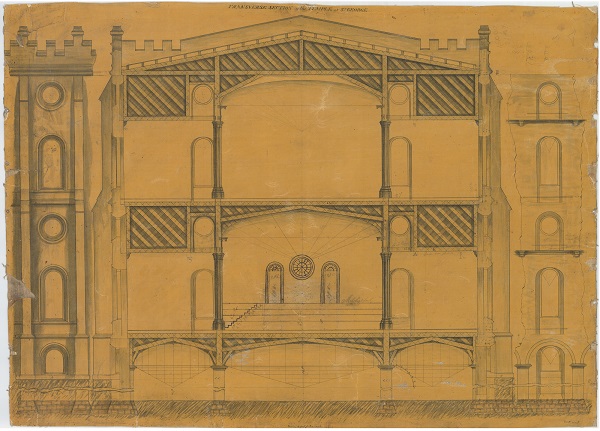 Interior rendering of St. George Temple. Courtesy of Church History Library.
Difficulties during Construction
Ground was broken November 9, 1871. Music was provided by a Swiss brass band from nearby Santa Clara. President George A. Smith offered the prayer dedicating the site. “If the brethren undertake to do this work with one heart and mind,” President Brigham Young promised, “we shall be blessed exceedingly, and prospered of the Lord in our earthly substance.”
Placing his spade in the ground, President Young declared, “I now commence by moving this dirt in the name of Israel’s God.” All present responded with “Amen.” Erastus Snow earnestly prayed “that our beloved President, Brigham, might live to officiate at [the temple’s] dedication.” The people “gave a hearty Amen.” After the congregation sang “The Spirit of God,” President Young stood on a chair and led them in the Hosanna Shout. That very afternoon, plows and scrapers began excavating for the foundation.[6]
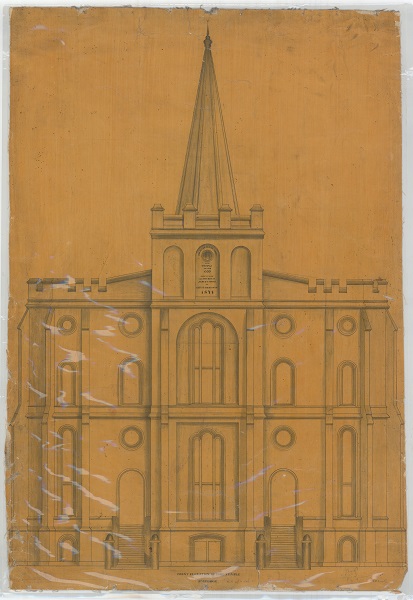 Exterior rendering of St. George Temple. Courtesy of Church History Library.
As the excavation progressed, workmen discovered that the site was filled with water and mud. To provide a firm foundation for the temple, “hundreds of tons” of rock had to be pounded into the ground. Not any rock would do. Black volcanic rock which would not decay in the moisture had to be brought by wagon from a ridge west of the settlement. To pound this rock into place, a primitive pile driver was improvised. A small brass cannon, which the Mormon Battalion had acquired at Sutter’s Mill in California, was filled with lead. A heavy framework about thirty feet high was constructed, and the thousand-pound weight was hoisted by horses and then allowed to fall. “So great was the momentum that the hammer would bounce three times before coming to rest.”[7]
During the six years of construction, the whole community demonstrated a spirit of cooperation and dedication. Men took wagons some eighty miles to Mount Trumbull in Arizona to obtain timber of sufficient size. Often eight days of travel across the hot desert were required to bring as few as two huge logs back to St. George.
Local able-bodied men were expected to donate one day in ten as tithing labor, following the pattern which had been established in Nauvoo. Eighteen-year-old John Stucki walked five miles from the nearby Swiss colony in order to work in the stone quarry; he then gave half of his pay back to the temple fund. Also, men from the northern settlements were called on forty-day missions to help with the construction.[8]
On Wednesday, April 1, 1874, President Brigham Young and other general and local Church leaders gathered to place a metal box in the temple’s southeast cornerstone. The box contained copies of the standard works, other books, and newspapers of the time. Also placed in the box was a silver plaque listing key events in Church and St. George history and the names of the General Authorities then serving. President Young explained that these items were selected “in token of our faith, to be here preserved until the Savior comes; and then to be subject to His will and pleasure, together with the Temple, for the use of the living and the dead.”[9]
 Men working with stone for the St. George Temple. Courtesy of the Church History Library.
The baptismal font and oxen, constructed in Salt Lake City, were a personal gift of President Brigham Young. The font was shipped in sections and assembled in the partially completed St. George Temple. It was dedicated August 11, 1875, and beginning that same day was used for baptisms initiating people into the United Order. When Elder Orson Hyde visited the temple and saw the font in place, he “came out weeping with joy. He thanked God that he had lived to see another font in place in a temple of the Lord.”[10]
The main walls of the temple were of red sandstone, quarried just north of town. These were covered with plaster to give the temple its familiar gleaming white appearance. Visiting the temple just before its dedication, Wilford Woodruff was impressed with the structure that was “as white as snow both inside and out and is a beautiful contrast with the red appearance of the surrounding country.”[11] The temple’s whiteness distinguished it from other buildings in the area and symbolized its holy purposes.
The southern Utah Saints were eager to see the temple completed and to have the opportunity of performing sacred ordinances therein. On Christmas Day of 1876, for example, “forty women were sewing carpets and all the men were at work” to get the temple ready for dedication.[12]
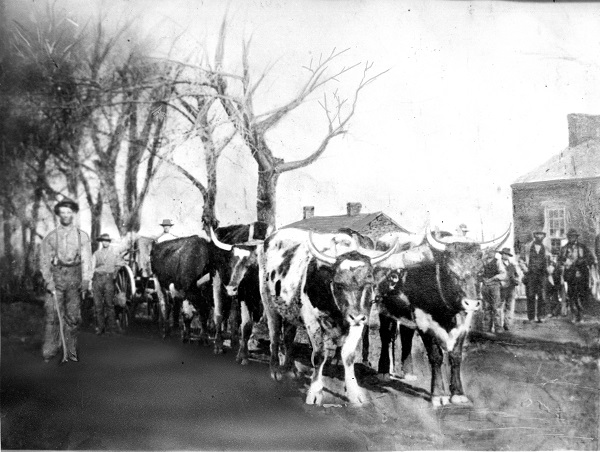 Teams prepared to haul the baptismal font to St. George in 1874. Courtesy of Church History Library.
A Piecemeal Dedication
Baptistry and Lower Assembly Hall Dedicated
The Saints gathered at the temple on New Year’s Day in 1877 to dedicate the portions of the building sufficiently completed at that time. In the baptistry, Elder Wilford Woodruff, who was to become the temple’s first president, reminded the congregation what a privilege it was once again to be able to enter a temple built by the Lord’s command and especially dedicated to him. After prayer was offered there, the group moved to the main assembly room on the ground floor where Erastus Snow, also of the Twelve, offered a dedicatory prayer.
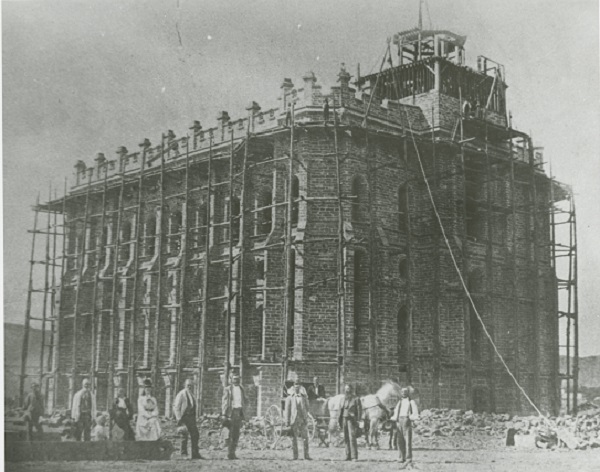
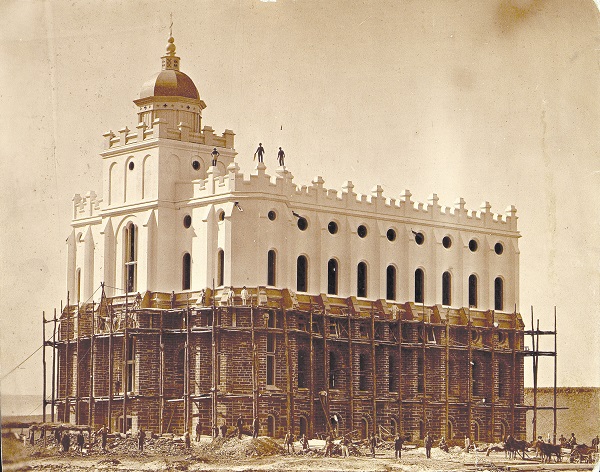 Top and Bottom: St. George Temple before plastering and during the process of making the temple white. Courtesy of Church History Library.
President Young was determined to attend the services even though he was so ill that he had to be carried about in a large chair by four men. He had not expected to speak, but during the service he received enough strength that he was able to walk to the pulpit and address the congregation with great power:
Now we have a Temple which will all be finished within a few days. . . . We enjoy privileges that are enjoyed by no one else on the face of the earth. Suppose we were awake to this thing, namely, the salvation of the human family, this house would be crowded, as we hope it will be, from Monday morning until Saturday night. . . . What do you suppose the fathers would say if they could speak from the dead? Would they not say, “We have lain here thousands of years, here in this prison house, waiting for this dispensation to come?” . . . When I think upon this subject, I want the tongues of seven thunders to wake up the people. Can the fathers be saved without us? No. Can we be saved without them? No.
One who was present recalled that as President Young spoke, he “brought his cane down very hard on the pulpit. He said, ‘If I mar the pulpit some of these good workmen can fix it up again.’ He did mar the pulpit, but the people did not fix it up again. They left it for a mark to be carried through the years.”[13] The marking can be seen in the St. George Temple pulpit to this day.
Temple Dedicated by Daniel H. Wells
Finally, weeks after ordinance work had begun, the Church’s annual general conference was held in the now completed St. George Temple. In connection with this conference the temple was officially dedicated on April 6, 1877, the dedicatory prayer being offered by Daniel H. Wells, second counselor to Brigham Young in the First Presidency. Elements of the prayer acknowledged that the Lord had led the Saints “to this distant land” and that through His “continued blessings they have been enabled to gather together the materials of which this building is composed; to put together and erect the same, even a Temple.” In view of the temple’s swampy site, the prayer continued: “We dedicate and consecrate the foundation of this building upon which it stands. Cause, O Lord, that it may not give way nor yield in consequence of any destructive elements which may be in the soil, but the nature of those elements be changed so as to become strengthening instead of weakening, that the same may always remain firm and sound.” The prayer minutely referred to each part of the building. It suggested possible uses of the small “side rooms” above the arched ceilings of the two main halls. “They may be used, by the Priesthood, for prayer, for worship, for councils or meetings, for administering the Holy Ordinances of Thy house that they may be holy unto Thee, the Lord our God.” The prayer concluded by petitioning, “Let Thy peace and blessing dwell and abide here in this Holy Temple” and may the St. George Temple “stand as a monument of purity and holiness as long as the earth shall remain.”[14]
Many traveled long distances to be present at this special general conference and temple dedication. They had to bring their own provisions because there were only limited accommodations along the way and in St. George. Most camped near the temple or in the yards of St. George friends.
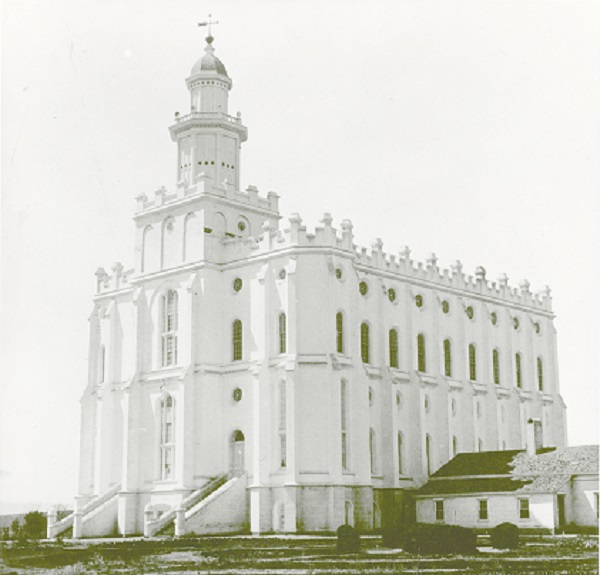 St. George Temple with a new tower. Courtesy of Church History Library.
Struck by Lightning
The people of St. George passed down a tradition that Brigham Young was pleased with the temple which the Saints had sacrificed to build, except for in one area. He did not like the short-domed tower, preferring a taller tower that would give the temple a more magnificent appearance. Contemporary accounts do not contain references to Brigham’s thoughts about the shorter tower. Yet, a year after his death, during a severe thunderstorm on October 16, 1878, a bolt of lightning struck and destroyed the dome, which was later replaced by the taller tower that President Young had initially wanted. “Brother Brigham finally got his way,” the St. George Saints concluded.[15] Whether it really was Brigham or the likelihood that the temple’s tower, which was the highest point in the area, would be struck by lightning eventually, there is a more important issue.
Those that were present to assess the damage after the lightning, including John D. McCallister and James G. Bleak, realized that the lightning and subsequent fire could have destroyed the entire temple structure, not just the dome. In a letter to Wilford Woodruff, Bleak stated, “We find in repairing the roof, that the hand of the Lord, and nothing else, must have saved the building from being burned at the time the tower was struck by lightning.” He continued, describing how the fire did not go below the tower even though, “the fire must have smoldered for some time, and that too, right in contact with the tar-covered canvas which covers the roof. We acknowledge the preserving hand of the Almighty.”[16]
The First Endowments for the Dead
Baptisms for the dead had commenced in the St. George Temple on January 9, 1877, with Elder Woodruff, who was serving as the newly called temple president, personally baptizing and confirming the first 141. President Young also assisted in the laying on of hands.[17] Two days later, for the first time in this dispensation, the endowment was also given in behalf of the dead. Just the month before his martyrdom, Joseph Smith had taught the necessity of these ordinances: “It is not only necessary that you should be baptized for your dead, but you will have to go through all the ordinances for them, the same as you have gone through to save yourselves.”[18] Unfortunately, intensifying persecution and the Prophet’s death prevented the Saints from inaugurating endowments for the dead at Nauvoo. With the completion of the first temple in the west, this service could be commenced. Heretofore, the Saints could experience the teachings of the endowment only once—for themselves. Now they could return time after time, serving in behalf of their deceased loved ones and gaining a deeper understanding of the endowment’s teachings.
Elder Bruce C. Hafen has shared that three temples were needed for the full restoration of temple ordinances: (1) priesthood keys were bestowed at Kirtland, (2) baptisms for the dead and endowments and sealings for the living were inaugurated at Nauvoo, and (3) endowments and sealings for the dead commenced at St. George.[19]
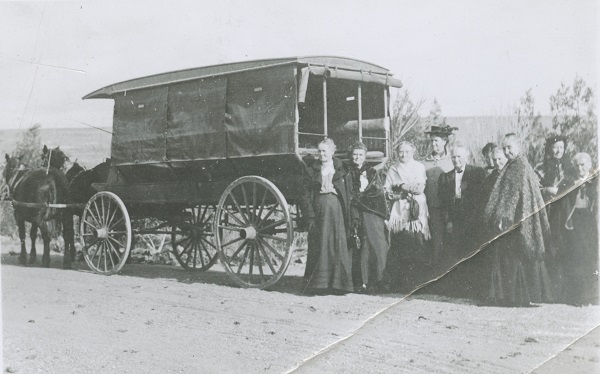 Ordinance workers ride a wagon to come to the temple. Courtesy of Church History Library.
The introduction of endowments for the dead focused greater attention on these sacred instructions. Up to this time, these teachings had been communicated from one person to another only in oral form. As the lone survivor of the original group receiving the endowment from Joseph Smith in 1842, President Young was concerned that this ordinance be preserved. He therefore spent much time during the early months of 1877 giving instructions on this important subject. On January 14, he specifically assigned Elders Wilford Woodruff and Brigham Young Jr. to write these ceremonies “from beginning to end.” During the next several weeks, these two Apostles met with President Young, who reviewed what they had written and made corrections as necessary. By March 21, 1877, the project was completed, and a standardized endowment ceremony was taught to the temple workers at St. George.[20]
The original plan was to present the endowment in basement rooms, some areas being divided by white canvas partitions or temporary screens. Baptisms would take place on other days of the week, so the same dressing areas could be used both for baptisms and for the endowment. When the numbers of faithful Saints flocking to the temple quickly overwhelmed these facilities, Wilford Woodruff consulted with Brigham Young and others.
By the beginning of March 1877, after just seven weeks, they decided to use the lower of the two large assembly halls, immediately above the basement, to relieve the pressure. Henceforth, the areas representing the Creation and Garden of Eden were in the two basement rooms east of the font, and the larger world room was to the west. Patrons then climbed a flight of stairs into the spacious assembly room above; the western portion, representing the terrestrial kingdom, was separated from the celestial room at the eastern end by one of the white screens. The room in the tower behind the Melchizedek Priesthood pulpits was then used for sealings. This basic arrangement would continue in the St. George Temple until it was remodeled sixty years later.

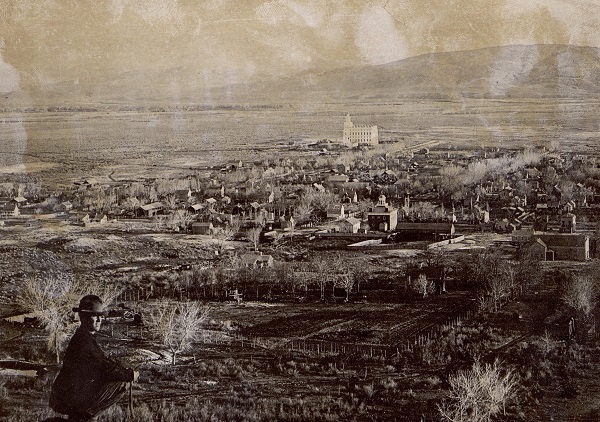 Top and Bottom: The temple and the growing St. George community during the nineteenth century. Courtesy of Church History Library.
Permission to Officiate for Others Than Relatives
 Wilford Woodruff, 1877. Courtesy of Church History Library.
While directing the unfolding of vicarious service at St. George, Wilford Woodruff {portrait} became increasingly concerned about the redemption of his own deceased relatives. Not having any family members with him in St. George, he worried about how this could be accomplished. On February 23 he made this a special matter of prayer: “The Lord told me to call upon the Saints in St. George and let them officiate for me in that temple and it should be acceptable unto him.”[21] “I saw an [effectual] door open to me for the redemption of my dead. And … I felt like shouting Glory Halleluiah [sic] to God and the Lamb.”
Up until 1877, temple ordinances were generally not performed for nonfamily members. On March 1, Elder Woodruff’s seventieth birthday, some 154 sisters came to the temple to act as proxies for his female relatives. “I feel thankful to you my sisters for this manifestation of kindness,” he told them as they gathered at the beginning of the endowment session, “for you might have searched the world over and you could not have found a present as dear to me as this. What is gold or silver in comparison to the redemption of our dead? Nothing.”[22] One sister later recalled that when she heard Elder Woodruff needed help, “we prayed that we might be chosen, and our joy was great when we received our notice that we were to be numbered with the proxies of this first company.” She and others returned to the temple again and again to officiate for those on the Woodruff list.[23] Thus, the Saints not only had the responsibility to perform vicarious ordinances in behalf of deceased loved ones but also had the permission to help others with this sacred work. This precedent laid the foundation for the massive effort that became such an important component of the Saints’ temple service in later years.
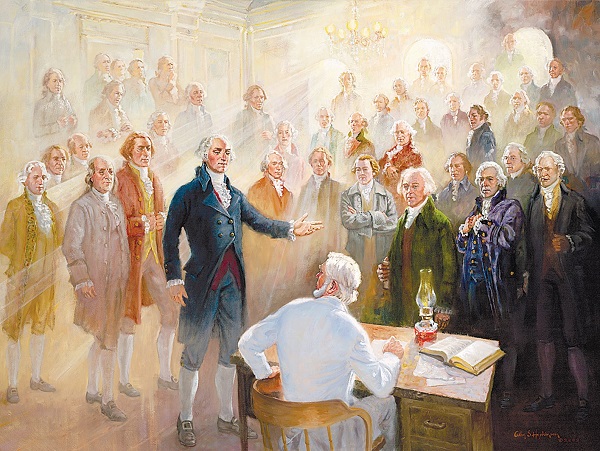 Glen Hopkinson, Redeemed. Used with permission.
Wilford Woodruff Visited by Spirits of the Dead
Performing ordinances beyond one’s own ancestors was underscored in an unusual way, as one fulfillment to President Brigham Young’s question at the temple dedication: “What do you suppose the fathers would say if they could speak from the dead? . . . What would they whisper in our ears?”[24] For two consecutive nights in August 1877, Wilford Woodruff learned the answer to that question. He felt the presence of an esteemed group of men, the signers of the Declaration of Independence, urging him with a desperate request to receive the ordinances of salvation. In his own words, Elder Woodruff described the experience:
The spirits of the dead gathered around me, wanting to know why we did not redeem them. Said they, “You have had the use of the Endowment House for a number of years, and yet nothing has ever been done for us. We laid the foundation of the government you now enjoy . . . and were faithful to God.
The men were the signers of the Declaration of Independence, and they waited on me for two days and two nights. I thought it very singular, that notwithstanding so much work had been done . . . nothing had been done for them. . . . Heretofore our minds were reaching after our more immediate friends and relatives.[25]
Following this experience, on Sunday, August 19, 1877, Elder Woodruff studied a work written by Evert A. Duyckinck, entitled Eminent Men and Women of Europe and America, identifying those individuals he felt should be the first group of nonrelatives to receive vicarious ordinances. Two days later, on August 21, 1877, Elder Woodruff stepped into the temple baptismal font and was baptized by John D. T. McAllister for one hundred prominent men of the seventeenth and eighteenth centuries, including the signers of the Declaration of Independence and other noted individuals such as Daniel Webster, Henry Clay, John Wesley, and Benito Juárez. Elder Woodruff then baptized Brother McAllister for all the deceased presidents of the United States except three (whose ordinances have been performed by relatives in the Church more recently). Sister Lucy Bigelow Young was then baptized for seventy prominent women, including Martha Washington and Elizabeth Barrett Browning.
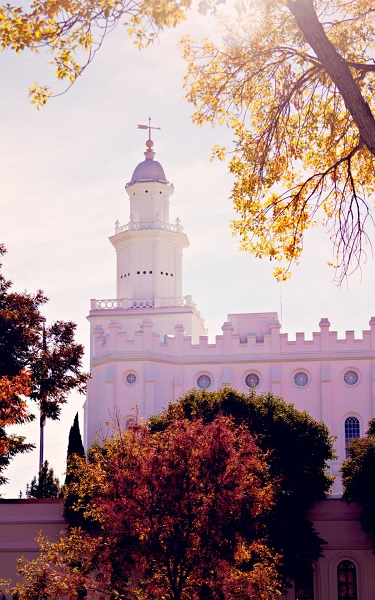 St. George Utah Temple. Courtesy of Intellectual Reserve, Inc.
Contemporary historians may judge favorably or unfavorably some of these eminent men and women whom Wilford Woodruff decided to put on the list to be baptized and confirmed in the temple. However, it should be remembered that notwithstanding the weaknesses demonstrated in a person’s life, all people have the opportunity to continue to grow and change in the spirit world and to accept or reject the ordinances offered to them through the temple. Ultimately, Christ alone will balance justice and mercy and make a final judgment of the lives of God’s children.
Historian Jennifer Ann Mackley noted how for Wilford Woodruff this experience “changed not only his view of temple work but has become an important symbol of the universal nature of temple work. His experience underscored the role of the living in providing the opportunity to accept Christ’s salvation to all who have ever lived. It also reminded the Saints that those in the spirit world expected them to fulfill their responsibility.”[26]
Historian Richard E. Bennett, who has studied how temple work unfolded, concluded, “It is hard to overemphasize the importance of what happened for the first time in the St. George Temple beginning in January 1877. With the introduction of endowments for the dead for both deceased friends and family ancestors, members began returning to the temple on a much more regular basis than before. Such increased temple attendance forged a renewal of their own temple covenants and instilled a heightened sense of family history, temple consciousness, and personal worthiness upon the many who frequented the temple, both men and women.”[27]
At about this same time, the publication of a new edition of the Doctrine and Covenants also heightened “temple consciousness.” The 1876 edition, prepared under the direction of Elder Orson Pratt, added twenty-three sections for the first time, some directly related to temple service: Section 2 was Moroni’s 1823 paraphrase of Malachi’s prophecy about Elijah restoring priesthood keys. Section 109 was the dedicatory prayer for the Kirtland Temple. Section 110 included the account of Elijah’s coming in 1836 (see verses 13–16). Section 132 explained eternal or celestial marriage (see especially verses 7 and 15–24).
While the far-reaching events were taking place in St. George, steps were being taken which would lead to the construction of yet two other temples in Utah. Of these new temples, Elder Woodruff spoke in general conference and said the Saints would “begin to see the necessity of building others, for in proportion to the diligence of our labors in this direction, will we comprehend the extent of the work to be done, and the present is only a beginning.”[28]
Notes
[1] Daniel Tyler, “Temples,” Juvenile Instructor, August 15, 1880, 182.
[2] Stanley B. Kimball, Heber C. Kimball: Mormon Patriarch and Pioneer (Urbana: University of Illinois Press, 1981), 201.
[3] John Taylor, in Journal of Discourses (London: Latter-day Saints’ Book Depot, 1854–86), 23:14, November 9, 1881.
[4] David H. Cannon, Jr., October 14, 1942, quoted in Janice F. DeMille, The St. George Temple: The First 100 Years (Hurricane, UT: Homestead Publishers, 1977), 20–21.
[5] Juanita Brooks, “The St. George Temple” (MS, Juanita Brooks papers, Utah State Historical Society), 3.
[6] Tyler, “Temples,” 182; DeMille, St. George Temple, 21–23.
[7] N. B. Lundwall, Temples of the Most High (Salt Lake City: Bookcraft, 1947), 86; DeMille, St. George Temple, 26–29.
[8] Brooks, “St. George Temple,” 3.
[9] Southern Utah Mission Historical Record, 1873–1877, MS, Church History Library, 78.
[10] DeMille, St. George Temple, 39–41.
[11] Scott G. Kenney, ed., Wilford Woodruff’s Journal (Midvale, UT: Signature Books, 1985) 7:291, November 10, 1876.
[12] Kenney, Wilford Woodruff’s Journal, 7:297, December 25, 1876.
[13] Brigham Young, in Journal of Discourses, 18:304, January 1, 1877. Maggie Cragun interview, “The Dedication of the St. George Temple” (Juanita Brooks papers, Utah State Historical Society);
[14] Quoted in N. B. Lundwall, Temples of the Most High (Salt Lake City: Bookcraft, 1947), 79–83.
[15] DeMille, St. George Temple, 88.
[16] St. George Utah Stake manuscript history and historical reports, Church History Library, July 30, 1883.
[17] Kenney, Wilford Woodruff’s Journal, 7:321, January 9, 1877.
[18] Joseph Smith, History of the Church of Jesus Christ of Latter-day Saints, ed. B. H. Roberts, 2nd ed., rev. (Salt Lake City: Deseret Book, 1962), 6:365.
[19] Bruce C. Hafen, Evening at the Museum presentation, Church History Museum, May 2014, https://
[20] Kenney, Wilford Woodruff’s Journal, 7:322, 327, and 340, January 14, February 12, and March 21, 1877; see also “St. George Temple: One Hundred Years of Service,” Ensign, March 1977, 94.
[21] G. Homer Durham, ed., Discourses of Wilford Woodruff (Salt Lake City: Bookcraft, 1969), 159; Kenney, Wilford Woodruff’s Journal, 7:329, February 23, 1877.
[22] Kenney, Wilford Woodruff’s Journal, 7:330–32, March 1, 1877.
[23] Martha Cragun Cox, “Autobiography,” holograph, Church History Library, 150.
[24] Brigham Young, in Journal of Discourses, 18:304.
[25] Wilford Woodruff, in Journal of Discourses, 19:229, September 16, 1877.
[26] Jennifer Ann Mackley, Wilford Woodruff’s Witness of the Development of Temple Doctrine (Seattle, WA: High Desert Publishing, 2014), 184.
[27] Richard E. Bennett, Temples Rising (Salt Lake City: Deseret Book, 2019), 229–30.
[28] Wilford Woodruff, in Journal of Discourses, 19:229–30, as quoted in Mackley, Wilford Woodruff’s Witness, 194.
