
 menu icon in the top, right corner of the screen.
 icon above to close this box.
 icon at the bottom of the screen below the browser—if you don't see it, swipe up to unhide it.
The Efficient Ogden and Provo Temples
Richard O. Cowan and Clinton D. Christensen, "The Efficient Ogden and Provo Temples," in Temples in the Tops of the Mountains: Sacred Houses of the Lord in Utah (Provo, UT: Religious Studies Center, Brigham Young University; Salt Lake City: Deseret Book), 108–29.
Utah’s first four temples were dedicated within a space of only sixteen years. Then more than three-quarters of a century would pass before the next of these holy houses would go into service. During this time, the Saints in Ogden and Provo anxiously looked forward to the time when they might have their own temples.
Years of Anticipation
In Ogden
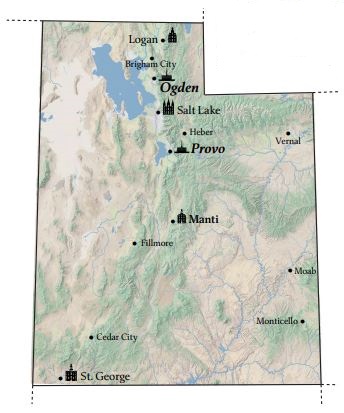 Utah temples up to the 1970s. Courtesy of Lee R. Cowan.
During the early twentieth century, Saints in the Ogden area typically attended the Salt Lake Temple but longed to have their own. On December 12, 1920, Church Patriarch Hyrum G. Smith told attendees at the North Weber Stake conference that Ogden would have a temple “in the near future.”[1] The Joseph Clark family offered the Church a site on the hill above Tyler and 30th Streets (where the St. Benedict’s Hospital now stands) with the understanding that a temple would be built there someday.
Early on Sunday morning, May 15, 1921, President Heber J. Grant, his counselor Anthony W. Ivins, and local Church leaders inspected this and a downtown site, but the prophet concluded that the time was not right to build a temple in Ogden.[2] President Grant, however, indicated that Church funds were committed to other projects, so “there was no telling when a temple would be built in Ogden.”[3] Nevertheless, he conceded, “if all the members of the Church would pay an honest tithing we would build all the temples we need.”[4] The Great Depression of the 1930s and World War II during the 1940s put off Ogden’s hopes further.
During the 1950s the Ogden area was part of the Logan Temple district. Stakes typically chartered evening bus trips to Cache Valley for a temple session, but travel was especially dangerous during winter conditions in Sardine Canyon. By that time David O. McKay, who had grown up in nearby Huntsville and served as principal of Ogden’s Weber Stake Academy, had become President of the Church. Church members in Ogden naturally wondered if chances for an Ogden Temple were greater. One stake president, Lawrence Olpin of the Lorin Farr Stake, even offered to donate his property to become a temple site. The First Presidency “decided to express appreciation to President Olpin for his offer, and to tell him that we [still] have no plans to build a temple in Ogden.”[5]
In Provo
A similar anticipation existed in Provo. For decades residents had referred to what would become the southwest corner of Brigham Young University’s upper campus, which overlooked the town to the south, as “Temple Hill.” This tradition stemmed from a prophecy believed to have been made by Brigham Young himself sometime in the late 1860s. After he and his party “ascended to the summit of this beautiful hill,” Brigham reportedly declared, “You are now standing on holy ground, and the day will come when a magnificent temple will be erected here to our God.”[6]
At the turn of the twentieth century, however, BYU officials dramatically expanded the campus atop this hill by erecting a building in honor of Karl G. Maeser, the school’s first permanent principal. At its 1911 dedication, Elder John Henry Smith—a member of the Quorum of the Twelve—noted that although the grounds had been “rendered sacred to many of us from our earliest childhood in the thought that a temple someday would be erected upon this hill,” the building would instead become a “temple of learning.” Following the dedication of the Maeser Building, the idea of a temple on what had become the BYU campus faded. Still, members of the Church remained hopeful that a house of the Lord would be built somewhere nearby.
With proposals during the 1940s and ’50s for teaching languages to missionaries at Brigham Young University, the idea of a temple in Provo revived. In 1952, BYU president Ernest L. Wilkinson wrote to the First Presidency. He treasured Brigham Young’s prophecy that a temple would be built on Temple Hill, now occupied by the BYU campus. He concluded that with the construction of a temple on or next to the campus, “all of the missionaries’ training could be accomplished here.”[7] The need for a temple nearby was further affirmed as university enrollment soared from 4,510 in 1950 to 10,305 in 1960 and the first student stake was organized in 1956; however, another decade would pass before these ideas became a reality.
About this same time, Ben E. Lewis, who was serving as president of the East Sharon Stake just northeast of the BYU campus, had the following experience:
One day I had a call from one of our Bishops in the Oak Hills area, saying one of the members of his Ward, a Brother Leichty who owned a sizable piece of property in the Ward, had come to him and told him of a dream he had the night before in which he had witnessed the construction of a Temple on his property, and that if the Church wanted to build a Temple there he would donate his land for that purpose. This call came just three days before we were having our quarterly Stake Conference to which a General Authority had been assigned to come. Back in those days we had two conference sessions, one in the morning and one in the afternoon. In between these sessions we would take the General Authority to one of our homes for dinner. It was our turn to host the General Authority for the Sunday dinner which was held in the family room of our home which sat on a hill overlooking the valley. The room had large pane glass windows, and we could look from that room and see the location of the Leichty property. This provided an opportunity for me to put in a “plug” for a temple in Provo. When I brought the General Authority into our family room I took him over to the window where we could look out and see the Leichty property, and told him about Brother Leichty’s dream, and that he had expressed his willingness to donate the property to the Church if they wanted to build a temple on it. The General Authority turned to me and said, “Brother Ben, if the Church ever decides to build a Temple in Provo, we will let you know.” That took care of that. Barbara called, “It’s time to sit down for dinner.”[8]
The Decision to Build Two New Temples
As early as the 1950s, President David O. McKay had discussed the possibility of constructing new temples on the Wasatch Front, but other building projects—such as hundreds of chapels, the large Los Angeles Temple, and the first three overseas temples—had consumed available Church funds. But by the later 1960s, this situation had improved.[9]
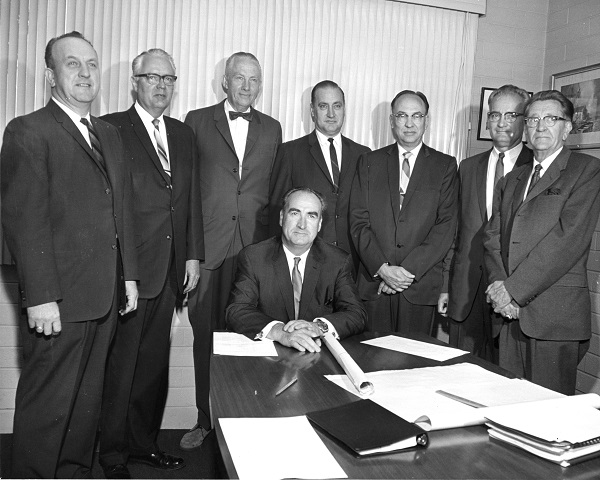 Church Building Committee in 1965. Left to right: Emil B. Fetzer, Allan M. Acomb, Julian S. Cannon, Mark B. Garff (chairman seated), Fred A. Baker, Victor Laughlin, Horace A. Christiansen, Ray Engebretsen. Courtesy of FamilySearch.
A new Church Building Committee came into being on July 1, 1965. It was formed to give stability and order to the Church’s massive post–World War II building program. Mark B. Garff, a Salt Lake construction company owner, became chairman, and Fred A. Baker, vice president of Ogden’s Commercial Security Bank, became vice chairman with responsibility for budgets and finances. Emil B. Fetzer became Church architect and a member of the committee. One of his duties was to inspect temples periodically “to ascertain that they would always be in proper condition to be worthy houses of the Lord. This entailed the responsibility to make certain that all necessary and required repairs, modifications and up-grading were promptly and properly accomplished.” He personally reported the results of these inspections to the First Presidency. In 1967 he informed them that the Logan and Manti Temples were “drastically and urgently in need of extensive upgrading, reconditioning, remodeling and refurbishing.” Furthermore, their compliance with building codes had been “grandfathered,” meaning that if anything at all was done to the building, the whole structure would need to be rebuilt and brought up to the latest codes. He estimated that these repairs would require the temples to be closed for at least two years.[10] Another problem was that the Logan, Manti, and especially Salt Lake Temples were seriously overcrowded. In the light of this information, Church leaders considered what would be the best course to follow.
Noting that BYU students traveled to Manti in great numbers, Garff suggested the possibility of building “a small temple in Provo and one in Ogden.” President McKay directed him to investigate the matter further and then make a report. On Tuesday, August 8, 1967, leaders of the Building Committee met with the First Presidency. Garff indicated that the overcrowding in the Logan and Manti Temples was “becoming so acute that it becomes necessary either to remodel those temples or build new ones.” He recommended building new ones “if for no other reason than economics,” because “remodeling the old temples would cost nearly twice as much as building the new ones.” Baker pointed out that the Salt Lake Temple’s workload in 1966 was two and a half times as great as it had been in 1950, so this temple particularly would need to be remodeled to expand its capacity if the other temples were not built.
Architect Fetzer presented various options. The Presidency approved the concept of building temples in Ogden and Provo and directed Garff and the Building Committee “to go forward and make provisions for the location of the new temples, prepare their plans, and so far as possible have the same plan for both temples.”[11] Brother Fetzer felt sure that even before he made his report on the Logan and Manti Temples, “the First Presidency clearly had in mind to build the new Temples in Ogden and in Provo.”[12]
When President McKay approved the temples, he felt some reluctance about the costs and of announcing two temples at one time. Consequently, he gave “absolute guidelines” to the Church Building Committee. Fred Baker recalled the prophet saying there would be no solemn assembly room, no multiple towers, no excess footage, and “no angel Moroni.”[13] Further, President McKay emphasized that these temples would be working temples and practical. Indeed, they were quite simple in style compared to their predecessor the Oakland Temple, which finished before them in 1964, and the Washington D.C. Temple, which followed them in 1974.
The Amazing Announcement
Without any delay, presidencies of the twenty-eight stakes in the Provo area were invited to a special meeting, which would be held on Monday morning, August 14, 1967. A similar meeting was held that afternoon with the twenty-five stake presidencies in Ogden. Presiding at these gatherings were Hugh B. Brown and N. Eldon Tanner, counselors to David O. McKay in the First Presidency. Also in attendance were Mark B. Garff and Fred A. Baker of the Church Building Committee.
The Presidency explained that 52 percent of all temple work was being done in the Salt Lake, Logan, and Manti Temples, which consequently were seriously overcrowded. Rather than expending funds to enlarge these temples, Church leaders concluded to build two new ones in Ogden and Provo to reduce the amount of travel required of the Saints. In each location, a committee of stake presidents was appointed to recommend a specific temple site to the First Presidency, who would make the final decision. Sites for both temples were announced within two weeks.
Essential Preparations
Sites for the New Temples
Although other sites were considered, the site chosen for the Ogden Temple was Tabernacle Square in downtown. The Church had owned this ten-acre block bounded by Washington and Grant Avenues and 21st and 22nd Streets since pioneer times. When Brigham Young laid out the town, he had designated this block as the spiritual center for the community. Ground was broken at the southeast corner of the block for the original Weber Stake Tabernacle in 1855, and after delays caused by the Utah War, it was completed and dedicated in 1859. The third ward built its meetinghouse and amusement hall on the southwest corner, and the stake Relief Society also erected its building on the block. A new Ogden Tabernacle was dedicated on the north side of the block in 1956.
The Provo committee discussed several possibilities. One was the downtown park adjacent to the Provo Tabernacle, but it was substantially smaller than the corresponding property in Ogden—less than two acres. There was not enough room for a temple building or for parking. They also felt the temple should be within walking distance of Brigham Young University so students could participate conveniently.
The committee visited other sites but kept returning to the seventeen acres BYU had by then bought from the Leichty brothers just below the mouth of Rock Canyon. The advantage of this site was that it was close to BYU and on a hill, where it could be seen from many different places in the valley; those who came to the temple could look out and get a panoramic view of the valley, Utah Lake, and the Oquirrh Mountains beyond. The First Presidency approved the committee’s recommendation and directed the architect to proceed with the plans.[14]
Designing the New Temples
Significant innovations in presenting the endowment during the 1950s would impact the Ogden and Provo Temples. With the rapid growth in the Church around the world after World War II, President David O. McKay recognized the need to build more but less costly temples. The Church Building Committee sought ideas from Latter-day Saint architects about how to accomplish this. Harold W. Burton realized that it would be necessary to reduce the size of these sacred structures without diminishing their “functional capacity.” His experience in the motion picture industry in Southern California led him to a possible solution. “It was my opinion that if the first four temple ordinance rooms could be combined, and with picture projection substituted for mural paintings to create a proper setting pertaining to the creation, the garden, and the world, very substantial reduction in the size of the Temple could be effected.” Although some felt this idea was “too revolutionary,” it was adopted for the Swiss Temple.[15] Using modern motion picture equipment made it possible to present the endowment in a single ordinance room, in more than one language, and with far fewer than the usual number of temple workers. This landmark decision brought a fundamental change in the design of temples.
 Joseph F. Merrill (center) and Gordon B. Hinckley producing a Church film. Courtesy of Church History Library.
The new temple film was produced by Gordon B. Hinckley, secretary of the missionary committee (not yet a General Authority), who worked closely with President McKay. “It was a charge of enormous significance,” his biographer declared. “The ramifications of this project were enormous, as they would extend far beyond the temple in Switzerland.” In the fifth-floor room of the Salt Lake Temple where Elder Talmage had completed his monumental book Jesus the Christ, Brother Hinckley spent many evenings, Saturdays, and some Sunday mornings outlining ideas. With President McKay, he spent considerable time reviewing the temple ceremonies and praying for divine guidance. President McKay later remarked, “There is no other man in the church who has done so much in assisting to carry this new temple plan to the Saints of the world as has Brother Hinckley.”[16] Elder Harold B. Lee insisted that “there was no difference” between the endowment instruction given formerly “and that which was later given in temples except as to the method.” He believed that the use of films to present the “teachings of the holy endowment” had come “under inspiration to our President.”[17]
The Swiss Temple—dedicated in 1955—set the pattern for the New Zealand and London Temples, which opened three years later. Originally, each of these newer temples had only one presentation room, meaning that a new session could begin only every two hours. The Oakland Temple—dedicated in 1964—had two large endowment rooms, enabling a new session to start every hour or so. Designs for the new Ogden and Provo Temples would bring even greater improvements.
Announcement
At the August 14, 1967, meetings where the Ogden and Provo Temples were announced, Church leaders explained that these new temples “will be of the smaller type,” following the pattern developed for the first overseas temples, “but so designed to have a high capacity.”[18] Building both temples from the same basic plan would expedite construction and economize. Efficiency and convenience were prime concerns.
A few days after this meeting, officials of the Church Building Committee were summoned to visit with President David O. McKay and his counselors in his Hotel Utah apartment. After some preliminary discussion about the new temples, President McKay turned to Emil B. Fetzer, the Church architect, and declared, “Brother Fetzer, I would like you to design the new Temples for Ogden and for Provo. Rather than building huge monumental buildings as has been the custom of the past, I would like these two Temples to be functional and economical with temple quality. In the coming years, many Temples will be built. Of necessity, these Temples must be functional in design and cost so that they may accomplish their sacred purposes and be blessings to the Church membership.”[19]
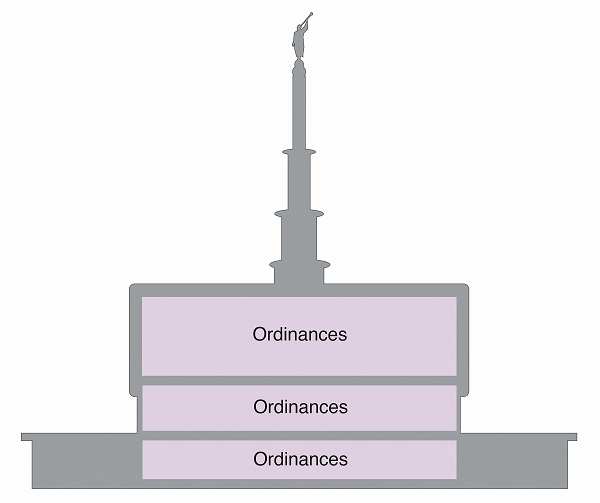 Cross section of Ogden and Provo Temples. Courtesy of Lee R. Cowan.
As Brother Fetzer and the others left the meeting and walked down the hall to the elevator, he recalled, “I was in shock. I never had the slightest inkling nor gave it any thought that I would ever be given an assignment to design a Temple. Yet, it had indeed happened. The Prophet of the Lord had given me the assignment to design not one but two Temples. This was a major emotional high point to last a lifetime and longer—an exciting moment to cherish and remember forever.”[20]
Emil Fetzer worked closely with Mark B. Garff and Fred A. Baker of the Church Building Committee. In the new temples, they originally understood that they would present the endowment in the traditional way. At a meeting with the First Presidency on October 29, however, Baker was told that the Presidency had approved the use of films in North America as well as overseas, and that the new temples should use films rather than having companies progress from room to room. This surprised him. Architect Fetzer was not at this meeting because he was in Southern California on business.
 Ordinance rooms surrounding the celestial room in the Provo Temple, January 1972 Ensign.
The following day, Fetzer and Baker needed to fly to Europe on Building Committee matters. They met in the Kennedy airport in New York before boarding a Pan American DC-8 jet for the overnight trans-atlantic flight. After dinner, Baker shared the First Presidency’s instructions with Fetzer, and they proceeded to discuss the “grand assignment” to design the two temples. As they attempted to work at their seats, a stewardess offered them the use of a table in the galley where they could spread out their papers. Brother Fetzer recalled,
After we had discussed Temple design for some time, all of a sudden I felt as though I were walking through a Temple Building. I described to Brother Baker what I was seeing in my mind as I was walking through the Temple—the Temple recommend desk in the main entrance foyer, the inner foyer, the offices and ancillary spaces and facilities on the ground floor. On the second floor I saw and described the chapel and sealing rooms. However, the most important of all that I was seeing was the unusual plan configuration of the third floor. There was a large, beautiful, center room surrounded by a cluster of six [endowment presentation] rooms which completely surrounded the celestial room. A broad, circular hallway went completely around the six rooms with access to them from this hallway. It was a wonderful concept and a very unique and distinctive plan arrangement.
Before they knew it, it was daylight, and the plane was landing in Frankfurt. They had been discussing the temple “all night long.”[21]
Fetzer later reported that the idea for the outside hallway came from a park in Copenhagen, which was completely surrounded by a roadway in the form of an elongated ellipse. He called this a “Danish ellipse,” and “a modification of this idea was adapted to be exactly what I needed to accommodate the rooms and corridors of the upper two floors.”[22] Still, he insisted, this “unique and fundamental modification of Temple design concept was more than my own thinking. It was a direct inspiration given to me by the Holy Spirit.”[23]
Mark B. Garff explained that “most monumental structures have been designed with first emphasis on the outside appearance, with the interior fit to the outside design.” In contrast to this pattern, he noted that Emil Fetzer “gave first consideration and emphasis to the needs of the interior and then designed the exterior to enclose the areas.” Hence, the outside walls of the temple’s main upper portion followed the rounded course of the third-floor hallway”[24] and illustrated the architectural maxim “form follows function.”

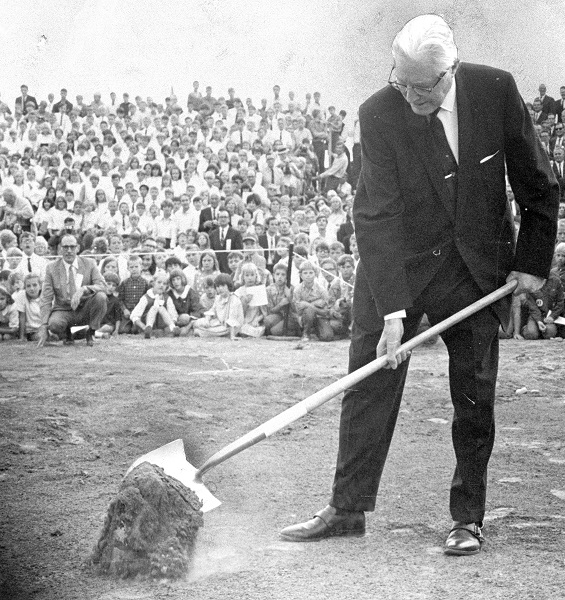 Top and Bottom: President Hugh B. Brown at Ogden Temple and Provo Temple groundbreakings. Courtesy of Deseret News and Church History Library.
The main floor of the 115,000-square-foot temples would be rectangular, while the upper two floors would have elliptical corners. “Since the second floor is recessed below the third floor and since gold glass windows of the second floor are continuous full height panels,” Architect Fetzer explained, “it gives an appearance that the third floor is floating above the Temple base.” He continued, “This is the effect that I desired—that the sacred ordinance rooms and the celestial room would appear to be above and separated from the mundane and worldly aspects of life.”[25]
To make the temples as functional as possible, Fetzer consulted with temple presidents and workers, members of the Genealogical Society, the Building Committee, other Latter-day Saint architects, and General Authorities. To facilitate movement from floor to floor, he provided not only elevators, but escalators, which were “never before planned in temples.” Fetzer explained that the continuous hallways around the perimeter of the second and third floors would make it impossible to get lost; all people needed to do was keep walking and they would be brought back to the starting point.[26]
The exterior of each temple was of white cast stone, gold anodized aluminum grilles, and bronze glass panels. A spire in the center of the building, golden in color, reached a height of about 185 feet. Over the years, various symbolic meanings have been read into the temple’s design. Upon looking at the rounded corners and gold colored towers, many local Church members believed the temples were designed to symbolize the cloud and pillar of fire that led the ancient Israelites during their wanderings in the desert. However, Fred Baker, who worked closely with Emil Fetzer in designing the temple, recalled, “We didn’t have any symbolism in mind. . . . The truth is that we were so focused on what happened inside the temple, it never entered our mind” that there should be any symbolism outside.[27]
Fundraising
The First Presidency asked members in each temple district to contribute one million dollars, less than one-fourth of the total cost for erecting their temple. General Church funds would pay the balance. The Presidency asked local leaders to give this priority and let their “other building projects go for the time being and raise this money as fast as possible.”[28] The stake presidencies received this challenge “with great enthusiasm,”[29] anticipating that the Saints would be eager to assume a major share of the construction cost.
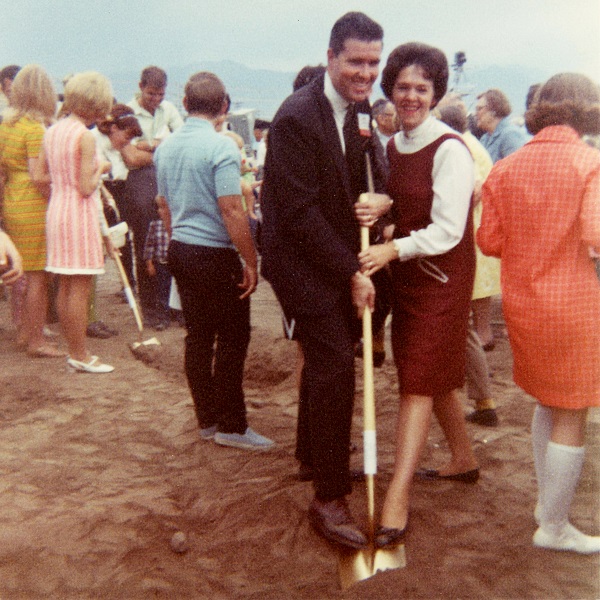 Richard and Dawn Cowan at the Provo Temple groundbreaking. Courtesy of Richard Cowan.
Church members responded willingly and enthusiastically. A bishop in the Ogden area brought up the ward’s quota in priesthood meeting, and by the time Sunday School was over only three hours later, the entire amount had been contributed.
In the Spanish Fork Stake, fundraising was well underway for a total of $320,000 needed for a new stake center and for a new chapel in Salem. With the announcement of a temple, these plans were temporarily set aside. “It seemed that every heart was touched,” stake president Joseph Toronto gratefully noted. The stake’s share for the temple was fifty-six thousand dollars, but “we raised over seventy-five thousand dollars, the easiest money we ever collected because of the great willingness of both young and old to sacrifice,” President Toronto affirmed. “For example, children would say, ‘Grandpa, we can’t have an ice cream cone, go to the movie, or go on that vacation. We are sacrificing to build the temple.’ There were many sacrifices from our faithful members. The Saints not only paid their allotments for the temple in record time, but also their allotments for stake and ward buildings. And tithing increased also.”[30]
The Church organized the “Youth Build a Temple” program (YBAT), and many young people were eager to help build their temple. A ward in Harrisville, for example, was assessed $3,461 as its share. The bishop was eager to get his youth involved: “The girls scraped and painted old barns, tended children, bottled fruit, and did ironing. The boys did everything from washing cars to laying sewer pipes. And the money was raised.”[31] In both Ogden and Provo the Saints contributed substantially more than they were asked.
Construction of the Temples

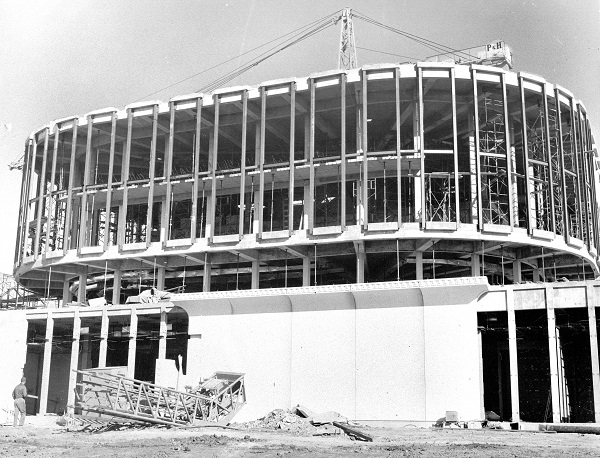 Top and Bottom: Early construction progress of Ogden Temple. Courtesy of Deseret News and Church History Library.
President Hugh B. Brown, first counselor in the First Presidency, presided at the groundbreaking ceremony for the Ogden Temple on September 8, 1969, President McKay’s ninety-sixth birthday. He conducted the same inaugural ceremony in Provo just one week later. He praised the Saints for their willingness to contribute funds for the temple. In Provo, he recounted his own contributions to the Church both in time and money and then concluded that “the Church owes me not one cent. I have received more than I have ever given.” President Brown concluded with his testimony and then reaffirmed, “The Lord owes me nothing, I owe him everything.”[32]
On each occasion, after President Brown officially turned the first shovel of dirt, the other General Authorities followed. Next the stake presidents and then the bishops in the temple districts had their turns. Finally, others who were present were able to participate by wielding the gold-colored shovels to turn over some of the soil.
The final set of plans for each temple filled 135 large pages. Several construction companies were invited to study these plans and submit a formal bid. “Contractors were selected based on their past construction performances and on the size of projects that they had successfully completed commensurate to the size, cost, scope and finish of the Temples,” Emil B. Fetzer explained. “Due to the sacred character of the Temples, selected contractors were required to be Temple worthy members of the Church.”[33] The Okland Construction Company received the contract for the Ogden Temple, and the Hogan & Tingey Construction Company won the contract to build the similar Provo Temple—each costing just over $4,275,000. Builders were asked to rush their work “against an early deadline.”[34]
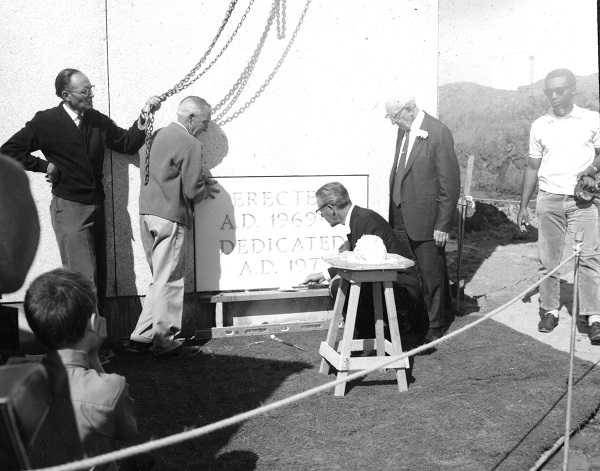
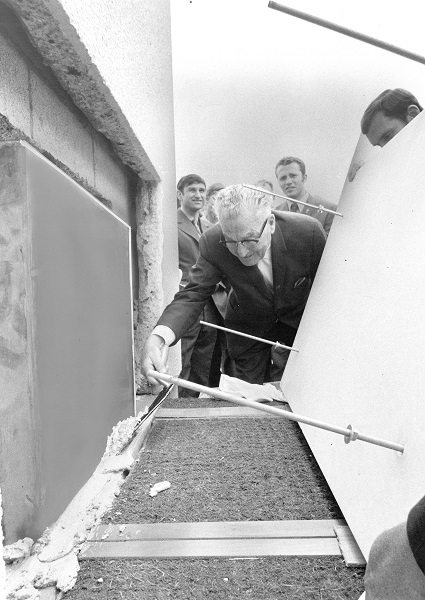 Presidents N. Eldon Tanner and Joseph Fielding Smith (top) at Ogden Temple cornerstone ceremony and President Harold B. Lee (right) at Provo Temple cornerstone ceremony. Courtesy of Deseret News and Church History Library.
Because the stainless-steel baptismal fonts were so large, they needed to be put into place in the temple basement before the concrete for the main floor was poured overhead. Wrapped in heavy plastic, the font was protected from damage as construction then proceeded all around it. By the end of 1970, the outer walls of the ground floor were completed, and structural steel for the upper floors was in place.[35]
When temples were built of large hewn stones, placing the cornerstone had marked the beginning of construction, such as at Kirtland, Nauvoo, and Salt Lake City. When reinforced concrete became the norm, as was the case with Ogden and Provo, cornerstone laying became purely symbolic and was conducted during construction after the walls surrounding the cornerstone area were sufficiently completed. President N. Eldon Tanner, second counselor in the First Presidency, officially placed the Ogden Temple’s cornerstone on September 9, 1970—just one year after groundbreaking. Church President Joseph Fielding Smith presided at Provo’s cornerstone laying on May 21, 1971. More than six thousand interested spectators gathered at each of these ceremonies. At each temple, the cornerstone box contained historical memorabilia including copies of the scriptures, photos of Church leaders, copies of current Church magazines and of local newspapers, and photos of temple construction to that point.
When the 118-foot spires were put into place during the summer of 1971, the exterior appeared to be finished. The spire was anchored to a steel base and was sheathed by four tiers of fiberglass. A metal spike or lightning rod topped the last four feet of the spire.
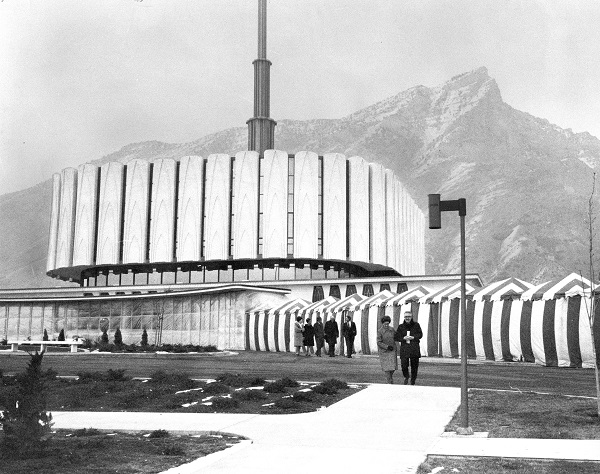 Provo Temple open house. Courtesy of Deseret News and Church History Library.
Open House and Dedication
Keith Wilcox, president of the Weber Heights Stake, chaired the Ogden Temple dedication committee. He would later help design the Washington D.C. Temple and serve as the Ogden Temple’s third president and as a General Authority Seventy from 1984 to 1989. He insisted that construction of the temple had raised the spiritual level of the entire community. The public open house, which operated from December 16 to 30, 1971, attracted over 150,000 visitors. After first seeing exhibits and watching an introductory video in the adjacent tabernacle, they proceeded to the temple.
During the Provo open house, January 10 to 29, 1972, the 246,201 visitors started their experience in a large, heated tent set up in front of the temple. An enclosed passageway to the front door not only sheltered them from the winter weather but also ensured that their shoes were clean and dry by the time they reached the temple. Some traveled hundreds of miles to the event; youth groups in chartered buses came from as far as St. George.
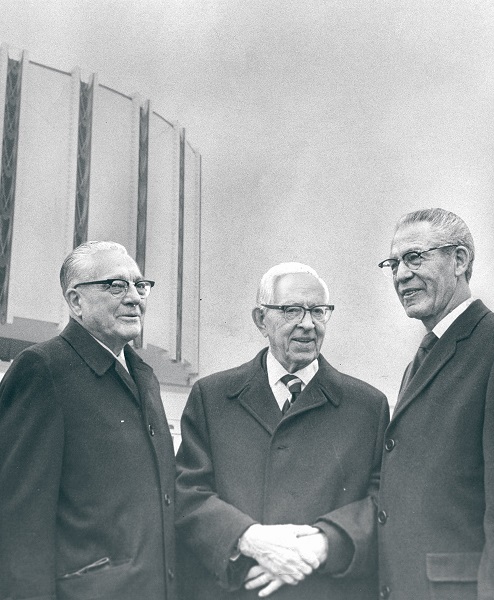 First Presidency at Ogden Temple dedication: Harold B. Lee, Joseph Fielding Smith, and N. Eldon Tanner. Courtesy of Deseret News and Church History Library.
Those participating in the open houses felt a special spirit as they visited the temple. The Church’s New Era magazine published a number of responses from the youth and young adult readers: “I had such a wonderful feeling while inside the temple, I didn’t want to leave”; “After coming 600 miles to see the house of the Lord, then having the experience, I realized it was worth traveling around the world for”; “The whole temple seemed to be a part of heaven”; “The spirit there was unbelievable, and it is not even dedicated yet”; “I think it has caused me to have a new outlook on life. Now I look forward to the future instead of fearing it”; “This was the most completely peaceful twenty minutes that I have ever experienced.” Some were particularly impressed with the sealing rooms: “When I saw the sealing rooms, I knew that I truly wanted a temple marriage”; “The mirrors give such a beautiful representation of eternity.”[36]
President Joseph Fielding Smith dedicated the Ogden Temple in six sessions, two each day from Tuesday, January 18, through Thursday, January 20, 1972. Overflow groups were accommodated in the nearby Ogden Tabernacle. In his opening remarks, President Smith declared, “May I remind you that when we dedicate a house of the Lord, what we really do is dedicate ourselves to the Lord’s service with a covenant that we shall use the house in the way that He intended.”[37]
Only two sessions were required for the dedication of the Provo Temple on Wednesday, February 9, because several large auditoriums in nine buildings on the BYU campus carried the proceedings by means of closed-circuit television. One of these was the recently opened 23,000-seat Marriott Center. Because this venue was typically filled with cheering crowds at basketball games, witnessing throngs leaving the dedication sessions in reverent silence was an unusual and impressive experience.
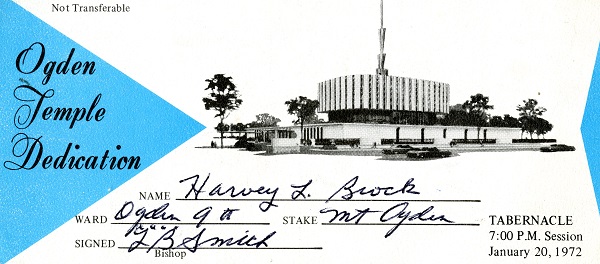
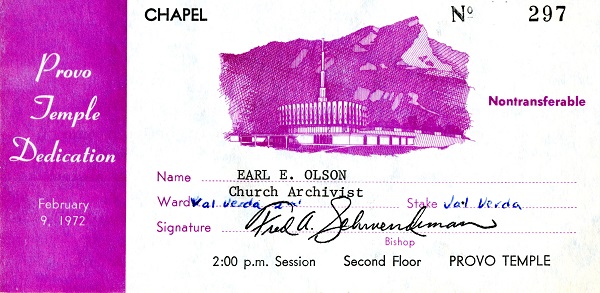 Top: Ogden Temple dedication ticket. Bottom: Provo Temple dedication ticket. Courtesy of Church History Library.
President Joseph Fielding Smith shared the same prepared message in each of the two sessions. In Provo he noted that his grandfather, Hyrum Smith, had been born on this date in 1800 and that it was fitting that this anniversary was being marked by the dedication of another temple “wherein those keys and powers, held jointly by him and the Prophet Joseph Smith, may be used for the salvation and exaltation of many of our Father’s children.” President Smith testified that the decision to build these temples had come through inspiration. He affirmed that “in this holy house we are entitled to receive revelation and guidance from on high. The Lord is anxious to reveal His mind and His will to us, and to give us counsel and direction and doctrine as rapidly as we are able to receive them.”[38]
President Smith had his first counselor, Harold B. Lee, read the dedicatory prayer in each session. The prayer in Provo specifically petitioned, “Let that great temple of learning—the Brigham Young University . . . be prospered to the full. Let Thy enlightening power rest upon those who teach and those who are taught. . . . May those who teach and study in all academic fields have their souls enlightened with spiritual knowledge, so they will turn to Thy house for blessings and knowledge and learning that surpass all that may be found elsewhere.” Looking to the future, President Smith acknowledged that “we look forward to the day, O our God, when Thou wilt reveal unto Thy servants where other temples shall be built, in all the nations where Thy saints increase in numbers and serve Thee in righteousness.”[39] The Ogden and Provo Temples were the fourteenth and fifteenth operating temples in the Church. In less than three decades, the total would exceed one hundred.
Impact of the New Temples
When Fred Baker of the Building Committee took the initial reports of activity in the Ogden Temple to Church headquarters, he found the senior Brethren to be stunned; they couldn’t believe that the “little temple in Ogden” was outperforming the “flagship temple” in Salt Lake City. With the coming of these two new temples, this sacred work surged. Between 1971 and 1975, in the area bounded by Logan on the north and Manti on the south, the number of ordinances soared by about 140 percent. Because the activity in the Logan, Salt Lake, and Manti Temples was not diminished significantly, most of this increase came from the two new temples. For the next quarter of a century, the Provo Temple led the Church in the total number of endowments performed for the dead, even when the estimated 15 percent from Brigham Young University and the nearby Missionary Training Center was subtracted.
 Ogden Utah Temple (center), February 2010. Courtesy of Intellectual Reserve, Inc.
Attending the temple was an important activity for these two groups. It was not only part of preparation for missionary service, but it was also significant to the future missionaries personally. Elder Glenn Griffin recalled, “I was quite nervous about the following two years. I will never forget the peace that I felt whenever I walked the grounds of the Provo Temple.”[40] A sister missionary, BreeAnna Barney, appreciated the power she felt as she walked toward the temple with a group of enthusiastic missionaries.[41]
Students at Brigham Young University also appreciated the temple. Clayton Schmoekel thought of it as “a place of refuge” while he was away from home. “Sometimes school can be very difficult, and trials and temptations build up.” Attending the temple gave him confidence. “The temple always gives me hope,” he gratefully acknowledged.[42] When Rylie Jex left home, she encountered new faces and new challenges. “I was grateful for one steadfast thing in my life amidst all the changes,” she reflected.[43] Gladys Ibarra, a student from Florida, similarly remembered, “When I came to BYU my whole world turned upside down—with its beautiful tall mountains, dry climate, snow, and members surrounding me everywhere. I knew I was far away from the tropical paradise I called home. It was a huge and intimidating change in my life, but one of the greatest blessings to me was having a temple nearby. It was the one place where every time I entered I knew where I was, who I was, and I felt peace and at home.”[44]
Briana Crook described how driving down University Parkway from Orem, she could “see the Provo Temple lit up, in all its glory welcoming me home.”[45] Brooke LeFevre thought of the temple back home as “my temple,” but acknowledged that after coming to BYU, the Provo Temple had assumed that role. She was grateful that the temple workers became acquainted with her by name; one time when she came alone without her friend, one kindly worker said, “Oh, don’t you worry. We will always be here for you; you are never alone.” This simple assurance “brought immediate tears to my eyes,” she gratefully reflected.[46]
When Kate Kimball was called to leadership in her campus ward Relief Society, she was overwhelmed. However, she acknowledged, “When I attended the Provo Temple as a willing servant of God, I received promptings which directed me how to best fulfill my calling. I was able to see the sisters in my ward as if through the eyes of God. My love for them grew with each thoughtful visit to the temple.”[47]
Returned missionaries linked attending the temple with memories of their earlier experience at the MTC. Young married students looked upon attending the temple together as a powerful means to strengthen their eternal relationship. For many, Friday-evening temple trips became a favorite date night and included dinner in the temple cafeteria before the endowment session. Others found the temple to be a particular strength as they prepared for eternal marriage. Cory Hinds expressed that when he was present as his fiancée received her endowment, he realized, “The joy I felt watching new converts on my mission enter into the waters of baptism did not come close to comparing to the joy I felt as my soon-to-be bride entered into temple covenants with the Lord.”[48] Daniel Wahlgren, a new husband, affirmed, “I love the temple and want to share that with my wife. We’ve only been married a few weeks, but I want our marriage to be a forever and eternal marriage.”[49]
The exteriors of these two temples remained relatively unchanged for over three decades. Then, as part of a project to upgrade the Ogden Temple and enhance its grounds, a statue of Moroni was placed atop the temple’s tower on November 18, 2002. A similar statue was placed on the twin Provo Temple a few months later, May 12, 2003. The golden towers of these temples were painted a brilliant white to increase contrast between them and the gold-leafed angelic figures. Because the entrances of both temples were on the west, observers wondered in which direction Moroni would face.[50] Most (but not all) Latter-day Saint temples face east, so ideally, they conjectured, statues of Moroni should face that direction. Because the Second Coming of Jesus Christ has been likened to the dawning of a new day (see Joseph Smith—Matthew 1:26), orienting the herald angel toward the east suggests a call to prepare for the Savior’s advent. The Ogden and Provo statues were placed facing east.
The unique design of these two temples would continue to distinguish them among the growing number of these sacred houses worldwide. In the meantime, additional temples had been built in Utah—three larger and one smaller. Three others had been remodeled in significant ways.
Now that the Ogden and Provo Temples were up and running and had taken a considerable load from Logan and Manti, the time had come to look at renovating and refurbishing the first three pioneer temples that were now almost a century old.
Notes
[1] “Ogden to Get a Temple Mormons Are Told,” Standard-Examiner (Ogden, UT), December 13, 1920.
[2] Deseret News, May 16, 1921; see also Salt Lake Tribune, May 17, 1921, in Journal History of The Church of Jesus Christ of Latter-day Saints, May 15, 1921, 1.
[3] Doyle L. Green, “Two Temples to be Dedicated,” Ensign, January 1972, 6.
[4] “First Presidency Inspects Temple Site, Deseret News, May 16, 1921, 5.
[5] Gregory A. Prince and Wm. Robert Wright, David O. McKay and the Rise of Modern Mormonism (Salt Lake City: University of Utah Press, 2005), 269.
[6] Benjamin H. Bullock, affidavit, 1952, Church History Library.
[7] Ernest L. Wilkinson to the First Presidency, August 7, 1952, Brigham Young University Archives.
[8] Ben E. Lewis, “I Remember, 1988–2000,” 25-26, L. Tom Perry Special Collections, Harold B. Lee Library, Brigham Young University, Provo, Utah.
[9] Prince and Wright, David O. McKay and the Rise of Modern Mormonism, 269.
[10] Emil B. Fetzer, Completed Writings of Emil Baer Fetzer (privately published, 2003), 1, Church History Library, Salt Lake City.
[11] Prince and Wright, David O. McKay and the Rise of Modern Mormonism, 269.
[12] Fetzer, “Sacred Twin Temples,” 2.
[13] Fred A. Baker, interview by Justin R. Bray and Scott R. Christensen, January 12, 2012, Church History Library.
[14] Lewis, “I Remember,” 13:27.
[15] Harold W. Burton, “Architectural Features of the Oakland Temple of The Church of Jesus Christ of Latter-day Saints,” MS 4235, folder 1, Church History Library, 6.
[16] David O. McKay, dedication proceedings, New Zealand Temple, April 20–23, 1958, Church History Library, quoted in Richard O. Cowan, Temples to Dot the Earth (Springville, UT: Cedar Fort, 2011), 177.
[17] Harold B. Lee, “Preparing to Meet the Lord,” Improvement Era, February 1965, 122.
[18] Henry A. Smith, “2 New Temples Planned,” Church News, August 19, 1967, 4.
[19] Emil B. Fetzer, “The Sacred Twin Temples: Ogden Temple Provo Temple,” in Emil Fetzer and June Fetzer, Completed Writings of Emil Baer Fetzer (n.p., the authors, 2003), 3.
[20] Fetzer, “Sacred Twin Temples,” 3.
[21] Fetzer, “Sacred Twin Temples,” 3.
[22] Fetzer, “Sacred Twin Temples,” 4; see also Doyle L. Green, “Two Temples to Be Dedicated,” Ensign, January 1972, 6–11.
[23] Fetzer, “Sacred Twin Temples,” 4.
[24] Fetzer, “Sacred Twin Temples,” 5.
[25] Fetzer, “Sacred Twin Temples,” 5.
[26] Fetzer, “Sacred Twin Temples,” 5.
[27] Fred A. Baker, interview by Justin R. Bray and Scott R. Christensen, January 12, 2012, Church History Library.
[28] Quoted in Joseph Young Toronto, Forever and Ever: The Life History of Joseph Young Toronto (Provo, UT: BYU Press, 1996), 171.
[29] Henry A. Smith, “2 New Temples Planned,” Church News, August 19, 1967, 4.
[30] Toronto, Forever and Ever, 171.
[31] Elaine Cannon, “Their Book of Acts,” New Era, February 1971, 13.
[32] Stephen W. Gibson, “A New Temple Begins,” Church News, September 20, 1969, 3.
[33] Fetzer, “Sacred Twin Temples,” 9.
[34] “Church in Action: Provo Temple Rises Rapidly,” Church News, May 2, 1970, 13.
[35] “Church in Action,” Church News, October 17, 1970, 13.
[36] “Inside a House of the Lord,” New Era, April 1972.
[37] “New Ogden Temple Dedicated,” Church News, January 22, 1972, 3.
[38] “Hyrum Smith Honored by Pres. Smith,” Church News, February 12, 1972, 3–4.
[39] “Dedication Prayer of Provo Temple,” Church News, February 12, 1972, 5; for the complete text of the dedicatory prayer, see appendix C.
[40] Glenn Griffin, statement to Richard O. Cowan, September 14, 2012.
[41] BreeAnna Barney, statement to Richard O. Cowan, September 13, 2012.
[42] Clayton Schmoekel, statement to Richard O. Cowan, September 13, 2012.
[43] Rylie Jex, statement to Richard O. Cowan, September 8, 2012.
[44] Gladys Ibarra, statement to Richard O. Cowan, September 6, 2012.
[45] Briana Crook, statement to Richard O. Cowan, September 13, 2012.
[46] Brooke LeFevre, statement to Richard O. Cowan, September 12, 2012.
[47] Kate Kimball, statement to Richard O. Cowan, September 12, 2012.
[48] Cory Hinds, statement to Richard O. Cowan, September 6, 2012.
[49] Daniel Wahlgren, statement to Richard O. Cowan, September 13, 2012.
[50] “Moroni Statue,” Daily Herald (Provo, UT),May 13, 2003, A1.
