
 menu icon in the top, right corner of the screen.
 icon above to close this box.
 icon at the bottom of the screen below the browser—if you don't see it, swipe up to unhide it.
Beginnings
Richard O. Cowan and Clinton D. Christensen, "Beginnings," in Temples in the Tops of the Mountains: Sacred Houses of the Lord in Utah (Provo, UT: Religious Studies Center, Brigham Young University; Salt Lake City: Deseret Book), 1–5.
 Rob Martin/
Almost from the beginning, Latter-day Saints have been a temple-building and temple-attending people.[1] For them, temples are more than ordinary meetinghouses; they truly are the “house of the Lord.” Since Old Testament times, temples have served two major functions: first, they have been places where heaven and earth meet—a place of revelation between God and man—and second, places where sacred ceremonies or “ordinances” have been performed by which the faithful enter covenants with God. Holy instructions and promises connected with these ordinances testify of humankind’s ultimate eternal destiny and set forth how it can be attained.
Two temples had been built by the Latter-day Saints before the Saints entered the valley of the Great Salt Lake in 1847. Church leaders like Brigham Young and Wilford Woodruff brought in their hearts and minds the ordinances of the temple as instructed by the Prophet Joseph Smith. They planned to build more temples as the Restoration continued. The Kirtland and Nauvoo Temples were preparatory temples to what Latter-day Saints would later associate with the fullness of temple ordinances we see today. The Lord was laying the foundation for the work to redeem the dead with these temples.
In Kirtland, Ohio, the Latter-day Saints overcame poverty and persecution to build their first temple in the mid-1830s. Their sacrifice surely did bring forth the blessings of heaven. As the temple neared completion, the Saints enjoyed a rich outpouring of spiritual gifts, including prophecy, speaking in tongues, and visions of angels. Joseph Smith declared that “this was a time of rejoicing long to be remembered.”[2] These events climaxed with glorious experiences during the day-long dedication of the temple on Sunday, March 27, 1836. One week later, on April 3, the Prophet recorded that Jesus Christ appeared in glory to accept the temple and that Elijah the prophet, in fulfillment of Malachi’s prophecy, restored the sealing keys that were “to turn the hearts of the fathers to the children, and the children to the fathers” (Doctrine and Covenants 110:15; see Malachi 4:6). Within a few years, the first genealogical societies were organized in both Europe and North America. Latter-day Saints often refer to this interest in ancestors as “the spirit of Elijah.”
 Kirtland Temple photo. Courtesy of Church History Library, Salt Lake City.
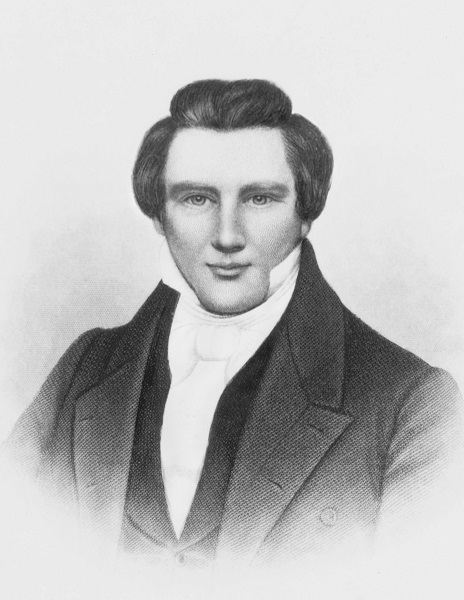 Joseph Smith. Courtesy of Intellectual Reserve, Inc.
Clearly the first function of temples—a place of revelation—had been restored. The Kirtland Temple, however, had no facilities for ordinances—the second function of temples. Instead, it was designed more for general meetings, consisting mostly of two large halls, one above the other. Being the Church’s only building, it needed to be a multipurpose structure accommodating various activities. However, Joseph Smith did make the first step toward future temple ordinances within the Kirtland Temple. On January 21, 1836, Joseph Smith “administered” and other elders performed the ordinances of washing and anointing, which at the time were performed in preparation for the elders to take the gospel to the nations.[3] Also on the same day that washing and anointing were performed in the Kirtland Temple, Joseph received the revelation known as Doctrine and Covenants 137. In this vision, Joseph saw his unbaptized brother Alvin Smith in the celestial kingdom, learning that he too would be an “heir to salvation.”[4] God taught Joseph that there was a plan for the dead to receive exaltation. It is fitting that this revelation occurred in the first temple of the restored Church, as temples would be an essential place for ordinances to be carried forward for the living and the dead.
Temple Ordinances Restored
A greater fullness of sacred ordinances unfolded while the second temple was being built at Nauvoo, Illinois. In 1840, Joseph Smith taught the Saints that they could be baptized on behalf of the dead (compare 1 Corinthians 15:29). They eagerly went into the Mississippi River to perform this ordinance, thus making gospel blessings available to their loved ones who had died without this opportunity. In 1842 the Prophet presented the endowment, which was a “course of instructions” describing the path which leads back into the presence of God.[5] Joseph recorded that on May 4 he had “spent the day” with a select group “instructing them in the principles and order of the Priesthood, attending to washings, anointing, endowments, and the communication of keys pertaining to the Aaronic Priesthood, and so on to the highest order of the Melchizedek Priesthood” and teaching all the “principles by which any one is enabled to secure the fullness of those blessings” and be prepared to dwell in the presence of God “in the eternal worlds.”[6] Soon couples were also being “sealed,” or married, making solemn covenants “for time and for all eternity” (see Doctrine and Covenants 132:7–20). Children could also be linked to their parents through sacred ceremonies performed by priesthood authority.[7]
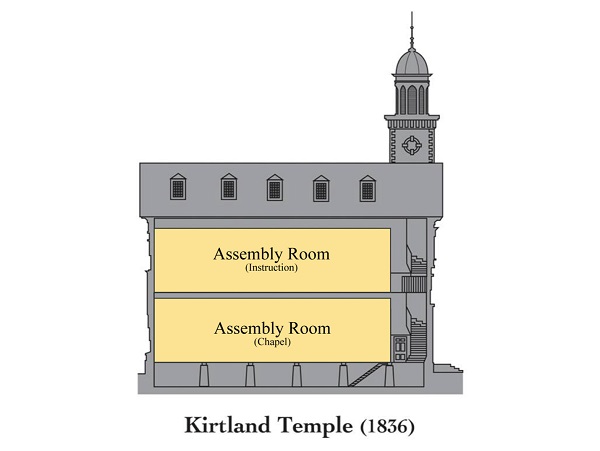 Diagram of Kirtland Temple. Courtesy of Lee R. Cowan.
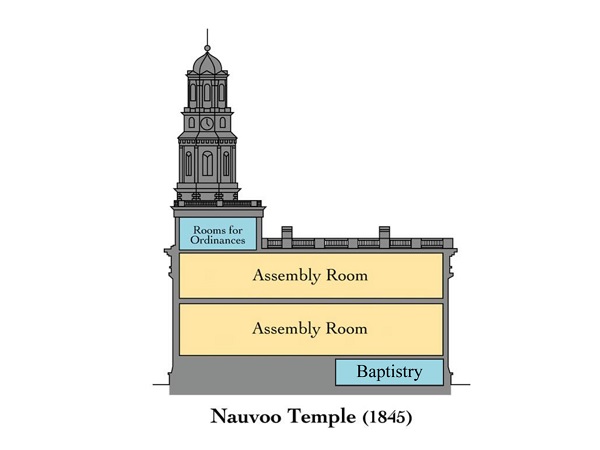 Diagram of Nauvoo Temple. Courtesy of Lee R. Cowan.
Thus, the second function of temples—sacred ordinances—had been restored. When completed, the Nauvoo Temple repeated the pattern of two large meeting rooms but added a font in the basement and facilities for other ordinances on its uppermost floor.
Temples in Utah
Unfortunately, the forces of religious bigotry climaxed with the murders of Joseph Smith and his brother Hyrum in 1844. As anti-Mormon persecution continued, the Saints in Nauvoo—under the leadership of Joseph’s successor, Brigham Young—made their well-known trek across the plains to new homes in the Rocky Mountains. The endowment they had received in the Nauvoo Temple fortified them for this ordeal. “What was it that gave those early Church members such strength?” asked Elder David A. Bednar. “What fueled their devotion and enabled them to press forward in overwhelmingly adverse conditions? It was the fire of the temple covenants and ordinances that burned in their hearts.”[8] For example, of the trek across muddy Iowa, Sarah Rich wrote, “If it had not been for the faith and knowledge that was bestowed upon us in that temple . . . , our journey would have been like . . . taking a leap in the dark.”[9]
Soon after the first pioneers entered the Salt Lake Valley in 1847, Brigham Young sent scouts north and south to locate possible sites for additional settlements. During his lifetime, some 350 communities would be established in “the top of the mountains” (Isaiah 2:2). Utah became a territory of the United States in 1850 and was admitted to the Union as a state in 1896. Four temples were dedicated here during the last quarter of the nineteenth century. With the dedication of these temples, additional knowledge would be received by Church leaders for the work of redeeming the dead, which will be shown in the following chapters.
 Nauvoo Temple. Courtesy of Church History Library.
 Drawing of the Nauvoo Temple baptistry. Courtesy of Intellectual Reserve, Inc.
During the twentieth century, the number of Latter-day Saints continued to grow in Utah and in other areas, particularly in the western United States. Rapid international growth came during the second half of the century. In all these areas, the Church built holy temples.
As the twentieth century drew to a close and a new millennium dawned, the population and number of Latter-day Saints in Utah mushroomed. People were drawn by expanding economic opportunities and by the area’s wholesome lifestyle. Over the years, twenty-eight beautiful temples would be dedicated, enhancing the spiritual lives of the Saints in the Beehive State.
Notes
[1] For a discussion of Latter-day Saint temples, see James E. Talmage, The House of the Lord (Salt Lake City: Bookcraft, 1962); Boyd K. Packer, The Holy Temple (Salt Lake City: Bookcraft, 1980); and Richard O. Cowan, Temples to Dot the Earth (Springville, UT: Cedar Fort, 1997).
[2] History, 1838–1856, volume B-1 [1 September 1834–2 November 1838], http://
[3] https://
[4] https://
[5] Talmage, House of the Lord, 99–100.
[6] Teachings of Presidents of the Church: Joseph Smith (Salt Lake City: The Church of Jesus Christ of Latter-day Saints, 2007), 414; Saints: The History of the Church of Jesus Christ in the Latter Days (Salt Lake City: The Church of Jesus Christ of Latter-day Saints, 2018), 1:453–55.
[7] Saints, 1:578–80.
[8] Jason Swensen, “Elder Bednar Declares Miracles Have Not Ceased,” Church News, January 23, 2021, 6.
[9] Quoted by Ronald A. Rasband, “Recommended to the Lord,” Ensign, November 2020, 24.
