
 menu icon in the top, right corner of the screen.
 icon above to close this box.
 icon at the bottom of the screen below the browser—if you don't see it, swipe up to unhide it.
Tossed on the Waves of Affliction
Kyle R. Walker, "Tossed on the Waves of Affliction," in Sister to the Prophet: The Life of Katharine Smith Salisbury (Provo, UT: Religious Studies Center, Brigham Young University; Salt Lake City: Deseret Book), 149–64.
When he found out how destitute we were, he cried [in pity].
—Solomon J. Salisbury
AS WILLIAM SMITH BEGAN PREACHING against the Twelve at St. Louis, in November 1845, Jenkins became his most ardent advocate. The only surviving Smith brother championed his family rights in his lectures to large audiences in the area and began promoting Joseph Smith III as the rightful successor to his father.[1] The intervening years revealed how William was less of an advocate for Joseph III’s leadership than he was for himself, but it was a postulation that strengthened his own position. He contended that it was his own right to hold the office of president until the youthful Joseph III matured, and William later transposed this lineal argument into his own right to lead the Saints.[2]
William knew firsthand what issues resonated among scattered Saints who had not followed Brigham Young and the Saints who migrated west, and he used that to his advantage. He preached on an antipolygamy platform, attempting to expose the Twelve’s private acceptance of the practice at Nauvoo. His duplicity was risky, but he recognized it as the best course to rally Saints to support his leadership. While his sensational disclosures wowed crowded audiences at St. Louis, and he successfully disrupted the local branch that had been loyal to the Twelve, his actual adherents were only about twenty. By the end of November, William decided to move further east to Cincinnati, leaving Jenkins in charge of his small branch of followers at St. Louis.[3]
In the meantime, Katharine and the children experienced a difficult winter at Nauvoo where they received little money from Jenkins’s labors in St. Louis. That probably meant that Jenkins’s efforts at preaching and retaining William’s smattering of followers consumed his time more than securing steady work. Katharine found solace in her family relationships, including remaining close to her sister-in-law Emma Hale Smith. During that previous summer, Emma and William Smith had discussed their views on succession. Emma had experienced her own frustrations with the Twelve at Nauvoo, primarily over differentiating which properties and publications belonged to her family and which belonged to the church. It was an issue that was never fully sorted out and created animosity on both sides.[4] Her discussions with William had led William to believe he had her endorsement if he should try and reform the church on a platform that was opposed to polygamy, something Emma was decidedly opposed to. However, before he even fled Nauvoo, she had withdrawn her support of his efforts, most likely because William had preached a public sermon advocating plural marriage at Nauvoo in August 1845.[5] William’s ongoing conflict with leaders in Nauvoo probably distracted him from noticing that he had lost her favor, as she astutely detected his deceit and ambition. Emma also knew William’s erratic history and conflicts with his brother Joseph and with other members of the Twelve, which impacted her trust of William and his motives.
Jenkins was absent from his family for the next five months. Katharine possibly worried whether Jenkins would ever return. There were other examples of sisters in Nauvoo whose husbands abandoned them, albeit rare, after leaving to work in St. Louis during this chaotic time. Like Jenkins, James Harris left his wife Emmeline (later known as Emmeline B. Wells) in Nauvoo to work in St. Louis because he was “restless, jobless, and overburdened with responsibility.” Though James had promised to return in two weeks, those weeks stretched into months, until Emmeline eventually realized he was never coming home. She sank into an “emotional abyss,” wrote her biographer, and “those months of empty waiting had left her morbidly reflective.” Emmeline wrote that while she had been “brought to this great city by one to whom I ever expected to look for protection,” instead she had been “left dependent on the mercy and friendship of strangers.”[6] Unlike Emmeline, Katharine at least had the support and comfort of her sisters and mother, but she could assuredly relate to Emmeline’s feelings of loneliness and worry about an uncertain future. Jenkins had been frequently absent for undetermined lengths of time and had been inconsistent as a provider.
William Smith and Jenkins Salisbury Vie for Nauvoo Property
In March 1846 William Smith hastily returned to Nauvoo from Cincinnati, stopping only briefly in St. Louis to pick up Jenkins. The timing of their return was not coincidental because most Saints had left the city just weeks earlier. Jenkins, in a letter intended for publication in Thomas Sharp’s Warsaw Signal, wrote,“Wm. Smith, brother of the late Mormon Prophet, informs me, that he has returned here for the purpose of gathering his family together, with all such of the Mormons as are willing to be guided by his counsel and remove immediately out of the state.” Jenkins further outlined his view that Smith’s “patriarchal office” entitled him to “secure to the real church all real estate and other property which rightly belongs to the church.”[7] To their dismay however, that plan did not materialize as smoothly as the two men hoped, as there were many Saints still loyal to the Twelve living at Nauvoo and trustees who remained in town to oversee the buying and selling of property. In the end, the only property William helped secure was a home that was deeded to his mother in the city—a residence he hoped to inherit after her death—after he intervened in negotiating between Nauvoo trustees and his mother.[8]
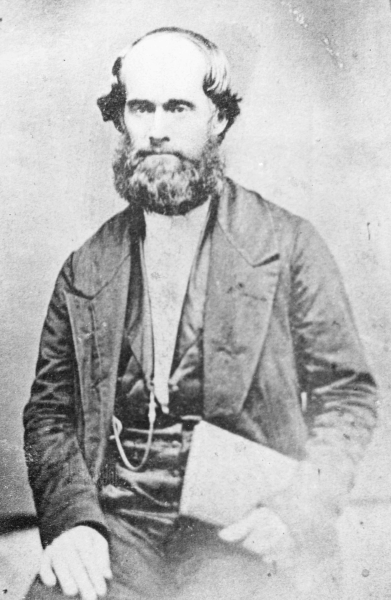 James J. Strang, 1813–56. Photograph ca. 1850, photograph of original by Sainsbury and Johnson, Salt Lake City. Courtesy of Church History Library.
While at Cincinnati, William became distracted from launching his own church once he learned of James J. Strang’s emerging branch of the church. Strang had established his headquarters in Voree, Wisconsin, and some of his early adherents in both Cincinnati and Nauvoo began to turn William to their cause. Even before his arrival in Nauvoo, William had shelved the idea of lineal succession in favor of Strang, who claimed Joseph Smith had sent him a letter appointing him as his successor just weeks before his death. As the two men struck up a correspondence, William received assurances from Strang of being appointed to prominent leadership positions within his church should the two link their aspirations.[9]
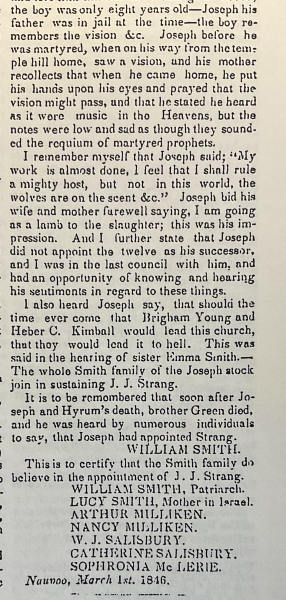 Letter from William Smith to James J. Strang, published in the Voree Herald 1, no. 7 (July 1846): 3, with his mother and his three sisters’ names attached. Katharine later denied ever signing a statement in support of James J. Strang.
While the Salisburys supported William’s vacillating claims during the previous year and even for a time after he returned to Nauvoo in the summer of 1846, that support began to wane as he switched his loyalty to Strang. However, that did not prevent William from including the names of his mother, sisters, and their spouses in several letters he wrote to Strang in 1846, implying that the entire Smith family were unitedly supporting his church.[10] It was William’s attempt to bolster his status in the new movement, and he assumed his remaining family members would follow his lead, but including their names without their consent caused confusion for the family. Katharine later issued an affidavit denying that she had ever supported Strang: “I now in truth declare that I never signed my name to such [a] certificate or document; neither did I give my consent for anyone to sign it.” She further recounted, “I never knew anything about Strang or his work,” adding, “I do not believe that my mother, Lucy Smith, or my sisters, Lucy Millikin and Sophronia MCClerrie signed any such certificate.”[11]
After affiliating with Strang for approximately one year and having been appointed an apostle and patriarch in Strang’s church, William was excommunicated by Strang for practicing polygamy in 1847.[12] Following his break with Strang, William attempted to revive his earlier church organization with some marked success in the years 1847–53 near Amboy, Lee County, Illinois. That also came crashing down once his followers discovered he was secretly practicing polygamy in his church.[13] His brothers-in-law, Jenkins Salisbury and Arthur Millikin, acted as agents for his newspaper, but that was the extent of their involvement, and the Salisburys never removed to northern Illinois, providing evidence of only tacit support to his movement during those years.[14] However, during that decade after Joseph and Hyrum’s deaths, William successfully laid the groundwork for a church organization based on lineal rights and opposed to polygamy among his family and followers. His supporters at Amboy and in southern Wisconsin almost immediately picked up where William had left off in the mid-1850s and provided a nucleus of leaders that ultimately formed the Reorganized Church of Jesus Christ of Latter Day Saints. Imbued with William’s teaching on lineal succession, William’s former disciples eventually persuaded Joseph III to assume leadership of their Church.[15] William’s teachings on lineal succession, and his narrative of injustice and maltreatment of the Smith family during the years 1845–53 profoundly impacted Katharine and her children in the ensuing decades.
Relocating in Missouri and Illinois
When William departed from Nauvoo in the spring of 1846 to follow James J. Strang, the Salisburys also left Nauvoo. Jenkins had been absent from Nauvoo the previous year and missed out on a prime opportunity to use his skill as a blacksmith in helping the Saints build and repair wagons for their journey west. With little work available in the city after the Saints’ departure in February, Jenkins and Katharine loaded up all their belongings and decided to take their family south on the Mississippi River to try and obtain work in St. Louis.
In company with the family of Latter-day Saint Charles Kelley, whose friendship dated back to their time spent in Ohio,[16] the Salisburys purchased a weathered flatboat and the two families began their journey downriver. After a brief stop at Keokuk, Iowa, they continued their journey south until they were several miles below Alexandria, Missouri. As they rounded Fox Island, their flatboat collided with a large steamboat as it was launching from shore, destroying their smaller rig and spilling all their belongings and both families into the river. With the assistance from a group of men on shore, they managed to rescue the children along with the damaged flatboat, but only a portion of their belongings. The experience was traumatizing for the family, including the Salisburys’ five children, who remembered details of the experience for the remainder of their lives.[17]
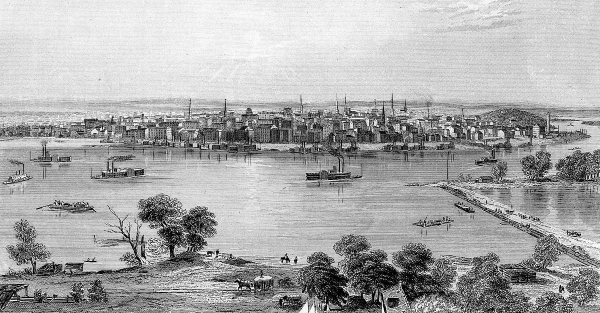 View of St. Louis in 1852, drawn by J. W. Hill, engraved by Wellstood and Peters, in the Ladies Repository 15, no. 1 (January 1855), x. Note the size of the smaller flatboats on the right side of the sketch in comparison to the much larger steamboats.
 Lucy Salisbury Duke with her youngest daughter, Emma, ca. 1870s, photographer unknown. Courtesy of Carla Duke
When Jenkins and Charles contemplated repairing the flatboat and continuing their journey, Katharine resolutely declared that she and the children had “had their last ride on that scow.”[18] Katharine could be firm when she needed to be, as she recognized the precariousness of continuing the journey in the rickety vessel and was protective of her young children. Those who knew her well described her as being “very hale and strong” and possessing a “commanding presence,” depictions which described both her stature and her temperament. Descendants recount how she could be resolute when necessary: “The kind of woman who would hen-peck a man that didn’t have equal determination.”[19] This was one of those instances, as Katharine was adamant the family remain in the area. Solomon recalled that once his mother refused to travel on the flatboat, “that ended the discussion,” and “right there the Saint Louis trip ended.”[20]
The Salisburys spent the remainder of the summer near Fox Island, where Jenkins and Charles cut cordwood for the steamships who docked in the vicinity. They managed to eke out a living until August, when the entire crew came down with the “shaking ague” (likely malaria). Kelley’s wife died of the disease a short time later, and Charles departed for the East to be with family. The Salisburys moved their family into the town of Alexandria, but it did little to improve their health. Once Katharine also became ill, city authorities intervened to assist their family and “hired a colored lady to take care of us,” and a local doctor was assigned to attend to the family.[21] Their two-year-old daughter, Emma, did not survive the winter, dying of malaria on October 10, 1846, and was buried “in the river bottom.”[22]
The Salisburys’ eldest daughter Lucy, who was only twelve years old at the time, had to grow up quickly during the chaos of the mid-1840s. She met Samuel Duke while the family was still living in Alexandria that same winter. Samuel worked alongside Jenkins at his trade as a blacksmith, perhaps laboring as an apprentice as Jenkins had done during his youth. [23] Samuel, who was born in North Carolina, was seventeen years older than Lucy. Perhaps she was taken in by the Duke family when the Salisburys became a ward of the town. The affection between them seemingly blossomed into romance, and the two wed a short time later, on January 21, 1847, in Alexandria.[24] Though not illegal to marry at age twelve in the state of Missouri, the union pushed the limits of societal propriety. Both Samuel and Lucy misstated their age each time the census was taken for several decades while they lived in Illinois, probably to avoid any legal complications and make the marriage appear more acceptable to neighbors.[25] At a much later date, Lucy’s cousin Joseph Smith III summarized their marriage as an “unfortunate” union when she married Samuel Duke, “a man perhaps twice as old as she.” While Samuel had initially made a favorable impression upon the family, according to Joseph III, he ultimately “proved to be a reckless and roistering fellow, unfitted to make her happy.”[26] The newlyweds followed Lucy’s parents each time they relocated over the next decade.
In the early months of 1847 and on advice from their attending physician, the Salisburys moved their family across the Mississippi River to Warsaw, Illinois. The family likely concealed their identity while in the area, as Warsaw was the hub of anti-Mormon sentiment in Hancock County, Illinois, in the 1840s and home to many of those who participated in killing Katharine’s brothers and driving the Saints from the state just a few months earlier. Solomon recalled that his family “rented an old house on the bluff below the city” while they lived in Warsaw, slept on straw with no covers at night, and did not possess a change of clothing. A neighbor generously loaned them a stove to heat their home, but their only possession was Katharine’s milk cow, which had somehow survived the family’s migrations, even the flatboat accident on the Mississippi. Jenkins worked some at his blacksmith trade in town but evidently had not fully recovered his health. Nearing his twelfth birthday, Solomon contributed by obtaining work assisting with a local ferry boat operation, for which he was paid twenty-five cents a day.[27]
Adding to their difficulties, Katharine was in the late stages of pregnancy. The family recognized Warsaw would not be a permanent place of settlement, and by fall Jenkins wrote to a childhood friend named Donk Alexander, then living in McDonough County, Illinois, to see what assistance he could provide. Alexander immediately came to the family’s rescue, bringing two wagons to pick up the family and transport them some forty-five miles east to his home. When he drove up to the house, Jenkins remarked, “Donk, what did you bring two teams for? All I’ve got are the wife and children.” When Alexander saw what few belongings they possessed and observed their destitute circumstances, he wept in pity.[28]

The Salisburys lived with the Alexanders until their health improved, and probably remained there until after Katharine delivered a son they named Loren Ephraim on May 2, 1847.[29] Within months of Loren’s birth, the Salisburys moved just across the county line into Hancock County, to the town of Webster, Illinois. The rural village had previously been the location of a flourishing branch of the church, known initially as Ramus and then renamed Macedonia during the first half of the decade, and where Sophronia and her family had resided during that time period. However, by the time the Salisburys moved to town, the name had been changed to Webster in an effort to erase any reminders of the church in their community.[30] It had only been a year since the Battle of Nauvoo had successfully driven most of the remaining Saints from the county.[31] By the summer of 1847 there were less than two hundred inhabitants in town,[32] and the community appeared desolate, with twenty-five or more abandoned homes that the Saints had left behind. The Salisburys moved quietly into one of one of these empty residences, and Jenkins began advertising his work as a blacksmith. With only a smattering of residents in the area, he would again have to travel to obtain money for the family. His efforts included several moves back and forth across the McDonough and Hancock County line, as well as spending time in Quincy and Warsaw, Illinois.[33]
It continued to remain a chaotic time for the family, as they sometimes remained in Webster, and other times the family relocated with Jenkins for months at a time. During this time their youngest child, six-month-old Loren, died at Webster on November 18, 1847, adding to the family’s sorrow.[34] Katharine gave birth to their final child in Webster on January 27, 1850, a son whom they named Frederick Vilian.[35] Only five of the eight children born to the Salisburys survived to adulthood.
During the period of 1844–51, the family had moved at least nine times, creating an environment of uncertainty for their growing family. Solomon moved in with his older sister Lucy and her husband, Samuel Duke, in McDonough County in the late 1840s, which provided him with more stability and work during the harvest season. By the early 1850s, the family settled more permanently in Webster. However, illness struck the family again in the year 1853, and this time it hit Jenkins the hardest. He contracted typhoid fever, and his condition quickly grew worse until his death on October 28, 1853, at the age of forty-four. Katharine was left a widow with four boys to raise between the ages of three and seventeen, residing in an area where her neighbors were hostile toward their faith.[36] The precariousness of her situation would bring tremendous challenges during the ensuing three decades.
Notes
[1] William Small (St. Louis) to Benjamin Winchester, November 24, 1845, Messenger and Advocate of the Church of Christ (Pittsburgh) 2, no. 2 (December 1845): 407–8.
[2] William Smith, A Revelation Given to William Smith, in 1847, On the Apostacy of the Church and the Pruning of the Vineyard of the Lord (n.p., 1848), 1–2, M293.1, CHL; Kyle R. Walker, William B. Smith: In the Shadow of a Prophet (Salt Lake City: Greg Kofford Books, 2015), 311–15, 352–54
[3] Small to Winchester, November 24, 1845.
[4] Valeen Tippetts Avery and Linda King Newell, “The Lion and the Lady: Brigham Young and Emma Smith,” Utah Historical Quarterly 48, no. 1 (1980): 81–97.
[5] “Brother Salsbury had just [come?] to St. Louis without obtaining your name [of support],” wrote William to Emma from St. Louis on October 21, 1845. “Judge my Serprise Emma when you now refuse to help me to reform the Church after the many times I have talked with you on this Subject and asked what I Should do to save my fathers family, . . . and the answer was for me to Come out and proclame against the Spiritual wife doctrine [and] the usurpation of the 12.” William Smith (St. Louis) to Emma Smith, October 21, 1845, CHL. For information on William Smith’s Nauvoo sermon advocating polygamy, see Dean C. Jessee, ed., John Taylor Nauvoo Journal (Provo, UT: Grandin Book, 1996), 97–99.
[6] Emmeline eventually married Newel K. Whitney as a plural wife, on February 14, 1845. Carol Cornwall Madsen, Emmeline B. Wells: An Intimate History (Salt Lake City: University of Utah Press, 2017), 53–57.
[7] W. J. Salisbury (Nauvoo, IL) to Mr. [Thomas] Sharp for the Warsaw Signal, Warsaw Signal 3, no. 2 (April 8, 1846): 2.
[8] Orson Hyde (Nauvoo, IL) to Dear Brethren, March 27, 1846, Brigham Young Office Files, 1832–78, General Correspondence, Incoming, 1840–77, Letters from Church Leaders and Others, 1840–77, Orson Hyde, 1846, CHL; Kyle R. Walker, “Looking After the First Family of Mormonism: LDS Church Leaders’ Support of the Smiths after the Murders of Joseph and Hyrum,” John Whitmer Historical Association Journal 32, no. 1 (Spring/
[9] William Smith (Nauvoo, IL) to Brother [James] Strang, March 17, 1846, James Jesse Strang Collection, 1832–1947, Beincke Rare Book and Manuscript Library, Yale University Library, New Haven, CT; William Smith to Dear Brother Strang, April 12, 1846, Voree Herald 1, no. 6 (June 1846): 3–4. Strang published William’s letters in his Voree Herald newspaper, and William was ordained as the presiding patriarch and as a member of Strang’s First Presidency, per William’s request. “The First Presidency,” Zion’s Reveille 1, no. 12 (December 1846): 3; “Patriarchs,” Zion’s Reveille 2, no. 1 (January 14, 1847): 3.
[10] William Smith (Nauvoo, IL) to James J. Strang, March 1, 1846, Voree Herald 1, no. 7 (July 1846): 3; “Opinions of the Smith Family,” Voree Herald 1, no. 6 (June 1846): 1.
[11] Katharine Salisbury (Fountain Green, IL) to Editors Herald, March 26, 1899, Saints’ Herald 46, no. 17 (April 26, 1899): 261.
[12] In August, James J. Strang’s Zion’s Reveille reported, “It becomes our painful duty to give public notice that William Smith, the Patriarch, has been sometime since suspended, pending trial on charges of gross immorality.” Zion’s Reveille 2, no. 23 (August 26, 1847): 3. By October it was official, as the paper related that “William Smith, Patriarch, [has been] excommunicated for adultery. . . . And the whole congregation lifted their hands against him.” “Conference of the Church of Jesus Christ of Latter Day Saints, at Voree,” Gospel Herald 2, no. 30 (October 14, 1847): 2. For more information on Strang and Smith’s alliance and subsequent fall out, see Walker, William B. Smith, 328–37.
[13] Walker, William B. Smith, 339–403.
[14] “List of Agents for This Paper,” Melchisedek and Aaronic Herald 1, no. 5 (August 1849): 2.
[15] Kyle R. Walker, “William B. Smith and the ‘The Josephites,’” Journal of Mormon History 40, no. 4 (Fall 2014): 82–103.
[16] Both Jenkins Salisbury and Charles Kelley (or Kelly) participated in the Zion’s Camp expedition in 1834, were ordained to the office of Seventy and were excommunicated in May 1836 for neglecting their families. After relocating to Illinois, the Kelleys also lived near the Salisburgs in Plymouth. Brent M. Rogers et al., eds., Documents, Volume 5: October 1835–January 1838, vol. 5 of the Documents series of The Joseph Smith Papers, ed. Ronald K. Esplin, Matthew J. Grow, and Matthew C. Godfrey, (Salt Lake City: Church Historian’s Press, 2017), 243–44; Solomon J. Salisbury, Reminiscences of an Octogenarian (self-pub., ca. 1926), 5; E. H. Young, A History of Round Prairie and Plymouth, 1831–1875 (Chicago: Geo. T. Titus, Book and Job Printer, 1876), 87–88.
[17] Salisbury, Reminiscences of an Octogenarian, 5.
[18] Salisbury, Reminiscences of an Octogenarian, 5.
[19] Herbert S. Salisbury, “Things the Prophet’s Sister Told Me,” 2–3, typescript, San Rafael, CA, June 30, 1945, CHL; “Sister of a Prophet,” Saints’ Herald 40, no. 36 (September 9, 1893): 1.
[20] Salisbury, Reminiscences of an Octogenarian, 5.
[21] Salisbury, Reminiscences of an Octogenarian, 5.
[22] Dorothy D. Dean, Salisbury Family Group Sheet, n.d., copy of original in author’s possession. Solomon said Emma died at Alexandria, Missouri, in 1847. The family continued to live in Alexandria in the early months of 1847, and it appears that Solomon’s memory was a general recollection of the winter of 1846–47. Salisbury, Reminiscences of an Octogenarian, 5. Katharine said Emma died in 1856, but it appears to either have been a mistake by Katharine, or George A. Smith transcribed it incorrectly from Katharine’s genealogy sheet. George A. Smith (Salt Lake City) to Cousin Catherine [Salisbury], August 17, 1865, Historian’s Office letterpress copybooks, 1854–1879, Vol. 2, 1859–1869, CHL; John Smith Papers, 1833–1854, Journal, 1846 February–1854 May, CHL.
[23] Richard P. Howard, ed., TheMemoirs of President Joseph Smith III (1832–1914) (Independence, MO: Herald Publishing House, 1979), 189.
[24] The couple was married by M. J. Brown, justice of the peace, and the marriage record was not recorded until August 18, 1848. Marriage Records, Book A, 1837–54, p. 85, Clark County Courthouse, Kohoka, MO.
[25] In the 1850 census, Samuel’s age is correct, but Lucy’s age is recorded as eighteen, when she was only fifteen at the time the census was enumerated. In the 1860 census, Lucy’s age is correct, while Samuel’s age is listed as thirty-two, ten years younger than his actual age. 1850 United States Federal Census, McDonough County, Illinois; 1860 United States Federal Census, Hire Township, McDonough County, Illinois. While I have been unable to locate Samuel Duke’s birth record, Joseph Smith III confirmed that Duke was “a man perhaps twice as old as she [Lucy].” Richard P. Howard, ed., The Memoirs of President Joseph Smith III (1832–1914) (Independence, MO: Herald Publishing House, 1979), 189.
[26] Howard, Memoirs of President Joseph Smith III, 189.
[27] Salisbury, Reminiscences of an Octogenarian, 6.
[28] Salisbury, Reminiscences of an Octogenarian, 6.
[29] George A. Smith (Salt Lake City) to Cousin Catherine [Salisbury], August 17, 1865, Historian’s Office letterpress copybooks, 1854–1879, vol. 2, 1859–1869, CHL; John Smith Papers, 1833–1854, journal, 1846 February–1854 May, CHL; Dorothy D. Dean, Salisbury Family Group Sheet, n.d., copy of original in author’s possession; Lucy Mack Smith, Biographical Sketches, 43.
[30] Charles J. Scofield, ed., History of Hancock County Illinois (Chicago: Munsell Publishing, 1921), 671; Susan Sessions Rugh, Our Common Country: Family Farming, Culture, and Community in the Nineteenth-Century Midwest (Bloomington: Indiana University Press, 2001), 52.
[31] Kenneth W. Godfrey, “The Battle of Nauvoo Revisited,” John Whitmer Historical Association Journal, Nauvoo Conference Special Edition (2002): 133–46.
[32] Rugh, Our Common Country, 82.
[33] Salisbury, Reminiscences of an Octogenarian, 6–7.
[34] George A. Smith (Salt Lake City) to Cousin Catherine [Salisbury], August 17, 1865, Historian’s Office letterpress copybooks, 1854-1879, vol. 2, 1859–1869, CHL; John Smith Papers, 1833–1854, journal, 1846 February–1854 May, CHL; Dorothy D. Dean, Salisbury Family Group Sheet. Solomon said his brother Loren died while the family was living in McDonough County. Orville F. Berry, “The Mormon Settlement in Illinois,” Transactions of the Illinois State Historical Society for the Year 1906, no. 11 (1906), 94.
[35] George A. Smith (Salt Lake City)to Cousin Catherine [Salisbury], August 17, 1865, Historian’s Office letterpress copybooks, 1854–1879, vol. 2, 1859–1869, CHL; John Smith Papers, 1833–1854, journal, 1846 February–1854 May, CHL; Dean, Family Group Sheet.
[36] Dean, Family Group Sheet. Jenkins’s original headstone also has the date of October 28, 1853. Katharine said that Jenkins died on November 27, 1853. George A. Smith (Salt Lake City) to Cousin Catherine [Salisbury], August 17, 1865, Historian’s Office letterpress copybooks, 1854–1879, Vol. 2, 1859–1869, CHL; John Smith Papers, 18331854, Journal, 1846 February–1854 May, CHL.
