
 menu icon in the top, right corner of the screen.
 icon above to close this box.
 icon at the bottom of the screen below the browser—if you don't see it, swipe up to unhide it.
Succession
Kyle R. Walker, "Succession," in Sister to the Prophet: The Life of Katharine Smith Salisbury (Provo, UT: Religious Studies Center, Brigham Young University; Salt Lake City: Deseret Book), 131–48.
Brigham Young assumed leadership and took many members to Utah. . . . Joseph’s family and all the rest of us stayed in Illinois, although Brigham tried hard to get us to go with him.
—Katharine Smith Salisbury
THE SALISBURYS HAD A DIFFICULT TIME deciding to leave Plymouth, Illinois. They now owned substantial land in the area and had built a blacksmith shop near their log home. Jenkins’s blacksmith business had started to produce a steady income. That temporary prosperity was fleeting as the Latter-day Saints’ reputation deteriorated at Plymouth, and residents refused to allow Jenkins to cater to their needs for work at the anvil. That had forced Jenkins to seek work in St. Louis by the spring of 1844. As threats increased and income vanished, Katharine and Jenkins felt they had no other option but to leave the community where they had resided for nearly five years.
They immediately put their property up for sale, which sold a month later, on September 16, 1844, for just a hundred dollars. It was half of what they had paid several years earlier, despite improvements they had made, including construction of Jenkins’s blacksmith shop.[1] The buyer was Dr. Henry P. Griswold, the neighbor who had refused to keep the Salisbury children at his home while Katharine was attending her brothers’ funeral at Nauvoo. The purchase allowed him to expand his vast property holdings, and by 1850 he was among the wealthiest residents at Plymouth.[2]
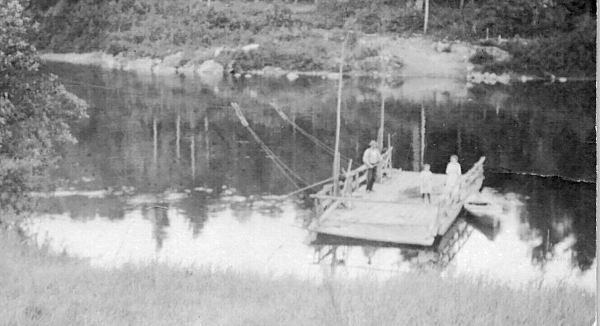 Ferry crossing at Peru, Maine. Date and photographer unknown. Note the cables and poles to assist in crossing, similar to what Solomon described when his family crossed the Illinois River.
Most of the Saints that had once swelled the population of the small community also left Plymouth that summer. E. H. Young’s history of Plymouth recorded that most of the Mormon population in town moved after Joseph and Hyrum were murdered, some within days of the event. “They disappeared quietly and almost without observation,” Young unsympathetically recorded, failing to mention the threats and intimidation by locals that led to their hasty departure. “A few, occupying farms near by, abandoned their crops, taking with them a few of their most portable goods.” Young reflected the community sentiment that “Plymouth was thus relieved of its Mormon population in 1844” and proudly recounted how “a number of the citizens of Plymouth participated in the closing scenes of the so-called Mormon War” two years later, “which resulted in the expulsion of the Mormons from the state.” The only vestige of Latter-day Saint occupation at Plymouth after the year 1846 was a signpost that still hung on the outside of William Smith’s “Mormon Hotel,” which William had sold several years earlier. Young described it as an “obnoxious remembrancer of the past.” In a final act to permanently stamp out the influence of the church on their community, a “vigilance committee” was formed and tore down the sign, notwithstanding protests of the current owner of the hotel.[3] It marked the end of the church in Plymouth.
Beardstown, Illinois
The Salisburys headed forty miles southeast of Plymouth, landing in the town of Beardstown, located in Cass County, Illinois, where they crossed the Illinois River. Solomon recalled how their several wagons were “ferried across [the Illinois River] on a flatboat, one team at a time. They had a cable fastened on each side of the river, and pulled the boat across, assisted by a man on either side of the boat, using poles.” The Salisburys settled about eight miles from Beardstown, initially staying with an older resident by the last name of Wagener while Jenkins hastily built a log cabin for his family. He advertised his work as a blacksmith and began making and repairing wagons, harnesses, and tools for the local farmers and businesses in town.[4]
Beardstown was a thriving manufacturing and shipping community, whose most prominent business was pork packing. During the peak season from November to February, anywhere from forty thousand to seventy-five thousand hogs were slaughtered in town and then shipped on the Illinois River. The town’s production of pork rivaled any western city in the country, even that of Cincinnati, whose population was more than forty-four thousand than that of Beardstown.[5] The numerous local businesses in town provided Jenkins with the necessary blacksmithing work to provide for his family, much more so than in the remote town of Plymouth.
While the Salisburys thought removing themselves several counties away from the difficulties at Plymouth would allow them to earn a living in peace, someone soon learned of their identity. Hostilities toward Latter-day Saints had reached across county lines to Beardstown. “We soon found that we could not rest here in peace,” recalled Solomon, “in a short time it was noised abroad that my mother . . . was a sister to the Mormon prophet.”[6] After only five months at Beardstown, the Salisburys were already contemplating another move. In January 1845, Katharine wrote to her mother Lucy at Nauvoo, indicating that the family was managing well but that they were contemplating relocating to Nauvoo.[7] Evidently, things grew worse by spring, when residents warned them to leave town and gradually increased pressure by avoiding doing business with Jenkins. “They starved us out,” recalled Solomon of the family’s brief stay in Beardstown. “We were very poor, and all depended on father’s work.”[8]
Nauvoo, Illinois
During another precarious living situation, Jenkins left for St. Louis to try and obtain work. He returned after only working for a few months, and the family was again on the move by late May.[9] With hostilities still at a fever pitch in western Illinois, the Salisburys decided that it would be safer to move to Nauvoo, where they had the support of the greater Smith family. They traveled west on a back trail and then north through Carthage, arriving in Nauvoo in early June, 1845.[10] With no money or property to their name, the Salisburys moved in with William Smith, who had only recently moved into the William Marks home on Water Street.[11] Marks was now managing the Mansion House with Emma Hale Smith, and the church rented the home from Marks allowing William and the Smith family to live there rent-free.[12] Mother Smith, along with her daughter Lucy and her family, also resided in the home that summer. Though the home was a commodious brick residence, the arrival of the Salisbury family swelled the number living there to sixteen, making living space cramped.[13]
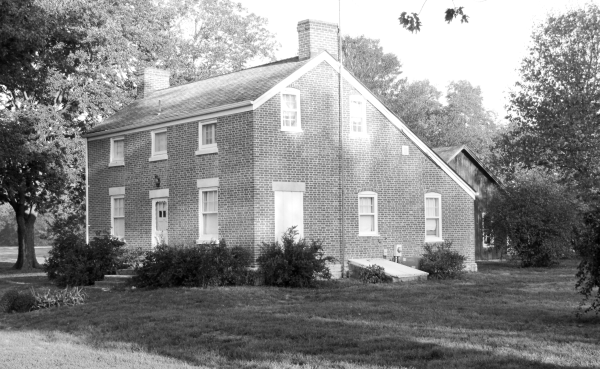 William Marks Home, Nauvoo, Illinois. Photograph by Kyle R. Walker, 2019.
Settling at Nauvoo
It was the first time Jenkins and Katharine lived in Nauvoo, though they had made regular visits. Due to their living in Plymouth from 1839 to 1844 and their one-year stay in Beardstown the following year, they had been absent during a critical transitional period for the church. The Salisburys missed Sidney Rigdon’s attempt to move the church to Pennsylvania in a role as self-appointed guardian the previous summer. They also missed the Quorum of the Twelve’s return to Nauvoo during that same period and the pivotal meeting held on August 8, 1844, where an overwhelming majority of Saints accepted Brigham Young’s leadership.[14]
One would have initially thought Jenkins would have emerged as a natural leader at some point in the upstart religion, especially with his background in the law, but such was never the case. His brother-in-law Joseph had valued loyalty above all other traits when appointing individuals to leadership roles, and Jenkins’s bouts of drinking and vacillating allegiance to the church prevented him from ever being a serious candidate in the church’s hierarchy of leaders. By the mid-1840s, it had been more than a decade since he was actively involved with the church, and Brigham Young knew of Jenkins’s long-standing position of agnosticism. This fact, combined with the family’s decision to live distanced from Nauvoo, meant that the Salisburys remained on the periphery of meaningful church developments during the Nauvoo period, such as the introduction of temple ordinances and the covert practice of plural marriage.
Yet there was a spiritual resurgence that corresponded with Jenkins return to Nauvoo that summer. Perhaps the deaths of his brothers-in-law, who had remained supportive and encouraging of Jenkins, spurred him to reevaluate his religious position. He published a letter in the Nauvoo Neighbor that June indicating that he had reconciled aspects of his skepticism, “which have been the main pillars of my unbelief in Christianity the last ten years.”[15] He also wrote several letters to Brigham Young, whom he addressed as “President”—an indication of his acceptance of his leadership of the church. “Of late there is a great many ideas runing through my weak head,” Jenkins began one letter to Young, “but when I come in contact with any that I think is good I sometimes communicate them to others.” Jenkins included items of information about prosecuting those he felt were responsible for murdering Joseph and Hyrum, as well his ideas about the church relocating to California. He was obviously informed on the current political climate of the United States and correctly anticipated a potential war with Mexico. Jenkins shared his view that the timing of a western migration was ideal, suggesting to Young that the Saints should immediately remove to California, make land claims, and then align themselves with the Mexican government in defending those claims against “this D——m government.”[16] Like other Saints during this time period, the Salisburys were distrustful of the government to protect the rights of a religious minority, as they anticipated being driven from their homes once again.[17] Jenkins’s few surviving holograph letters reveal his bright intellect, sense of humor, his expansive vocabulary, and how he drew upon his limited legal training in an attempt to secure justice for the Saints. He was obviously acting as an advocate for the church that summer and was fully supportive of Brigham Young’s leadership. That dramatic shift must have been thrilling for Katharine and the children to witness.
William Smith and Succession
During the years 1843–45, Katharine’s brother William had been absent from Nauvoo and Plymouth while serving as a missionary and overseeing the eastern branches of the Church. This meant that William had also been absent during this critical transitional period, in part because of the chronic illness of his first wife, Caroline, which had delayed his return to Nauvoo until May 4, 1845.[18] William had been introduced to plural marriage by his brother Joseph before the latter’s death and had been sealed to a second wife, Mary Ann Covington, by Brigham Young in May 1843.[19] His leadership had been divisive during his time in the East, where he had introduced a loose version of plural marriage among the eastern branches of the Church and had taken excessive liberties in bestowing the sealing power on several cohorts in the area without authorization from leaders at Nauvoo.[20] Two of his colleagues in the Twelve, Wilford Woodruff and Parley P. Pratt, both wrote to Brigham Young expressing their reservations about William’s leadership in the East when they traveled through the area in the years 1844–45.[21] As a result, Brigham Young eventually sent Parley P. Pratt to replace William as leader in the East, which did not sit well with William.[22]
The Salisburys return to Nauvoo coincided with the completion of William Smith’s two-year mission. William had initially been supportive of Brigham Young’s leadership after the death of his brother Joseph, writing to Young and indicating that “you are the President of the Corum, [as] Peater was head after Christ & had the Keys a[nd] right to get revelations.”[23] The Salisburys shared that view, as evidenced in Jenkins’s letters to Young in 1845. Throughout the first half of 1845, William appears to have increasingly desired a more expansive role in the church’s leadership circle, lobbying for something akin to the positions his brother Hyrum held at the time of his death. This was especially true once he was replaced by Parley P. Pratt as the de facto leader of the eastern branches and felt his authority was being increasingly restricted after his return to Nauvoo. After Young and his colleagues of the Twelve ordained him to the office of presiding patriarch on May 24, 1845, William almost immediately began to try and expand the authority of that office. After some back-and-forth editorials between William and the Twelve published in the Times and Seasons, things finally reached a climax at a meeting held on June 25, 1845, at the Masonic Hall in Nauvoo.
 William B. Smith, ca. 1870. Photograph by H. P. Brown. Courtesy of Community of Christ Library Archives.
During this critical meeting, William shared his evolving view that the priesthood came through his family, even threatening church leaders that if they continued to attempt to restrict his authority, he would take the entire Smith family and leave Nauvoo. “We received our priesthood from God through Joseph Smith and not through William,” Young countered during the tense meeting, and “furthermore that where the Smith family goes the Church will not go, nor the priesthood either!”[24] John Taylor, William’s colleague in the Twelve, recorded that William “seemed humbled under the influence of what Brother Brigham had said.” William then retracted his declaration, responding that “he did not mean that he would take the priesthood away with him; but that he would take his family away.” After several hours of deliberation, Young and other church leaders felt they had allayed William’s concerns, but inwardly he was seething.[25]
William fumed to his family who were present at home the next day about what had transpired at the meeting, venting about his perception that the whole Smith family was being undermined and how his rights as a leader in the church were being restricted. William had become skillful at playing the victim and successfully convinced his family that he had been wronged. He also expressed his concern about his personal safety, fearing that he might be harmed or murdered by either those inside or outside the church. That very night, Lucy Mack Smith had a dream where she “saw William in a room full of armed men and he having no weapons. They would have crushed him down, if it had not been for the power of God.” The dream closely paralleled William’s version of the meeting. Lucy was also told by an unnamed “messenger” during the dream that her family “were the first founders, fathers, and heads of this Church” and that William, as patriarch, was to be “President over all the church,” where he would “regulate the affairs of the Church.”[26] The timing of the dream was not coincidental, and it evidences William’s influence in persuading his mother and sisters that he and the family were being treated unfairly. The Smiths relished their role in being the founding family of the Restoration, and William had convinced them that he should hold a more prominent place within the post-Joseph church.
News of Lucy’s dream quickly reached church leaders. William ensured the dream was written down, but at least one church leader felt that it had been “corrected and altered by William Smith so as to suit his wishes by representing him as the legal successor of Joseph.”[27] Several days later, on June 30, a majority of the Twelve met with Lucy and her daughters, explaining their concerns about William’s ambition and views on leadership, and Lucy responded by retracting what was being construed from her dream. Lucy felt that the contents of her dream were not written down correctly and indicated that she never intended the dream to be read publicly and that she had only intended to share it with her “own children and not for the Priesthood or the church.” She thought that “William did not want it [the presidency],” further explaining “that she wanted peace, union, and harmony” with the authorities. Katharine and her younger sister Lucy, along with Lucy’s husband Arthur, were present on this occasion, and all expressed their “satisfaction” with acknowledging the leadership of the Twelve. The meeting was closed with prayer, “and the family manifested good feelings.” Tellingly, neither William nor Jenkins were present at this meeting of reconciliation, though they had been invited.[28]
Members of the Twelve worked diligently in the ensuing months to assuage those feelings William had produced in the family, which included deeding property and a brick home in Nauvoo to family members, hosting a grand dinner celebration to honor the greater Smith family, and continuing to provide housing and money for William to meet his needs.[29] Still, William continued to feel like his authority in the church was being limited, and it certainly was. As the summer progressed, leaders at Nauvoo grew increasingly apprehensive about William’s shifting ideas about leadership even as he began to distance himself from meetings with the Twelve. “Wm. . . . considers he is not accountable to Brigham nor the Twelve nor any one else,” William Clayton recorded in his diary in summarizing the feelings of the Twelve, adding, “I fear his course will bring us much trouble.”[30] The more William Smith felt reined in by other members of the Twelve, the more outspoken he became in promoting Smith family rights. It became a vicious cycle that ended up influencing the feelings of the entire Smith family. After several more clashes with his colleagues in the Twelve that summer and with little consultation with his mother or sisters, William fled Nauvoo in the middle of the night in mid-September 1845.[31]
During those final months in Nauvoo, he continued to experience anxiety about his personal safety at Nauvoo and not without cause. After he beat up Nauvoo policeman Elbridge Tufts for ignoring his directives in late June, William lost the support and protection of the police, and ever afterward he experienced concerns about his safety within the city.[32] Jenkins remained a close confidant to William during this time and continued to adopt William’s view that the Smith family had been wronged and that William should have a more prominent leadership role. As the two distanced themselves from the main body of leadership at Nauvoo, they felt increasingly ostracized. By September William’s anxiety bordered on paranoia and was a factor in his leaving Nauvoo so impulsively. It was a decision he would later regret, but neither he nor Jenkins ever fully reconciled with Brigham Young and other members of the Twelve.
William’s anxiety about his safety also impacted the family. At one point, in late summer, Katharine felt apprehensive about even stepping outside the home for fear that she would be mistaken for her husband or William due to her height.[33] Jenkins also felt fearful for his safety due to William repeatedly recounting how he felt like his life was threatened. It was Jenkins and Hiram Stratton[34] who came to William in a panic the night he fled Nauvoo, urgently warning him he needed to leave the city that very night as there was a “secret plot” to take his life.[35] Jenkins escaped the city a few weeks after William, after a close friend in Nauvoo “warned me not to stay in the county through the summer on peril of my life.”[36] William later acknowledged that he, and by extension Jenkins, overreacted when they fled Nauvoo. He described how Stratton and Jenkins’s “account of things in a tone of earnest zeal threw me into a dreadful state of excitement” and how this report, combined with other stresses at the time, “almost deranged my senses.”[37] On the heels of the murder of her brothers, combined with the perception that the lives of William and Jenkins were threatened, Katharine and the children were overwhelmed with trepidation for their own safety.
Never one to react mildly to perceived injustices, William eventually published his grievances in a pamphlet he deemed A Proclamation, which denounced the Twelve and led to his excommunication from the church in October 1845. Foremost among places he sent copies of his pamphlets was to Thomas Sharp and his Warsaw Signal.[38] Sharp was an individual whom William previously clashed with in their respective newspapers a few years earlier, and who would be tried for the murder of his brothers.[39] Yet William knew it was one of the few outlets where his voice could reach the Saints after fleeing Nauvoo, and it was an avenue to gather Saints to support his views and potential leadership. Jenkins also voiced his endorsement of William’s leadership, similarly publishing an editorial in Sharp’s Warsaw Signal in which he defended William and the rights of the Smith family.[40]
In his “Proclamation,” William had transformed his account of events that had transpired at Nauvoo into a narrative that bolstered his claims to leadership. Two rumors he generated at the time stuck in the minds of the Salisbury family: first, that Brigham Young had invented polygamy after Joseph’s death and second, that his brother Samuel’s death had resulted from being poisoned by Brigham Young at Nauvoo.[41] Neither was true, and William knew it. William had been sealed to Mary Ann Covington as a plural wife at Nauvoo before Joseph’s death and with his brother’s approval and assistance. Further undermining William’s claims was that Brigham Young had been the one to perform this union to Mary Ann Covington in May 1843, as well as sealing several wives to William during the summer of 1845.[42] Similarly, contemporary accounts of Samuel’s death note his cause of death as “bilious fever,” and no Smith family member ever suspected foul play in the year 1844. William was absent on his mission during the time Samuel died, as was Brigham Young, whom William later implicated as orchestrating the poisoning. Any report of poisoning would have had to be secondhand at best.[43] Nevertheless, William succeeded in heightening animosity toward Brigham Young within the Smith family, and these rumors influenced Katharine and her posterity for generations.[44]
 Daguerreotype of Nauvoo, with temple in the background. Photograph ca. 1846. Courtesy of Church History Library.
The winter of 1845–46 was a difficult period for the Salisbury family. There must have been mixed feelings for the family as they watched their fellow Saints eagerly receive temple ordinances and then depart on their epic journey to the Salt Lake Valley. For the first time since the 1820s, there appears to have been a division within the Smith family regarding their religious views. Mother Lucy and Sophronia and Sophronia’s husband, William McCleary, all received their endowments in the Nauvoo Temple that winter.[45] Jenkins and Katharine, along with Katharine’s sister Lucy and her husband, Arthur Millkin, chose not to receive the ordinances of the temple. That decision resulted from their support of William Smith.
Both before and after the main body of the Saints left Nauvoo, Brigham Young had labored diligently to get the Smith family to join them on their journey, but to no avail.[46] Lucy Mack Smith had initially expressed a desire to join the Saints in the migration, but at age seventy she understandably decided to remain with her daughters and under their care. She also desired to be buried by the side of her husband in Nauvoo.[47] Katharine later recalled that “Brigham Young assumed leadership and took many members to Utah, among them Hyrum Smith’s family. Joseph’s family and all the rest of us stayed in Illinois, although Brigham tried hard to get us to go with him.”[48] The only member of the immediate Smith family who had leanings toward going West was Sophronia. Her husband, William McCleary, went ahead of her to Winter Quarters sometime in the year 1846, and when he returned in the spring of 1847 to bring Sophronia and his stepdaughter Mariah with him, Sophronia appears to have changed her mind about migrating West.[49] Perhaps like her mother, Sophronia decided to live near her remaining family members. The two ostensibly decided to separate for a time, as William returned alone to Winter Quarters, where he eventually migrated to Utah in October 1849 without Sophronia and Mariah.[50]
Katharine and the children remained interested observers of all that was transpiring in the ensuing months. As the main body of the church prepared to leave the city, the children remembered there were thousands of Saints who “had been picking corn all fall to secure money to go west.”[51] Ten-year-old Solomon had a fond recollection of being taken by his mother on a tour inside of the Nauvoo Temple that fall as workers were hurriedly finishing the temple, and he was in awe at the cost and labor required to build the enormous structure.[52] He remembered that year was a particularly cold winter in which “the ice [on the Mississippi River] was three and a half or four feet thick in February.” He described how the family watched as “most of the church [members] in Nauvoo, with Brigham Young, crossed over on the ice.” Solomon added how “the winter of 1845 and 1846 was a hard winter on us,” with “no work to be had.”[53] With the departure of the Saints and with little or no regular income coming in, things were about to go from bad to worse.
Notes
[1] Deed Book N, pp. 484–85, Land and Records Office, Hancock County Courthouse, Carthage, IL.
[2] The Griswolds were one of the wealthiest families living at Plymouth, with approximately five thousand dollars in property holdings by the year 1850. 1850 United States Federal Census, Hancock County, Henry P. Griswold. Griswold practiced medicine for thirteen years at Plymouth, retiring in the year 1850. “In removing to Hamilton [IL],” wrote his biographer, “Dr. G[riswold] retired from practice, preferring to live at his ease in the enjoyment of a moderate fortune.” Thomas Gregg, History of Hancock County, Illinois (Chicago: Chas. C. Chapman, 1880), 806. See also E. H. Young, A History of Round Prairie and Plymouth, 1831–1875 (Chicago: Geo. J. Titus Book and Job Printer, 1876), 45–46.
[3] Young, A History of Round Prairie and Plymouth, 87–88, 92. William had sold his prosperous business to his brother-in-law, George D. Grant, for $1500 on November 10, 1840, who in turn sold the property to Don Carlos Smith the following month. The business appears to have become a family operation, as the property changed hands several times over the next few years, at one point being purchased in the names of William’s daughters, Mary Jane and Caroline Louisa. Book H, Deeds and Mortgages, November 10, 1840, 638–39; Bonds and Mortgages, Book 1, 102; Bonds and Mortgages, Book K, 8; all in Hancock County Courthouse, Carthage, IL. E. H. Young noted the last Mormon ties to the hotel ended when it was sold to David Higby in the year 1847. Young, A History of Round Prairie and Plymouth, 91.
[4] Solomon J. Salisbury, Reminiscences of an Octogenarian (self-pub., ca. 1926), 4. There are multiple families with the last name of Wagener that lived in Beardstown, IL.
[5] William Henry Parrin, ed., History of Cass County, Illinois (Chicago: O. L. Baskin, 1882), 114.
[6] Salisbury, Reminiscences of an Octogenarian, 4.
[7] Lucy Mack Smith (Nauvoo, IL) to William Smith, January 23, 1845, CHL.
[8] Salisbury, Reminiscences of an Octogenarian, 4.
[9] W[ilkins] J[enkins] Salisbury (St. Louis, MO) to Brigham Young, May 9, 1845, Brigham Young Office Files 1832–78, General Correspondence, Incoming, 1844–77, box 20, folder 15, CHL.
[10] Salisbury, Reminiscences of an Octogenarian, 4. The Salisburys appear to have arrived in Nauvoo in early June, as Jenkins had a letter published in the June 18 issue of the Nauvoo Neighbor. W. J. Salisbury to Mr. Editor, Nauvoo Neighbor 3, no. 7 (June 18, 1845): 3.
[11] William said that he moved into the William Marks home “soon after” his wife Caroline’s death, which occurred on May 22, 1845. William Smith to Joshua Grant Jr., August 12, 1845, Nauvoo Neighbor 3, no. 16 (August 20, 1845): 3. The Salisbury family appear to be living in the Marks home by the end of June 1845. See Dean C. Jessee, ed., John Taylor Nauvoo Journal (Provo, UT: Grandin Book, 1996), 79.
[12] Brigham Young, in “Conference Minutes,” Times and Seasons 6, no. 16 (November 1, 1845): 1014.
[13] William had recently remarried Mary Jane Rollins on June 22, 1845, and he lived in the home with his new bride and two daughters. William Smith to Joshua Grant Jr.; “Married,” Nauvoo Neighbor 3, no. 9 (July 2, 1845): 3. There were seven in the Salisbury family (including Jenkins, who remained in Nauvoo through June), three in the Millikin family, plus Lucy Mack Smith and her caregiver/
[14] Matthew J. Grow et al., eds., Administrative Records, Council of Fifty Minutes, March 1844–January 1846, vol. 1 of the Administrative Records series of The Joseph Smith Papers, ed. Ronald K. Esplin, Matthew J. Grow, and Matthew C. Godfrey (Salt Lake City: Church Historian’s Press, 2016), 206–8.
[15] W. J. Salisbury to Mr. Editor.
[16] Salisbury to Brigham Young, May 9, 1845; W[ilkins] J[enkins] Salisbury (City of Joseph [Nauvoo, IL]), to Brigham Young, July 28, 1845, Brigham Young Office Files 1832–78, General Correspondence, Incoming, 1844–77, box 20, folder 15, CHL.
[17] JSP, A1:6, xxv–xliii.
[18] William Smith (Nauvoo, IL) to Dear Brethren, May 10, 1845, Nauvoo Neighbor 3, no. 2 (May 14, 1845): 2–3.
[19] Mary Ann [Covington Sheffield] West, Testimony, in United States Testimony 1892, Court of Appeals (Eighth Circuit), 495–96, MS 1160, CHL; Kyle R. Walker, William B. Smith: In the Shadow of a Prophet (Salt Lake City: Greg Kofford Books, 2015), 179–80.
[20] For more information on William’s activities as president of the eastern branches of the church, see Walker, William B. Smith, 180–207.
[21] Wilford Woodruff (Boston), to Brigham Young, October 9, 1844; Wilford Woodruff (Scarborough, ME) to Brigham Young, November 16, 1844; P. P. Pratt (New York City) to Brigham Young, May 7, 1845, all in Brigham Young Office Files 1832–78, Letters from Church Leaders and Others, 1840–77, CHL.
[22] Walker, William B. Smith, 202–6.
[23] William Smith (Bordentown, NJ) to Brigham Young, August 24, 1844, CHL.
[24] William Smith, “A Proclamation,” Warsaw Signal 2, no. 32 (October 29, 1845): 1.
[25] Jessee, John Taylor Nauvoo Journal, 73–75. For further context on William Smith’s views and behavior that led up to this meeting, see Walker, William B. Smith, 261–65.
[26] Jessee, John Taylor Nauvoo Journal, 73–74.
[27] George D. Smith, ed., An Intimate Chronicle: The Journals of William Clayton (Salt Lake City: Signature Books, 1995), 169–70.
[28] Jessee, John Taylor Nauvoo Journal, 79. Taylor wrote a letter to William following the meeting with Lucy and her daughters, indicating that “we expected to have had your company [at the meeting] but were disappointed.” Jessee, John Taylor Nauvoo Journal, 79.
[29] Kyle R. Walker, “Looking After the First Family of Mormonism: LDS Church Leaders’ Support of the Smiths after the Murders of Joseph and Hyrum,” John Whitmer Historical Association Journal 32, no. 1 (Spring/
[30] Smith, An Intimate Chronicle, 166.
[31] For a discussion on the timing of William’s departure from Nauvoo, see Walker, William B. Smith, 299n68.
[32] The conflict between William and the Nauvoo police was a central theme addressed during the June 25, 1845, meeting with other church leaders at the Masonic Hall. Jessee, John Taylor Nauvoo Journal, 69–73; Walker, William B. Smith, 261–66.
[33] Mary Bailey Smith Norman (Idaho Falls, ID) to Ina Coolbrith, April 24, 1908, typescript, Community of Christ Library-Archives.
[34] Hiram Stratton was a Zion’s Camp veteran and would be disfellowshipped several months later, on January 18, 1846, for “unchristianlike conduct.” “Notice,” Times and Seasons 6, no. 21 (January 15, 1846): 1096.
[35] William Smith, “A Proclamation,” 1.
[36] W. J. Salisbury (Nauvoo, IL) to Mr. [Thomas] Sharp for the Warsaw Signal, Warsaw Signal 3, no. 2 (April 8, 1846): 2. Jenkins was in St. Louis with William Smith by at least October 21, 1845. William Smith (St. Louis) to Emma Smith, October 21, 1845, CHL; see also William Smith (St. Louis) to Orson Hyde, November 12, 1845, in Warsaw Signal 2, no. 36 (November 26, 1845): 2.
[37] William Smith (Springfield, IL) to Brigham Young, May 7, 1855, Brigham Young Office Files, 1832–78, Letters from Church Leaders and Others, 1840–77, CHL.
[38] William Smith, “A Proclamation,” 1.
[39] William Smith Testimony, Temple Lot Case Testimonies, 186, US Eighth Circuit Court, 1892, MS 1160, CHL; Walker, William B. Smith, 158–62; Thomas Gregg, History of Hancock County, Illinois, Together with an Outline History of the State, and a Digest of State Laws (Chicago: Charles C. Chapman, 1880), 752–56.
[40] Salisbury to Sharp, Warsaw Signal 3, no. 2 (April 8, 1846): 2.
[41] William Smith, “A Proclamation,” 1; William Smith to the editor, New York Tribune 17, no. 5025 (May 28, 1857): 5.
[42] Mary Ann [Covington Sheffield] West, Testimony, in United States Testimony 1892, Court of Appeals Eighth Circuit, 495–96, MS 1160, CHL. William was sealed to Mary Elizabeth Jones by Brigham Young during the summer of 1845. Mary Ann [Covington Sheffield] West, Testimony, 497, 509. Under the date of August 8, 1845, Brigham Young recorded in his journal, “In the evening went to Wm. Smiths and sealed [him] to Miss [Henriette] Rice.” Brigham Young Office Files, 1832–78, Brigham Young Journals, 1832–46, CHL. For more details on these sealings, see Walker, William B. Smith, 573–81.
[43] Lucy Mack Smith, Biographical Sketches of Joseph Smith the Prophet and His Progenitors for Many Generations (Liverpool: S.W. Richards, 1853), 280; Mary Bailey Smith Norman, “Samuel Harrison Smith” (reminiscence), typescript, June 24, 1914, CHL; J. Winter Smith, taped interview by Dean Jacobs, transcription by Tom Duke, Smith Family Reunion, August 18–19, 1972, Nauvoo, IL; Dean L. Jarman and Kyle R. Walker, “Samuel Harrison Smith,” in Kyle R. Walker, ed., United by Faith: The Joseph Sr. and Lucy Mack Smith Family (American Fork, UT: Covenant Communications; Provo, UT: BYU Studies, 2006), 230–34.
[44] For evidence of how William’s narrative influenced Katharine and other members of the surviving Smith family, see Herbert S. Salisbury, “Reminiscences of Joseph Smith as Told by His Sister, Catherine Smith-Salisbury to Her Grandson, Herbert S. Salisbury,” Saints’ Herald 60, no. 41 (October 8, 1913): 983; Mary Bailey Smith Norman (Idaho Falls, ID) to My dear Ina (Coolbrith), n.d., Community of Christ Library-Archives, Independence, MO.
[45] Nauvoo Temple Endowment Register, December 23, 1845, 50; Richard L. Anderson, “What Were Joseph Smith’s Sisters Like, and What Happened to Them after the Martyrdom?,” Ensign 9 (March 1979): 43.
[46] Lucy Mack Smith, in general conference, October 8, 1845, Nauvoo, IL, Historian’s Office, General Church Minutes, 1839–77, October 6–8, 1845, 7–13, CHL; Walker, “Looking After the First Family of Mormonism,” 27–28.
[47] Lucy Mack Smith, in general conference, October 8, 1845.
[48] Salisbury, “Reminiscences of Joseph Smith,” 984.
[49] W. W. Phelps wrote to Reuben Miller on May 30, 1847, that “Bro McCleary came with me to take his wife, and mother Smith if she wishes, on to the camp.” W. W. Phelps (Nauvoo, IL) to Reuben Miller, May 30, 1847, CHL.
[50] William McCleary appears to have returned to Winter Quarters and migrated to the Salt Lake Valley as part of the Silas Richards company. The wagon company left Kanesville, Iowa, on July 10, 1849, and arrived in the Salt Lake Valley the last week of October. William McCleary, Silas Richards company, Church History Biographical Database, available at ChurchofJesusChrist.org. I have been unable to locate a death date for William McCleary, but he appears to have either died in Utah in the early 1850s or while on a return trip on the pioneer trail from Salt Lake City to Illinois.
[51] Salisbury, Reminiscences of an Octogenarian, 4.
[52] “Tells of Solomon Salisbury’s Life,” Saints’ Herald 74, no 5 (February 2, 1927): 136.
[53] Salisbury, Reminiscences of an Octogenarian, 4–5.
