
 menu icon in the top, right corner of the screen.
 icon above to close this box.
 icon at the bottom of the screen below the browser—if you don't see it, swipe up to unhide it.
The Sacred Record
Kyle R. Walker, "The Sacred Record," in Sister to the Prophet: The Life of Katharine Smith Salisbury (Provo, UT: Religious Studies Center, Brigham Young University; Salt Lake City: Deseret Book), 29–42.
[Katharine] said she hefted those plates and felt that they were separate metal plates and heard the tinkle of sound they made.
—Herbert S. Salisbury
KATHARINE WAS TEN YEARS OLD when Joseph reported his initial encounter with the angel Moroni, and she turned fourteen when Joseph brought the plates home in the fall of 1827, mature enough to be an active and eager participant in the foundational events leading to the organization of the Church of Christ. The circumstances that occurred during this seven-year period (1823–30) dominated the memories of her youth and provide a unique perspective into the earliest Restoration events viewed through the lens of a teenage girl. Besides describing how these events impacted her personally, Katharine often underscored the influence they had on the family and their reputation in the greater Palmyra community. The circumstances related to the coming forth of the Book of Mormon unquestionably left an indelible impression on her youthful mind during these critical developmental years.
After her brother Joseph had learned of the ancient record from the angel Moroni, Katharine was excited as she and her family eagerly anticipated his bringing home the plates. However, she was heartbroken to learn that the angel initially prevented Joseph from retrieving the plates in his annual visits to the Hill Cumorah during the years 1823–26. “I well remember the trials my brother had before he obtained the records,” wrote Katharine of that period. After he had seen the angel Moroni, she remembered that Joseph “went frequently to the hill,” and how he recounted to the family that he had “seen the records, also the brass plates and the sword of Laban with the breast plate and interpreters.” She recalled Joseph’s disappointment when he could not obtain the plates during these visits and that he would often counsel with his father about why he could not get them. Katharine said that her father played a role of comforting his namesake son, explaining to Joseph that the timing must not have been right.[1]
Like Smith family friend Joseph Knight Sr., Katharine recalled Joseph being told to bring Alvin, and after Alvin’s death in November 19, 1823, Emma, with him to the Hill Cumorah to obtain the plates.[2] When the time finally arrived for Joseph to receive the plates, Katharine said her brother was “commanded to go on the 22d day of September 1827 at 2 o’clock [a.m.].”[3] Mother Lucy remembered Joseph and Emma borrowed Joseph Knight Sr.’s wagon, who was then staying with the family, and that the couple left for the hill shortly after midnight.[4] It was a sleepless night for Lucy, and perhaps Katharine as well, as they anxiously waited for Joseph and Emma’s return. Katharine and her mother both recall that Joseph initially hid the plates in a hollow log the same night he received them from Moroni. Mother and daughter also recounted their apprehension that outsiders might potentially locate the plates in the woods before they could be secured in the Smith home.[5]
 Hill Cumorah, by George Edward Anderson, August 1907. Courtesy of L. Tom Perry Special Collections, Harold B. Lee Library, Brigham Young University.
The next day, Katharine was at home when Joseph retrieved the plates from their hiding place in the woods on September 23, 1827.[6] She described how Joseph eventually reclaimed them from a hollow log in the woods and how he scuffled with three different men who were intent on taking the plates as he brought the frock-covered plates to the house. Because of an injury to his right hand and arm during these scraps, Katharine saw him carrying the bundle “clasped to his left side with his left hand and arm” as he came running onto the Smith family property.[7] When he entered the house, he was completely out of breath and then “threw himself on the bed and fainted.” Katharine was evidently the first in the family to handle the plates while covered, as she took the bundle from Joseph, set them on the family table, and assisted her mother in reviving Joseph until he was breathing properly. She saw that his right thumb was dislocated and that his right arm “was very lame” from his exchange with the assailants. After examining his hand, she “treated it for the bruises on his knuckles” while her father went in search of the men who had attacked him.[8]
Like others in the family, Katharine also expressed disappointment in not being able to see the plates while uncovered. “We had supposed that when he [Joseph] should bring them home, the whole family would be allowed to see them,” she recounted, “but he [Joseph] said it was forbidden of the Lord. . . . We had therefore to be content until they were translated and we could have the book to read.”[9] Yet her youthful curiosity meant that she occasionally had opportunities to examine the plates while covered. She frequently recounted to her descendants how she had lifted and felt the plates on multiple occasions. In one instance, she discovered the plates wrapped up and sitting on a table while she was dusting a room where Joseph was in the habit of studying. She described how she “hefted the plates and found them very heavy” and estimated that they weighed about sixty pounds. She then examined them more closely, rippling her “fingers up the edge of the plates and felt they were separate metal plates and heard the tinkle of the sound that they made,” noting that they were held together at the back by three rings.[10]
Despite the family being ostracized by the greater Palmyra community, a trusted few were still permitted into their family circle. The Smith parents confided the news of the receipt of the plates to prominent Palmyra resident Martin Harris.[11] Katharine felt confident enough in one close friend, Caroline Rockwell, just one year older than Katharine, to confide in her some details about the plates. She showed Caroline the locked chest where the plates were hidden and a previous hiding spot under the bricks of the hearth where the family had kept them safe from treasure seekers.[12] It was comforting for Katharine to have at least one confidant who believed the family’s story.
For the next three years, Joseph would be consumed with protecting and translating the plates, and his family viewed themselves in a similar, albeit supportive role in the process. At least part of that perception stemmed from what Joseph related to them about Moroni’s instructions, in which he directed family involvement, including a strict charge to keep the Book of Mormon plates safe from outsiders. Joseph also shared Moroni’s warning of the necessity for the entire family to keep the plates secret or their very lives would be in peril. When Joseph was initially unable to obtain the plates until he was more spiritually minded, Lucy recorded that it wasn’t just Joseph that needed to be prepared, but that “we”—the whole family—“doubled our diligence in prayer and supplication to God.”[13] The Smiths strove to be worthy of such an important assignment, and once the plates were finally in their home, they were vigilant in fulfilling the angel’s charge to use all their efforts to preserve and protect them. Like her mother, Katharine viewed protecting the plates and assisting with the publication of the Book of Mormon as a family effort. On one occasion, when recounting early Restoration events to an RLDS congregation of Saints later in life, Katharine declared, “I stand before you a remnant of the family that brought forth the sacred record.”[14]
Such warnings about the family’s safety were impactful on a fourteen-year-old girl, as evidenced in her surviving recollections. It’s no wonder that Katharine remembered this three-month period when the plates were in the Smith home as one in which the home environment became filled with watchfulness.[15] “We got a chest and locked the records up in the house,” recalled Katharine. “From that time on our house was searched all around; and our field and our wheat stacks were searched. The mob was around our house nearly every night, and one night they went into father’s cooper shop and tore up his floor and dug the earth up.”[16] At times she described these groups as “crowds” who would search their property and in one instance, “trying with iron rods to find the plates.”[17] William similarly recalled groups surrounding the house, where they would “throw stones, sticks and dirt against it, and insult us in all manner of ways.”[18] Though there were a number of documented instances of groups trying to wrest the plates from Joseph during this time, perhaps she overstated that a mob was around the home every night. Yet the fact that Katharine remembered it that way reveals the impact these events had upon her youthful mind.
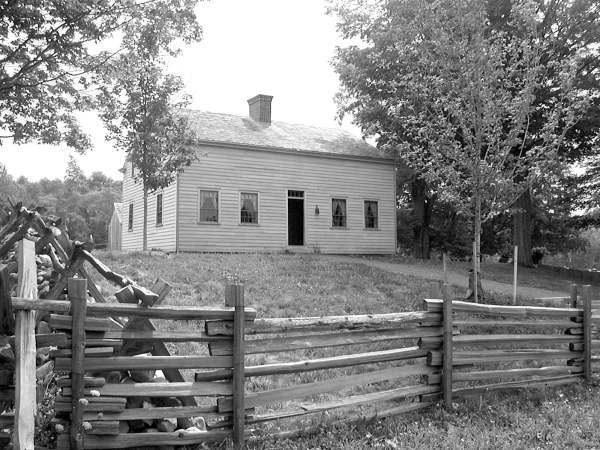 Smith frame home, Manchester, New York. Photograph by Alexander L. Baugh, 2005.
Katharine also recounted one memorable experience in which she played a central role in safeguarding the plates. She recalled an occasion where Joseph had the plates outside of the family home. Hearing a ruckus outside, Katharine opened the front door just as her brother Joseph “came rushing up, panting for breath, . . . and in a gasping voice whispered hoarsely, ‘take these quickly and hide them.’” Katharine, obviously prepared for such a circumstance by this juncture, took the bundle from Joseph to her room, where she and Sophronia slept. Her exceptional strength assisted her in hefting the heavy plates. Sophronia pulled back the covers, Katharine placed the bundle on the bed, and then they replaced the covers pretending to be asleep. “The mob, failing to find Joseph outside, returned to the house to search,” as Katharine later recounted the incident to her family, “but they did not disturb the girls since they appeared to be sleeping.”[19]
Such circumstances created fear for Katharine, as the family grew increasingly clannish to protect their mission from outsiders. In December 1827 Joseph and Emma took the record and left for Pennsylvania to find more solitude than the Palmyra community afforded, and Katharine’s older siblings Hyrum and Sophronia both married and moved out of the home near that same time.[20] The Smiths who remained on the family property bore the brunt of continued harassment. According to Smith family accounts, the Smiths were hassled by local ministers, neighbors who were denied a look at the plates, lawsuits, copyright infringements, and creditors who uncharacteristically demanded immediate payment.[21] Also, after Alvin’s death in 1823, the family failed to make their hundred-dollar annual payment on the property the following year, which resulted in them losing the property by 1825. While they were still allowed to live on the farm, by the year 1830 they were forced to move, losing all the improvements they had made to the farm and the two homes they had built.[22] It was a devastating financial blow to the family, as Joseph Sr. and Lucy, nearing their sixties, were now too old to try to start all over again.
Such difficulties, combined with the family’s limited living space and lack of financial means, led Katharine to leave the immediate Palmyra vicinity as early as the winter of 1828–29. She traveled to nearby Farmington Township and began teaching school.[23] Because family circumstances were more settled during Katharine’s teen years, she had been able to attend school with the younger Smith children. One schoolmate of the Smith children recalled rather generally that most of the Smith children were “dull scholar[s]” except for “[Samuel] Harrison and Catherine.”[24] These educational opportunities, frequently denied the older Smith siblings, prepared Katharine to launch out on her own as a schoolteacher.
Although it’s possible she lived intermittently with the family in Palmyra-Manchester, Katharine does not appear to have returned home again permanently until early October 1830. Her return coincided with the family’s final weeks in the area, and those became some of the most difficult. Just before Katharine returned home, Joseph Sr. was jailed for failure to pay a debt, and Hyrum had left for Colesville, New York, leaving the family unprotected during a time when the threat of violence persisted. [25] During this time, when the men of the family were absent, the Smith women experienced perhaps their worst encounter with a mob up to that time. Katharine remembered:
A few days after he [Hyrum] was gone, a number of men, came and searched our house for him. Mother, myself and younger sister [Lucy] were the only ones at home. When we insisted that he was not there, their anger turned upon us and they commenced to rob the house. While they were plundering us, my brother, William, came. . . . Upon coming in he asked mother, ‘What were those men doing?’ She told him they had come for Hyrum and were now plundering the house. Arming himself with a stout club, he soon drove them from the house. They had come in carriages with dark lanterns, and if they had found Hyrum it was their intention to have him put to death.[26]
Her brawny elder brothers, including nineteen-year-old William, afforded her some sense of security during such episodes of harassment from neighbors.
Katharine was also a recipient of slander sometime during the years 1830–31 and beyond. After the Book of Mormon was published, antagonists developed several theories to try and explain how Joseph Smith produced such a complex and lengthy book with his limited education. The foremost theory in the early 1830s was that the Smith family had known Sidney Rigdon before the book’s publication and that the two men labored for years to manufacture the text. Rigdon, they theorized, must have been instrumental in the book’s publication.[27] To strengthen their hypothesis, a rumor was circulated that Katharine was pregnant with Rigdon’s child while still living in New York, which would confirm that Rigdon had known the Smith family before December 1830. It is unknown when the rumor first surfaced, but probably at least by the year 1831. Surviving recollections of Palmyra neighbors, as well as the story appearing in a book published by Palmyra historian Pomeroy Tucker, provide evidence of how extensively the story circulated through the community.[28] While the rumors about Katharine and Rigdon’s relationship were untrue (as well as Rigdon knowing the Smith family prior to the publication of the Book of Mormon), the account no doubt left its mark, and neighbors later repeated their negative impressions regarding Katharine’s reputation. Though nothing has survived related to how she responded to these rumors besides denying the family knew Rigdon before 1830, they must have been emotionally taxing and embarrassing to her.[29]
The decade of the 1820s was foremost in Katharine’s memories when she reflected on her childhood in later years, as she claimed to “recall the time of the wonderful vision as vividly as though it were but yesterday.”[30] The anxiety and hypervigilance about safeguarding both the plates and the family made these years especially challenging, but it was also because it had been a time where she experienced her own spiritual awakening. There was no question in her mind that her brother possessed the plates and that it contained a sacred record of an ancient people. The ostracism and fear she experienced was tempered by an air of excitement and increased devotion as the family unitedly prepared to read the promised record and looked forward to formally organizing the Church of Christ. “Every room was filled with the Holy Ghost,” Katharine recalled of that three-month period in 1827 when the record was in their home. “You could go into any room in the house and feel the presence of the spirit.”[31] Her faith was also strengthened by reading the Book of Mormon once it came off Grandin’s Press in Palmyra. “Many times when I have read its sacred pages, I have wept like a child,” recalled Katharine of her conversion, “while the Spirit has borne witness with my spirit to its truth.”[32]
With the publication of the Book of Mormon in 1830, Joseph was eager to formally organize the Church of Christ, and Katharine was among those early believers who gathered at the Peter Whitmer Sr. home on April 6, 1830, at Fayette, New York. “I was one of the number who met in the first conference held in these last days, when the church was first organized,” she recalled of the historic occasion. “We only numbered thirty, but we were a happy little band. It was a great day of rejoicing for us.”[33] Though her parents were baptized that day, Katharine, along with brothers William (age nineteen) and Don Carlos (age fourteen) and her close friend Caroline Rockwell, waited until the next church conference to be baptized on June 9, 1830. Katharine, who turned seventeen that same month, was baptized by David Whitmer in the crystal clear waters of Seneca Lake, and Oliver Cowdery performed her confirmation the following day.[34] She was elated to finally unite with the newly restored Church, but never could have imagined the trajectory that decision would bring to her life in the ensuing decades.
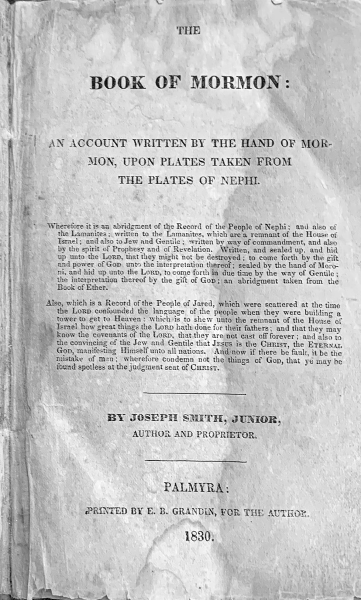 Title page of the first edition of the Book of Mormon, 1830. Courtesy of McKay Library, 38 BYU–Idaho.
Notes
[1] Katharine Salisbury (Hancock County, IL) to Dear Sisters, March 10, 1886, Saints’ Herald 33, no. 17 (May 1, 1886): 260. Katharine’s mother Lucy does not mention Joseph viewing these other items in the stone box in her history during this time or afterward, and never notes the Liahona or brass plates. She does recount handling both the interpreters (Urim and Thummim) and breastplate, describing these items in detail in her history. As with Katharine’s recollections, Lucy recounted her husband’s surprise when Joseph could not obtain the plates but does not mention him comforting his son Joseph and offering an explanation as to why he could not yet obtain the record. Lucy Mack Smith, Biographical Sketches of Joseph Smith and His progenitors for Many Generations (Liverpool: S W. Richards, 1853), 86, 101, 106–7.
[2] Kyle R. Walker, “Katharine Smith Salisbury’s Recollections of Joseph’s Meetings with Moroni,” BYU Studies Quarterly 41, no. 3 (2002): 13–15; Dean C. Jessee, “Joseph Knight’s Recollection of Early Mormon History,” BYU Studies Quarterly 17, no. 1 (1976): 31.
[3] Salisbury to Dear Sisters, 260.
[4] Lucy Mack Smith, Biographical Sketches, 99–100.
[5] Walker, “Katharine Smith Salisbury’s Recollections,” 15; Lucy Mack Smith, Biographical Sketches, 102–4.
[6] Lucy Mack Smith, Biographical Sketches, 102–5.
[7] Herbert S. Salisbury, “Things the Prophet’s Sister Told Me,” 1, San Rafael, CA, June 30, 1945, typescript, CHL.
[8] Walker, “Katharine Smith Salisbury’s Recollections,” 15; Isaac Birkenhead Ball, “The Prophet’s Sister Testifies She Lifted the B. of M. Plates,” typescript interview with Herbert S. Salisbury, ca. 1954, 2, CHL. Lucy Mack Smith, who was also present on this occasion, failed to mention that Joseph fainted, but noted that when he arrived at the house “he was . . . altogether speechless from fright and fatigue of running.” Additionally, Lucy commented on Joseph’s dislocated thumb but did not mention his lame arm or bruised knuckles. Lucy Mack Smith, Biographical Sketches, 105–6.
[9] Salisbury to Dear Sisters, 260.
[10] Ball, “The Prophet’s Sister Testifies,” 1; Frederick V. Salisbury, “The Teachings and Testimonies of My Mother,” 1926–28, unpublished manuscript, 14, Hancock County Historical Society, Carthage, IL. This account parallels Emma Hale Smith’s, who said, “The plates often lay on the table without any attempt at concealment, wrapped in a small linen table cloth, which I had given them to fold them in. I once felt of the plates, as they lay on the table, tracing their outline and shape. They seemed pliable like thick paper, and would rustle with a metallic sound when the edges were moved by the thumb, as one does sometimes thumb the edges of a book.” Joseph Smith III, “Last Testimony of Sister Emma,” Saints’ Herald 26, no. 19 (October 1, 1879): 289–90.
[11] Lucy Mack Smith, Biographical Sketches, 102.
[12] Arthur B. Deming, “Mrs. M. C. R. Smith’s Statement,” Naked Truths about Mormonism, 1 (April, 1888): 1. Caroline Rockwell was the daughter of Orin and Sarah Witt Rockwell and a younger sister to Orrin Porter Rockwell. The family lived within a mile of the Smith home. Members of the Rockwell family were some of the first to unite with the Church of Christ after its organization in 1830 and were frequent visitors in the Smith home. Harold Schindler, Orrin Porter Rockwell: Man of God Son of Thunder, 2nd rev. ed. (Salt Lake City: University of Utah Press, 1983), 3–6; Karen Lynn Davidson et al.,Histories, Volume 1: Joseph Smith Histories, 1832–1844, vol. 1 of the Histories series of The Joseph Smith Papers, ed. Dean C. Jessee, Ronald K. Esplin, and Richard Lyman Bushman (Salt Lake City: Church Historian’s Press, 2012), 390.
[13] Lavina Fielding Anderson, ed., Lucy’s Book: A Critical Edition of Lucy Mack Smith’s Family Memoir (Salt Lake City: Signature Books, 2001), 343; Lucy Mack Smith, Biographical Sketches, 84, 86.
[14] Walker, “Katharine Smith Salisbury’s Recollections,” 11.
[15] Mary Salisbury Hancock, “The Three Sisters of the Prophet Joseph Smith, Part 1,” Saints’ Herald 101, no. 2 (January 11, 1954): 12.
[16] Walker, “Katharine Smith Salisbury’s Recollections,” 15–16.
[17] Salisbury, “The Teachings and Testimonies of My Mother,” 4; Eric A. Eliason, “Seer Stones, Salamanders, and Early Mormon ‘Folk Magic’ in the Light of Folklore Studies and Bible Scholarship,” BYU Studies Quarterly 55, no. 1 (2016): 73–93.
[18] William Smith, William Smith on Mormonism (Lamoni, IA: Herald Steam Book and Job Office, 1883), 13.
[19] Hancock, “Three Sisters,” 12.
[20] Hyrum had married Jerusha Barden on November 2, 1826, and after his marriage they moved into the log home where the Smith family had earlier resided on the property. Hyrum Smith Family Bible; Lucy Mack Smith, Biographical Sketches, 40; William Smith on Mormonism, 14. Sophronia married Calvin Stoddard on December 3, 1827. Stoddard Family Bible, original in possession of Reid Moon, Provo, UT. The author wishes to acknowledge Reid Moon for sharing high resolution photographs of the Stoddard Family Bible.
[21] Lucy Mack Smith, Biographical Sketches, 95–98, 111–12, 159–65; William Smith on Mormonism, 12–14.
[22] The Smith family was forced to move from their larger frame home back into their log home, where Hyrum and his family were living, sometime in the Spring 1829. By the summer of 1829, Hyrum was married and had two children of his own, making living space cramped. Larry C. Porter, A Study of the Origins of The Church of Jesus Christ of Latter-day Saints in the States of New York and Pennsylvania, 1816–1831 (Provo, UT: BYU Studies and Joseph Fielding Institute for Latter-day Saint History, 2000), 37, 43n193; “Records of Early Church Families,” Utah Genealogical Magazine 26 (1935): 103.
[23] Catharine Smith v. Trustees of Farmington School District No. 5, February–June 1829, Judgment Docket, Victor, Ontario County Historical Society, Canandaigua, NU. For a further discussion on this source, see Dan Vogel, ed., Early Mormon Documents, vol. 3 (Salt Lake City: Signature Books, 2000), 503.
[24] Arthur B. Deming, “C. M. Stafford’s Statement,” Naked Truths About Mormonism 1 (April 1888): 1.
[25] Hyrum departed on either September 29 or October 6, 1830, to preside over the Colesville Branch of the church. Lucy Mack Smith, Biographical Sketches, 191. For a discussion on the specific timing of Hyrum’s journey, see Porter, Study of Origins, 38; JSP,D1:268n152.
[26] Katharine Salisbury (Fountain Green, IL) to Dear Sisters of the “Home Column,” May 16, 1886, Saints’ Herald 33, no. 26 (July 3, 1886): 405. Lucy Mack Smith recounted the same incident in her history but described William driving the mob out with a “large handspike, . . . exclaiming ‘Away from here, you cut-throats, instantly, or I will be the death of everyone one of you.’” Lucy Mack Smith, Biographical Sketches, 164.
[27] See, for example, Eber D. Howe, Mormonism Unvailed (Painesville, OH: Eber D. Howe, 1834), 100.
[28] Pomeroy Tucker, Origin, Rise, and Progress of Mormonism (New York: D. Appleton, 1867), 81–82. See statements made by Palmyra neighbors Lorenzo Saunders and C. M. Stafford, cited in Vogel, Early Mormon Documents, 2:127, 163, 195.
[29] “Testimony of Katherine Salisbury,” Sworn Affidavit, April 15, 1881, copy of holograph, Community of Christ Library-Archives, Independence, MO, also printed in Saints’ Herald 28, no. 11 (June 1, 1881): 169.
[30] Walker, “Katharine Smith Salisbury’s Recollections,” 10.
[31] Oscar Case, Reminiscence, ca. 1894, Tom and Carla Duke Papers, Burlington, IA, typescript copy in author’s possession.
[32] Salisbury to Dear Sisters, 260.
[33] Salisbury to Dear Sisters, 260. David Whitmer remembered that “about 50 members & the 6 elders were present.” Journal of Edward Stevenson, January 2, 1887, CHL. Larry C. Porter documents a list of seventy-three individuals who likely attended that day. Larry C. Porter, “Organizational Origins of the Church of Jesus Christ, 6 April 1830,” in Regional Studies in Latter-day Saint History: New York and Pennsylvania, ed. Larry C. Porter, Milton V. Backman Jr., and Susan Easton Black (Provo, UT: BYU Department of Church History and Doctrine, 1992), 154–55. Katharine also indicated that her brother Joseph designated six original members of the Church: “Joseph Smith Jr., Oliver Cowdery, Samuel H. Smith, Hyrum Smith, David Whitmer, and Peter Whitmer Jr.” Salisbury, “Things the Prophet’s Sister Told Me.” Katharine’s list is identical to the six men Richard L. Anderson identified after consolidating surviving sources. However, neither Anderson nor Michael Hubbard MacKay were apparently aware of Katharine’s list. Richard L. Anderson, “Who Were the Six Who Organized the Church on 6 April 1830?” Ensign 10, no. 6 (June 1980): 44–45. See also Michael Hubbard MacKay, Sacred Space: Exploring the Birthplace of Mormonism (Provo, UT: Religious Studies Center, Brigham Young University; Salt Lake City: Deseret Book, 2016), 52–55.
[34] Davidson et al., JSP, H1:390.
