
 menu icon in the top, right corner of the screen.
 icon above to close this box.
 icon at the bottom of the screen below the browser—if you don't see it, swipe up to unhide it.
“My Brothers Are Dead”
Kyle R. Walker, "'My Brothers Are Dead'," in Sister to the Prophet: The Life of Katharine Smith Salisbury (Provo, UT: Religious Studies Center, Brigham Young University; Salt Lake City: Deseret Book), 117–30.
I shall never forget that Saturday, June 23 [22], when I last saw my brothers alive. It was my farewell to them on this earth.
—Katharine Smith Salisbury
THE YEAR 1844 found the Salisburys on the cusp of financial stability. Jenkins’s blacksmith business was expanding, and they had firmly established themselves in the Plymouth community. Their family also continued to grow by the mid-1840s, with the arrival of a daughter they named for their esteemed sister-in-law Emma, born on March 25, 1844.[1] As they became more settled, the older children began attending school in a log schoolhouse under the tutelage of Bryant Peterson, who later became a lawyer at Carthage.[2] As it turned out, the summer of 1843 to the spring of 1844 was the most secure period of their lives since their marriage thirteen years earlier.
While the inhabitants of western Illinois had welcomed the beleaguered Saints just a few years earlier, by 1842 the Mormon influence on the political climate within Hancock County negatively impacted locals’ view of the Saints. As the decade progressed, the community of Saints at Nauvoo increasingly clashed with their neighbors. As the Saints’ political power increased, those in small communities throughout the county attempted to quell their influence. Community leaders at Carthage and Warsaw were particularly influential, including Thomas C. Sharp, who publicized his brash anti-Mormon views in his Warsaw Signal newspaper. Eventually those difficulties began to expand to outlying communities where Saints had gathered in small clusters, including those Saints in Plymouth. In December 1843, a mob robbed and then burned the home of a Latter-day Saint named David Holman in nearby Ramus, Illinois, where Katharine’s sister Sophronia and her family lived[3] As the Salisburys learned of these developments, it increased their apprehension for their own safety.
While Samuel Smith’s reputation had been impeccable during the time he lived near Plymouth, his brother William’s example had been less than admirable, perhaps contributing to the animosity towards the Saints that developed at Plymouth. His hot temper and brash reactivity often led to conflict with locals. In one instance, William engaged in a verbal exchange with a longtime Plymouth resident who probably reflected the sentiments of the community at large when he asserted his disappointment that Joseph Smith had not yet been arrested by the state. The brief exchange quickly led to an all-out brawl, where William gave the man a “stinging blow” that nearly leveled him. Eventually several residents intervened to break up the fracas, but word of the fight and William’s reputation immediately spread throughout the small community.[4] Though William eventually relocated to Nauvoo in early 1842, he continued to stir up trouble with his combative editorials in the Wasp newspaper that he oversaw at Nauvoo. His election as a county representative to the Illinois legislature the following year, where he vociferously defended the controversial Nauvoo Charter, probably served only to heighten Plymouth residents’ concerns about the political influence of Latter-day Saints in the county.[5] There are no surviving accounts of Jenkins Salisbury’s reputation in the community, but he was definitely linked to his brother-in-law in the minds of his neighbors, as he remained supportive and close to William. It was also well known among locals that Katharine was a sister to the church’s prophet in Nauvoo.[6]
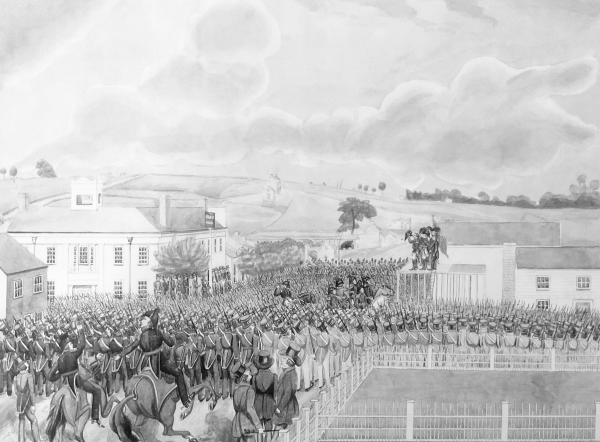 Robert Campbell, General Joseph Smith Addressing the Nauvoo Legion (ink and watercolor on paper, 1845). This scene depicts Joseph Smith’s address in Nauvoo on June 18, 1844. Courtesy of Church History Museum.
Amidst the turmoil in Nauvoo in the month of June 1844, Katharine headed to the city of the Saints to visit family. Perhaps she wanted to ascertain for herself her brother’s safety after reading about developments at Nauvoo once Joseph, as city mayor, ordered the destruction of the press of the Nauvoo Expositor, and state officials ultimately sought his arrest for his role in the event. As things escalated in the ensuing weeks, the Saints’ efforts to try and allay feelings with Governor Thomas Ford and in outlying communities throughout Hancock County proved unsuccessful. An editorial in the Warsaw Signal written by Thomas Sharp in mid-June called for “war and extermination” of the Mormons, indicating it was not a time for words but that comments should instead “BE MADE WITH POWDER AND BALL!!!”[7]
Katharine arrived in the city the week of June 16–22 amidst turmoil. She probably had little time to personally visit with her elder brothers for any length of time owing to the chaos that had engulfed Nauvoo, perhaps staying at the Mansion House where her mother was then living.[8] On Tuesday, June 18, she listened to Joseph preach from a makeshift stand across the street from the Mansion House, which would be his final sermon to the Saints. “I was in Nauvoo a few days before my brothers were brought to Carthage,” Katharine recalled of that day, “where Joseph preached a sermon to the largest crowd I have ever seen.” In retrospect, she was grateful to have been present for his final discourse, describing his remarks that day as “more in the nature of a prophecy than a sermon.”[9] Dressed in his full Nauvoo Legion uniform, he declared martial law but encouraged the Saints to only take defensive measures to protect themselves. At one point during his sermon, Joseph unsheathed his sword, expressing his determination to defend the Saints and their legal rights, “or my blood shall be spilt on the ground like water.” “You are a good people; therefore, I love you with all my heart,” he continued. “You have stood by me in the hour of trouble, and I am willing to sacrifice my life for your preservation.”[10] Katharine remembered that he also made reference to enemies among the Saints who were present on that occasion, declaring “that there are those among you who will betray me soon; in fact, you have plotted to deliver me up to the enemy to be slain.”[11]
Katharine felt that the Saints’ political influence was the primary reason they clashed with their neighbors in the county. “The vote at Nauvoo soon became so large that the church held the balance of power in western Illinois,” she later summarized. “As that part of the state was mostly pro-slavery, the same acts and scenes of violence were soon enacted as before in Missouri. False accusations and false stories circulated,” she recalled, describing how these rumors persisted in Hancock County some fifty years after that tumultuous summer of 1844. Katharine also conceded that religious differences contributed to escalating difficulties.[12]
On Saturday, June 22, Katharine had her final exchange with her two brothers. As she prepared to return to her home in Plymouth, Joseph and Hyrum both met briefly with their younger sister. “Joseph took my hands tenderly in his,” Katharine recalled of that poignant exchange etched in her memory, “saying: ‘Goodbye, sister [K]atharine. When this trouble blows over I shall come down to Plymouth and make you a visit.’” She also recounted how Hyrum bid her a simple “goodbye,” but thought that the tone of his voice “had a deeper feeling than I had ever known him to entertain.” Katharine sensed the apprehensiveness her brothers were experiencing in contemplating being arrested and taken to Carthage, and those final exchanges became more poignant in her mind in light of the trauma that happened next. The Smiths turned themselves over to authorities two days later, and just five days after their exchange with Katharine, they were murdered by a mob while being held in Carthage Jail. “I shall never forget that Saturday, June 23 [22], when I last saw my brothers alive,” she wrote. “It was my farewell to them on this earth.”[13] Years later, she kept a picture of her brothers on her mantle that reminded her of the way her brothers were dressed the last time she saw them.[14]
Katharine was uneasy as she returned home on the evening of June 22. She learned of her brothers being arrested that next week and of various town militias gathering at Carthage. It was in the morning of June 28, the day after her brothers were murdered, that she received news from a courier of what had transpired.[15] Perhaps her brother Samuel had sent the messenger and buggy to transport her to Carthage. He had hurriedly ridden from Plymouth to Carthage the previous evening upon learning that his brothers were in danger, arriving in town just after the murders had occurred. Instead of helping defend his brothers, he performed the morbid task of removing his brother’s lifeless bodies from the jail, and cleaning and preparing to transport them to Nauvoo the next day.[16]
 Copy of lithograph of Joseph and Hyrum Smith, original created in 1847. Courtesy of Church History Library. Katharine kept this photo in her house and said that her brothers were dressed in these outfits when she last saw them.
In the weeks before the murder of Hyrum and Joseph, Jenkins had gone south to St. Louis to obtain work, promising to send money back to help support the family. As animosity increased towards the Saints, locals avoided going to him to do their blacksmith work because of the family’s connection to the church’s founder, something that would be a recurring theme in the ensuing years. Katharine was once again alone in raising their five children during a most difficult time. Probably to help generate income, but possibly for protection as well, the Salisburys had the John and Phebe Husbands family (also Latter-day Saints) move in with them after Jenkins left.[17]
After receiving the news from Carthage, Katharine left her children in the care of this family living in her home and immediately left for Carthage in a buggy.[18] Many Carthage residents had fled town, fearing the Saints would retaliate. When Katharine arrived in the deserted town, she located her brother Samuel at the Hamilton House, where she viewed the mangled bodies of her brothers and saw John Taylor, who had been wounded but had survived. Later that day, Artois Hamilton, the proprietor of the Hamilton House, along with his son William, drove a wagon carrying Hyrum’s body back to Nauvoo, while Samuel Smith drove a second wagon with Joseph’s body.[19] Katharine had arrived in time to accompany Samuel and the cortege back to Nauvoo.[20]
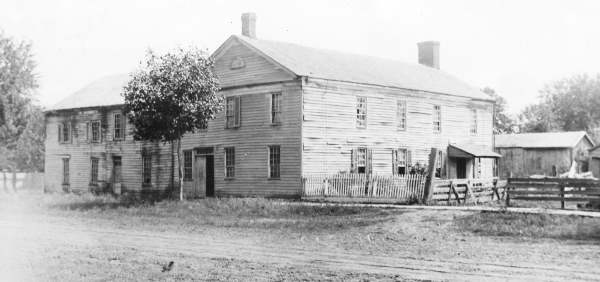 Hamilton House, Carthage, Illinois, where the bodies of Joseph and Hyrum Smith were taken after they were shot at Carthage Jail. Courtesy of Church History Library.
“Every heart is filled with sorrow,” Vilate Kimball wrote to her husband Heber, who was then in the East laboring as a missionary, “and the very streets of Nauvoo seem to mourn.”[21] While the entire community of Nauvoo would remain in a state of mourning throughout the summer, for the Smith family, the deaths of Hyrum and Joseph meant an added measure of loss. They were not only heads of the church they espoused but also leaders of the greater Smith family and left a void that would never be filled. As Mother Lucy steeled herself to view her sons later that same day, she was overcome with emotion as she entered the room and saw the lifeless bodies and listened to the “sobs and groans . . . of their wives, children, brother, and sisters,” who had all gathered at the Mansion House in Nauvoo.[22] Twenty-five-year-old Sarah Kimball was present at the Mansion House that day and also recounted listening to the “smothered sobs” throughout the room, describing how Lucy sat in an armchair in the corner of the room next to her namesake daughter. Sarah tenderly held Mother Lucy’s hand, attempting to offer some consolation as Lucy sobbed in silence for more than three minutes. She finally spoke, expressing to Sarah her disbelief as to why anyone would want to kill her sons. Turning to her daughter Lucy, Mother Smith queried as if seeking confirmation, “Don’t you know Lucy how mild Hyrum always was?”[23] She vocalized the shock her family was experiencing.
Ultimately Lucy said she found comfort through the lens of her faith and in an answer that she described as a “voice” reassuring her that her sons had been taken home to be with God and were now out of reach of their enemies.[24] She shared those impressions with her surviving children who were present. Katharine, who was dealing with her own grief, shared little about her feelings at the time. Much like her mother had described in her history, later accounts reveal she experienced mixed emotions of grief and indignation.[25] She heard rumors that Joseph had uttered the Masonic cry for help during the attack and that there were Masons among the mob who shot her brothers. Later, when her children and grandchildren affiliated with Masonry in the state of Illinois, she was incensed and would not support their decision because of the duplicity she perceived among its members related to the murder of her brothers.[26]
 Death masks of Joseph and Hyrum Smith. Photograph by Kyle R. Walker, 2020.
Katharine stayed in town long enough to participate in the funeral services held on Saturday evening, June 29. She was also one of a few trusted family members and friends who knew of the secret burial of her brothers in the basement of the unfinished Nauvoo House. “There was a price set on Joseph’s head,” she recalled of that chaotic time, “and we concealed the bodies for a day and a night.”[27] The bodies remained in that location until fall, when Emma had them secretly reinterred in unmarked graves across the street, in the yard of her and Joseph’s original Homestead residence. Emma must have communicated that information to Katharine as well, as Katharine recalled that “we then buried them near the old home.”[28]
When Katharine finally returned home after that haunting weekend, she was in for an additional shock. She had hurriedly left on Friday morning the previous week and thought her children would be safe when she left them with the Husbands family at her home in Plymouth. However, her son Solomon recounted that the Husbands family became fearful for their own safety in the aftermath of what had transpired at Carthage and decided to leave Plymouth immediately. Sometime during the night after Katharine had left, “they packed what clothing they could carry on their backs and left on foot for Nauvoo.”[29] They left in secret, not even informing the Salisbury children of their intended departure, and the children awoke to find themselves alone.
Eldest daughter Lucy, nearing her tenth birthday, and Solomon, just a year younger, led out in trying to care for the younger children, which included four-month-old Emma. After two days on their own, the frightened and hungry children mustered up the courage to go across the street to the home of Dr. Henry P. and Lucy Griswold for food. Upon learning of their plight, Lucy took them in, fed them, and allowed them to sleep on their floor that night. Henry was among those who had gone to Carthage as part of a military contingent from Plymouth,[30] and when he returned home later that night and saw the Salisbury children in his home, he asked Lucy who the children were. Lucy, who had already learned of the murder of the Smiths at Carthage, informed him that “they are the little Mormon children from across the street; their mother has gone to Carthage where her brothers have been murdered and she has not returned.” Indignantly, Henry replied, “sure, and we will all be murdered if we keep them here.” “Certainly no one could blame us for feeding these hungry little children,” Lucy protested, but Henry stood firm. The Griswolds reluctantly housed them that night and fed them the next morning, when they abruptly sent them back home, telling them, “Your mother will surely be back today.”[31] Katharine most likely arrived home on Monday, July 1. Reeling from the events of the previous few days, she must have felt additionally devastated after learning what had transpired at home in her absence.
She returned to Nauvoo just a month later, upon learning of Samuel’s unexpected death on July 30, 1844.[32] Samuel had been involved in a high-speed horse chase at the time he was attempting to aid his brothers on June 27, from which he received an injury to his side. After arriving in Nauvoo with the bodies of his brothers, he confided to his mother about a severe, internal pain that he was experiencing. He was eventually diagnosed with “bilious fever,” which caused his death only a few weeks later.[33] His death added to the overwhelming grief the Smith family experienced that fateful summer. Writing to her only surviving son William a few months after these events, Lucy Mack Smith reflected on the “deep affliction” the family was experiencing. “Wiliam I once had 5 noble and manly sons[,] a compa[n]ion who was the delight of my heart[,] besides 3 dutiful and affectionate Daughters whose affections . . . made me as happy as it was possible for a mother to be. 4[34] of those sons with their Father are in the cold and silent mansion of the tomb.”[35] Lucy’s “dutiful and affectionate” daughters would continue to fulfill that role in the years that followed.
In the ensuing weeks, life became increasingly dangerous for Saints who lived outside Nauvoo, and Plymouth was no exception. Animosity had increased during the previous year, but now it became more personal and progressively more threatening. As tensions reached a crescendo by the summer of 1844, the Salisburys became special targets of their neighbors’ animosity for their connection to the divisive religion. Solomon described how the “mob spirit seemed to run riot” that summer. He recalled that on multiple occasions “when we got up in the morning we would find written notices giving us twenty-four hours to leave the country, or they would burn or kill the outfit.” He further recalled that even before the death of his uncles at Carthage, his father had left for St. Louis, at least in part, because he felt fearful for his life. Jenkins returned at some point that summer, probably after learning of the murder of his brothers-in-law. The family stubbornly held on throughout most of the summer, but by August they felt it was too dangerous to remain in Plymouth.[36] For the third time in a decade, the Salisburys were forced to uproot and start again; only this time it was a financial blow from which they never recovered.
Notes
[1] George A. Smith (Salt Lake City) to Cousin Catherine [Salisbury], August 17, 1865, Historian’s Office letterpress copybooks, 1854–1879, vol. 2, 1859–1869, CHL; John Smith Papers, 1833–1854, journal, 1846 February–1854 May, CHL; Lucy Mack Smith, Biographical Sketches of Joseph Smith the Prophet and His Progenitors for Many Generations (Liverpool: S. W. Richards, 1853), 43; Dorothy D. Dean, Salisbury Family Group Sheet, n.d., copy of original in author’s possession; Orville F. Berry, “The Mormon Settlement in Illinois,” Transactions of the Illinois State Historical Society For the Year 1906, no. 11 (1906): 94.
[2] Solomon J. Salisbury, Reminiscences of an Octogenarian (self-pub., ca. 1926), 3.
[3] Andrew H. Hedges, Alex D. Smith, and Brent M. Rogers, eds., Journals, Volume 3: May 1843–June 1844, vol. 3 of the Journals series of The Joseph Smith Papers, ed. Ronald K. Esplin and Matthew J. Grow (Salt Lake City: Church Historian’s Press, 2015), 150; Andrew H. Hedges, Alex D. Smith, and Richard Lloyd Anderson, eds., Journals, Volume 2: December 1841–April 1843, vol. 2 of the Journals series of The Joseph Smith Papers, ed. Ronald K. Esplin and Matthew J. Grow (Salt Lake City: Church Historian’s Press, 2011), 323–24.
[4] E. H. Young, A History of Round Prairie and Plymouth, 1831–1875 (Chicago: Geo. J. Titus Book and Job Printer, 1876), 70–71.
[5] Kyle R. Walker, William B. Smith: In the Shadow of a Prophet (Salt Lake City: Greg Kofford Books, 2015), 158–69.
[6] Young, A History of Round Prairie and Plymouth, 64.
[7] “Unparalleled Outrage at Nauvoo,” Warsaw Signal, no. 18 (June 12, 1844): 2.
[8] Sarah M. Kimball (Nauvoo, IL) to Mrs. Serepta Heywood, in Joseph L. Heywood Letters, 1841–47, CHL. Sarah indicated that Lucy Mack Smith had a room in the Mansion House during the summer of 1844.
[9] “Anniversary at Carthage,” Salt Lake Tribune 44, no. 57 (June 24, 1894): 16.
[10] Joseph Smith History, 1838–1856, vol. F-1 [1 May 1844–August 1844, June 18, 1844], CHL. For a discussion on this sermon, see Brett D. Dowdle et al. eds., Documents, Volume 15: 16 May–28 June 1844, vol. 15 of the Documents series of The Joseph Smith Papers, ed. Matthew C. Godfrey, R. Eric Smith, and Ronald K. Esplin (Salt Lake City: Church Historian’s Press, 2023), 317–22.
[11] “Anniversary at Carthage,” 16. Because of later interpretations regarding succession, which stemmed from her brother William’s narrative of events, Katharine later identified Brigham Young and other apostles as some of those conspirators who were present that her brother Joseph referred to during his speech. Young and most of the other apostles were laboring as political missionaries in the eastern United States during the time of this speech, so they would not have been present in the audience. George Laub, who was also present on this occasion, similarly remembered that Joseph spoke about his enemies seeking his life during his remarks. However, the only person Laub remembered Joseph specifically naming was Joseph Jackson, a noted enemy of the Saints by this juncture, and Laub did not record Joseph stating that there were enemies among the Saints that day when he spoke. George Laub, reminiscences and journal, 1845–46, 49–52, CHL.
[12] “Reminiscences of Joseph Smith, as Told by His Sister, Catherine Smith-Salisbury, to Her Grandson, Herbert S. Salisbury,” Saints’ Herald 60 (October 8, 1913): 984.
[13] “Anniversary at Carthage,” 16.
[14] “Anniversary at Carthage,” 16.
[15] Mary Salisbury Hancock, “The Three Sisters of the Prophet Joseph Smith, Part III,” Saints’ Herald 101, no. 4 (January 25, 1954): 82
[16] Mary Bailey Smith Norman, “Samuel Harrison Smith,” reminiscence, typescript, June 24, 1914, CHL; J. Winter Smith, taped interview by Dean Jacobs, transcription by Tom Duke, Smith Family Reunion, August 18–19, 1972, Nauvoo, IL; Dean L. Jarman and Kyle R. Walker, “Samuel Harrison Smith,” in Kyle R. Walker, ed., United by Faith: The Joseph Sr. and Lucy Mack Smith Family (American Fork, UT: Covenant Communications; Provo, UT: BYU Studies, 2006), 230–31.
[17] Solomon remembered that the Husbands family had “two girls and a boy whose ages ranged from 16 to 21.” Salisbury, Reminiscences of an Octogenarian, 14; John and Phebe Husbands were endowed in the Nauvoo Temple on February 7, 1846. Nauvoo Temple Endowment Register, 1845–46, CHL.
[18] Hancock, “Three Sisters, Part III,” 82–83.
[19] Statement of William R. Hamilton, in Orville F. Berry, “The Mormon Settlement in Illinois,” Transactions of the Illinois State Historical Society for the Year 1906, no. 11 (1906): 99; Leonard, Nauvoo: A Place of Peace, A People of Promise, 400–401; Norman, “Samuel Harrison Smith”; J. Winter Smith, taped interview.
[20] Hancock, “Three Sisters,” 83.
[21] Vilate Kimball (Nauvoo, IL) to Heber C. Kimball, June 30, 1844, CHL.
[22] Lucy Mack Smith, Biographical Sketches, 279.
[23] Sarah M. Kimball to Mrs. Serepta Heywood.
[24] Lucy Mack Smith, Biographical Sketches, 279.
[25] Lucy Mack Smith, Biographical Sketches, 278.
[26] Herbert S. Salisbury, “Things the Prophet’s Sister Told Me,” 6, San Rafael, CA, June 30, 1945, typescript, CHL.
[27] “Anniversary at Carthage,” 16.
[28] “Anniversary at Carthage,” 16; Barbara Hands Bernauer, “Still ‘Side by Side’—The Final Burial of Joseph and Hyrum Smith,” John Whitmer Historical Association Journal 11 (1991): 18–20; Leonard, Nauvoo: A Place of Peace, A People of Promise, 403–4.
[29] Salisbury, Reminiscences of an Octogenarian, 14.
[30] Statement of Solomon J. Salisbury, in Berry, “The Mormon Settlement in Illinois,” 95.
[31] Hancock, “Three Sisters, Part III,” 83; Berry, “The Mormon Settlement in Illinois,” 95. For information on the Griswolds, see Young, A History of Round Prairie and Plymouth, 45–46; 1850 United States Federal Census, Hancock County, IL, Henry P. Griswold. The Griswolds bought all the Salisburys’ property in September 1844 after the Salisburys were forced from the community.
[32] “Died,” Times and Seasons 5, no. 14 (August 1, 1844): 606–7.
[33] Norman, “Samuel Harrison Smith”; J. Winter Smith, taped interview; Lucy Mack Smith, Biographical Sketches, 280. For more information on the circumstances surrounding Samuel’s death, see Jarman and Walker, “Samuel Harrison Smith,” 230–34.
[34] She was likely referring to the recent losses of Don Carlos (1841), Hyrum, Joseph, and Samuel. The number would have been five if Alvin was included.
[35] Lucy Mack Smith (Nauvoo, IL) to Wiliam Smith, January 23, 1845, CHL.
[36] Salisbury, Reminiscences of an Octogenarian, 4.
