
 menu icon in the top, right corner of the screen.
 icon above to close this box.
 icon at the bottom of the screen below the browser—if you don't see it, swipe up to unhide it.
Mountain Saints
Kyle R. Walker, "Mountain Saints," in Sister to the Prophet: The Life of Katharine Smith Salisbury (Provo, UT: Religious Studies Center, Brigham Young University; Salt Lake City: Deseret Book), 181–98.
The memory of our beloved Prophet is deeply cherished in the hearts of the Saints, and for his sake, his relations and members of his family, notwithstanding differences of opinion, are kindly regarded.
—Brigham Young, 1871
IN THE DECADE AFTER THE SAINTS fled Nauvoo in the spring of 1846, there had been no documentable interaction between the Salisburys and their Smith relatives who had settled in the Salt Lake Valley under Brigham Young’s leadership. That began to change by the mid- to late-1850s as members of the Smith family in the West began serving missions to the eastern United States and Europe. While en route to their missions, Katharine’s cousins George A. and John Lyman Smith, as well as sons of her brothers Hyrum and Samuel Smith, stopped in Nauvoo and sought out their Smith relatives who had remained in the Midwest. These interactions reveal much about Smith family relations, attitudes toward succession in the church, and the family’s sense of privilege in being part of the founding family of the Latter-day Saint movement.
One of the first to return to the Midwest and seek out his relatives in the area was seventeen-year-old Samuel H. B. Smith, the only son of Katharine’s elder brother Samuel and his first wife, Mary Bailey Smith.[1] Katharine had developed an attachment to Samuel H. B. when he was a child because both families lived in Plymouth, Illinois, in the early 1840s. His mother had died in 1841, and he was orphaned after his father died of bilious fever in the summer of 1844.[2] Though he had a stepmother (Levira Clark) at the time of his father’s death, he and his two older sisters must not have been close to her. They did not live with her for any substantial amount of time after their father died, and Samuel H. B. rarely, if ever, ment`ioned her in his journal. Instead, Samuel H. B. lived with various relatives in the ensuing decade, including with his stepmother’s parents at Winter Quarters. He was the only one of his siblings to move to the Salt Lake Valley in the decade after the deaths of Hyrum and Joseph, immigrating in the year 1848.[3] His sister Mary remained in the Midwest, helping care for her grandmother Lucy Mack Smith, and after Lucy died in 1856, she lived with Katharine and her sisters until she married.[4]
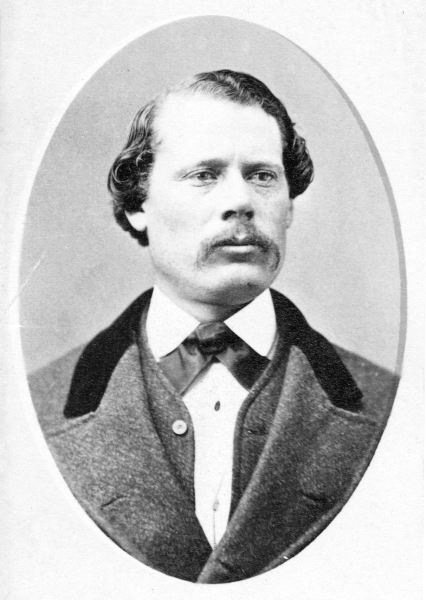 Samuel H. B. Smith, photograph by Charles R. Savage, Salt Lake City, ca. 1860s. Courtesy of Church History Library.
Samuel H. B. was appointed to a mission in 1856 at the youthful age of seventeen, traveling with a large contingent of missionaries who crossed the plains that spring and arriving in St. Louis, Missouri, in June. On the journey east, he was tutored by more experienced missionaries, including his father’s cousin George A. Smith, who turned thirty-nine that summer and was a member of the Quorum of the Twelve Apostles. “I had considerable talk with George A., in reference to the Smith family,” recorded Samuel H. B. during the overland journey. In returning to the Midwest, both were concerned about the well-being of their Smith relatives who stayed in Illinois and were determined to reconnect. After arriving in St. Louis, Samuel H. B. remained in the city just a few days before he caught a steamer upriver to Nauvoo, where he headed immediately to the home of his aunt Emma Hale Smith Bidamon.[5] He had missed seeing his grandmother Lucy Mack Smith by only a month, because she had passed away on May 14, 1856.[6]
Emma had remarried Lewis Bidamon a decade earlier. When Samuel visited, all four of Emma’s sons and her adopted daughter Julia were residing together at the Mansion House in Nauvoo.[7] He found Emma and her family “comfortably situated” but expected a friendlier reception than he received. “They manifested some interest in so unexpected a visit,” wrote Samuel H. B. of their initial greeting, “but at the same time appeared a little shy.”[8] His use of the word shy as recorded in his journal meant that Emma and her family were restrained in their warmth and affection toward him. Wounds created in the aftermath of her husband’s death had been slow to heal for Emma, and her typical welcoming attitude was absent when interacting with those from the West. Katharine’s cousins John Lyman Smith and George A. Smith, as well as nephew Joseph F. Smith, all visited Emma in the years 1855–60, and each separately recorded her reception as “cool” and “distant.”[9] Emma’s reserve toward her orphaned nephews Samuel H. B. and Joseph F. must have been psychologically painful to the youths.
After staying in Nauvoo for just a few days, Samuel H. B. then headed east to locate the three Smith sisters and found Katharine and her sister Lucy Millikin living on farms near Fountain Green, Illinois. Here he also found his older sister Mary Bailey Smith, who was “busily engaged” in working in the Millikins’ home. It was a joyous reunion with his sister Mary, whom he had not seen in nearly a decade, and he found a much warmer reception among his relatives here than he had in Nauvoo. After laboring as a missionary in Illinois for several months, Samuel H. B. was drawn back to Fountain Green, where he spent the winter living with his relatives before leaving for a mission to England in June 1857.[10]
George F. A. Spiller, Samuel H. B.’s missionary companion, recorded the hospitable reception they experienced when visiting the three Smith sisters in Illinois. “I accompanied Elder Samuel H. B. Smith in his visits to his relations and formed a very agreeable acquaintance with Mrs. Sophronia McClarie, Mrs. Catherine Salisbury, and Mrs. Lucy Millkin,” he recounted. “I remained with them over two nights and they made me heartily welcome.” Spiller was anxious to record that although the three Smith sisters had not gone west, they still “testified that they knew that their brother Joseph was a prophet of God.” When they prepared to leave the area, Spiller recounted how the sisters “earnestly requested” them to return to stay with them as soon as they could.[11]
In a letter he penned to George A. Smith, Samuel H. B. summarized his memorable stay with his relatives in the area that winter. He enthusiastically expressed his view that he had “partly persuaded” his sister Mary “to go to the [Salt Lake] Valley with me.” Among the three Smith sisters, he felt that Katharine was most open to the possibility of gathering with the Saints in the West. “Aunt Katharine I believe will go next year if her way opens,” he opined, “for She has a desire to be amongst the Saints ever more, but has to keep rather still about it, for it beats all how the Peoples minds are tethered against the Saints in that place [Fountain Green]. The very name Mormons is almost poison to them and there is nothing to[o] bad to say about the Saints.”[12] Though his youthful missionary enthusiasm probably overstated the likelihood of Katharine relocating to Salt Lake City, Samuel H. B.’s efforts that winter assuaged some of the animosity between branches of the Smith family and paved the way for additional relatives and traveling missionaries who visited the Smith sisters in subsequent years.
By the late 1850s, Katharine felt comfortable enough with her nephews that she struck up an ongoing correspondence with three of them—Samuel H. B., John Smith[13] (who visited in the year 1859), and Joseph F. Smith[14] (who visited in the year 1860). The traveling missionaries also occasionally preached in the area. One such occasion happened in the summer of 1860, when Samuel H. B. and Joseph F. stayed with their Smith relatives for a week on their way to their missions in England. Joseph F. reported that there was a small LDS branch in McDonough County, where two of the Smith sisters resided. Joseph F. invited his Smith relatives in the area to attend several of his sermons directed to that branch. Katharine, Sophronia, and Lucy’s families all joined the small congregation of Saints that week, and Joseph F. recorded that he “did some tall preaching to them.” Joseph F. thought that the three Smith sisters “all though[t] I was prejudiced against them for certain causes which they themselves have imagined,” but by the time he left, felt that he and Samuel H. B. “got them to think very differently of a great many things.”[15]
Just a few months earlier, Joseph Smith III had been installed as president of the Reorganized Church of Jesus Christ of Latter Day Saints (RLDS) at Amboy, Illinois, and the three Smith sisters had been distantly apprised of those proceedings. Joseph F. reported the reservations among the three Smith sisters regarding Joseph III’s efforts to organize. “They all seemed to feel very shy about Joseph [III]’s step,” Joseph F. summarized in a letter he wrote to George A. Smith, but “at the same time they seemed to want it to be right.” He sensed there was a mix of apprehension and hopefulness among the Smith sisters for Joseph III’s success. Perhaps their fear stemmed from the possibility that animosity might increase toward Latter-day Saints in the communities where they lived and what that might mean for them personally and for their expanding posterity. But they had also observed their brother William’s failed attempts at organizing within the state and possibly remained skeptical that Joseph III’s organization would succeed.[16] The three Smith sisters would wait more than twelve years after Joseph III was ordained president before they affiliated with the RLDS Church.
Katharine’s third eldest son Don Carlos went overland in the year 1864 initially to participate in the California Gold Rush. His elder cousin Mariah, who had helped raise Don Carlos, along with her husband, Barnett Woolley, had given him a deed to a gold mine in Idaho. Instead of mining, Don Carlos spent the next year and a half driving a stage line route through northern Nevada for the Wells Fargo Express Company. He was paid the lucrative sum of fifty dollars a month in gold for his services and returned to Fountain Green, Illinois, in the fall of 1866 with five hundred dollars in gold. On his journey home, he decided to visit relatives in Salt Lake City, because his Smith cousins had often encouraged him to visit when they had stayed at the Salisbury home in Illinois. Once word spread that Don Carlos was in the city, he was welcomed by his first cousins Joseph F. Smith and John Henry Smith and his mother’s first cousin George A. Smith, whom he said “treated him like a brother.” Brigham Young also welcomed him to the city, fed and entertained him at his home, and then gave him a tour of the city. He described how they collectively gave him “a friendly and hearty welcome and treated [me] like a member of the royal family.” Young then arranged for Don Carlos to be transported to Council Bluffs with one of his own mule teams.[17]
Financial Support from Latter-day Saint Leaders
After learning of Don Carlos’s positive interactions in Salt Lake City and establishing warm relationships with her nephews for more than a decade, Katharine felt comfortable enough with the Saints in the West to reach out to Brigham Young for financial assistance. On April 29, 1871, she wrote directly to Young, petitioning him for two hundred dollars to help her build a home just a few miles northeast of Fountain Green. Young promptly responded to her request, writing that “the memory of our beloved Prophet is deeply cherished in the hearts of the Saints, and for his sake, his relations and members of his family, notwithstanding differences of opinion[,] are kindly regarded.”[18] Young sent the two hundred dollars with a traveling missionary named Warren Dusenbery, who arrived with the money less than a month after her initial request. Katharine immediately wrote to Young, indicating that the money was “thankfully received” and that she was certain the money would prove to be “the Blessing I desired of it, and I feel shure the Lord will bless the doner for the gift.”[19]
 Letter from Brigham Young to Katharine Smith Salisbury, dated April 29, 1871. Original now housed in the L. Tom Perry Special Collections, Harold B. Lee Library, Brigham Young University.
 Sketch of Katharine’s home in Fountain Green, Illinois, with (left to right) Katharine; her son, Frederick; and Frederick’s wife, Mary Brewer. Salt Lake Tribune 44, no. 57 (June 24, 1894): 16.
Her home was under construction by January 1872, and Katharine described how workers were “putting it up as fast as they can.” However, Katharine underestimated the costs associated with constructing her home, and she continued to write to Latter-day Saint leaders in Salt Lake City in the ensuing months requesting additional funds. The excitement over the prospect of owning a home and property spilled out in her letters. “I send my respects to you,” she wrote to Brigham Young and George A. Smith, “and my thanks to[o] for the help you have rendered me in sending me the amount to build my house [where] I can spend my remaining days in.” Though she described the home as modest, she indicated “that lumber is very dear and carpenters work is verry high” and feared she would not have enough funds to complete construction.[20] In several different payments, Young eventually sent several additional payments totaling thirteen hundred dollars so that Katharine could finish her home and purchase twenty acres of land.[21]
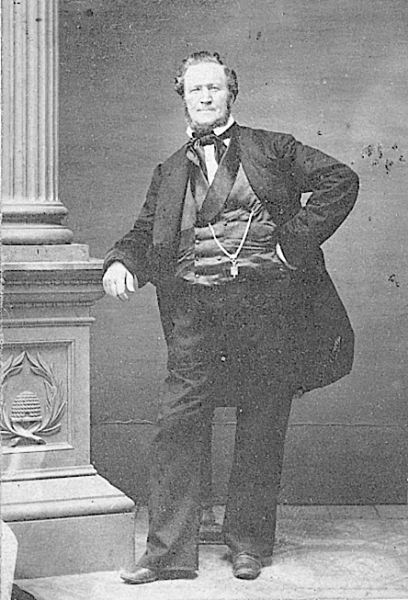 Brigham Young, ca. 1855, by Savage & Ottinger, Salt Lake City. Courtesy of L. Tom Perry Special Collections, Harold B. Lee Library, Brigham Young University.
 George A. Smith, ca. 1872, by Charles R. Savage, Salt Lake City. This photograph was in Katharine Salisbury’s photobook. Courtesy of Mary Dennis.
Katharine continued to correspond with Brigham Young and George A. Smith throughout the decade of the 1870s. For a time, at least, President Young’s generosity seemed to heal former misunderstandings. Katharine wrote to Young, “My gratitude to you is unbounded and i shall ever pray for blessing[s] to rest uppon your venerable head. . . . I will send you my likeness [photograph] . . . and wish you would send me yours in return that i may look uppon [it] with thankfullness for the great help you have rendered to me in the hour of my greates[t] need.”[22] Her home was finished by June. George A. Smith visited Katharine in the latter part of 1872 and wrote to Brigham Young, describing her home and her gratitude for the financial gift. “[K]atherine is living on the place, that you furnished her means to purchase,” he explained, “and is . . . the happiest Woman I have seen on the journey.” He depicted her property as “a piece of Timber land, which your last bounty enables her to increase to twenty acres. And as in all her live [life] she has never been able to enjoy a home of her own for a single hour, her gratitude to you seems unbounded.”[23] She moved into her home just a month before her fifty-ninth birthday and after all her children were grown.
 Katharine Salisbury (far right) next to her grandson, Herbert S. Salisbury. Alexander Hale Smith, son of Joseph and Emma Hale Smith, is on the far left. Don Carlos Salisbury is seated fourth from left. Photograph ca. 1893. Courtesy of Mary Dennis.
Following Brigham Young’s death in 1877, Katharine continued to petition Latter-day Saint leaders for financial assistance. During the 1870s Katharine still struggled financially and at one point borrowed money against her house to meet her financial obligations. When a new owner then assumed her mortgage, he threatened to evict her from the property if she could not make regular payments.[24] That series of events certainly reminded Katharine of what had happened to her parents when she was still a teenager, when her family had lost their Palmyra farm under similar circumstances. Katharine anxiously wrote to several Latter-day Saint leaders in the years 1877–79, including church president John Taylor and apostle Orson Pratt begging for assistance to retain her property.[25] Joseph F. Smith, now a member of the Quorum of the Twelve, who became aware of the request, was less inclined to use church funds to support Katharine than had been Young, for he knew that she and her sons were now members of the RLDS Church. He felt Katharine should first try and petition RLDS leaders for support. Notwithstanding these reservations, through Joseph F. Smith’s intercession, he persuaded John Taylor to send another three hundred dollars to Katharine to ensure creditors would not foreclose on her property.[26] The monies enabled her to remain in her home and expand her property to forty acres, where she lived with her youngest son Frederick for the remainder of her life, nearly thirty years after Young’s initial gift.
In time, the circumstances surrounding the monies sent from Latter-day Saint leaders to purchase her home and property were reinterpreted. The gift apparently did not fit RLDS rhetoric about Young’s caricature as being hostile and neglectful toward the Smith family, and Katharine’s descendants in turn surmised that the monies were instead sent to pay for her to gather with the Saints in the West. As Katharine’s grandson Herbert Salisbury summarized, “Brigham Young sent my grandmother, [K]atherine Smith Salsibury, several hundred dollars . . . telling her that he was sending that money to her and that he would like to have her remove to Utah. My grandmother [instead] took that money and stayed right there among the mobocrats and bought 40 acres of land and built a house with her money.” However, this version of events that was perpetuated in the Salisbury family does not align with contemporary statements, as Katharine specifically had requested the money to build a home in Fountain Green, Illinois, and Young sent the money for that express purpose. What makes the later reinterpretation further puzzling is that Young’s initial holograph letter sent to Katharine with the two hundred dollars and signed by Young remained a treasured heirloom among her descendants.[27] During the decade of the 1870s, Katharine responded to each financial gift by expressing her appreciation to Latter-day Saint leaders, including her desire that she “would like very much to See you all once more before we depart this life. May the blessings of heaven rest upon you and all the church.”[28] After uniting with the RLDS Church, Katharine’s public comments about Latter-day Saint leaders probably contributed to her descendants’ misunderstanding of the purpose of the funds. Towards the end of her life, Katharine indicated that she had been entitled to the monies, stating on several occasions that “Brigham restored to me $500 of the Smith estate.”[29] It was a similar view as her brother William held and promoted in the aftermath of his brothers’ deaths—namely, that due to sacrifices the family had made in laying the foundations of the church, they were entitled to financial remuneration.[30] One specific example Katharine recounted was that she believed that Orson Pratt or other leaders were receiving profits from the sale of her mother’s history, published in 1853.[31]
 Title page of Lucy Mack Smith’s Biographical Sketches of Joseph Smith the Prophet and His Progenitors for Many Generations (Liverpool: S.W. Richards, 1853).
Perhaps Emma and her sons ongoing disagreements with Brigham Young influenced Katharine’s views as Emma’s sons’ negative missionary experiences with leaders in the Salt Lake Valley reignited differences between branches of the Smith family.[32] Katharine’s perspective on those Saints in the Salt Lake Valley appear to have been closely aligned with Emma’s. The two remained close in those decades after Joseph’s death, evidenced by Katharine’s sons serving as pallbearers at Emma’s funeral in the year 1879.[33]
These differences notwithstanding, Katharine’s personal letters and in-person interactions with Latter-day Saint members and traveling missionaries remained remarkably positive. Victor E. Bean and Herbert H. Bell’s visit to Katharine in the summer of 1885 provides another example. Bean recounted how he and his companion were received with kindness and were invited to stay several nights at her home. “She is living with her son on a 20 acre farm that she says Pres Young bought for her,” recounted Bean in his journal, and Katharine described to them in detail how Young “sent her $13000.00 [$1,300] which bought her the place she now lives on.” Bean said that during their religious discussion that day that he “found them pretty strong in the Josephite faith,” but afterward asked Katharine “what I should tell the folks in Utah.” “She began to sob in tears,” described Bean, as seeing the missionaries “carried her mind back to early days when her Brothers used to go in the same way to preach the gospel. She said she would be very glad to see her folks in Utah but that she was poor and about worn out and thought that she wouldn’t live to ever visit Utah. She invited us and any of our brethren to always call and see her when passing through.”[34]
Her recounting of Young’s gift to the traveling missionaries seems at odds with some of her public statements during the final twenty years of her life. Perhaps her public rhetoric, as expressed in letters intended for publication in the RLDS official newspaper, the Saints’ Herald, were more divisive than her true feelings. In her personal letters to those in the West, she frequently included them as being one with her in the faith, often closing her letters with phrases such as “your sister in the gospel,” or “your sister in the church of God.”[35] She obviously considered those in the West her fellow Saints. Before Bean and his companion left their home that summer, the Salisburys requested them to pray over Katharine’s two granddaughters—perhaps a reference to a priesthood blessing—who were sick with the measles in her home. As the missionaries then prepared to depart, Bean said “we bid them good bye [and] we left Mrs. Salisbury in tears.”[36] It was her last documentable interaction with the Saints headquartered in Salt Lake City.
Notes
[1] Samuel said he was born at Marrowbone, Caldwell County, MO, on August 2, 1838. Lucy Mack Smith, in her history, recorded the date as August 1. Samuel H. B. Smith Reminiscences and Diary, 1856 April–1863 July, CHL; Lucy Mack Smith, Biographical Sketches of Joseph Smith the Prophet and His Progenitors for Many Generations (Liverpool: S. W. Richards, 1853), 43.
[2] “Died,” Times and Seasons 5, no. 14 (August 1, 1844): 606–7. For more information on the circumstances leading to Samuel’s death, see Mary Bailey Smith Norman, “Samuel Harrison Smith,” reminiscence, typescript, June 24, 1914, CHL; J. Winter Smith, taped interview by Dean Jacobs, transcription by Tom Duke, Smith Family Reunion, August 18–19, 1972, Nauvoo, IL; Dean L. Jarman and Kyle R. Walker, “Samuel Harrison Smith,” in United by Faith: The Joseph Sr. and Lucy Mack Smith Family, ed. Kyle R. Walker (American Fork, UT: Covenant Communications; Provo, UT: BYU Studies, 2006), 230–31.
[3] Samuel H. B. traveled with Truman O. Angell’s contingent of Brigham Young’s 1848 company, arriving in the Salt Lake Valley on September 22, 1848. Samuel H. B. Smith Reminiscences and Diary, 2–4.
[4] Mary Bailey Smith was born March 27, 1837, and died October 13, 1916. “Records of Early Church Families,” Utah Genealogical Magazine 26, no. 19 (July 1835): 103–4. After two unsuccessful marriages, Mary eventually married John Norman and the two migrated to Salt Lake City, where Mary was rebaptized into the Church of Jesus Christ of Latter-day Saints. Ruby K. Smith, Mary Bailey (Salt Lake City: Deseret Book, 1954), 97.
[5] Samuel H. B. Smith Reminiscences and Diary, 12–14.
[6] Buddy Youngreen, “The Death Date of Lucy Mack Smith: 8 July 1775–14 May 1856,” BYU Studies 12, no. 3 (Spring 1972), 318.
[7] Linda King Newell and Valeen Tippetts Avery, Mormon Enigma: Emma Hale Smith, 2nd ed. (Chicago: University of Illinois Press, 1994), 261–66.
[8] Samuel H. B. Smith Reminiscences and Diary, 14.
[9] Joseph F. Smith (Colchester, IL) to Levira Smith, June 28, 1860, Joseph F. Smith Papers, 1854–1918, Family Correspondence, CHL; George A. Smith Papers, 1834–1877, Autobiographical Writings, journal, 1856 April–1857 May, entry for October 30–31, 1856; John Lyman Smith, a first cousin to Joseph Smith, had also visited Emma’s family the previous year, on July 2, 1855, and similarly described her as “very cool and distant.” David Francis Haight, ed., “Biography of John Lyman Smith,” entry for July 2, 1855, CHL.
[10] Samuel H. B. Smith Reminiscences and Diary, 14–16.
[11] George F. A. Spiller (St. Louis, MO) to T. B. H. Stenhouse, December 8, 1856, Mormon 2, no. 44 (December 20, 1856): 2–3.
[12] Samuel H. B. Smith (New York City) to George A. Smith, June 2, 1857, in George A. Smith Papers, 1834–1877, General Correspondence, Incoming Letters, 1857, CHL. Samuel H. B. also spent three weeks with his sister Susannah in Wisconsin during his missionary travels in the fall of 1856 and felt that both his sisters would follow him to Salt Lake City when he visited them again after his mission was complete. Samuel H. B. Smith Reminiscences and Diary, 14–15.
[13] John Smith (1832–1911) was the son of Hyrum and Jerusha Barden Smith, and served as the presiding patriarch for the Church of Jesus Christ of Latter-day Saints headquartered in Salt Lake City from 1855 to 1911.
[14] Joseph F. Smith (1838–1918) was the son of Hyrum and Mary Fielding Smith, and later became president of the Church of Jesus Christ of Latter-day Saints headquartered in Salt Lake City from 1901 to 1918.
[15] Joseph F. Smith (Hull, England) to George A. Smith, August 22, 1860, George A. Smith Papers, 1834–1877, General Correspondence, Incoming Letters, R–Y, 1860, CHL.
[16] Joseph F. felt that Lucy Millikin and her family appeared most receptive to his preaching and purpose. Lucy took her nephew warmly by the hand, and Joseph F. recorded that she “was the first one to receive me in the true spirit of friendship.” Joseph F. Smith to George A. Smith, August 22, 1860.
[17] Herbert S. Salisbury, “The Western Adventures of Don Carlos Salisbury,” unpublished typescript, San Rafael, CA, 1945, 1–2, 12–13, 17, CHL.
[18] Brigham Young (Salt Lake City) to Katharine Salisbury, May 17, 1871, Brigham Young Office Files, box 8, Letterpress Copybook vol. 12, 684–85, CHL.
[19] Katharine Salisbury (Fountain Green, IL) to Brigham Young, May 28, 1871, Brigham Young Office Files, 1832–1878, General Correspondence, Incoming, 1840–1877, Re–Sn, CHL.
[20] Katharine Salisbury (Fountain Green, IL) to Dear Cousin [George A. Smith] and Brigham Young, January 14, 1872, Brigham Young Office Files, 1832–1877, box 34, folder 15, CHL.
[21] Brigham Young and George A. Smith (Salt Lake City) to Daniel H. Wells, October 26, 1871, Brigham Young Office Files, box 73, folder 34; D. McKenzie (Salt Lake City) to Mrs. Katharine Salisbury, November 13, 1871, Brigham Young Office Files, box 8, vol. 12, CHL. Katharine wrote to Brigham Young and George A. Smith on January 14, 1872, indicating she had received an additional $200 “from the hands of brother [Cyrus] Sanford.” Salisbury to Smith and Young, January 14, 1872. For evidence of an additional $400 sent by Young to Salisbury, see E. Cecil McGavin, The Family of Joseph Smith (Salt Lake City: Bookcraft, 1963), 105.
[22] Katharine Salisbury (Fountain Green, IL) to Brigham Young, October 20, 1872, Brigham Young Office Files, 1832–1878, General Correspondence, Incoming, 1840–1877, General Letters, N–Sn, 1872, CHL.
[23] George A. Smith (New York City) to Brigham Young, November 1, 1872, Brigham Young Office Files, 1832-1878, General Correspondence, Incoming, 1840–1877, Letters from Church Leaders and Others, George A. Smith, 1872–1873, CHL.
[24] Katharine Salisbury (Fountain Green, IL) to George A. Smith and Brigham Young, July 25, 1873, George A. Smith Papers 1834–1875, Incoming Letters, folder 13, CHL; Katharine Salisbury (Fountain Green, IL), to John Taylor, August 15, 1879, First Presidency (John Taylor) correspondence, 1877–1887, CHL.
[25] Salisbury to Taylor, August 15, 1879; Katharine Salisbury (Fountain Green, IL) to Orson Pratt, December 20, 1877, Historian’s Office correspondence files, 1856–1926, CHL; Katharine Salisbury (Fountain Green, IL) to Orson Pratt, January 23, 1878, Historian’s Office correspondence files, 1856–1926, CHL.
[26] Joseph F. Smith (Salt Lake City) to Catherine Salisbury, August 29, 1879; Joseph F. Smith (Salt Lake City) to Catherine Salisbury, September 7, 1879; Joseph F. Smith (Salt Lake City) to Arthur Millkin, September 7, 1879, all in Joseph F. Smith Letterpress Copybooks, 1875–1917, CHL.
[27] Brigham Young to Katharine Salisbury, May 17, 1871. Katharine’s grandson Herbert S. Salisbury owned this letter from Young for a time, which he described as being written by his secretary in a “nice spencerian hand.” Despite the contents of the letter in his possession, Herbert still insisted that the money was intended to have her relocate to Utah and that his grandmother wrote back to Young in “positive and insulting language, as she was angry at him for claiming that her brother authorized polygamy,” something that never occurred. Isaac Birkenhead Ball, “The Prophet’s Sister Testifies She Lifted the B. of M. Plates,” typescript interview with Herbert S. Salisbury, ca. 1954, 2, CHL; Herbert S. Salisbury, “Reminiscences of Joseph Smith as Told by His Sister, Catherine Smith Salisbury, to Her Grandson, Herbert S. Salisbury,” Saints Herald 60, no. 41 (October 8, 1913): 983–84. In the year 2003, the author discovered this letter, along with many of Katharine’s surviving letters and personal photobook, at the home of one of her descendants living in Burlington, Iowa. The author helped facilitate the acquisition of this collection, which is now housed in the L. Tom Perry Special Collections at Brigham Young University.
[28] Katharine Salisbury to Brigham Young, May 28, 1871.
[29] Salisbury, “Reminiscences of Joseph Smith as Told by His Sister,” 983–84.
[30] Kyle R. Walker, “Looking After the First Family of Mormonism: LDS Church Leaders’ Support of the Smiths after the Murders of Joseph and Hyrum,” John Whitmer Historical Association Journal 32, no. 1 (Spring/
[31] Katharine Salisbury to Orson Pratt, December 20, 1877.
[32] Valeen Tippetts Avery, From Mission to Madness: Last Son of the Mormon Prophet (Urbana: University of Illinois Press, 1998), 88–113.
[33] Joseph Smith III said that all four of Katharine’s boys served as Emma’s pallbearers. Richard P. Howard, ed., The Memoirs of President Joseph Smith III (1832–1914) (Independence, MO: Herald House, 1979), 186.
[34] Victor E. Bean Journals, 1884–1889, vol. 2, 1885 January–October, entries for July 4–5, 1885, 117–19, CHL.
[35] Katharine Salisbury to Brigham Young, October 20, 1872; Katharine Salisbury (Fountain Green, IL) to George A. Smith and Brigham Young, July 25, 1873, George A. Smith Papers 1834–1875, Incoming Letters, folder 13, CHL. Katharine continued to refer to LDS leaders as being one with her years after she had joined the RLDS Church. See, for example, Katharine Salisbury to Orson Pratt, January 23, 1878.
[36] Victor E. Bean Journals, entry for July 5, 1885, 119.
