
 menu icon in the top, right corner of the screen.
 icon above to close this box.
 icon at the bottom of the screen below the browser—if you don't see it, swipe up to unhide it.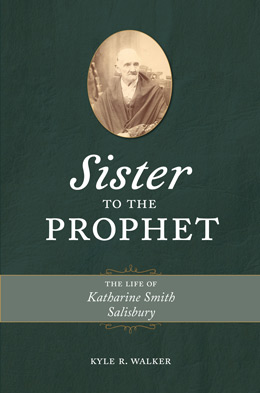
Migrating to Ohio
Kyle R. Walker, "Migrating to Ohio," in Sister to the Prophet: The Life of Katharine Smith Salisbury (Provo, UT: Religious Studies Center, Brigham Young University; Salt Lake City: Deseret Book), 43–56.
[Mother’s] faith was strong in the Lord, for she believed that he had commanded us to go and would carry us safely through.
—Katharine Salisbury
WHILE STILL LIVING IN NEW YORK, Katharine became acquainted with a recent convert named Wilkins Jenkins Salisbury, most likely when the Smiths were living near Waterloo, New York, not far from Fayette. The Smiths had moved to the area after being forced from their property in the fall of 1830. Jenkins, as he was known, was born January 6, 1809, on the family farm, which was located between the towns of Middlesex and Rushville, Ontario County, New York (both towns became part of Yates County in 1823).[1] Jenkins’s father, Gideon Salisbury, was a Revolutionary War veteran who first enlisted in 1777. One of Gideon’s most notable contributions came serving as a private under the command of brigadier general “Mad Anthony” Wayne not long after the latter’s victory in the Battle of Stony Point. Gideon later participated in the Battle of Stone Arabia. In the last battle, which the Americans lost to a combined army of British and American Indian soldiers, Gideon was shot five times through his clothes and had his cartridge box shot off his belt but escaped without injury.[2] After the war, Gideon married Margaret Elizabeth Shields in Philadelphia, and they relocated their family to Rushville, New York, being some of the earliest settlers in the region.[3]
The religious fervor connected to the Second Great Awakening swept through the town of Rushville, New York, during the same time it reached Palmyra, twenty miles to the north. In the year 1816 alone, more than one hundred converts were made to the Presbyterian faith during a season of revivals, a trend that continued intermittently through the year 1831. It is unknown what influence the increasing religious fervor had on Jenkins or his family, but during that fifteen-year period hundreds of converts linked themselves to several competing churches in the sparsely populated region.[4] The Salisbury family possibly participated in these religious gatherings, but at the very least were witnesses to the religious enthusiasm which permeated their community.
Jenkins was the youngest of eleven children born to the Salisburys.[5] His next older sister Samantha recalled that Jenkins left the family home in his youth, probably in his early teens, to learn the blacksmith trade. Samantha remembered their childhood relationship with fondness, describing Jenkins as a kind and thoughtful brother, but also remembered that she did not see him much after he left home.[6] It might have also been during this apprenticeship that Jenkins had some sort of training in law, though that experience appears to have been only minimal, as Jenkins worked as a blacksmith for most of his adult life.[7] It was common for families to hire out children during adolescence to learn a trade, which typically ended once a youth reached adulthood, between the ages of eighteen to twenty. Jenkins appears to have followed that pattern. Perhaps he had apprenticed as a blacksmith in the Seneca Falls–Waterloo region because it was one of the largest communities close to Rushville, just twenty-three miles northeast of the Salisbury home. Jenkins’s father Gideon had lived near Waterloo before settling his family at Rushville, conceivably coordinating his son’s apprenticeship with one of his former neighbors.[8]
Jenkins turned twenty in 1829. The completion of his apprenticeship coincided with the organization of the Church of Christ held at Fayette, New York, April 6, 1830, as well as the launching of missionary efforts throughout Western New York in subsequent months.[9] “My brothers and the Whitmer brothers, held meetings, first at one house and then at the other, for preaching and prayer,” Katharine recalled of their six-month stay near Waterloo, “and this continued until near spring [1831], first one preaching and then the other, wherever they could get a hearing.”[10] Perhaps Jenkins was among those that attended one of these preaching meetings held by the Smiths and Whitmers. Though details of Jenkins’s conversion have not survived, he became an enthusiastic convert the first year after the church’s organization. Katharine and Jenkins met while both were living in the region. If he was indeed residing near Waterloo, perhaps he was also among those who regularly gathered at the Smith home in Kingdom, a town midway between Waterloo and Seneca Falls.[11] Lucy Mack Smith recalled that her home became a place of resort for several dozen people, who would join them for their evening devotionals.[12]
 William B. Smith, ca. 1860. Original in the L. Tom Perry Special Collections, Harold B. Lee Library, Brigham Young University. Photograph by Kyle R. Walker. Courtesy of Mary Dennis.
Jenkins developed a fast friendship with Katharine’s older brother William during this same period. Only two years apart in age (William turned twenty in March 1831), the two were entering the same life stage of launching into adulthood and shared independent and impetuous personalities. Jenkins had been separated from his family since his early teens, and of necessity made his way in the world without the immediate support of his family during his developmental years. William was unique among the Smith family. Though he had believed his brother Joseph’s visionary experiences, he was the only member of the Smith family to manifest periods of religious indifference. He later confessed that he was less spiritually inclined than the rest of his family due to his “wild and inconsiderate” personality, which, he said, led to “frequent lectures from my mother and my brother Joseph.” However, he had reconciled his skepticism by the time he and Jenkins first became acquainted, demonstrating his commitment by being baptized and confirmed in the newfound religion the previous summer.[13] The two would remain lifelong friends, and the handsome and charismatic younger brother of the Prophet would have great influence on Jenkins during the next quarter of a century. Jenkins also developed a fondness for the Smiths’ daughter Katharine, seventeen years old at the time they first met and four years younger than Jenkins. Family tradition holds that their relationship began before migrating from the state.[14]
In December 1830, Joseph Smith received revelation that the church should move en masse from New York to northeastern Ohio, where early missionaries had enjoyed marked success in making converts to the newly organized faith. Joseph Sr., Joseph Jr. and Emma, and Hyrum and Jerusha all left between January and March 1831, while the three branches of the church hurriedly prepared for an anticipated migration west later that spring. For Katharine and her family, the call to relocate meant prompt action, and “therefore all preparations were made for emigrating to the West.”[15] Some others were less enthusiastic about uprooting. John Whitmer indicated that following the revelation to gather to Ohio there were a few church members who felt Joseph “had invented it himself to deceive the people that in the end he might get gain.”[16] Katharine’s twenty-three-year-old brother Samuel was also away from home at the time serving as a missionary in Ohio with Orson Pratt, leaving William as the oldest Smith brother at home and allowing him to take on an unexpected leadership role.[17] In an attempt to strengthen loyalty to his prophet-brother and as part of their spiritual preparation for their journey, William Smith “visited the church calling on every family (as our custom is) . . . [and] prayed with them and did not leave the house until every member of the family prayed vocally that was over eight years old.”[18] The approach was effective in reinvigorating their faith, and the group eagerly anticipated the spring thaw, which would afford passage by canal.
New York canals opened for travel by mid-April, and word disseminated among Saints in the region that they should gather at the Smith home on the weekend of April 29–May 1, 1831. Among the group of fifty were the eight remaining Smith family members: Mother Lucy, her three daughters (including Sophronia’s husband, Calvin Stoddard, and their one-year-old daughter, Eunice), sons William and Don Carlos, and family friend Jenkins Salisbury.[19] Just before leaving the state, Jenkins certainly visited his family one more time at their home near Rushville. He would rarely see them again.[20]
At the time of departure, Lucy tried to get fifty-four-year-old Solomon Humphrey or thirty-year-old Hiram Page to lead the migration, but after Page nominated Lucy as a capable leader, the large contingent of Saints received the proposal enthusiastically. The fact that Lucy, fifty-six years old and already a grandmother, directed the migration not only was an unusual occurrence for a woman in the early history of the church but also reflected the high regard the Saints held for the Smith family.[21]
On Monday, May 2, 1831, the Fayette Branch left for Ohio, initially traveling east on the Cayuga–Seneca Canal until it connected with the Erie Canal, where they headed directly west.[22] Lucy’s proficient leadership during the migration had a marked influence on Katharine, as she rehearsed details of the journey on several occasions throughout her life. Lucy had demonstrated an astute leadership ability in previous settings, such as when the Smiths had migrated to Palmyra, New York, from Vermont, but never on such a large scale. “My mother took charge of the company,” remembered Katharine, “and with the aid of Bro. Humphr[e]y and my brother William, we accomplished the journey as far as Buffalo” by canal boat.[23] Lucy embraced her leadership role in earnest, linking their journey to migrations described in the Book of Mormon and insisting the group evince comparable faith to those earlier Saints. “I then called the brethren and sisters together, and reminded them that we were travelling by the commandment of the Lord, as much as father Lehi was, when he left Jerusalem,” she declared. “If faithful,” Lucy continued, “we had the same reason to expect the blessings of God. I then desired them to be solemn, and lift their hearts continually in prayer, that we might be prospered.”[24] Lucy went to such lengths as to attempt to separate men and women during the journey, no doubt to curtail flirting and rivet the company’s focus on their spiritual migration. Perhaps Jenkins and Katharine’s newfound relationship was part of her motivation to keep the group separated by gender because Lucy may have been concerned about Katharine’s age (only seventeen) and the mutual attraction she observed between the two. After counseling with Humphrey and Page, she mandated that the group pray together twice daily and engage in regular hymn singing.[25]
Frustrated about the way mothers in the group were failing to manage their children, Lucy grew anxious for the children’s safety and took matters into her own hands. She called for the children to gather around her and committed them to respond promptly when she signaled by raising her hand during times when their passage became dangerous. Lucy reported that the children all strictly kept their promise during the entire journey.[26]
 Lucy Mack Smith, 1853, engraving by Frederick Piercy, in Route from Liverpool to Great Salt Lake Valley (Liverpool, Franklin D. Richards, 1855).
Lucy also led out in managing the group’s limited resources during the journey, as she indicated that most of the church branch were without enough food. The first leg of the journey took five days, and they arrived in Buffalo on Saturday, May 7, only to find the harbor blocked with ice.[27] Lucy scrambled to find shelter for her large group amid a freezing rainstorm. William held an umbrella over his aging mother’s head as she negotiated with proprietors at the harbor.[28] Katharine likely stayed with Sophronia and her daughter Eunice and assisted in caring for her younger sister Lucy, only nine years old at the time of the journey.
The difficult circumstances again turned Mother Smith to her faith. After visiting with other migrating contingents also delayed at the harbor, she learned that they were concealing their faith, thinking that doing so might help them get to their destination sooner and prevent persecution. Lucy rebuked leaders from both groups, declaring, “If you are ashamed of Christ, you must not expect to be prospered; and I shall wonder if we do not get to Kirtland before you.” Her declaration proved to be prescient.[29]
After securing passage on the ship Niagara captained by a man named Blake (an acquaintance of Lucy’s deceased brother Stephen Mack), Lucy secured lodging for her company in a room on shore for the night. The following day, May 8, Captain Blake allowed the company to stay on board his ship, but after measuring the ice he and the other boatmen were skeptical that the ice would not break up for another two weeks. The news must have been devastating to the group. With the harbor thronged with people and limited finances and food, Lucy and the other leaders could not imagine trying to obtain lodging for their large group for two more weeks. Realizing their plight, Lucy summoned the group together and declared, “Now brethren and sisters, if you will raise your desires to heaven, that the ice may be broken up, and we be set at liberty, as sure as the Lord lives, it will be done.”[30] Katharine recounted that the group “held a prayer meeting” under Lucy’s direction, “and prayed that the Lord would open the way for us to reach our destination.” Following their prayer, Katharine indicated that Lucy then directed them to sing “praises to our God for the blessings he had bestowed upon us in restoring the gospel in these last days.”[31]
While the group was still singing, Captain Blake came to Lucy and requested that they stop, as he noticed movement in the harbor and needed his deck hands to hear his orders and prepare the sail. “Shortly afterwards we heard a great noise and cracking in the ice,” described Katharine, and “the captain called all hands and set them to work, for the crack had widened and a channel had opened in the ice wide enough for our boat to pass out.”[32]
Although Lucy and Katharine’s accounts sound like theirs was the only ship that made it through the ice that day, three others successfully passed through before the ice prevented passage once again. A Buffalo newspaper reported that “the schr. [schooner] Gov. Cass, Capt. Whitaker, left our harbor this morning of the of 8th inst. although large quantities of ice impeded her offing; she was soon followed by the Steamboat Pioneer, Niagara, and Superior in succession.”[33] For the company of Saints, the opening of the passageway through the harbor was nothing short of a miracle.
The two-to-three-day journey on Lake Erie nevertheless proved difficult. Apparently, the thin passageway through the ice had damaged the Niagara’s waterwheel, and Katharine recalled that their company had to stop that evening on the Canadian side of Lake Erie to make repairs to the ship. The weather during their lake passage also contributed to a demanding voyage. Captain Blake, who had been navigating on Lake Erie for nearly thirty years, informed the company “that it was the roughest time he had ever had” navigating his ship on the lake.[34] Hence, Mother Smith nursed a number of her group who were seasick in route.[35] “After a long and tedious passage,” confirmed William, “facing many storms, cold winds and rains, we at length arrived at Fairport [Harbor]” in Ohio.[36]
 Buffalo Village from the Light-house, 1826, from H. Perry Smith, History of the City of Buffalo and Erie County, vol. 2 (Syracuse, NY: D. Mason, 1884).
Katharine’s faith was strengthened by the entire experience, but most especially because of her mother’s example. The night they had stayed on shore in Buffalo’s harbor, she watched as her mother stayed up until two in the morning expounding the basic tenets of the Church of Christ to her elderly female host. The following day, after the company gathered on the ship, and as the group’s religious affiliation became known, a man yelled from shore, “Is the Book of Mormon true?” At the top of her lungs so that all within the sound of her voice could hear, Lucy replied, “That book was brought forth by the power of God, and translated by the gift of the Holy Ghost; and, if I could make my voice sound as loud as the trumpet of Michael, the Archangel, I would declare the truth.”[37] Katharine’s faith was especially strengthened when the ice blocking Buffalo’s harbor seemed to miraculously part, allowing for the ship’s passage. The previous night she had witnessed her mother on her knees from dusk to dawn praying for the group’s “deliverance” from their “pitiable surroundings.” She felt that the experience was a direct result of her mother’s faith and spiritual direction.[38] She astutely watched her mother organize, protect, feed, house, and successfully relocate a company of fifty Saints three hundred miles to the west. “Mother bore all their complainings patiently, and had great charity for and sympathy with them,” recalled Katharine. “Her faith was strong in the Lord, for she believed that he had commanded us to go and would carry us safely through.”[39]
 Steamboat on Lake Erie near Cleveland, Ohio, ca. 1834, sketch by Karl Bodmer, in Maximilian, Prinz von Wied, Voyage dans l’intérieur de l’Amérique du Nord (Paris: A. Bertrand, 1840). Courtesy of New York Public Library.
When they finally arrived at Fairport Harbor on May 9 or 10,[40] William Smith and Jenkins Salisbury went on foot ahead of the rest of the group to locate the rest of the Smith family, who were living in Kirtland some fourteen miles away.[41] They would not get far, as Joseph Jr. and Samuel were anxiously watching and waiting for the company in the vicinity, fearing their delay meant an accident had occurred. Upon seeing her sons coming toward her, Lucy took Samuel by the right hand and Joseph by the left, and they all wept for joy at their safe arrival. The Smith brothers took them immediately to the home of Edward Partridge, a recent convert who lived nearby in Painesville, Ohio, where they enjoyed their first full meal since leaving two weeks earlier. “My brothers [then] took us to Kirtland where we met father,” Katharine recalled with fondness. “I can tell you it was a day of rejoicing, and when memory brings these things afresh to my mind I can not help weeping. . . . We were a united, happy family.”[42]
Notes
[1] Gideon Salisbury Family Bible, photocopy of original in Gideon Salisbury Revolutionary War Pension File, US Revolutionary War Pension and Bounty-Land Warrant Application Files, 1800–1900, ancestry.com.
[2] Gideon Salisbury Family Bible.
[3] Lewis Cass Aldrich, ed., History of Yates County, N. Y. (Syracuse, NY: D. Mason, 1892), 473–74; Warren L. Van Dine, “Statement About His Salisbury Family” (unpublished typescript, ca. 1975), 7, Hancock County Historical Society, Carthage, IL.
[4] Presbyterian reverend James H. Hotchkin documented that the converts made at Rushville, New York, was only surpassed by what was happening at Palmyra during that particular year. In September 1816 “a glorious work had commenced” at Palmyra, recounted Hotchkin, where “about 120 hopeful converts are stated on the minutes of the Synod, as the result of this effusion of the Holy Spirit.” James H. Hotchkin, A History of the Purchase and Settlement of Western New York, and of the Rise, Progress, and Present State of the Presbyterian Church in that Section (New York: M. W. Dodd, 1848), 126, 130, 136, 146–47; Aldrich, History of Yates County, 464–66.
[5] Gideon Salisbury Family Bible.
[6] Samantha Arnold (n.p.) to Katharine Salisbury, January 1, 1853 [1854], copy of original in Katharine Smith Salisbury Correspondence, L. Tom Perry Special Collections, Harold B. Lee Library, Brigham Young University, Provo, UT.
[7] Mary Salisbury Hancock, “The Three Sisters of the Prophet Joseph Smith, Part 1,” Saints’ Herald 101, no. 2 (January 11, 1954): 12; Emma M. Phillips, Dedicated to Serve: Biographies of 31 Women of the Restoration (Independence, MO: Herald House, 1970), 13.
[8] Other possible nearby locations for his apprenticeship include Geneva, Penn Yan, Canandaigua, Lyons, or Palmyra. Gideon Salisbury Family Bible.
[9] For a discussion on Fayette, New York, as the church’s organizational location, see Michael Hubbard MacKay, Sacred Space: Exploring the Birthplace of Mormonism (Salt Lake City: Deseret Book, 2016).
[10] Katharine Salisbury (Fountain Green, IL) to Dear Sisters of the “Home Column,” May 16, 1886, Saints’ Herald 33, no. 26 (July 3, 1886): 404–5.
[11] Larry C. Porter, A Study of the Origins of The Church of Jesus Christ of Latter-day Saints in the States of New York and Pennsylvania, 1816–1831 (Provo, UT: BYU Studies and Joseph Fielding Institute for Latter-day Saint History, 2000), 104–5.
[12] Lucy Mack Smith, Biographical Sketches, 167–68.
[13] William was baptized on June 9, 1830, on the same day as Katharine and their younger brother Don Carlos. William Smith, William Smith on Mormonism (Lamoni, IA: Herald Steam Book and Job Office, 1883), 6, 10, 15–16. For more information on William’s lack of spirituality in his youth, see Kyle R. Walker, William B. Smith: In the Shadow of a Prophet (Salt Lake City: Greg Kofford Books, 2015), 66–69.
[14] Van Dine, “Statement About His Salisbury Family,” 9.
[15] William Smith on Mormonism, 18.
[16] John Whitmer, History, 1831–circa 1847, in Karen Lynn Davidson, Richard L. Jensen, and David J. Whittaker, eds., Histories, Volume 2: Assigned Historical Writings, 1831–1847, vol. 2 of the Histories series of The Joseph Smith Papers, ed. Dean C. Jessee, Ronald K. Esplin, and Richard Lyman Bushman (Salt Lake City: Church Historian’s Press, 2012), 21.
[17] Orson Pratt described that “on the 2d of January, 1831, I attended a conference at the house of Father Whitmer; and soon after Samuel H. Smith and myself commenced laboring for one of the Saints Joseph Coe, to assist him in making preparations to remove to Ohio. . . . And in a few weeks, Elder Samuel H. Smith and myself started on foot for Kirtland, Ohio, a distance of several hundred miles.” The two missionaries arrived in Kirtland on February 27. Orson Pratt, “History of Orson Pratt,” Millennial Star 27 (October 21, 1865), 55; Dean L. Jarman and Kyle R. Walker, “Samuel Harrison Smith,” in United by Faith: The Joseph Sr. and Lucy Mack Smith Family, ed. Kyle R. Walker (American Fork, UT: Covenant Communications, 2006), 212–14.
[18] Lavina Fielding Anderson, ed., Lucy’s Book: A Critical Edition of Lucy Mack Smith’s Family Memoir (Salt Lake City: Signature Books, 2001), 511.
[19] Lucy Mack Smith, Biographical Sketches, 172–73. “I do not remember how many there were in our company,” recalled Katharine of the journey, “but of our own family there were eight. Mother, my oldest sister, her husband [Calvin] and one child [Eunice], brother William and Don Carlos, myself and sister Lucy.” Salisbury to Dear Sisters, May 16, 1886.
[20] Writing to her sister-in-law Katharine Salisbury in 1854, Jenkins’s sister, Samantha Arnold, indicated that she had not seen Jenkins for fourteen years. He likely visited them again during his mission to New York in the year 1831 (see chapter 5). Samantha Arnold to Katharine Salisbury, January 1, 1853 [1854].
[21] Anderson, Lucy’s Book, 512–13.
[22] Larry C. Porter, “‘Ye Shall Go to the Ohio’: Exodus of the New York Saints to Ohio, 1831,” in Regional Studies in Latter-day Saints Church History: Ohio, ed. Milton V. Backman Jr. (Provo, UT: Brigham Young University Department of Church History and Doctrine, 1990), 15.
[23] Salisbury to Dear Sisters, May 16, 1886.
[24] Lucy Mack Smith, Biographical Sketches, 173.
[25] Lucy Mack Smith, Biographical Sketches, 173, 179–80; Anderson, Lucy’s Book, 514.
[26] Lucy Mack Smith, Biographical Sketches, 174–75.
[27] Lucy Mack Smith, Biographical Sketches, 176–78.
[28] Anderson, Lucy’s Book, 523.
[29] Lucy Mack Smith, Biographical Sketches, 176.
[30] Lucy Mack Smith, Biographical Sketches, 181.
[31] Salisbury to Dear Sisters, May 16, 1886.
[32] Salisbury to Dear Sisters, May 16, 1886.
[33] “Opening of Navigation,” Buffalo Journal & General Advertiser XVI, no. 48 (May 11, 1831), 2, as cited in Fred E. Woods, “Mormon Migration on Lake Erie and Through Fairport Harbor,” Inland Seas 60 (Winter 2004): 297.
[34] Salisbury to Dear Sisters, May 16, 1886.
[35] Lucy Mack Smith, Biographical Sketches, 181–82.
[36] William Smith on Mormonism, 19.
[37] Lucy Mack Smith, Biographical Sketches, 178–80.
[38] “Awaiting a Revelation—Story of a Winter Journey,” Kansas City Daily Journal 37, no. 304 (April 12, 1895): 3.
[39] Salisbury to Dear Sisters, May 16, 1886.
[40] Fred Woods documents that Lucy’s group left Buffalo Harbor on May 8, 1831. Katharine indicated that they spent the night of the 8th on the Canadian side of Lake Erie making repairs to the ship, meaning that the earliest date they could have arrived in Kirtland would be May 9. Woods, “Mormon Migration on Lake Erie,” 297–98.
[41] William Smith on Mormonism, 19.
[42] Lucy Mack Smith, Biographical Sketches, 183; Salisbury to Dear Sisters, May 16, 1886. The Smiths in Kirtland were apprehensive for the safety of the group in the days leading up to their arrival. Lucy indicated that Samuel “had been warned of God in a dream to meet the company from Waterloo, and feared that some disaster had befallen me.” Lucy Mack Smith, Biographical Sketches, 183. Katharine remembered that her brothers were waiting in the vicinity because “word had reached them that we were all drowned.” Salisbury to Dear Sisters, May 16, 1886.
