
 menu icon in the top, right corner of the screen.
 icon above to close this box.
 icon at the bottom of the screen below the browser—if you don't see it, swipe up to unhide it.
Migrating to the Frontier, 1838–39
Kyle R. Walker, "Migrating to the Frontier, 1838–39," in Sister to the Prophet: The Life of Katharine Smith Salisbury (Provo, UT: Religious Studies Center, Brigham Young University; Salt Lake City: Deseret Book), 93–102.
We went from the frying pan into the fire.
—Katharine Smith Salisbury
THE SMITH CHILDREN were collectively moving into a new stage of life by the mid-1830s. Except for youngest sister Lucy, all of Katharine’s siblings had married and were now raising families in Ohio. The Salisburys were now a family of four and managed to eke out a living in Chardon. Katharine continued to enjoy her close association with her elder sister, Sophronia, and the two lived close during their seven-year stay in Ohio. As their husbands wrestled with their loyalty to the church and its founder, the Smith sisters found solace in their common experience, intensified because of the publicity it created in being members of the founding family of their shared faith.
Tragedy struck Sophronia in the fall of 1836 when her husband Calvin contracted tuberculosis. Sensing that he would not recover, Sophronia brought him home to his family in Macedon, New York (six miles west of Palmyra), to be near his family during his final weeks. Calvin died on November 19 and was buried in a small plot on the family’s property, and Sophronia and her only surviving daughter, Mariah, returned to Ohio after the funeral.[1] Over the next year Katharine assumedly played a supportive role in consoling and comforting her older sister as she grieved Calvin’s death until Sophronia eventually met William McCleary the following summer, whom she married on February 11, 1838, in Kirtland.[2]
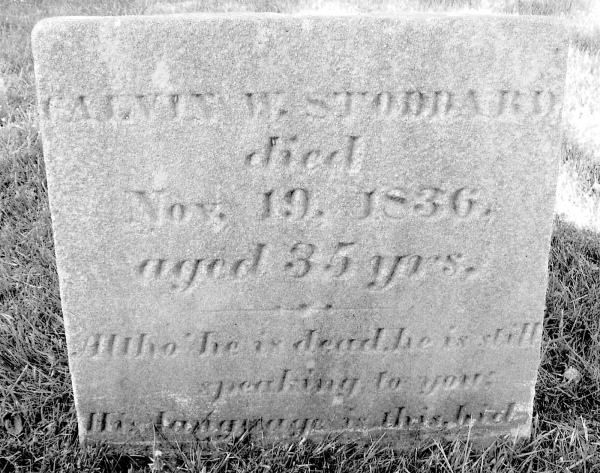 Calvin Stoddard gravestone, Palmyra, New York. Photograph by Kyle R. Walker, 2019. The bottom of the inscription reads “Altho’ he is dead, he is still speaking to you; His language is this, bid your follies adieu.”
By that point, the church was being forced out of Ohio. The failure of the Kirtland Safety Society and other financial and ecclesiastical difficulties had led some leaders to denounce Joseph Smith’s leadership. Forming their own Restoration offshoot—deemed the original Church of Christ, these dissidents threatened not only lawsuits but even the lives of Joseph Smith and other church leaders. Joseph Smith was warned in a revelation received in January 1838 that members of the First Presidency, their families, and loyal followers should leave Ohio for Zion “as soon as it is practicable.”[3] With discord building in Kirtland, Joseph had decided to transfer church headquarters to Missouri, and because of increasing attacks, he, Hyrum, and Sidney Rigdon had fled Kirtland that same month ahead of the rest of the Smith family. The Salisburys experienced their own financial losses during the year 1838 because they had invested their small income in the Kirtland Bank. Both Katharine and Sophronia each bought twenty thousand shares, which amounted to about $107 and was all the savings the Salisbury family possessed.[4] The rest of their earnings was spent on property in Kirtland right next to where William Smith had built his home. Their dream of building a home next to his and finally settling in the city of the Saints never materialized.[5] Jenkins’s inability to provide steady income prevented that project from ever getting launched.
Migration to Missouri and Alvin’s Birth
Accompanied by a few close friends, the greater Smith family made the trek from Ohio to Missouri some two months before the main body, the latter dubbed the Kirtland Camp of Saints.[6] Brothers Hyrum, Joseph, and Samuel, with their families, had already relocated to Missouri.[7] The remainder of the Smith clan consisted of the families of Joseph Sr. and Lucy (which included their daughter Lucy, who turned seventeen that summer), William and Sophronia McCleary, William and Caroline Smith, Jenkins and Katharine Salisbury, and Don Carlos and Agnes Smith. The Smiths began their journey on May 7, 1838, with seven wagons, fifteen horses, two cows, and seventy-five dollars in cash, but the trip was fraught with challenges.[8] Leaving before the heat of summer arrived seemed like an ideal time to travel, but spring rains and unusually cold weather made the journey exceptionally difficult. Writing en route from Terre Haute, Indiana, Don Carlos described to his brother Joseph how the group had “camped out at night, notwithstanding the rain and cold,” likely because they did not have money enough to secure lodging. “Father & Mother are not well,” he further recounted, adding that “we have had unaccountable bad roads, had our horses down in the mud, and broke of[f] one wagon tongue . . . and broke down the carriage twice.”[9]
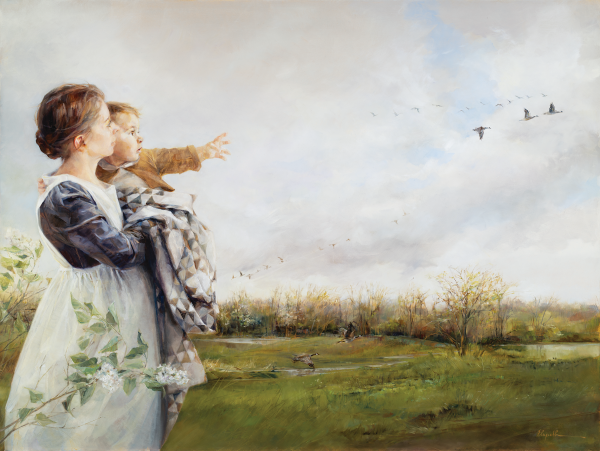 Shall We Not Go On, by Elspeth C. Young. An original oil painting depicting Katharine and her son, Solomon, preparing for the journey from Ohio to Missouri. Courtesy of Al Young Studios.
Lucy Smith’s account of the journey spoke of the challenges of the journey as she indicated that her health declined to a point where she could no longer sit up in the wagon and had to reduce her travel to less than four miles a day. The journey was even more difficult for the Salisburys. Besides caring for three-year-old Lucy and two-year-old Solomon, Katharine was in the late stages of pregnancy. By the time the group reached the Mississippi River, these collective challenges were nearing a crisis. While waiting to cross the river, it rained for three days straight, and with no viable shelter they were unable to change out of wet clothing.[10]
After crossing the Mississippi, Katharine was on the verge of delivering her baby. The group hurriedly found a dilapidated and abandoned slave hut, as it provided the best shelter they could find for the expectant mother. Though Lucy was ill, she and her daughter Sophronia assisted Katharine in delivering a healthy baby son on June 7, whom the Salisburys named for Katharine’s respected elder brother Alvin. Joseph Sr. then went ahead of the group, securing more comfortable lodging for his daughter four miles further along the road. As evidence of Katharine’s hardiness, she traveled four miles in a lumber wagon the same day she gave birth.[11]
At this juncture of their journey, the family decided it would be best to split into three companies. William, Don Carlos, and their families traveled on to Far West, Missouri, arriving sometime during the week of June 22–29.[12] Mother Lucy needed time to recuperate from her illness, and she and her husband found lodging at Huntsville, Missouri. William and Sophronia McCleary stayed behind with the Salisburys in the home that Joseph Sr. had procured, some forty miles east of Huntsville, to allow time for Katharine to recover from childbirth.[13]
Sophronia stayed especially close to Katharine in the days after Alvin’s birth, caring for her and assisting in the care of her newborn son. Jenkins also did his best to care for Katharine during those intervening days of her recovery. Leaving Katharine in Sophronia’s capable hands, he rode eighty miles round trip to Huntsville on horseback, where he reported to his in-laws on Katharine’s improving condition and procured a wagon with which to transport his family. With only minimal time for recovery, Katharine was on the move again, traveling thirty miles just two days after delivering Alvin and another ten miles the next day to catch up with her parents in Huntsville. Mother Lucy was amazed at Katharine’s remarkable recovery and her determination to travel so soon after giving birth. It rained continuously the day theSalisburys arrived in Huntsville, but Lucy remembered of her daughter’s tenacity, “This did not stop [K]atharine.” Despite suffering with chills and fever for a time, Katharine recovered quickly, and her delivery caused only minimal disruption on the journey.[14] This second contingent of the Smith family arrived in Far West, Missouri, sometime in mid-July.
Katharine and her descendants often recounted the trying circumstances surrounding Alvin’s birth as evidence of the Salisburys’ sacrifices made during their forced migrations in the years 1838–39. Family members recalled that the Salisburys lost most of their possessions during these two successive migrations, including all the furniture they owned.[15] The Salisburys’ stay in Missouri lasted only seven months, and Katharine recalled that with their move to Missouri, “we jumped from the frying pan into the fire.” In her assessment most of the conflict between the Saints and the Missourians centered on cultural and political differences, most especially stemming from the Saints opposition to slavery. She watched as the Missourians “began to raid the ‘Mormon’ settlements and towns, insulting the women, murdering the men, burning houses and carrying off cattle and other property.” She recorded in her own history the familiar accounts circulated among the Saints related to the massacre at Hawn’s Mill and the injustices they experienced in being driven from Missouri because of Governor Lilburn Boggs’s Extermination Order.[16]
Migration to Illinois
Conflict between the Saints and the Missourians reached a crescendo that fall, and the Smith clan was once again on the move, this time in the dead of winter. Katharine’s brothers Hyrum and Joseph were arrested on October 31 and remained imprisoned in Missouri for the next six months while Samuel fled from Missouri as a fugitive to avoid arrest. Her brother William also left a short time after the siege at Far West, leaving Don Carlos to relocate the remainder of the family.[17] “While my brother was detained in jail under false charges,” recounted Katharine, “the rest of us were driven in a destitute condition through the winter snows to Quincy, Illinois.”[18] Katharine and her son Solomon both said their family left the state in the fall of 1838, but that must have been just a general recollection because Lucy recorded that both Katharine and Sophronia, along with their families, were among their group that left Far West in mid-February, 1839.[19] This February departure date fits better with Katharine’s depiction of “winter snows” during the exodus and Solomon’s recollection that they traveled with “about one hundred and twenty-five families in the caravan, guarded by Missouri cavalry.” Though Solomon was only four years old at the time, he remembered the difficulties associated with their journey east that fateful winter and crossing the frozen Mississippi River to Quincy, Illinois.[20] Like her sister-in-law Emma, Katharine carried her children in her arms as she crossed the ice-covered river.[21] Though her time in Missouri was brief, Katharine resented the way she and the Saints had been treated by the Missourians in being driven from the state. When recounting the details of these two migrations in later years, she was often overcome with emotion when she reflected on the suffering she experienced during that challenging winter of 1838–39.[22]
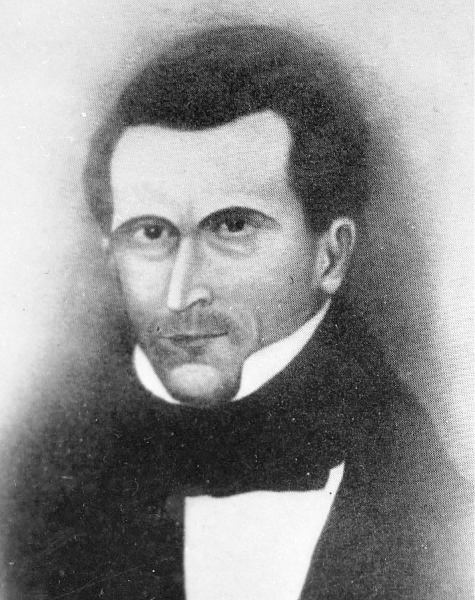 George Miller, 1794–1856 (n.d.), from H. W. Mills, “De Tal Palo Tal Astilla,” Historical Society of Southern California 10, no. 3 (1917): 112–13.
Not long after landing at Quincy, Illinois, the Smith group who had migrated from Missouri all lived together in a house that Samuel had secured for them, but living in such cramped quarters with multiple families meant they were eager to find alternative housing. In what the Smith parents described as an answer to prayer, several of Katharine’s brothers, along with Jenkins, were offered work and housing near Macomb, Illinois, some seventy miles northeast of Quincy. George Miller, a wealthy landowner and a faithful Presbyterian from nearby McDonough County, was eager to assist the beleaguered Saints. In addition to his eight-room home, Miller had some log houses that were in disrepair on his expansive three-hundred-acre property and offered living quarters and food in exchange for improving the homes. The Salisburys, along with the families of Samuel and Don Carlos Smith, enthusiastically took him up on the offer.[23] The Smith family had an immediate influence on Miller, and during those months they lived on his property they began teaching him about the church and gifted him a copy of the Book of Mormon. Miller was baptized that August, and shortly afterward he sold his property and moved closer to Nauvoo, where he was eventually appointed a bishop.[24] The Salisburys remained in McDonough County through the summer of 1839 but would be forced to search for a more permanent residence with Miller’s departure.[25] The Salisburys would once again be drawn to live near Katharine’s brother William.
Notes
[1] Calvin’s date of death is mentioned in the Stoddard Family Bible, photographs courtesy of Reid Moon, original in possession of Reid Moon, Provo, UT. For a discussion on the circumstances related to Calvin’s death, see Gracia N. Jones, “Sophronia Smith Stoddard McCleary,” in United by Faith: The Joseph Sr. and Lucy Mack Smith Family, ed. Kyle R. Walker (American Fork, UT: Covenant Communications; Provo, UT: BYU Studies, 2006), 77, 199n63.
[2] In Sophronia’s only known holograph letter, she said that she married William McCleary on Christmas Eve 1837. Sophronia McCleary (Nauvoo, IL) to Naomi Seaver, November 2, 1840, copy of original in author’s possession, courtesy of Richard L. Anderson. However, in her family Bible she recorded the date as February 6, 1838. Stoddard Family Bible. Ohio marriage records indicate that she made application for marriage on February 6, but the couple was married on February 11, 1838. Geauga County, Ohio, Probate Court, Marriage Records, vol. C, 262, available at Ancestry.com.
[3] Matthew C. Godfrey et al., eds., Documents, Volume 4: April 1834–September 1835, vol. 4 of the Documents series of The Joseph Smith Papers, ed. Ronald K. Esplin and Matthew J. Grow (Salt Lake City: Church Historian’s Press, 2016), 441–42, 500–502.
[4] Kirtland Safety Society Bank Stock Ledger, Kirtland Township, Geauga County, Ohio, October 18, 1836–June 12, 1837, 193–96, Chicago History Museum, https://
[5] Oliver Granger and William Smith, Bond, Kirtland Township, Geauga County, OH, to James Hall, assignee of Keeler, McNeil & Co., NY, January 20, 1843, Hiram Kimball Collection, CHL. The Salisbury property was registered with the county clerk on March 7, 1838, but was likely purchased at an earlier date. Jenkins and Katharine officially registered the property with the county clerk in anticipation of leaving the state because they did not want to lose the property. The Salisburys had purchased the land from Sophia Stevens (the wife of Uzziel Stevens) and registered it in Katharine’s name. She acquired a city lot on block 112 sub lots 19 and 20 that was 30/
[6] The Kirtland Camp left Ohio for Missouri the first week of July 1838. Milton V. Backman Jr., The Heavens Resound: A History of the Latter-day Saints in Ohio, 1830–1838 (Salt Lake City: Deseret Book, 1983), 354–55.
[7] Brent M. Rogers et al., eds., Documents, Volume 5: October 1835–January 1838, vol. 5 of the Documents series of The Joseph Smith Papers, ed. Ronald K. Esplin, Matthew J. Grow, and Matthew C. Godfrey (Salt Lake City: Church Historian’s Press, 2017), 441–42; Hyrum Smith to the Saints Scattered Abroad, in Times and Seasons 1, no. 2 (December 1839): 21; Dean L. Jarman and Kyle R. Walker, “Samuel Harrison Smith,” in Walker, United by Faith, 224.
[8] Lewis Robbins, Autobiographical Sketch, circa 1845, 4, MS 18637, CHL. Robbins was a close friend of the Smith family.
[9] Don C[arlos] Smith (Terre Haute, IN) to Bro. Joseph [Smith], in Dean C. Jessee, Mark Ashurst-McGee, and Richard L. Jensen, eds., Journals, Volume 1: 1832–1839, vol. 1 of the Journals series of The Joseph Smith Papers, ed. Dean C. Jessee, Ronald K. Esplin, and Richard Lyman Bushman (Salt Lake City: Church Historian’s Press, 2008), 280–81.
[10] Lucy Mack Smith, Biographical Sketches of Joseph Smith the Prophet and His Progenitors for Many Generations (Liverpool: S. W. Richards, 1853), 219–20.
[11] Smith, Biographical Sketches, 220–21; George A. Smith (Salt Lake City) to Cousin Catherine [Salisbury], August 17, 1865, Historian’s Office letterpress copybooks, 1854–79, vol. 2, 1859–1869, CHL; John Smith Papers, 1833–1854, Journal, 1846 February–1854 May, CHL.
[12] Lewis Robbins, Autobiographical Sketch, 4, said that he and the Smith clan started from Ohio on May 1, 1838, reaching Far West in “seven weeks and three days.” Robbins had traveled with William and Don Carlos when the group split into three. However, May 1 appears to have been the date when Robbins started from Kirtland to Norton, Ohio, where he joined the Smith family. Don Carlos Smith to Bro. Joseph [Smith], dates their departure from Norton on May 7, making it difficult to determine whether Robbins counted the opening date as their departure from Kirtland or Norton.
[13] Lucy Mack Smith, Biographical Sketches, 219–20.
[14] Lucy Mack Smith, Biographical Sketches, 219–20.
[15] Warren Van Dine, “Biographical Sketch of Catherine Smith Salisbury,” unpublished typescript, 1971, CHL.
[16] “Reminiscences of Joseph Smith, as Told by His Sister, Catherine Smith-Salisbury, to Her Grandson, Herbert S. Salisbury,” Saints’ Herald 60 (October 8, 1913): 984. Herbert S. Salisbury quoted a lengthy history from his grandmother in this source, which is written in the first person. Herbert appears to have had a copy of a history written by his grandmother which has not been located.
[17] Mark Ashurst-McGee et al., eds., Documents, Volume 6: February 1838–August 1839, vol. 6 of the Documents series of The Joseph Smith Papers, ed. Ronald K. Esplin, Matthew J. Grow, and Matthew C. Godfrey (Salt Lake City: Church Historian’s Press, 217), 269–72; Dean L. Jarman and Kyle R. Walker, “Samuel Harrison Smith,” in Walker, United by Faith, 226–27; Kyle R. Walker, William B. Smith: In the Shadow of a Prophet (Salt Lake City: Greg Kofford Books, 2015), 140–42.
[18] “Reminiscences of Joseph Smith,” 984.
[19] Lucy Mack Smith, Biographical Sketches, 254; JSP, D6:331–32; William G. Hartley, “Missouri’s 1838 Extermination Order and the Mormons’ Forced Removal to Illinois,” in A City of Refuge: Quincy, Illinois, ed. Susan E. Black and Richard E. Bennett (Salt Lake City: Millennial Press, 2000), 18.
[20] Solomon J. Salisbury, Reminiscences of an Octogenarian (self-pub, ca. 1922), 3.
[21] “Tells of Solomon Salisburys’ Life,” Saints’ Herald 74, no. 5 (February 2, 1927): 136. Lucy Mack Smith indicated that she was ferried across the river. Lucy Mack Smith, Biographical Sketches, 324–25. It is possible that both accounts are accurate, as some who crossed the Mississippi River at this time indicated that they crossed “partly in a boat and partly on the ice.” Scott H. Partridge, ed., Eliza Maria Partridge Journal (Provo, UT: Grandin Book, 2003), 7.
[22] Mary Salisbury Hancock, “The Three Sisters of the Prophet Joseph Smith, Part II,” Saints’ Herald 101, no. 3 (January 18, 1954): 11.
[23] Lucy Mack Smith, Biographical Sketches, 261; Richard E. Bennett, “‘A Samaritan Had Passed By’: George Miller—Mormon Bishop, Trailblazer, and Brigham Young Antagonist,” Journal of the Illinois State Historical Society 82, no. 1 (Spring 1989): 3.
[24] Bennett, “‘A Samaritan Had Passed By,’” 4–5.
[25] JSP, J1:341–42.
