
 menu icon in the top, right corner of the screen.
 icon above to close this box.
 icon at the bottom of the screen below the browser—if you don't see it, swipe up to unhide it.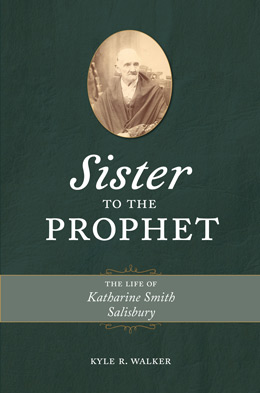
Introduction
Kyle R. Walker, "Introduction," in Sister to the Prophet: The Life of Katharine Smith Salisbury (Provo, UT: Religious Studies Center, Brigham Young University; Salt Lake City: Deseret Book), xiii–1.
Katharine was the longest-surviving member of the Joseph Sr. and Lucy Mack Smith family, passing away at the age of eighty-six, on February 2, 1900. Her longevity meant that she, unlike her two sisters, had ample opportunity to record her history, including a cache of letters, interviews, and recorded speeches that help document her remarkable life. She is one of a small cluster of first-generation female members of the Church of Jesus Christ of Latter-day Saints for whom a full-length biography can be written. One researcher has estimated that in the archives of the church, men’s diaries and histories outnumber women’s ten to one, making it difficult to document women’s lives and experience.[1] The same, if not a greater disparity, holds true in the Community of Christ’s Library-Archives. “Although limited education may have contributed to the scarcity of women’s writings” among female Saints, explained Laurel Thatcher Ulrich, “a more important factor was the cultural assumption that their words—like their duties—were essentially private and therefore beyond the reach of history. Men, not women, routinely served missions, and diary keeping was a missionary duty.”[2] Thus, Katharine’s recollections, despite most coming later in life, contribute to our appreciation of women’s lived experience and contributions in the early church, as well as enriching our understanding of the founding family of the Restoration.
Katharine was one of eleven family members who were present during the time her brother Joseph recounted his earliest visionary experiences. She was at home when her brother retrieved the Book of Mormon plates from a hiding place in the woods in late September 1827 and was active in protecting the plates during those few months while the plates were housed in the Smith home. She attended the meeting of church organization on April 6, 1830, and was baptized at the first church conference held a few months later, on June 9, 1830. Katharine also attended the dedication of the Kirtland Temple and contributed significant work efforts to the interior of the finished edifice. She migrated with the Saints from New York to Ohio, then to Missouri, and finally to Illinois. Before her family’s move to Illinois, she was often present at major church events, as she frequently resided with her parents in Kirtland and in Missouri, even after her marriage to Jenkins Salisbury in 1831. Thus, Katharine’s surviving recollections about early church history contribute to our understanding of these early Restoration events, particularly from a Smith family perspective. Her recitals about the First Vision, Moroni’s visits, her company’s migration to Kirtland, and the hostilities the Saints experienced in Missouri and Nauvoo contain details that are not mentioned in any other source.
Katharine’s recollections are also critical in understanding the views of Smith family members as to why they did not follow Brigham Young’s leadership after the year 1846. William Smith, the only surviving male member of the Smith family after the summer of 1844, had a profound influence on his sisters, including his advocating for lineal succession after his own clash with leaders at Nauvoo in the year 1845. Nowhere is William’s teachings and influence on his siblings more evident than in the surviving writings of Katharine and her posterity. However, unlike William’s persisting hostility towards the Mountain Saints, Katharine’s attitude towards those in the West softened during the final decades of her life. More so than any of her siblings, Katharine maintained positive exchanges with church leaders in Salt Lake Valley, as well as with her Smith nephews as they crisscrossed through Illinois during their missionary travels. Those documented interactions fill important gaps in the historical record, resulting in a more nuanced understanding of the relationship between surviving Smith family members in the Midwest and church leaders in the West during the second half of the nineteenth century.
During the decade of the 1870s, Katharine and her children linked themselves with the Reorganized Church of Jesus Christ of Latter Day Saints (RLDS, now Community of Christ). In her final years, she was viewed as a living link between the early church, which her brother Joseph had founded, and the Reorganization, led by her nephew Joseph Smith III. Because of the respect RLDS church members held for the Smith family, Katharine was afforded privileges that were denied other women of her day, including speaking at the Church’s general conference and sitting on the stand at RLDS district meetings. In both the venue of RLDS conferences, and with the publication of her letters in the church-sponsored newspaper the Saints’ Herald, Katharine found channels where she could express her views. Through these mediums she often recounted her recollections of early church history and perpetuated feminine ideals, much like her mother Lucy had done in Nauvoo in an earlier era.
Katharine’s life was filled with hardships and challenges. Beginning in her teen years, her life was riddled with religious prejudice and the resulting ostracism she experienced from her peers. After her marriage, three of her children died in infancy. She experienced a challenging marriage to her husband, who was only intermittently available as a provider and vacillated in his loyalty to the faith she espoused. This led to a life of poverty and struggle, made more challenging when the Salisburys were driven from Ohio and Missouri in company with the Saints, and more especially after her husband passed away at forty-four. Raising four boys as a widow in rural Hancock County, Illinois, surrounded by neighbors who had earlier driven the Saints from town, she and her children continued to experience untold hardships as her connection to Joseph Smith became known to neighbors. Through all these challenges she remained loyal to her brother, vouching for his prophetic appointment for the remainder of her life. She successfully perpetuated that belief to her posterity. Her faith in Christ and in her brother’s teachings helped her endure life’s hardships.
Notes
[1] Maureen Ursenbach Beecher, introduction, “The Life Writings of Ordinary Women,” in The Personal Writings of Eliza Roxey Snow, ed. Maureen Ursenbach Beecher (Salt Lake City: University of Utah Press, 1995), xv, as cited in Laurel Thatcher Ulrich, A House Full of Females: Plural Marriage and Women’s Rights in Early Mormonism, 1835–1870 (New York: Alfred A. Knopf, 2017), xxi.
[2] Ulrich, A House Full of Females, xxi. Ulrich notes as an example that out of the 114 missionary diaries digitized by Brigham Young University Library, only five were written by women (401–2n28).
