
 menu icon in the top, right corner of the screen.
 icon above to close this box.
 icon at the bottom of the screen below the browser—if you don't see it, swipe up to unhide it.
Heavenly Messengers
Kyle R. Walker, "Heavenly Messengers," in Sister to the Prophet: The Life of Katharine Smith Salisbury (Provo, UT: Religious Studies Center, Brigham Young University; Salt Lake City: Deseret Book), 15–28.
He told us later that a personage had appeared to him and told him "Join none of them, for they are all wrong"
—Katharine Smith Salisbury
BY THE 1820s Lucy led out in getting most of the family to attend local church services and, whenever they were in the area, the camp meetings, with their more emotional, intense, and concentrated religious experiences. The Second Great Awakening with its accompanying revivals drew women like Lucy out of the home and into the community in ever increasing numbers. Female converts outnumbered males in congregations all over the country as women’s church affiliation increasingly drew them into the public arena.[1] Lucy and her daughters were part of this wave of revivalism sweeping through America.
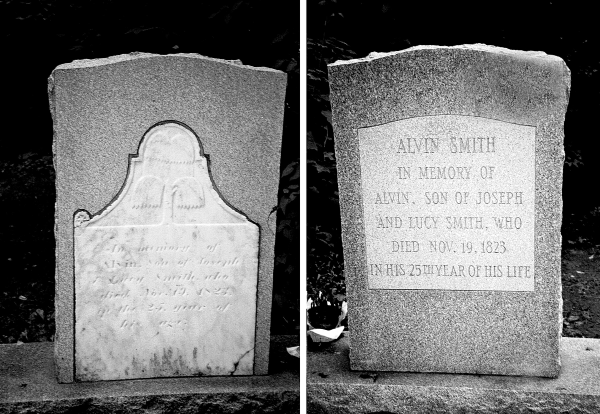 Alvin Smith gravestone, General John Swift Memorial Cemetery, Palmyra, New York. Photograph by Kyle R. Walker, 2019.
Lucy’s motivation to unite with a church increased after the unexpected death of her eldest son Alvin, which occurred late in the evening on November 19, 1823. After only a few days of sickness, with symptoms characteristic of appendicitis, Alvin succumbed to the disease.[2] Just before he passed, he gathered each of his family members around him to give them a final charge. Though Lucy didn’t record what Alvin said to ten-year-old Katharine, both his life and his parting counsel had an impact on her. She looked up to Alvin and admired his work ethic and example, later naming a son after her steady older brother.[3] Alvin’s death was a psychological and economic blow that had lasting consequences for the family.[4]
Following Alvin’s death, Lucy indicated that the family “flocked to the meeting house to see if their [sic] was a word of comfort for us that might relieve our overcharged feelings.” Lucy led out in those efforts, even attempting to persuade her husband to join the rest, but neither of her Josephs would attend with her for long.[5] Notwithstanding, her efforts were influential, and the children described their mother as “a very pious woman and much interested in the welfare of her children, [and] made use of every means which her parental love could suggest, to get us engaged in seeking for our souls’ salvation, or . . . ‘in getting religion.’”[6]
 Sketch of Union Hall, Palmyra, New York, where members of the Smith Family attended the Western Presbyterian Church of Palmyra. Courtesy of Village Hall, Palmyra, New York.
Lucy was enacting a role that was increasingly pervasive among women in the first half of the nineteenth century, who were customarily “the chief transmitters of religious and moral values.”[7] Mothers did not simply “conduct their religious lives as disconnected individuals; instead they drew other members of their families into the congregation.” The religious literature of the day counseled women to “set a powerful example for their household [and] their influence might help bring all the members of the family to God.”[8] Katharine watched as her mother led out in these efforts becoming Katharine’s role model for what it meant to be a devout mother.
Katharine was also influenced by the Palmyra community in her developing spirituality as the population was saturated with religious fervor during her youth. Palmyra was at the center of the “burned-over district,” a label given to this area of Western New York because of the way religion spread like wildfire throughout the region.[9] She doubtless attended camp meetings with the rest of the family and watched as Sophronia joined her mother and brothers Hyrum and Samuel as they linked themselves with the Presbyterian faith.[10] She attended with her mother and older siblings when the Presbyterian congregation met in the Union Church House on Church Street but was too young to be received as a formal member. In one reminiscence, her brother William mentioned that Katharine also joined the Presbyterian Church, though this was probably a mistake, as he omitted her name on other occasions.[11] His slip in memory might have resulted from his and Katharine’s affiliation with the Presbyterian Church’s Sunday school during their youth.[12] The Presbyterian minister Benjamin Stockton had successfully recruited most of the Smith family to join his local congregation, and by establishing a youth Sunday school, he hoped it would ensure the younger generation would adopt the same course. The local Sunday school stressed memorization of scriptural passages such as the Lord’s Prayer, the Ten Commandments, and Christ’s Sermon on the Mount.[13] Katharine rapidly increased in her knowledge of the Bible during these formative years.
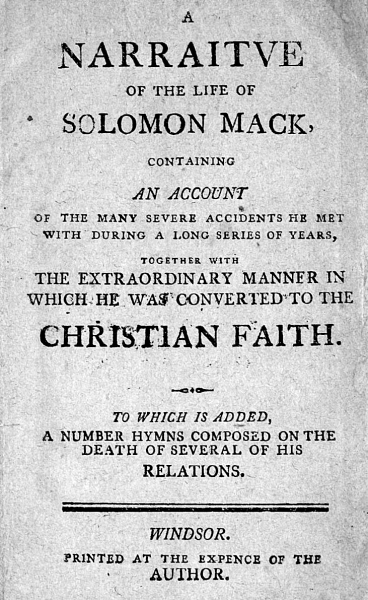 Title page of A Narraitve [sic] of the Life of Solomon Mack, published in 1811 by Katharine’s grandfather.
While religious enthusiasm permeated the town, what transpired within the Smith home proved to be even more impactful. During Katharine’s youth she not only listened to details of her father’s religious dreams (significant enough to her parents that Lucy ensured they were later recorded in her history), but she also undoubtedly heard of her grandfather Solomon Mack’s late life conversion to Christianity. Solomon had gone so far as to publish a small tract containing an account of his newfound faith, a copy of which was surely available for reading in the Smith home.[14] Katharine also learned from her mother how the efficacy of prayer spared Sophronia’s life during her bout with typhoid fever in the year 1812.[15] The family’s full confidence in God’s divine intervention in their lives was a part of the Smith family oral culture and shaped their united acceptance of the supernatural occurrences that transpired in the 1820s.
The First Vision
In the year 1820, when Katharine’s elder brother Joseph was just fourteen, he said that God and Jesus Christ appeared to him. After months of struggle and deliberation, and perhaps at the instigation of a local Methodist preacher, Joseph sought seclusion in a wooded grove on the family’s one-hundred-acre property to seek forgiveness and ask which church he should join. He not only received the mercy he was seeking, but was also answered that he was not to unite with any particular faith, but that in time the true gospel would be revealed to him.[16] Probably because of Lucy’s efforts to help the children investigate and unite with a church and due to her personal religious leanings, Joseph first reported to his mother that he had learned for himself that Presbyterianism was not true.[17]
While he appears to have been reluctant to share all that he learned during his theophany, according to Katharine he did share some details about his experience with the family that went beyond that brief conversation with his mother. Though she was young at the time and her memories were recorded only late in life, Katharine’s recollections may help to sort out which details Joseph shared with his family during the decade of the 1820s. In one account, recorded by Katharine’s adult granddaughter, Mary Salisbury Hancock, Katharine recounted that it was “in the spring of 1820, [that] a great religious revival took place in a beautiful grove near by.” She continued, it was “after one of these [camp] meetings and at a time of great indecision your Uncle Joseph read in the Bible, during a time of meditation, ‘If any of you lack wisdom, let him ask of God.’ Thinking of this he went to the woods to be alone and pray. He told us later that a personage had appeared to him and told him ‘Join none of them, for they are all wrong.’”[18]
On another occasion, in an account recorded by Katharine’s son Frederick, Katharine provided additional details about Joseph’s First Vision and its impact on the family. “After Joseph had seen the heavenly messengers,” recorded Frederick from his mother’s report, “she [Katharine] said that he would teach the family.” Katharine described one evening when the family gathered around the fireplace after their work was completed and listened to Joseph’s “description of the heavenly messages which he had received from God and his Son.”[19] While it is possible that the identity of the messengers came from later recitals or publications which Katharine had read by the time she recounted these events, she most often recalled that Joseph was visited by a heavenly messenger(s) who directed him not to join any of the existing churches. Consolidating Smith family members references to the First Vision, it appears that Joseph may have simply shared with his family that he was visited by messengers or angels (a more general reference to any otherworldly visitor) who had answered his prayer that he must join none of the existing churches. Joseph’s parents, and even Joseph himself on one occasion, similarly referred to God and Jesus Christ as the “first angels” who visited him when rehearsing the story of his First Vision.[20]
 Sacred Grove, by George Edward Anderson, August 1907. Courtesy of L. Tom Perry Special Collections, Harold B. Lee Library, Brigham Young University.
Smith family recollections of the First Vision do not indicate that Joseph disclosed at that time that he had been told about his future role in establishing Christ’s restored church on the earth. Thus, for the Smiths, Joseph’s posture during those intervening years was not unlike his father’s: he kept himself distanced from formal affiliation of the religions in his community but often dialogued with family members about religious topics.[21] Following his First Vision, Joseph stopped attending the Presbyterian meetings with other members of the family but told his mother he did not wish to prevent her or the rest of the family from going to their meetings. “But do not ask me to join them,” Joseph said tellingly. “I can take my Bible and go into the woods, and learn more in two hours, than you can learn at [your] meeting[s] in two years.”[22] It was an obvious allusion to his First Vision. Katharine remembered her brother’s spiritual struggle and was aware of his religious stance in the intervening years.
One element of Joseph’s First Vision that Katharine frequently recounted in later life was Joseph’s sharing his experience with a local Methodist minister and of the latter’s negative reaction. This detail undoubtedly stood out to her because of its immediate impact on the entire family. “The next time Joseph saw the [Methodist] preacher he told him of his [First Vision] experience,” related Katharine, and “the minister was very angry and told other ministers of Joseph’s experience, which they all said could not have happened since angels did not visit the earth in these days. This caused a great uproar, and Joseph was soon in disgrace.” Katharine further remembered that the entire Smith family “were shunned and their good deeds quickly forgotten.”[23]
While both Joseph and the family experienced the harsh treatment by community members after the minister spread word of Joseph’s First Vision, Katharine recollected that it especially impacted her older sister Sophronia. “The ill treatment of her friends” contributed to both an emotional and physical decline, where “she grew thin and pale until it was feared she was developing ‘quick consumption.’” Katharine recounted that her sister’s illness occurred in the wake of the Methodist minister disseminating Joseph’s story when Sophronia was seventeen, which would have been in the years 1820–21.[24] Her affinity for her eldest sister etched the experience into her childhood memory and corroborates what Joseph Jr. said about the persecution for both himself and the family during that early period.[25] Katharine described how the “persecution started against [my] brother at the time of his first vision, and increased after he had received the plates.”[26]
The Angel Moroni
Katharine always differentiated between Joseph’s First Vision and his initial experience with Moroni, something other family members did not always clearly delineate. Joseph said it was during the night of September 21, 1823, and into the next morning, when he was visited four times by an angel who identified himself as Moroni, an ancient American prophet. He had come in response to Joseph’s inquiry about his standing before God. Katharine remembered that just before Moroni’s appearance, Joseph had been musing over his First Vision during a time of prayer and contemplation.[27] Besides instructing him about a number of biblical prophecies about the last days, the angel informed him about an ancient record that was buried in a nearby hill that Joseph would be instrumental in translating.[28]
While Joseph was initially reluctant to share all the details about his experience with the Father and Son following his First Vision, this time he was instructed by the angel to tell his father of his experience. Katharine remembered that Joseph initially told his father and two of his brothers about his experience, probably Alvin and William.[29] She recollected that the three of them “talked quite a spell,” and it made her curious about what was so important to take that much time away from their work, “because I knowed [sic] they were so busy with their harvesting.” Later that day, Joseph shared his experience with the rest of the family. Katharine recollected several details that were unique, including Joseph recounting that Moroni’s white clothing included “a girdle about his waist,” and that in addition to his clothing, that his hands and wrists were also “pure and white.”[30]
“The whole family were melted to tears,” recalled William of the family gathering at the time Joseph shared his experience, “and believed all he said. . . . [We] were convinced that he was totally incapable of arising before his aged parents, his brothers and sisters, and so solemnly giving utterance to anything but the truth.”[31] Katharine wholeheartedly accepted his accounts of heavenly visitors from the first and looked forward with eager anticipation to her brother retrieving the sacred record.
Notes
[1] Martha Sonntag Bradley, “‘Seizing Sacred Space’: Women’s Engagement in Early Mormonism,” Dialogue: A Journal of Mormon Thought 27, no. 2 (1994): 59; Nancy Woloch, Women and the American Experience: A Concise History, 2nd ed. (New York: McGraw, 1994), 121, as cited in Susan M. Cruea, “Changing Ideals of Womanhood During the Nineteenth-Century Woman Movement,” ATQ: 19th Century American Literature and Culture 19, no. 3 (2005): 195.
[2] Lucy Mack Smith, Biographical Sketches of Joseph Smith the Prophet and His Progenitors for Many Generations (Liverpool: S. W. Richards, 1853), 87–90; Richard L. Anderson, “Alvin Smith,” in United by Faith: The Joseph Sr. and Lucy Mack Smith Family, Kyle R. Walker, ed. (American Fork, UT: Covenant Communications Inc.; Provo, UT: BYU Studies, 2006), 91–93, 98–99.
[3] Katharine named her second son Alvin, who was born June 7, 1838, when the Salisbury family was migrating from Ohio to Missouri. Lucy Mack Smith, Biographical Sketches, 43, 219–20. Joseph Jr. recorded a few lines in his journal about his trusted older brother: “In him there was no guile. He lived without spot from the time he was a child. From the time of his birth, he never knew mirth. He was candid and sober and never would play; and minded his father, and mother, in toiling all day.” Andrew H. Hedges, Alex D. Smith, and Richard Lloyd Anderson, eds., Journals, Volume 2: December 1841–April 1843, vol. 2 of the Journals series of The Joseph Smith Papers, ed. Dean C. Jessee, Ronald K. Esplin, and Richard Lyman Bushman (Salt Lake City: Church Historian’s Press, 2011), 117.
[4] The most immediate economic consequence was the loss of the family’s one-hundred-acre property just two years later. Alvin had been instrumental in making the annual one-hundred-dollar payment on the farm, a demand the family failed to fulfill in the ensuing years. Anderson, “Alvin Smith,” 91–93; Lucy Mack Smith, Biographical Sketches, 71.
[5] Lavina Fielding Anderson, ed., Lucy’s Book: A Critical Edition of Lucy Mack Smith’s Family Memoir (Salt Lake City: Signature Books, 2001), 357, quote crossed out in original; and Lucy Mack Smith, Biographical Sketches, 90.
[6] William Smith, William Smith on Mormonism: A True Account of the Origin of the Book of Mormon (Lamoni, IA: Herald Steam Book and Job Office, 1883), 6.
[7] Ruth R. Bloch, “American Feminine Ideals in Transition: The Rise of the Moral Mother, 1785–1815,” Feminist Studies 4, no. 2 (June 1978): 100.
[8] Nancy Grey Osterud, Bonds of Community: The Lives of Farm Women in Nineteenth-Century New York (Ithaca, NY: Cornell University Press, 1991), 262–64.
[9] Spencer W. McBride and Jennifer Hill Dorsey, eds., New York’s Burned-Over District: A Documentary History (Ithaca, NY: Cornell University Press, 2023); Whitney R. Cross, The Burned-Over District: The Social and Intellectual History of Enthusiastic Religion in Western New York, 1800–1850 (Ithaca, NY: Cornell University Press, 1950).
[10] Karen Lynn Davidson, David J. Whittaker, Mark Ashurst-McGee, and Richard L. Jensen, eds., Histories: Volume 1: 1832–1844, vol. 1 of the Histories series of The Joseph Smith Papers (Salt Lake City: Church Historian’s Press, 2008), 208. Historians Milton Backman and James Allen offer corroborating evidence on at least three members of the Smith family joining the Western Presbyterian Church at Palmyra when they document that the Smiths were visited by Presbyterian church leaders in March 1830 due to inactivity during the previous eighteen months. These three were Mother Lucy, Hyrum, and Samuel. There is no mention of Sophronia, although she was still living in the area. Milton V. Backman Jr. and James B. Allen, “Membership of Certain of Joseph Smith’s Family in the Western Presbyterian Church of Palmyra,” BYU Studies Quarterly 10, no. 4 (Summer 1970): 482–84.
[11] “Sermon by Elder Wm. B. Smith,” 2; “Wm. B. Smith’s Last Statement,” 6. William failed to mention Sophronia’s affiliation in this latter account, so he may have mistakenly substituted Katharine’s name for Sophronia’s. In another account, William omitted Samuel’s name from the list, and apparently could not remember which sister it was that joined. Said William, “My mother and brother Hyrum and a sister were members of the Presbyterian Church.” “William B. Smith: Experience and Testimony,” 388.
[12] “Sermon by Elder Wm. B. Smith,” 2. Lorenzo Saunders recollected that Joseph Smith Jr. also attended Stockton’s Sabbath School “at the old Presbyterian Church.” Lorenzo Saunders, interview by William H. Kelley, September 17, 1884, 1–18, E. L. Kelley Papers, Community of Christ Library Archives, Independence, MO.
[13] T. Osgood, “Messrs. Editors,” Wayne Sentinel 2 (December 15, 1824): 2; “Many are inquiring . . .,” Wayne Sentinel 2 (December 15, 1824): 2. See also H. Michael Marquardt and Wesley P. Walters, Inventing Mormonism: Tradition and the Historical Record (Salt Lake City: Smith Research Associates, 1994), 20, for a discussion of Stockton’s religious activities in Palmyra.
[14] Lucy Mack Smith, Biographical Sketches, 47, 60–61. When preparing her history in the 1840s, Lucy indicated she had in her possession “a sketch of my father’s life, written by himself,” and then quoted from his book. Lucy Mack Smith, Biographical Sketches, 15–20; Solomon Mack, A Narraitve [sic] of the Life of Solomon Mack (Windsor, VT: self-pub., 1811).
[15] Lucy Mack Smith, Biographical Sketches, 20, 60–61, 73–74.
[16] Joseph Smith, “Church History,” Times and Seasons 3, no. 9 (March 1, 1842), 706–7; “Sermon by Elder Wm. B. Smith,” Zion’s Ensign 3, no. 35 (August 27, 1892): 2.
[17] Joseph Smith, History, 1838–1856, volume A-1 [23 December 1805–30 August 1834], 132, CHL.
[18] Mary Salisbury Hancock, “The Three Sisters of the Prophet Joseph Smith, Part 1,” Saints’ Herald 101, no. 2 (January 11, 1954): 11. Mary Salisbury Hancock was in her twenties during the last decade of her grandmother Katharine’s life. She quotes her grandmother throughout this article, indicating that she had documented what Katharine told the family on this occasion.
[19] Frederick V. Salisbury, “The Teachings and Testimonies of My Mother,” unpublished typescript, ca. 1926–28, 2, Warren L. Van Dine Papers, Hancock County Historical Society, Carthage, IL.
[20] For a discussion of Smith family member’s use of the word “angel” or “heavenly messenger” when referring to the First Vision, see Kyle R. Walker, “Smith Family Recollections of Joseph Smith’s First Vision,” Journal of Mormon History 47, no. 2 (April 2021), 5–6.
[21] Anderson, ed., Lucy’s Book, 335.
[22] Lucy Mack Smith, Biographical Sketches, 90.
[23] Hancock, “Three Sisters,” 11. William said something similar, when he recalled the dramatic shift in the family’s reputation, stating, “We never knew we were bad folks until Joseph told his vision.” “Wm. B. Smith’s Last Statement,” 6. Jeremy Talmage summarizes that the most likely reason the Methodist minister rejected Joseph Smith’s experience was because Joseph insisted it had been an “objective experience.” Evangelicals contended that visions were “permissible as long as they preserved the strict separation between the spiritual and the sensory, mind and matter. Smith’s conviction about the reality of his vision, including his detailed physical description of Divinity, is the most likely reason for his rejection.” Jeremy Talmage, “‘Effusions of an Enthusiastic Brain: Joseph Smith’s First Vision and the Limits of Experiential Religion,” BYU Studies Quarterly 59, no. 1 (2020): 29.
[24] Hancock, “Three Sisters,” 11. If prejudice against the Smith family did not really begin until after Joseph received the plates in the fall of 1827, as several historians have postulated, then Sophronia would have been age twenty-four, and likely engaged to be married to Calvin Stoddard. Sophronia married Calvin Stoddard on December 30, 1827, just three months after Joseph received the plates. Stoddard Family Bible, photocopy in author’s possession. During the time of their courtship, Calvin “often visited the Smith home and was much interested in Joseph’s visit with the angel. . . . Stoddard became fond of Sophronia, which fondness grew into affection and love during his frequent visits.” Hancock, “Three Sisters,” 12. For references related to Joseph overstating the persecution during the 1820–23 period, see Richard L. Bushman, Joseph Smith: Rough Stone Rolling (New York: Alfred A. Knopf, 2005), 43; Steven C. Harper, First Vision: Memory and Mormon Origins (New York: Oxford University Press, 2019), 48–49.
[25] Joseph Jr. said that “telling the story [of the First Vision] had excited a great deal of prejudice against me among professors of religion and was the cause of great persecution which continued to increase . . . though I was an obscure boy only between fourteen and fifteen years of age.” JSP, H1:216.
[26] Salisbury, “Teachings and Testimonies of My Mother,” 4.
[27] Kyle R. Walker, “Katharine Smith Salisbury’s Recollections of Joseph’s Meeting with Moroni,” BYU Studies 41, no. 3 (2002): 114.
[28] JSP, H1:224–27.
[29] William Smith on Mormonism, 9.
[30] Walker, “Katharine Smith Salisbury’s Recollections,” 11–13.
[31] William Smith on Mormonism, 9–10.
